
SOC 2 Certification in Kyiv
CertPro CPA LLC – Licensed CPA Firm conducts independent SOC 2 certification audits for organizations operating across Kyiv. SOC 2 certification evaluates the design and operating effectiveness of an organization’s controls against SOC 2 requirements and regulatory standards.
OUR CLIENTS










SOC 2 Certification for Kyiv-Based Technology and Financial Organizations
SOC 2 Certification in Kyiv is issued exclusively by a Licensed CPA Firm following an independent examination conducted under AICPA attestation standards AT-C Section 205. The examination evaluates an organization’s controls against the Trust Services Criteria for Security, Availability, Processing Integrity, Confidentiality, and Privacy. The resulting SOC 2 attestation report documents control design and operating effectiveness. It is recognized in enterprise vendor assurance programs, third-party risk management frameworks, and cross-border procurement processes involving U.S.-based and international enterprise customers.
Kyiv occupies a defining position in Eastern Europe’s technology landscape. The city hosts one of the region’s most concentrated ecosystems of software development firms, IT outsourcing companies, SaaS providers, cybersecurity organizations, fintech startups, and cloud service providers. Thousands of technology professionals operate from Kyiv, delivering services to enterprise customers across North America, Western Europe, and the Asia-Pacific region. This international service delivery model places Kyiv-based organizations directly within the scope of U.S. enterprise vendor security review requirements — many of which mandate SOC 2 attestation as a condition of contract award or renewal.
SOC 2 Certification in Kyiv is not issued by consulting firms, technology vendors, platform providers, or self-assessment bodies. The SOC 2 examination is performed exclusively by a Licensed CPA Firm authorized under AICPA professional standards. This distinction is critical for Kyiv-based organizations: only a CPA-issued SOC 2 attestation report satisfies the requirements of enterprise procurement teams, information security questionnaires, and third-party risk management programs operated by U.S. and multinational enterprise customers. Reports produced through consulting engagements, readiness assessments, or vendor-issued compliance tools do not constitute SOC 2 attestation and are not accepted as equivalent by enterprise buyers.
The SOC 2 compliance framework is structured around five Trust Services Criteria categories. Security is the foundational category and is required in every SOC 2 engagement. The remaining four categories — Availability, Processing Integrity, Confidentiality, and Privacy — are selected based on the services an organization delivers and the commitments it makes to customers. For Kyiv-based software development and IT outsourcing firms, Security and Confidentiality are typically the most relevant categories. Fintech organizations and cloud providers frequently include Availability and Processing Integrity. Organizations handling personal data under privacy-sensitive service agreements may also include the Privacy category. Scope determination is a structured process conducted by the Licensed CPA Firm based on the organization’s system description, service commitments, and contractual obligations.
Two distinct report types are produced through SOC 2 audit engagements: SOC 2 Type 1 and SOC 2 Type 2. A SOC 2 Type 1 report evaluates the design of controls at a specific point in time, providing a snapshot assessment of whether controls are suitably designed to meet the Trust Services Criteria. A SOC 2 Type 2 report evaluates both the design and operating effectiveness of controls over an observation period — typically a minimum of six months. Enterprise customers overwhelmingly require SOC 2 Type 2 reports because they provide evidence that controls functioned consistently over time, not merely that they existed on a single date. Organizations pursuing SOC 2 Certification in Kyiv for the first time frequently begin with a Type 1 engagement to establish a baseline, followed by a Type 2 engagement covering the subsequent observation period. Both report types are issued by a Licensed CPA Firm and carry formal attestation authority under AICPA standards.

What Is SOC 2 Certification?
SOC 2 Certification is a formal, independent attestation issued by a Licensed CPA Firm following an examination of an organization’s controls against the AICPA Trust Services Criteria. The term “SOC” stands for System and Organization Controls. The “2” designation refers specifically to controls relevant to security, availability, processing integrity, confidentiality, and privacy as they relate to customer data and service delivery systems. SOC 2 differs from compliance frameworks that permit self-attestation or third-party consulting certification: only a Licensed CPA Firm can issue a valid SOC 2 attestation report. This independence is fundamental to the credibility of the report in the eyes of enterprise customers, regulators, and procurement evaluators.
Trust Services Criteria and Control Categories
The Trust Services Criteria (TSC) are developed and maintained by the AICPA and form the evaluative framework applied during every SOC 2 examination. The Security category — formally referred to as the Common Criteria — is mandatory in all SOC 2 engagements and covers logical access controls, change management, risk assessment, incident response, and monitoring. Each Trust Services Criteria category is further subdivided into individual criteria points. Against these points, the auditor evaluates whether the organization’s controls are suitably designed and, in Type 2 engagements, whether they operated effectively throughout the observation period. The Trust Services Criteria are updated periodically by the AICPA to reflect evolving risks in cloud computing, data privacy, and cybersecurity — ensuring that SOC 2 compliance remains aligned with current technology and threat environments.
The SOC 2 examination produces a formal attestation report that includes the auditor’s opinion, a description of the organization’s system, management’s assertion, and detailed testing results. The system description is prepared by management and covers the infrastructure, software, people, procedures, and data that constitute the in-scope system. The auditor evaluates the completeness and accuracy of the system description and then tests controls against the applicable Trust Services Criteria. For Kyiv-based technology and fintech organizations, the system description typically encompasses cloud infrastructure, application environments, development pipelines, access management systems, and data handling procedures relevant to customer service delivery.
SOC 2 Type 1 vs. SOC 2 Type 2 Reports
SOC 2 Type 1 and SOC 2 Type 2 reports serve distinct purposes and are evaluated differently by enterprise customers. A Type 1 report assesses whether controls are suitably designed to meet the Trust Services Criteria as of a specific date. It provides a point-in-time assessment rather than evidence of sustained control operation. A Type 2 report covers an observation period during which the auditor tests whether controls not only exist but functioned as intended throughout the period. The observation period for a Type 2 engagement is typically six to twelve months, though periods of three months may be accepted in initial engagements where no prior SOC 2 history exists. Enterprise procurement programs in North America and Western Europe standardly require SOC 2 Type 2 attestation, making it the de facto standard for Kyiv-based organizations seeking to qualify as vendors to U.S. and European enterprises.
| Report Type | Assessment Scope | Observation Period | Primary Use Case |
|---|---|---|---|
| SOC 2 Type 1 | Control design only | Point in time | Initial certification baseline |
| SOC 2 Type 2 | Control design and operating effectiveness | 6–12 months (minimum 3 months for initial engagements) | Enterprise vendor qualification and ongoing assurance |
| SOC 2 + Privacy | Trust Services Criteria plus Privacy category | Aligned with Type 1 or Type 2 scope | Organizations handling regulated or privacy-sensitive personal data |
SOC 2 Certification Audit Process for Organizations in Kyiv
The SOC 2 audit process for Kyiv-based organizations follows a structured sequence of evaluation stages defined by AICPA attestation standards and the professional requirements governing Licensed CPA Firms. Each stage produces documented outputs that form the basis of the auditor’s opinion and the final attestation report. The process is entirely independent: the Licensed CPA Firm conducting the SOC 2 examination does not design controls, implement procedures, or advise on remediation — it exclusively evaluates evidence submitted by the organization against the applicable Trust Services Criteria.
The SOC 2 audit engagement begins with scope definition, during which the Licensed CPA Firm and the organization establish the boundaries of the system under examination. Scope determination for Kyiv-based organizations typically involves identifying the specific services delivered to customers, the infrastructure components supporting those services, the data processed on behalf of customers, and the applicable Trust Services Criteria categories. Organizations with complex environments — such as multi-cloud architectures, distributed development teams, or embedded subservice providers — require careful boundary-setting to ensure the system description accurately reflects the control environment being evaluated. The audit program is then designed to test the specific controls relevant to the chosen Trust Services Criteria, calibrated to the complexity and risk profile of the in-scope system.
Stage 1 of the SOC 2 audit involves a review of the organization’s system description and documentation to assess whether the documented control environment is consistent with the scope established during planning. The auditor examines policies, procedures, control matrices, and organizational documentation to evaluate completeness and design suitability against the Trust Services Criteria. Stage 2 involves substantive testing of control operating effectiveness for Type 2 engagements, or design confirmation for Type 1 engagements. Testing methodologies include inspection of control evidence, re-performance of control procedures, inquiry of personnel responsible for control operation, and observation of control activities. Evidence collected during Stage 2 testing is evaluated against each applicable criterion, and any testing exceptions are documented as control deviations or nonconformities.
For Type 2 engagements, the observation period runs from the start date established in the audit plan through the period end date. During this window, the Licensed CPA Firm evaluates whether controls operated consistently and without material deviation. Sampling methodologies are applied to test populations of control evidence — such as access provisioning records, change management approvals, vulnerability scan reports, and incident logs — to determine whether controls functioned as designed across the full observation period. Kyiv-based organizations with established control environments and well-documented control evidence typically proceed through Stage 2 testing within the structured timelines defined in the audit program.
Following completion of audit testing, any identified control deviations or nonconformities are formally documented and communicated to management. The organization reviews findings and provides factual responses. The Licensed CPA Firm’s certification committee then evaluates the aggregate findings and determines the form of the auditor’s opinion. Opinions may be unqualified (no material exceptions), qualified (material exceptions noted), or adverse — depending on the nature and pervasiveness of identified exceptions. The final SOC 2 attestation report is issued upon completion of the certification committee review. The report is formally dated as of the period end date for Type 2 engagements, or as of the examination date for Type 1 engagements. Kyiv-based organizations typically share the completed report under a non-disclosure agreement with enterprise customers requesting vendor assurance documentation.
| Audit Stage | Key Activities | Output |
|---|---|---|
| Scope Definition | System boundary identification, Trust Services Criteria selection, subservice organization mapping | Defined audit scope and engagement letter |
| Audit Program Determination | Risk assessment, control matrix review, sampling methodology design | Audit program documentation |
| Stage 1 Audit | System description review, documentation assessment, control design evaluation | Stage 1 findings and readiness observations |
| Stage 2 Audit | Control testing, evidence inspection, re-performance, personnel inquiry | Testing workpapers and exception log |
| Nonconformity Review | Exception evaluation, management response, materiality assessment | Nonconformity report |
| Certification Decision | Committee review of aggregate findings, auditor opinion determination | Auditor’s opinion |
| Attestation Report Issuance | Report finalization, management assertion inclusion, report dating | SOC 2 attestation report |
| Surveillance and Recertification | Annual Type 2 re-engagement or continuous monitoring review | Updated SOC 2 attestation report |
- ✓Scope Definition and Audit Program Determination
- ✓Stage 1 and Stage 2 Audit Execution
- ✓Nonconformity Review, Certification Decision, and Report Issuance
Why Organizations in Kyiv Pursue SOC 2 Certification
Demand for SOC 2 Certification in Kyiv is driven by the structure of the city’s technology export economy. Kyiv-based organizations predominantly deliver services to enterprise customers in the United States, Canada, the United Kingdom, Germany, and other markets where SOC 2 attestation is a standard component of vendor qualification. The commercial drivers for pursuing a SOC 2 examination are specific and material: without a current SOC 2 attestation report, Kyiv-based vendors frequently cannot complete information security questionnaires required during contract evaluation, cannot qualify for enterprise procurement programs with SOC 2 vendor requirements, and may be excluded from RFP processes in regulated sectors — including financial services, healthcare technology, and government contracting.
Enterprise Vendor Qualification and Third-Party Risk Management
U.S. and European enterprises operating third-party risk management (TPRM) programs routinely classify cloud service providers, SaaS vendors, software development partners, and managed service providers as critical or high-risk vendors. These classifications trigger mandatory assurance requirements, which in the technology sector most frequently take the form of a current SOC 2 Type 2 attestation report. A Kyiv-based software development firm contracted to build or maintain systems for a U.S. financial institution, healthcare organization, or federal contractor will typically be required to provide SOC 2 attestation as part of the annual vendor review cycle. The SOC 2 compliance attestation report substitutes for — or substantially reduces the scope of — security questionnaires and on-site assessments that would otherwise be required during vendor due diligence.
For Kyiv-based fintech organizations delivering payment processing, data analytics, or financial technology infrastructure to regulated financial institutions, SOC 2 attestation satisfies assurance requirements embedded in bank vendor management programs. U.S. federal banking regulators — including the Office of the Comptroller of the Currency and the Federal Deposit Insurance Corporation — expect financial institutions to obtain independent assurance from technology service providers. SOC 2 Type 2 attestation issued by a Licensed CPA Firm satisfies this expectation and is documented in bank examination workpapers as evidence of vendor control assurance. SOC 2 compliance that Kyiv fintech organizations achieve through formal attestation is therefore directly relevant to maintaining and expanding relationships with regulated financial institution customers.
SaaS and Cloud Vendor Procurement Requirements
Kyiv’s SaaS ecosystem has expanded significantly, with numerous organizations offering cloud-delivered applications to enterprise customers in regulated and non-regulated sectors. Enterprise SaaS procurement processes in North America and Western Europe routinely require SOC 2 Type 2 attestation as a prerequisite for contract award. Procurement teams at enterprises with established information security programs will not accept security questionnaire responses as a substitute for a Licensed CPA Firm-issued SOC 2 attestation report. SOC 2 certification that Kyiv software development and SaaS organizations obtain therefore functions as a commercial credential — enabling participation in enterprise procurement processes that would otherwise be inaccessible. The report also reduces the time and administrative burden of responding to individual customer security assessments by providing a standardized, CPA-verified document that addresses common vendor assurance questions systematically.
SOC 2 Certification Requirements and Scope Evaluation
SOC 2 certification requirements are defined by the AICPA Trust Services Criteria and the professional attestation standards governing the Licensed CPA Firm conducting the examination. The requirements are not prescriptive in the sense of mandating specific technologies or security tools. Instead, they specify the criteria against which control design and operating effectiveness are evaluated. An organization pursuing SOC 2 Certification in Kyiv must demonstrate that its control environment addresses each applicable criterion within the chosen Trust Services Criteria categories — through documented, evidence-based controls that are consistently applied throughout the observation period.
The control environment evaluated during a SOC 2 examination encompasses the people, processes, and technologies that collectively address the Trust Services Criteria. Documentation requirements for a SOC 2 audit include an information security policy, risk assessment documentation, a system description prepared by management, access control policies and procedures, change management procedures, incident response plans, business continuity and disaster recovery documentation, and vendor management policies governing subservice organizations. For Type 2 engagements, the organization must also maintain contemporaneous evidence demonstrating that controls operated throughout the observation period. This includes access provisioning and deprovisioning records, change management approvals, vulnerability scan results, penetration testing reports, security monitoring logs, and business continuity test results.
Kyiv-based technology organizations typically maintain infrastructure across multiple cloud environments, including AWS, Microsoft Azure, and Google Cloud Platform. The SOC 2 examination evaluates controls as they operate across the actual infrastructure in scope, including controls inherited from cloud platform providers through the shared responsibility model. Where an organization relies on subservice organizations — such as co-location data centers, cloud infrastructure providers, or third-party security operations centers — the SOC 2 examination must address how those subservice relationships are managed and how controls at the subservice organization level complement the organization’s own controls. Subservice organizations may be addressed using the carve-out method, in which the subservice organization’s controls are excluded from scope, or the inclusive method, in which evidence from the subservice organization is incorporated into the examination.
The scope of a SOC 2 attestation is formally defined in the system description and governs which services, infrastructure, locations, and control activities fall within the examination boundary. Changes to the in-scope system — such as migration to new infrastructure, acquisition of new business units, or material changes to service delivery processes — may require scope adjustments in subsequent audit cycles. SOC 2 attestation reports do not carry indefinite validity: enterprise customers typically treat a SOC 2 report as current for twelve months from the period end date. Organizations pursuing ongoing SOC 2 compliance in Kyiv conduct annual Type 2 re-engagements to maintain current attestation status. Annual recertification ensures the report reflects current control operation and addresses any changes to the Trust Services Criteria or the organization’s control environment since the prior examination period.
- ✓Information security policy and supporting procedure documentation
- ✓Risk assessment and risk treatment documentation covering the in-scope system
- ✓System description prepared by management covering infrastructure, software, people, procedures, and data
- ✓Access control records including provisioning, deprovisioning, and periodic access reviews
- ✓Change management logs and approval documentation for the observation period
- ✓Vulnerability management records including scan results and remediation tracking
- ✓Incident response records and evidence of incident management activities
- ✓Business continuity and disaster recovery test results and supporting documentation
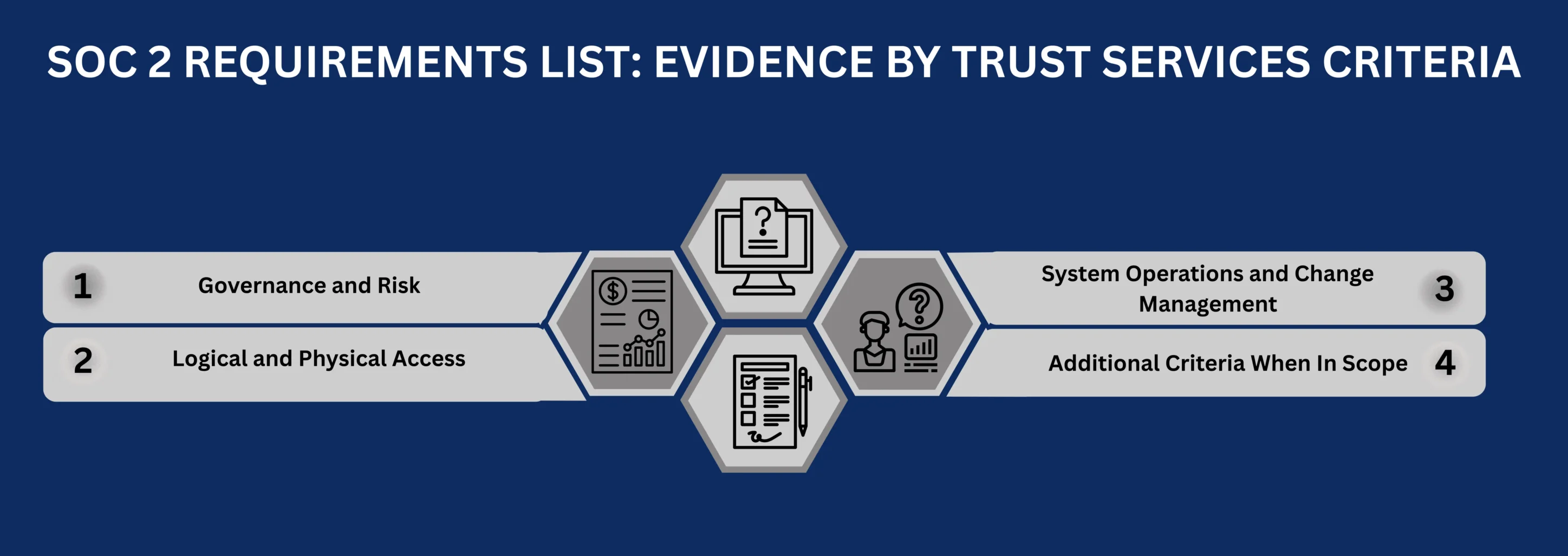
- ✓Control Environment and Documentation Requirements
- ✓Scope Boundaries, Maintenance, and Recertification
Business Sectors in Kyiv Seeking SOC 2 Certification
SOC 2 Certification in Kyiv is pursued across a broad range of technology and financial services sectors. The city’s technology ecosystem is structurally oriented toward international service delivery, which means that a substantial proportion of Kyiv-based organizations operate within the vendor risk management scope of U.S. and European enterprise customers requiring independent SOC 2 attestation. The distribution of demand across sectors reflects Kyiv’s established strengths in software engineering, cybersecurity, financial technology, and managed services.
Software Development and IT Outsourcing
Kyiv is one of Eastern Europe’s most significant concentrations of software development and IT outsourcing talent. Organizations providing custom software development, application maintenance, quality assurance, and DevOps services to U.S. and European enterprises frequently encounter SOC 2 attestation requirements during vendor qualification. When a Kyiv-based software development firm is engaged to build or operate systems that process customer data or integrate with enterprise production environments, the contracting enterprise’s information security team will typically require SOC 2 Type 2 attestation as a condition of the engagement. SOC 2 certification that Kyiv IT companies obtain documents the security controls governing how customer code, data, and intellectual property are protected within the development and delivery environment.
Fintech, Cybersecurity, and Managed Service Providers
SOC 2 compliance that Kyiv fintech organizations pursue reflects the assurance expectations of regulated financial institution customers and payment ecosystem participants. Kyiv-based fintech firms providing payment technology, fraud detection, data analytics, and financial infrastructure services must demonstrate independent control verification to satisfy bank vendor management requirements and payment card industry procurement standards. Cybersecurity organizations based in Kyiv — including managed security service providers, security operations centers, and threat intelligence firms — are themselves subject to SOC 2 attestation requirements from enterprise customers who require assurance that the security vendor’s own control environment is independently verified. Managed service providers operating from Kyiv that administer IT infrastructure, cloud environments, or endpoint security for enterprise customers similarly require current SOC 2 attestation to satisfy the vendor assurance requirements of their customer base.
- ✓Software development and IT outsourcing firms delivering services to U.S. and European enterprises
- ✓SaaS providers offering cloud-delivered applications to enterprise customers in regulated sectors
- ✓Fintech organizations providing payment technology, data analytics, or financial infrastructure
- ✓Cybersecurity companies and managed security service providers serving regulated enterprises
- ✓Cloud service providers and infrastructure-as-a-service organizations hosting customer data
- ✓Managed service providers administering IT infrastructure and endpoint environments for enterprise customers
- ✓Data processing and business process outsourcing organizations handling sensitive customer information
Benefits of SOC 2 Certification for Kyiv-Based Organizations
SOC 2 attestation issued by a Licensed CPA Firm provides Kyiv-based organizations with documented, independently verified evidence of control effectiveness. The benefits of SOC 2 Certification are directly tied to the commercial and regulatory contexts in which Kyiv-based technology and financial services organizations operate — specifically, the enterprise vendor assurance requirements, procurement qualification standards, and third-party risk management programs of U.S. and international enterprise customers.
A current SOC 2 Type 2 attestation report issued by a Licensed CPA Firm satisfies the information security assurance requirements embedded in enterprise vendor qualification programs across financial services, healthcare technology, government contracting, and technology sector procurement. Kyiv-based organizations holding a current SOC 2 attestation report can complete enterprise security questionnaires by referencing the report — rather than providing detailed responses to each individual question. This reduces the time required to respond to vendor due diligence requests from weeks to days. In competitive RFP processes, SOC 2 attestation distinguishes qualified vendors from those unable to demonstrate independent control verification, providing a material commercial advantage when multiple Kyiv or Eastern European technology vendors are competing for the same contract.
The SOC 2 audit that Kyiv organizations complete also provides internal operational benefits that extend beyond vendor qualification. The structured audit process requires organizations to document controls systematically, maintain contemporaneous evidence of control operation, and formally assess risks relevant to the in-scope system. These requirements produce a documented control environment that supports operational consistency, facilitates onboarding of new personnel responsible for control activities, and provides an evidence base for internal management reporting on information security performance. The annual recertification cycle sustains organizational focus on control maintenance and creates a structured cadence for reviewing and updating the control environment as the organization’s systems and service commitments evolve.
The independent nature of SOC 2 attestation is its defining feature. A Licensed CPA Firm conducting a SOC 2 examination has no financial or operational interest in the outcome of the audit. This means the resulting attestation report carries credibility that self-assessments and consulting-firm certifications cannot replicate. Enterprise customers, regulators, and procurement evaluators recognize this independence and treat CPA-issued SOC 2 attestation reports as authoritative evidence of control effectiveness. For Kyiv-based organizations seeking to establish long-term vendor relationships with U.S. enterprise customers, the institutional credibility of a Licensed CPA Firm-issued SOC 2 attestation report is a foundational element of the vendor assurance posture expected by sophisticated buyers operating mature third-party risk management programs.
- ✓Independent, CPA-issued attestation recognized by enterprise vendor assurance programs in North America and Europe
- ✓Qualification for enterprise procurement processes requiring SOC 2 Type 2 attestation as a vendor prerequisite
- ✓Reduction in time and administrative burden associated with responding to individual customer security questionnaires
- ✓Documented evidence of control design and operating effectiveness suitable for regulatory and customer review
- ✓Structured annual recertification cycle maintaining current attestation status and control environment relevance
- ✓Formal system description and control documentation supporting operational consistency and personnel onboarding
- ✓Institutional credibility derived from Licensed CPA Firm independence throughout the attestation process
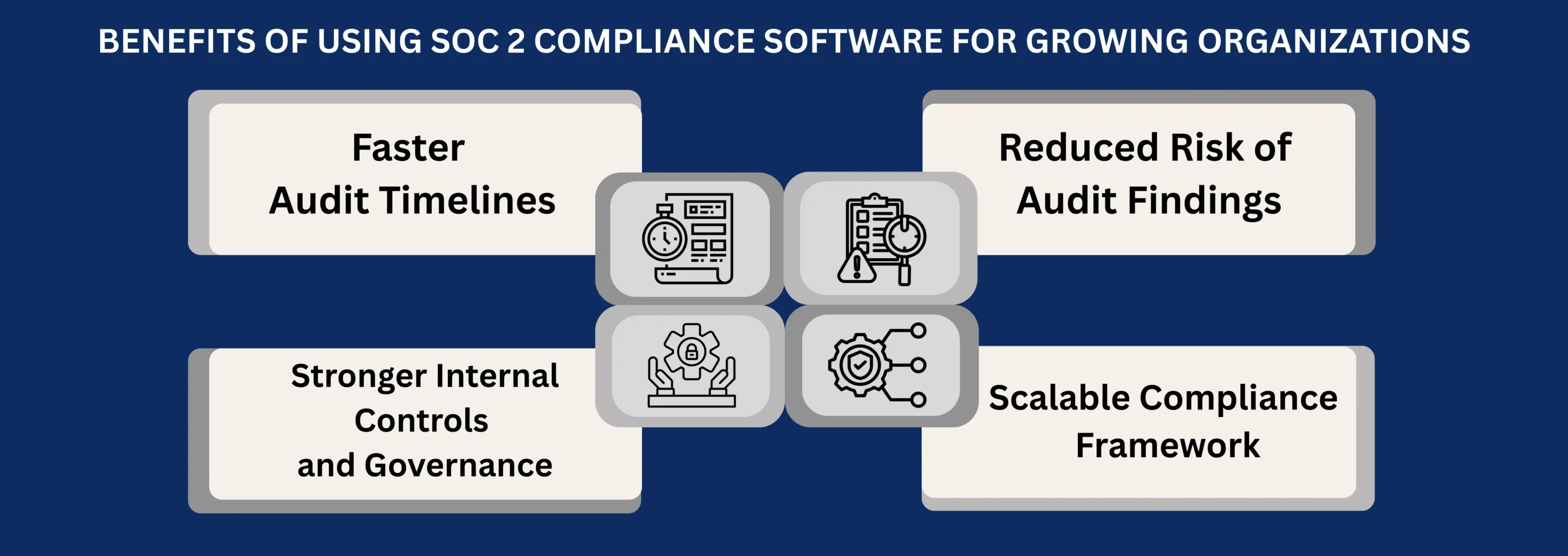
- ✓Enterprise Procurement Access and Vendor Qualification
- ✓Independent Validation and Structured Audit Methodology
SOC 2 Attestation and Report Validity for Kyiv Organizations
SOC 2 attestation validity and report currency are practical concerns for Kyiv-based organizations managing ongoing vendor relationships with enterprise customers. Understanding how SOC 2 reports are dated, how long they are treated as current by enterprise customers, and how report currency is maintained through annual re-engagement is essential for organizations planning their SOC 2 compliance calendar. The SOC 2 examination is a formal attestation under AICPA standards, and the resulting report reflects the control environment as evaluated during a specific examination period — it does not guarantee control effectiveness in perpetuity.
Report Dating, Currency, and Annual Renewal
A SOC 2 Type 2 attestation report is dated as of the end of the observation period covered by the examination. Enterprise customers treat a SOC 2 report as current for approximately twelve months from the period end date. After twelve months, the report is considered stale and no longer satisfies current-year vendor assurance requirements. Kyiv-based organizations maintaining ongoing vendor relationships with enterprise customers must conduct annual Type 2 re-engagements to ensure continuous report currency. The annual re-engagement produces a new SOC 2 attestation report covering the subsequent twelve-month observation period, confirming that controls continued to operate effectively following the prior examination. Organizations experiencing a lapse in SOC 2 attestation — even briefly — risk being placed in remediation status within their customers’ third-party risk management programs, which can delay contract renewals or trigger additional scrutiny during vendor review cycles.
Bridge Letters and Gap Period Management
In situations where an organization’s current SOC 2 attestation report covers a period that ended more than twelve months ago but a new report has not yet been issued, some Licensed CPA Firms issue bridge letters — also referred to as gap letters — that confirm no material changes to the control environment have occurred since the prior report period ended. Bridge letters are management representations accompanied by a limited attestation from the CPA Firm and may be accepted by some enterprise customers as interim assurance pending issuance of the new report. However, bridge letters are not a substitute for a current SOC 2 Type 2 attestation report and are not universally accepted by enterprise procurement programs. Kyiv-based organizations are best positioned to avoid gap periods by aligning their annual re-engagement schedule with the report currency expectations of their largest enterprise customers.
SOC 2 Certification vs. Other Compliance Frameworks for Kyiv Organizations
Kyiv-based technology organizations frequently evaluate SOC 2 Certification in Kyiv alongside other information security and compliance frameworks — most commonly ISO 27001, ISO 27701, and PCI DSS. Each framework serves different purposes and addresses different assurance audiences. Understanding how SOC 2 differs from these frameworks enables organizations to determine the appropriate certification pathway based on their customer requirements, target markets, and contractual obligations — rather than selecting frameworks based on general market perception alone.
SOC 2 Compared to ISO 27001
SOC 2 and ISO 27001 are both widely recognized information security assurance frameworks, but they differ substantially in scope, governing body, assessment methodology, and market recognition. SOC 2 attestation is issued by a Licensed CPA Firm under AICPA attestation standards and is oriented toward evaluating controls as they relate to the specific services delivered to customers. ISO 27001 certification is issued by an accredited certification body under ISO/IEC standards and certifies an organization’s information security management system (ISMS) against a defined set of control domains. SOC 2 is the dominant assurance standard in the U.S. enterprise technology market, while ISO 27001 holds broader international recognition — particularly in European and Asia-Pacific markets. Kyiv-based organizations serving U.S. enterprise customers typically prioritize SOC 2 certification, while those expanding into European regulated markets may pursue ISO 27001 in parallel. The two frameworks are not mutually exclusive and may be pursued concurrently or sequentially based on customer requirements.
SOC 2 Compliance vs. SOC 2 Certification
A critical distinction exists between SOC 2 compliance and SOC 2 certification. SOC 2 compliance refers to an organization’s internal adherence to the Trust Services Criteria through the design and operation of relevant controls — but without independent third-party verification. SOC 2 certification — more precisely, SOC 2 attestation — refers to the formal examination conducted by a Licensed CPA Firm and the resulting attestation report documenting the auditor’s opinion on control design and operating effectiveness. Enterprise customers require SOC 2 attestation, not self-declared SOC 2 compliance. An organization that maintains all required controls internally but has not engaged a Licensed CPA Firm to conduct a SOC 2 examination does not hold SOC 2 attestation and cannot provide an attestation report to customers requiring independent third-party verification. This distinction is particularly important for Kyiv-based organizations responding to vendor security questionnaires that specifically request a Licensed CPA Firm-issued SOC 2 report.
| Framework | Issuing Authority | Primary Market | Assessment Basis | Report Type |
|---|---|---|---|---|
| SOC 2 | Licensed CPA Firm (AICPA standards) | U.S. enterprise and cloud markets | Trust Services Criteria | Attestation report (Type 1 or Type 2) |
| ISO 27001 | Accredited certification body (ISO/IEC standards) | International and European markets | ISMS control domains | Certification with surveillance audits |
| PCI DSS | Qualified Security Assessor (PCI SSC standards) | Payment card industry globally | Payment data security requirements | Report on Compliance (ROC) |
FAQ
▶
What is SOC 2 Certification in Kyiv and who issues it?
▶
What types of organizations in Kyiv require SOC 2 Certification?
▶
What is the difference between SOC 2 Type 1 and SOC 2 Type 2?
▶
How long does a SOC 2 attestation report remain valid?
▶
What Trust Services Criteria are most relevant for Kyiv-based technology companies?
▶
What is the minimum observation period for a SOC 2 Type 2 audit in Kyiv?
▶
How does SOC 2 attestation differ from SOC 2 compliance?
▶
What documentation must Kyiv-based organizations maintain for a SOC 2 audit?
SOC 1 VS SOC 2: WHICH REPORT YOUR CUSTOMERS ACTUALLY ASK FOR
If you sell SaaS or provide outsourced services, you have likely been asked for a SOC report. However, the follow-up question is rarely easy to answer…
SOC 2 Certified: What Does It Mean for Your Business
For companies that handle sensitive data or run cloud-based services, the question “Can you provide your SOC 2 report?” carries enormous weight. Yet, …
HOW SOC 2 AUDITORS REVIEW EVIDENCE OVER TIME
Most businesses pursuing a SOC 2 report spend months building security controls but overlook a fundamental reality: SOC 2 auditors do not just verify …
Get In Touch
have a question? let us get back to you.