
SOC 2 Certification in Leeds
SOC 2 Certification in Leeds is issued by a Licensed CPA Firm following an independent examination conducted under AICPA attestation standards AT-C Section 205. The examination evaluates whether an organisation’s controls meet the Trust Services Criteria (TSC) for security, availability, processing integrity, confidentiality, and privacy. Leeds-based organisations operating in financial services, legal technology, healthcare technology, SaaS, and cloud infrastructure increasingly require SOC 2 attestation to meet U.S. enterprise procurement and third-party vendor risk management requirements.
OUR CLIENTS










SOC 2 Certification for Leeds-Based Financial and Technology Organisations
SOC 2 Certification in Leeds is issued by a Licensed CPA Firm following an independent examination conducted under AICPA attestation standards AT-C Section 205. The examination evaluates whether an organisation’s controls meet the Trust Services Criteria (TSC) for security, availability, processing integrity, confidentiality, and privacy. Leeds-based organisations operating in financial services, legal technology, healthcare technology, SaaS, and cloud infrastructure increasingly require SOC 2 attestation to meet U.S. enterprise procurement and third-party vendor risk management requirements.
Leeds as a Financial, Legal, and Technology Services Hub
Leeds holds a recognised position as one of the UK’s most significant financial and professional services centres outside London. The city is home to major banking institutions, asset management firms, legal services providers, and a growing concentration of fintech companies that process high volumes of sensitive financial data on behalf of institutional and retail clients.
This financial infrastructure, combined with an expanding cluster of healthcare technology organisations, digital media companies, and retail e-commerce technology providers, has positioned Leeds as a city whose data-intensive enterprises frequently encounter U.S.-origin procurement requirements centred on independent SOC 2 attestation. SOC 2 Certification in Leeds has therefore become a prerequisite in many enterprise vendor qualification processes — particularly for organisations supplying software, managed services, or cloud infrastructure to U.S.-regulated financial institutions and global technology procurement teams.
The Leeds technology ecosystem includes a substantial number of SaaS providers, managed service providers, and cloud hosting organisations that handle personally identifiable information, financial records, and health-related data on behalf of their customers. These organisations are increasingly subject to contractual requirements from U.S.-based enterprise clients that mandate independent third-party examination of security and privacy controls before contracts are executed or renewed.
SOC 2 compliance that Leeds organisations must demonstrate is not self-assessed — it requires examination by a Licensed CPA Firm operating under AICPA professional standards. The resulting SOC 2 attestation report serves as the authoritative evidence document in enterprise procurement, financial sector vendor due diligence, and international SaaS expansion contexts.
SOC 2 as an AICPA Attestation Engagement
SOC 2 is not a certification in the ISO sense. It is an attestation engagement governed by the American Institute of Certified Public Accountants (AICPA) under AT-C Section 205. A SOC 2 examination produces an attestation report — issued by a Licensed CPA Firm — in which the auditor expresses an opinion on whether the service organisation’s controls were suitably designed and, in the case of a Type 2 report, operating effectively over a defined observation period.
The AICPA Trust Services Criteria form the evaluative framework against which control effectiveness is assessed. The SOC 2 examination differs from ISO 27001 certification in that it is specifically oriented toward service organisations and is structured to address the security and data handling commitments made to user entities and their customers.
The SOC 2 attestation framework recognises two distinct report types. A SOC 2 Type 1 report evaluates the design and suitability of controls at a single point in time. A SOC 2 Type 2 report evaluates both the design and operating effectiveness of controls over an observation period that typically spans six to twelve months.
For Leeds-based organisations seeking SOC 2 Certification in Leeds for U.S. enterprise procurement purposes, a Type 2 report is typically the required standard. It provides evidence of sustained control effectiveness rather than a point-in-time snapshot. Both report types are issued by a Licensed CPA Firm following completion of the SOC 2 examination and are subject to AICPA quality standards.
Role of an Independent Licensed CPA Firm in SOC 2 Attestation
A Licensed CPA Firm conducts the SOC 2 examination in accordance with AICPA attestation standards and issues the resulting SOC 2 attestation report. The Licensed CPA Firm must be independent of the organisation under examination — it cannot have provided consulting, implementation, or control design services to the same entity.
This independence requirement is foundational to the credibility and market acceptance of the SOC 2 attestation report. In enterprise procurement contexts, the independence of the examining CPA firm is a condition that user entities and their auditors explicitly verify before relying on the report as evidence of control effectiveness.
For Leeds-based organisations engaging in U.S. market expansion, the SOC 2 attestation that enterprise buyers require must originate from a firm that holds a valid CPA licence and operates under AICPA professional standards. The SOC 2 audit firm that Leeds organisations select must be able to issue a formal attestation report signed by a licensed CPA — not merely a compliance assessment or third-party review report.
This distinction is critical. Only a Licensed CPA Firm conducting a formal SOC 2 examination under AT-C Section 205 produces a report that meets the evidentiary standards required by U.S. enterprise procurement, financial services vendor risk programmes, and regulated technology sector client requirements.

What Is SOC 2 Certification?
SOC 2 Certification refers to the outcome of a formal SOC 2 examination conducted by a Licensed CPA Firm, resulting in an attestation report that expresses an independent opinion on a service organisation’s controls. The examination evaluates controls relevant to one or more of the five Trust Services Criteria categories: Security (Common Criteria), Availability, Processing Integrity, Confidentiality, and Privacy. Security is mandatory in every SOC 2 examination; the remaining four categories are included based on the nature of the services provided and the commitments made to user entities.
Trust Services Criteria and the Five Categories
The AICPA Trust Services Criteria (TSC) define the evaluative framework used in every SOC 2 examination. The Security category — also referred to as the Common Criteria — addresses logical and physical access controls, system operations, change management, risk mitigation, and monitoring.
Availability criteria address whether systems are available for operation and use as committed. Processing Integrity criteria evaluate whether system processing is complete, valid, accurate, timely, and authorised. Confidentiality criteria assess whether information designated as confidential is protected as agreed. Privacy criteria evaluate the collection, use, retention, disclosure, and disposal of personal information in accordance with the organisation’s privacy commitments and applicable privacy requirements.
| TSC Category | Scope of Evaluation | Applicability |
|---|---|---|
| Security (Common Criteria) | Logical and physical access controls, change management, risk mitigation, and monitoring | Mandatory in all SOC 2 examinations |
| Availability | System uptime, performance monitoring, and incident response | Applicable to hosting, SaaS, and cloud infrastructure providers |
| Processing Integrity | Completeness, accuracy, and authorisation of processing | Applicable to transaction processing, payroll, and financial systems |
| Confidentiality | Protection of information designated as confidential | Applicable to B2B data handling, legal, and financial data environments |
| Privacy | Collection, use, retention, and disposal of personal information | Applicable to organisations handling PII or health-related data |
SOC 2 Type 1 vs. SOC 2 Type 2 Reports
A SOC 2 Type 1 report assesses the design and suitability of controls at a specific point in time. The Licensed CPA Firm evaluates whether the described controls are appropriately designed to meet the relevant Trust Services Criteria as of the report date. A SOC 2 Type 2 report extends this evaluation over an observation period — typically six to twelve months — and includes testing of whether controls operated effectively throughout that period.
SOC 2 Type 2 certification is considered the more demanding standard because it demonstrates sustained control performance, not merely an intended control design. For Leeds-based financial services organisations, enterprise procurement teams consistently specify Type 2 attestation as the required evidential standard.
The distinction between Type 1 and Type 2 is commercially significant for organisations seeking SOC 2 Certification in Leeds for enterprise client purposes. Many U.S.-based enterprise buyers, regulated financial institutions, and global SaaS platforms specify SOC 2 Type 2 in their vendor security requirements documentation.
A Type 1 report may be accepted during an initial vendor qualification phase, but ongoing supplier relationships typically require annual SOC 2 Type 2 attestation to confirm that controls have remained effective. SOC 2 compliance that Leeds technology providers demonstrate through Type 2 reports is therefore a recurring, evidence-based commitment rather than a one-time assessment.
System Description and Management Assertion
A foundational element of the SOC 2 examination is the service organisation’s system description, which defines the boundaries of the system being evaluated. The system description must identify the services provided, the infrastructure, software, people, procedures, and data included within scope, and the control objectives relevant to the examination.
Management of the service organisation also provides a written assertion confirming that the system description is accurate and that controls were suitably designed and — for Type 2 reports — operating effectively. The Licensed CPA Firm evaluates the accuracy of the system description and the validity of management’s assertion as part of the SOC 2 examination procedures.
SOC 2 Certification Audit Process for Organisations in Leeds
The SOC 2 audit process for Leeds-based organisations follows a structured sequence of activities governed by AICPA attestation standards. Each stage of the SOC 2 examination produces documented outputs that contribute to the final attestation report issued by the Licensed CPA Firm. The process applies uniformly whether the organisation is seeking SOC 2 Type 1 or Type 2 attestation, though the observation period requirement distinguishes the two report types in terms of examination scope and duration.
The SOC 2 examination begins with scope definition. During this phase, the Licensed CPA Firm and the service organisation establish which Trust Services Criteria categories will be included, which systems and services fall within the examination boundary, and whether a Type 1 or Type 2 report is being pursued. Engagement acceptance procedures require the CPA firm to assess its independence from the organisation and confirm that the examination is technically feasible.
The audit programme is then determined, outlining the specific control objectives, testing procedures, evidence requirements, and the observation period dates for Type 2 examinations.
For SOC 2 audit engagements in Leeds, the scoping phase is particularly important for organisations with complex technology architectures, subservice organisations, or multi-entity structures. Subservice organisations — third parties that provide components of the in-scope system — must be addressed through either the inclusive method, where their controls are included in the examination scope, or the carve-out method, where the service organisation describes the services provided by subservice organisations and users are directed to obtain separate assurance.
The audit programme determination documents how each of these structural elements will be addressed in the examination.
During the fieldwork phase, the Licensed CPA Firm’s auditors execute the testing procedures defined in the audit programme. For SOC 2 Type 1 examinations, this involves evaluating whether controls are suitably designed to meet the Trust Services Criteria as of the report date. For SOC 2 Type 2 examinations, auditors additionally test the operating effectiveness of controls across the entire observation period using a combination of inquiry, observation, inspection of documentation, and re-performance.
Evidence collected during the SOC 2 audit includes access control logs, change management records, security incident reports, encryption configurations, vendor management documentation, and system monitoring outputs.
The SOC 2 examination distinguishes between control design and control operation. A control may be suitably designed but fail in operation if it is not consistently applied throughout the observation period. Auditors assess both dimensions for Type 2 engagements.
Where controls are executed by automated systems, auditors evaluate the reliability of the automated process and the associated IT environment controls. Where controls depend on human action, auditors test a sample of instances across the observation period to evaluate consistency of execution. Identified deficiencies are documented and communicated to management prior to finalisation of the SOC 2 attestation report.
Upon completion of fieldwork, the Licensed CPA Firm prepares the SOC 2 attestation report. The report includes the auditor’s opinion, management’s assertion, the system description, the description of tests of controls, and the results of those tests. For Type 2 reports, the results section identifies any control exceptions — instances where a control did not operate effectively — and documents their nature and frequency.
The CPA firm’s opinion may be unmodified (clean), qualified, adverse, or a disclaimer of opinion, depending on the significance of any identified exceptions. The SOC 2 attestation is then issued and distributed to the service organisation for sharing with user entities under confidentiality provisions.
| Audit Stage | Key Activities | Output |
|---|---|---|
| Scoping and Engagement Acceptance | Define system boundaries, select TSC categories, confirm CPA firm independence | Signed engagement letter and audit programme |
| Stage 1 – Documentation Review | Review system description, management assertion, and control documentation | Documented observations and information requests |
| Stage 2 – Control Testing | Inquiry, observation, inspection, and re-performance over the observation period | Test results and identified control exceptions |
| Nonconformity Review | Communicate exceptions to management and review management responses | Exception log and management responses |
| Attestation Issuance | Finalise auditor opinion and issue the SOC 2 attestation report | Signed SOC 2 Type 1 or Type 2 attestation report |
- ✓Scoping, Engagement Acceptance, and Audit Programme Determination
- ✓Fieldwork, Control Testing, and Evidence Collection
- ✓Reporting, Nonconformity Review, and Attestation Issuance
Why Organisations in Leeds Pursue SOC 2 Certification
SOC 2 Certification in Leeds is pursued primarily in response to explicit requirements from enterprise clients, financial sector procurement programmes, and third-party risk management frameworks operated by U.S.-regulated organisations. Leeds-based technology and financial services companies increasingly encounter SOC 2 requirements during contract negotiations with U.S. enterprise buyers, during vendor onboarding by financial institutions, and during due diligence reviews conducted by multinational organisations evaluating cloud and SaaS providers.
Enterprise Vendor Qualification and U.S. Market Access
U.S. enterprise organisations routinely require SOC 2 Type 2 attestation as a condition of vendor approval. For a Leeds-based SaaS provider seeking to contract with a U.S. financial institution, healthcare system, or technology platform, the absence of a current SOC 2 attestation report frequently results in disqualification from the procurement process — or extended due diligence timelines that delay contract execution. SOC 2 Certification in Leeds therefore directly affects an organisation’s ability to qualify as an approved vendor in competitive enterprise sales processes.
A specific example illustrates the commercial relevance: a Leeds-based cloud infrastructure provider responding to an RFP from a U.S. asset management firm will typically receive a vendor security questionnaire requesting a current SOC 2 Type 2 report. Without an existing attestation, the vendor must either complete the SOC 2 examination before contract award or accept deferral until the attestation is available.
Completing the SOC 2 audit in advance of procurement processes eliminates this delay and demonstrates proactive commitment to control effectiveness — a quality that enterprise security teams evaluate positively during vendor risk assessments.
Financial Sector and Fintech Procurement Expectations
SOC 2 certification pursued by Leeds fintech and financial services organisations reflects the sector-specific expectations of regulated financial institutions. Banks, insurance companies, and investment management firms operating under U.S. regulatory frameworks — including those of the SEC, FINRA, and banking regulators — are required to conduct third-party risk assessments of technology vendors.
SOC 2 attestation from a Licensed CPA Firm is a standard and broadly accepted form of assurance in these assessments. Leeds-based fintech companies supplying payment processing, fraud analytics, regulatory reporting, or portfolio management technology to U.S.-regulated institutions must typically maintain current SOC 2 Type 2 attestation as a condition of supplier approval.
SOC 2 certification that Leeds financial services providers obtain also supports compliance with UK regulatory expectations for third-party technology risk management. The Financial Conduct Authority (FCA) and the Prudential Regulation Authority (PRA) expect regulated firms to obtain assurance from technology suppliers regarding the security and resilience of systems that support regulated activities.
While UK regulators do not formally mandate SOC 2 attestation, a SOC 2 Type 2 report from a Licensed CPA Firm provides structured, evidence-based assurance that regulated firms can use to satisfy their own third-party risk management obligations under FCA and PRA operational resilience requirements.
Healthcare Technology, Legal Services, and Data-Intensive Sectors
Leeds-based healthcare technology organisations supplying clinical decision support systems, electronic health record platforms, or health data analytics services to U.S. healthcare providers encounter SOC 2 requirements as part of business associate and vendor risk management programmes. While HIPAA governs protected health information in the U.S., SOC 2 attestation — particularly when the Privacy and Security criteria are included — provides a structured framework for demonstrating that data handling controls meet the expectations of U.S. healthcare clients.
Legal technology providers in Leeds that process client matter data, litigation support information, or legal research data on behalf of U.S. law firms similarly encounter SOC 2 requirements in vendor qualification processes.
SOC 2 Certification Scope and Independent Decision Framework
The scope of a SOC 2 examination is defined by the system boundaries, the Trust Services Criteria categories included, and the observation period for Type 2 reports. The Licensed CPA Firm independently determines whether the examination scope is sufficient to support the opinion expressed in the attestation report. Scope decisions are not made unilaterally by the service organisation — the CPA firm applies professional judgement to evaluate whether the defined system boundaries accurately represent the services and controls relevant to user entity commitments.
Evidence-Based Assessment and Control Evaluation
The SOC 2 examination is an evidence-based assessment. The Licensed CPA Firm does not accept management representations as sufficient evidence of control effectiveness — it independently tests controls using documented procedures and evaluates the sufficiency and appropriateness of audit evidence collected.
Control evaluation encompasses both the design adequacy of controls (whether they are capable of achieving the relevant Trust Services Criteria) and, for Type 2 examinations, the consistency of control operation throughout the observation period. Evidence assessed includes system-generated logs, configuration records, policy documents, training records, access provisioning and deprovisioning records, and change management system outputs.
The SOC 2 compliance assessment performed by the Licensed CPA Firm distinguishes between complementary user entity controls (CUECs) and controls operated entirely by the service organisation. CUECs are controls that user entities are expected to implement for the overall system to meet the Trust Services Criteria.
The CPA firm documents CUECs in the system description and ensures that the service organisation’s controls and user entity controls collectively address the relevant criteria. This distinction is important for Leeds-based service organisations whose attestation reports are reviewed by sophisticated user entities with their own control environments.
Nonconformity Review and Certification Committee Decision
Where the SOC 2 examination identifies control exceptions — instances in which a control did not operate as described or failed to achieve the relevant Trust Services Criterion — these are documented in the attestation report along with the nature, frequency, and potential impact of each exception. The Licensed CPA Firm evaluates whether identified exceptions are pervasive or isolated and determines whether they affect the overall opinion expressed in the report.
A single isolated exception in a Type 2 report does not automatically result in a qualified opinion. However, exceptions that indicate systematic control failures or that affect criteria central to user entity commitments may result in a modified opinion.
Report Validity, Maintenance, and Recertification
A SOC 2 attestation report does not carry a fixed expiry date in the same manner as some certification standards, but the convention in enterprise procurement and financial sector vendor management is that a SOC 2 Type 2 report covering a twelve-month period is renewed annually. Most U.S. enterprise buyers and regulated financial institutions require that the most recent SOC 2 report cover a period ending no more than twelve months before the date of the vendor review.
Leeds-based organisations maintaining SOC 2 Certification in Leeds must therefore plan for annual SOC 2 examination cycles to ensure that current attestation reports are available to present to user entities and prospective customers throughout the year.
Benefits of SOC 2 Certification for Leeds-Based Organisations
SOC 2 Certification in Leeds provides organisations with independently verified evidence of control effectiveness that is recognised across U.S. enterprise procurement frameworks, financial sector vendor risk programmes, and international technology client requirements. The following represent the principal outcomes associated with completing a SOC 2 examination conducted by a Licensed CPA Firm.
- ✓Independent third-party validation of security and data protection controls by a Licensed CPA Firm operating under AICPA attestation standards
- ✓Recognition in U.S. enterprise vendor qualification processes, including financial services, healthcare, and technology sector procurement programmes
- ✓Demonstration of sustained control effectiveness over a defined observation period through SOC 2 Type 2 attestation
- ✓Structured evidence of SOC 2 compliance with the AICPA Trust Services Criteria, addressing security, availability, processing integrity, confidentiality, and privacy
- ✓Competitive differentiation in enterprise sales processes where SOC 2 attestation is a specified vendor requirement
- ✓Assurance documentation that user entities can use to satisfy their own third-party risk management obligations to regulators and internal governance bodies
- ✓Annual SOC 2 examination cycle that drives continuous evaluation of the control environment and identification of control gaps before they affect user entity commitments
- ✓Credible, auditor-signed SOC 2 attestation report that replaces or supplements self-completed vendor security questionnaires in enterprise procurement contexts
The primary commercial value of SOC 2 attestation for Leeds-based organisations is the substitution of independent auditor evidence for self-reported security assurances. Enterprise procurement teams and vendor risk managers at regulated financial institutions apply consistent scepticism to self-attested security questionnaires, but treat SOC 2 Type 2 reports from Licensed CPA Firms as objective, auditor-verified evidence.
SOC 2 attestation obtained from a Licensed CPA Firm carries the credibility of an independent professional opinion — one that is subject to AICPA quality standards and CPA firm licensing requirements — rather than the limited credibility of management self-certification.
For Leeds-based SaaS providers and cloud service organisations competing in markets where multiple vendors offer comparable technical capabilities, SOC 2 Type 2 certification can represent a decisive differentiator in procurement decisions. Enterprise buyers with formal vendor risk management programmes reduce their due diligence burden when a vendor holds a current SOC 2 Type 2 attestation, shortening contract timelines and reducing the probability of vendor disqualification on security grounds.
The competitive and commercial implications of SOC 2 Certification in Leeds therefore extend beyond regulatory compliance into direct revenue and market access outcomes.
Annual SOC 2 examination cycles provide Leeds-based organisations with a structured mechanism for evaluating the effectiveness of their control environment on a recurring basis. The SOC 2 audit process requires that organisations maintain consistent control operation throughout the observation period, which necessitates ongoing monitoring, documentation, and review of controls rather than point-in-time preparation.
This sustained control discipline, reinforced by annual SOC 2 examination, supports the development of a mature control environment that reduces the likelihood of security incidents, data breaches, and service availability failures that could affect user entities and trigger contractual or regulatory consequences.
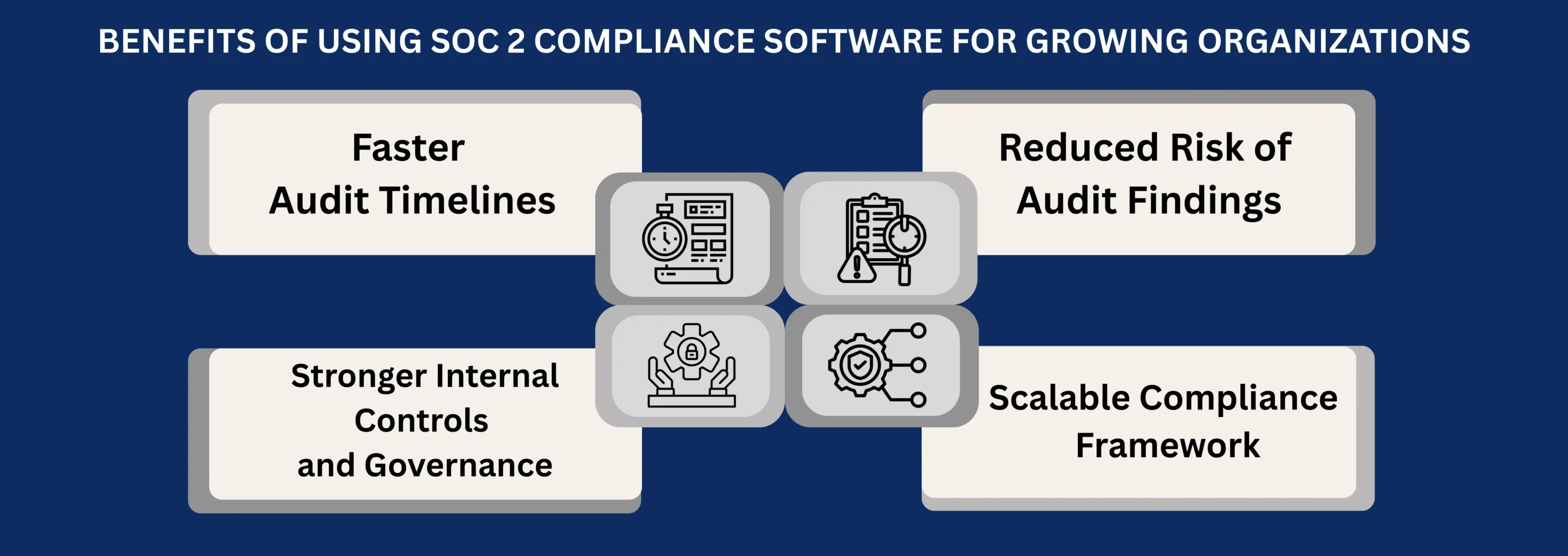
- ✓Third-Party Validation and Enterprise Trust
- ✓Ongoing Control Environment Evaluation
SOC 2 Certification Requirements for Leeds Organisations
SOC 2 Certification in Leeds requires that service organisations satisfy a defined set of structural, documentation, and control requirements before and during the SOC 2 examination. These requirements are evaluated by the Licensed CPA Firm during the examination and are documented in the attestation report. Organisations that do not meet the baseline requirements for scope definition, system description accuracy, or management assertion may be subject to a modified opinion or a qualified attestation report.
The SOC 2 examination requires that the service organisation produce a comprehensive system description that accurately represents the services, infrastructure, software, people, procedures, and data within the examination scope. Management must provide a written assertion confirming the accuracy of the system description and the suitability of the controls described.
Supporting documentation required for SOC 2 audit purposes includes information security policies, access control procedures, change management procedures, incident response plans, business continuity and disaster recovery plans, vendor management frameworks, and evidence of control monitoring activities conducted throughout the observation period for Type 2 examinations.
Documentation requirements for SOC 2 compliance that Leeds organisations must satisfy extend to evidence that controls were actually applied during the observation period — not merely that policies describing the controls exist. For access management controls, this requires provisioning and deprovisioning logs, periodic access reviews, and privileged access management records. For change management controls, this requires change request records, testing documentation, approval evidence, and post-implementation review records.
The Licensed CPA Firm evaluates the completeness and reliability of this evidence as part of the control testing procedures conducted during the SOC 2 examination.
The technical controls evaluated in a SOC 2 examination under the Security (Common Criteria) category include logical access controls such as multi-factor authentication, role-based access provisioning, privileged access management, and periodic access reviews. Network security controls covering firewalls, intrusion detection systems, network segmentation, and encryption in transit and at rest are also evaluated.
System monitoring controls — including security information and event management (SIEM) systems, log management, and alert response procedures — are assessed. Vulnerability management programmes, including regular scanning, penetration testing, and patch management, are reviewed as components of the risk mitigation control environment.
Operational controls assessed in the SOC 2 examination include human resources procedures governing background screening, security training, and employee departure processes. Physical and environmental controls — data centre access restrictions, environmental monitoring, and physical security procedures — are evaluated where the organisation operates or leases physical infrastructure. Third-party vendor management controls are examined to confirm that subservice organisations and critical suppliers are subject to appropriate security assessments and contractual security requirements.
For Leeds-based organisations that rely on major cloud infrastructure providers such as AWS, Azure, or Google Cloud, the auditor assesses whether appropriate complementary controls are in place at the service organisation level.
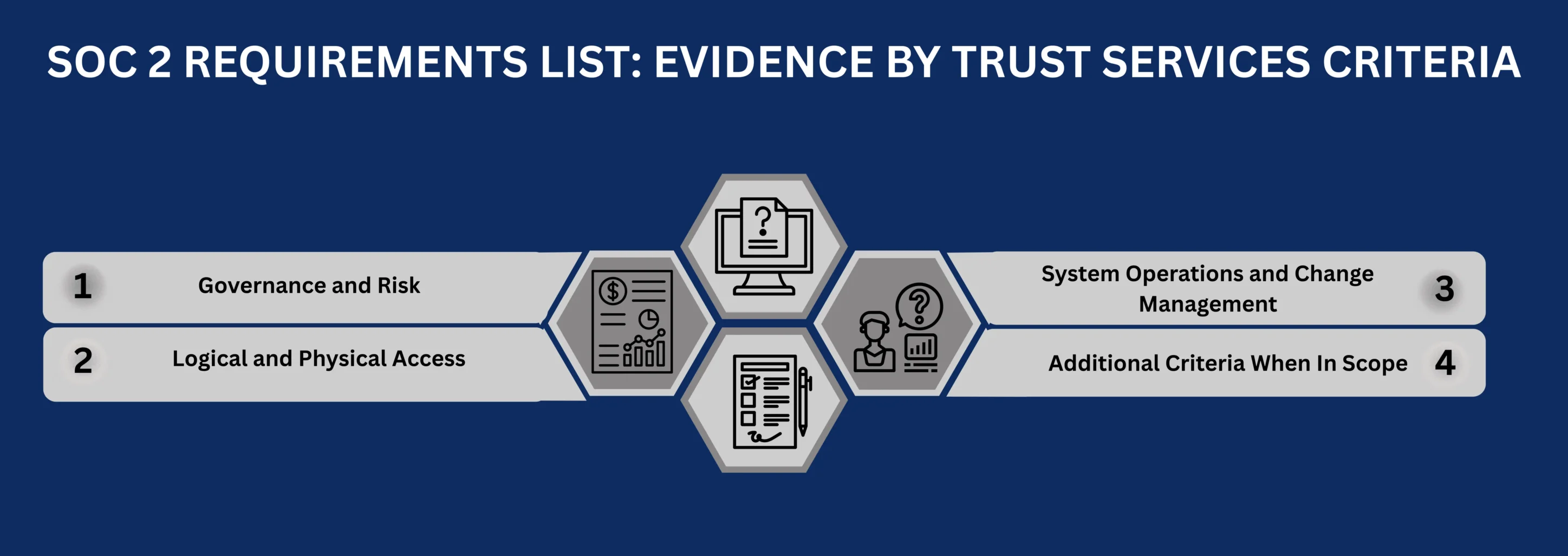
- ✓Documentation Requirements
- ✓Technical and Operational Control Requirements
SOC 2 Certification and Related Compliance Frameworks
Leeds-based organisations frequently operate within multiple compliance frameworks simultaneously. Understanding how SOC 2 Certification relates to other standards — including ISO 27001, GDPR, Cyber Essentials, and HIPAA — is important for organisations determining their attestation and compliance strategy. The SOC 2 examination is not designed to replace these frameworks but addresses a distinct set of user entity and enterprise procurement requirements that other frameworks do not directly satisfy.
SOC 2 vs. ISO 27001
SOC 2 and ISO 27001 are both independently verified assessments of information security controls, but they differ in their governing frameworks, scope orientation, and market recognition. ISO 27001 is a globally recognised information security management system standard that specifies requirements for establishing, implementing, maintaining, and continually improving an ISMS. ISO 27001 certification is issued by accredited certification bodies and is widely recognised in European and UK procurement contexts.
SOC 2 attestation is governed by the AICPA and is the dominant assurance standard in U.S. enterprise technology and financial services procurement. Leeds-based organisations seeking both European and U.S. market access may determine that both ISO 27001 certification and SOC 2 attestation are required, as the two reports serve different market audiences.
The evaluative focus of SOC 2 differs from ISO 27001 in that the SOC 2 examination is oriented toward the specific services and commitments a service organisation makes to user entities, whereas ISO 27001 addresses the organisation’s information security management system as a whole. SOC 2 testing is driven by the Trust Services Criteria and the service organisation’s system description, making it more directly aligned with customer-facing service commitments.
ISO 27001 audits evaluate management system conformance against a defined set of clauses and Annex A controls. For SOC 2 examination purposes, controls from ISO 27001’s Annex A may serve as relevant evidence, but the SOC 2 auditor evaluates them against the Trust Services Criteria rather than ISO 27001 conformance requirements.
SOC 2 and GDPR Alignment
Leeds-based organisations subject to the UK GDPR and the EU GDPR may find that SOC 2 attestation — particularly when the Privacy Trust Services Criterion is included in the examination scope — provides documentation of privacy-relevant controls that supports their GDPR accountability obligations. The GDPR requires data controllers and processors to implement appropriate technical and organisational measures to protect personal data, and the SOC 2 Privacy criteria address the collection, use, retention, disclosure, and disposal of personal information in accordance with the organisation’s privacy notice and applicable privacy requirements.
While a SOC 2 attestation report does not constitute a GDPR compliance determination, the control evidence documented in a SOC 2 Type 2 report contributes to demonstrable accountability under GDPR Article 5(2).
Sectors in Leeds Seeking SOC 2 Certification
SOC 2 Certification in Leeds is pursued across a range of sectors whose common characteristic is the handling of sensitive data on behalf of enterprise clients or regulated institutions. The following sectors represent the primary sources of SOC 2 audit demand among Leeds-based organisations.
- ✓Financial services technology providers supplying trading platforms, regulatory reporting systems, and risk analytics to U.S.-regulated financial institutions
- ✓Fintech companies offering payment processing, embedded finance, open banking infrastructure, and fraud detection services to enterprise clients
- ✓SaaS providers delivering business process, productivity, and workflow automation applications to U.S. enterprise and mid-market clients
- ✓Cloud service providers and managed service providers hosting regulated workloads on behalf of financial, healthcare, and legal sector clients
- ✓Healthcare technology organisations supplying clinical systems, health data analytics, and patient engagement platforms to U.S. healthcare providers
- ✓Legal technology providers offering document management, e-discovery, legal research, and contract lifecycle management platforms
- ✓Retail and e-commerce technology companies supplying platform infrastructure, customer data analytics, and supply chain systems to enterprise retailers
- ✓Digital media and content technology organisations processing consumer behavioural data and targeted advertising infrastructure on behalf of enterprise clients
SaaS and Cloud Providers in the Leeds Technology Ecosystem
The Leeds technology ecosystem has seen significant growth in SaaS and cloud service organisations over the past decade, driven by investment in digital infrastructure, a strong university talent pipeline, and the presence of established financial and professional services clients. These organisations — ranging from early-stage startups to established scale-ups — increasingly encounter SOC 2 requirements as they expand into U.S. markets or deepen relationships with U.S.-owned enterprises operating from Leeds.
Completing a SOC 2 audit supports their positioning as enterprise-ready vendors and accelerates procurement timelines with U.S. buyer organisations that apply standard vendor security qualification criteria.
Managed service providers (MSPs) based in Leeds that supply IT infrastructure management, network operations, security monitoring, and cloud management services to financial sector clients face specific SOC 2 requirements. Financial services firms that engage MSPs as technology suppliers are required by their own regulators and internal risk frameworks to obtain assurance regarding the security and availability controls operated by their technology providers.
A SOC 2 Type 2 report from a Licensed CPA Firm satisfies this requirement more effectively than informal security questionnaire responses and is accepted in formal vendor risk management programmes operated by regulated financial institutions across the U.S. and internationally.
FAQ
▶
What is SOC 2 Certification and who issues it?
▶
What is the difference between SOC 2 Type 1 and SOC 2 Type 2?
▶
Which Trust Services Criteria must be included in a SOC 2 examination?
▶
How long does a SOC 2 Type 2 observation period last?
▶
Is SOC 2 Certification mandatory for Leeds-based organisations?
▶
How does SOC 2 differ from ISO 27001 for Leeds organisations?
▶
Can a Leeds-based organisation share its SOC 2 report with multiple clients?
▶
What is the relationship between SOC 2 compliance and SOC 2 certification?
SOC 1 VS SOC 2: WHICH REPORT YOUR CUSTOMERS ACTUALLY ASK FOR
If you sell SaaS or provide outsourced services, you have likely been asked for a SOC report. However, the follow-up question is rarely easy to answer…
SOC 2 Certified: What Does It Mean for Your Business
For companies that handle sensitive data or run cloud-based services, the question “Can you provide your SOC 2 report?” carries enormous weight. Yet, …
HOW SOC 2 AUDITORS REVIEW EVIDENCE OVER TIME
Most businesses pursuing a SOC 2 report spend months building security controls but overlook a fundamental reality: SOC 2 auditors do not just verify …
Get In Touch
have a question? let us get back to you.