
SOC 2 Certification in London
CertPro is a Licensed CPA Firm conducting SOC 2 Certification in London against the AICPA Trust Services Criteria. Each SOC 2 audit evaluates security, availability, confidentiality, processing integrity, and privacy controls for service organisations operating across London’s financial, technology, and data infrastructure sectors.
OUR CLIENTS










Introduction to SOC 2 Certification in London
SOC 2 Certification in London is the formal attestation process through which service organisations demonstrate that their information security controls meet the American Institute of Certified Public Accountants (AICPA) Trust Services Criteria. As London continues to function as one of Europe’s premier financial and technology hubs, demand for independently verified data security practices has grown substantially. Organisations in fintech, cloud computing, legal services, and enterprise software routinely face client requirements for a current SOC 2 report before contracts can be executed.
SOC 2, or Service Organization Control 2, is a framework developed by the AICPA for service organisations that store, process, or transmit customer data. Unlike prescriptive compliance mandates, SOC 2 compliance evaluates an organisation’s controls against five Trust Services Criteria: Security, Availability, Confidentiality, Processing Integrity, and Privacy. The Security criterion is mandatory for all SOC 2 engagements; the remaining four criteria are selected based on the nature of services provided and commitments made to customers. This flexibility makes SOC 2 Certification in London especially relevant across diverse industry verticals.
What Is SOC 2 and Why It Matters for London Businesses
SOC 2 is not a product certification or a regulatory mandate in the traditional sense. It is a SOC 2 attestation report issued by a Licensed CPA Firm following a rigorous audit of a service organisation’s internal controls. The report communicates to clients, prospects, and regulators that an independent auditor has examined the organisation’s systems and determined that controls are suitably designed (Type 1) or both suitably designed and operating effectively over a defined period (Type 2). For London-based businesses competing for enterprise and government contracts, a SOC 2 report serves as a credible, independently verified signal of operational trustworthiness.
London’s position as a global financial centre means that businesses headquartered here frequently enter commercial relationships with counterparties in the United States, where SOC 2 reports are a standard procurement requirement. North American enterprises — particularly those in financial services, healthcare, and government contracting — require their vendors to maintain current SOC 2 attestation as standard due diligence protocol. London-based fintech companies, SaaS providers, managed service providers, and data processors seeking to expand into US markets will encounter this requirement repeatedly. SOC 2 Certification in London therefore functions as both a market access credential and a demonstration of institutional security maturity.
SOC 2 Type 1 and Type 2 Explained
A SOC 2 Type 1 certification in London evaluates whether an organisation’s controls are suitably designed to meet the relevant Trust Services Criteria at a specific point in time. This report is appropriate for organisations that have recently implemented controls and need to demonstrate design adequacy before undergoing a longer observation period. A SOC 2 Type 1 audit in London typically takes six to twelve weeks and results in an auditor’s opinion on the accuracy of the system description and the suitability of control design.
A SOC 2 Type 2 audit in London, by contrast, evaluates both the design and operating effectiveness of controls over a defined period — typically between six and twelve months. The Type 2 report provides substantially greater assurance to clients because it demonstrates that controls were not only designed correctly but also functioned as intended across a sustained observation window. Most enterprise procurement teams and regulated financial institutions in London require a SOC 2 Type 2 report rather than a Type 1, as it reflects ongoing operational discipline rather than a point-in-time snapshot.
| Feature | SOC 2 Type 1 | SOC 2 Type 2 |
|---|---|---|
| Scope | Point-in-time assessment | Period-based assessment (6–12 months) |
| Auditor Opinion | Design suitability of controls | Design and operating effectiveness |
| Typical Duration | 6–12 weeks | 6–12 months observation period |
| Client Acceptance | Initial vendor onboarding | Enterprise and regulated sector standard |
| Renewal Cycle | Followed by Type 2 engagement | Annual recertification required |
The Trust Services Criteria Framework
The AICPA Trust Services Criteria (TSC) form the evaluative foundation of every SOC 2 audit. The Security criterion — also referred to as the Common Criteria — encompasses logical and physical access controls, system operations, change management, and risk mitigation processes. All SOC 2 engagements must address the Security criterion. London organisations operating in healthcare data management, cloud infrastructure, or payment processing frequently elect to include the Availability and Confidentiality criteria to reflect their specific service commitments and contractual obligations.
The Privacy criterion within the Trust Services Criteria evaluates how an organisation collects, uses, retains, discloses, and disposes of personal information. For London organisations subject to the UK General Data Protection Regulation (UK GDPR) and oversight by the Information Commissioner’s Office (ICO), the Privacy criterion provides a complementary layer of SOC 2 compliance assurance that aligns with statutory obligations. While a SOC 2 audit does not replace UK GDPR compliance, the two frameworks share substantive overlap in areas such as data minimisation, consent management, breach notification, and individual rights fulfilment.

Benefits of SOC 2 Certification in London
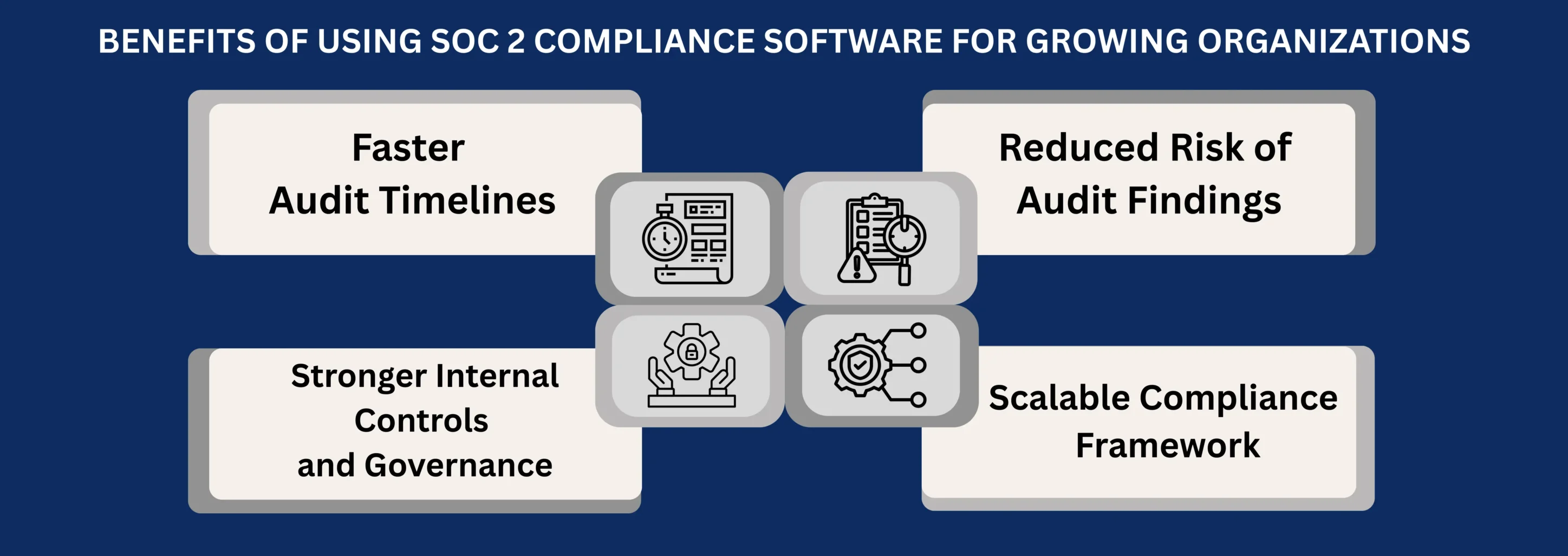
The benefits of SOC 2 Certification in London extend well beyond possessing a formal report. For service organisations operating in a competitive, compliance-aware market, SOC 2 attestation delivers measurable commercial, operational, and reputational advantages. London’s concentration of regulated industries — including financial services supervised by the Financial Conduct Authority (FCA), insurance entities governed by the Prudential Regulation Authority (PRA), and NHS-adjacent health technology providers — creates an environment where independently verified security practices directly influence procurement decisions and contract outcomes.
SOC 2 Certification in London functions as a commercial differentiator in competitive tender processes. Enterprise procurement teams across London’s financial services, legal, and technology sectors routinely include SOC 2 report requirements in their vendor due diligence questionnaires. Organisations that hold a current SOC 2 Type 2 report can fulfil these requirements immediately, reducing sales cycle length and eliminating lengthy security review processes. In regulated financial services environments, the ability to produce a SOC 2 report on demand can be the determining factor in contract award decisions.
For London-based technology companies pursuing expansion into North American markets, SOC 2 attestation is frequently a non-negotiable prerequisite. US-headquartered enterprises — particularly those in financial services, healthcare, and government contracting — require their vendors to maintain current SOC 2 reports as standard due diligence protocol. London fintech companies and SaaS providers that obtain SOC 2 Certification in London are therefore better positioned to compete for high-value US contracts without experiencing procurement delays caused by security verification gaps.
The SOC 2 audit process itself drives material improvements in an organisation’s internal control environment. The audit examination requires organisations to document, test, and evidence their security controls across logical access management, encryption standards, incident response, change management, and vendor risk oversight. This systematic examination frequently identifies control gaps that, once remediated, reduce the organisation’s exposure to data breaches, service disruptions, and regulatory enforcement actions. London organisations that complete a SOC 2 Type 2 audit typically emerge with a more robust, better-documented control environment than existed prior to the audit cycle.
The discipline required to maintain SOC 2 compliance over the annual audit cycle instils operational consistency across security and technology teams. Organisations that undergo annual SOC 2 recertification develop institutionalised practices around access reviews, security awareness training, vulnerability management, and evidence collection. These practices reduce the likelihood of security incidents and support more efficient responses when incidents do occur. For London organisations operating under FCA operational resilience requirements, the control disciplines embedded through SOC 2 compliance directly support broader regulatory obligations.
SOC 2 attestation communicates institutional trustworthiness to existing and prospective clients. In an environment where data breaches and third-party vendor failures generate significant reputational and financial consequences, clients place material value on independently verified security assurances. A current SOC 2 report, issued by a Licensed CPA Firm, provides a level of assurance that self-assessed security questionnaires cannot replicate. For London-based service organisations whose competitive positioning depends on client confidence in their data handling practices, SOC 2 Certification in London is a tangible expression of that commitment.
- ✓Accelerates enterprise vendor onboarding by providing independently verified security assurance
- ✓Differentiates the organisation in competitive tender processes within London’s financial and technology sectors
- ✓Supports market access into North American markets where SOC 2 attestation is a standard procurement requirement
- ✓Reduces client security questionnaire burden through a single comprehensive SOC 2 audit report
- ✓Strengthens internal control environment across access management, encryption, and incident response
- ✓Aligns security practices with UK GDPR and ICO enforcement expectations in overlapping control areas
- ✓Demonstrates operational resilience consistent with FCA and PRA supervisory expectations
- ✓Provides annual recertification discipline that sustains SOC 2 compliance effectiveness over time
- ✓Reduces insurance underwriting risk by evidencing formalised security controls to cyber insurers
- ✓Builds institutional trust with clients, partners, and regulators through independent third-party attestation
- ✓Commercial and Market Access Advantages
- ✓Risk Reduction and Internal Control Strengthening
- ✓Reputational Assurance and Client Trust
SOC 2 Certification Process in London
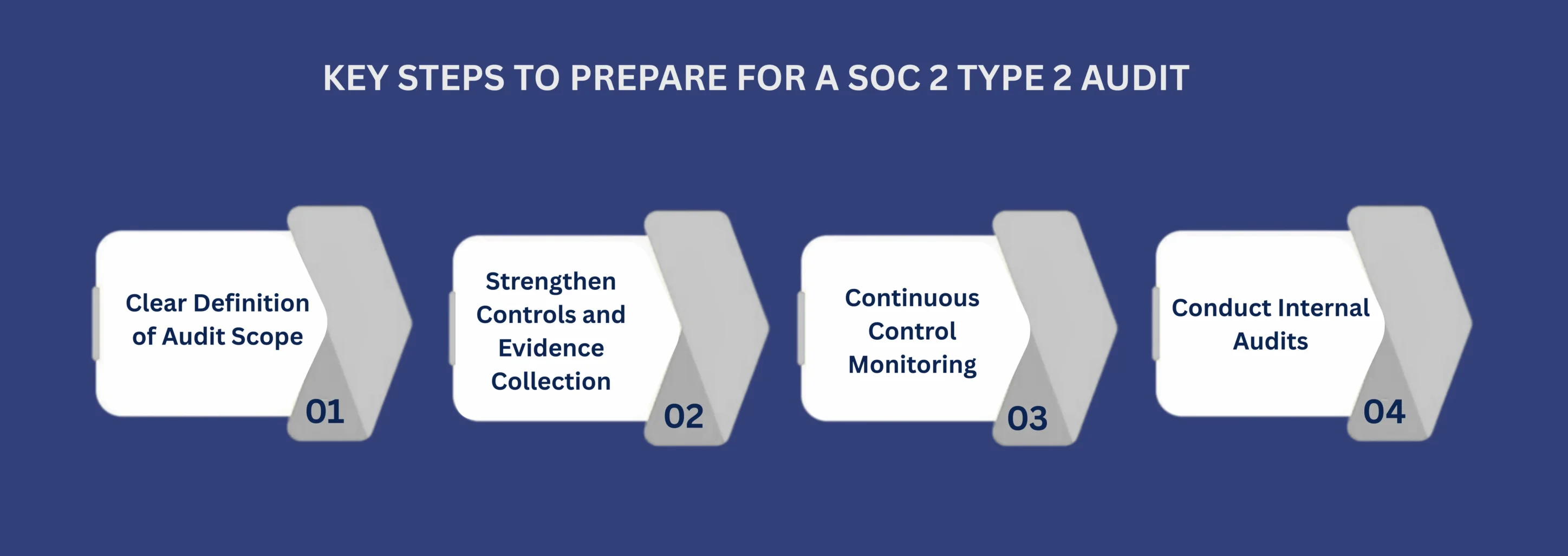
The SOC 2 certification process follows a structured sequence of audit stages, each designed to evaluate a different dimension of the organisation’s control environment. CertPro, as a Licensed CPA Firm, conducts SOC 2 audit engagements in London in accordance with AICPA attestation standards and the AT-C Section 205 framework. Each stage of the audit produces specific outputs that contribute to the final SOC 2 attestation report. Organisations seeking SOC 2 Certification in London should understand the full process to plan internal resources, documentation requirements, and observation period timelines effectively.
Scope definition is the foundational stage of every SOC 2 audit engagement. During this stage, the auditor works with the organisation to identify the systems, infrastructure, and personnel that fall within the audit boundary. For London organisations, this typically encompasses cloud-hosted infrastructure (whether on AWS, Microsoft Azure, or Google Cloud facilities with UK data residency), internal networks, third-party subservice organisations, and the specific services delivered to customers. The scope document formally defines what the auditor will examine and establishes the Trust Services Criteria applicable to the engagement.
Audit program determination follows scope definition and involves the auditor establishing specific control objectives, testing procedures, and evidence requirements that will govern the engagement. The audit program is calibrated to the organisation’s selected Trust Services Criteria, the complexity of its technology environment, and the nature of its service commitments. London organisations with complex multi-cloud architectures or those operating as subservice organisations within larger supply chains may have more extensive audit programs than simpler, single-platform providers. The audit program is documented before fieldwork commences, providing the organisation with a clear understanding of what will be evaluated.
The Stage 1 audit involves the auditor’s review of the organisation’s system description — the written narrative that describes the services provided, the components of the system (infrastructure, software, data, people, and procedures), and the controls implemented to address the Trust Services Criteria. The system description must be materially accurate, complete, and consistent with how the system actually operates. Auditors examine the description against evidence gathered during walkthroughs and documentation reviews to verify that no material omissions or inaccuracies are present. For organisations pursuing SOC 2 Type 1 certification in London, the Stage 1 audit produces the auditor’s opinion on description accuracy and control design suitability.
During the Stage 1 audit, the auditor conducts walkthroughs of key processes and examines policy documentation, procedural records, organisational charts, and system configuration evidence. For London organisations with distributed teams — common in the post-pandemic hybrid working environment — walkthroughs may be conducted remotely via secure video conferencing and screen-sharing platforms. Physical site visits to London data centres or office premises are conducted where required for controls relating to physical security and environmental protection.
Control testing is the most evidence-intensive stage of the SOC 2 Type 2 audit process in London. During this stage, auditors select samples of evidence from across the observation period to verify that controls operated as described. Evidence types include operational evidence (system-generated logs, access control records, encryption configuration exports), observational evidence (screenshots, system configurations, real-time demonstrations), analytical evidence (dashboards, trend reports, security scanning outputs), and testimonial evidence (personnel interviews and written attestations confirming that documented processes were followed).
Centralised logging and monitoring systems are particularly important during the control testing stage. Auditors rely on log data to verify that access controls, change management procedures, and incident response processes operated correctly throughout the observation period. London organisations that maintain a centralised log management system with robust retention policies, indexed search capability, and automated alerting provide auditors with clear, consistent evidence trails. Gaps in logging coverage or evidence retention frequently result in auditor exceptions or qualified opinions on the SOC 2 attestation report.
Following control testing, the auditor conducts a nonconformity review in which identified control deficiencies are assessed for severity and impact. Deficiencies are classified as control deficiencies, significant deficiencies, or material weaknesses depending on their potential impact on the Trust Services Criteria. The organisation is given the opportunity to review and respond to identified exceptions before the final report is issued. Where deficiencies are identified, the organisation may provide contextual information, evidence of remediation actions, or management responses that are incorporated into the final SOC 2 attestation report.
The certification decision is made by the Licensed CPA Firm’s engagement partner based on the totality of audit evidence gathered and the assessment of identified exceptions. The resulting SOC 2 attestation report includes the auditor’s opinion, the system description, the description of control testing procedures, the results of testing, and any identified exceptions. The report is then issued to the organisation and shared with specified users — typically clients and business partners — under a confidentiality agreement. Following issuance, the organisation enters the surveillance and recertification cycle, with annual SOC 2 audits required to maintain current certification status.
- ✓Stage 1: Scope Definition and Audit Program Determination
- ✓Stage 2: Stage 1 Audit and System Description Review
- ✓Stage 3: Control Testing and Evidence Evaluation
- ✓Stage 4: Nonconformity Review, Certification Decision, and Attestation Issuance
Requirements for SOC 2 Certification in London
SOC 2 Certification in London imposes both organisational and technical requirements that service organisations must satisfy before an unqualified auditor opinion can be issued. These requirements are derived from the AICPA Trust Services Criteria and are evaluated through the SOC 2 audit process by the Licensed CPA Firm conducting the engagement. Unlike prescriptive standards that specify exact technical configurations, SOC 2 compliance requires organisations to demonstrate that their controls are appropriate for their specific system boundaries, service commitments, and risk environment.
Organisational requirements for SOC 2 compliance begin with a formally documented information security policy framework. The framework must address risk assessment methodology, acceptable use, access control standards, incident response procedures, business continuity and disaster recovery planning, vendor management, and change management. Each policy must be approved by senior leadership, communicated to relevant personnel, and reviewed on a defined periodic basis. Policy documentation must accurately reflect actual operational practice — auditors cross-reference policy content against system configurations, access logs, and personnel interview responses to identify inconsistencies.
SOC 2 compliance also requires organisations to maintain a formal risk assessment process. The risk assessment must identify threats and vulnerabilities relevant to systems within the audit scope, evaluate the likelihood and impact of identified risks, and document controls implemented to mitigate those risks to an acceptable level. For London organisations operating in regulated sectors, the risk assessment framework should be calibrated to reflect sector-specific threats — including cyber-attacks targeting financial data, regulatory penalties for data breaches, and service disruption risks relevant to the organisation’s availability commitments.
Technical requirements for SOC 2 certification encompass a broad range of infrastructure and system-level controls. Logical access controls must enforce the principle of least privilege, with role-based access assignments formally documented and subject to periodic review. Multi-factor authentication (MFA) must be implemented for all remote access to production systems and privileged account access. Encryption must be applied to data at rest and in transit using industry-standard algorithms. Vulnerability scanning must be conducted on a defined periodic basis, with a formal process for prioritising and remediating identified vulnerabilities within defined timeframes.
Centralised logging is a core technical requirement for SOC 2 compliance. The logging system must capture security-relevant events — including authentication events, access control changes, privileged account activity, system configuration changes, and security alert triggers — and retain logs for a period sufficient to support the audit observation window. Log integrity controls must prevent unauthorised modification or deletion of log records. Automated alerting for defined security events must be implemented and evidenced. London organisations using cloud-native logging tools such as AWS CloudTrail, Azure Monitor, or Google Cloud Audit Logs must demonstrate that these tools are correctly configured and producing complete audit trails.
SOC 2 compliance requires organisations to maintain a formal vendor management programme that addresses risks posed by third-party service providers and subservice organisations. Where critical functions are outsourced to third parties — such as cloud infrastructure providers, payment processors, or identity verification services — the organisation must evaluate and document the security controls of those providers. In practice, this is typically achieved by obtaining the subservice organisation’s current SOC 2 report and reviewing it for relevant control gaps. The auditor will examine vendor management records, subservice organisation reports, and complementary user entity controls as part of the SOC 2 audit process.
- ✓Formally documented information security policy framework approved by senior leadership
- ✓Documented risk assessment process covering threats, vulnerabilities, and mitigating controls
- ✓Role-based access controls enforcing least privilege with periodic access reviews
- ✓Multi-factor authentication for remote access and privileged account management
- ✓Encryption of data at rest and in transit using current industry-standard algorithms
- ✓Centralised logging of security-relevant events with integrity controls and defined retention periods
- ✓Vulnerability management programme with defined scanning frequency and remediation timelines
- ✓Incident response plan with defined detection, containment, notification, and recovery procedures
- ✓Business continuity and disaster recovery plans tested on a defined periodic basis
- ✓Vendor management programme with formal third-party risk assessments and subservice organisation reviews

- ✓Organisational and Documentation Requirements
- ✓Technical and Infrastructure Requirements
- ✓Third-Party and Subservice Organisation Requirements
SOC 2 Compliance in London: Regulatory and Industry Context
SOC 2 compliance in London operates within a broader regulatory landscape shaped by UK GDPR, FCA operational resilience requirements, the Network and Information Systems (NIS) Regulations, and the emerging UK Cyber Security and Resilience Bill. Achieving SOC 2 Certification in London does not automatically satisfy these regulatory frameworks, but the control disciplines embedded in a SOC 2-compliant environment provide substantial overlap with the technical and organisational measures required by UK data protection and financial services regulation.
SOC 2 and UK GDPR: Overlapping Obligations
UK GDPR Article 32 requires organisations that process personal data to implement appropriate technical and organisational measures to ensure a level of security appropriate to the risk. These measures include encryption, ongoing confidentiality and integrity assurance, system resilience, and the ability to restore data following a technical incident. The SOC 2 Trust Services Criteria — particularly Security, Availability, Confidentiality, and Privacy — address substantively similar control requirements. London organisations that maintain SOC 2 compliance can leverage their SOC 2 audit documentation to demonstrate UK GDPR Article 32 compliance to the ICO, reducing duplicative compliance effort.
The ICO has taken an increasingly active enforcement stance in recent years, issuing significant fines for organisations that fail to implement adequate technical and organisational security measures. High-profile enforcement actions against UK financial services and technology companies underscore the material regulatory risk of inadequate data security controls. SOC 2 compliance, evidenced through a current SOC 2 attestation report, provides London organisations with a documented record of independent control verification. This record can support regulatory responses and demonstrate good faith security investment in the event of an ICO investigation.
FCA Operational Resilience and SOC 2 Alignment
The FCA’s operational resilience framework, which took effect in March 2022, requires FCA-regulated firms to identify their important business services, set impact tolerances, and ensure they can remain within those tolerances during severe but plausible disruptions. Third-party technology providers that support FCA-regulated firms’ important business services are subject to scrutiny under outsourcing and third-party risk management requirements. SOC 2 Certification in London’s financial services context therefore carries direct relevance to FCA-regulated procurement decisions — regulated firms must verify that their technology vendors maintain adequate security and availability controls, and a current SOC 2 Type 2 report provides the independently verified evidence required to satisfy that obligation.
SOC 2 vs. ISO 27001 for London Organisations
London organisations frequently encounter the question of whether to pursue SOC 2 certification or ISO 27001 certification. The two frameworks address information security management from different perspectives. ISO 27001 is a globally recognised standard that specifies requirements for an information security management system (ISMS), resulting in a certification issued by an accredited certification body. SOC 2 is an AICPA-governed attestation framework that results in an auditor’s report on specific controls relevant to the Trust Services Criteria. ISO 27001 enjoys broad global recognition and is frequently required by European public sector procurement processes, while SOC 2 attestation is the preferred standard for North American commercial relationships.
The two frameworks are not mutually exclusive, and many London organisations serving both European and North American markets pursue both certifications. There is substantive control overlap between ISO 27001 Annex A controls and the SOC 2 Trust Services Criteria, meaning that an organisation with a mature ISO 27001-compliant ISMS will have foundational controls already in place that satisfy many SOC 2 requirements. The primary distinction lies in the audit output: ISO 27001 produces a certificate indicating conformance with the standard, while a SOC 2 audit produces a detailed attestation report specifying what controls were tested and whether they operated effectively — a level of transparency that enterprise clients and regulated sector procurement processes often find preferable.
SOC 2 Audit Evidence Collection and Management
Evidence collection is one of the most operationally demanding aspects of a SOC 2 audit for London organisations. The quality, completeness, and organisation of evidence provided to the auditor directly influences the efficiency of the audit process and the clarity of the resulting SOC 2 attestation report. Organisations that maintain continuous evidence collection practices throughout the observation period — rather than assembling evidence retrospectively at audit time — produce more complete and consistent evidence sets that support thorough auditor examination without unnecessary delays.
Types of SOC 2 Audit Evidence
SOC 2 audit evidence falls into four primary categories. Operational evidence consists of system-generated records — access logs, authentication records, change management tickets, vulnerability scan reports, and security alert logs — that demonstrate controls functioning in real time. This category carries the greatest weight in the auditor’s assessment of control effectiveness. For London organisations, operational evidence from cloud platforms, identity and access management systems, and security information and event management (SIEM) tools forms the evidentiary backbone of the SOC 2 Type 2 report.
Observational evidence encompasses screenshots, system configuration exports, and direct auditor observations of controls in operation. Analytical evidence includes dashboards, trend reports, exception reports, and statistical analyses that demonstrate control performance patterns over time. Testimonial evidence — interviews, written attestations, and signed confirmations from personnel responsible for executing controls — validates that documented processes are followed in practice. Each evidence type serves a distinct purpose in the SOC 2 audit examination, and an effective evidence programme maintains all four types across the observation period.
Centralised Logging as an Evidence Foundation
Centralised log management is the operational foundation of SOC 2 audit evidence collection for technology-driven organisations. A centralised logging system aggregates security-relevant events from across the organisation’s infrastructure — servers, applications, network devices, identity management platforms, and cloud services — into a single searchable repository. The system classifies, indexes, and filters log data to enable efficient retrieval during auditor examination. Automated alerting functions notify security personnel of anomalous events in real time, and the alert records themselves serve as evidence of monitoring control operation.
For SOC 2 audit purposes, centralised logging systems must demonstrate log integrity — that is, logs cannot be altered or deleted without detection. Audit trails must cover the full observation period without gaps that would prevent the auditor from verifying control operation at any point during the period. London organisations operating in multi-cloud environments should ensure their centralised logging system ingests events from all in-scope cloud tenants and that the log retention policy aligns with the audit observation period plus a reasonable buffer. Deficiencies in logging coverage are among the most frequently identified control gaps during SOC 2 audits in London.
SOC 2 Certification Cost in London
The cost of SOC 2 Certification in London varies based on organisational complexity, the number of Trust Services Criteria selected, the audit period length, and the maturity of the existing control environment. There is no fixed or standardised pricing for SOC 2 audits — each engagement is scoped and priced based on the specific characteristics of the organisation and its systems. London organisations should treat SOC 2 certification cost as a function of audit scope rather than a commodity procurement decision, as the quality and thoroughness of the SOC 2 audit directly affects the credibility of the resulting report.
Factors Influencing SOC 2 Audit Cost
The primary cost driver for a SOC 2 audit engagement is organisational complexity — the number of systems, applications, and infrastructure components within the audit scope, the number of personnel whose roles involve relevant controls, and the complexity of third-party integrations and subservice organisation relationships. A London-based startup with a single SaaS product hosted on a single cloud platform will have a substantially simpler audit scope than a mid-market financial services technology provider with multiple products, on-premises data centre infrastructure, and numerous third-party integrations. Audit fees reflect this complexity differential.
The number of Trust Services Criteria selected also influences cost. An engagement covering only the mandatory Security criterion requires auditors to test a defined set of controls. Each additional criterion — Availability, Confidentiality, Processing Integrity, or Privacy — expands the scope of control testing and increases the volume of evidence required. London organisations that provide cloud hosting services may elect to include the Availability criterion, adding uptime monitoring, redundancy architecture, and incident response evidence requirements to the audit programme. The incremental cost of additional criteria is proportional to the testing scope they add.
SOC 2 Certification Cost Ranges for London Organisations
| Organisation Type | Audit Type | Estimated Cost Range (GBP) |
|---|---|---|
| Early-stage startup (single product, single cloud) | Type 1 | £8,000 – £15,000 |
| Growth-stage SaaS company (multiple products) | Type 2 | £20,000 – £40,000 |
| Mid-market technology provider (complex infrastructure) | Type 2 | £40,000 – £80,000 |
| Financial services technology company (regulated) | Type 2 (multiple TSC) | £60,000 – £120,000+ |
| Annual recertification (established programme) | Type 2 renewal | £15,000 – £50,000 |
Beyond direct audit fees, organisations should account for internal resource costs associated with evidence collection, personnel time for auditor interviews, and any remediation activities identified during the SOC 2 audit process. Organisations with immature evidence collection practices may incur additional internal costs during the first SOC 2 audit cycle as they establish the systems and processes needed to produce complete evidence sets. Subsequent annual audit cycles typically require less internal resource investment as evidence collection becomes an embedded operational practice rather than a one-time exercise.
SOC 2 Certification for London Sectors: Financial Services, Fintech, and Technology
SOC 2 Certification in London carries particular significance for organisations operating in the financial services, fintech, and technology sectors that dominate London’s commercial landscape. The City of London and Canary Wharf financial districts are home to major global banks, investment managers, insurance companies, and the technology providers that serve them. The Square Mile’s concentration of regulated financial institutions creates a procurement environment in which SOC 2 attestation is a standard expectation for any technology vendor seeking to serve the financial sector.
SOC 2 Certification London Fintech Sector Applications
London fintech organisations pursuing SOC 2 Certification face a dual compliance challenge: satisfying FCA regulatory requirements as authorised payment institutions or electronic money institutions while simultaneously meeting the security verification requirements of enterprise banking and insurance clients. SOC 2 Type 2 certification addresses the client-facing dimension of this challenge by providing an independently verified report on security and availability controls. London’s fintech ecosystem — concentrated in areas such as Shoreditch, Old Street, and the Silicon Roundabout corridor — includes numerous high-growth payment providers, open banking platforms, and financial data aggregators for whom SOC 2 attestation is a commercial prerequisite.
Open banking providers operating under the Payment Services Regulations 2017 (PSR 2017) must maintain robust security controls to protect the payment account data they access on behalf of consumers. SOC 2 compliance provides an evidence-based framework for demonstrating that these controls are operating effectively, complementing the technical standards mandated by the PSR 2017 and the FCA’s Strong Customer Authentication requirements. For London-based account information service providers (AISPs) and payment initiation service providers (PISPs) seeking enterprise clients, a current SOC 2 Type 2 report is an increasingly standard client requirement.
SOC 2 Certification for London Financial Services Vendors
SOC 2 Certification in London’s financial services sector extends to the broad ecosystem of technology vendors serving FTSE 100 and FTSE 250 companies. Enterprise risk management platforms, treasury management systems, regulatory reporting solutions, and cloud-based document management providers that serve London’s financial sector are routinely asked to produce SOC 2 reports during vendor due diligence processes. The FCA’s requirements for regulated firms to manage third-party operational risk have elevated the importance of independent SOC 2 attestation across the entire financial services supply chain.
London data centres hosting regulated financial services workloads are also subject to SOC 2 audit scrutiny. Major colocation and cloud providers serving the London financial market — including facilities in Slough, Docklands, and the M4 corridor — frequently maintain SOC 2 Type 2 reports that their financial services clients can reference to satisfy supply chain due diligence requirements. Technology vendors that rely on these facilities as subservice organisations must review the data centre provider’s SOC 2 report and document the complementary controls they have implemented to address any control gaps identified in the provider’s report.
SOC 2 Compliance for London Startups and Scale-Ups
SOC 2 compliance for London startups is increasingly relevant at earlier stages of the company lifecycle than was historically the case. As enterprise procurement processes have become more sophisticated, even early-stage SaaS companies and cloud service providers frequently encounter SOC 2 requirements during their first significant enterprise sales processes. London startups that invest in SOC 2 compliance early — building control frameworks, logging infrastructure, and documentation practices from the outset — are better positioned to pass their first SOC 2 audit without the remediation delays that affect organisations approaching the certification process reactively.
SOC 2 Certified vs. SOC 2 Compliant: Understanding the Distinction
A frequently misunderstood distinction in the market is the difference between being SOC 2 certified and being SOC 2 compliant. SOC 2 compliance refers to an organisation’s internal adherence to security controls that align with the Trust Services Criteria, without independent third-party verification of that alignment. An organisation can claim SOC 2 compliance based on its own assessment of its control environment — but this claim carries no auditor attestation and is therefore not independently verifiable by clients or regulators. SOC2 Certification, by contrast, requires a formally issued SOC 2 attestation report from a Licensed CPA Firm.
SOC 2 Certification in London requires that a Licensed CPA Firm has independently examined the organisation’s controls and issued a formal SOC 2 attestation report expressing an opinion on whether those controls meet the Trust Services Criteria. The report is the product of a rigorous SOC 2 audit process conducted by credentialed professionals, and its value lies precisely in the independence and professional standards of the auditor who issued it. London organisations that market themselves as SOC 2 certified must be able to produce a current, independently issued attestation report on request — any organisation that cannot do so is, at best, SOC 2 compliant by self-assessment rather than SOC 2 certified by independent attestation.
Enterprise clients and regulated financial institutions in London are increasingly sophisticated in distinguishing between SOC 2 certified and SOC 2 compliant claims. Procurement teams routinely request copies of the actual SOC 2 report — not just a certification badge or a compliance attestation letter — and review the auditor’s opinion, the observation period, and identified exceptions before making vendor approval decisions. The practical implication for London service organisations is clear: a claimed SOC 2 compliant status without an independently issued SOC 2 attestation report will not satisfy rigorous enterprise procurement requirements.
CertPro SOC 2 Audit Services in London
CertPro is a Licensed CPA Firm that conducts SOC 2 audit engagements in London in strict accordance with AICPA attestation standards. As an independent audit firm, CertPro evaluates service organisations’ controls objectively against the Trust Services Criteria and issues professionally credentialed SOC 2 attestation reports. CertPro’s London SOC 2 audit practice serves organisations across financial services technology, cloud computing, legal technology, healthcare information systems, and managed IT services sectors.
CertPro’s Audit Methodology and Standards
CertPro conducts SOC 2 audit engagements in London under the AICPA’s AT-C Section 205 attestation standards, which govern the examination of subject matter other than financial statements. Each engagement is led by a Certified Public Accountant with specialisation in information security controls and SOC 2 attestation. The audit methodology follows a structured programme encompassing scope definition, system description review, control walkthrough and documentation examination, evidence-based control testing across the observation period, nonconformity assessment, and formal SOC 2 attestation report issuance. All engagements are subject to quality review procedures before the final report is issued.
CertPro’s SOC 2 audit engagements are strictly evaluation-focused. CertPro does not provide security implementation services, policy drafting services, or control design services to organisations simultaneously undergoing a SOC 2 audit — a practice that would compromise auditor independence. This independence is fundamental to the credibility of the SOC 2 attestation report and is required by AICPA professional standards. London organisations that engage CertPro for a SOC 2 audit receive an objective, independent assessment of their controls rather than a validation of services previously provided by the same firm.
Scope of CertPro’s SOC 2 Certification Services in London
CertPro conducts SOC 2 Type 1 certification engagements in London for organisations that have recently established their control frameworks and require an initial attestation of control design suitability. CertPro also conducts SOC 2 Type 2 audit engagements in London for organisations seeking to demonstrate sustained control effectiveness over a defined observation period. Annual recertification audits are conducted for organisations that have previously completed a Type 2 engagement and require a renewed report to maintain current SOC 2 certification status with their clients.
CertPro’s London SOC 2 audit practice covers all five Trust Services Criteria: Security, Availability, Confidentiality, Processing Integrity, and Privacy. The selection of applicable criteria is determined during the scope definition stage based on the organisation’s services, contractual commitments, and system characteristics. CertPro also conducts SOC 2 attestation engagements that incorporate additional regulatory framework alignment — for example, organisations seeking to demonstrate alignment between their SOC 2 compliance controls and UK GDPR Article 32 technical and organisational measures can request that the audit scope address this alignment explicitly.
FAQ
▶
What is SOC 2 Certification in London and who needs it?
▶
How long does the SOC 2 audit process take in London?
▶
What is the difference between SOC 2 Type 1 and Type 2?
▶
Is SOC 2 certification mandatory for London businesses?
▶
How does SOC 2 compliance relate to UK GDPR for London organisations?
▶
How often must SOC 2 certification be renewed in London?
▶
Which Trust Services Criteria should London organisations select?
▶
What does a SOC 2 attestation report contain?

SOC 1 VS SOC 2: WHICH REPORT YOUR CUSTOMERS ACTUALLY ASK FOR
If you sell SaaS or provide outsourced services, you have likely been asked for a SOC report. However, the follow-up question is rarely easy to answer…
SOC 2 Certified: What Does It Mean for Your Business
For companies that handle sensitive data or run cloud-based services, the question “Can you provide your SOC 2 report?” carries enormous weight. Yet, …

Secure Email Platform Exclaimer Renews ISO, SOC 2
Excerpt from The Manila Times Article, Published on February 26, 2026 Secure email solutions provider Exclaimer has renewed its ISO and SOC 2 certific…
Get In Touch
have a question? let us get back to you.