
SOC 2 Certification in Nashville
SOC 2 Certification in Nashville is conducted by a Licensed CPA Firm under AICPA attestation standards. It provides independently verified evidence that an organization’s controls are designed and operating effectively against the applicable Trust Services Criteria. The resulting attestation report is recognized by enterprise procurement teams, regulated institutions, and international buyers as authoritative third-party evidence of a service organization’s control environment.
OUR CLIENTS










SOC 2 Certification for Nashville-Based Financial, Healthcare, and Technology Organizations
SOC 2 Certification in Nashville is conducted by a Licensed CPA Firm under AICPA attestation standards. It provides independently verified evidence that an organization’s controls are designed and operating effectively against the applicable Trust Services Criteria. The resulting attestation report is recognized by enterprise procurement teams, regulated institutions, and international buyers as authoritative third-party evidence of a service organization’s control environment.
Nashville occupies a distinctive position in the U.S. economy as the nation’s leading healthcare management and health IT hub, a recognized fintech center, a logistics and supply chain corridor, and a rapidly expanding SaaS and cloud technology ecosystem. Organizations across these sectors routinely process sensitive customer data — including protected health information, financial records, and personally identifiable information — under contractual and regulatory obligations that require independent verification of control effectiveness.
SOC 2 Certification in Nashville, conducted by a Licensed CPA Firm under AICPA attestation standards, provides that independent verification. The examination evaluates whether an organization’s controls are designed and operating effectively against the applicable Trust Services Criteria. The resulting SOC 2 attestation report — issued as a Type I or Type II — is recognized by enterprise procurement teams, regulated institutions, and international buyers as authoritative third-party evidence of a service organization’s control environment.
Nashville-based SaaS providers, health IT companies, managed service providers, cloud hosting organizations, fintech firms, and data-driven enterprises across the healthcare corridor and technology district pursue SOC 2 attestation to meet vendor security requirements, satisfy contractual obligations, and demonstrate control effectiveness to enterprise customers.
The city’s concentration of hospital systems, payer organizations, revenue cycle management companies, and healthcare technology vendors creates sustained demand for SOC 2 compliance documentation. Enterprise procurement processes at major Nashville-area health systems and financial institutions regularly require vendors to produce current SOC 2 reports as a condition of onboarding or contract renewal. This demand extends across the entire vendor ecosystem — including data analytics firms, cloud infrastructure providers, billing and claims processors, and technology platforms supporting Nashville’s dominant healthcare sector.
SOC 2 Certification in Nashville is not limited to any single sector. The city’s growing technology district — anchored by firms in software development, cybersecurity, digital health, and enterprise automation — produces organizations that serve regulated clients nationwide and internationally. These organizations encounter SOC 2 audit requirements during enterprise sales cycles, partnership agreements, insurance underwriting processes, and investor due diligence reviews.
SOC 2 compliance across Nashville reflects the breadth of the city’s data-handling economy, from healthcare analytics startups to established managed service providers serving multi-state financial institutions. A Licensed CPA Firm conducting a SOC 2 examination in Nashville evaluates controls across Security, Availability, Processing Integrity, Confidentiality, and Privacy Trust Services Criteria — depending on the scope defined by the service organization and the commitments made to user entities. The attestation report produced carries formal standing under AICPA professional standards and serves as the primary instrument through which Nashville organizations demonstrate verified control effectiveness to enterprise, regulated, and international counterparties.

What Is SOC 2 Certification?
SOC 2 Certification is the formal outcome of a SOC 2 examination conducted by a Licensed CPA Firm under the American Institute of Certified Public Accountants (AICPA) attestation standards — specifically AT-C Section 205. The examination evaluates whether a service organization’s controls are suitably designed and, in the case of a Type II report, operating effectively over a defined observation period.
SOC 2 is not a self-certification or a checklist-based compliance program. It is a rigorous, evidence-based professional attestation conducted by independent auditors who are licensed and qualified under AICPA standards to issue formal opinions on control environments. The term “SOC 2 certified” refers to organizations that have received an attestation report from a Licensed CPA Firm confirming that their controls meet the applicable Trust Services Criteria.
Trust Services Criteria: The Evaluation Framework
The AICPA Trust Services Criteria (TSC) define the control requirements against which a SOC 2 examination is conducted. The five Trust Services Categories are: Security (also called the Common Criteria), Availability, Processing Integrity, Confidentiality, and Privacy. Security is mandatory in every SOC 2 engagement. The remaining four categories are included based on the service organization’s service commitments and system description.
Security criteria address logical access controls, change management, risk mitigation, monitoring, and incident response. Availability criteria address system performance and uptime commitments. Processing Integrity criteria address whether systems process data completely, accurately, and in a timely manner. Confidentiality and Privacy criteria address the protection of sensitive and personal data, respectively. Each criterion specifies points of focus that auditors use to evaluate whether controls are suitably designed and operating as intended.
For Nashville organizations operating in healthcare IT, the Privacy and Confidentiality criteria frequently apply alongside Security, given the sensitivity of protected health information they process. Fintech and financial services firms in Nashville often include Availability and Processing Integrity criteria in their SOC 2 examination scope, reflecting system uptime and transaction accuracy commitments made to enterprise customers.
SaaS providers serving multi-sector clients may include all five Trust Services Categories depending on the nature of the data processed and the contractual obligations to user entities. The scope determination is documented in the service organization’s system description and governs which criteria the Licensed CPA Firm evaluates during the SOC 2 audit.
SOC 2 Type I vs. SOC 2 Type II: Key Distinctions
SOC 2 reports are issued in two forms: Type I and Type II. A SOC 2 Type I report evaluates whether controls are suitably designed at a single point in time. The Licensed CPA Firm reviews control design documentation, system descriptions, and evidence of control existence to determine whether controls are structured appropriately to meet the applicable Trust Services Criteria as of a specified date.
A SOC 2 Type II report evaluates both control design and operating effectiveness over a defined observation period — typically six to twelve months. The Type II examination requires the auditor to test whether controls functioned consistently throughout the observation period, not just whether they were properly designed at inception. Enterprise procurement teams, regulated institutions, and sophisticated buyers generally require Type II reports because they provide evidence of sustained control performance over time, rather than a single-date snapshot.
| Report Type | Evaluation Focus | Time Dimension | Common Use Case |
|---|---|---|---|
| SOC 2 Type I | Control design suitability | Single point in time | Initial attestation, new market entry |
| SOC 2 Type II | Control design and operating effectiveness | 6–12 month observation period | Enterprise procurement, regulated clients, ongoing vendor assurance |
SOC 2 Certification Audit Process for Organizations in Nashville
The SOC 2 audit process in Nashville follows a structured sequence of evaluation stages established under AICPA attestation standards. Each stage produces documented outputs that inform the Licensed CPA Firm’s assessment and ultimately support the issuance of an attestation report.
The process is consistent in structure whether conducted for a Nashville health IT startup, a managed service provider, or a fintech platform — though the specific controls tested and criteria applied vary based on the organization’s scope and system description. The SOC 2 audit Nashville organizations undergo is evidence-driven, requiring the service organization to produce documentation, logs, system configuration records, and personnel evidence demonstrating control operation throughout the relevant period.
The SOC 2 examination begins with a formal scope definition process. The service organization identifies the systems, services, and infrastructure components that fall within the examination boundary. This includes the services provided to user entities, the infrastructure and software components supporting those services, the personnel responsible for control operation, and the procedures and data involved in service delivery.
The scope determination governs which Trust Services Criteria apply and which controls the Licensed CPA Firm will test. Once scope is established, the service organization prepares a system description — a detailed narrative of the system’s components, boundaries, service commitments, and relevant aspects of the control environment. The Licensed CPA Firm reviews this system description for completeness and accuracy as part of the examination. Inaccuracies or omissions in the system description may result in qualified findings in the attestation report.
For Nashville organizations, scope definition frequently involves distinguishing between infrastructure hosted in third-party cloud environments — such as AWS, Azure, or Google Cloud — and controls owned directly by the service organization. Subservice organizations (vendors or providers whose services are part of the service organization’s system) are addressed through either the inclusive or carve-out method in the system description.
Health IT companies in Nashville frequently use carve-out treatment for electronic health record platforms or cloud hosting providers, while retaining responsibility for application-level access controls, data handling procedures, and monitoring activities within their own scope. The system description must accurately reflect whichever method is applied.
During fieldwork, the Licensed CPA Firm conducts evidence collection and control testing against the applicable Trust Services Criteria. For a Type I engagement, testing focuses on documentation review, system configuration inspection, and inquiry-based procedures to evaluate control design at the specified date. For a Type II engagement, testing extends across the entire observation period and includes examination of system-generated logs, access review records, change management documentation, incident response records, vendor management evidence, and personnel training documentation.
The auditor applies substantive testing procedures, corroborative inquiry, and inspection of physical and electronic evidence to assess whether each control operated as described in the system description throughout the observation period.
Control testing for Nashville organizations commonly covers logical access provisioning and deprovisioning, multi-factor authentication enforcement, encryption in transit and at rest, vulnerability scanning and patch management, backup and recovery procedures, change management approval workflows, security incident logging and response, vendor risk assessments, and business continuity testing.
Each tested control is evaluated against the relevant Trust Services Criteria points of focus. The Licensed CPA Firm documents testing procedures and results in the audit workpapers, which are retained as the evidentiary basis for the attestation report. Nonconformities identified during testing are communicated to the service organization and addressed through the observation and reporting process prior to report finalization.
Upon completion of fieldwork and resolution of noted exceptions, the Licensed CPA Firm issues the SOC 2 attestation report. The report includes the auditor’s opinion, the service organization’s system description, a description of the controls, and — for Type II reports — the results of control testing across the observation period.
The attestation report is typically valid for twelve months from the end of the observation period. After that window, enterprise customers and procurement teams expect an updated report. Organizations maintaining SOC 2 compliance in Nashville conduct annual SOC 2 examination cycles to ensure continuous report currency. The report is distributed under a non-disclosure agreement to user entities and their auditors on a need-to-know basis, consistent with AICPA guidance on restricted-use reports.
| Audit Stage | Key Activities | Output |
|---|---|---|
| Scope Definition | System boundary identification, TSC selection, subservice organization determination | Documented scope and system description |
| Documentation Review | Policy review, system description accuracy assessment, control inventory validation | Readiness findings, system description confirmation |
| Type I Assessment | Control design evaluation at a single point in time | Type I attestation report |
| Type II Fieldwork | Evidence collection, control testing across observation period | Testing workpapers, exception documentation |
| Report Issuance | Nonconformity review, opinion formation, report finalization | SOC 2 Type II attestation report |
- ✓Scope Definition and System Description Review
- ✓Fieldwork, Evidence Collection, and Control Testing
- ✓Attestation Report Issuance and Ongoing Surveillance
Why Nashville Organizations Pursue SOC 2 Certification
The demand for SOC 2 Certification in Nashville reflects the city’s position at the intersection of regulated healthcare, financial services, and technology sectors. Organizations that process sensitive data on behalf of other entities — whether as cloud platforms, managed service providers, data analytics firms, or software vendors — face consistent requirements from enterprise customers to produce verified attestation reports.
SOC 2 Certification in Nashville addresses these requirements by providing independent, professionally issued documentation of control effectiveness that procurement teams can rely upon without conducting their own audit of the vendor’s systems.
Enterprise Vendor Security Reviews and Procurement Requirements
Enterprise organizations across Nashville’s healthcare, financial, and technology sectors maintain formal vendor security review processes. These processes evaluate prospective and existing vendors on the basis of their control environments, data handling practices, and security posture — before and during engagement. A current SOC 2 Type II report is the standard instrument used to satisfy vendor security review requirements in these procurement processes.
Rather than requiring a direct audit of the vendor, enterprise buyers accept the Licensed CPA Firm’s attestation report as independent evidence of control effectiveness. This approach is operationally significant: it allows Nashville-based vendors to serve enterprise customers at scale without subjecting each customer’s security team to the cost and logistics of individual vendor audits. SOC 2 attestation Nashville vendors obtain is therefore both a compliance document and a commercial enabler.
Consider a representative scenario: a Nashville SaaS company supplying revenue cycle management software to a regional hospital system is required to produce a current SOC 2 Type II report during the hospital’s annual vendor review. The hospital’s internal audit and procurement team reviews the attestation report — including the auditor’s opinion, control descriptions, and testing results — to determine whether the vendor’s control environment meets the hospital’s security and privacy standards.
Without a current SOC 2 report, the vendor may face delays in contract renewal, be required to complete a lengthier security questionnaire process, or be excluded from the vendor panel entirely. This scenario plays out across hundreds of vendor relationships in Nashville’s healthcare corridor every year.
SOC 2 Certification for Nashville Healthcare IT and Fintech Organizations
SOC 2 Certification pursued by Nashville healthcare organizations and health IT vendors reflects the sector’s data sensitivity and regulatory environment. Nashville is home to a concentration of healthcare companies — including hospital management corporations, payer platforms, pharmacy benefit managers, and health analytics firms — that collectively process vast quantities of protected health information.
Technology vendors supporting these organizations are subject to Business Associate Agreement obligations under HIPAA. Enterprise health system procurement processes routinely require SOC 2 Type II reports covering Security, Confidentiality, and Privacy criteria as a condition of vendor approval. SOC 2 Certification Nashville fintech companies obtain addresses analogous requirements from banks, credit unions, and payment processors that rely on third-party technology platforms to process financial transactions and customer account data.
SOC 2 Certification pursued by Nashville SaaS companies serves the broadest range of demand drivers. SaaS providers in Nashville serve enterprise clients across multiple verticals simultaneously — encountering SOC 2 requirements from healthcare, financial services, legal, logistics, and government customers within a single sales pipeline.
The SOC 2 examination scope for SaaS providers typically includes Security as the mandatory criterion, with Availability frequently added to address uptime and performance commitments, and Confidentiality added where the platform processes data classified as confidential under customer contracts. A single SOC 2 Type II report covering the appropriate criteria can satisfy multiple customers’ procurement requirements simultaneously, reducing the administrative burden of responding to individual security questionnaires across a diverse client base.
SOC 2 Certification Requirements and Evaluation Criteria
SOC 2 compliance requires a service organization to maintain and operate controls that satisfy the applicable Trust Services Criteria across the relevant examination scope. The specific control requirements depend on which Trust Services Categories are included in the examination, the nature of the organization’s services, and the commitments made to user entities in service agreements. The Licensed CPA Firm evaluates controls against these requirements using evidence-based procedures, forming an independent opinion on whether controls are suitably designed and operating effectively.
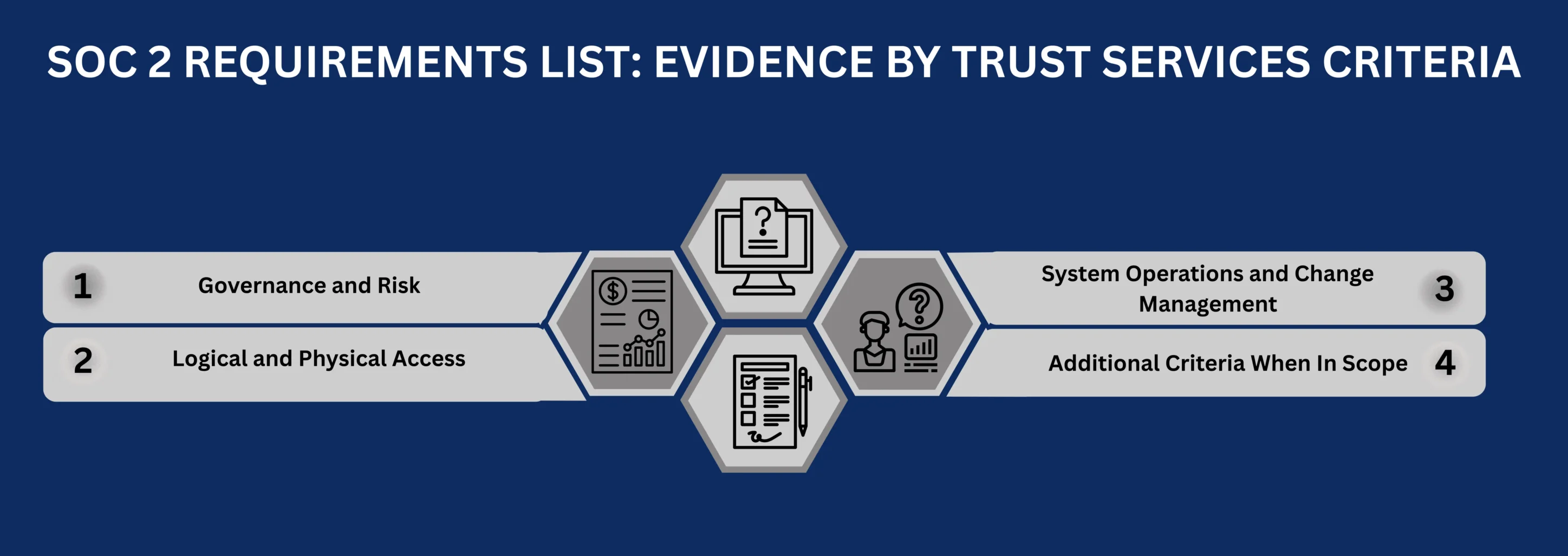
The Security criterion — designated as the Common Criteria — is mandatory in every SOC 2 examination. The Common Criteria address control environment foundation, risk assessment and management, logical and physical access controls, system operations, change management, and risk mitigation activities.
Organizations must demonstrate that logical access to systems and data is restricted to authorized personnel through documented provisioning and deprovisioning processes, multi-factor authentication, and periodic access reviews. Change management controls must document how system changes are authorized, tested, approved, and implemented. Monitoring controls must demonstrate that security events are logged, reviewed, and acted upon within defined timeframes. Incident response procedures must be documented and tested, confirming that security incidents are identified, contained, and remediated according to established protocols. Each of these areas is tested during the SOC 2 audit, with the auditor inspecting system-generated evidence alongside policy documentation.
Nashville organizations frequently demonstrate Security criterion controls through a combination of technical configurations and process documentation. Technical evidence includes firewall rule sets, identity and access management system logs, encryption configuration records, vulnerability scan reports, and security information and event management (SIEM) system outputs.
Process evidence includes change request records, access review completion documentation, incident response runbooks and post-incident reports, and vendor risk assessment records. The Licensed CPA Firm evaluates both categories of evidence to determine whether the controls described in the system description actually functioned as stated throughout the observation period. Gaps between documented controls and operational evidence constitute potential exceptions that may be reflected in the attestation report.
When Availability is included in the examination scope, the Licensed CPA Firm evaluates controls addressing system uptime, performance monitoring, capacity planning, disaster recovery, and business continuity. Evidence includes uptime monitoring reports, disaster recovery test results, capacity planning documentation, and incident logs related to system availability.
Processing Integrity criteria require evidence that data is processed completely, accurately, and in a timely manner — demonstrated through input/output reconciliation procedures, error handling controls, and system processing logs. Confidentiality criteria require demonstration that data identified as confidential under user agreements is protected through appropriate classification, access restriction, transmission encryption, and disposal controls.
Privacy criteria are evaluated against the AICPA’s Generally Accepted Privacy Principles (GAPP) and address the collection, use, retention, disclosure, and disposal of personal information. Nashville health IT organizations and companies handling consumer financial data frequently include Privacy criteria in their SOC 2 examination scope, as their data handling practices are subject to heightened regulatory scrutiny and enterprise customer expectations regarding personal data protection.
The Licensed CPA Firm evaluates privacy notice adequacy, consent mechanisms, data retention schedules, third-party disclosure controls, and data subject rights fulfillment procedures as part of the Privacy criterion assessment. SOC 2 attestation covering Privacy criteria is increasingly requested by enterprise health system procurement teams as a supplement to HIPAA Business Associate Agreement compliance documentation.
- ✓Security (Common Criteria): Mandatory in every SOC 2 examination — covers access controls, change management, monitoring, and risk mitigation
- ✓Availability: System uptime, performance monitoring, disaster recovery, and business continuity controls
- ✓Processing Integrity: Completeness, accuracy, timeliness, and authorization of data processing
- ✓Confidentiality: Protection of data identified as confidential in user entity agreements
- ✓Privacy: Collection, use, retention, disclosure, and disposal of personal information per AICPA GAPP
- ✓System Description: Accurate narrative of system components, service commitments, and control environment — required for every SOC 2 engagement
- ✓Observation Period: Minimum six months for Type II; twelve months is the standard for most enterprise procurement requirements
- ✓Security Criterion Requirements
- ✓Availability, Processing Integrity, Confidentiality, and Privacy Requirements
Benefits of SOC 2 Certification for Nashville-Based Organizations
SOC 2 Certification in Nashville delivers documented, independently verified evidence of control effectiveness that serves multiple organizational objectives. The attestation report issued by a Licensed CPA Firm is recognized across enterprise procurement processes, regulated financial institutions, international buyers, and technology sector due diligence reviews as authoritative evidence that a service organization’s control environment has been independently examined and found to meet professional standards.
The benefits of SOC 2 Certification extend beyond the attestation report itself to include the operational discipline of maintaining audit-ready controls across an annual examination cycle.
The primary benefit of SOC 2 Certification in Nashville is the replacement of self-attested security claims with independently verified attestation. Organizations that have completed a SOC 2 examination can point to the Licensed CPA Firm’s opinion — rather than their own assertions — as evidence that their controls meet the applicable Trust Services Criteria.
This distinction is significant in procurement contexts: enterprise customers and regulated institutions place considerably more weight on independently issued attestation reports than on vendor-completed security questionnaires or internal compliance documentation. The SOC 2 examination is conducted under AICPA professional standards, which impose independence requirements, evidence standards, and quality controls on the auditing firm — lending formal credibility to the resulting attestation.
For Nashville organizations entering enterprise sales cycles with major health systems, financial institutions, or technology companies, a current SOC 2 Type II report materially reduces the time and effort required to satisfy vendor security review requirements. Rather than completing lengthy security questionnaires for each prospective customer, organizations with a current SOC 2 report can reference the attestation as a standardized, auditor-issued response to vendor security inquiries.
This operational efficiency translates directly into faster deal closure timelines and reduced sales friction — particularly in procurement-intensive markets such as Nashville’s healthcare and financial services sectors.
SOC 2 attestation Nashville organizations obtain is specifically recognized in the vendor qualification processes of enterprise buyers operating under regulatory oversight. Banks, insurance companies, hospital systems, and government contractors in Nashville maintain vendor risk management programs that require periodic evidence of third-party control effectiveness.
The SOC 2 Type II report satisfies these requirements because it is issued by a Licensed CPA Firm operating under AICPA standards, carries formal attestation standing, and covers a defined observation period that procurement teams can evaluate against their own vendor review timelines. Organizations that allow their SOC 2 reports to lapse — by failing to complete annual examination cycles — risk removal from vendor panels or delays in contract renewal at major Nashville-area enterprises.
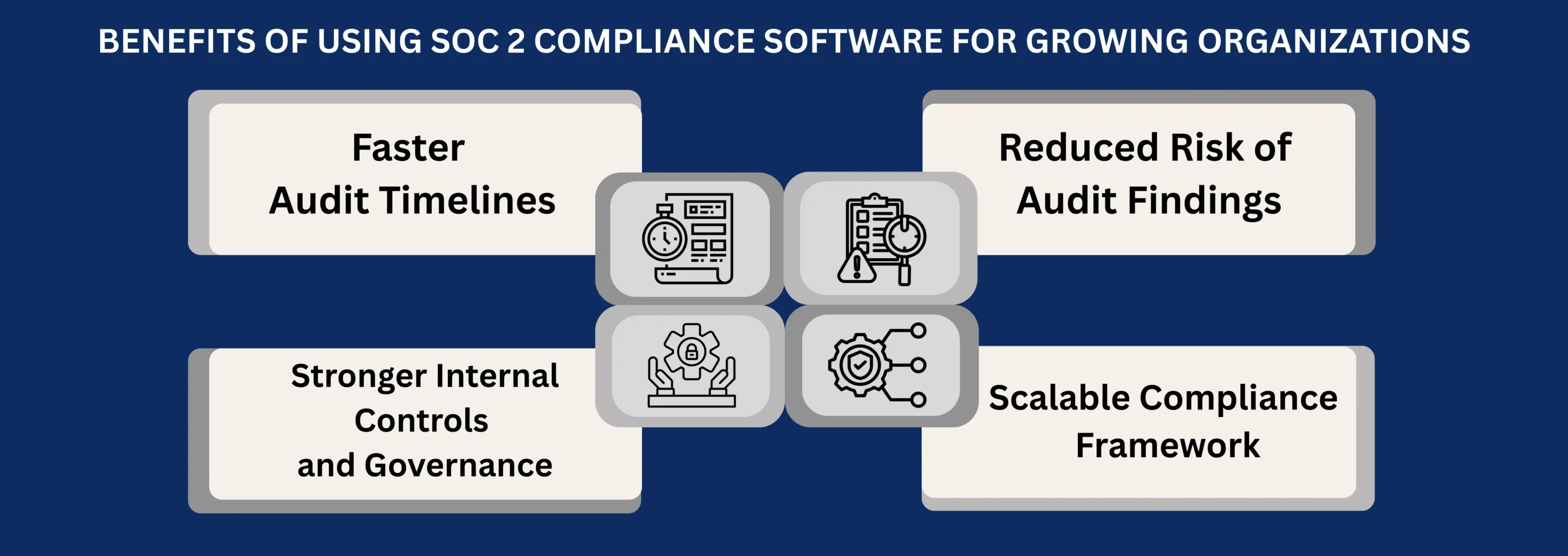
- ✓Independent verification of control effectiveness issued by a Licensed CPA Firm under AICPA attestation standards
- ✓Satisfaction of enterprise vendor security review requirements across healthcare, financial, and technology sector procurement
- ✓Reduction in vendor security questionnaire burden through standardized SOC 2 attestation report distribution
- ✓Demonstrated SOC 2 compliance as evidence of operational discipline and risk management maturity
- ✓Support for international market entry where U.S. SOC 2 attestation is recognized as a control assurance standard
- ✓Annual SOC 2 examination cycle supporting continuous improvement of the control environment
- ✓Differentiation in competitive procurement processes where SOC 2 certification is a qualifying requirement
- ✓Independent Third-Party Validation of Control Effectiveness
- ✓Recognition in Enterprise and Regulated Sector Procurement
Nashville Industry Sectors Pursuing SOC 2 Certification
SOC 2 Certification in Nashville is pursued across a broad range of industry sectors reflecting the city’s diverse data-handling economy. The demand for SOC 2 attestation across Nashville is driven by the concentration of regulated industries and technology vendors that serve them — each facing enterprise procurement requirements that specify independent attestation of control effectiveness as a vendor qualification criterion.
Healthcare IT, Health Technology, and Life Sciences
Nashville’s position as the national capital of healthcare management — with more healthcare companies headquartered in the metropolitan area than any other U.S. city — generates significant demand for SOC 2 Certification among technology vendors serving the sector. Health IT platforms, electronic health record integration vendors, revenue cycle management systems, population health analytics companies, telehealth platforms, and clinical decision support tools that process protected health information on behalf of covered entities are prime candidates for SOC 2 examination.
These organizations typically require SOC 2 examination scope covering Security, Confidentiality, and Privacy criteria to address both enterprise procurement requirements and the data sensitivity of the information they handle. Many Nashville health IT companies pursue SOC 2 Certification as a prerequisite to vendor approval by Nashville healthcare institutions — alongside HIPAA Business Associate Agreement execution and, in some cases, HITRUST certification for enterprise health system relationships.
Life sciences and pharmaceutical technology companies based in Nashville’s growing bioscience corridor also encounter SOC 2 requirements when supplying data management, clinical trial support, or laboratory information systems to regulated research institutions and pharmaceutical manufacturers. These organizations process data subject to both research data governance policies and enterprise security standards, making SOC 2 attestation a relevant credential for establishing vendor trust with institutional counterparties.
The SOC 2 examination for life sciences technology vendors typically focuses on Security and Confidentiality criteria, with Processing Integrity added when the platform is involved in data collection or analysis that feeds into regulatory submissions or clinical outcomes reporting.
Fintech, Financial Technology, and Managed Service Providers
Nashville’s financial technology sector spans payment processing platforms, lending technology providers, insurance technology firms, investment management software vendors, and bank technology solution providers. These organizations process financial records, account data, and personally identifiable information on behalf of regulated financial institutions — subjecting them to rigorous third-party risk management requirements from bank regulators, institutional customers, and insurance underwriters.
SOC 2 Certification Nashville fintech companies obtain satisfies vendor risk management requirements imposed by financial institution customers, whose internal audit functions and regulatory examinations include reviews of third-party vendor control documentation. Managed service providers (MSPs) in Nashville — supplying IT infrastructure, cybersecurity monitoring, cloud management, and support services — are among the most consistent pursuers of SOC 2 Certification because their customers’ own compliance programs require evidence of MSP control effectiveness.
| Industry Sector | Common SOC 2 Criteria | Primary Demand Driver |
|---|---|---|
| Healthcare IT / Health Technology | Security, Confidentiality, Privacy | Hospital system and payer vendor approval processes |
| Fintech / Financial Technology | Security, Availability, Processing Integrity | Bank and financial institution third-party risk programs |
| SaaS Providers | Security, Availability, Confidentiality | Enterprise customer procurement requirements |
| Managed Service Providers | Security, Availability | Customer internal audit and regulatory compliance programs |
| Cloud Hosting / Infrastructure | Security, Availability | Enterprise and regulated sector customer SLAs |
SOC 2 Compliance: Maintaining Certification Across Annual Cycles
SOC 2 compliance is not a one-time achievement. The SOC 2 attestation report issued at the conclusion of an examination covers a specific observation period and is considered current by enterprise procurement teams for approximately twelve months from the end of that period. Organizations that fail to complete successive annual SOC 2 examinations allow their attestation reports to lapse — which can create complications in vendor renewal processes and procurement cycles. SOC 2 compliance Nashville organizations maintain through annual examination cycles reflects an ongoing commitment to control operation, not merely an initial audit exercise.
Annual Examination Cycles and Report Currency
Most enterprise customers and regulated institutions accept SOC 2 reports covering observation periods ending within the prior twelve months. An organization whose most recent SOC 2 Type II report covers a period ending more than twelve months prior is considered to have a lapsed report. Such organizations may be required to complete an updated SOC 2 examination before enterprise customers will accept it as current.
Nashville organizations serving enterprise healthcare or financial sector clients face particularly strict report currency requirements, as their customers’ internal audit functions track vendor report expiration as part of ongoing third-party risk monitoring. To maintain continuous report currency, service organizations schedule successive SOC 2 examinations so that each new report’s observation period begins as soon as the prior period ends — producing a continuous attestation record.
Organizations that have undergone significant operational changes — such as infrastructure migrations, acquisitions, major system implementations, or changes in service scope — should review whether the existing SOC 2 report scope remains accurate and whether the system description requires updating. Material changes to the system environment or service commitments during an observation period should be documented and disclosed in the system description.
The Licensed CPA Firm conducting the examination will evaluate whether changes were properly managed and controlled, and whether the updated system description accurately reflects the organization’s operating environment at the end of the observation period. Undisclosed material changes may result in qualified or adverse findings in the attestation report.
Complementary Standards and Cross-Framework Considerations
Nashville organizations frequently operate under multiple compliance frameworks simultaneously, particularly in the healthcare and financial sectors. SOC 2 Certification does not replace HIPAA compliance, PCI DSS assessment, or other regulatory requirements — but it provides a complementary layer of independently verified control evidence that supports compliance representations across multiple frameworks.
Organizations pursuing both SOC 2 and HIPAA compliance can often leverage SOC 2 audit evidence to support HIPAA Security Rule documentation, as the Common Criteria address many of the same administrative and technical safeguard requirements. Similarly, organizations subject to PCI DSS can use SOC 2 examination evidence to demonstrate control environments for non-cardholder data systems, reducing duplicative audit efforts. SOC 2 versus ISO 27001 is a common cross-framework question for Nashville organizations serving both U.S. and international markets. U.S.-focused organizations typically prioritize SOC 2 due to its recognition in domestic procurement, while organizations with significant international exposure may pursue both frameworks for comprehensive coverage.
Licensed CPA Firm SOC 2 Examination in Nashville
A SOC 2 examination must be conducted by a Licensed CPA Firm. This requirement is established under AICPA attestation standards and distinguishes the SOC 2 attestation report from self-assessments, vendor security questionnaire responses, and internal audit outputs. Only a firm licensed as a Certified Public Accounting firm and operating under AICPA professional standards has the authority to issue a formal SOC 2 attestation report.
Organizations that receive SOC 2 reports from non-CPA consulting firms, cybersecurity companies, or technology platforms are not receiving a formally issued SOC 2 attestation under AICPA standards — regardless of how the report is labeled or marketed. Enterprise procurement teams and regulated institution vendor programs specify Licensed CPA Firm attestation as a qualification requirement precisely because of this distinction.
Independence Requirements and Auditor Qualifications
The Licensed CPA Firm conducting a SOC 2 examination must maintain independence from the service organization being examined. Independence requirements prohibit the examining firm from having financial relationships, employment relationships, or other connections that could compromise the objectivity of the examination. These independence standards are established under AICPA independence rules and monitored through the AICPA’s peer review program.
The peer review program requires Licensed CPA Firms conducting attestation engagements — including SOC 2 examinations — to undergo periodic review by independent reviewers who assess the quality and compliance of the firm’s attestation work. The AICPA has issued specific guidance for peer reviewers evaluating SOC 2 engagements, addressing quality risks associated with the increasing use of compliance automation platforms in audit workflows. Nashville organizations selecting a Licensed CPA Firm for a SOC 2 examination should verify the firm’s independence, AICPA membership, and peer review standing as part of the engagement selection process.
The SOC 2 examination is conducted under AT-C Section 205 of the AICPA’s Statements on Standards for Attestation Engagements (SSAE). The examining CPA firm applies professional judgment in designing audit procedures, evaluating evidence, and forming an opinion on whether controls meet the applicable Trust Services Criteria.
The auditor’s report includes a description of the examination scope, the criteria applied, the procedures performed, and the auditor’s conclusion. For Type II reports, the report also includes a description of each control tested and the results of testing — including any exceptions noted. This level of detail allows enterprise customers and their auditors to evaluate the quality and depth of the SOC 2 examination rather than relying solely on the auditor’s conclusion. The SOC 2 examination Nashville organizations undergo follows the same professional standards as examinations conducted anywhere in the United States, with the Licensed CPA Firm applying consistent methodology regardless of industry or organizational size.
FAQ
▶
What is SOC 2 Certification and who needs it in Nashville?
▶
What is the difference between SOC 2 Type I and SOC 2 Type II?
▶
How long does a SOC 2 audit take for Nashville organizations?
▶
Which Trust Services Criteria apply to Nashville healthcare IT companies?
▶
How long is a SOC 2 attestation report valid?
▶
What is the difference between SOC 2 compliance and SOC 2 certification?
▶
Does SOC 2 certification replace HIPAA compliance for Nashville health IT vendors?
▶
Can Nashville startups and small organizations pursue SOC 2 certification?
SOC 1 VS SOC 2: WHICH REPORT YOUR CUSTOMERS ACTUALLY ASK FOR
If you sell SaaS or provide outsourced services, you have likely been asked for a SOC report. However, the follow-up question is rarely easy to answer…
SOC 2 Certified: What Does It Mean for Your Business
For companies that handle sensitive data or run cloud-based services, the question “Can you provide your SOC 2 report?” carries enormous weight. Yet, …
HOW SOC 2 AUDITORS REVIEW EVIDENCE OVER TIME
Most businesses pursuing a SOC 2 report spend months building security controls but overlook a fundamental reality: SOC 2 auditors do not just verify …
Get In Touch
have a question? let us get back to you.