
SOC 2 Certification in Phoenix
The following frequently asked questions address common inquiries from Phoenix-area organizations considering SOC 2 Certification. Answers are structured for direct extractability by procurement teams, compliance officers, and technology decision-makers evaluating SOC 2 attestation options. Each answer reflects current AICPA standards and enterprise market conventions applicable to Phoenix organizations.
OUR CLIENTS










SOC 2 Certification in Phoenix: Independent Attestation by a Licensed CPA Firm
SOC 2 Certification in Phoenix is conducted by a Licensed CPA Firm under the American Institute of Certified Public Accountants (AICPA) attestation standards. The certification provides independently verified evidence that an organization’s information security controls have been examined against the AICPA Trust Services Criteria (TSC) and found to operate effectively. For Phoenix-based organizations — including SaaS providers, cloud infrastructure companies, semiconductor firms, fintech enterprises, and healthcare technology organizations — SOC 2 attestation communicates to enterprise customers, procurement teams, and regulators that internal controls over customer data have been independently assessed, not merely self-declared.
SOC 2 Certification delivers a level of assurance that internal compliance programs alone cannot replicate. When enterprise clients, procurement committees, and regulatory bodies request third-party verification of vendor security practices, a formal SOC 2 attestation issued by a Licensed CPA Firm is the recognized standard response.
Phoenix has emerged as a significant technology and financial services hub in the southwestern United States. The presence of major semiconductor manufacturers — including Intel and TSMC — combined with a rapidly expanding fintech corridor and one of the highest concentrations of data center infrastructure in the country, means that a large number of Phoenix-area organizations handle sensitive customer data at enterprise scale.
These organizations routinely face SOC 2 compliance requirements from enterprise clients, healthcare system partners, and financial institutions that require independent verification of vendor security controls before onboarding or contract renewal. SOC 2 Certification in Phoenix has become a practical prerequisite for technology vendors operating in this competitive, security-conscious market.
SOC 2 Certification is not a self-certification or a compliance checklist. It is a formal attestation issued exclusively by a licensed CPA firm following a structured examination of controls against defined Trust Services Criteria. The distinction matters: SOC 2 compliance describes an organization’s internal adherence to security policies, while SOC 2 attestation describes the outcome of an independent audit conducted by a qualified external examiner.
Being SOC 2 certified means that a licensed CPA firm has reviewed control design, tested control operation over a defined period, gathered sufficient audit evidence, and issued a formal opinion on whether those controls meet the AICPA’s established criteria. This independently verified opinion is what enterprise procurement teams and regulators rely upon — not self-reported security documentation.
CertPro is a Licensed CPA Firm providing independent SOC 2 examination services exclusively under AICPA attestation standards. CertPro performs SOC 2 audits, issues SOC 2 attestation reports, and maintains strict independence from consulting, advisory, implementation, and remediation activities. For Phoenix organizations seeking a credible, auditor-issued SOC 2 report that satisfies enterprise procurement requirements, regulatory expectations, and third-party risk management frameworks, the examination is performed under AT-C Section 205 and AT-C Section 320 as applicable.
The attestation opinion reflects whether controls were designed appropriately and operated effectively throughout the examination period — delivering a documented, third-party record that procurement teams, enterprise customers, and audit committees can rely upon with confidence.
Organizations in Phoenix pursuing SOC 2 Certification should understand that the process begins with scope determination — identifying which systems, services, and Trust Services Criteria categories are relevant to the engagement — and concludes with issuance of a formal SOC 2 report. The report communicates the auditor’s opinion to management, the board, and to user entities who rely on the organization’s services.
SOC 2 Type 1 reports address control design at a point in time, while SOC 2 Type 2 reports address both design and operating effectiveness across a defined observation period. Both report types are issued exclusively by licensed CPA firms following structured examination procedures, and both carry equal standing as formal attestation documents under AICPA standards.

AICPA Trust Services Criteria: The Foundation of SOC 2 Examination
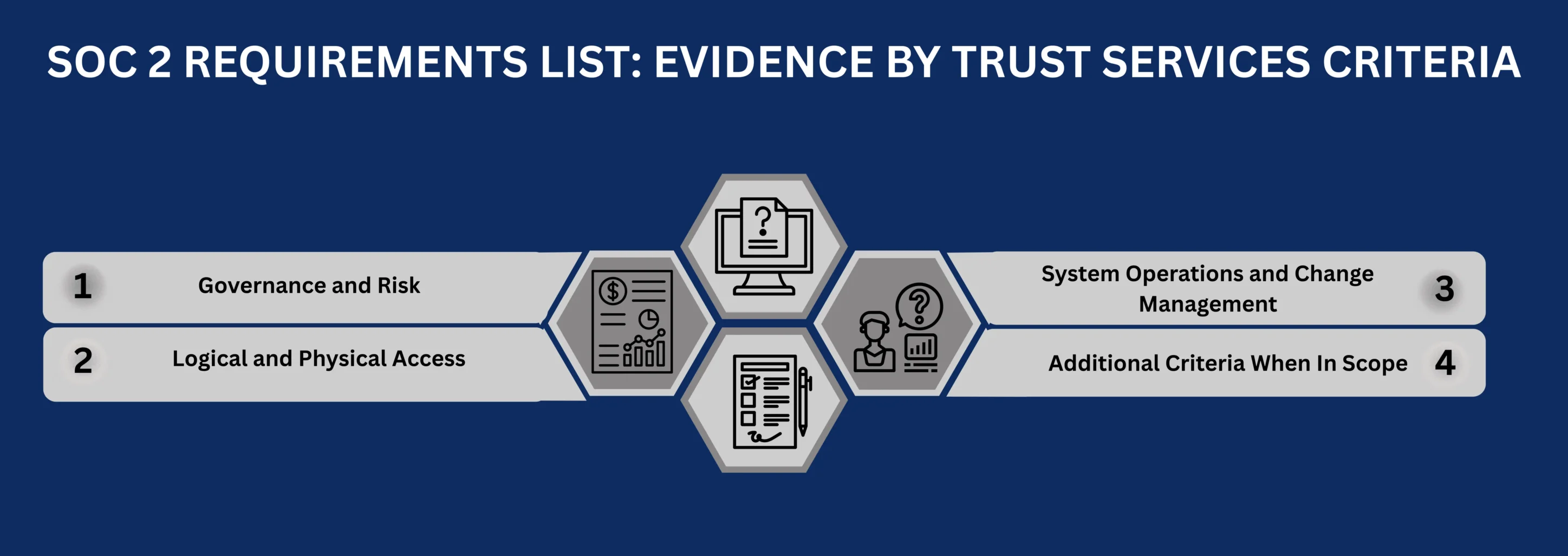
The AICPA Trust Services Criteria (TSC) define the evaluation framework applied in every SOC 2 examination. The TSC establish what controls an organization must implement, how those controls must operate, and what evidence auditors must gather to issue an attestation opinion. The criteria are organized into five categories, of which Security is mandatory in every SOC 2 engagement.
Organizations select the remaining four criteria — Availability, Processing Integrity, Confidentiality, and Privacy — based on the nature of their services and the commitments made to customers. Each criterion maps to specific control activities, policies, procedures, and monitoring mechanisms that auditors evaluate during the SOC 2 examination. For Phoenix organizations, selecting the right combination of criteria at the outset of an engagement ensures the resulting report addresses the concerns most relevant to their client base and industry obligations.
The Security criterion — also referred to as the Common Criteria (CC) — is the only TSC category required in every SOC 2 examination. It addresses the protection of information and systems from unauthorized access, unauthorized disclosure, and damage to systems that could compromise the availability, integrity, confidentiality, and privacy of information — or affect the entity’s ability to meet its objectives.
The Common Criteria encompass logical and physical access controls, system monitoring, change management, risk assessment, incident response, and vendor management. For Phoenix-area SaaS providers and cloud companies, the Common Criteria evaluation typically encompasses user access provisioning, multi-factor authentication enforcement, encryption standards, intrusion detection, and security event logging — each verified through audit evidence gathered during the SOC 2 examination period.
The Availability criterion addresses whether systems are available for operation and use as committed or agreed. This criterion is particularly relevant for Phoenix data center operators, cloud service providers, and SaaS companies that contractually commit to specific uptime levels. Auditors evaluate backup systems, disaster recovery procedures, capacity management, and incident response protocols.
The Processing Integrity criterion addresses whether system processing is complete, valid, accurate, timely, and authorized — a critical consideration for fintech platforms and healthcare technology organizations processing transactions or patient data. The Confidentiality criterion applies to information designated as confidential, evaluating controls around data classification, encryption, and access restriction. The Privacy criterion — the broadest in scope — addresses the collection, use, retention, disclosure, and disposal of personal information in accordance with the entity’s privacy notice and the AICPA’s generally accepted privacy principles.
| TSC Category | Scope of Evaluation | Relevant Phoenix Industries |
|---|---|---|
| Security (Common Criteria) | Access controls, monitoring, change management, risk assessment, incident response | All organizations — mandatory in every SOC 2 examination |
| Availability | Uptime commitments, disaster recovery, capacity management, incident handling | Data centers, cloud providers, SaaS platforms |
| Processing Integrity | Completeness, accuracy, timeliness, and authorization of system processing | Fintech, healthcare technology, payment processors |
| Confidentiality | Data classification, encryption, and access restriction for confidential information | SaaS, semiconductor firms, enterprise technology vendors |
| Privacy | Collection, use, retention, disclosure, and disposal of personal information | Healthcare technology, consumer SaaS, HR platforms |
- ✓Security (Common Criteria) — Mandatory TSC Category
- ✓Availability, Processing Integrity, Confidentiality, and Privacy Criteria
SOC 2 Type 1 and SOC 2 Type 2 Reports: Definitions and Distinctions
SOC 2 examinations produce two distinct report types — Type 1 and Type 2 — each serving different assurance purposes and addressing different audit questions. Understanding the distinction is essential for Phoenix organizations determining which examination is appropriate for their current customer commitments, procurement requirements, and audit readiness.
Both report types are issued by a Licensed CPA Firm following structured examination procedures, and both constitute formal SOC 2 attestation documents under AICPA standards. The choice between Type 1 and Type 2 is not a quality distinction — it is a scope distinction defined by what the examination period covers and what the auditor’s opinion addresses. Choosing correctly from the outset helps Phoenix organizations meet client expectations and avoid unnecessary delays in vendor approval processes.
SOC 2 Type 1 Report: Point-in-Time Control Design Assessment
A SOC 2 Type 1 report — formally a Type 1 SOC 2 examination — addresses whether an organization’s controls are suitably designed to meet the applicable Trust Services Criteria as of a specific point in time. The auditor evaluates control design, reviews relevant policies and procedures, and issues an opinion on whether those controls, if operating as described, would satisfy the TSC requirements. A Type 1 report does not include an observation period and does not assess whether controls operated continuously over months.
Phoenix organizations frequently pursue a SOC 2 Type 1 audit as an initial step to establish a documented baseline of their control environment before advancing to a Type 2 examination. Enterprise customers reviewing vendor security may accept a Type 1 report as interim assurance — particularly for newer organizations or those early in establishing their control environment.
SOC 2 Type 2 Report: Operating Effectiveness Across an Observation Period
A SOC 2 Type 2 report addresses both the design and operating effectiveness of controls across a defined observation period — typically a minimum of six months, with twelve months being the standard convention for mature programs and the expectation of most enterprise procurement teams. During a SOC 2 Type 2 audit in Phoenix, the licensed CPA firm collects evidence demonstrating that controls operated continuously and effectively throughout the examination period.
This evidence includes system-generated logs, access review records, change management documentation, incident response records, and vendor review artifacts. The Type 2 report carries greater assurance weight than a Type 1 report because it demonstrates consistent control operation — not just design intent. For Phoenix-based SaaS providers, fintech platforms, and data center operators, the SOC 2 Type 2 report is the standard deliverable expected by enterprise clients, financial institution partners, and organizations applying third-party risk management frameworks.
| Dimension | SOC 2 Type 1 | SOC 2 Type 2 |
|---|---|---|
| Audit Question | Are controls suitably designed as of a specific date? | Are controls suitably designed and operating effectively over the observation period? |
| Observation Period | None — point-in-time assessment only | Minimum 6 months; typically 12 months for ongoing annual cycles |
| Evidence Collection | Design documentation and policy review | Continuous evidence collection across the full observation period |
| Report Output | Auditor opinion on control design | Auditor opinion on both design and operating effectiveness |
| Common Use Case | Initial attestation; interim vendor assurance | Enterprise procurement, ongoing vendor assurance, regulatory submissions |
SOC 2 Audit Process for Phoenix Organizations
The SOC 2 audit process follows a structured examination methodology governed by AICPA attestation standards. Each stage of the SOC 2 examination produces documented outputs that form the basis of the auditor’s opinion. For Phoenix organizations — whether pursuing an initial SOC 2 Type 1 examination or an ongoing SOC 2 Type 2 audit cycle — the process is consistent, evidence-based, and fully independent of any consulting or advisory engagement.
The following stages describe how a Licensed CPA Firm conducts a SOC 2 examination from initiation through report issuance. Understanding each stage helps Phoenix technology companies, SaaS providers, and cloud infrastructure operators prepare effectively and manage examination timelines with confidence.
- Scope Definition: The organization and the Licensed CPA Firm establish which systems, services, and Trust Services Criteria categories are covered by the SOC 2 examination. Scope boundaries directly determine which controls are evaluated and which user entities the report addresses.
- Audit Program Determination: The auditor develops the examination program, identifying the specific control objectives, testing procedures, and evidence requirements applicable to the defined scope and selected TSC categories.
- Stage 1 — Documentation and Design Review: The auditor reviews the organization’s control documentation, policies, procedures, and system descriptions to assess whether controls are suitably designed to meet the applicable Trust Services Criteria. This stage corresponds to a SOC 2 Type 1 examination if no observation period follows.
- Stage 2 — Observation Period and Control Testing: For SOC 2 Type 2 examinations, the auditor initiates the observation period — typically six to twelve months — during which control operation is monitored, evidence is collected, and control testing is performed across the full examination window.
- Evidence Collection and Evaluation: The auditor gathers evidence including system-generated logs, access review records, configuration screenshots, change management records, vendor assessment documentation, and management attestations. All evidence is evaluated against TSC requirements.
- Nonconformity Identification and Reporting: Exceptions, deviations, and control failures identified during testing are documented. The auditor communicates findings to management, and exceptions are reflected in the final report with explanatory context.
- Certification Committee Review and Attestation Decision: The Licensed CPA Firm’s attestation committee reviews the examination findings, evaluates the sufficiency and appropriateness of evidence, and issues an independent attestation opinion.
- Report Drafting and Issuance: The formal SOC 2 report is drafted, reviewed, and issued. The report includes the auditor’s opinion, management’s assertion, a description of the control environment, and — for Type 2 reports — a detailed listing of control tests performed and results obtained.
The observation period is the defined timeframe during which a Licensed CPA Firm collects evidence of control operation for a SOC 2 Type 2 examination. The AICPA does not prescribe a fixed minimum, but six months is the broadly accepted industry standard for an initial Type 2 engagement, and twelve months is the standard for organizations maintaining an ongoing annual audit cycle. The observation period begins on a defined start date and ends on the examination’s report date.
During this period, the auditor evaluates whether controls operated continuously and consistently — not merely whether they were in place at the start and end of the window. For Phoenix organizations pursuing SOC 2 Certification, the observation period is one of the most operationally significant phases of the entire engagement.
For Phoenix-area organizations with enterprise clients in financial services, semiconductor manufacturing, or healthcare technology, the observation period is a critical factor in report credibility. A twelve-month observation period demonstrates sustained control operation across full business cycles — including major system changes, personnel turnover, and peak processing periods.
Enterprise procurement teams reviewing vendor security frequently specify a minimum observation period in their third-party risk management requirements. Reports covering shorter periods may require supplemental explanation or may not satisfy vendor assurance requirements without additional context. The observation period’s start and end dates are stated explicitly in the issued SOC 2 report, and user entities can independently verify coverage.
- ✓Examination Stages: Scoping Through Report Issuance
- ✓Observation Period: Definition, Duration, and Significance
Who Needs SOC 2 Certification in Phoenix?
SOC 2 Certification in Phoenix is pursued by organizations across a wide range of industries that handle sensitive customer data, operate technology platforms used by enterprise clients, or provide cloud-based services to regulated industries. The demand for SOC 2 attestation in the Phoenix market is driven by several converging factors: the concentration of enterprise technology buyers in financial services and healthcare, the growth of the semiconductor ecosystem requiring supply chain security assurance, the expansion of data center and cloud infrastructure serving regulated industries, and the increasing adoption of third-party risk management frameworks by large Phoenix-area enterprises.
Organizations that process, store, or transmit customer data on behalf of other businesses face the most direct SOC 2 compliance requirements. Their clients’ own audit obligations extend to vendor assurance — making SOC 2 Certification in Phoenix a foundational requirement rather than a competitive differentiator for many technology service providers.
Technology, Cloud, and SaaS Organizations
SaaS providers and cloud service organizations based in Phoenix constitute the largest segment of organizations pursuing SOC 2 Certification. These companies routinely receive SOC 2 report requests from enterprise clients during vendor onboarding, contract renewal, and security questionnaire processes. For a Phoenix-based SaaS company serving financial institutions, healthcare organizations, or enterprise technology buyers, the absence of a current SOC 2 report can delay or prevent contract execution.
SOC 2 attestation provides a standardized, auditor-issued response to security questionnaires that eliminates redundant assessment requests and accelerates vendor review cycles. Cloud infrastructure providers, managed service providers (MSPs), and data hosting organizations in Phoenix similarly face SOC 2 compliance requirements from clients whose own regulatory frameworks — including HIPAA, PCI DSS, and SOX — extend vendor security obligations to cloud providers.
Semiconductor, Fintech, and Healthcare Technology Organizations
Phoenix’s semiconductor manufacturing ecosystem — anchored by Intel’s longstanding campus presence and TSMC’s significant ongoing investment — creates downstream demand for SOC 2 attestation among technology service providers, software vendors, and supply chain partners operating in the region. Semiconductor firms and their technology vendors frequently handle proprietary design data, operational technology system information, and intellectual property subject to confidentiality and processing integrity requirements.
Fintech organizations operating in Phoenix’s growing financial services corridor — including payment processors, lending platforms, and digital banking infrastructure providers — face SOC 2 compliance requirements from banking partners and regulatory bodies. Healthcare technology companies serving Arizona’s large hospital networks and insurance carriers face both SOC 2 examination requirements and HIPAA alignment expectations, making the Privacy and Availability criteria particularly relevant to their examination scope.
- ✓SaaS providers and cloud-based software companies serving enterprise clients
- ✓Data center operators and colocation providers in the Phoenix metropolitan area
- ✓Managed service providers (MSPs) and IT infrastructure organizations
- ✓Fintech platforms, payment processors, and digital financial services companies
- ✓Healthcare technology organizations and health data analytics providers
- ✓Semiconductor technology vendors and supply chain software providers
- ✓Enterprise software companies with financial institution or healthcare system clients
- ✓Professional services firms handling sensitive client data on technology platforms
SOC 2 Certification Audit Process: Control Environment and Evidence Standards
The control environment is the foundation against which a SOC 2 examination is conducted. It encompasses the policies, procedures, organizational structures, governance frameworks, and monitoring activities that collectively define how an organization manages security risk and protects customer data. During a SOC 2 audit, the Licensed CPA Firm evaluates the control environment not as a static document set, but as an operational system.
Auditors assess whether controls function as described under real operational conditions — including periods of organizational change, system updates, personnel transitions, and incident response events. For Phoenix organizations pursuing SOC 2 Certification, building and maintaining a well-documented control environment is the single most important factor in achieving a clean attestation opinion.
Internal controls in the SOC 2 context are the specific activities, mechanisms, and safeguards an organization implements to meet the Trust Services Criteria. Control design addresses whether a control, if operating as intended, would satisfy the applicable TSC requirement. Control operating effectiveness addresses whether the control actually performed as designed throughout the observation period.
A Licensed CPA Firm evaluating SOC 2 compliance in Phoenix must assess both dimensions for a Type 2 examination — design alone is insufficient for a Type 2 opinion. Auditors test control operation through inquiry, observation, inspection of evidence, and re-performance, selecting a representative sample of control instances across the observation period. For Phoenix organizations with complex, multi-system environments — such as cloud infrastructure providers or fintech platforms — control testing may encompass hundreds of individual evidence items across access controls, change management, monitoring, and vendor management domains.
The quality and sufficiency of audit evidence directly determines the credibility of the SOC 2 attestation opinion. AICPA attestation standards require that evidence be sufficient and appropriate — sufficient meaning enough evidence exists to support the auditor’s conclusion, and appropriate meaning the evidence is relevant and reliable. System-generated evidence — such as access logs, automated configuration reports, and system-generated change records — carries higher reliability weighting than management-prepared summaries.
The auditor’s independence from the organization being examined is a non-negotiable requirement under AICPA standards. CertPro, as a Licensed CPA Firm, maintains strict independence from consulting, advisory, implementation, and remediation activities — preserving the objectivity that gives the SOC 2 attestation its value to user entities and enterprise procurement teams reviewing vendor security documentation.
- ✓Internal Controls: Design and Operating Effectiveness
- ✓Evidence Collection Standards and Auditor Independence
Report Issuance and SOC 2 Report Validity
The SOC 2 report is the formal output of the SOC 2 examination. It is issued by the Licensed CPA Firm and addressed to the organization’s management and board. The report is then shared — under confidentiality agreements — with user entities, enterprise clients, and prospective customers who require independent verification of the organization’s security controls.
Understanding report structure, validity conventions, and distribution practices is essential for Phoenix organizations managing vendor assurance programs and enterprise client relationships. A well-structured SOC 2 report communicates not only control effectiveness but also the scope, methodology, and professional standards under which the examination was conducted.
SOC 2 Report Structure and Auditor’s Opinion
A SOC 2 report consists of several standardized sections: the independent service auditor’s report (the opinion), management’s assertion about the fairness of the system description and the suitability of control design and operating effectiveness, a description of the system and the boundaries of the examination, and — for Type 2 reports — a detailed matrix of control objectives, controls tested, testing procedures performed, and results of those tests.
The auditor’s opinion may be unqualified (controls met the TSC criteria), qualified (some controls did not meet criteria but the deviation is limited), or adverse (controls did not meet criteria in material respects). Exceptions noted during the SOC 2 examination are disclosed in the report with explanatory context, allowing user entities to assess residual risk and evaluate the adequacy of the control environment for their specific reliance requirements.
Report Validity and the Annual Audit Cycle
SOC 2 reports do not carry an indefinite validity period. The broadly accepted industry convention treats a SOC 2 report as current for twelve months from the end of the observation period. Enterprise clients, financial institution procurement teams, and third-party risk management programs typically require that SOC 2 reports be no older than twelve months at the time of vendor review. Once a report ages beyond twelve months, user entities may request an updated report before extending reliance.
This twelve-month convention drives the annual SOC 2 audit cycle — organizations pursuing SOC 2 attestation in Phoenix initiate a new examination each year to maintain a current report. The annual cycle also ensures that the attestation reflects the organization’s current control environment rather than historical configurations that may no longer be in effect.
Benefits of SOC 2 Certification for Phoenix-Based Organizations
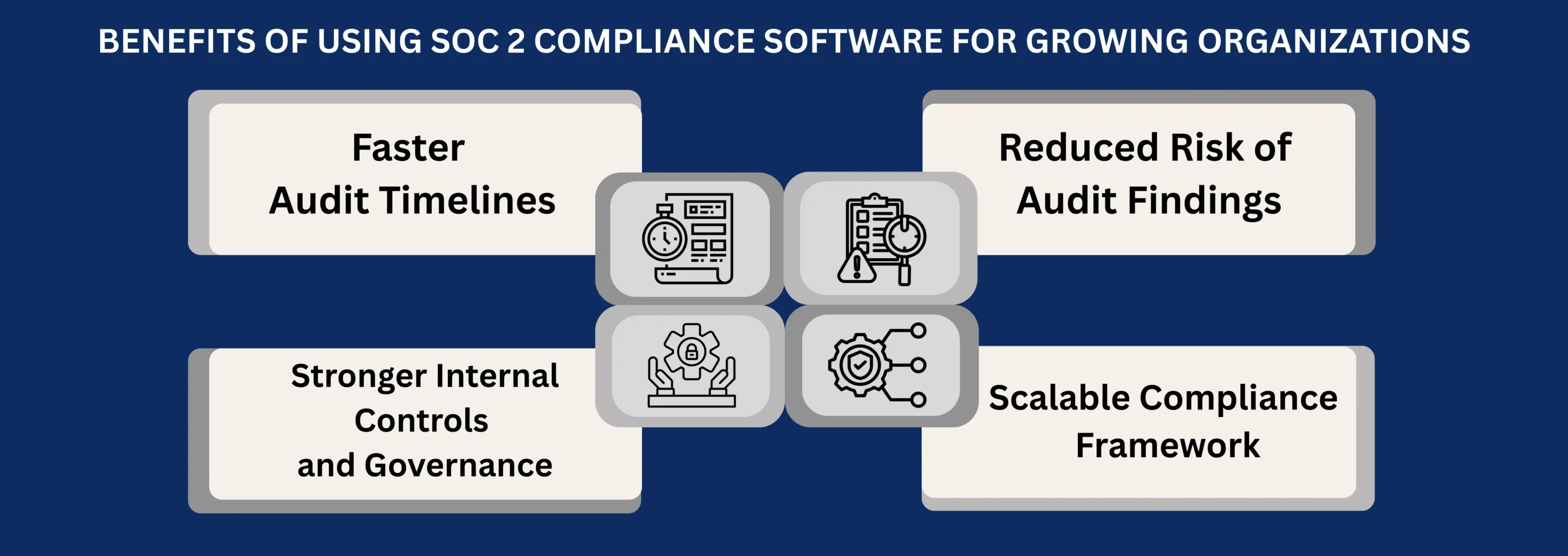
SOC 2 Certification in Phoenix delivers documented, independently verified evidence of control effectiveness that supports multiple business objectives simultaneously. The benefits extend across enterprise sales, vendor assurance programs, regulatory alignment, and organizational governance — each representing a distinct value dimension that the SOC 2 attestation addresses.
For Phoenix companies operating in competitive, security-conscious markets, a current SOC 2 report functions as both a business development asset and a risk management tool. The following describes the primary business benefits of SOC 2 Certification for organizations across the Phoenix technology and financial services ecosystem.
For Phoenix technology companies competing for enterprise contracts, the SOC 2 report functions as a standardized security credential that satisfies vendor assurance requirements without requiring prospective clients to conduct independent on-site security assessments. Enterprise buyers — particularly in financial services, healthcare, and semiconductor supply chains — routinely require SOC 2 reports as a condition of vendor approval.
A Phoenix-based SaaS company that has completed a SOC 2 examination can reference its report in response to security questionnaires, accelerating vendor review timelines and reducing the volume of bespoke security inquiries that procurement teams otherwise generate. In competitive procurement scenarios where multiple vendors are under evaluation, a current SOC 2 Type 2 report provides documented third-party verification of control effectiveness that self-reported security documentation simply cannot replicate.
Third-party risk management (TPRM) frameworks adopted by Phoenix’s financial institutions, healthcare systems, and government contractors require documented evidence of vendor control effectiveness — not vendor-issued security assertions. SOC 2 attestation in Phoenix provides a Licensed CPA Firm’s independent evaluation that satisfies TPRM requirements across multiple client relationships simultaneously.
Rather than responding to individualized security questionnaires from each enterprise client, Phoenix organizations with a current SOC 2 report can distribute the report under non-disclosure agreement — providing each client’s risk management team with auditor-verified evidence. This efficiency benefit is significant for high-growth Phoenix technology companies managing dozens of enterprise client relationships. Additionally, SOC 2 examination results contribute to regulatory alignment across frameworks including HIPAA Security Rule evaluations, NIST Cybersecurity Framework assessments, and FTC Safeguards Rule compliance programs — where demonstrating independent control verification strengthens overall compliance posture.
- ✓Independent third-party verification of security control design and operating effectiveness
- ✓Standardized vendor assurance credential accepted across enterprise procurement programs
- ✓Acceleration of vendor onboarding and contract approval timelines with enterprise clients
- ✓Satisfaction of third-party risk management (TPRM) documentation requirements
- ✓Documented evidence of control effectiveness for regulatory alignment and audit support
- ✓Differentiation in competitive enterprise sales processes where multiple vendors are evaluated
- ✓Ongoing assurance through the annual SOC 2 audit cycle ensuring controls remain effective over time
- ✓Foundation for international expansion into markets requiring independent security attestation
- ✓Enterprise Sales Acceleration and Vendor Assurance
- ✓Third-Party Risk Management and Regulatory Alignment
Ongoing SOC 2 Compliance and the Annual Audit Cycle in Phoenix
SOC 2 Certification is not a one-time event. Maintaining current SOC 2 attestation requires organizations to sustain their control environment year-round and undergo annual SOC 2 examination cycles to produce reports that remain valid under the twelve-month convention. For Phoenix organizations with enterprise clients, annual SOC 2 audit cycles are typically specified in vendor contracts or procurement frameworks as a condition of continued vendor approval.
The annual cycle also creates internal governance discipline. Organizations that maintain SOC 2 compliance in Phoenix year-round develop stronger operational security cultures, more consistent evidence collection practices, and more reliable audit readiness — relative to organizations that treat SOC 2 Certification as a periodic project rather than an ongoing operational commitment.
Maintaining Control Effectiveness Between Examination Periods
The period between SOC 2 examination cycles is operationally significant because control failures that occur outside the examination window may be captured in the subsequent annual audit. Organizations that allow controls to lapse between examinations — relaxing access review frequency, deferring patch management, or failing to document vendor assessment activities — are likely to encounter exceptions in the next SOC 2 Type 2 report that reflect those operational gaps.
Sustained control operation requires consistent execution of control activities, continuous evidence preservation, and periodic internal monitoring — not as audit preparation activities, but as standard operational practices that the annual SOC 2 examination will independently verify. Phoenix organizations managing data center operations, cloud infrastructure, or fintech platforms with high transaction volumes face particular discipline requirements around continuous logging, automated monitoring, and documented incident response procedures throughout the observation period.
Surveillance and Recertification Examination Structure
For organizations maintaining annual SOC 2 attestation cycles in Phoenix, each year’s examination covers a defined twelve-month observation period — typically aligned with the prior report’s end date to maintain continuous coverage. The recertification examination follows the same structured methodology as the initial Type 2 engagement: scope definition, audit program determination, evidence collection across the observation period, control testing, exception identification, and attestation opinion issuance.
Scope changes that occur between examination periods — such as new products added to the service scope, infrastructure changes, or adoption of new Trust Services Criteria categories — are evaluated within the new examination’s scope definition stage. A Licensed CPA Firm conducting the recertification examination maintains independence from any interim consulting or advisory activities, preserving the objectivity of the attestation opinion that user entities rely upon when making vendor approval decisions.
Why Phoenix Organizations Choose CertPro for SOC 2 Attestation
CertPro performs SOC 2 examinations as a Licensed CPA Firm operating exclusively under AICPA attestation standards. The firm’s scope is strictly limited to audit and attestation services — no consulting, advisory, implementation, policy development, control design, or managed compliance activities are offered. This exclusive focus on independent examination preserves the auditor independence that gives a SOC 2 attestation its credibility and acceptance in enterprise procurement, regulatory, and third-party risk management contexts.
For Phoenix organizations seeking SOC 2 Certification from an examiner whose opinion will be relied upon by sophisticated enterprise clients and financial institution partners, the independence and institutional standing of the Licensed CPA Firm issuing the report is a material consideration — one that distinguishes a credible SOC 2 attestation from a non-authoritative vendor security assessment.
Licensed CPA Firm Credentials and AICPA Standards Compliance
SOC 2 examinations may only be performed and reported upon by Licensed CPA Firms. This is a regulatory requirement under AICPA standards — non-CPA firms, cybersecurity consultancies, and ISO certification bodies are not authorized to issue SOC 2 reports. The AICPA’s SOC for Service Organizations framework explicitly restricts SOC 2 examination authority to licensed practitioners who maintain professional standards in attestation, independence, quality control, and peer review.
CertPro’s SOC 2 examination services are conducted under AT-C Section 320, which governs reporting on an examination of controls at a service organization relevant to security, availability, processing integrity, confidentiality, or privacy. Engagement quality is maintained through internal review, peer review processes, and adherence to the AICPA’s Statements on Standards for Attestation Engagements (SSAE). Phoenix organizations that receive CertPro’s SOC 2 attestation receive a report issued under the same professional standards framework that enterprise clients, regulators, and audit committees recognize and rely upon.
Phoenix Market Knowledge and Industry-Specific Examination Experience
CertPro’s examination teams bring direct experience with the industries concentrated in the Phoenix technology and financial services ecosystem. SOC 2 examinations for cloud infrastructure providers require familiarity with cloud architecture control environments and the evidence types generated by automated cloud management platforms. Examinations for fintech organizations require understanding of payment processing control environments, transaction monitoring controls, and the regulatory alignment expectations of banking institution clients.
Healthcare technology examinations require familiarity with HIPAA Security Rule intersections and the Privacy criterion requirements relevant to protected health information environments. This industry-specific examination experience means that SOC 2 audit programs are scoped and executed with appropriate precision — neither over-inclusive in ways that extend examination timelines unnecessarily, nor under-inclusive in ways that leave material control areas unaddressed. The result is a SOC 2 examination in Phoenix that produces a report accurately reflecting the organization’s full control environment within the defined scope.
FAQ
▶
What is SOC 2 certification?
▶
Who needs SOC 2 certification?
▶
How long does SOC 2 certification take?
▶
What are the benefits of SOC 2 certification?
▶
What is the cost of SOC 2 certification?
▶
How do I prepare for SOC 2 certification?
▶
What happens after SOC 2 certification?
▶
How long does the SOC 2 certification process take?
SOC 1 VS SOC 2: WHICH REPORT YOUR CUSTOMERS ACTUALLY ASK FOR
If you sell SaaS or provide outsourced services, you have likely been asked for a SOC report. However, the follow-up question is rarely easy to answer…
SOC 2 Certified: What Does It Mean for Your Business
For companies that handle sensitive data or run cloud-based services, the question “Can you provide your SOC 2 report?” carries enormous weight. Yet, …
HOW SOC 2 AUDITORS REVIEW EVIDENCE OVER TIME
Most businesses pursuing a SOC 2 report spend months building security controls but overlook a fundamental reality: SOC 2 auditors do not just verify …
Get In Touch
have a question? let us get back to you.