
SOC 2 Certification in Prague
SOC 2 examination requirements are defined by the AICPA Trust Services Criteria and the professional attestation standards governing the Licensed CPA Firm’s examination conduct. Unlike certification frameworks with prescriptive control lists, the Trust Services Criteria are principles-based: organizations are evaluated on whether their controls — as designed and implemented — satisfy the criteria relevant to their service commitments and system characteristics. The following requirements apply to all SOC 2 examinations conducted for Prague-based organizations.
OUR CLIENTS










SOC 2 Certification for Prague-Based Technology and Financial Organizations
SOC 2 Certification in Prague is issued by a Licensed CPA Firm following an independent examination conducted under the American Institute of Certified Public Accountants (AICPA) attestation standards, specifically AT-C Section 205. The examination evaluates an organization’s controls against the Trust Services Criteria (TSC) governing security, availability, processing integrity, confidentiality, and privacy. The resulting attestation report provides customers, enterprise procurement teams, and regulated institutions with independent, evidence-based assurance that the examined organization maintains effective controls over the systems handling their data.
Prague holds a well-established position as a Central and Eastern European hub for software development, IT outsourcing, shared services operations, and financial technology. The city’s technology sector includes a significant concentration of SaaS providers, cloud infrastructure companies, managed service providers, and enterprise software developers — many of which maintain active commercial relationships with clients in North America and Western Europe. These client relationships frequently carry contractual and procurement requirements for SOC 2 attestation, reflecting the U.S.-origin framework’s dominance in enterprise vendor assurance and third-party risk management programs. SOC 2 Certification in Prague serves as the recognized mechanism by which Prague-based service organizations demonstrate control effectiveness to these demanding counterparties.
Prague’s financial services sector — encompassing banking operations, payment processing, insurance technology, and capital markets infrastructure — similarly encounters SOC 2 compliance requirements when serving regulated institutions or processing transactions on behalf of U.S.-aligned financial entities. Automotive engineering and manufacturing firms operating in the Czech Republic increasingly rely on connected systems and digital supply chain platforms that handle sensitive operational and customer data, creating additional demand for independent SOC 2 examination. The growing ecosystem of technology startups and scale-up companies headquartered in Prague — many pursuing international expansion — also requires SOC 2 attestation to satisfy the vendor security questionnaire processes of enterprise prospects in regulated markets.
SOC 2 is defined as an attestation engagement, not a consultancy or certification-body process in the traditional ISO sense. A Licensed CPA Firm conducts the SOC 2 audit under professional auditing standards and issues an attestation report expressing an independent opinion on the design and operating effectiveness of the examined organization’s controls. The Trust Services Criteria, established by the AICPA, constitute the objective evaluation framework against which all control environments are assessed. Organizations in Prague that complete a SOC 2 examination receive a formal attestation report — either a Type 1 or Type 2 report — that can be shared with customers, regulators, and procurement officers as independent evidence of control maturity.

What Is SOC 2 Certification?
SOC 2 — System and Organization Controls 2 — is a framework developed by the AICPA to evaluate the controls implemented by service organizations to protect the data and systems they manage on behalf of their customers. A SOC 2 examination produces an attestation report in which a Licensed CPA Firm expresses an independent opinion on whether the organization’s controls meet the applicable Trust Services Criteria. The framework applies to any service organization that stores, processes, or transmits customer data — including cloud providers, SaaS companies, data centers, managed service providers, and financial technology firms. SOC 2 Certification in Prague follows the same AICPA-governed examination standards applied globally, ensuring that Prague-based organizations can deliver internationally recognized attestation reports to their clients.
Trust Services Criteria: The Evaluation Framework
The Trust Services Criteria define the categories of controls evaluated during a SOC 2 examination. Security — also referred to as the Common Criteria — is mandatory for all SOC 2 examinations and addresses logical and physical access controls, system operations, change management, and risk mitigation. The remaining four criteria — availability, processing integrity, confidentiality, and privacy — are included based on the commitments the service organization makes to its customers in service agreements and system descriptions.
For example, a Prague-based SaaS provider handling personal data of EU residents may include the privacy criterion in addition to security, reflecting both customer expectations and data protection obligations under applicable law. The Licensed CPA Firm determines which criteria apply based on the organization’s service commitments and the scope of the system under examination.
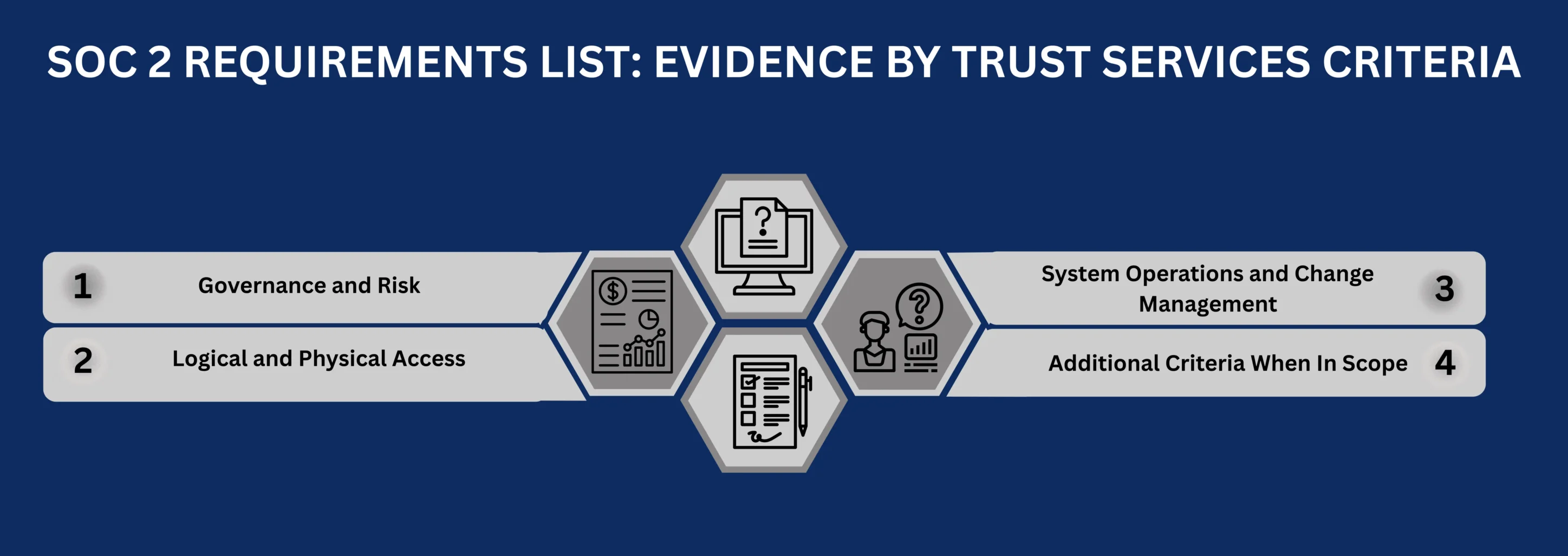
Each Trust Services Criterion contains specific points of focus — detailed requirements that auditors use to evaluate whether controls are suitably designed and, in a Type 2 examination, operating effectively over time. The security criterion alone encompasses more than sixty points of focus across nine categories: CC1 (Control Environment), CC2 (Communication and Information), CC3 (Risk Assessment), CC4 (Monitoring Activities), CC5 (Control Activities), CC6 (Logical and Physical Access Controls), CC7 (System Operations), CC8 (Change Management), and CC9 (Risk Mitigation).
Prague organizations undergoing a SOC 2 audit are evaluated against each applicable point of focus through document review, management inquiry, observation, and testing of control evidence across the defined examination period.
SOC 2 Type 1 and SOC 2 Type 2 Reports
SOC 2 examination produces two distinct report types. A SOC 2 Type 1 report expresses an auditor’s opinion on whether the organization’s controls are suitably designed to meet the applicable Trust Services Criteria as of a specific point in time. A SOC 2 Type 2 report expresses an opinion on both the design and the operating effectiveness of controls over a defined observation period — typically a minimum of six months.
SOC 2 Type 1 certification is often used by Prague organizations to establish an initial attestation baseline when entering new enterprise procurement processes. SOC 2 Type 2 certification is the standard required by enterprise customers and regulated institutions that need assurance of sustained control performance. The Type 2 report carries greater evidential weight and is the prevailing requirement in North American enterprise vendor risk management programs.
| Report Type | Scope | Observation Period | Typical Use Case |
|---|---|---|---|
| SOC 2 Type 1 | Control design at a point in time | None (single date) | Initial vendor attestation, early-stage procurement |
| SOC 2 Type 2 | Control design and operating effectiveness | Minimum 6 months | Enterprise vendor reviews, regulated institution requirements |
| SOC 2 + Privacy | Security and privacy criteria combined | Minimum 6 months | Organizations handling personal data under privacy commitments |
| SOC 2 Restricted Use | Defined user group only | As agreed with auditor | Specific customer or regulator reporting |
SOC 2 Certification Audit Process in Prague
The SOC 2 audit process in Prague follows a structured examination methodology governed by AICPA attestation standards AT-C Section 205. Each stage of the examination produces defined outputs — from the initial scope determination through the issuance of the final attestation report. The Licensed CPA Firm conducts each stage independently, evaluating evidence provided by the organization against the applicable Trust Services Criteria without involvement in the design or implementation of the controls under review. The following stages define the SOC 2 examination process for Prague-based organizations.
The SOC 2 examination begins with scope definition, in which the Licensed CPA Firm and the organization jointly identify the system boundary subject to examination. The system description — a management-prepared document that defines the services provided, infrastructure components, data flows, control environment, and subservice organizations — is reviewed for completeness and accuracy against the actual operational environment.
For Prague-based technology organizations, the system scope typically encompasses cloud infrastructure (whether hosted locally, within the EU, or in U.S.-based data centers), application layers, access management systems, third-party integrations, and change management processes. The scope determination directly governs which Trust Services Criteria apply and which control categories will be examined during the SOC 2 audit that Prague auditors conduct.
Control testing constitutes the core of the SOC 2 examination. The Licensed CPA Firm selects samples of control evidence across the examination period and evaluates each control through inspection of documentation, inquiry of personnel, observation of processes, and re-performance where appropriate. For a SOC 2 Type 2 examination, control testing spans the entire observation period — typically six to twelve months — to assess whether controls operated consistently and effectively throughout that time.
Evidence categories reviewed during a SOC 2 audit in Prague include access provisioning and deprovisioning records, vulnerability scan and penetration test reports, change management tickets, incident response logs, vendor due diligence documentation, encryption configuration evidence, backup and recovery test results, and employee security training completion records. Each control is evaluated against the specific points of focus within the applicable Trust Services Criterion.
Subservice organization relationships require particular attention during the SOC 2 compliance examination for Prague organizations. Prague-based organizations frequently rely on external cloud providers (such as AWS, Microsoft Azure, or Google Cloud), payroll processors, colocation facilities, and software vendors as components of their service delivery.
The Licensed CPA Firm applies either the carve-out method — excluding subservice organization controls from the examination scope while disclosing their existence — or the inclusive method, incorporating subservice organization controls within the examination boundary. The treatment of subservice organizations is documented in the system description and reflected in the auditor’s report, providing downstream customers with a clear understanding of the full control environment supporting the services they receive.
Following the completion of control testing, the Licensed CPA Firm conducts a nonconformity review to assess whether any identified control exceptions or deviations affect the overall opinion on control design or operating effectiveness. Exceptions are documented with descriptions of the deviation, the population and sample size tested, and the auditor’s assessment of the exception’s impact on the applicable Trust Services Criterion.
The final SOC 2 attestation report that Prague organizations receive contains the independent auditor’s opinion, the management-prepared system description, and a description of tests of controls and results. A qualified opinion indicates that certain controls did not meet the applicable criteria. An adverse opinion indicates pervasive control failures. An unqualified opinion confirms that controls met the applicable Trust Services Criteria throughout the examination period.
| Audit Stage | Key Activities | Output |
|---|---|---|
| Scope Definition | System boundary identification, TSC determination, system description review | Defined examination scope and applicable criteria |
| Stage 1 — Documentation Review | Review of policies, procedures, control documentation, and system description accuracy | Documentation assessment findings |
| Stage 2 — Control Testing | Evidence sampling, personnel inquiry, observation, re-performance across observation period | Control test results and exception identification |
| Nonconformity Review | Assessment of exceptions, evaluation of impact on opinion | Exception documentation and opinion determination |
| Attestation Report Issuance | Independent auditor’s report preparation and delivery | SOC 2 Type 1 or Type 2 attestation report |
- ✓Scope Definition and System Description Review
- ✓Control Testing and Evidence Collection
- ✓Nonconformity Review and Attestation Report Issuance
Why Organizations in Prague Pursue SOC 2 Certification
SOC 2 certification for Prague companies arises from a convergence of market demand, enterprise procurement requirements, and regulatory alignment pressures specific to the city’s commercial ecosystem. Prague-based organizations serving North American enterprise clients, regulated financial institutions, healthcare technology customers, or U.S. federal government contractors encounter SOC 2 attestation as a baseline vendor qualification requirement.
The demand is structural: enterprise vendor risk management programs routinely require annual SOC 2 Type 2 reports from all material third-party service providers. Organizations unable to produce a current attestation report face disqualification from procurement processes regardless of their technical capabilities.
Software Development and IT Outsourcing Sector
Prague’s software development and IT outsourcing sector represents one of the primary demand drivers for SOC 2 audit engagements in Prague. Czech Republic-based software development firms providing nearshore development services to U.S. and UK enterprise clients handle access to customer codebases, production environments, and proprietary business data as part of their service delivery.
Enterprise clients in regulated sectors — including financial services, healthcare technology, and legal technology — require SOC 2 Type 2 attestation from all vendors with access to sensitive systems, including development contractors. The SOC 2 examination conducted by a Licensed CPA Firm evaluates the access controls, change management processes, and data handling practices of the development organization against the security criterion, providing the enterprise client with documented, auditor-verified assurance.
IT outsourcing organizations in Prague that provide managed services, infrastructure management, application support, or security operations to international clients similarly face SOC 2 compliance requirements from their client base. A managed service provider operating from Prague that monitors and manages the IT environments of U.S.-based financial institutions must maintain a current SOC 2 Type 2 report to satisfy the third-party risk management programs of those institutions.
The SOC 2 examination conducted for Prague-based managed service providers evaluates the provider’s own control environment — including the logical separation of customer environments, incident detection and response procedures, privileged access management, and the controls applied to the monitoring tools and platforms used to deliver the managed service.
Financial Technology and SaaS Providers
Prague’s financial technology ecosystem — which includes payment processing platforms, banking infrastructure providers, investment management software firms, and insurance technology companies — encounters SOC 2 attestation requirements from multiple directions simultaneously. Fintech organizations processing payment transactions on behalf of regulated financial institutions must satisfy the SOC 2 compliance requirements imposed by those institutions as a condition of ongoing service agreements.
SOC 2 certification obtained by Prague fintech companies serves as documented evidence that the control environment governing payment processing, data segregation, encryption, and access management meets the standards required by enterprise and regulated-entity clients. The SOC 2 examination evaluates controls across the entire fintech service delivery chain — including application security, infrastructure security, data handling, and third-party payment network integrations.
SOC 2 Certification Requirements and Evaluation Criteria
SOC 2 examination requirements are defined by the AICPA Trust Services Criteria and the professional attestation standards governing the Licensed CPA Firm’s examination conduct. Unlike certification frameworks with prescriptive control lists, the Trust Services Criteria are principles-based: organizations are evaluated on whether their controls — as designed and implemented — satisfy the criteria relevant to their service commitments and system characteristics. The following requirements apply to all SOC 2 examinations conducted for Prague-based organizations.
The system description is a management-prepared document required for every SOC 2 examination. It must accurately describe the services provided, the infrastructure (hardware, software, network components, and data centers) supporting those services, the people and processes involved in service delivery, the data processed and how it flows through the system, and the control environment governing each component.
Management is required to assert that the system description is accurate, that controls are suitably designed (for Type 1), and that controls operated effectively throughout the examination period (for Type 2). The Licensed CPA Firm reviews the system description for completeness and accuracy, testing assertions against observed operational reality during the SOC 2 audit. Prague organizations with complex multi-cloud architectures, significant subservice organization relationships, or rapidly evolving systems require particular attention to system description accuracy and ongoing maintenance as their operating environment changes.
SOC 2 examination requires that organizations maintain documented evidence of control operation across the examination period. Evidence standards vary by control type: automated controls may be evidenced through system-generated logs and configuration screenshots, while manual controls require documented records of human review, approval, or action at each applicable control frequency.
For Prague-based organizations, control evidence requirements typically include documented information security policies and procedures, risk assessment records, access review documentation, vulnerability management records, security incident logs, business continuity and disaster recovery test results, vendor risk assessments, and employee security awareness training records. The Licensed CPA Firm evaluates this evidence for completeness, authenticity, and consistency with the control descriptions in the system description during the SOC 2 examination.
- ✓Documented information security policies covering access control, incident response, change management, and data classification
- ✓Risk assessment records identifying and evaluating threats to the in-scope system and data
- ✓Access provisioning and deprovisioning records demonstrating timely user lifecycle management
- ✓Vulnerability management records including scan results, remediation timelines, and residual risk acceptances
- ✓Change management documentation covering review, testing, and approval of system changes
- ✓Incident response records documenting detection, containment, investigation, and notification activities
- ✓Business continuity and disaster recovery test documentation with results and remediation items
- ✓Vendor and subservice organization due diligence records demonstrating third-party risk oversight
The SOC 2 Type 2 observation period is the duration over which the Licensed CPA Firm evaluates the operating effectiveness of controls. A minimum six-month observation period is required for an initial SOC 2 Type 2 examination; subsequent annual reports typically cover a twelve-month period. The observation period start and end dates are stated explicitly in the attestation report, and customers and procurement teams evaluate the currency of the report based on these dates.
A SOC 2 Type 2 attestation report is generally considered current for twelve months from the period end date. Reports older than twelve months are typically treated as stale in enterprise vendor risk management contexts. Prague organizations that undergo annual SOC 2 examinations maintain a continuous cycle of current attestation — with successive Type 2 reports covering consecutive twelve-month periods — eliminating coverage gaps that might raise concerns during customer security reviews.
- ✓System Description and Management Assertions
- ✓Control Documentation and Evidence Standards
- ✓Observation Period and Report Validity
Benefits of SOC 2 Certification for Prague-Based Organizations
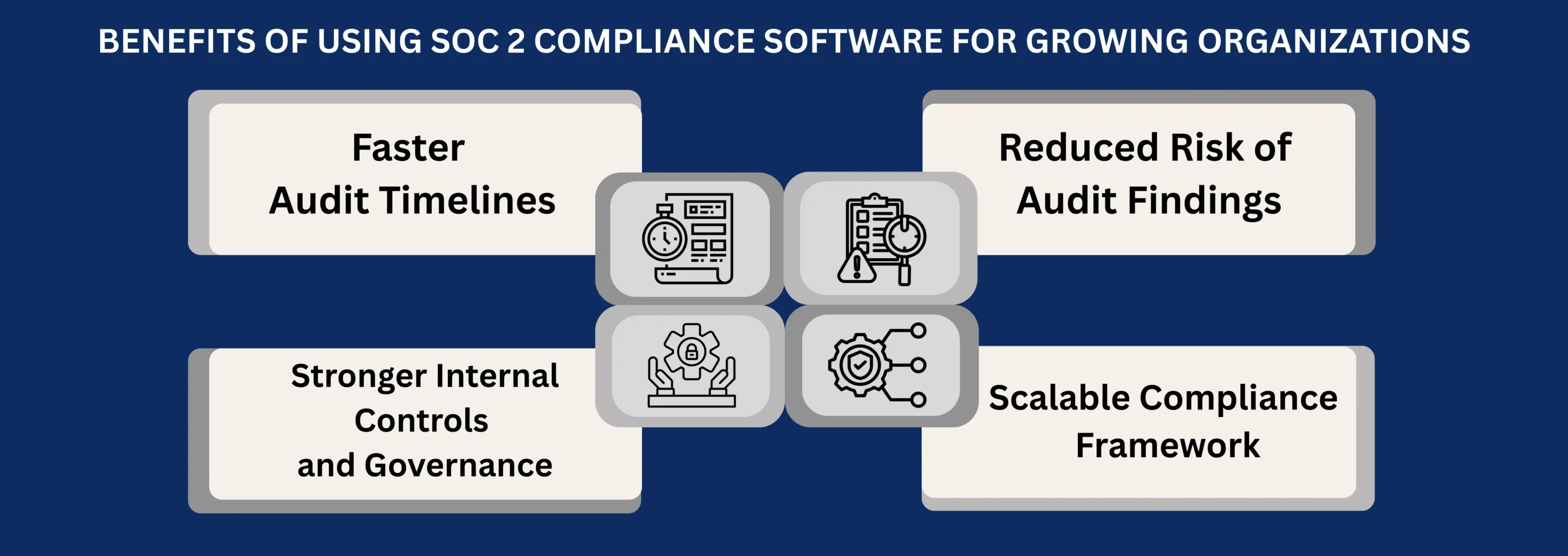
SOC 2 Certification in Prague delivers verifiable, independently validated assurance of control effectiveness that functions as a direct input to enterprise procurement decisions, financial sector vendor reviews, and regulatory due diligence processes. The benefits described below are outcomes of the attestation process itself — evidence of control maturity documented by a Licensed CPA Firm — rather than claimed attributes of the examined organization’s own security posture.
A current SOC 2 Type 2 report satisfies the primary third-party risk management requirement imposed by enterprise customers in North American and Western European markets. Prague-based technology vendors that maintain a current SOC 2 attestation report can respond to vendor security questionnaires by referencing the report and providing a copy under non-disclosure agreement — substantially reducing the time and administrative burden associated with each enterprise procurement cycle.
The independent nature of the SOC 2 examination — conducted by a Licensed CPA Firm rather than the vendor itself — provides the evidential weight that enterprise risk management programs require. Self-assessed security questionnaires and vendor-prepared documentation do not satisfy the independent verification requirement that a SOC 2 attestation fulfills in the procurement context.
Consider a practical example of SOC 2 attestation value in Prague: a Czech software-as-a-service provider seeking to close a contract with a U.S. financial institution submits to the institution’s third-party risk management review. The institution’s vendor risk program requires a current SOC 2 Type 2 report covering security and availability criteria. The Prague SaaS provider holding a current SOC 2 attestation completes the review in a matter of weeks. A similarly capable provider without attestation faces months of additional documentation requests, security assessments, and escalation reviews before a contract decision is reached. SOC 2 Certification in Prague thus functions as a structural accelerant in enterprise sales cycles where regulated institutions are the customer.
SOC 2 attestation provides customers with independent, auditor-verified documentation of the control environment protecting their data. For enterprise customers that process sensitive personal information, financial records, or proprietary business data through Prague-based service providers, the SOC 2 report constitutes the primary mechanism for discharging their own third-party oversight obligations.
Customers subject to regulatory requirements — such as U.S. financial institutions under the Gramm-Leach-Bliley Act, healthcare organizations under HIPAA, or European entities conducting international data transfers — require contractual evidence that service providers maintain controls consistent with applicable regulatory expectations. SOC 2 compliance demonstrated by Prague organizations through a Type 2 examination provides this contractual evidence in a format recognized by auditors, regulators, and legal counsel across jurisdictions.
- ✓Independent verification of control design and operating effectiveness by a Licensed CPA Firm
- ✓Recognition in enterprise vendor risk management programs across North American and Western European markets
- ✓Satisfaction of contractual third-party oversight requirements imposed by regulated institutional clients
- ✓Structured annual examination cycle providing ongoing assurance of control continuity
- ✓Documented evidence base for responding to customer security questionnaires and due diligence requests
- ✓Differentiation in competitive procurement processes where SOC 2 attestation is a qualifying criterion
- ✓Alignment of internal control documentation and evidence practices with internationally recognized audit standards
- ✓Support for regulatory compliance obligations requiring third-party risk documentation from service recipients
- ✓Enterprise Procurement and Vendor Risk Qualification
- ✓Customer Trust and Contractual Compliance
SOC 2 Certification Scope for Prague Organizations: Business Sectors and System Boundaries
The scope of a SOC 2 examination is defined by the system or service under examination — not by the legal structure or size of the organization. Prague-based organizations across multiple industry sectors pursue SOC 2 examination based on the nature of the services they provide and the data they process on behalf of customers. The Licensed CPA Firm establishes the examination boundary in collaboration with management during the scope definition phase, ensuring that the system description accurately reflects the operational scope of the services subject to the attestation.
Cloud and SaaS Organizations in Prague
Cloud service providers and SaaS companies headquartered or operating from Prague represent the most frequent candidates for SOC 2 examination in the city. These organizations process customer data on shared infrastructure, making independent assurance of logical separation, access controls, and data protection controls a foundational customer expectation.
The SOC 2 examination scope for a Prague-based SaaS provider typically encompasses the application layer, the underlying cloud infrastructure (whether self-managed or provided by a hyperscale cloud provider using the carve-out or inclusive method), the identity and access management systems controlling user access, the change management processes governing application updates, and the monitoring systems detecting security incidents. SOC 2 examinations that Prague SaaS companies undergo commonly include both security and availability criteria, reflecting customer expectations for both data protection and service continuity.
Automotive, Manufacturing, and Shared Services Organizations
Prague’s automotive engineering and manufacturing sector increasingly operates connected production systems, supplier data exchange platforms, and digital quality management tools that handle sensitive operational and partner data. When these systems are provided as services to external parties — for example, a Czech automotive technology provider delivering connected vehicle data platforms or supplier collaboration portals to international automotive OEMs — the provider organization may be required to demonstrate SOC 2 compliance as a condition of the OEM’s vendor assurance program.
Similarly, Prague’s extensive shared services sector — which provides finance, human resources, procurement, and IT services to multinational corporations across the CEE region — generates SOC 2 examination requirements from parent organizations and regulated clients that impose third-party assurance obligations on shared service centers handling sensitive financial and personnel data.
SOC 2 Compliance vs. SOC 2 Attestation: Definitions and Distinctions
SOC 2 compliance and SOC 2 attestation are related but distinct concepts that Prague-based organizations and their customers must understand clearly. SOC 2 compliance refers to an organization’s internal state of having implemented controls that satisfy the applicable Trust Services Criteria. SOC 2 attestation — the SOC 2 examination conducted by a Licensed CPA Firm — is the independent verification of that compliance state, expressed through a formal attestation report.
Compliance without attestation provides no independent external validation. Attestation is the mechanism by which compliance is externally verified and documented for customer, regulator, and procurement audiences. In practice, an organization may internally assess itself as compliant with SOC 2 requirements, but only a SOC 2 attestation issued by a Licensed CPA Firm constitutes the independently verified documentation that enterprise vendor risk programs and regulated institutions require. SOC 2 Certification in Prague bridges this gap by providing formal, auditor-issued verification.
SOC 2 vs. ISO 27001: Comparative Framework Analysis
Prague-based organizations frequently evaluate SOC 2 examination against ISO 27001 certification as alternative or complementary information security assurance frameworks. SOC 2 is a U.S.-origin AICPA attestation engagement, primarily recognized in North American enterprise markets, that evaluates specific controls against the Trust Services Criteria based on the organization’s service commitments. ISO 27001 is an internationally recognized management system standard evaluated through certification body audits, with broad global recognition across European and Asian markets.
The two frameworks differ in several material respects. SOC 2 produces a detailed attestation report describing specific tests of controls and results, making it directly useful in vendor due diligence processes. ISO 27001 produces a certification confirming conformance to a management system standard without the same level of operational control detail. Prague organizations serving North American enterprise clients typically prioritize SOC 2 audit; those serving European public sector or regulated entities may additionally maintain ISO 27001 certification for local market recognition.
Annual Examination Cycles and Report Currency
SOC 2 attestation reports are period-specific documents. A SOC 2 Type 2 report covers a defined examination period and is considered current for approximately twelve months from the period end date. Prague organizations that rely on SOC 2 attestation for ongoing commercial relationships must maintain annual examination cycles to ensure continuous availability of a current attestation report.
A lapsed or stale SOC 2 report — one whose examination period ended more than twelve months prior — raises questions during vendor reviews about the currency of the control environment and may trigger additional customer diligence requirements. Annual SOC 2 examinations conducted by the Licensed CPA Firm evaluate the organization’s controls over successive twelve-month periods. Each examination report provides fresh independent assurance to the organization’s customer base and builds an audit trail of sustained control effectiveness over multiple years.
SOC 2 Examination Prague: Independent Decision Framework and Report Outcomes
The SOC 2 examination that Prague organizations undergo results in an attestation report expressing one of several possible auditor opinions. The opinion is determined independently by the Licensed CPA Firm based on the evidence collected during the examination, the significance of any control exceptions identified, and the overall adequacy of the control environment relative to the applicable Trust Services Criteria. The examination outcome is not predetermined and is not subject to negotiation — the auditor’s professional standards require an objective evaluation based solely on the evidence reviewed.
Opinion Types and Their Implications
A SOC 2 attestation report may express an unqualified opinion, a qualified opinion, an adverse opinion, or a disclaimer of opinion. An unqualified opinion — the most favorable outcome — indicates that the organization’s controls were suitably designed and (for Type 2) operated effectively throughout the examination period without material exception. A qualified opinion indicates that, except for specific identified exceptions, the controls met the criteria; the exceptions are described in detail in the report.
An adverse opinion indicates that controls failed to meet the applicable Trust Services Criteria in ways that are pervasive rather than isolated. A disclaimer of opinion indicates that the Licensed CPA Firm was unable to obtain sufficient evidence to form an opinion. Enterprise customers and regulated institutions reviewing a Prague organization’s SOC 2 attestation report evaluate the opinion type, the description of any exceptions, and management’s response to those exceptions as part of their vendor risk assessment process.
Complementary User Entity Controls
SOC 2 attestation reports include a section describing complementary user entity controls (CUECs) — controls that the service organization’s system description assumes customers will implement to achieve the stated control objectives. CUECs are particularly relevant for SaaS providers and cloud service organizations in Prague where control effectiveness depends on both the service provider’s controls and the customer’s own access management, data handling, and integration security practices.
When a customer reviews a Prague-based provider’s SOC 2 report and identifies CUECs, the customer’s own security team must verify that the corresponding controls are in place within their environment. The identification and documentation of CUECs in the system description is a management responsibility reviewed by the Licensed CPA Firm during the SOC 2 examination for completeness and accuracy relative to the actual service delivery model.
FAQ
▶
What is SOC 2 Certification and who issues it in Prague?
▶
What is the difference between SOC 2 Type 1 and SOC 2 Type 2?
▶
Which Trust Services Criteria are mandatory for a SOC 2 examination?
▶
How long does the SOC 2 Type 2 observation period last?
▶
How long is a SOC 2 attestation report valid?
▶
Which Prague-based organizations are required to obtain SOC 2 attestation?
▶
What is the difference between SOC 2 compliance and SOC 2 attestation?
▶
How does a SOC 2 examination handle third-party cloud providers used by Prague organizations?
SOC 1 VS SOC 2: WHICH REPORT YOUR CUSTOMERS ACTUALLY ASK FOR
If you sell SaaS or provide outsourced services, you have likely been asked for a SOC report. However, the follow-up question is rarely easy to answer…
SOC 2 Certified: What Does It Mean for Your Business
For companies that handle sensitive data or run cloud-based services, the question “Can you provide your SOC 2 report?” carries enormous weight. Yet, …
HOW SOC 2 AUDITORS REVIEW EVIDENCE OVER TIME
Most businesses pursuing a SOC 2 report spend months building security controls but overlook a fundamental reality: SOC 2 auditors do not just verify …
Get In Touch
have a question? let us get back to you.