
SOC 2 Certification in Queensland
SOC 2 Certification in Queensland delivers verifiable, independently attested evidence of control effectiveness that serves multiple organizational objectives — from satisfying enterprise procurement requirements to supporting regulatory compliance programs. The benefits described below reflect the direct outcomes of a completed SOC 2 examination conducted by a Licensed CPA Firm, not the outcomes of internal compliance programs or advisory engagements alone.
OUR CLIENTS










What Is SOC 2 Certification?
SOC 2 Certification in Queensland is the outcome of an independent examination conducted by a Licensed CPA Firm under the American Institute of Certified Public Accountants (AICPA) attestation standards. The process evaluates whether an organization’s internal controls meet the AICPA Trust Services Criteria (TSC) across one or more of five defined categories: Security, Availability, Processing Integrity, Confidentiality, and Privacy. The result is a formal SOC 2 attestation report — not a self-declaration, internal audit summary, or vendor questionnaire response — but an externally issued, evidence-based opinion on control design and, for Type 2 engagements, operating effectiveness over a defined observation period.
SOC 2 compliance is distinct from SOC 2 Certification. Compliance refers to an organization’s internal adherence to policies and control frameworks without independent verification. SOC 2 Certification, by contrast, requires a Licensed CPA Firm to independently assess, test, and attest to the operating effectiveness of those controls. For Queensland organizations supplying technology services, data processing functions, or cloud infrastructure to enterprise clients — particularly those based in the United States, United Kingdom, or other jurisdictions with mature third-party risk management frameworks — SOC 2 attestation is the standard form of independent assurance expected during vendor procurement and security due diligence.
SOC 2 Type 1 and Type 2 Reports Explained
A SOC 2 Type 1 report evaluates the design of an organization’s controls at a specific point in time. The Licensed CPA Firm assesses whether the controls described in the organization’s system description are suitably designed to meet the applicable Trust Services Criteria as of the report date. A Type 1 report does not test whether those controls functioned consistently over time — it is a design-level assessment only. Type 1 reports are commonly used by Queensland organizations initiating SOC 2 Certification for the first time, where the immediate objective is to confirm that control architecture meets the TSC before committing to a longer observation window.
A SOC 2 Type 2 report extends the scope of the SOC 2 examination to include operating effectiveness testing over an observation period that typically spans six to twelve months. During the SOC 2 audit, the Licensed CPA Firm collects evidence — logs, configuration records, access reviews, incident reports, and change management records — to determine whether controls operated as designed throughout the observation period. SOC 2 Type 2 reports carry significantly greater weight in enterprise procurement contexts because they demonstrate sustained control performance rather than a point-in-time design review. For Queensland SaaS providers, managed service providers, and cloud infrastructure companies serving regulated enterprise clients, a Type 2 report is the expected deliverable.
Trust Services Criteria: The Evaluation Framework
The AICPA Trust Services Criteria form the evaluative framework applied during every SOC 2 examination. The Security category — also referred to as the Common Criteria — is mandatory for all SOC 2 engagements. It addresses logical and physical access controls, risk assessment processes, change management, monitoring operations, and incident response. The remaining four categories — Availability, Processing Integrity, Confidentiality, and Privacy — are selected based on the organization’s service commitments and the nature of the data processed. Queensland organizations that process personal information under the Australian Privacy Act 1988 frequently include the Privacy TSC in their SOC 2 scope to align SOC 2 attestation with domestic regulatory obligations while satisfying international client requirements.
Each Trust Services Criterion specifies points of focus that the Licensed CPA Firm evaluates during the SOC 2 audit. These points of focus describe the characteristics that effective controls should exhibit — for example, logical access provisioning, multi-factor authentication, encryption of data in transit and at rest, and defined incident response procedures. The examination tests whether the organization’s implemented controls satisfy these characteristics through evidence review, inquiry, observation, and re-performance. The scope of the SOC 2 examination — which TSC categories apply, which systems are in scope, and which third-party service providers are relevant — is defined before the audit commences and documented in the system description included in the final report.

SOC 2 Certification Audit Process for Queensland Organizations
The SOC 2 audit process for Queensland organizations follows a structured sequence of examination stages governed by AICPA attestation standards. Each stage produces defined outputs that form the basis for the Licensed CPA Firm’s certification decision. The process is consistent regardless of industry sector — whether the organization is a SaaS provider in Brisbane, a resources technology company in the Bowen Basin, or a healthcare data platform operating across regional Queensland. The stages below describe each phase as it applies to a standard SOC 2 examination engagement, from initial scope definition through to final SOC 2 attestation report issuance.
| Audit Stage | Key Activities | Output |
|---|---|---|
| Scope Definition & Application Review | Define in-scope systems, TSC categories, and observation period; review system description draft | Agreed scope documentation |
| Stage 1 Audit — Readiness Review | Review control documentation, policies, and system description for completeness against TSC requirements | Stage 1 findings report |
| Stage 2 Audit — Type 1 Assessment | Evaluate control design at a point in time; assess suitability against applicable Trust Services Criteria | Type 1 draft report |
| Stage 2 Audit — Type 2 Assessment | Test operating effectiveness of controls over the observation period through evidence review, inquiry, and re-performance | Type 2 draft report |
| Nonconformity Review & Certification Decision | Review exceptions, assess materiality, finalize report; Licensed CPA Firm issues SOC 2 attestation opinion | Final SOC 2 attestation report |
The SOC 2 examination begins with scope definition. The Licensed CPA Firm reviews the organization’s proposed system description, which identifies the in-scope services, infrastructure components, data flows, and relevant third-party service providers. The Stage 1 review assesses whether the system description is complete, whether the selected Trust Services Criteria categories are appropriate for the services provided, and whether the organization’s documented control environment is sufficient to proceed to evidence-based testing. For Queensland organizations initiating SOC 2 Certification for the first time, the Stage 1 review frequently surfaces documentation gaps — missing access control policies, undefined incident response procedures, or incomplete vendor management records — that must be addressed before Stage 2 commences.
The observation period for a Type 2 engagement is established at this stage. The AICPA requires a minimum observation period of six months for a Type 2 report, though twelve-month periods are standard in enterprise procurement contexts. Queensland organizations targeting U.S. financial services clients or multinational enterprise customers commonly elect twelve-month observation windows. This produces SOC 2 reports that satisfy the most demanding vendor review requirements. The start of the observation period marks the point from which the Licensed CPA Firm will collect and evaluate operating effectiveness evidence — including system-generated logs, configuration screenshots, process records, and management review documentation.
Stage 2 of the SOC 2 audit involves the direct examination of controls against the Trust Services Criteria. For a Type 2 engagement, the Licensed CPA Firm applies multiple testing procedures — inquiry of personnel responsible for control execution, inspection of evidence samples drawn from across the observation period, observation of control activities, and re-performance of selected procedures to confirm that outputs match documented expectations. Evidence samples are drawn from the full observation window, not just the most recent month, to assess whether controls operated consistently. Control deviations identified during testing are documented as exceptions and assessed for materiality before the SOC 2 Certification decision is made.
The SOC 2 examination for Queensland technology organizations typically covers evidence categories including: logical access provisioning and de-provisioning records, multi-factor authentication enforcement logs, encryption configuration documentation, vulnerability scan results and remediation records, change management approval documentation, incident response records, business continuity and disaster recovery test results, and vendor risk assessment documentation. The breadth and volume of evidence required for a Type 2 report is substantially greater than for a Type 1 assessment, reflecting the extended scope of operating effectiveness testing across the full observation period.
Following Stage 2 testing, the Licensed CPA Firm reviews all identified exceptions and control deviations. Each exception is assessed for materiality — whether it represents a design deficiency, an operating effectiveness failure, or a compensating control that mitigates the impact. Exceptions are documented in the report alongside management’s response and any corrective actions taken during the observation period. The certification committee then reviews the complete body of evidence and exceptions to issue the final SOC 2 attestation opinion. That opinion is included in the SOC 2 report alongside the system description, the Licensed CPA Firm’s report, and the results of control testing for each criterion in scope.
The final SOC 2 attestation report is a confidential document shared with specified user entities — typically customers and prospective customers who have executed a non-disclosure agreement. Queensland organizations should be aware that SOC 2 reports are not public documents. Distribution is controlled by the service organization, and clients requesting reports as part of vendor due diligence should expect to execute a confidentiality agreement before receiving access. The report remains valid as evidence of control effectiveness for the period covered by the observation window. Organizations are expected to maintain annual SOC 2 audit cycles to provide current attestation to clients and meet ongoing procurement requirements.
- ✓Stage 1: Scope Definition and Documentation Review
- ✓Stage 2: Control Testing and Evidence Collection
- ✓Nonconformity Review and Attestation Report Issuance
SOC 2 Certification Requirements and Evaluation Criteria
SOC 2 Certification requirements are defined by the AICPA Trust Services Criteria and the terms of the engagement between the organization and the Licensed CPA Firm. Unlike prescriptive certification frameworks that specify exact controls, the TSC establishes criteria-level requirements — organizations must demonstrate that their controls achieve the objectives described in each criterion, but the specific control mechanisms may vary based on the organization’s technology environment, risk profile, and service commitments. This principle-based structure means that SOC 2 Certification in Queensland is applicable across a wide range of technology and service organization types without requiring a single standardized control implementation.
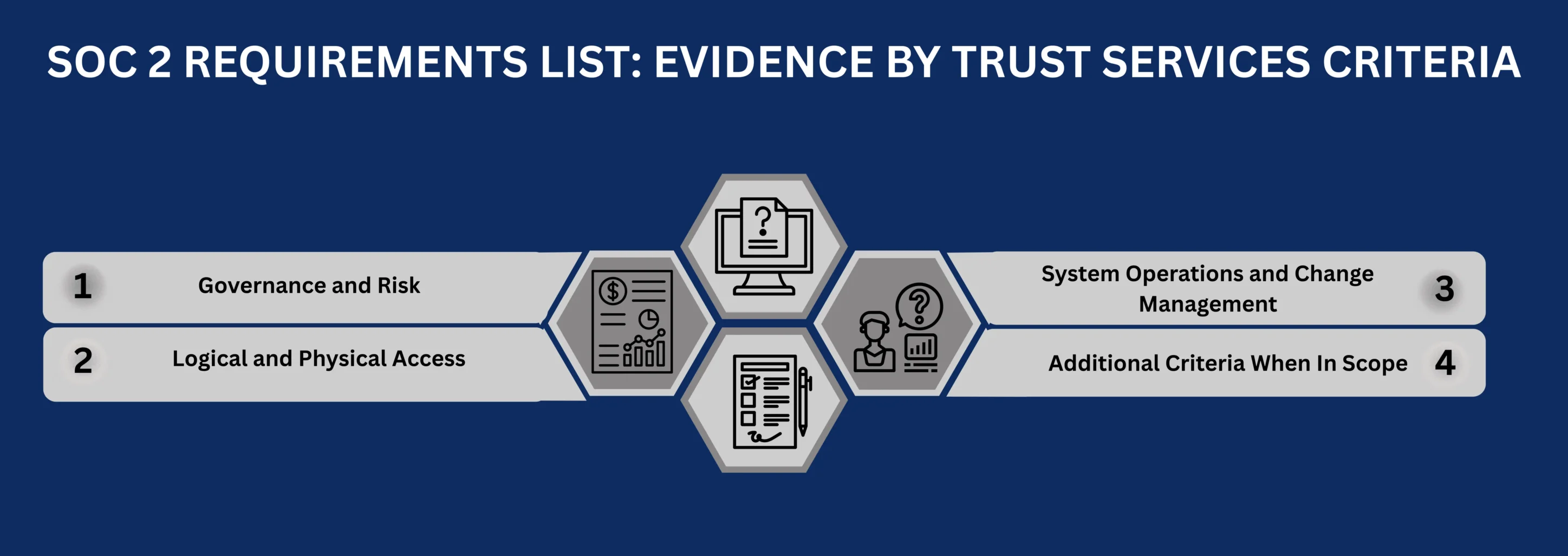
SOC 2 compliance requires that an organization maintain documented policies and procedures governing each control area included in the TSC scope. Core documentation requirements include an information security policy, an access control policy, a change management policy, an incident response plan, a business continuity and disaster recovery plan, a vendor risk management policy, and a data classification and handling standard. For Queensland organizations that include the Privacy TSC in their SOC 2 scope, a privacy notice and a data retention and disposal policy are also required. These documents must be formally approved by management, communicated to relevant personnel, and subject to periodic review — all of which the Licensed CPA Firm will verify during the SOC 2 examination.
The system description — a narrative document prepared by the service organization’s management — is a critical component of every SOC 2 attestation. It describes the service organization’s system boundaries, the nature of the services provided, the principal service commitments made to user entities, the components of the system (infrastructure, software, people, processes, and data), and the controls designed to meet the Trust Services Criteria. The Licensed CPA Firm evaluates the completeness and accuracy of the system description as part of both Stage 1 and Stage 2 of the SOC 2 audit. An incomplete or inaccurate system description is one of the most common sources of exception findings in first-cycle SOC 2 examinations.
Technical controls evaluated during the SOC 2 examination include logical access management, network security architecture, encryption, vulnerability management, and monitoring. Logical access controls must demonstrate that access to in-scope systems is provisioned based on role-based access principles, that access is de-provisioned promptly upon personnel departure or role change, that privileged access is separately controlled and reviewed, and that multi-factor authentication is enforced for access to production systems and sensitive data. Network controls must demonstrate segregation of environments — particularly between production and non-production systems — and the presence of firewall rules, intrusion detection, and monitoring configurations that align with the Security TSC.
Encryption requirements under the Security and Confidentiality TSC require that sensitive data is encrypted both in transit and at rest using industry-accepted algorithms. Vulnerability management programs must demonstrate that the organization conducts periodic vulnerability scans, reviews results, and remediates identified vulnerabilities within defined timelines. Monitoring controls must show that the organization collects and reviews security event logs, investigates anomalies, and maintains an audit trail of system activity across the observation period. Queensland technology organizations operating multi-cloud environments — common among SaaS providers and cloud-native companies in the Brisbane and Gold Coast technology corridors — must ensure that technical controls are consistently applied and evidenced across all in-scope infrastructure providers to satisfy SOC 2 compliance requirements.
A SOC 2 attestation report does not carry a suspension or withdrawal mechanism in the same way that ISO certification does — the report reflects the state of controls during a defined observation period and cannot be revoked retrospectively. However, the practical equivalent of suspension occurs when an organization fails to maintain annual SOC 2 audit cycles. SOC 2 reports are time-bounded; a report covering a twelve-month observation period ending in June 2024 does not provide assurance of control effectiveness for the period after June 2024. Enterprise clients conducting vendor due diligence will request the most recent available report and will typically not accept reports older than twelve months as current evidence of control effectiveness.
- ✓Documentation and Policy Requirements
- ✓Technical Control Requirements
- ✓Conditions for Suspension or Withdrawal of Attestation
Queensland Industries and Sectors Pursuing SOC 2 Certification
SOC 2 Certification in Queensland is pursued across a broad range of technology-intensive industries. Queensland’s industrial structure — spanning resources and mining technology, agricultural technology, tourism and hospitality technology, healthcare information management, and advanced manufacturing — generates substantial demand for independent control assurance from both domestic enterprise clients and international customers. SOC 2 Certification for Queensland companies has become a baseline expectation in vendor procurement processes conducted by U.S., U.K., and Canadian enterprise organizations, particularly for suppliers that handle sensitive customer data, process financial transactions, or provide cloud-based software services.
Resources, Mining Technology, and Agricultural Technology
Queensland’s resources and mining technology sector — centered on coal, liquefied natural gas, and base metals operations in the Bowen Basin, Galilee Basin, and Townsville industrial corridor — relies on operational technology platforms, asset management systems, and data analytics services provided by technology vendors subject to enterprise security due diligence. Queensland technology vendors in this sector face procurement requirements from major mining operators and international joint venture partners who conduct structured vendor security reviews. SOC 2 Type 2 attestation provides documented evidence that control frameworks governing access to operational data and enterprise systems meet independently verified standards, making SOC 2 Certification an important differentiator for technology suppliers in this sector.
Queensland’s agricultural technology sector — serving the state’s significant sugar cane, beef cattle, horticulture, and grain production industries — has seen increasing adoption of cloud-based farm management platforms, precision agriculture tools, and supply chain data services. Technology providers serving agricultural enterprises, food processing companies, and agribusiness exporters frequently encounter SOC 2 Certification requirements from corporate customers conducting third-party risk assessments. SOC 2 compliance for Queensland agricultural technology companies — demonstrated through independent attestation — confirms that their platforms handle producer data, financial records, and supply chain information within independently verified security and availability control environments.
SaaS Providers, Cloud Companies, and Financial Services Technology
SOC 2 Certification for Queensland fintech and financial services technology organizations is driven by direct regulatory expectations and enterprise client requirements. Queensland-based fintech companies providing payment processing, lending technology, insurance technology, and wealth management platforms to clients in regulated markets must demonstrate independent control assurance to satisfy vendor due diligence requirements imposed by Australian Prudential Regulation Authority (APRA)-regulated institutions and their international counterparts. SOC 2 Certification for Queensland financial services technology suppliers provides a structured attestation that satisfies these requirements without requiring the organization to respond to hundreds of individual security questionnaires.
Brisbane technology companies — particularly SaaS providers and cloud service organizations operating from the Brisbane CBD, Fortitude Valley technology precinct, and the broader South East Queensland technology corridor — commonly encounter SOC 2 Certification requirements from enterprise customers at the point of contract negotiation. Cloud infrastructure providers, managed service providers, and data hosting organizations serving Queensland’s healthcare, legal, financial, and government-adjacent sectors are frequently required to produce current SOC 2 Type 2 reports as a condition of vendor approval. Queensland SaaS providers that maintain current SOC 2 attestation are better positioned to satisfy security review requirements and accelerate enterprise procurement processes.
Tourism, Hospitality Technology, and Healthcare Information Management
Queensland’s tourism and hospitality sector — one of the state’s largest economic contributors, anchored by the Great Barrier Reef, Whitsundays, and Gold Coast tourism precincts — relies extensively on property management systems, booking platforms, loyalty program technology, and customer data management platforms. Technology vendors serving international hotel brands, resort operators, and tourism management organizations face SOC 2 Certification requirements from international parent companies conducting global vendor security reviews. SOC 2 attestation demonstrates that customer payment data, personal information, and loyalty program records are handled within independently verified control environments — a critical assurance requirement for hospitality technology vendors operating at scale.
Benefits of SOC 2 Certification for Queensland-Based Organizations
SOC 2 Certification in Queensland delivers verifiable, independently attested evidence of control effectiveness that serves multiple organizational objectives — from satisfying enterprise procurement requirements to supporting regulatory compliance programs. The benefits described below reflect the direct outcomes of a completed SOC 2 examination conducted by a Licensed CPA Firm, not the outcomes of internal compliance programs or advisory engagements alone.
- ✓Independent third-party validation of security, availability, processing integrity, confidentiality, and privacy controls against AICPA Trust Services Criteria
- ✓Formal SOC 2 attestation report suitable for distribution to enterprise clients during vendor due diligence and procurement reviews
- ✓Structured SOC 2 audit methodology that identifies control gaps through evidence-based testing rather than self-assessment
- ✓Recognition in enterprise procurement processes across U.S., U.K., Canadian, and Asia-Pacific markets that require SOC 2 Type 2 reports from technology vendors
- ✓Ongoing oversight through annual SOC 2 audit cycles that maintain current attestation status for continuous client assurance
- ✓Alignment with Australian Privacy Act 1988 obligations through inclusion of the Privacy Trust Services Criterion in the SOC 2 examination scope
- ✓Competitive differentiation in Queensland’s technology market where SOC 2 attestation is increasingly a baseline requirement for enterprise contract eligibility
- ✓Reduced client security questionnaire burden — a current SOC 2 report satisfies the majority of standard vendor security assessment questions
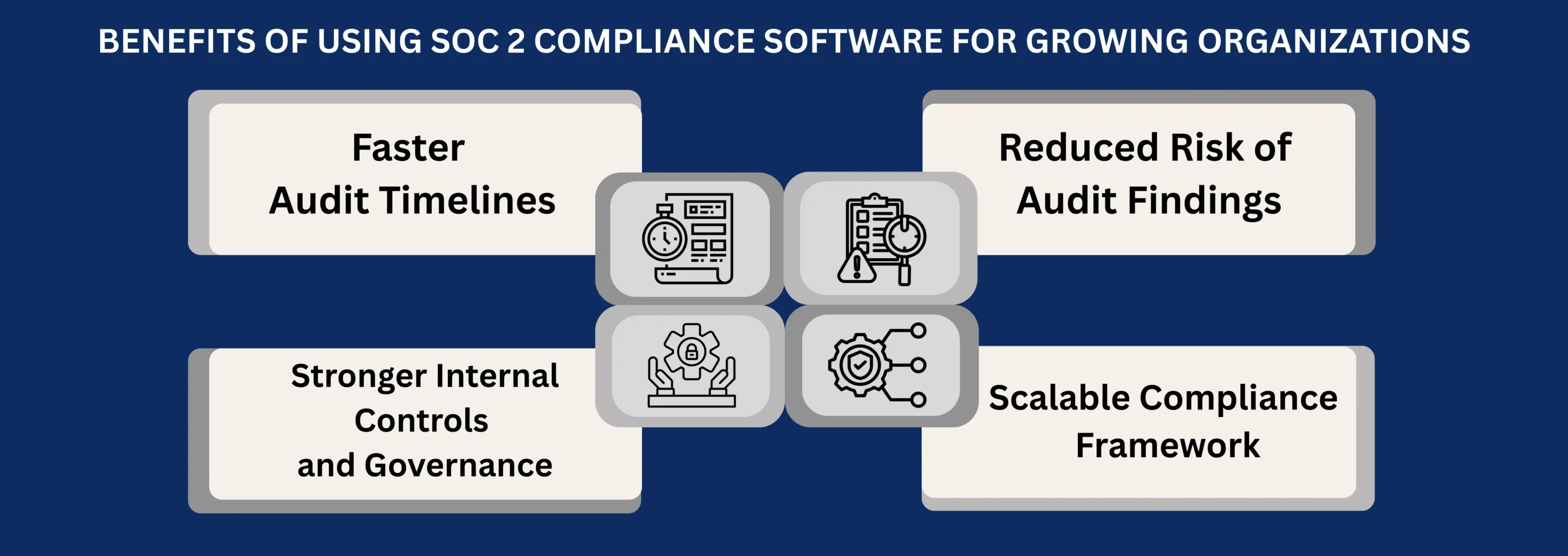
The primary benefit of SOC 2 Certification is the production of independently verified evidence of control effectiveness. Internal control assessments, vendor security questionnaire responses, and self-certifications do not carry the same evidentiary weight as a SOC 2 attestation issued by a Licensed CPA Firm following an evidence-based examination. The SOC 2 examination evaluates actual control performance — reviewing system logs, configuration records, access review documentation, and process evidence — rather than relying solely on management representations. For Queensland organizations seeking to differentiate their security posture in competitive enterprise sales processes, the SOC 2 attestation report provides objective, auditor-verified evidence that cannot be replicated through internal processes alone.
Annual SOC 2 audit cycles maintain the currency of attestation and demonstrate ongoing control discipline rather than a one-time compliance exercise. Enterprise clients — particularly U.S.-headquartered technology companies, financial institutions, and healthcare organizations — conduct annual vendor security reviews and expect current SOC 2 reports from their critical service providers. Queensland organizations that maintain uninterrupted annual SOC 2 audit cycles demonstrate a sustained commitment to control effectiveness that is visible and verifiable to clients throughout the vendor relationship. This ongoing oversight structure is one of the key distinctions between SOC 2 Certification and point-in-time security assessments.
SOC 2 Certification is recognized as the standard form of independent control assurance in enterprise technology procurement processes across North America, and increasingly across the United Kingdom, European Union, and Asia-Pacific markets. For Queensland technology organizations targeting international enterprise customers, a current SOC 2 Type 2 report satisfies the vendor security assurance requirements imposed by procurement teams, legal departments, and risk management functions. This removes the need for the organization to complete bespoke security questionnaires for each prospective client. In financial sector procurement — particularly for technology vendors seeking to supply services to APRA-regulated institutions or their U.S. counterparts — SOC 2 attestation is frequently listed as a mandatory vendor qualification requirement alongside contractual security obligations.
- ✓Verification of Control Effectiveness Through Independent Examination
- ✓Recognition in Enterprise Procurement and Financial Sector Vendor Reviews
SOC 2 Certification vs. Other Assurance Frameworks
Queensland organizations evaluating information security assurance frameworks frequently compare SOC 2 Certification with ISO/IEC 27001 certification, PCI DSS certification, and IRAP assessments. Each framework serves distinct purposes, and the selection depends on client requirements, target markets, and the nature of the data processed. SOC 2 Certification and ISO 27001 certification address overlapping control domains but are governed by different standards bodies and produce different forms of assurance output. Understanding these distinctions enables organizations to select the appropriate framework — or combination of frameworks — for their specific assurance objectives.
| Dimension | SOC 2 Certification | ISO 27001 Certification |
|---|---|---|
| Governing Body | AICPA (American Institute of CPAs) | ISO/IEC (International Organization for Standardization) |
| Report Type | Attestation report issued by Licensed CPA Firm | Certificate issued by accredited certification body |
| Geographic Recognition | Primary recognition in U.S. and North American markets; growing global acceptance | Global recognition across all major markets |
| Evaluation Scope | Tests specific controls against Trust Services Criteria and service commitments | Evaluates Information Security Management System (ISMS) against ISO 27001 clauses and Annex A controls |
| Observation Period | Type 2: minimum 6 months operating effectiveness testing | Ongoing; annual surveillance audits and three-year recertification cycle |
SOC 2 vs. ISO 27001: Framework Selection for Queensland Organizations
Queensland organizations with U.S.-headquartered enterprise clients or prospective customers should prioritize SOC 2 Certification, as it is the expected assurance standard in North American technology procurement contexts. ISO 27001 certification, while globally recognized, is less commonly requested in U.S. vendor security reviews than a SOC 2 Type 2 report. Conversely, Queensland organizations targeting European, Middle Eastern, or Asia-Pacific markets — where ISO 27001 is the dominant assurance framework — may find ISO 27001 certification more directly responsive to client requirements. Organizations serving both markets may pursue dual certification, though each framework requires a separate independent examination by the relevant type of certification body.
SOC 2 attestation differs from PCI DSS certification in both scope and purpose. PCI DSS is a payment card industry security standard specifically governing the processing, storage, and transmission of cardholder data, whereas SOC 2 examines a broader range of control objectives across the Trust Services Criteria applicable to the organization’s service commitments. Queensland fintech organizations processing card payments may require both PCI DSS compliance and SOC 2 Certification — PCI DSS to satisfy card brand network requirements and SOC 2 attestation to satisfy enterprise client vendor assurance requirements. The two certifications address different audiences and serve distinct assurance purposes without substituting for one another.
SOC 2 and Australian Regulatory Context
SOC 2 Certification does not replace compliance obligations under Australian law, including the Australian Privacy Act 1988, the Notifiable Data Breaches scheme, APRA Prudential Standard CPS 234 Information Security, or Queensland’s own information privacy obligations under the Information Privacy Act 2009 (Qld). However, the controls evaluated during a SOC 2 examination — particularly those under the Privacy and Security Trust Services Criteria — substantially overlap with the technical and organizational controls required to meet these domestic obligations. Queensland organizations that maintain SOC 2 attestation and align their control environments with the TSC are typically better positioned to demonstrate compliance with domestic privacy and security requirements, as the evidence base developed for the SOC 2 audit is directly relevant to regulatory review contexts.
SOC 2 Report Validity, Maintenance, and Annual Audit Cycles
A SOC 2 attestation report is valid as evidence of control effectiveness for the observation period it covers. A Type 2 report covering the twelve-month period from 1 July 2023 to 30 June 2024 attests to control performance during that specific window. After the report period ends, the attestation does not automatically expire — the report remains a factual record of the controls that were in place and operating during the covered period. However, enterprise clients and procurement teams treat SOC 2 reports as current only if they cover a period ending within the preceding twelve months. An organization that does not conduct an annual SOC 2 audit will be unable to provide a current report and will typically fail vendor security review requirements that specify currency of attestation.
Annual Audit Cycles and Continuous Compliance Monitoring
SOC 2 Certification requires annual audit cycles to maintain current attestation status. Each annual cycle constitutes a new SOC 2 examination conducted by the Licensed CPA Firm, with a new observation period, new evidence collection, and a new attestation report. Organizations that change auditors between cycles must ensure that the incoming Licensed CPA Firm has access to prior-year reports and documentation sufficient to understand the control environment’s history. Changes to system architecture, service commitments, or in-scope TSC categories between annual cycles must be reflected in the updated system description reviewed during Stage 1 of the new engagement.
Continuous compliance monitoring — the practice of maintaining real-time or near-real-time evidence collection through automated tools — has become standard practice among Queensland SaaS providers and cloud organizations that undergo annual SOC 2 audits. Automated evidence collection platforms aggregate access logs, configuration change records, vulnerability scan results, and policy acknowledgement records into centralized repositories reviewed during the annual SOC 2 examination. This approach reduces the manual effort associated with evidence preparation and ensures that evidence is available across the full observation period rather than reconstructed retrospectively at the end of the audit year. Automated evidence trails also reduce the risk of evidence gaps that could result in exception findings during the SOC 2 audit.
SOC 2 Report Distribution and Confidentiality Controls
SOC 2 attestation reports are restricted-use documents. The AICPA’s attestation standards limit the distribution of SOC 2 reports to the service organization’s management, user entities (current and prospective customers who have agreed to confidentiality terms), and regulators with legal authority to receive the report. Queensland organizations distributing SOC 2 reports to prospective clients should require the execution of a non-disclosure or confidentiality agreement before report delivery. The report should not be published on public websites or included in marketing materials in full-text form. Summary information about the SOC 2 examination scope and attestation period may be referenced publicly, but the full report is a confidential document subject to the distribution restrictions specified by the AICPA and the Licensed CPA Firm that issued the attestation.
Cross-Border SOC 2 Compliance Scenarios for Queensland Organizations
Queensland technology organizations frequently supply services to clients headquartered in multiple jurisdictions, each with distinct vendor assurance requirements. SOC 2 Certification in Queensland addresses the U.S.-centric vendor security assurance requirement — the most common international assurance standard encountered by Queensland technology exporters — while remaining compatible with broader international assurance programs. The following scenario illustrates a typical cross-border SOC 2 compliance context for a Queensland technology organization pursuing enterprise growth in international markets.
Scenario: Queensland SaaS Provider Supplying U.S. Financial Services Clients
A Brisbane-based SaaS provider offering a compliance management platform to financial services firms in the United States encounters the following vendor assurance requirements during enterprise sales: the prospective U.S. client’s information security team requires a current SOC 2 Type 2 report covering the Security and Availability Trust Services Criteria; the client’s legal team requires evidence that the SaaS provider maintains privacy controls aligned with U.S. state privacy law obligations for data processed on behalf of U.S. customers; and the client’s procurement team requires confirmation that the SaaS provider’s subservice organizations (cloud infrastructure providers) are also subject to independent control review. The SOC 2 Type 2 report — issued by a Licensed CPA Firm following a twelve-month SOC 2 examination — directly addresses all three requirements through the system description, the attestation opinion, and the complementary user entity controls and subservice organization disclosure sections of the report.
In this scenario, the Queensland SaaS provider’s SOC 2 attestation also supports the domestic Australian regulatory environment. The same control evidence used to satisfy the SOC 2 examination — access control records, encryption configurations, and incident response documentation — is directly relevant to demonstrating compliance with APRA CPS 234 obligations applicable to the provider’s Australian financial services clients, and to the Notifiable Data Breaches obligations under the Australian Privacy Act. The annual SOC 2 audit cycle creates a structured, recurring evidence collection process that simultaneously benefits international client assurance requirements and domestic regulatory compliance programs.
Subservice Organizations and Third-Party Risk in SOC 2 Examinations
SOC 2 examinations for Queensland technology organizations must address the role of subservice organizations — third-party providers on whose services the in-scope organization relies to deliver its own services. Cloud infrastructure providers (such as AWS, Azure, or Google Cloud), data center operators, and third-party software vendors that have access to in-scope data or systems may be classified as subservice organizations and must be addressed in the SOC 2 system description. The Licensed CPA Firm evaluates whether the service organization’s monitoring and oversight of subservice organizations is adequate, including whether the organization obtains and reviews SOC 2 reports from subservice organizations that are themselves subject to independent examination. This carve-out and inclusive approach determination is a key scoping decision in every SOC 2 engagement.
FAQ
▶
What is SOC 2 Certification and how does it differ from SOC 2 compliance?
▶
Which Queensland organizations require SOC 2 Certification?
▶
What is the difference between a SOC 2 Type 1 and Type 2 report?
▶
How long does a SOC 2 audit take for a Queensland organization?
▶
Who can conduct a SOC 2 examination in Queensland?
▶
How long is a SOC 2 attestation report valid?
▶
Which Trust Services Criteria should a Queensland organization include in its SOC 2 scope?
▶
Does SOC 2 Certification satisfy Australian Privacy Act obligations?
SOC 1 VS SOC 2: WHICH REPORT YOUR CUSTOMERS ACTUALLY ASK FOR
If you sell SaaS or provide outsourced services, you have likely been asked for a SOC report. However, the follow-up question is rarely easy to answer…
SOC 2 Certified: What Does It Mean for Your Business
For companies that handle sensitive data or run cloud-based services, the question “Can you provide your SOC 2 report?” carries enormous weight. Yet, …
HOW SOC 2 AUDITORS REVIEW EVIDENCE OVER TIME
Most businesses pursuing a SOC 2 report spend months building security controls but overlook a fundamental reality: SOC 2 auditors do not just verify …
Get In Touch
have a question? let us get back to you.