
SOC 2 Certification in San Francisco
CertPro is a Licensed CPA Firm conducting independent SOC 2 examinations for organizations operating in San Francisco under AICPA Trust Services Criteria (TSC). Our engagements produce formally attested Type I or Type II reports covering Security, Availability, Processing Integrity, Confidentiality, and Privacy controls across defined audit scopes and observation periods. Whether you need SOC 2 Certification in San Francisco for the first time or are renewing an existing attestation, CertPro provides the independent professional authority your customers and partners require.
OUR CLIENTS










What Is SOC 2 Certification?
SOC 2 Certification is a formal attestation standard developed and governed by the American Institute of Certified Public Accountants (AICPA). It establishes a structured framework for evaluating how service organizations manage and protect customer data through independently tested internal controls. The standard applies specifically to service organizations that store, process, or transmit customer information on behalf of other entities. This makes SOC 2 Certification directly relevant to SaaS companies, cloud providers, fintech firms, AI startups, and managed service providers operating across the United States — including the highly competitive San Francisco technology market.
SOC 2 Certification in San Francisco is issued exclusively by a Licensed CPA Firm following a formal SOC 2 examination conducted under AICPA AT-C Section 205 attestation standards. The term “certified” in this context reflects the outcome of an independent third-party examination in which a qualified auditor reviews, tests, and formally attests to the design and operating effectiveness of an organization’s controls. Unlike self-assessments or questionnaire-based programs, SOC 2 attestation involves systematic evidence collection, rigorous control testing, and professional judgment exercised by credentialed attestation professionals.
The AICPA Trust Services Criteria Framework
The AICPA Trust Services Criteria (TSC) serve as the evaluative foundation for every SOC 2 examination. The TSC is organized into five principal categories: Security, Availability, Processing Integrity, Confidentiality, and Privacy. Security is the only mandatory category and addresses how organizations protect information and systems against unauthorized access — both physical and logical. The remaining four categories are selected based on the nature of the service commitments an organization makes to its customers and the contractual obligations it must fulfill.
Each Trust Services Criteria category contains a set of points of focus and illustrative controls that auditors use to evaluate whether an organization’s control environment is suitably designed and operating effectively. For example, the Security category encompasses logical access controls, change management procedures, risk assessment activities, monitoring operations, and incident response capabilities. The Availability category evaluates whether systems are available for operation and use as committed. Processing Integrity addresses whether system processing is complete, valid, accurate, timely, and authorized. The Confidentiality and Privacy categories govern how organizations protect sensitive data and personally identifiable information throughout its lifecycle.
SOC 2 Type I vs. SOC 2 Type II Reports
SOC 2 compliance examinations produce two distinct report types that serve different purposes and carry different levels of assurance. A SOC 2 Type I report evaluates the suitability of design of an organization’s controls at a single point in time. It answers whether controls were properly designed as of a specific date — without assessing whether those controls operated consistently over a sustained period. Type I reports are commonly used by organizations beginning their attestation program and seeking to demonstrate initial control design to prospective customers or partners.
A SOC 2 Type II report evaluates both the suitability of design and the operating effectiveness of controls over a defined observation period, typically ranging from six to twelve months. This report type carries substantially greater evidentiary weight because it demonstrates that controls did not merely exist on paper — they functioned as intended across an extended timeframe. Enterprise customers, financial institutions, and regulated entities almost universally require SOC 2 Type II reports when evaluating third-party service providers. The SOC 2 Type II audit engagements conducted by CertPro in San Francisco follow AICPA standards throughout the full observation period to produce formally attested Type II opinions.
| Attribute | SOC 2 Type I | SOC 2 Type II |
|---|---|---|
| Assessment Focus | Control design at a point in time | Control design and operating effectiveness over time |
| Observation Period | Single date | Typically 6–12 months |
| Assurance Level | Design suitability only | Design and operational effectiveness |
| Common Use | Initial attestation, vendor qualification | Enterprise procurement, regulatory requirements |
| AICPA Standard | AT-C Section 205 | AT-C Section 205 |
Who Requires SOC 2 Certification?
SOC 2 Certification for San Francisco startups and established enterprises is increasingly required by enterprise customers, financial institutions, government contractors, healthcare organizations, and any entity conducting formal vendor risk assessments. Organizations that provide cloud infrastructure, software-as-a-service platforms, data analytics, payment processing, HR information systems, or any service involving access to customer data are most frequently subject to SOC 2 requirements in procurement and contracting contexts. In San Francisco’s highly competitive technology market, the absence of a current SOC 2 attestation report can directly prevent contract execution with enterprise buyers who maintain formal third-party risk management programs.
Beyond contractual requirements, many organizations pursue SOC 2 attestation proactively to differentiate their security posture in competitive sales processes, satisfy investor due diligence requirements, or meet the expectations of strategic partners. A completed SOC 2 audit establishes an independent, professionally attested record of control performance that no internal policy document or self-certification program can replicate. This independent evidentiary record is what distinguishes SOC 2 attestation from simple SOC 2 compliance declarations — and why it carries significant weight in business-to-business trust frameworks.

ENQUIRE NOW
Related Resources
Related Services in San Francisco
SOC 2 Certification Audit Process in San Francisco
The SOC 2 audit process in San Francisco follows a structured sequence of evaluation stages governed by AICPA attestation standards. CertPro, operating as an independent Licensed CPA Firm, executes each stage according to formal audit methodology, professional standards, and evidence-based procedures. The process is designed to produce a formal attestation opinion that accurately reflects the state of an organization’s control environment relative to the applicable Trust Services Criteria. Each stage of the SOC 2 examination produces documented evidence supporting the final attestation report issued to the auditee.
Scope definition is the foundational stage of every SOC 2 audit engagement. During this stage, the auditor and the service organization jointly identify which systems, services, infrastructure components, and organizational units fall within the audit boundary. The scope directly determines which Trust Services Criteria categories apply, which controls will be subject to testing, and which locations, personnel, and third-party service providers must be included in the examination. An accurately defined scope prevents material omissions that could result in a qualified opinion and ensures the resulting attestation report accurately reflects the organization’s actual service delivery environment.
For San Francisco-based technology organizations, scope definition frequently involves evaluating cloud infrastructure hosted across multiple providers, distributed engineering teams, third-party subservice organizations, and software development pipelines. The auditor documents the system description that will appear in the final SOC 2 report — describing the services provided, the components of the system, and the boundaries of the audit scope. This system description is a critical element of the attestation report because it establishes the factual basis upon which the auditor’s opinion rests.
Following scope definition, the auditor develops a tailored audit program specifying the procedures, sampling methodologies, evidence requirements, and testing protocols to be applied across each applicable Trust Services Criteria category. The audit program accounts for the specific characteristics of the organization’s control environment, the nature of the services provided, the complexity of the technology infrastructure, and the risk profile associated with the systems in scope. For a SOC 2 Type II examination, the audit program also establishes the observation period start and end dates along with the evidence collection schedule.
The audit program specifies which controls will be tested through inquiry, observation, inspection of documentation, or re-performance. High-risk controls and automated controls with significant impact on data security typically receive more extensive testing procedures. The program also identifies the populations from which samples will be drawn for recurring controls such as access reviews, change management approvals, and security monitoring activities. This structured approach ensures the SOC 2 examination produces evidence sufficient to support a professionally defensible attestation opinion.
Evidence collection is the most substantive phase of the SOC 2 examination. During this stage, the auditor collects and evaluates evidence demonstrating how controls operated throughout the observation period. Evidence forms include configuration screenshots, system-generated logs, policy documents, procedure records, user access lists, change tickets, security alert records, training completion records, vendor contracts, and personnel acknowledgment forms. The auditor evaluates whether each piece of evidence is sufficient, appropriate, and directly correlated to the control being tested.
For recurring controls tested over a SOC 2 Type II observation period, the auditor applies statistical or risk-based sampling to select representative instances from the full population of control executions. For example, if an organization performs monthly access reviews across a twelve-month period, the auditor selects a sample of those reviews and evaluates whether each was completed, documented, and acted upon in accordance with the organization’s defined procedures. Exceptions identified during testing are documented and assessed for their impact on the overall attestation opinion.
Upon completing evidence collection and control testing, the auditor conducts a structured nonconformity review to evaluate the nature, frequency, and severity of any exceptions identified during testing. Not every exception results in a qualified opinion. The auditor applies professional judgment to determine whether exceptions represent isolated deviations, compensating controls, or material weaknesses that affect the overall reliability of the control environment. This assessment considers the pervasiveness of the exception, the risk associated with the affected control, and whether the exception represents a systemic failure or an isolated occurrence.
The attestation decision results in one of three opinion types: an unqualified opinion indicating controls were suitably designed and operated effectively; a qualified opinion indicating that with specific noted exceptions the controls were otherwise effective; or an adverse opinion indicating controls did not meet the applicable criteria. Following the attestation decision, the Licensed CPA Firm issues the formal SOC 2 report — including the auditor’s opinion, the system description, the description of controls tested, and the results of testing. The completed SOC 2 attestation report is then distributed to the service organization for sharing with customers and stakeholders under appropriate confidentiality agreements.
- ✓Stage 1: Scope Definition
- ✓Stage 2: Audit Program Determination
- ✓Stage 3: Evidence Collection and Control Testing
- ✓Stage 4: Nonconformity Review and Attestation Decision
Benefits of SOC 2 Certification for San Francisco-Based Organizations
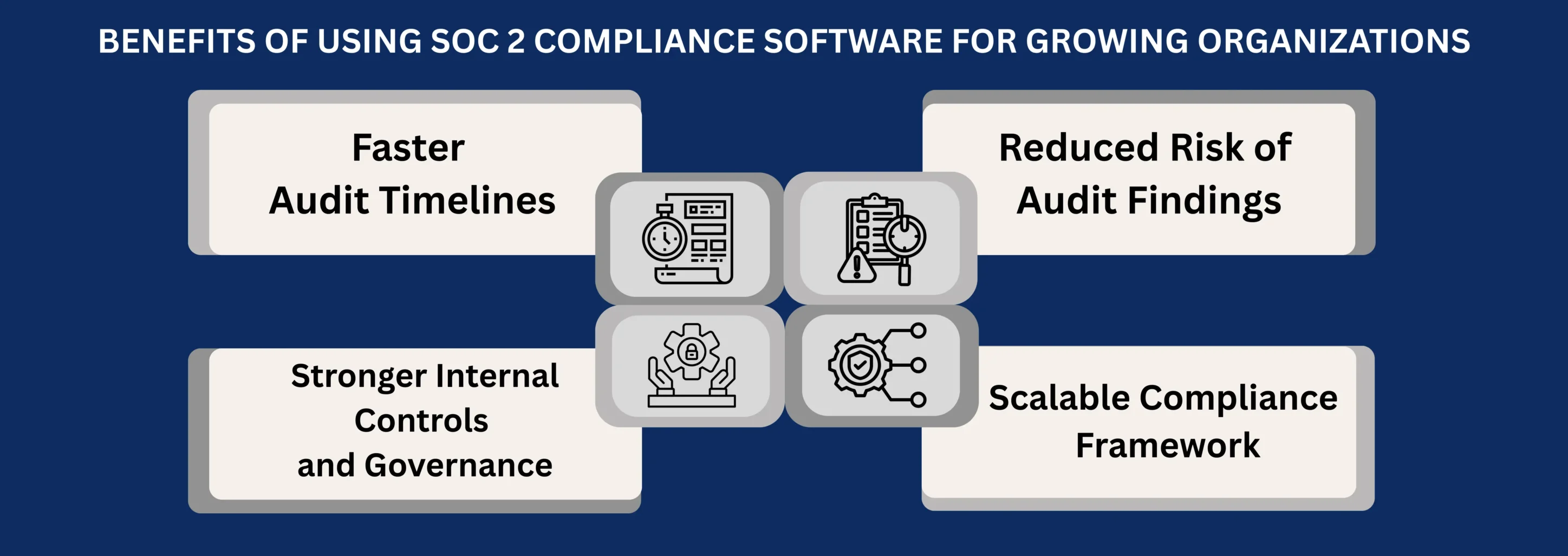
SOC 2 Certification in San Francisco delivers measurable operational, commercial, and reputational benefits to service organizations competing in one of the world’s most demanding technology markets. San Francisco’s position as a global hub for enterprise software, artificial intelligence, cloud infrastructure, fintech innovation, and cybersecurity development means that SOC 2 attestation is frequently a threshold requirement rather than merely a differentiating factor. Organizations that hold a current SOC 2 attestation report are better positioned to close enterprise contracts, pass vendor security assessments, and build lasting trust with institutional customers and strategic partners.
Enterprise procurement processes for technology vendors routinely include formal security assessments, vendor risk questionnaires, and requests for third-party attestation reports. A current SOC 2 Type II report from a Licensed CPA Firm directly satisfies these requirements. It eliminates the need for time-consuming security questionnaire responses, on-site security reviews, or custom audit accommodations. For San Francisco technology companies with active enterprise sales pipelines, the ability to deliver a SOC 2 Type II report on demand can significantly reduce contract cycle times and remove security compliance as a deal-blocking obstacle.
San Francisco fintech organizations and SaaS providers pursuing SOC 2 compliance frequently report that enterprise customers — particularly in financial services, healthcare, and government sectors — require SOC 2 Type II reports as a non-negotiable condition of vendor onboarding. The attestation report functions as a pre-vetted security credential that eliminates duplicative review processes across multiple customer relationships. Instead of completing a unique security assessment for each enterprise customer, an organization with a current SOC 2 attestation can distribute a single independently verified report that satisfies the requirements of multiple customers simultaneously.
Venture capital firms, private equity investors, and strategic acquirers conducting due diligence on San Francisco technology companies increasingly include SOC 2 attestation status as an element of their technical and operational review. A current SOC 2 Type II report demonstrates that an organization has implemented and maintained a structured control environment — reducing perceived operational risk and supporting higher valuation multiples in fundraising and M&A contexts. For venture-backed startups pursuing Series A or later-stage capital, SOC 2 Certification signals organizational maturity and institutional readiness to sophisticated investors familiar with enterprise software due diligence standards.
Many U.S. regulatory frameworks and industry standards reference or recognize SOC 2 attestation as evidence of control effectiveness. Organizations subject to HIPAA, CCPA, GLBA, FedRAMP, PCI DSS, or state-level data protection requirements can leverage a completed SOC 2 examination to demonstrate that relevant controls have been independently tested and verified. While SOC 2 attestation does not constitute full compliance with these specific regulations, the independently tested control evidence it provides materially strengthens regulatory compliance documentation and supports responses to regulatory examinations or inquiries.
- ✓Satisfies enterprise vendor security assessment requirements without repeated custom reviews
- ✓Demonstrates independent verification of control design and operating effectiveness
- ✓Supports investor due diligence and organizational maturity signaling
- ✓Reduces friction in contract negotiations with regulated industry customers
- ✓Provides documented evidence of control performance for regulatory inquiries
- ✓Enables direct response to security questionnaires from multiple customers using a single SOC 2 attestation report
- ✓Strengthens third-party risk management positioning for customers evaluating service provider risk
- ✓Supports alignment with HIPAA, CCPA, GLBA, and other applicable regulatory frameworks
- ✓Establishes a formal, annually renewed independent attestation record
- ✓Differentiates security posture in competitive procurement processes in the San Francisco technology market
- ✓Enterprise Sales Enablement and Contract Velocity
- ✓Investor Due Diligence and Capital Formation
- ✓Regulatory Alignment and Third-Party Risk Management
SOC 2 Certification Requirements for San Francisco Service Organizations
SOC 2 Certification in San Francisco requires service organizations to establish, document, and operate a control environment that satisfies the applicable Trust Services Criteria categories selected for the audit scope. The specific requirements vary based on the nature of the services provided, the systems in scope, the TSC categories selected, and whether the organization is pursuing a Type I or Type II report. However, certain foundational requirements apply uniformly across all SOC 2 examinations conducted under AICPA standards.
Documentation requirements for SOC 2 compliance encompass formal written policies, procedures, and control descriptions that define how the organization addresses each applicable Trust Services Criteria point of focus. At a minimum, organizations must maintain documented information security policies, access control procedures, change management procedures, incident response plans, vendor management policies, and risk assessment processes. These documents must be formally approved, version-controlled, and accessible to relevant personnel — demonstrating that the control environment is systematically managed rather than ad hoc.
Beyond policy documentation, SOC 2 audit evidence requirements extend to operational records that demonstrate control execution during the observation period. These records include access provisioning and de-provisioning logs, change approval tickets, security monitoring alert records, vulnerability scan results, penetration test reports, business continuity test documentation, vendor contract reviews, and employee security training completion records. The auditor evaluates whether these operational records are complete, accurate, and consistent with the control descriptions documented in the organization’s policies and procedures.
Technical control requirements for the Security Trust Services Criteria category include logical access controls, encryption standards, network security configurations, vulnerability management programs, and security monitoring capabilities. Logical access controls must enforce the principle of least privilege, require multi-factor authentication for privileged access, and include periodic access review procedures. Encryption requirements typically mandate the use of industry-standard protocols for data in transit and at rest, with documented key management procedures. Network security configurations must include defined perimeter controls, segmentation where appropriate, and documented firewall rule review procedures.
Vulnerability management programs required for SOC 2 compliance must include periodic scanning of in-scope systems, a documented process for evaluating and remediating identified vulnerabilities based on severity ratings, and records demonstrating that remediation activities were completed within defined timeframes. Security monitoring requirements mandate the collection and review of security event logs from in-scope systems, with documented procedures for investigating and responding to anomalous events. These technical controls must be implemented, configured, and operating throughout the observation period to satisfy the evidential requirements of a SOC 2 Type II examination.
Organizational requirements for SOC 2 Certification include defined roles and responsibilities for information security, a formal risk assessment process, a security awareness training program, and a documented incident response capability. The organization must demonstrate that personnel with security responsibilities have been assigned, trained, and are actively executing their defined responsibilities. Background screening procedures for personnel with access to sensitive systems are frequently evaluated as part of the SOC 2 examination’s human resources-related control requirements.
Vendor management requirements for SOC 2 compliance mandate that organizations identify and evaluate the security controls of subservice organizations providing services within the audit scope. When a subservice organization’s controls are relevant to service commitments made to customers, the organization must either obtain and review the subservice organization’s own SOC 2 report or apply complementary user entity controls that address the risks associated with the subservice relationship. This vendor oversight requirement is particularly relevant for San Francisco technology organizations that extensively use cloud infrastructure providers, third-party identity management services, and specialized software components in their service delivery.
- ✓Documentation Requirements
- ✓Technical Control Requirements
- ✓Organizational and Personnel Requirements
SOC 2 Certification Cost in San Francisco
The investment associated with SOC 2 Certification in San Francisco is determined by the scope and complexity of the examination rather than standardized fee schedules. Key factors that influence scope — and therefore overall engagement cost — include the number of Trust Services Criteria categories selected, the complexity of the system in scope, the number of in-scope locations, the volume of controls subject to testing, the length of the observation period for Type II engagements, and the number of subservice organizations requiring evaluation. Organizations with simpler, more narrowly defined control environments and a single TSC category in scope will have a fundamentally different examination profile than enterprises with complex multi-system environments and multiple TSC categories.
SOC 2 Type I examinations are generally less resource-intensive than Type II examinations because they assess control design at a single point in time rather than operating effectiveness across an extended observation period. Organizations that begin with a Type I report and subsequently pursue Type II attestation benefit from the existing documentation, control structures, and auditor familiarity developed during the initial engagement. For San Francisco Bay Area SOC 2 audit engagements, CertPro provides transparent scope-based engagement structures that allow organizations to understand the basis of the examination before commencing the audit process.
Scope Factors That Influence Examination Complexity
The primary scope factors that determine examination complexity include the number of Trust Services Criteria categories in scope, the number of distinct systems and services being examined, the geographic distribution of operations and personnel, the number and nature of subservice organizations, and the maturity of existing documentation and control evidence. Organizations that operate highly standardized, well-documented control environments with complete evidence records typically progress through the SOC 2 audit more efficiently than those with fragmented documentation, inconsistent control execution, or complex multi-platform technical environments.
| Scope Factor | Impact on Examination |
|---|---|
| Number of TSC Categories | Each additional category adds controls and testing procedures |
| System Complexity | Multi-platform environments require broader evidence collection |
| Observation Period Length | Longer periods increase sample sizes for recurring controls |
| Subservice Organizations | Each subservice organization requires evaluation of complementary controls |
| Documentation Maturity | Complete, organized evidence reduces examination timeline and cost |
SOC 2 Compliance for San Francisco Technology Sectors
San Francisco’s technology ecosystem encompasses a diverse range of organizations for which SOC 2 compliance is either contractually required, commercially necessary, or strategically important. The city’s concentration of enterprise software companies, cloud infrastructure providers, artificial intelligence developers, financial technology firms, cybersecurity organizations, and healthcare technology companies creates a market environment where SOC 2 attestation is a baseline expectation in enterprise-to-enterprise relationships. Each technology sector presents distinct control environment characteristics that shape the scope and focus of the SOC 2 examination.
SaaS and Cloud Service Providers
Software-as-a-service companies and cloud service providers represent the largest cohort of organizations pursuing SOC 2 Certification in San Francisco — for both early-stage startups and established platforms alike. These organizations typically process customer data on shared infrastructure, making the Security and Availability Trust Services Criteria universally applicable to their SOC 2 scope. The Security category addresses how the SaaS platform prevents unauthorized access to customer data across multi-tenant environments, while the Availability category evaluates whether the platform maintains uptime commitments and recovers from disruptions within defined service level agreement parameters.
For SaaS companies operating on cloud infrastructure such as AWS, Google Cloud Platform, or Microsoft Azure, the SOC 2 examination must address the shared responsibility model governing which controls are managed by the cloud provider and which are the responsibility of the SaaS organization. Auditors evaluate whether the organization has implemented appropriate complementary user entity controls addressing risks not covered by the cloud provider’s own attestation reports. This requires a clear mapping of control responsibilities and documented evidence that the organization’s controls appropriately supplement the infrastructure-level controls provided by the cloud platform.
Fintech and Financial Services Technology
San Francisco fintech organizations pursuing SOC 2 compliance face particularly rigorous customer and regulatory expectations given the sensitivity of financial data processed through their platforms. Fintech companies providing payment processing, lending origination, investment management, banking-as-a-service, or insurance technology services frequently encounter SOC 2 Type II requirements as a condition of partnerships with licensed financial institutions, payment networks, and banking regulators. The Processing Integrity and Confidentiality TSC categories are often added to the Security category scope for fintech organizations to address the accuracy of financial transaction processing and the protection of sensitive financial account data.
Artificial Intelligence and Data Analytics Companies
Artificial intelligence companies and data analytics platforms in San Francisco that process customer datasets to train models, generate predictions, or produce analytical outputs present unique SOC 2 scope considerations. The Privacy category becomes highly relevant when AI platforms process personally identifiable information, as the AICPA Privacy TSC maps closely to principles derived from the Generally Accepted Privacy Principles (GAPP) framework. Auditors evaluating AI platforms examine whether personal data used in model training or inference activities is collected, used, retained, and disclosed in accordance with disclosed privacy notices and applicable regulatory requirements.
Processing Integrity is another critical TSC category for AI and analytics organizations, as customers rely on the accuracy and completeness of outputs generated by these platforms to inform business decisions. SOC 2 examination procedures for Processing Integrity evaluate whether the organization has implemented controls to detect and correct errors in data inputs, model outputs, and analytical results. For organizations providing AI-powered services to regulated industries, the combination of Security, Processing Integrity, Confidentiality, and Privacy categories in the SOC 2 scope often reflects the full breadth of customer expectations and contractual commitments.
Cybersecurity and Managed Service Providers
Cybersecurity companies and managed service providers operating in San Francisco occupy a uniquely sensitive position in the SOC 2 examination landscape because their services often involve privileged access to customer systems, security event data, and sensitive operational information. Enterprise customers of cybersecurity and managed detection and response services routinely require SOC 2 Type II reports that specifically address how the provider controls access to customer environments, manages the confidentiality of security event data, and maintains the integrity of security monitoring outputs. The SOC 2 examination for these organizations must address both the security of the provider’s own systems and the controls governing access to customer-controlled environments.
SOC 2 Attestation: Understanding the Report Structure
The SOC 2 attestation report is a formally structured document produced by the Licensed CPA Firm following completion of the SOC 2 examination. Understanding the structure of the SOC 2 report is essential for organizations distributing it to customers, for customers reviewing it as part of vendor risk assessments, and for auditors using it to plan user entity controls or complementary assessments. The report structure follows AICPA standards and contains defined sections that serve distinct informational and evidentiary purposes.
Components of the SOC 2 Attestation Report
The SOC 2 attestation report contains four primary components: the independent service auditor’s report, management’s assertion, the description of the service organization’s system, and the description of controls, applicable criteria, and results of tests. The independent service auditor’s report contains the formal attestation opinion issued by the Licensed CPA Firm and states whether controls were suitably designed (Type I) or suitably designed and operating effectively (Type II) relative to the applicable Trust Services Criteria. This section is the definitive evidentiary output of the SOC 2 examination.
Management’s assertion is a formal written representation by the service organization’s management confirming that the system description is fairly presented and that controls were suitably designed — and, for Type II reports, operating effectively. The system description provides a detailed narrative of the services provided, the infrastructure and software components of the system, the people involved in service delivery, the procedures governing system operation, and the relevant aspects of the control environment. This section gives report users sufficient context to understand the scope and nature of the services being attested.
Control Testing Results and Exceptions
The description of controls, applicable criteria, and results of tests is the most operationally detailed section of the SOC 2 attestation report. For each control in scope, this section describes the control activity, identifies the applicable Trust Services Criteria point of focus, and presents the auditor’s test of the control along with the result of that test. When exceptions are identified, the section describes the nature of the exception, the sample size tested, the number of exceptions found, and the auditor’s evaluation of the exception’s impact on the overall control objective. This level of detail allows report users to make informed judgments about the significance of any noted exceptions.
Sophisticated report users — including enterprise procurement teams and third-party risk management analysts — review the control testing results section carefully. They evaluate not just whether the overall opinion is unqualified, but whether specific controls relevant to their risk assessment concerns operated without exception. For organizations distributing SOC 2 reports to multiple customers, the testing results section provides a level of transparency that supports customer trust and reduces the need for supplementary security inquiries. This transparency is a defining characteristic of SOC 2 attestation that distinguishes it from security certifications that issue only pass/fail determinations without detailed testing results.
Report Validity and Annual Recertification
SOC 2 attestation reports do not carry a perpetual validity period. A SOC 2 Type II report covers a specific, defined observation period and reflects the auditor’s findings for that period only. Customers reviewing SOC 2 reports as part of vendor risk assessments evaluate both the opinion and the currency of the report. Industry practice generally treats reports older than twelve months as requiring renewal, and many enterprise procurement programs specifically require reports with observation periods ending no more than twelve months prior to the date of review. Organizations must complete annual SOC 2 audit cycles to maintain current certified status and meet customer expectations for up-to-date attestation evidence.
Annual recertification through a subsequent SOC 2 Type II examination provides the most current evidence of control effectiveness and maintains the continuous attestation record that sophisticated customers value most. Organizations that complete successive annual SOC 2 examinations accumulate a longitudinal record of control performance — demonstrating not just point-in-time design but sustained operational consistency across multiple audit cycles. This ongoing record of independent attestation represents the highest level of assurance that SOC 2 compliance can provide and is particularly valued by enterprise customers with formal annual vendor reassessment programs.
SOC 2 Certification in San Francisco: Steps to Obtain the Attestation
Obtaining SOC 2 Certification in San Francisco follows a defined sequence of activities spanning scope definition, evidence collection, formal examination, and report issuance. The timeline varies based on report type and organizational complexity, but follows a consistent procedural pathway governed by AICPA attestation standards. The following steps outline the structured pathway through which CertPro, as an independent Licensed CPA Firm, conducts SOC 2 examinations for San Francisco service organizations.
- Engagement initiation: Define the service system boundary, applicable TSC categories, and report type (Type I or Type II) with the service organization.
- Audit program development: Develop tailored testing procedures, sampling methodologies, and evidence requirements based on the defined scope.
- System description review: Evaluate the accuracy and completeness of management’s system description against the actual service delivery environment.
- Control design evaluation: Assess whether documented controls are suitably designed to meet the applicable Trust Services Criteria points of focus.
- Evidence collection: Collect and evaluate operational evidence demonstrating control execution throughout the observation period (Type II) or at the point-in-time date (Type I).
- Control testing: Apply inquiry, observation, inspection, and re-performance procedures to evaluate control operating effectiveness.
- Exception evaluation: Document and assess identified exceptions for their nature, frequency, and impact on control objectives.
- Nonconformity review: Complete a structured review of all exceptions to determine the appropriate attestation opinion.
- Report drafting: Draft the SOC 2 attestation report including the auditor’s opinion, system description, control descriptions, and testing results.
- Attestation issuance: Issue the formal SOC 2 attestation report signed by the Licensed CPA Firm upon completion of quality review procedures.
SOC 2 Type I examinations can typically be completed within four to eight weeks from engagement initiation, depending on scope complexity and the completeness of available documentation. Because the Type I examination does not require an extended observation period, the primary time driver is the collection and evaluation of control design evidence at the selected point-in-time date. Organizations with well-organized documentation and responsive evidence coordination can complete the Type I examination efficiently within this range.
SOC 2 Type II examinations require a minimum observation period of six months, with twelve-month periods being the industry standard for renewals and ongoing attestation programs. The auditor’s fieldwork for evidence collection and control testing typically begins during or shortly after the close of the observation period, with report issuance occurring within four to eight weeks following the completion of fieldwork — depending on exception volume and report complexity. Organizations planning their SOC 2 audit timeline in San Francisco should account for the full observation period plus fieldwork and reporting time to accurately project when the final attestation report will be available for customer distribution.
- ✓Timeline Considerations for SOC 2 Type I and Type II Engagements
SOC 2 Certification vs. Other Security Frameworks: What San Francisco Organizations Should Know
San Francisco organizations evaluating security attestation options frequently consider SOC 2 in the context of other widely recognized frameworks — including ISO 27001, PCI DSS, HIPAA, FedRAMP, and NIST CSF. Understanding how SOC 2 Certification differs from these frameworks is essential for making informed decisions about which attestation program best satisfies customer requirements, regulatory obligations, and market positioning objectives. Each framework serves a distinct purpose and addresses a specific risk or compliance domain, and they are not mutually exclusive.
SOC 2 vs. ISO 27001
SOC 2 and ISO 27001 are both widely recognized security attestation standards, but they differ fundamentally in origin, structure, and primary market application. SOC 2 is a U.S.-origin standard developed by the AICPA and is most recognized in North American markets. ISO 27001 is an international standard issued by the International Organization for Standardization, with strong recognition in European, Asia-Pacific, and global markets. For San Francisco organizations with predominantly U.S.-based customer relationships, SOC 2 is generally the more directly applicable and market-recognized standard. Organizations with significant international customer bases may pursue both certifications to satisfy different geographic market requirements.
Structurally, ISO 27001 focuses on the design and implementation of an Information Security Management System (ISMS) and is assessed against a defined set of controls in Annex A. A SOC 2 examination focuses on specific Trust Services Criteria directly tied to the service commitments and contractual requirements of the service organization. A key practical difference is that SOC 2 Type II reports include detailed testing results and sample-level evidence of control operating effectiveness — providing report users with substantially more operational transparency than an ISO 27001 certificate, which confirms scope and standard conformance but does not publish detailed testing results.
SOC 2 vs. PCI DSS
PCI DSS (Payment Card Industry Data Security Standard) is a mandatory security standard applicable to organizations that process, store, or transmit payment card data. Unlike SOC 2, which is a voluntary attestation program, PCI DSS compliance is required by payment card brands and acquiring banks as a condition of processing card transactions. SOC 2 and PCI DSS serve different purposes: PCI DSS addresses the security of payment card data specifically, while SOC 2 attestation addresses the broader control environment across the service organization’s defined scope. Organizations that process payment cards and also provide services requiring SOC 2 attestation must maintain compliance with both standards — though there is meaningful control overlap in areas such as access management, encryption, and vulnerability management.
SOC 2 vs. FedRAMP
FedRAMP (Federal Risk and Authorization Management Program) is a U.S. government authorization framework applicable to cloud service providers seeking to offer services to federal agencies. FedRAMP is built on NIST SP 800-53 security controls and requires a formal authorization process conducted by a Third Party Assessment Organization (3PAO). A SOC 2 examination is not a substitute for FedRAMP authorization for federal customers. However, San Francisco cloud service providers serving both government and commercial customers may hold both a FedRAMP authorization and a SOC 2 Type II attestation to satisfy the distinct requirements of their respective customer segments. The control frameworks have meaningful overlap, and organizations with established FedRAMP programs can leverage existing control documentation in their SOC 2 examination scope.
| Framework | Governing Body | Primary Market | Report Type | Mandatory? |
|---|---|---|---|---|
| SOC 2 | AICPA | U.S. Commercial | Type I / Type II Attestation | Contractually required |
| ISO 27001 | ISO/IEC | Global | Certificate | Voluntary / market-driven |
| PCI DSS | PCI SSC | Payment Card Industry | Report on Compliance / AOC | Mandatory for card processors |
| FedRAMP | U.S. GSA | U.S. Federal Government | Authorization to Operate | Mandatory for federal cloud |
| HIPAA | U.S. HHS | U.S. Healthcare | Not a certification | Mandatory for covered entities |
Why CertPro Is the Preferred SOC 2 Audit Firm for San Francisco Organizations
CertPro operates exclusively as a Licensed CPA Firm conducting independent SOC 2 examinations under AICPA attestation standards. This exclusive focus on attestation services — as opposed to consulting or advisory activities — is a defining characteristic that preserves auditor independence throughout every SOC 2 examination. Independence is not merely a professional standard but a substantive quality assurance mechanism: an auditor who designs or implements controls cannot independently attest to those same controls. CertPro’s examination-only positioning ensures that every SOC 2 attestation report issued under the CertPro signature reflects genuinely independent professional judgment.
Licensed CPA Firm Authority and Professional Standards
SOC 2 examination reports can only be issued by a Licensed CPA Firm operating under AICPA professional standards. This is not a procedural technicality — it is a substantive credential requirement that determines the legal and professional validity of the attestation. Only a Licensed CPA Firm has the authority to issue formally attested SOC 2 opinions under AICPA AT-C Section 205, and only reports issued by such firms carry the professional credibility that enterprise customers, regulatory bodies, and investment professionals expect. CertPro’s status as a Licensed CPA Firm is the foundational credential underlying every SOC 2 attestation it issues.
CertPro’s audit professionals maintain current knowledge of AICPA Trust Services Criteria updates, evolving cloud security standards, and emerging technology risk areas that affect the SOC 2 examination landscape for San Francisco technology organizations. The firm’s examination methodology is developed in accordance with AICPA attestation standards and quality control standards, ensuring that each SOC 2 audit produces evidence sufficient to support a defensible attestation opinion. Organizations seeking SOC 2 Certification in San Francisco through CertPro receive a formally structured examination process governed by professional standards that are publicly documented and subject to peer review oversight.
Sector Experience in San Francisco Technology Markets
CertPro’s examination experience spans the primary technology sectors represented in San Francisco’s business ecosystem — including SaaS platforms, cloud infrastructure providers, fintech organizations, AI and machine learning companies, cybersecurity firms, healthcare technology providers, and managed service organizations. This sector breadth means that CertPro’s audit professionals bring direct familiarity with the control environment characteristics, technical architectures, and Trust Services Criteria implications specific to each sector. Engagements with this SOC 2 certified CPA firm benefit from contextual knowledge applied to the design of audit programs that accurately reflect the risk and control landscape of the organization being examined.
Secure SOC 2 Certification in San Francisco with CertPro
CertPro conducts independent SOC 2 examinations for service organizations operating in San Francisco under AICPA Trust Services Criteria and AT-C Section 205 attestation standards. Every SOC 2 Certification in San Francisco issued by CertPro reflects a formally structured examination process executed by credentialed Licensed CPA professionals — producing attestation reports that satisfy enterprise customer requirements, investor due diligence standards, and third-party risk management expectations. The examination process encompasses scope definition, audit program development, evidence collection, control testing, nonconformity review, and formal report issuance in full accordance with AICPA professional standards.
Organizations in San Francisco’s SaaS, cloud, fintech, AI, cybersecurity, and managed service sectors that require SOC 2 Type I or SOC 2 Type II attestation reports are encouraged to initiate an engagement with CertPro to receive an examination scope assessment based on their specific service environment and applicable Trust Services Criteria. SOC 2 compliance organizations across all San Francisco industries and company sizes benefit from an independently attested report — one that provides verified, professionally credentialed evidence of control effectiveness and represents the definitive standard for third-party security assurance in the U.S. technology market.
FAQ
▶
What is SOC 2 attestation reports can only be issued by licensed?
▶
What is SOC 2 certification and who issues it?
▶
What is the difference between SOC 2 compliance and SOC 2 certification?
▶
How long does a SOC 2 audit take in San Francisco?
▶
Which Trust Services Criteria categories should a San Francisco organization include in its SOC 2 scope?
▶
How long is a SOC 2 attestation report valid?
▶
Can a small San Francisco startup obtain SOC 2 certification?
▶
What is the difference between a SOC 2 and a SOC 3 report?
SOC 1 VS SOC 2: WHICH REPORT YOUR CUSTOMERS ACTUALLY ASK FOR
If you sell SaaS or provide outsourced services, you have likely been asked for a SOC report. However, the follow-up question is rarely easy to answer…

AICPA Issues New Guidance for Peer Reviewers Evaluating SOC 2 Engagements
AICPA SOC 2 guidance has been issued to help peer reviewers identify quality risks associated with SOC 2 engagements as the use of compliance automati…
SOC 2 Certified: What Does It Mean for Your Business
For companies that handle sensitive data or run cloud-based services, the question “Can you provide your SOC 2 report?” carries enormous weight. Yet, …
Get In Touch
have a question? let us get back to you.