
SOC 2 Certification in Victoria
SOC 2 Certification in Victoria is issued exclusively by a Licensed CPA Firm following an independent examination of an organization’s control environment against the AICPA Trust Services Criteria (TSC). The certification reflects an objective, evidence-based attestation decision — not a self-declaration or internal compliance assessment — made by an independent third party operating under AICPA attestation standards (AT-C Section 205).
OUR CLIENTS










Independent SOC 2 Certification by a Licensed CPA Firm in Victoria
SOC 2 Certification in Victoria is issued exclusively by a Licensed CPA Firm following an independent examination of an organization’s control environment against the AICPA Trust Services Criteria (TSC). The certification reflects an objective, evidence-based attestation decision — not a self-declaration or internal compliance assessment — made by an independent third party operating under AICPA attestation standards (AT-C Section 205).
Victoria occupies a prominent position in Australia’s technology and financial services landscape. The state is home to a concentrated cluster of SaaS providers, cloud infrastructure companies, managed service providers (MSPs), financial technology firms, biotech and medical research organizations, education technology enterprises, and advanced manufacturing operations.
Each of these sectors routinely handles sensitive customer data and operates within supply chains that include U.S.-based enterprises and regulated institutions. As a result, demand for SOC 2 Certification in Victoria has expanded significantly — driven by international vendor due diligence requirements, enterprise procurement security reviews, and contractual obligations tied to U.S. market access.
SOC 2 certification is not issued by a government body, industry association, or self-certification registry. It is produced exclusively by a Licensed CPA Firm authorized to conduct attestation engagements under AICPA standards. The firm conducts a formal SOC 2 examination of the service organization’s control environment, evaluates evidence collected during the audit period, and assesses control design and operating effectiveness against the applicable Trust Services Criteria.
The result is an attestation report that includes the auditor’s opinion. This report — either a Type I or Type II — constitutes the externally verified record of the organization’s control posture.
The Trust Services Criteria are organized across five categories: Security (Common Criteria), Availability, Processing Integrity, Confidentiality, and Privacy. The Security category is mandatory in every SOC 2 engagement. Organizations in Victoria select additional criteria categories based on the nature of their services, the types of data they process, and the expectations of their customer base.
A cloud infrastructure provider, for example, may include Availability criteria. A healthcare data processor may include Privacy criteria alongside Security. Selecting the right criteria scope is a foundational step in any SOC 2 Certification in Victoria engagement.
SOC 2 compliance in a standalone sense refers to an organization’s internal adherence to defined control objectives and policies. SOC 2 attestation — the formal output of a SOC 2 examination — is a materially different designation. It provides an independently verified, auditor-signed opinion on whether the organization’s controls were suitably designed (Type I) or both suitably designed and operating effectively over a defined period (Type II).
Enterprise customers in U.S.-connected markets consistently require SOC 2 attestation reports rather than self-declarations of compliance. This makes external certification the recognized standard in vendor assurance and third-party risk management programs.
Organizations pursuing SOC 2 Certification in Victoria operate within a jurisdictional environment that intersects Australian privacy law — including the Privacy Act 1988 and the Australian Privacy Principles — alongside international data protection expectations tied to U.S. regulatory frameworks. SOC 2 audit Victoria engagements conducted by a Licensed CPA Firm address control environments that may span multiple data centers, cloud platforms, and operational jurisdictions.
The attestation report produced at the conclusion of the examination is directly recognized in U.S. enterprise procurement processes, financial sector vendor reviews, and SaaS customer due diligence workflows. This positions it as the most relevant third-party assurance instrument for Victoria-based organizations targeting U.S. market expansion or maintaining U.S. enterprise customer relationships.

What Is SOC 2 Certification?
SOC 2 certification is the formal output of a SOC 2 examination conducted by a Licensed CPA Firm under AICPA attestation standards. It establishes that an independent auditor has evaluated a service organization’s controls relevant to security, availability, processing integrity, confidentiality, and/or privacy — and has issued a written attestation opinion based on evidence collected during the engagement.
The term ‘SOC 2 certified’ reflects the completion of this examination and the issuance of an attestation report. It does not represent a self-assessed compliance status or an industry badge. For Victoria-based organizations, achieving SOC 2 Certification means obtaining an independently verified record of control effectiveness recognized by enterprise customers globally.
SOC 2 Type I vs. SOC 2 Type II Reports
A SOC 2 Type I report evaluates the design of an organization’s controls at a specific point in time. The Licensed CPA Firm assesses whether the controls described in the service organization’s system description are suitably designed to meet the applicable Trust Services Criteria as of a stated date. A Type I report does not test whether controls operated effectively over time — it addresses design adequacy only.
Organizations in Victoria pursuing SOC 2 attestation for the first time may elect a Type I engagement as an initial step before undertaking a more comprehensive Type II examination.
A SOC 2 Type II report is the more demanding and more widely accepted form of SOC 2 examination. It covers both the design and the operating effectiveness of controls over a defined observation period — typically a minimum of six months, with twelve-month periods being standard for mature programs.
During the observation period, the Licensed CPA Firm collects and tests evidence of control operation, identifies any deviations, and evaluates the frequency and impact of identified exceptions. The resulting attestation report carries substantially greater weight in enterprise vendor due diligence processes than a Type I report. Most U.S.-based enterprise customers require SOC 2 Type II as a condition of vendor approval.
| Report Type | Evaluation Scope | Time Coverage | Primary Use |
|---|---|---|---|
| SOC 2 Type I | Control design adequacy | Point in time | Initial attestation, early-stage SOC 2 certification |
| SOC 2 Type II | Design and operating effectiveness | Minimum 6 months (typically 12) | Enterprise vendor due diligence, ongoing SOC 2 assurance |
| SOC 2 + Privacy | Security plus Privacy TSC | Point in time or period | Healthcare data processors, consumer data platforms |
| SOC 2 + Availability | Security plus Availability TSC | Period of time | Cloud infrastructure providers, SaaS uptime commitments |
Trust Services Criteria and Control Categories
The AICPA Trust Services Criteria define the control requirements against which a SOC 2 examination is conducted. The Security category — also referred to as the Common Criteria — is mandatory in every engagement. It covers logical and physical access controls, risk assessment processes, change management, incident response, and monitoring activities.
Organizations in Victoria engaging in SOC 2 compliance programs must address all Common Criteria regardless of which additional categories they elect. The Common Criteria form the structural foundation of the control environment and are assessed in every SOC 2 audit Victoria engagement.
Additional Trust Services Criteria categories extend the scope of the SOC 2 examination based on the organization’s service commitments and system descriptions. Availability criteria address whether systems are operational and accessible in accordance with service commitments. Processing Integrity criteria evaluate whether system processing is complete, valid, accurate, timely, and authorized. Confidentiality criteria assess controls over information designated as confidential. Privacy criteria examine the organization’s collection, use, retention, disclosure, and disposal of personal information.
SOC 2 Certification in Victoria for companies in financial services, biotech, and SaaS often incorporates Confidentiality and/or Privacy criteria alongside Security, reflecting the sensitive nature of data handled across these sectors.
SOC 2 Certification Audit Process in Victoria
The SOC 2 audit process for Victoria-based organizations follows a structured sequence of examination stages governed by AICPA attestation standards. Each stage is executed independently by the Licensed CPA Firm. The sequence is designed to produce an evidence-based attestation opinion that is directly usable in enterprise procurement and vendor assurance contexts.
The following stages describe the SOC 2 examination methodology as applied to SOC 2 Certification in Victoria engagements.
The SOC 2 examination begins with a scoping and application review phase. The Licensed CPA Firm reviews the organization’s service description, system boundaries, data flows, and subservice organization arrangements to determine which Trust Services Criteria categories are applicable. Scope determination is a critical step — it defines the boundaries of the attestation report and directly influences which controls will be tested.
Organizations in Victoria must provide a complete and accurate system description that reflects the services delivered to user entities and the controls implemented to meet service commitments. Incomplete scoping at this stage can lead to gaps in the final SOC 2 attestation report.
Following scope confirmation, the Licensed CPA Firm develops an audit program that specifies the testing procedures, evidence requirements, sampling methodology, and evaluation criteria to be applied throughout the engagement. The audit program is aligned with the applicable Trust Services Criteria and reflects the complexity and risk profile of the organization’s control environment.
For organizations pursuing SOC 2 audit Victoria engagements that include multiple criteria categories or complex cloud environments, the audit program will address a broader range of control domains and require more extensive evidence collection.
For SOC 2 Type II engagements, the observation period is the defined timeframe during which the Licensed CPA Firm collects evidence of control operation. A minimum observation period of six months is required under AICPA standards, with twelve months being standard for annual audit cycles. During this period, the auditor tests whether each in-scope control operated as described and met the applicable Trust Services Criteria.
Evidence types include system-generated logs, access review records, change management tickets, incident response documentation, configuration screenshots, and personnel attestations. All evidence must be contemporaneous — collected during the observation period — to satisfy AICPA SOC 2 examination requirements.
Control testing involves evaluating both the design and, for Type II engagements, the operating effectiveness of each control. The Licensed CPA Firm applies inquiry, observation, inspection, and re-performance procedures as appropriate for each control. Where deviations from control operation are identified, these are documented as exceptions and evaluated for their impact on the auditor’s opinion.
Nonconformities identified during the SOC 2 examination are reported in the attestation report along with the organization’s response. The presence of exceptions does not automatically result in an adverse opinion — the auditor’s evaluation considers the nature, frequency, and impact of identified deviations.
At the conclusion of the SOC 2 examination, the Licensed CPA Firm issues the attestation report. The report includes the auditor’s opinion, the organization’s system description, the applicable Trust Services Criteria, the results of control testing, and any identified exceptions. The attestation report is the primary deliverable of the SOC 2 audit process.
It is distributed to user entities and their auditors under a confidentiality agreement. SOC 2 attestation reports are typically valid for a twelve-month period from the end of the observation period. After this window, a new examination cycle is required to maintain current SOC 2 Certification in Victoria.
| Audit Stage | Key Activities | Output |
|---|---|---|
| Scoping & Application Review | System description review, criteria selection, boundary definition | Confirmed SOC 2 audit scope |
| Audit Program Determination | Testing procedures, sampling methodology, evidence requirements | Documented audit program |
| Observation Period (Type II) | Continuous control operation, evidence accumulation | Evidence repository for SOC 2 testing |
| Control Testing | Inquiry, inspection, observation, re-performance | Test results and exception log |
| Attestation Report Issuance | Auditor opinion, system description, test results | Signed SOC 2 attestation report |
- ✓Scoping, Application Review, and Audit Program Determination
- ✓Control Testing, Observation Period, and Evidence Collection
- ✓Attestation Report Issuance and Ongoing Surveillance
Why Organizations in Victoria Pursue SOC 2 Certification
The drivers for SOC 2 Certification in Victoria are rooted in the commercial and regulatory realities faced by organizations operating in the state’s technology and financial services sectors. Victoria-based enterprises that sell software, deliver cloud-hosted services, or manage sensitive customer data on behalf of U.S.-connected organizations encounter systematic requests for SOC 2 attestation reports.
These requests arise during vendor onboarding, annual security reviews, and contract renewal processes. They are not discretionary — they reflect mandatory requirements embedded in enterprise procurement and third-party risk management programs.
Enterprise Vendor Due Diligence and Procurement Requirements
Enterprise organizations operating in U.S. markets require their technology vendors and service providers to submit SOC 2 Type II attestation reports as a condition of vendor approval. This requirement applies to Victoria-based SaaS companies, cloud service providers, data hosting organizations, and managed service providers that serve U.S. enterprise customers.
The SOC 2 report is reviewed by the customer’s internal audit, information security, and procurement teams as part of their third-party risk assessment. Without a current SOC 2 attestation, Victoria-based technology organizations may be excluded from vendor shortlists, face extended procurement timelines, or encounter contractual barriers that prevent deal closure.
Consider a concrete example that illustrates Victoria’s market reality: a Melbourne-based SaaS company providing enterprise workflow automation software to a U.S. financial services firm receives a vendor security questionnaire during the annual review cycle. The questionnaire includes a mandatory requirement for a current SOC 2 Type II report covering the Security and Availability criteria. Without this attestation, the vendor faces contract suspension.
The SOC 2 examination, conducted by a Licensed CPA Firm, produces the attestation report that satisfies this requirement and enables the vendor relationship to continue. SOC 2 compliance Victoria programs that do not culminate in an externally issued attestation report do not satisfy this requirement.
Financial Services, Fintech, and Regulated Sector Expectations
Victoria’s financial services sector — concentrated in Melbourne’s central business district and extending across the state’s fintech ecosystem — operates under heightened vendor assurance expectations. Banks, insurance carriers, asset managers, and payment processors that engage Victoria-based technology vendors require SOC 2 attestation as part of their third-party risk management frameworks.
SOC 2 Certification in Victoria for financial services engagements frequently encompasses the Security, Availability, and Confidentiality criteria. This reflects the sensitive nature of financial data processed and the uptime commitments expected of financial technology infrastructure.
SOC 2 compliance Victoria fintech organizations also encounter demand from domestic regulated institutions that have adopted SOC 2 as a recognized assurance standard for cloud and technology vendors — even where Australian regulatory frameworks do not explicitly mandate it. APRA-regulated entities conducting technology vendor assessments increasingly reference SOC 2 Type II reports as a credible, independently verified source of control assurance.
For Victoria fintech companies pursuing international expansion into U.S. or U.K. markets, SOC 2 attestation is frequently the first external assurance instrument requested by prospective enterprise customers. This accelerates the commercial case for engaging a Licensed CPA Firm to conduct a formal SOC 2 examination.
Biotech, EdTech, and Emerging Technology Sectors
Victoria’s biotech and medical research sector — anchored by institutions and commercial organizations in Parkville and the broader Melbourne Biomedical Precinct — handles sensitive health data, clinical trial information, and research datasets subject to strict confidentiality and privacy obligations. Organizations in this sector that engage cloud platforms or SaaS tools to manage research data are increasingly asked by international research partners, pharmaceutical enterprises, and grant-funding bodies to demonstrate SOC 2 attestation covering Security, Confidentiality, and Privacy criteria.
The SOC 2 examination in Victoria provides an independently verified record of control effectiveness that satisfies these requirements and supports ongoing research partnerships.
Education technology organizations operating in Victoria — including learning management system providers, student data platforms, and digital assessment tools — serve institutions that process personal information about minors and students. These organizations encounter SOC 2 attestation requirements from U.S. school districts, universities, and education sector procurement bodies that require independent verification of data protection controls before approving vendor relationships.
SOC 2 audit Victoria technology companies in the EdTech space typically scope their engagements to include Security and Privacy criteria, with observation periods aligned to the academic year to ensure report currency during peak procurement cycles.
Certification Scope and Independent Decision Framework
The scope of a SOC 2 certification engagement is defined by the system boundaries documented in the service organization’s system description. The Licensed CPA Firm evaluates controls within those boundaries against the Trust Services Criteria selected for the engagement. Scope decisions directly affect which controls are tested, what evidence is required, and how the attestation report is structured.
Organizations must accurately define system boundaries to ensure the attestation report reflects the full range of services delivered to user entities and the controls implemented to support those services. Poorly defined scope can undermine the value of the final SOC 2 attestation in vendor assurance programs.
Evidence-Based Assessment and Control Evaluation
The SOC 2 examination is an evidence-based process. Every control assertion made in the system description must be supported by contemporaneous evidence that the Licensed CPA Firm can inspect, test, and evaluate. Evidence types include access control logs demonstrating authorization enforcement, change management records documenting approval workflows, vulnerability scan outputs evidencing security monitoring, incident response records showing timely detection and remediation, and vendor management documentation confirming subservice organization oversight.
The quality and completeness of evidence directly influences the auditor’s ability to form an opinion on control effectiveness and the final content of the SOC 2 attestation report.
Control design evaluation assesses whether each control, as documented, is capable of meeting the applicable Trust Services Criteria if it operates as intended. Operating effectiveness evaluation — conducted in Type II engagements — assesses whether the control actually functioned as designed throughout the observation period.
The Licensed CPA Firm applies professional judgment to determine whether identified exceptions are isolated incidents or indicators of systemic control failure. Nonconformities identified during the SOC 2 examination are documented in the attestation report and evaluated in the context of their potential impact on user entity data and system operations.
Subservice Organizations and Complementary User Entity Controls
Many Victoria-based service organizations rely on subservice organizations — such as cloud infrastructure providers, co-location data centers, and third-party identity management platforms — to deliver components of their services. The SOC 2 examination must address how these subservice organizations are managed and what controls they provide.
The service organization may elect to use an inclusive or carve-out method for addressing subservice organizations in the system description. Under the carve-out method, the subservice organization’s controls are excluded from the examination scope and separately addressed. Under the inclusive method, those controls are included within the SOC 2 audit scope.
Complementary user entity controls (CUECs) are controls that the service organization assumes user entities have implemented as part of the overall control environment. The SOC 2 attestation report identifies CUECs so that user entities and their auditors understand the control responsibilities that rest with the user organization rather than the service provider.
Victoria-based organizations must accurately document CUECs in their system description to ensure the attestation report clearly delineates the boundaries of the service organization’s control responsibility and the controls expected of user entities to achieve the stated control objectives.
Benefits of SOC 2 Certification for Victoria-Based Organizations
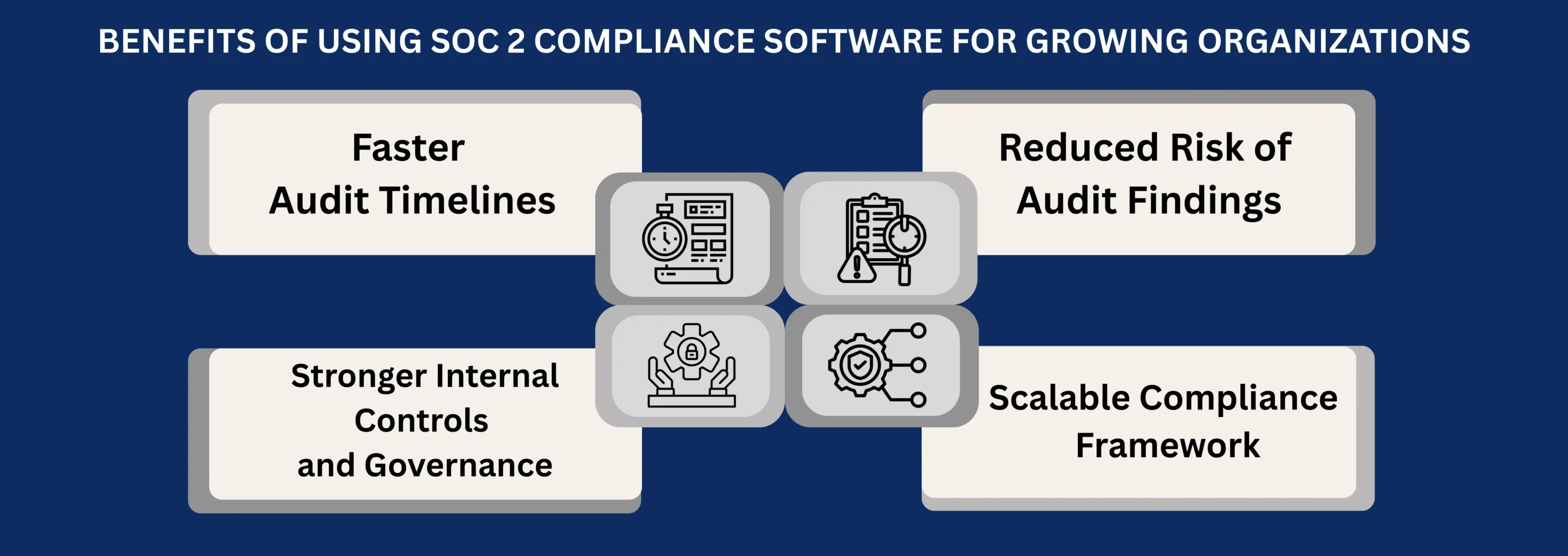
SOC 2 Certification in Victoria produces independently verified documentation of an organization’s control environment. The attestation report, issued by a Licensed CPA Firm, serves as the primary evidence instrument in enterprise vendor reviews, financial sector procurement processes, and international business development activities. The benefits below reflect the functional outcomes of completing a SOC 2 examination and maintaining annual audit cycles.
- ✓Independent third-party verification of control design and operating effectiveness against AICPA Trust Services Criteria
- ✓Recognized SOC 2 attestation instrument accepted in U.S. enterprise vendor due diligence and procurement processes
- ✓Demonstrated SOC 2 compliance supporting financial sector, healthcare, and regulated industry vendor approvals
- ✓Structured SOC 2 audit methodology providing annual visibility into control performance and exception trends
- ✓Reduced customer security questionnaire burden through distribution of the SOC 2 attestation report
- ✓Competitive differentiation in U.S. market expansion for Victoria-based SaaS and cloud service providers
- ✓Ongoing surveillance oversight through annual Type II audit cycles maintaining current SOC 2 certification status
- ✓Documented evidence of control maturity recognized in international supply chain and third-party risk programs
A current SOC 2 Type II attestation report directly reduces the time and resources required to respond to customer security questionnaires. Enterprise customers that have accepted a SOC 2 report into their vendor management program typically use the report as primary evidence of control assurance — reducing the number of individual questionnaire items that require separate responses.
For Victoria-based technology organizations managing relationships with multiple U.S. enterprise customers, the SOC 2 attestation report functions as a scalable assurance instrument. Produced once through a single examination engagement, it can be distributed to multiple customers under confidentiality agreements.
The reduction in questionnaire burden is particularly material for organizations in Victoria’s SaaS sector, where sales cycles with enterprise customers frequently stall at the security review stage. The SOC 2 attestation report provides procurement and information security teams with a standardized, auditor-reviewed document that addresses the most common vendor assurance questions in a single instrument.
This accelerates vendor approval timelines, reduces the internal resource cost of managing security review responses, and enables sales teams to advance enterprise deals through procurement without extended delays at the security diligence stage.
The annual SOC 2 audit cycle imposes structured discipline on an organization’s control environment. Because controls must operate effectively throughout the observation period to receive a clean attestation opinion, organizations maintaining SOC 2 certification in Victoria develop systematic processes for evidence collection, control monitoring, and exception management.
The audit cycle creates a recurring cadence of internal review that surfaces control gaps, operational deviations, and emerging risks before they become material findings in the attestation report. This discipline is inherently valuable independent of the attestation output it produces.
- ✓Vendor Assurance and Security Questionnaire Reduction
- ✓Control Maturity and Annual Audit Discipline
SOC 2 Certification Requirements for Victoria Organizations
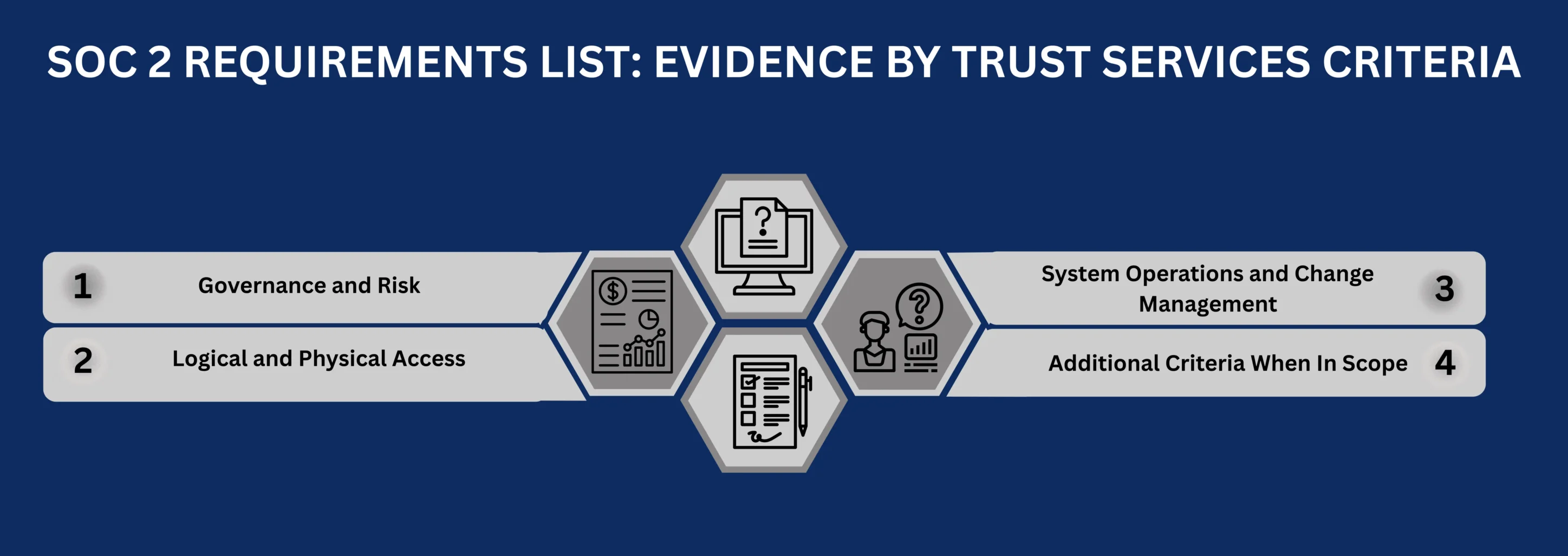
SOC 2 certification requirements are defined by the AICPA Trust Services Criteria and the attestation standards governing the examination engagement. Victoria-based organizations pursuing SOC 2 Certification must satisfy both documentation requirements and operational requirements before and during the examination. The following sections describe the primary requirements evaluated by the Licensed CPA Firm during the SOC 2 audit process.
The service organization must prepare and maintain a system description that accurately describes the services provided, the system boundaries, the principal service commitments and system requirements, the components of the system (infrastructure, software, people, processes, and data), and the controls implemented to address the Trust Services Criteria.
The system description is a central document in the SOC 2 examination — it forms the basis for control testing and the auditor’s evaluation of whether the description is fairly presented. Inaccuracies or omissions can result in qualification of the auditor’s opinion and undermine the value of the SOC 2 attestation.
Supporting documentation required for the SOC 2 examination includes information security policies covering access control, incident response, change management, and risk assessment; evidence of policy communication and employee acknowledgment; risk assessment outputs and treatment plans; vendor management records for subservice organizations; and system configuration documentation evidencing technical control implementation.
For SOC 2 compliance Victoria programs operating in cloud environments, infrastructure-as-code configurations, cloud security posture management tool outputs, and provider compliance documentation — such as AWS or Azure SOC 2 reports under the carve-out method — form part of the evidence base.
The Common Criteria (Security) require organizations to implement and evidence controls across logical access, physical access, change management, risk assessment, incident response, and monitoring. Specific technical requirements include multi-factor authentication for privileged access, encryption of data in transit and at rest, vulnerability scanning and patch management processes, logging and alerting for security events, and formal incident response procedures with documented testing.
These controls must be implemented, documented, and consistently operated throughout the observation period to support operating effectiveness testing during the SOC 2 audit Victoria engagement.
Additional criteria categories impose incremental technical requirements. Availability criteria require controls over system capacity monitoring, backup and recovery testing, and service continuity planning. Processing Integrity criteria require controls over input validation, output reconciliation, and error handling processes. Confidentiality criteria require controls over the identification, classification, and protection of confidential information — including retention and disposal procedures.
Privacy criteria require controls aligned with the organization’s privacy notice and applicable privacy principles, covering data collection, use limitation, access, and breach notification. Each category requires specific evidence demonstrating control operation during the SOC 2 examination observation period.
- ✓Documentation and System Description Requirements
- ✓Technical Control Requirements Across Trust Services Criteria
SOC 2 vs. Other Assurance Frameworks Relevant to Victoria
Victoria-based organizations evaluating their assurance program options frequently consider SOC 2 alongside other frameworks including ISO 27001, the NIST Cybersecurity Framework, and the Australian Government’s Essential Eight. Each framework addresses information security from a distinct perspective, and the choice of framework depends on the target market, customer requirements, and regulatory environment.
SOC 2 certification is the recognized standard specifically for U.S.-connected vendor assurance and third-party risk management. ISO 27001 is more commonly recognized in European and Asia-Pacific procurement contexts. Understanding this distinction is essential before committing to a SOC 2 examination or an alternative assurance path.
SOC 2 Certification vs. ISO 27001 Certification
SOC 2 and ISO 27001 differ in their governing bodies, audit structure, and primary markets. SOC 2 is governed by the AICPA and is conducted exclusively by a Licensed CPA Firm as an attestation engagement under AT-C Section 205. ISO 27001 is governed by the International Organization for Standardization and is certified by accredited certification bodies through a conformity assessment process.
SOC 2 evaluates controls against the Trust Services Criteria specific to a defined system and service period. ISO 27001 certifies an information security management system (ISMS) against a set of management system requirements and Annex A control domains. The two frameworks are complementary, but they serve different assurance purposes.
For Victoria-based organizations targeting U.S. enterprise markets, SOC 2 certification is typically prioritized over ISO 27001 because U.S. enterprise procurement teams and financial sector vendor programs specifically request SOC 2 attestation reports. ISO 27001 certification, while valuable for European and domestic Australian procurement, does not substitute for the SOC 2 examination output in U.S. vendor assurance contexts.
Organizations with global customer bases often pursue both certifications. However, where resources require prioritization, SOC 2 compliance Victoria programs directed at U.S. market access should target SOC 2 examination as the primary assurance instrument. SOC 2 examination Victoria engagements are the correct pathway for organizations whose primary assurance requirement is U.S. enterprise vendor approval.
SOC 2 and the Australian Regulatory Environment
SOC 2 attestation operates alongside — rather than in place of — Australian regulatory obligations. The Privacy Act 1988, the Australian Privacy Principles, the Notifiable Data Breaches scheme, and APRA Prudential Standard CPS 234 each impose distinct obligations on Victoria-based organizations. SOC 2 attestation does not constitute compliance with these instruments.
However, the control environment demonstrated through SOC 2 Certification in Victoria is directly relevant to meeting obligations under CPS 234 and the Privacy Act’s security requirement. Organizations that have completed a SOC 2 Type II examination possess documented and tested control environments that provide substantive evidence of information security maturity relevant to Australian regulatory assessments.
Maintaining SOC 2 Certification in Victoria
SOC 2 certification does not represent a permanent status. The attestation report issued at the conclusion of each examination covers a specific period and is typically valid for twelve months from the end of the observation period. Organizations maintaining SOC 2 Certification in Victoria must complete annual examination cycles to ensure their attestation report remains current and accepted in enterprise vendor programs.
The annual cycle requires ongoing control operation, continuous evidence collection, and engagement of the Licensed CPA Firm for each new examination period. Allowing certification to lapse can disrupt active enterprise customer relationships and stall procurement processes.
Annual Audit Cycles and Report Validity
Enterprise customers that rely on SOC 2 attestation reports for vendor assurance typically require current reports — issued within the preceding twelve months. Once a SOC 2 Type II report expires, customers may request updated reports or impose additional security review requirements pending receipt of a current attestation.
For Victoria-based organizations managing multiple enterprise customer relationships, maintaining a continuous annual audit cycle is the most effective approach to ensuring report currency across all customer programs simultaneously. Organizations should plan observation period start and end dates to align with customer contract renewal cycles where possible.
Scope changes between audit periods — such as the addition of new services, migration to a new cloud platform, or expansion of the system boundary — require evaluation of their impact on the examination scope and the Trust Services Criteria applicable to the new or modified system components. Material scope changes may require adjustment of the audit program or extension of the observation period to ensure adequate coverage of new control areas.
The Licensed CPA Firm evaluates scope changes in the context of each annual engagement and determines appropriate examination adjustments to maintain the integrity of the SOC 2 attestation output.
Control Monitoring and Evidence Management Between Audits
Effective maintenance of SOC 2 certification in Victoria requires continuous control monitoring and systematic evidence management throughout the year — not only in the weeks preceding the annual examination. Controls must operate consistently throughout the entire observation period to support operating effectiveness testing.
Organizations that allow controls to lapse or fail to collect contemporaneous evidence during the observation period risk producing audit findings that affect the auditor’s opinion. Systematic evidence collection processes — including automated log collection, periodic access reviews, change management record retention, and incident log maintenance — support clean examination outcomes in annual SOC 2 audit Victoria cycles.
FAQ
▶
Control Maturity and Annual Audit Discipline
▶
What is SOC 2 certification?
▶
Who needs SOC 2 certification?
▶
How long does the SOC 2 certification process take?
▶
What are the benefits of SOC 2 certification?
▶
How should an organization prepare for SOC 2 certification?
▶
What does the SOC 2 audit assess?
▶
What happens after SOC 2 certification is achieved?
SOC 1 VS SOC 2: WHICH REPORT YOUR CUSTOMERS ACTUALLY ASK FOR
If you sell SaaS or provide outsourced services, you have likely been asked for a SOC report. However, the follow-up question is rarely easy to answer…
SOC 2 Certified: What Does It Mean for Your Business
For companies that handle sensitive data or run cloud-based services, the question “Can you provide your SOC 2 report?” carries enormous weight. Yet, …
HOW SOC 2 AUDITORS REVIEW EVIDENCE OVER TIME
Most businesses pursuing a SOC 2 report spend months building security controls but overlook a fundamental reality: SOC 2 auditors do not just verify …
Get In Touch
have a question? let us get back to you.