
SOC 2 Certification in Vienna
SOC 2 Certification in Vienna is pursued primarily in response to explicit requirements from enterprise clients, financial sector procurement programs, and third-party risk management frameworks operated by U.S. and international organizations. The demand for SOC 2 attestation reflects a growing expectation that service organizations demonstrate independent verification of their control environments — not merely assert compliance through self-declaration. Several distinct business drivers motivate Vienna-based organizations to initiate the SOC 2 examination process.
OUR CLIENTS










SOC 2 Certification for Vienna-Based Financial and Technology Organizations
SOC 2 Certification in Vienna is issued by a Licensed CPA Firm following a formal examination conducted under AICPA attestation standards — specifically AT-C Section 105 and AT-C Section 205 — and evaluated against the Trust Services Criteria (TSC) established by the AICPA. The attestation confirms that a Vienna-based service organization’s control environment has been independently reviewed and formally attested, not self-assessed or self-declared. This independent examination is the foundation of SOC 2 attestation as a certification activity — one that is fundamentally distinct from consulting, readiness, or advisory services. Organizations seeking SOC 2 Certification in Vienna must engage a Licensed CPA Firm to conduct the formal SOC 2 audit; no other pathway produces a valid SOC 2 attestation report under AICPA standards.
Vienna as a Regional Hub for SOC 2 Demand
Vienna functions as a regional headquarters hub for Central and Eastern European operations, a concentration point for banking and financial services institutions, and a growing ecosystem of SaaS providers, enterprise software firms, cloud service providers, and managed IT services organizations. The city hosts regional offices of international banks, insurance groups, and financial intermediaries governed by both Austrian and EU-level regulatory frameworks.
Vienna-based life sciences and biotechnology companies — along with a diverse range of technology startups and scale-ups — process sensitive customer and patient data on behalf of U.S. and internationally regulated clients. As enterprise procurement programs and third-party risk management frameworks increasingly require verified security attestations, organizations in Vienna face SOC 2 compliance expectations from clients, partners, and stakeholders in North American and global markets. SOC 2 Certification in Vienna addresses these requirements through an independent examination that produces a formal attestation report issued under AICPA standards — not a self-assessment certificate or an internal compliance declaration.
Licensed CPA Firm and Independent Certification Authority
SOC 2 Certification is issued exclusively by a Licensed CPA Firm authorized to perform attestation engagements under AICPA standards. This distinguishes a SOC 2 attestation from ISO certifications, self-assessments, or vendor questionnaires. The Licensed CPA Firm conducts an independent SOC 2 examination of the service organization’s control environment, evaluating the design and operating effectiveness of controls relevant to the selected Trust Services Criteria — Security, Availability, Processing Integrity, Confidentiality, and Privacy.
For Vienna-based organizations, this means engaging a CPA Firm with demonstrated competency in international attestation engagements and familiarity with the regulatory landscape in which these organizations operate. The resulting SOC 2 attestation report is an auditor-issued document that carries institutional credibility in enterprise procurement reviews, vendor assurance programs, and financial sector due diligence processes. SOC 2 Certification in Vienna therefore represents an externally validated confirmation of a service organization’s control posture — not a self-declared compliance status.
Trust Services Criteria and Scope of Examination
The Trust Services Criteria (TSC) are the evaluative framework against which a SOC 2 examination is conducted. Developed and maintained by the AICPA, the TSC define specific control requirements across five categories: Security (the common criteria applicable to all SOC 2 engagements), Availability, Processing Integrity, Confidentiality, and Privacy.
Vienna-based organizations typically scope their SOC 2 examination to include Security as a mandatory category, with additional categories selected based on the nature of their services and contractual commitments to clients. A SaaS provider serving financial institutions in Vienna may include Availability and Confidentiality, while a healthcare data processor may additionally include Privacy. The scope of the SOC 2 examination is formally defined prior to audit commencement and documented in the system description prepared by the service organization. The Licensed CPA Firm evaluates controls against the TSC during the SOC 2 audit and issues an attestation opinion that reflects the examination findings — this opinion is the substantive output of SOC 2 Certification in Vienna.

SOC 2 Certification Audit Process for Organizations in Vienna
The SOC 2 audit process for Vienna-based organizations follows a structured examination methodology governed by AICPA attestation standards AT-C Section 105 and AT-C Section 205. Each stage of the SOC 2 examination involves defined activities, evaluation criteria, and documentation requirements. The process is conducted by a Licensed CPA Firm and results in either a SOC 2 Type I or SOC 2 Type II attestation report.
Understanding the SOC 2 audit process enables Vienna-based organizations to plan effectively for the examination and maintain evidence in a format that supports efficient evaluation by the auditing firm. Proper preparation at each stage reduces the likelihood of exceptions and contributes to a more efficient report issuance timeline.
The SOC 2 examination begins with a formal scope definition phase. The service organization and the Licensed CPA Firm jointly confirm the boundaries of the system under examination — including the infrastructure, software, people, procedures, and data relevant to the services provided. The organization determines which Trust Services Criteria categories to include in the SOC 2 audit based on its service commitments and customer contractual requirements.
The audit program is then formalized, specifying the evaluation criteria, evidence collection procedures, and observation period applicable to the engagement. For SOC 2 Type II examinations, the observation period typically spans a minimum of six months, during which the CPA Firm evaluates whether controls operated effectively over time. Vienna-based organizations engaged in financial data processing, cloud infrastructure management, or SaaS delivery commonly scope their SOC 2 audit to cover Security and Availability at a minimum. The scope is documented in the formal system description that accompanies the final attestation report.
A SOC 2 Type I examination assesses whether the service organization’s controls are suitably designed as of a specified point in time. The Licensed CPA Firm reviews the system description and evaluates the design of controls against the applicable Trust Services Criteria — without testing operating effectiveness over a period. A SOC 2 Type II examination extends the assessment to include testing of operating effectiveness over the observation period, typically six to twelve months, through evidence collection, inquiry, observation, and re-performance procedures.
The SOC 2 Type II report is the standard expected by most enterprise clients in financial services, technology, and regulated industries. Vienna-based organizations seeking to satisfy U.S. client procurement requirements or international vendor assurance programs are generally expected to produce a current SOC 2 Type II attestation report. Each examination type concludes with a formal attestation opinion issued by the Licensed CPA Firm, describing the auditor’s findings and any exceptions identified during the SOC 2 audit.
| Audit Stage | Key Activities | Output |
|---|---|---|
| Scope Definition | Confirm system boundaries, select Trust Services Criteria categories, document service commitments | Formal scope and audit program |
| Stage 1 Review | Review system description, evaluate control design against TSC, identify documentation gaps | Readiness assessment findings |
| Stage 2 Examination | Test operating effectiveness of controls over observation period through evidence collection and inquiry | Audit findings and exceptions |
| Nonconformity Review | Evaluate identified control deficiencies, determine severity, document management responses | Nonconformity log |
| Attestation Issuance | Licensed CPA Firm issues SOC 2 Type I or Type II report with formal auditor opinion | SOC 2 Attestation Report |
During the SOC 2 Type II observation period, the Licensed CPA Firm collects evidence through document review, system log inspection, personnel inquiry, and re-performance of selected control procedures. Evidence is evaluated against the applicable Trust Services Criteria to determine whether controls operated consistently and effectively throughout the examination period.
Where control deficiencies or exceptions are identified, the auditor documents these as nonconformities and communicates findings to the service organization. Management provides formal responses to identified exceptions, which are included in the final attestation report. The report contains the auditor’s opinion, the management-prepared system description, and detailed testing results for each Trust Services Criteria category in scope.
Vienna-based organizations should maintain continuous evidence documentation — including access logs, incident records, change management approvals, and vendor review records — throughout the observation period. Doing so supports an efficient SOC 2 examination and minimizes the likelihood of exceptions in the final report.
- ✓Scope Definition and Audit Program Determination
- ✓SOC 2 Type I and Type II Examination Stages
- ✓Evidence Collection, Nonconformity Review, and Report Issuance
Why Organizations in Vienna Pursue SOC 2 Certification
SOC 2 Certification in Vienna is pursued primarily in response to explicit requirements from enterprise clients, financial sector procurement programs, and third-party risk management frameworks operated by U.S. and international organizations. The demand for SOC 2 attestation reflects a growing expectation that service organizations demonstrate independent verification of their control environments — not merely assert compliance through self-declaration. Several distinct business drivers motivate Vienna-based organizations to initiate the SOC 2 examination process.
Enterprise Vendor Security Reviews and Financial Sector Procurement
Vienna-based technology and SaaS companies that supply services to U.S.-headquartered enterprises, financial institutions, or regulated entities routinely encounter SOC 2 compliance requirements embedded in vendor onboarding processes. Enterprise procurement teams and third-party risk management programs at major financial institutions require service providers to produce current SOC 2 Type II attestation reports as a condition of contract approval or vendor registration.
A Vienna-based SaaS provider offering data analytics or cloud infrastructure services to a U.S. bank, for example, would be expected to furnish a SOC 2 Type II report covering at minimum the Security Trust Services Criterion. Without SOC 2 attestation, a Vienna-based organization may be excluded from vendor lists or subject to prolonged due diligence processes that delay contract execution. SOC 2 Certification in Vienna therefore directly enables access to enterprise client relationships in regulated markets where independent control verification is a non-negotiable requirement.
International SaaS Expansion and Cross-Border Compliance Expectations
Vienna-based SaaS providers and cloud service companies expanding into North American markets face SOC 2 attestation requirements as a standard condition of market entry in regulated sectors. Enterprise buyers in the United States, Canada, and the United Kingdom routinely include SOC 2 Type II reports in their security assessment checklists during vendor selection.
For Vienna-based fintech organizations and enterprise software companies, achieving SOC 2 Certification in Vienna requires demonstrating that controls governing customer data security, system availability, and processing integrity have been independently audited by a Licensed CPA Firm. SOC 2 attestation also supports compliance with contractual obligations to clients operating under frameworks such as the U.S. Gramm-Leach-Bliley Act (GLBA), the Health Insurance Portability and Accountability Act (HIPAA), or sector-specific data security requirements. The SOC 2 examination provides a structured, internationally recognized mechanism for Vienna-based organizations to demonstrate control effectiveness to clients operating under diverse regulatory regimes.
Life Sciences, Biotech, and Managed Services Demand Drivers
Vienna’s established life sciences and biotechnology sector includes organizations that manage clinical trial data, patient health information, and regulated research datasets. These organizations frequently supply data management and IT services to U.S. and EU pharmaceutical companies, academic medical centers, and contract research organizations — all of which require SOC 2 compliance as part of their vendor assurance programs alongside HIPAA business associate requirements.
Managed service providers and IT outsourcing firms headquartered in Vienna similarly encounter SOC 2 attestation requirements from clients in financial services, healthcare, and government sectors. As regional headquarters for Central and Eastern European operations, Vienna-based entities also face SOC 2 examination requirements from parent companies that mandate SOC 2 compliance across all subsidiaries and service providers within their vendor ecosystem. SOC 2 Certification in Vienna for organizations in these sectors provides documented, auditor-issued evidence of control effectiveness that satisfies both parent company requirements and client procurement obligations.
SOC 2 Certification Requirements and Evaluation Criteria
SOC 2 Certification requirements are defined by the AICPA’s Trust Services Criteria and the attestation standards governing the examination engagement. The evaluation is conducted by a Licensed CPA Firm against objective criteria — not against a proprietary checklist or internal standard. Understanding the specific requirements enables Vienna-based organizations to structure their control environments in alignment with the TSC before engaging a CPA Firm for the formal SOC 2 audit in Vienna.
The Security category — also referred to as the Common Criteria — is mandatory in every SOC 2 examination and forms the evaluative foundation of all SOC 2 attestation engagements. The Common Criteria are organized around the COSO framework’s components: control environment, communication and information, risk assessment, monitoring activities, and control activities.
Within the Security category, the TSC address logical and physical access controls, system operations, change management, and risk mitigation. For Vienna-based technology organizations, the Security category requires documented and operational controls governing user access provisioning and de-provisioning, multi-factor authentication, encryption of data in transit and at rest, vulnerability management, and incident response.
The Licensed CPA Firm evaluates whether these controls are suitably designed (Type I) or both suitably designed and operating effectively over the observation period (Type II). Evidence required includes access review logs, system configuration records, vulnerability scan reports, incident response records, and documented change management procedures.
Beyond Security, Vienna-based organizations may include Availability, Processing Integrity, Confidentiality, or Privacy in their SOC 2 examination scope based on service commitments and client requirements. The Availability category evaluates controls ensuring the system is available for operation and use as committed — relevant for cloud infrastructure providers, SaaS platforms, and managed service providers with uptime obligations.
The Confidentiality category assesses controls protecting information designated as confidential — applicable to organizations handling proprietary client data, trade secrets, or regulated financial information. The Privacy category evaluates controls governing the collection, use, retention, disclosure, and disposal of personal information — particularly relevant for Vienna-based organizations processing data subject to GDPR obligations alongside U.S. privacy frameworks.
Each additional Trust Services Criterion requires its own set of documented controls and operational evidence. The selection of applicable categories is documented in the system description and confirmed with the Licensed CPA Firm during the scope definition phase of the SOC 2 audit engagement.
The SOC 2 examination requires a defined set of documentation that the service organization prepares and maintains prior to and throughout the audit engagement. The system description — a management-prepared document outlining the service organization’s system boundaries, control environment, and relevant controls — is a mandatory component of every SOC 2 attestation report.
Supporting documentation includes information security policies, access control procedures, risk assessment records, business continuity and disaster recovery plans, vendor management documentation, and operational logs. During a SOC 2 Type II examination, the Licensed CPA Firm collects and evaluates evidence of control operation across the observation period — including system-generated logs, approval records, exception reports, and personnel training records.
Vienna-based organizations are expected to maintain evidence in organized, retrievable formats that enable efficient sampling and testing by the auditing firm. The completeness and accuracy of documentation directly influences the efficiency of the SOC 2 audit and the nature of the auditor’s findings in the final attestation report.
- ✓Formally documented system description covering system boundaries and service commitments
- ✓Information security policy, access control policy, and incident response procedures
- ✓Risk assessment records identifying threats relevant to the Trust Services Criteria in scope
- ✓User access provisioning and de-provisioning logs covering the observation period
- ✓Vulnerability management records including scan results and remediation tracking
- ✓Change management approval records and system configuration baselines
- ✓Business continuity and disaster recovery plans with documented testing results
- ✓Vendor and subservice organization management documentation and monitoring records
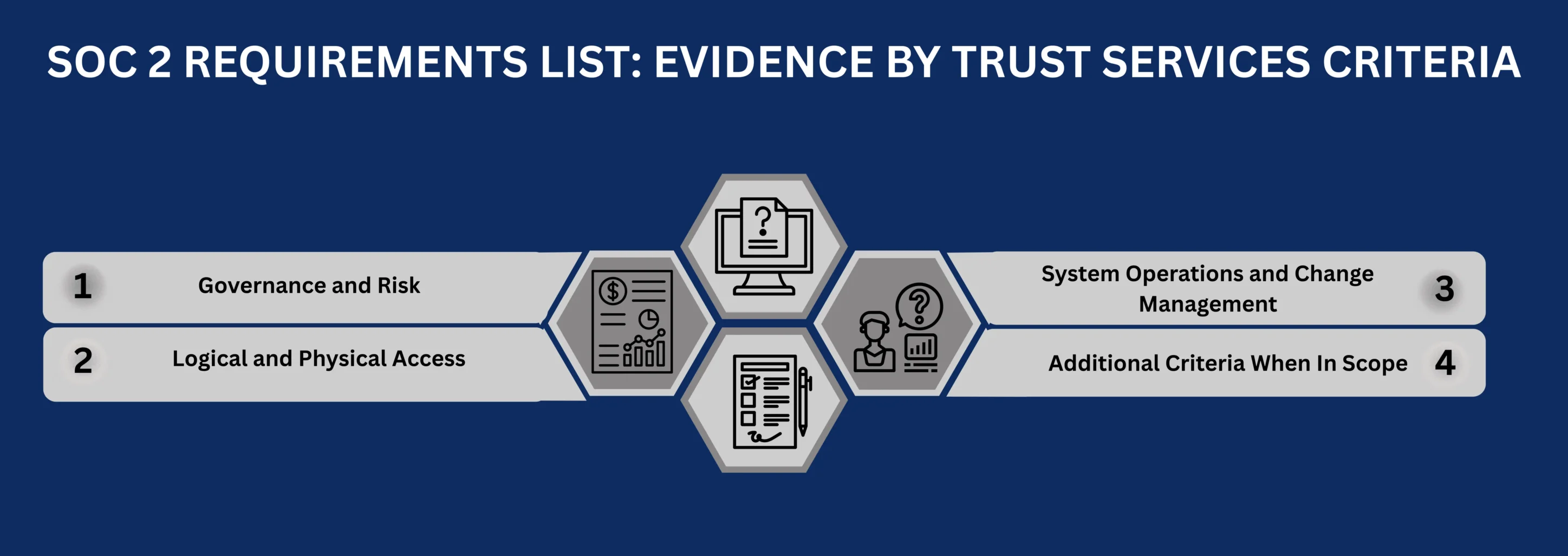
- ✓Trust Services Criteria: Security and Common Criteria
- ✓Additional Trust Services Criteria: Availability, Confidentiality, and Privacy
- ✓Documentation Requirements and Control Evidence
SOC 2 Type I vs. SOC 2 Type II: Selecting the Appropriate Report
SOC 2 Certification in Vienna is available in two report types — Type I and Type II — each serving distinct purposes in enterprise vendor assurance and client due diligence. The selection of the appropriate report type is determined by client requirements, the maturity of the organization’s control environment, and the specific nature of the attestation being sought. Understanding the structural difference between the two report types enables Vienna-based organizations to initiate the SOC 2 audit process with appropriate scope and timeline planning.
SOC 2 Type I: Point-in-Time Design Assessment
A SOC 2 Type I report reflects the Licensed CPA Firm’s opinion on whether the service organization’s controls are suitably designed to meet the applicable Trust Services Criteria as of a specific date. The Type I examination does not include testing of control operating effectiveness over time — it evaluates design only.
Vienna-based organizations may pursue a SOC 2 Type I report as an initial attestation to demonstrate to prospective clients that a structured control environment exists and has been independently evaluated. The SOC 2 Type I attestation is typically produced more quickly than a Type II report because it does not require an observation period. However, most mature enterprise procurement programs and financial institution vendor assurance frameworks require a SOC 2 Type II report before granting vendor approval.
A Type I report may serve as a transitional attestation while an organization accumulates the observation period evidence necessary for a Type II examination. The Type I report remains a valid point-in-time attestation and is issued under the same AICPA attestation standards as the Type II report.
SOC 2 Type II: Operating Effectiveness Over the Observation Period
A SOC 2 Type II report reflects the Licensed CPA Firm’s opinion on whether the service organization’s controls are suitably designed and operated effectively throughout the defined observation period. The observation period for a SOC 2 Type II examination is typically six to twelve months. During this period, the CPA Firm collects and evaluates evidence demonstrating that controls functioned as designed on a consistent basis.
The SOC 2 Type II attestation is the standard report type expected by enterprise clients in financial services, healthcare, and regulated technology sectors — including organizations in the U.S. market that require verified SOC 2 compliance from their European service providers. For Vienna-based SaaS companies, cloud providers, and financial technology organizations, the SOC 2 Type II report provides the most substantive form of attestation and carries the greatest weight in enterprise procurement and third-party risk management evaluations.
Annual renewal of the SOC 2 Type II attestation through successive examination cycles is required to maintain current certified status. Attestation reports are time-limited to the observation period covered and must be refreshed to remain acceptable to enterprise clients.
| Characteristic | SOC 2 Type I | SOC 2 Type II |
|---|---|---|
| Assessment focus | Control design as of a specified date | Control design and operating effectiveness over a defined period |
| Observation period | None — point-in-time assessment only | Typically 6 to 12 months |
| Enterprise acceptance | Limited — commonly used as a transitional attestation | Standard requirement in regulated and enterprise sectors |
| Report components | System description and control design opinion | System description, design opinion, and detailed test results |
| Renewal cycle | Not typically renewed on an annual basis | Annual renewal through successive examinations required |
Benefits of SOC 2 Certification for Vienna-Based Organizations
SOC 2 Certification delivers demonstrable and measurable outcomes for Vienna-based organizations operating in competitive, compliance-intensive markets. The benefits of SOC 2 attestation extend across commercial, operational, and risk management dimensions. Vienna-based service organizations gain independently verified evidence of control effectiveness that is recognized in enterprise procurement programs and financial sector due diligence processes globally — making SOC 2 Certification in Vienna a strategic investment as well as a compliance obligation.
SOC 2 Certification in Vienna provides organizations with an auditor-issued attestation report that serves as independent third-party verification of control effectiveness. This form of evidence carries substantially greater weight in enterprise vendor assessments than self-completed questionnaires or internal compliance declarations.
Enterprise procurement teams at financial institutions, technology companies, and regulated entities accept SOC 2 Type II attestation reports as a primary data point in their vendor security evaluation process. For Vienna-based organizations competing for contracts with U.S. and international enterprise clients, a current SOC 2 Type II attestation report reduces friction in vendor onboarding, shortens the due diligence cycle, and provides procurement teams with the structured evidence they require to approve vendor registration.
SOC 2 attestation also satisfies vendor risk management obligations for clients who are themselves subject to regulatory examination — as regulators frequently review the third-party assurance documentation maintained by regulated entities.
The SOC 2 examination process provides Vienna-based organizations with a structured methodology for evaluating control design and operating effectiveness that extends well beyond the audit period itself. The annual SOC 2 examination cycle creates a continuous rhythm of control monitoring, evidence documentation, and independent review — reinforcing operational discipline across the organization’s control environment.
For Vienna-based technology companies and financial services organizations, the requirement to maintain continuous evidence throughout the SOC 2 observation period — covering access reviews, vulnerability management, incident response, and change management — drives consistent operational practices that reduce security risk over time. The Licensed CPA Firm’s formal findings, including any identified exceptions or nonconformities, provide management with an independently validated view of control gaps that informs internal risk management decisions. This structured oversight function is a recognized benefit of SOC 2 compliance that extends beyond the commercial value of the attestation report itself.
- ✓Independent third-party validation of control design and operating effectiveness recognized in enterprise procurement
- ✓Formal attestation report issued by a Licensed CPA Firm under AICPA standards — not a self-declared certificate
- ✓Structured annual examination cycle that reinforces continuous control monitoring and evidence documentation
- ✓Satisfaction of client contractual requirements for SOC 2 compliance in financial services and technology sectors
- ✓Reduced vendor due diligence friction and faster onboarding with U.S. and international enterprise clients
- ✓Auditor-identified exceptions provide management with independently validated control improvement intelligence
- ✓Recognition in financial sector procurement programs operated by regulated institutions in North American and European markets
- ✓Support for international SaaS expansion into markets where SOC 2 Type II attestation is a standard vendor requirement
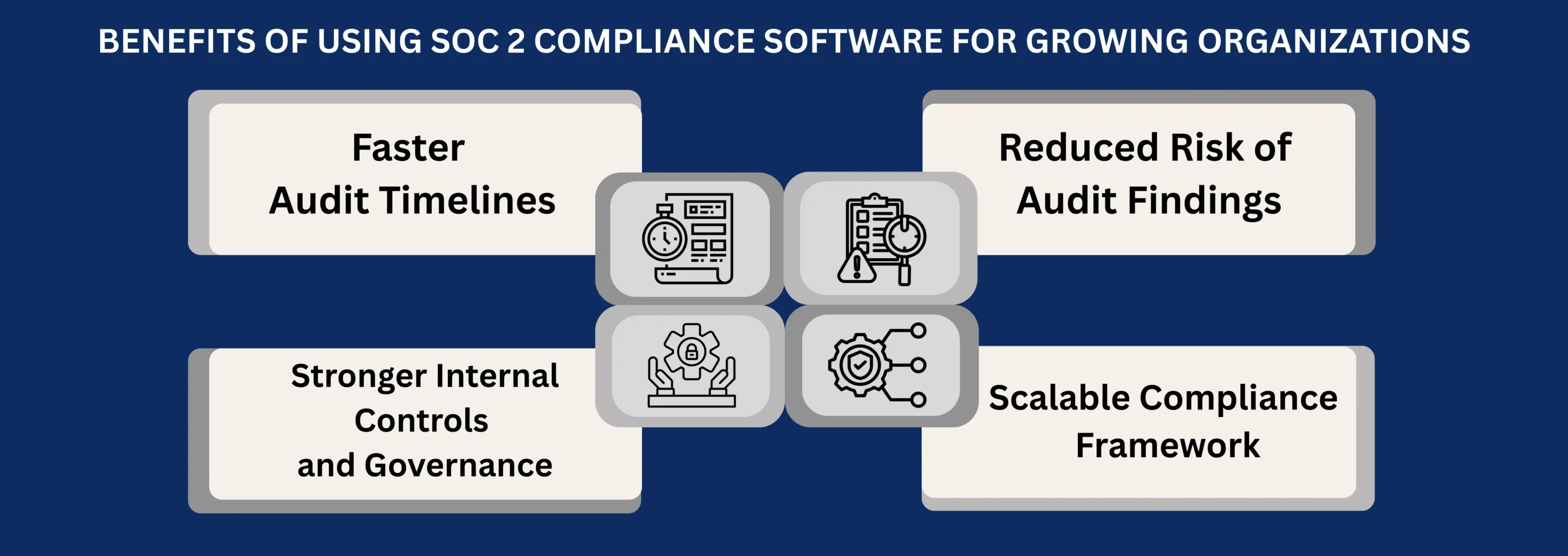
- ✓Independent Verification and Enterprise Procurement Recognition
- ✓Structured Audit Methodology and Ongoing Control Oversight
Business Sectors in Vienna Seeking SOC 2 Certification
SOC 2 Certification in Vienna is sought by a diverse range of business sectors whose operations involve processing, storing, or transmitting customer data on behalf of regulated clients. The city’s economic profile — encompassing financial services, life sciences, enterprise software, and regional headquarters functions — creates a concentrated demand for SOC 2 attestation that reflects both client-driven requirements and internal risk management objectives. Organizations across these sectors pursue SOC 2 Certification in Vienna to satisfy procurement requirements, maintain vendor-approved status, and demonstrate independently verified control effectiveness.
Financial Services, Fintech, and Banking Organizations
Vienna’s financial services sector includes international banking groups, insurance companies, asset management firms, and a growing fintech ecosystem. Financial services organizations in Vienna pursue SOC 2 Certification primarily in response to client expectations, correspondent banking relationships, and vendor risk management requirements imposed by U.S. financial institutions.
Vienna-based fintech companies — including payment processing platforms, digital banking infrastructure providers, and financial data aggregators — encounter SOC 2 examination requirements from clients and partners in North American markets where SOC 2 compliance is a standard vendor security baseline. For banking and financial services organizations in Vienna that act as subservice organizations for international financial groups, SOC 2 attestation provides the carve-out or inclusive documentation required by their clients’ own SOC 2 audit programs. The SOC 2 examination addresses controls relevant to transaction security, data confidentiality, and system availability — criteria directly aligned with the operational requirements of financial service delivery environments.
SaaS Providers, Cloud Companies, and Enterprise Technology Organizations
Vienna-based SaaS providers, cloud infrastructure companies, and enterprise software organizations constitute a primary segment of SOC 2 certification demand. These organizations typically provide services — including cloud storage, data processing, enterprise resource planning, and customer relationship management platforms — to clients in regulated industries who require SOC 2 compliance as a condition of vendor approval.
SOC 2 Certification in Vienna enables technology sector organizations to compete effectively for enterprise contracts in the U.S., UK, and global markets where SOC 2 Type II attestation is a standard procurement requirement. Vienna-based technology companies serving regulated clients in healthcare, financial services, and government sectors are expected to demonstrate current SOC 2 examination results annually to maintain vendor-approved status.
Managed service providers (MSPs) and IT outsourcing firms based in Vienna also encounter SOC 2 attestation requirements from enterprise clients who treat MSPs as subservice organizations within their own SOC 2 examination scope — requiring the MSP to produce its own SOC 2 report or be subject to complementary user entity controls.
Life Sciences, Biotech, and Regional Headquarters Organizations
Vienna’s established life sciences and biotechnology sector includes contract research organizations, clinical data management companies, and health informatics providers that process patient data, clinical trial records, and regulated research datasets. These organizations supply data processing and IT services to U.S. pharmaceutical companies, academic medical centers, and healthcare systems that require SOC 2 compliance as part of their vendor risk management programs alongside HIPAA business associate requirements.
Regional headquarters organizations that manage data flows, IT infrastructure, or shared services for Central and Eastern European operations on behalf of parent companies headquartered in the U.S. or internationally are increasingly required to demonstrate SOC 2 attestation as part of the parent entity’s group-level vendor assurance framework. The SOC 2 examination for these organizations documents the control environment governing the processing of data under regional headquarters functions — providing parent company auditors and regulators with independently verified evidence of control effectiveness at the Vienna entity level.
SOC 2 Certification Maintenance, Report Validity, and Recertification
SOC 2 Certification in Vienna is not a permanent designation. The SOC 2 attestation report covers a defined observation period — typically twelve months for Type II examinations — and its relevance as a current attestation diminishes as time passes beyond the report date. Vienna-based organizations that have achieved SOC 2 attestation are expected to maintain annual examination cycles to provide clients with continuously current evidence of control effectiveness. Allowing attestation to lapse can result in exclusion from vendor registers and enterprise procurement programs.
Report Validity and Annual Examination Cycles
A SOC 2 Type II attestation report is valid for the period it covers — typically a twelve-month observation period — and is considered current for approximately twelve months following the report issuance date. Enterprise clients and financial institution procurement programs generally require that the SOC 2 report provided during vendor onboarding or annual review covers an observation period ending within the previous twelve months.
Vienna-based organizations that allow more than twelve months to elapse between successive SOC 2 examinations risk producing outdated attestation reports that clients will not accept as evidence of current control effectiveness. To maintain continuous SOC 2 compliance, organizations schedule successive Type II examinations such that each new report’s observation period follows immediately from the preceding report’s coverage dates — creating a continuous chain of attestation without gaps. The Licensed CPA Firm engaged for the SOC 2 audit coordinates the timing of successive examinations to support this continuity objective.
Scope Changes, Control Updates, and Recertification Considerations
When a Vienna-based organization undergoes material changes to its systems, services, or control environment — such as migration to new cloud infrastructure, acquisition of a new business unit, or expansion of services into new geographic markets — the scope of the SOC 2 examination may require revision. Material changes to the system description or Trust Services Criteria in scope are evaluated by the Licensed CPA Firm prior to the commencement of the next examination cycle.
Significant scope expansions may require an extended observation period to ensure that the revised control environment is adequately covered by the SOC 2 audit. Organizations that introduce new subservice organizations — such as a new cloud infrastructure provider or a third-party data processing vendor — must address these additions within the system description and determine whether complementary user entity controls are appropriate. The annual SOC 2 examination cycle provides the framework within which scope changes are formally documented, evaluated, and incorporated into the updated attestation report issued by the Licensed CPA Firm.
FAQ
▶
What is SOC 2 Certification and how does it apply to Vienna-based organizations?
▶
Who issues SOC 2 Certification in Vienna?
▶
What is the difference between a SOC 2 Type I and SOC 2 Type II report?
▶
How long does the SOC 2 audit process take for Vienna-based organizations?
▶
Which Trust Services Criteria should Vienna-based organizations include in their SOC 2 examination?
▶
How does SOC 2 attestation differ from SOC 2 compliance?
▶
How often must Vienna-based organizations renew their SOC 2 Certification?
▶
Is SOC 2 Certification required for GDPR compliance in Vienna?
SOC 1 VS SOC 2: WHICH REPORT YOUR CUSTOMERS ACTUALLY ASK FOR
If you sell SaaS or provide outsourced services, you have likely been asked for a SOC report. However, the follow-up question is rarely easy to answer…
SOC 2 Certified: What Does It Mean for Your Business
For companies that handle sensitive data or run cloud-based services, the question “Can you provide your SOC 2 report?” carries enormous weight. Yet, …
HOW SOC 2 AUDITORS REVIEW EVIDENCE OVER TIME
Most businesses pursuing a SOC 2 report spend months building security controls but overlook a fundamental reality: SOC 2 auditors do not just verify …
Get In Touch
have a question? let us get back to you.