
A SOC 2 examination of BYOD (Bring Your Own Device) and mobile endpoints starts with the defined system scope, not the Mobile Device Management (MDM) enrollment list. The service auditor considers whether the relevant device population is complete and whether MDM reports provide reliable information for testing. Controls may address authentication, encryption, configuration, malicious software, access restrictions, and device handling. For a Type 2 examination, the service auditor also evaluates operating effectiveness over the examination period.
Mobile Device Management (MDM) can centrally manage laptops, smartphones, tablets, and other endpoints. It can enforce security configurations, manage access settings, report device compliance, and support remote lock or wipe actions. But an MDM console does not automatically establish which devices are relevant to a SOC 2 examination.
When an auditor opens a SOC 2 examination and asks for evidence of SOC 2 password requirements, most security teams reach for their written password policy. That document rarely tells the full story — especially when employees access production systems, cloud consoles, or customer data from personal iPhones and Android devices.
BYOD and mobile endpoints are where SOC 2 password requirements break down in practice. A policy can mandate 15-character passwords and MFA, but if those controls are not technically enforced on employee-owned devices, an independent auditor will note the gap. The question is not whether your policy says the right things. The question is whether your controls prove it.
This article explains exactly what independent auditors test when examining SOC 2 password requirements on BYOD and mobile endpoints:
- Covering the specific criteria under CC6
- The NIST SP 800-63B Rev 4 benchmarks auditors use
- The evidence they collect
- How SOC 2 encryption requirements and SOC 2 access control intersect on unmanaged devices
Understanding this scope helps technology organizations approach their SOC 2 examination with accurate expectations.
Concern
Technology organizations allowing employees to access production systems from personal phones and tablets face a specific audit risk: SOC 2 password requirements that are documented on paper but technically unenforceable on unmanaged endpoints expose a control gap that independent auditors are trained to find.
Overview
SOC 2 is a principles-based framework governed by the AICPA Trust Services Criteria. CC6.1, CC6.2, and CC6.3 require logical access controls, but the framework leaves enforcement method open. NIST SP 800-63B Rev 4 (July 2025) now sets the de facto benchmark auditors use.
Solution
Organizations must demonstrate that SOC 2 password requirements are technically enforced and not just written on every in-scope endpoint, including BYOD. MDM enrollment, conditional access policies, device-level encryption, and session-lock logs are the evidence auditors request.
How SOC 2 Password Requirements Map to CC6 and NIST SP 800-63B Rev 4
SOC 2 password requirements do not exist as a numbered checklist inside the AICPA Trust Services Criteria. Instead, they flow from the logical access control criteria in CC6. CC6.1 requires logical access security measures that protect information assets. CC6.2 requires that users are registered and authorized before receiving credentials. CC6.3 requires that access additions, changes, and removals follow a formal approval process (Source: AICPA Trust Services Criteria 2017, updated 2022).
Because the framework is principles-based, auditors exercise professional judgment to determine what 'appropriate' looks like in a given year. In practice, experienced auditors use NIST SP 800-63B as the reference benchmark for authentication strength. NIST SP 800-63B Revision 4, finalized in July 2025, made three changes that directly affect how auditors evaluate SOC 2 password requirements: minimum password length for single-factor authentication rose to 15 characters; mandatory periodic rotation was eliminated in favor of change-on-compromise only; and compromised credential screening became a required control rather than a recommendation (Source: NIST SP 800-63B Rev 4, 2025).
On mobile endpoints, the 15-character minimum interacts with device keyboards and autofill behavior in ways that complicate enforcement. Auditors are aware of this. They will ask whether your identity provider (IdP) or SSO platform enforces the length requirement at authentication time, independent of what the device's native keyboard suggests. Multi-Factor Authentication (MFA) configured at the IdP level is the most defensible position, because it shifts enforcement off the endpoint and onto a controlled system.
SOC 2 control activities under CC6.1 that auditors specifically test include:
- Whether your IdP configuration matches your documented policy
- Whether access logs capture authentication events from mobile user agents, and
- Whether conditional access rules block non-compliant devices from reaching production systems
| Control Area | Pre-Rev 4 Common Practice | NIST Rev 4 Requirement (2025) | Auditor Finding Risk if Unaddressed |
|---|---|---|---|
| Password length | 8–12 characters | 15 characters (single-factor) | High — directly contradicts current benchmark |
| Periodic rotation | 90-day mandatory reset | Change only on suspected compromise | Medium — forced rotation alone is now insufficient justification |
| Compromised credential screening | Optional / ad hoc | Required at creation and reset | High — absence is a documented gap |
| MFA on privileged access | Recommended | Effectively expected by auditors | High for cloud consoles, production DBs |
What Auditors Actually Test on BYOD and Mobile Endpoints
The audit surface expands significantly when employees use personal devices. An independent auditor conducting a SOC 2 examination will distinguish between three device categories: fully managed corporate devices enrolled in MDM, partially managed BYOD enrolled in a work profile, and unmanaged personal devices with no MDM enrollment. SOC 2 password requirements must be demonstrably enforced across all three if those devices access in-scope systems.
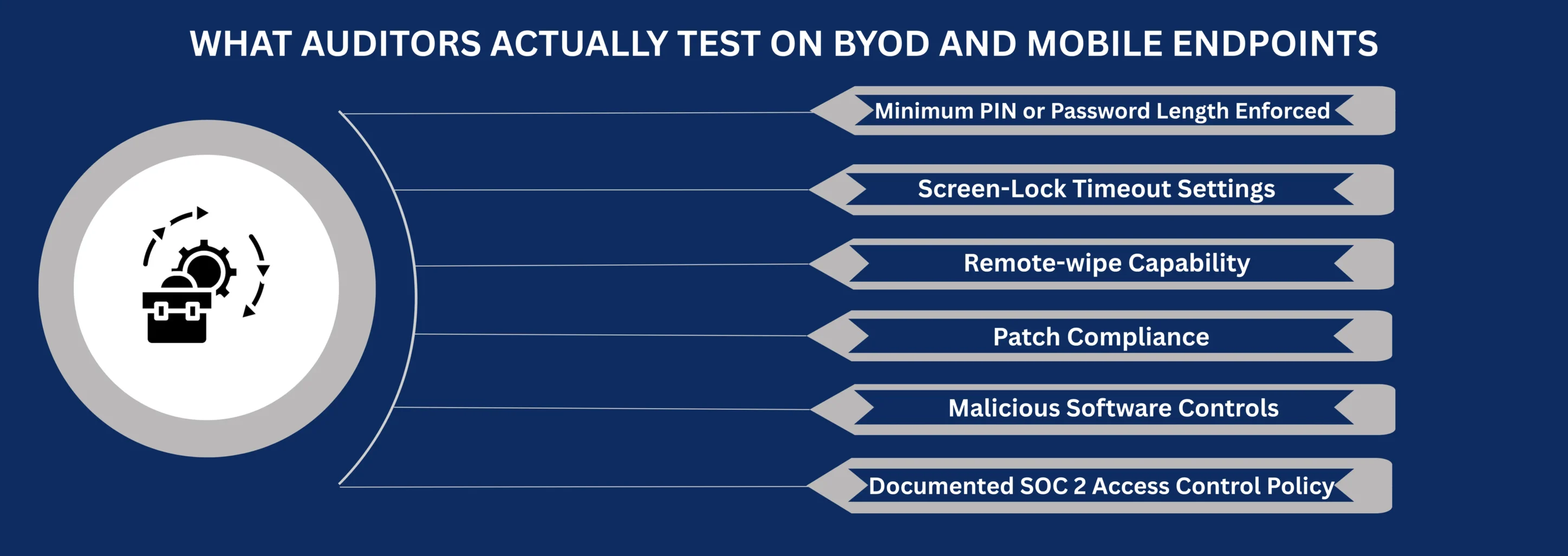
For MDM-enrolled devices, auditors typically request: MDM configuration exports showing screen-lock timeout settings, minimum PIN or password length enforced at the device level, and remote-wipe capability. They will cross-reference these exports against your documented SOC 2 access control policy to confirm the configuration matches the written requirement.
For unmanaged BYOD, auditors look for compensating controls. The most common and defensible approach is conditional access policy, enforced at the identity provider, that requires device compliance attestation before granting access to production systems. If your IdP logs show a mobile device authenticated without compliance evaluation, that is a finding under CC6.1.
Session timeout enforcement on mobile is a frequent audit finding. Policies often state a 15-minute inactivity timeout, but mobile apps commonly cache authentication tokens well beyond that window. Auditors may request token expiration configuration from your SSO platform to verify that session-level SOC 2 control activities align with the written policy. The gap between what a policy says and what a token lifetime allows is one of the most common mismatches in mobile endpoint audits.
SOC 2 Encryption Requirements on Mobile: A Distinct Control Layer
SOC 2 encryption requirements on mobile endpoints are tested separately from password strength but are closely related in audit evidence packages. CC6.1 requires that encryption is used to protect data, both at rest and in transit. On mobile, this means device-level storage encryption and transport-layer encryption for any data the device sends or receives.
Modern iOS and Android devices encrypt local storage by default when a device passcode is set. Auditors will verify this indirectly: MDM compliance reports that flag devices without a passcode are evidence that unencrypted storage may exist in your environment. If unmanaged BYOD devices can cache sensitive data locally without a passcode requirement, that is a SOC 2 encryption requirements gap, not just a password gap (Source: NIST SP 800-111, Guide to Storage Encryption Technologies).
For data in transit, auditors examine whether your mobile applications enforce TLS 1.2 or higher and whether certificate pinning or equivalent controls are in place to prevent man-in-the-middle interception. This is especially relevant for BYOD environments where users may connect over untrusted Wi-Fi networks.
A practical point auditors frequently raise: if a device is not enrolled in MDM and cannot be remotely wiped, then local data cached by your application remains accessible if that device is lost or stolen. Remote wipe capability is both a SOC 2 access control measure and an SOC 2 encryption requirements compensating control. Its absence on unmanaged BYOD should be addressed either by restricting offline data caching in your application or by requiring MDM enrollment for any device that accesses production data.
Building Auditable Evidence for SOC 2 Password Requirements on Mobile
An auditor does not accept a policy document as evidence of control operation. For SOC 2 Type 2 examinations, which cover a defined period, typically 6 to 12 months, auditors test whether controls operated consistently throughout that period. For mobile endpoints, this requires continuous, logged evidence, not a snapshot taken the week before fieldwork.
The evidence package auditors request for SOC 2 password requirements on BYOD and mobile typically includes: IdP authentication logs filtered by mobile user agents showing MFA events, MDM compliance dashboards or exports showing enrollment rates and policy violations, conditional access policy configuration screenshots, token lifetime configuration from your SSO platform, and records of any device-compromise or access-revocation events.
A critical distinction: if your conditional access policy excludes certain legacy applications or device types from MFA enforcement, auditors will identify those exclusions. Any carve-out from your stated SOC 2 access control policy requires documented justification and compensating controls. Unexplained exclusions in conditional access logs are a reliable path to a control deficiency finding.
Quarterly access reviews, required under SOC 2 control activities for CC6.3, must include mobile device access. If your review process covers only workstations and servers but not enrolled BYOD devices, the review is incomplete. Auditors will ask to see the scope of your access review population, and devices are part of that population when they access in-scope systems.
Conclusion
SOC 2 password requirements are not satisfied by a well-written policy. They are satisfied by documented, technically enforced, and continuously logged controls that an independent auditor can verify across every in-scope endpoint, including the personal devices in employees' pockets.
BYOD and mobile endpoints introduce an enforcement gap that the majority of compliance guidance overlooks. Auditors testing CC6.1, CC6.2, and CC6.3 will look past the policy document and into MDM configuration exports, IdP authentication logs, conditional access rules, session token lifetimes, and access review populations. SOC 2 encryption requirements add a second layer of scrutiny around device-level storage encryption and remote wipe capability.
The NIST SP 800-63B Rev 4 benchmark, which advocates 15-character minimums, with no mandatory rotation, and compromised credential screening, is the current standard against which auditors evaluate your controls. Organizations that have not updated their configurations to reflect the July 2025 revision are carrying an undisclosed audit risk.
CertPro is a licensed CPA firm that conducts independent SOC 2 examinations for technology organizations. As an independent attestation provider, CertPro issues SOC 2 audit reports based on evidence gathered during its examinations, providing the assurance that customers, partners, and prospects rely on when evaluating a service organization's security posture.