Every business regardless of size, industry, or geography operates within a web of rules it must follow. These rules are called regulatory requirements, and the structured systems organizations use to meet them are called compliance frameworks. Together, they form the foundation of how responsible, legally sound businesses operate.
Yet despite how frequently these terms appear in audit reports, vendor contracts, and risk assessments, many organizations lack a clear, working understanding of what regulatory requirements actually are, what a compliance framework includes, and how the two work together in practice.
This guide defines both terms clearly, explains why regulatory compliance matters, provides real compliance framework examples, and walks through how organizations can build a system that keeps them consistently compliant with requirements — today and as regulations evolve.
What Are Regulatory Requirements?
Regulatory requirements — also referred to simply as regulations — are the rules, standards, and obligations that an organization must abide by based on its industry, the type of data it handles, the markets it operates in, and the activities it conducts.
These requirements are set by governments, regulatory bodies, industry standards organizations, and sometimes by contractual obligations between businesses. They cover a wide range of areas including data privacy, information security, financial reporting, workplace safety, environmental practices, and consumer protection.
To define regulatory requirements precisely: they are mandatory obligations — legal, technical, or procedural — that an organization must fulfill to operate lawfully and ethically within its regulatory environment.
What Are Regulatory Requirements in Practice?
In practice, regulatory requirements can take the form of:
- Legal mandates — laws passed by government bodies that carry penalties for non-compliance (e.g., GDPR, HIPAA, SOX)
- Industry standards — frameworks developed by standards bodies that define minimum security or quality practices (e.g., ISO 27001, PCI DSS)
- Contractual obligations — requirements imposed by clients or partners as a condition of doing business (e.g., SOC 2 attestation required by enterprise buyers)
- Sector-specific rules — regulations tailored to particular industries such as healthcare, finance, or energy
Regulatory requirements are not static. They evolve as technology advances, new risks emerge, and regulators respond to changing business environments. Staying in compliance with requirements is therefore an ongoing operational responsibility, not a one-time task.
What Is a Compliance Framework?
A compliance framework is a structured system of policies, procedures, controls, and processes that an organization implements to meet its regulatory requirements systematically and verifiably.
The compliance framework definition in plain terms: it is the organized structure that translates regulatory requirements into actionable internal controls — telling your organization what to do, how to do it, who is responsible, and how to prove it.
A well-designed regulatory compliance framework does four things:
- Identifies which regulatory requirements apply to the organization
- Maps those requirements to internal controls and procedures
- Monitors ongoing compliance with those controls
- Documents compliance status for internal governance and external audit
What Is a Business Regulatory Framework?
A business regulatory framework is the combination of all the external regulations and internal policies that govern how a specific organization must operate. It is shaped by the industry the business operates in, the jurisdictions it serves, the data it handles, and the services or products it provides.
For example, a healthcare SaaS company operating in the US and EU would have a business regulatory framework that includes HIPAA (US patient data), GDPR (EU personal data), and potentially ISO 27001 (information security management) — each with its own specific regulatory requirements and controls.
Regulatory Compliance Frameworks: How They Work
Regulatory compliance frameworks provide a structured approach to managing compliance with requirements across an organization. Rather than responding reactively to individual regulations, a compliance framework creates a proactive, repeatable system.
The key components of any effective compliance regulatory framework include:
- Scope Definition: Identifying which regulations, standards, and contractual obligations apply to the organization — and why. This is determined by factors including industry, geography, data types handled, and business activities conducted.
- Risk Assessment: Evaluating where the organization is most exposed to compliance failures. A structured risk management process identifies high-priority gaps, assigns likelihood and impact ratings, and informs where controls are most urgently needed.
- Policy and Control Development: Translating regulatory requirements into documented policies, procedures, and technical controls. This is where compliance with requirements becomes operational — moving from “what the regulation says” to “what our organization does.”
- Employee Training and Awareness: Ensuring every employee understands the compliance policies relevant to their role. Most regulatory frameworks include training as a formal requirement, and auditors routinely assess whether training programs are in place and effective.
- Monitoring and Testing: Continuously verifying that controls are functioning as intended. This includes internal audits, control testing, automated monitoring tools, and periodic risk reassessments.
- Documentation and Reporting: Maintaining the evidence trail that demonstrates compliance of requirements to auditors, regulators, clients, and leadership. Without documentation, compliance work cannot be verified or trusted.
- Continuous Improvement: Regulatory requirements change. New regulations emerge, existing ones are updated, and business activities evolve. An effective compliance framework includes a process for identifying and responding to regulatory changes before they create gaps.
Compliance Framework Examples
The following are widely adopted compliance framework examples across key industries and risk domains. Each represents a structured set of regulatory requirements that organizations must meet — and can be formally audited or certified against:
SOC 2 — Security & Trust: Developed by the AICPA, SOC 2 is a compliance framework for technology and service organizations that defines requirements around security, availability, processing integrity, confidentiality, and privacy. It is one of the most commonly required frameworks in enterprise B2B relationships. SOC 2 Type 2 reports demonstrate that a company’s controls were operating effectively over a defined period — making it a key trust signal for clients evaluating vendors.
ISO 27001 — Information Security Management: ISO 27001 is the international standard for Information Security Management Systems (ISMS). It defines regulatory requirements for how organizations protect sensitive data — covering risk assessment, access controls, incident management, and business continuity. ISO 27001 certification is recognized globally and is increasingly required by enterprise clients across all sectors. The current version, ISO 27001:2022, has been in full enforcement since October 2025.
GDPR — Data Privacy (EU): The General Data Protection Regulation sets out the regulatory requirements for how organizations collect, process, store, and delete the personal data of EU residents. GDPR compliance applies to any organization handling EU citizen data — regardless of where the organization is based. Non-compliance penalties reach up to 4% of global annual revenue.
HIPAA — Healthcare Data Privacy (US): HIPAA defines the regulatory requirements for the protection of protected health information (PHI) in the US healthcare system. HIPAA compliance is mandatory for healthcare providers, health plans, and their business associates. Requirements cover administrative, physical, and technical safeguards for PHI across storage, transmission, and disclosure.
CCPA / CPRA — Consumer Privacy (California): CCPA/CPRA compliance governs how businesses handle the personal data of California residents. Requirements include transparent disclosure of data practices, the right for consumers to access and delete their data, and restrictions on the sale of personal information. With new US state-level privacy laws entering force across Delaware, Iowa, Nebraska, New Hampshire, Oregon, and Texas, CCPA represents the leading edge of a broader national regulatory trend.
PIPEDA — Privacy (Canada): PIPEDA governs how private sector organizations in Canada collect, use, and disclose personal information in commercial activities. Compliance with PIPEDA requirements demonstrates accountability for personal data handling under Canadian law.
ISO 27701 — Privacy Information Management: ISO 27701 extends ISO 27001 to include a Privacy Information Management System (PIMS), providing a structured framework for demonstrating compliance with data privacy regulatory requirements including GDPR. It is the leading international standard for operationalizing privacy governance.
ISO 42001 — AI Management Systems: As AI regulations advance globally, ISO 42001 provides the compliance framework for AI governance — defining requirements for responsible AI development, risk management, and transparency. With the EU AI Act entering enforcement and US federal AI governance frameworks advancing in 2025, ISO 42001 is becoming an increasingly important regulatory compliance framework for organizations developing or deploying AI systems.
PCI DSS — Payment Card Security: PCI DSS defines the regulatory requirements for organizations that store, process, or transmit payment card data. Version 4.0.1 entered full enforcement in March 2025, with updated requirements including stronger access controls, longer log retention, and enhanced risk-based flexibility. Compliance is contractually required by card networks and payment processors.
SOX — Financial Reporting (Public Companies): The Sarbanes-Oxley Act establishes regulatory requirements for internal controls over financial reporting in publicly traded companies. SOX compliance requires documented internal audit processes, control testing, and executive certification of financial statements.
Why Regulatory Requirements Matter for Your Business
Legal Protection: The most direct reason to comply with regulatory requirements is legal: non-compliance exposes businesses to fines, enforcement actions, license revocations, and litigation. GDPR fines can reach 4% of global annual revenue. HIPAA violations carry civil and criminal penalties. PCI DSS non-compliance can result in loss of payment processing privileges.
Market Access: Many regulatory compliance frameworks are not just legal obligations — they are market entry requirements. Enterprise clients routinely require SOC 2 or ISO 27001 compliance before signing vendor contracts. Healthcare clients require HIPAA compliance. EU clients require GDPR compliance. Being compliant with requirements opens commercial doors that remain closed to non-compliant organizations.
Competitive Advantage: Organizations that can demonstrate compliance with requirements across recognized frameworks build trust faster, win larger contracts, and retain clients more reliably than those that cannot. Compliance certifications serve as credible, third-party-verified signals of organizational maturity and trustworthiness.
Risk Reduction: A well-implemented regulatory compliance framework systematically identifies and addresses operational, legal, and reputational risks before they become incidents. This connects directly to the risk management process — compliance and risk management are not separate disciplines but two sides of the same organizational governance function.
Operational Discipline: Building compliance with requirements into daily operations forces organizations to document their processes, assign clear responsibilities, train their staff, and test their controls. The discipline this creates — traceability, accountability, consistency — makes organizations better run, more resilient, and easier to scale.
Challenges in Meeting Regulatory Requirements
Understanding what regulatory frameworks are is the first step. Meeting them consistently is harder. Common challenges include:
Keeping pace with change: Regulatory requirements evolve continuously. New privacy laws, updated security standards, and emerging AI governance requirements mean that compliance is never a finished state. Organizations need monitoring systems to detect regulatory changes and processes to update their frameworks accordingly.
Managing multiple frameworks simultaneously: Most organizations are subject to more than one set of regulatory requirements. Managing overlapping controls across SOC 2, ISO 27001, GDPR, and HIPAA simultaneously requires a unified, integrated approach to compliance management.
Resource constraints: Building and maintaining a robust compliance regulatory framework requires investment in people, technology, and processes. Smaller organizations in particular may lack the internal expertise to identify all applicable requirements and implement the controls needed to meet them.
Demonstrating compliance to external parties: Internal compliance work only creates value if it can be verified and communicated to clients, regulators, and partners. This is where independent external audits — conducted by accredited firms — play a critical role in converting internal effort into recognized, credible compliance status.
WHAT ARE REGULATORY COMPLIANCE REQUIREMENTS?
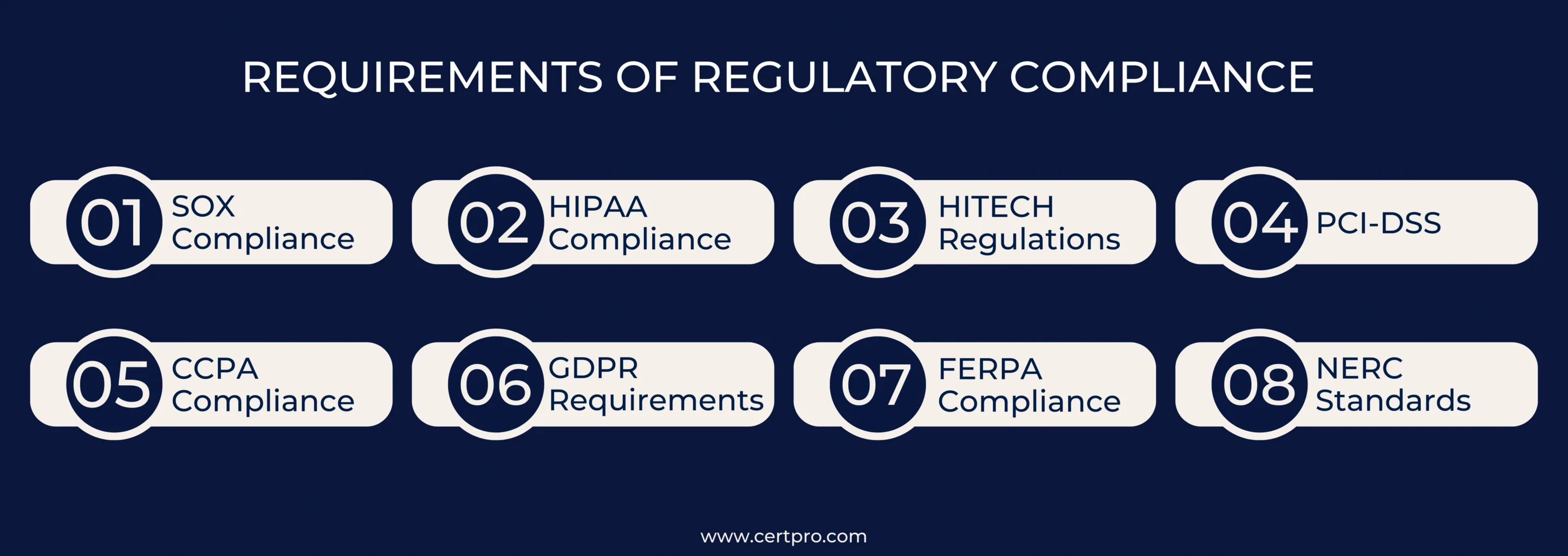
Regulatory compliance requirements are specific standards that organizations must adhere to based on their industry. It is crucial to research and understand the compliance requirements that directly affect your business. Some industries may require outside consultation to implement the necessary processes for meeting regulatory standards.
Outlined below are examples of regulatory compliance requirements and the industries they apply to:
SOX Compliance: After the Enron scandal, organizations should conduct internal audits to ensure adherence to SOX regulations, which govern internal accounting practices for publicly traded companies.
HIPAA: Healthcare organizations must comply with HIPAA to ensure secure storage, management, and disclosure of patient data, promoting improved safety and data management practices.
HITECH Regulations: HITECH establishes controls for healthcare organizations to manage digital patient data, including collection, storage, and secure transfer methods.
PCI-DSS: Merchants and payment processors must comply with PCI-DSS to protect financial information, employing proper data storage and secure data transfer protocols to combat rising credit card fraud.
CCPA Compliance: Businesses working with California consumer data must adhere to CCPA regulations, which mandate transparent disclosure of data handling practices and the ability to delete consumer data upon request.
GDPR Requirements: Organizations using EU consumer data must comply with GDPR, enabling EU consumers to have greater control over their data by implementing measures for data storage and deletion upon request.
FERPA Compliance: Educational institutions collecting student data must protect it according to FERPA regulations, implementing controls to prevent unauthorized access and safeguard educational records from theft.
NERC Standards: NERC helps utility and energy companies combat state-sponsored cyber-attacks, reducing the risk of infrastructure compromise and its potential impact on residents through the implementation of protective measures.
How CertPro Helps Organizations Meet Regulatory Requirements
Navigating regulatory compliance frameworks across multiple standards, jurisdictions, and industries is complex. Most organizations benefit significantly from working with an independent audit partner that brings both regulatory expertise and audit credibility.
CertPro CPA LLC is a licensed CPA firm providing independent audit and attestation services across the leading compliance frameworks — including SOC 2, ISO 27001, ISO 42001, HIPAA, GDPR, CCPA/CPRA, PIPEDA, and ISO 27701.
Our auditors assess your organization against the specific regulatory requirements of your applicable frameworks — identifying gaps, validating controls, and issuing the independent reports and certifications that clients and regulators rely on. Whether you are building your first compliance program or managing compliance across multiple frameworks, CertPro provides the expertise and independent validation you need.
Schedule a meeting with a CertPro auditor to begin your compliance framework assessment.
FAQ
What are regulatory requirements?
Regulatory requirements are the mandatory rules, standards, and obligations — legal, technical, or procedural — that an organization must meet based on its industry, geography, and business activities. They are set by governments, regulatory bodies, and standards organizations.
What is a compliance framework?
A compliance framework is a structured system of policies, controls, and procedures that an organization implements to identify, meet, monitor, and document its regulatory requirements. It transforms regulatory obligations into operational practice.
What are regulatory frameworks?
Regulatory frameworks are the broader systems of laws, regulations, and standards within which a business must operate. They define the regulatory environment for an industry or jurisdiction — encompassing everything from data privacy laws to financial reporting requirements to information security standards.
What is a business regulatory framework?
A business regulatory framework is the specific combination of regulatory requirements that applies to a given organization, shaped by its industry, the data it handles, the markets it serves, and its business activities. It is unique to each organization.
What are some compliance framework examples?
Leading compliance framework examples include SOC 2 (technology security), ISO 27001 (information security management), GDPR (EU data privacy), HIPAA (US healthcare data), PCI DSS (payment card security), CCPA/CPRA (California consumer privacy), ISO 42001 (AI management), and PIPEDA (Canadian privacy).
What is the difference between regulatory requirements and compliance frameworks?
Regulatory requirements are the external rules your organization must follow. A compliance framework is the internal structure you build to meet those rules. Requirements define what is needed; the framework defines how you achieve it.
What happens if an organization fails to meet regulatory requirements?
Non-compliance with regulatory requirements can result in financial penalties, legal action, license revocation, reputational damage, and loss of business. The consequences vary by framework — GDPR violations, for example, can result in fines of up to 4% of global annual revenue.
Are regulatory requirements the same across all industries?
No. Regulatory requirements vary significantly by industry, geography, and business type. Healthcare organizations face HIPAA requirements. Financial institutions face SOX and AML obligations. Technology companies handling EU data face GDPR. Each organization must identify the specific requirements applicable to its situation.