
Control outcomes rarely depend on whether a control exists. Instead, they depend on whether the organization can produce control evidence that proves the control operated as intended. Two organizations may perform the same control yet receive different audit outcomes. For example, one provides a dated system-generated export that demonstrates consistent operation. Meanwhile, the other submits a screenshot captured after the audit request. The control may be identical, but the evidence is not. As a result, compliance auditors evaluate the two very differently.
In practice, control evidence is the objective proof that a control exists, operates consistently, and achieves its intended purpose. It includes records, system configurations, audit logs, approval records, reports, and other verifiable artifacts that demonstrate control performance. To determine whether the evidence supports the control, auditors evaluate it against two fundamental principles: evidence sufficiency, meaning there is enough evidence to support a conclusion, and appropriateness, meaning the evidence is relevant, reliable, and independently verifiable.
With that foundation in place, this guide explains what control evidence is, how compliance auditors evaluate its quality, the characteristics of evidence that withstand audit scrutiny, and how these principles apply across SOC 2 compliance evidence and ISO 27001 audit evidence. Finally, it explores practical approaches to evidence management that help organizations maintain audit-ready records throughout the year instead of scrambling when an audit begins.

Concern
Most audit findings are evidence findings in disguise. Controls may operate exactly as designed yet still fail testing when control evidence is undated, incomplete, editable, or selected from a curated list instead of the full system population. As a result, auditors apply professional skepticism throughout the engagement and evaluate whether the evidence genuinely supports the operation of the compliance control, not just whether the control exists.
Overview
Compliance auditors evaluate control evidence using two fundamental principles: evidence sufficiency, which measures whether enough evidence exists to support a conclusion, and appropriateness, which evaluates its relevance and reliability. In addition, they assess evidence completeness by requesting full populations directly from source systems before selecting samples. They also weigh evidence based on how it was produced, giving greater confidence to independently verifiable, system-generated records than manually prepared documents.
Solution
Map every compliance control to the evidence it should generate. Then, collect that evidence directly from source systems instead of assembling it manually. Preserve timestamps, maintain complete populations, and perform evidence validation before the audit begins. Finally, establish centralized evidence management so audit records are maintained continuously, allowing auditors to evaluate existing evidence instead of requesting it at the last minute.
What Is Control Evidence?
Control evidence is the verifiable material that demonstrates a control exists, operated consistently throughout a defined period, and achieved its intended objective. It includes system configurations, access review exports, approval tickets, training records, scan reports, meeting minutes, and audit logs. In short, it is any objective record an independent auditor can examine to confirm that a compliance control operated as the organization claims.
In practice, the relationship between compliance and controls is established through this evidence. A well-formed piece of audit evidence connects a specific requirement to a specific record. For example, a requirement may state that user access must be reviewed quarterly. The compliance control performs that review, while the control evidence is the dated system export supported by reviewer approval. Likewise, every compliance control within SOC 2 compliance evidence, ISO 27001 audit evidence, and other compliance frameworks is evaluated through this chain. Therefore, a gap in the requirement, the control, or the evidence can result in an audit finding.
However, auditors expect control evidence to prove two different things. The first is design effectiveness, which confirms that a control is designed to achieve its intended objective. The second is operating effectiveness, which demonstrates that the control actually operated consistently throughout the audit period. As a result, evidence supporting design may include documented procedures and walkthroughs. By contrast, evidence supporting operation requires records collected across the entire audit period. This is why a single, well-prepared example created shortly before an audit rarely satisfies an auditor, even if the control itself is working as intended.
Evidence Sufficiency and Evidence Completeness: The Two Tests
Evidence sufficiency measures quantity. It answers a simple question: is there enough control evidence to support a reliable audit conclusion? Appropriateness, by contrast, measures quality. It determines whether the evidence is relevant to the compliance control being tested and whether it is reliable based on how it was created and maintained. Together, these two principles form the foundation of every compliance audit. Auditors rely on control evidence only when it satisfies both tests.
In practice, the amount of evidence required depends on risk. Controls protecting critical business processes, sensitive information, or production environments demand greater evidence sufficiency than controls supporting lower-risk activities. As risk increases, auditors expect broader samples, stronger corroboration, and multiple sources of supporting evidence. Consequently, applying the same sample size to every compliance control rarely reflects a risk-based audit approach and may raise questions about the quality of the testing itself.
Evidence completeness introduces a second test that organizations frequently overlook. Before selecting samples, auditors first establish the full population. This may include every user account created during the audit period, every production change, or every recorded security incident. Importantly, these populations come directly from source systems rather than manually prepared lists. As a result, control evidence drawn from an incomplete population cannot demonstrate that the control operated consistently across every applicable event.
Finally, electronic records are only as reliable as the systems that generate them. Evidence validation therefore extends beyond the record itself. Auditors also evaluate whether the underlying systems preserve the accuracy, integrity, and evidence completeness of the data. A protected system-generated export carries far greater audit value than a record that users can edit after creation.
How Auditors Perform Evidence Validation
Evidence validation is the process of determining whether control evidence is genuine, relevant, and reliable before audit conclusions are reached. In practice, auditors validate control evidence through four established techniques. The position of a record within this hierarchy largely determines the weight it carries during a compliance audit.
- Inquiry
Auditors ask personnel how a compliance control operates. This provides valuable context but represents the weakest form of evidence. Therefore, inquiry alone cannot demonstrate operating effectiveness.
- Observation
Auditors watch the control being performed. This provides stronger evidence but confirms only the activity observed at that specific point in time.
- Inspection
Auditors examine records, system configurations, reports, and supporting documents. For this reason, inspection forms the foundation of most compliance audits. The reliability of the control evidence depends on the integrity and independence of its source.
- Re-performance
Auditors independently execute the compliance control by recalculating results, repeating procedures, or tracing the workflow from beginning to end. As a result, this technique produces the strongest audit evidence.
Evidence validation also extends across time. Auditors expect control evidence to reflect the frequency of the control itself. For example, quarterly access reviews should produce four dated records across the audit period rather than several records created immediately before the audit. This principle is clearly demonstrated in how SOC 2 auditors review evidence over time, where consistency throughout the examination period carries greater weight than isolated examples.
Finally, auditors also evaluate how the evidence was produced. System-generated records generally provide stronger support than manually assembled files. Likewise, independently generated records carry greater reliability than self-prepared summaries, while tamper-resistant records outweigh editable documents. When control evidence falls short of these expectations, auditors typically expand testing and apply greater professional skepticism before reaching a conclusion.
Control Evidence in SOC 2 and ISO 27001 Audits
SOC 2 compliance evidence is organized around the Trust Services Criteria. Auditors evaluate each in-scope criterion by testing the compliance controls management has implemented and the control evidence supporting them. For example, logical access controls produce user provisioning records and periodic access reviews. Change management controls generate approved tickets and deployment records, while availability controls rely on backup and recovery test results. Throughout a Type II examination, every audit conclusion is supported by control evidence collected across the entire review period rather than from a single point in time.
Likewise, ISO 27001 audit evidence follows the same audit principles through a different framework structure. Certification auditors trace each applicable Annex A control from the Statement of Applicability to the operational records that demonstrate its implementation. In addition, the ISO 27001 internal audit should verify the same evidence before the certification audit begins. Risk assessments, management review records, corrective actions, and operational logs all contribute to demonstrating that the management system functions effectively.
Although the frameworks differ in structure, compliance audit controls ultimately rely on the same categories of control evidence. Access governance, change management, vulnerability management, incident response, supplier oversight, and security awareness all produce objective records that auditors evaluate for consistency and reliability. Therefore, organizations operating multiple compliance programs can often collect evidence once and map it across several frameworks, including SOC 2 compliance evidence and ISO 27001 audit evidence.
Ultimately, regardless of the framework, auditors apply the same expectation. Claims about compliance and controls must be supported by objective, verifiable records. Strong evidence management makes that possible by maintaining reliable control evidence throughout the year instead of reconstructing it when an audit begins.
Evidence Management: Building a System That Survives Audits
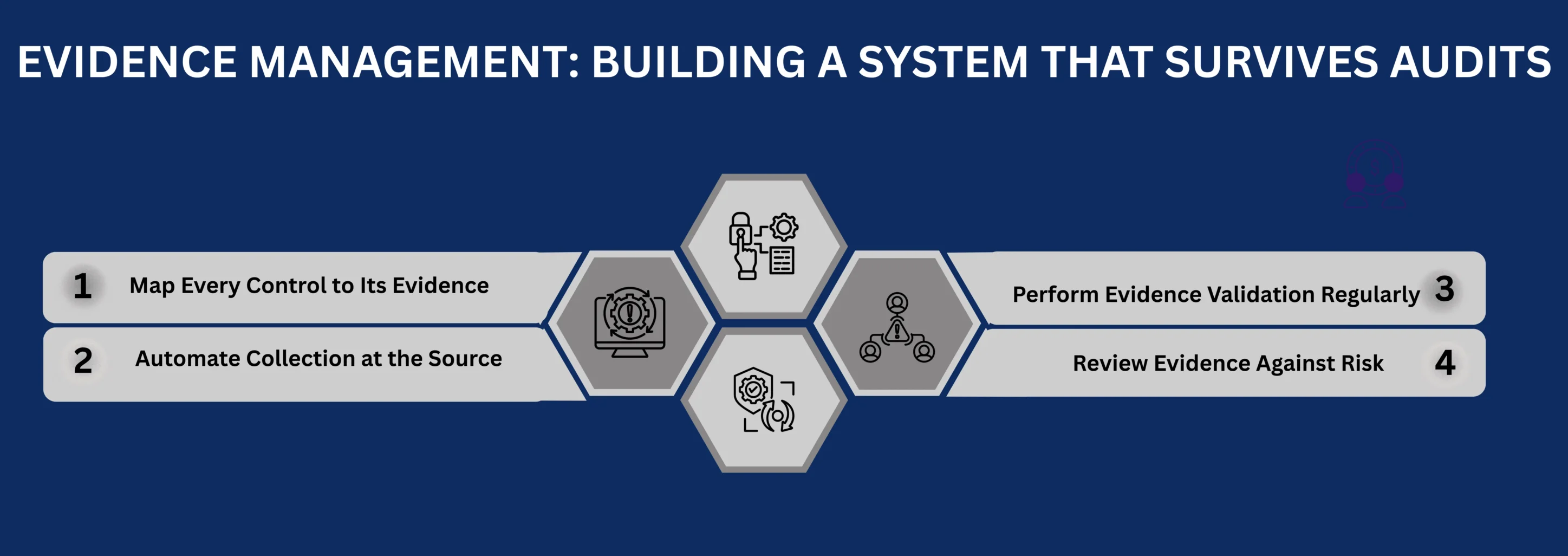
Evidence management is the operational discipline of mapping compliance controls to the records they should produce, collecting those records continuously from source systems, and maintaining them in a centralized repository. As a result, every audit request becomes an evidence retrieval exercise rather than a time-consuming reconstruction project. Four practices form the foundation of an effective evidence management process.
- Map Every Control to Its Evidence
Before an audit begins, define the control evidence each compliance control should produce, identify the source system, assign an owner, and document the expected collection frequency. In practice, this mapping confirms that evidence exists and establishes a consistent approach for future audits.
- Automate Collection at the Source
Automated evidence collection retrieves records directly from identity platforms, ticketing systems, cloud environments, and security tools. Consequently, timestamps, complete populations, and system integrity remain intact. Automation also reduces reliance on screenshots and manually assembled files, improving both evidence completeness and reliability.
- Perform Evidence Validation Regularly
Conduct evidence validation before auditors do. For example, sample complete populations, trace selected records from beginning to end, and verify dates against source systems. This approach identifies gaps early, allowing teams to correct issues before they become audit findings.
- Review Evidence Against Risk
Finally, evaluate evidence sufficiency and evidence completeness based on the risk of each compliance control, not on historical practice. Reassess expectations after system migrations, organizational changes, or new technology deployments. Ultimately, strong evidence management evolves alongside the business, allowing compliance audit controls to remain supported by reliable control evidence throughout the audit cycle.
Conclusion
Compliance audits do not rely on assumptions. They rely on control evidence that demonstrates a compliance control operated consistently and achieved its intended objective. Throughout an audit, auditors evaluate that evidence for evidence sufficiency, relevance, reliability, and evidence completeness before reaching a conclusion. As a result, organizations with well-maintained control evidence spend less time responding to audit requests and more time demonstrating that their compliance and controls operate as intended.
In practice, effective evidence management follows a simple principle. Every compliance control should produce objective control evidence. Every record should have a trusted source, a clear timestamp, and a complete population. In addition, organizations should perform regular evidence validation before an external audit begins. When these practices become part of day-to-day operations, audit preparation shifts from collecting documents under pressure to presenting records that already exist.
Ultimately, this approach benefits every compliance framework. Whether auditors examine SOC 2 compliance evidence, ISO 27001 audit evidence, or another set of compliance audit controls, they apply the same expectation: claims must be supported by objective, verifiable records. Strong evidence management creates that foundation and allows organizations to demonstrate compliance with confidence.
At CertPro, we evaluate control evidence every day. As a licensed CPA firm enrolled in the AICPA Peer Review Program, we conduct SOC 2 attestation engagements under AT-C 205 and perform ISO 27001 certification audits worldwide. Our auditors assess control evidence, perform evidence validation, and evaluate whether records demonstrate effective control operation throughout the audit period. Through our SOC 2 certification services, we support organizations from readiness through Type II reporting while maintaining the independence expected of an assurance provider.