
SOC 2 Certification in Florida
Executive Summary: SOC 2 Certification in Florida is issued exclusively by a Licensed CPA Firm following an independent examination conducted under AICPA AT-C Section 205 attestation standards. The SOC 2 examination evaluates a service organization’s controls against the Trust Services Criteria, producing a formal attestation report that confirms control design and operational effectiveness. Florida’s technology, fintech, healthcare, and cloud services sectors increasingly rely on SOC 2 certification as a baseline standard for vendor qualification and enterprise procurement.
OUR CLIENTS










What Is SOC 2 Certification in Florida?
SOC 2 Certification in Florida is a formal attestation issued by a Licensed CPA Firm following an independent examination of a service organization’s internal controls. The examination is governed by the American Institute of Certified Public Accountants (AICPA) under AT-C Section 205. It evaluates whether an organization’s controls meet the Trust Services Criteria (TSC) for security, availability, processing integrity, confidentiality, and privacy. The resulting SOC 2 report is not a self-declaration or internal assessment — it is an independent, third-party attestation produced exclusively by a licensed attestation body.
SOC 2 stands for System and Organization Controls 2. The AICPA developed this framework to give service organizations a structured, standardized mechanism for demonstrating the effectiveness of their information security and operational controls. Customers, business partners, and regulators rely on this independent verification. Unlike internal audits or self-assessments, a SOC 2 examination requires an independent CPA firm to gather evidence, test controls, and issue a formal opinion on whether the described controls meet the applicable Trust Services Criteria.
The Formal Definition of SOC 2 Attestation
SOC 2 attestation is the formal process by which a Licensed CPA Firm examines and renders an opinion on a service organization’s system description and the suitability of its controls. The term attestation distinguishes this process from a traditional financial audit. Rather than auditing financial statements, the CPA firm examines non-financial controls related to security and operational integrity. SOC 2 attestation in Florida follows AICPA professional standards, including AT-C Section 105 (Concepts Common to All Attestation Engagements) and AT-C Section 205 (Examination Engagements).
The SOC 2 examination produces one of two report types: a Type 1 report or a Type 2 report. A Type 1 report evaluates the design of controls at a single point in time, confirming that controls are suitably designed to meet the Trust Services Criteria. A Type 2 report evaluates both the design and operating effectiveness of controls over a defined observation period — typically six to twelve months. The Type 2 report is more rigorous and more widely required by enterprise customers and procurement teams across Florida’s business ecosystem.
Who Issues a SOC 2 Report?
A SOC 2 report is issued exclusively by a Licensed CPA Firm. Only firms holding a valid CPA license and meeting AICPA independence requirements are authorized to conduct SOC 2 examinations and issue the resulting attestation report. Technology vendors, cybersecurity consultants, and compliance platforms are not authorized to issue SOC 2 reports, regardless of the tools or frameworks they employ. Organizations in Florida seeking SOC 2 certification must engage a Licensed CPA Firm as the independent attestation provider.
CertPro operates as a Licensed CPA Firm and functions exclusively as an independent third-party attestation provider. CertPro’s SOC 2 examination engagements in Florida are conducted in strict accordance with AICPA attestation standards. The resulting SOC 2 reports are recognized by enterprise clients, financial institutions, healthcare organizations, and government contractors across the state. CertPro’s independence from the organizations it examines is a mandatory requirement under AICPA professional standards and is maintained throughout every engagement.
What SOC 2 Certification Confirms
SOC 2 certification confirms that a service organization’s controls have been independently examined and found to meet the applicable AICPA Trust Services Criteria. This confirmation goes beyond verifying the mere existence of controls. The attestation confirms that controls are suitably designed (Type 1) and, for Type 2 reports, that controls operated effectively over the specified observation period. The attestation does not guarantee the absence of security incidents, but it confirms that the control environment has been examined and tested against established professional standards.
In Florida’s competitive technology and services market, SOC 2 certification functions as a baseline qualification for enterprise vendor selection, third-party risk management programs, and regulated industry procurement. Financial institutions, healthcare organizations, and government contractors in Florida routinely require SOC 2 attestation as a condition of vendor onboarding. The certification communicates that an organization’s security and operational controls have withstood independent examination — a standard that internal policies and self-assessments cannot replicate.

ENQUIRE NOW
Related Resources
Related Services in Florida
AICPA Trust Services Criteria: The Framework Behind SOC 2 Compliance
The AICPA Trust Services Criteria (TSC) form the evaluative framework applied during every SOC 2 examination. The TSC defines the specific control categories and criteria that a Licensed CPA Firm uses to assess a service organization’s control environment. There are five Trust Services Criteria categories: Security, Availability, Processing Integrity, Confidentiality, and Privacy. The Security criterion — also called the Common Criteria — is mandatory for all SOC 2 examinations. The remaining four categories are selected based on the nature of the service organization’s commitments to its customers and applicable system requirements.
The Security criterion is the foundational Trust Services Category and is included in every SOC 2 examination. It addresses the protection of system resources against unauthorized access. The Common Criteria evaluate controls across logical and physical access, change management, risk mitigation, monitoring, and incident response. Security controls tested under this criterion include access control policies, multi-factor authentication, intrusion detection systems, vulnerability management programs, and security event monitoring mechanisms.
For Florida-based technology companies, cloud service providers, and SaaS organizations, the Security criterion examines the technical and administrative safeguards protecting customer data and system infrastructure. Auditors gather evidence including system-generated access logs, change management records, incident response documentation, and configuration standards. The SOC 2 examination tests not only whether these controls exist, but whether they functioned consistently throughout the observation period in Type 2 engagements.
The Availability criterion evaluates whether systems are available for operation and use as committed or agreed. This criterion is particularly relevant to cloud service providers, managed service providers, and SaaS companies in Florida whose service level agreements include uptime commitments. Controls tested under Availability include disaster recovery plans, business continuity procedures, performance monitoring systems, and redundancy configurations. Auditors examine evidence that these controls were executed consistently and that any availability incidents were managed according to documented procedures.
The Processing Integrity criterion evaluates whether system processing is complete, valid, accurate, timely, and authorized. This criterion applies most directly to organizations providing transaction processing, financial data management, or payroll services — sectors that represent a significant portion of Florida’s fintech and financial services ecosystem. Controls examined under Processing Integrity include input validation mechanisms, error detection procedures, reconciliation processes, and output verification controls. The Confidentiality criterion addresses whether information designated as confidential is protected in accordance with the organization’s commitments. Controls tested include data classification policies, encryption standards, contractual access restrictions, and data retention and disposal procedures.
The Privacy criterion evaluates the collection, use, retention, disclosure, and disposal of personal information in conformity with the organization’s privacy notice and the AICPA’s Privacy Management Framework. This criterion is selected when an organization collects, processes, or stores personal information and has made privacy commitments to its customers or users. For Florida organizations serving regulated industries — including healthcare technology and financial services — the Privacy criterion adds a structured examination layer that complements the Security Common Criteria required in every SOC 2 audit.
Privacy controls examined during a SOC 2 examination include consent mechanisms, data subject rights fulfillment procedures, privacy notice accuracy, data minimization practices, and third-party data sharing agreements. Auditors test whether privacy commitments documented in the organization’s privacy notice are reflected in operational controls and whether those controls functioned as described. Florida healthcare technology companies handling protected health information (PHI) may select the Privacy criterion to demonstrate alignment between SOC 2 compliance and HIPAA privacy obligations.
| Trust Services Criterion | Focus Area | Applicable Organizations |
|---|---|---|
| Security (Common Criteria) | Protection against unauthorized access and system threats | All service organizations — mandatory for every SOC 2 examination |
| Availability | System uptime and operational continuity | Cloud providers, SaaS companies, MSPs with uptime commitments |
| Processing Integrity | Completeness, accuracy, and authorization of processing | Fintech firms, payment processors, transaction processing systems |
| Confidentiality | Protection of confidential and proprietary information | Organizations handling NDA-protected or proprietary customer data |
| Privacy | Collection, use, and disposal of personal information | Healthcare technology, consumer platforms, and data processors |
- ✓Security (Common Criteria)
- ✓Availability, Processing Integrity, and Confidentiality
- ✓Privacy Criterion
SOC 2 Type 1 vs. SOC 2 Type 2: Definitions and Differences
SOC 2 examinations produce two distinct report types, each serving different audit purposes and customer requirements. Understanding the difference between SOC 2 Type 1 and Type 2 reports is essential for Florida organizations planning an attestation engagement and for their customers evaluating vendor risk. The primary distinction lies in examination scope: Type 1 evaluates control design at a point in time, while Type 2 evaluates both control design and operating effectiveness over a defined period.
SOC 2 Type 1 Report: Point-in-Time Design Assessment
A SOC 2 Type 1 report is produced following an examination of a service organization’s system description and the suitability of its control design as of a specific date. The Licensed CPA Firm examines whether the controls described are suitably designed to achieve the applicable Trust Services Criteria. A Type 1 examination does not assess whether those controls operated effectively over time — it evaluates design only. The report includes the system description provided by management, the auditor’s opinion on control design suitability, and any relevant observations about the control environment.
SOC 2 Type 1 reports are appropriate for organizations that have recently implemented a control framework and need to demonstrate control design to customers before a full observation period has elapsed. For Florida startups and early-stage SaaS companies entering enterprise sales cycles, a Type 1 report provides an initial attestation confirming that controls are properly designed and documented. However, enterprise customers and regulated-industry clients in Florida typically require Type 2 reports as the standard for vendor qualification and ongoing third-party risk management.
SOC 2 Type 2 Report: Operating Effectiveness Over Time
A SOC 2 Type 2 report is the more rigorous and widely recognized attestation. It documents the Licensed CPA Firm’s examination of both the design and operating effectiveness of controls over a defined observation period — typically between six and twelve months. The Type 2 examination requires auditors to gather and evaluate evidence generated throughout the observation period, not just documentation prepared for the audit. This includes system logs, configuration change records, incident reports, user access reviews, and monitoring outputs collected across the entire review period.
The SOC 2 Type 2 report demonstrates that security and operational controls functioned consistently over time — not just on the date of examination. This operating effectiveness standard explains why SOC 2 Type 2 is the preferred attestation format for enterprise procurement, financial institution vendor management programs, and government contractor qualification in Florida. Any organization can appear organized at a single point in time; Type 2 attestation confirms sustained operational discipline across months of continuous control operation.
Selecting the Appropriate Report Type
The selection between Type 1 and Type 2 depends on customer requirements, the organization’s control maturity, and the timeline for completing the attestation engagement. Florida organizations with mature, documented control environments may proceed directly to a Type 2 examination. Organizations in early stages of formal control documentation may complete a Type 1 examination first, establishing a baseline attestation before progressing to the full Type 2 observation period. The Licensed CPA Firm conducting the SOC 2 examination will assess scope, applicable Trust Services Criteria, and examination structure during the engagement planning phase.
| Attribute | SOC 2 Type 1 | SOC 2 Type 2 |
|---|---|---|
| Scope | Control design evaluated at a single point in time | Control design and operating effectiveness evaluated over a defined period |
| Observation Period | None — single examination date | Typically 6–12 months |
| Evidence Collected | Policy documents, system descriptions, and design artifacts | Operational evidence: logs, records, and monitoring outputs across the full period |
| Primary Use Case | Initial attestation for newly implemented control frameworks | Enterprise vendor qualification and ongoing third-party risk management |
| Audit Opinion | Opinion on suitability of control design | Opinion on both design suitability and operating effectiveness |
SOC 2 Audit Process for Florida Organizations
The SOC 2 audit process in Florida follows a structured, standardized methodology governed by AICPA attestation standards. Each stage of the examination is designed to gather and evaluate evidence that supports the auditor’s opinion on the service organization’s control environment. The Licensed CPA Firm acting as the independent attestation provider conducts each stage. The organization under examination participates by providing access to documentation, personnel, and systems — but the examination methodology and conclusions are determined solely by the CPA firm.
Scope definition is the foundational stage of the SOC 2 audit process. During this stage, the Licensed CPA Firm works with the service organization to identify the system boundaries, applicable Trust Services Criteria, and the organizational units included in the examination. Scope determination directly affects which controls are tested, which systems are included, and which criteria apply to the engagement. For Florida technology companies with multiple product lines or operating units, precise scope definition ensures the examination reflects the services most relevant to customer commitments.
The system description prepared by management is a critical component of every SOC 2 report. It describes the boundaries of the system, the services provided, the relevant infrastructure, the software and data components, and the people and processes involved in delivering those services. Auditors evaluate whether the system description is fairly presented — meaning it accurately reflects the actual system and does not omit relevant components. For Type 2 engagements, the observation period start and end dates are established during this stage.
Following scope definition, the Licensed CPA Firm develops the audit program — the structured set of procedures that will be executed to gather evidence and evaluate controls. The audit program identifies the specific controls to be tested, the testing procedures for each control, the types of evidence to be collected, and the sample sizes for control testing. Audit program design is driven by the applicable Trust Services Criteria, the complexity of the organization’s systems, and the nature of the services provided.
For Florida organizations operating cloud infrastructure, the SOC 2 audit program will include testing of identity and access management controls, encryption key management, network security configurations, and cloud-specific monitoring tools. For fintech organizations, the program may include transaction authorization controls, financial data integrity testing, and third-party payment processor oversight. The audit program is developed before evidence collection begins and provides the structured framework ensuring examination procedures are consistent, repeatable, and aligned with professional standards.
Evidence collection is the core activity of the SOC 2 examination. Auditors employ multiple procedures to gather evidence, including inquiry, observation, inspection of documents and records, and re-performance of control activities. Inquiry alone is not sufficient — auditors must corroborate management representations with documentary evidence and system-generated outputs. Evidence collected during a SOC 2 examination includes access control logs, change management tickets, security monitoring reports, vulnerability scan results, user access review records, training completion records, and incident response documentation.
For Type 2 examinations, evidence must span the entire observation period. Auditors apply sampling methodologies to select representative evidence from throughout the review period, testing whether controls functioned consistently over time rather than only at the start or end of the period. The volume and type of evidence collected depends on the frequency of each control — daily controls require more samples than annual controls. The Licensed CPA Firm’s auditors document all evidence collected and the conclusions drawn from that evidence in the working papers supporting the final attestation report.
The observation period is a defining characteristic of the SOC 2 Type 2 examination. It is the timeframe over which the Licensed CPA Firm evaluates whether controls operated effectively. The AICPA does not mandate a specific observation period length, but industry practice and customer requirements have established six to twelve months as the standard range. A twelve-month observation period provides the most comprehensive evidence of control consistency and is preferred by enterprise customers and regulated-industry procurement teams throughout Florida.
During the observation period, the service organization’s control environment is under continuous examination. Evidence generated throughout this period — system logs, configuration changes, access reviews, security incidents, and monitoring reports — is collected and retained for auditor review. Organizations entering their first SOC 2 Type 2 examination in Florida typically establish a minimum six-month observation period to balance the examination timeline with customer requirements. Subsequent annual examinations maintain a rolling twelve-month observation period to provide current, continuously validated attestation.
Following evidence collection and control testing, the Licensed CPA Firm reviews any identified exceptions or deviations from expected control operation. Exceptions are documented in the report, along with the auditor’s assessment of their impact on the overall control opinion. The presence of exceptions does not automatically result in a qualified or adverse opinion — auditors evaluate the nature, frequency, and risk significance of each exception relative to the overall control environment and the applicable Trust Services Criteria.
The SOC 2 report is issued following completion of the examination and management’s review of the draft report. The report includes the auditor’s opinion, the system description, a description of the controls tested, and the results of control testing. A SOC 2 report does not carry an indefinite validity period — reports are typically considered current for twelve months from the report date. After twelve months, customers and relying parties may treat the report as stale and require an updated examination. This is why annual SOC 2 audit cycles are standard practice for Florida organizations maintaining active vendor relationships.
- ✓Stage 1: Scope Definition
- ✓Stage 2: Audit Program Determination and Evidence Planning
- ✓Stage 3: Evidence Collection and Control Testing
- ✓Stage 4: Observation Period Requirements
- ✓Stage 5: Nonconformity Review, Report Issuance, and Report Validity
SOC 2 Certification Requirements in Florida
SOC 2 certification requirements in Florida are defined by AICPA attestation standards and the Trust Services Criteria framework. While no single legislative mandate requires SOC 2 for all Florida organizations, contractual requirements from enterprise customers, regulated industry obligations, and third-party risk management programs effectively establish SOC 2 as a practical requirement for service organizations in key Florida market sectors. Understanding what the examination requires allows organizations to approach the engagement with clarity about the documentation, systems access, and operational evidence needed.
For a SOC 2 examination to proceed, the service organization must have a defined, operational system that delivers services to customers. The organization must be able to produce a system description that accurately describes the services provided, the technology infrastructure, the data flows, and the people and processes involved. Controls must be formally documented and implemented — auditors cannot examine controls that exist only on paper or have not been put into operation. The organization must also be able to provide evidence that those controls have operated during the examination period.
Florida organizations should ensure that key documentation is in place before the examination begins. This includes information security policies, access control procedures, change management procedures, incident response plans, vendor management procedures, and business continuity documentation. System-generated evidence — access logs, monitoring outputs, configuration records — must be available for the observation period. The Licensed CPA Firm conducting the SOC 2 examination will identify specific evidence requirements during audit program planning. The fundamental requirement is that controls are operational and documented before examination commences.
Documentation requirements for a SOC 2 examination span multiple domains of the control environment. Policy documentation must address the security and operational domains included in the examination scope. Procedure documentation must describe how policies are implemented at the operational level — auditors verify that procedures reflect actual practice rather than aspirational standards. System configuration documentation, including network diagrams, data flow diagrams, and asset inventories, supports the system description and provides auditors with a baseline for verifying control configurations.
- ✓Information security policy covering access control, incident response, and risk management
- ✓Change management procedures and change approval records
- ✓User access provisioning and deprovisioning procedures
- ✓Periodic user access review records and approval documentation
- ✓Vulnerability management program documentation and scan results
- ✓Incident response plan and incident log records
- ✓Vendor management and third-party risk assessment procedures
- ✓Business continuity and disaster recovery plans with test records
- ✓Data classification policy and confidential data handling procedures
- ✓Employee security awareness training records and completion evidence
The technical requirements for a SOC 2 examination reflect the controls specified under the AICPA’s Common Criteria and any additional Trust Services Criteria included in the examination scope. Technical controls examined include logical access management systems, multi-factor authentication enforcement, encryption configurations for data in transit and at rest, network segmentation and firewall configurations, security information and event management (SIEM) systems, and automated vulnerability scanning tools. For Florida cloud service providers and SaaS companies, cloud-native security configurations — including identity and access management policies, cloud storage access controls, and API security settings — are examined as part of the technical control environment.
Physical and environmental controls are also evaluated where relevant to the system scope. For organizations operating data centers or colocation facilities in Florida, physical access controls — badge systems, visitor logs, surveillance systems, and environmental monitoring — are examined as part of the Common Criteria assessment. Organizations using third-party data centers or cloud infrastructure providers may rely on those providers’ SOC 2 reports as complementary user entity controls. The Licensed CPA Firm evaluates these in the context of the overall control environment.
- ✓Organizational Prerequisites for SOC 2 Examination
- ✓Documentation Requirements
- ✓Technical Requirements and Control Environment
Why SOC 2 Certification Matters for Florida Businesses
Florida has emerged as one of the most dynamic technology and services markets in the United States. The state’s economy spans a rapidly growing technology ecosystem centered in Miami, Tampa, and Orlando; a substantial fintech and financial services sector; large healthcare and healthcare technology organizations; aerospace and defense contractors; logistics and supply chain companies; and an expanding cluster of cybersecurity firms. Across all these sectors, SOC 2 compliance in Florida has become a functional requirement for organizations seeking to engage enterprise customers, government contractors, and regulated-industry clients.
Vendor Qualification and Third-Party Risk Management
Enterprise organizations in Florida operate formal third-party risk management programs that require vendors to demonstrate security control effectiveness before onboarding — and on an ongoing annual basis. SOC 2 attestation is the most widely accepted format for satisfying these requirements. A current SOC 2 Type 2 report allows the relying organization to review the independent auditor’s findings on control design and operating effectiveness without conducting its own vendor assessment. This streamlines vendor qualification and provides a standardized basis for risk evaluation across an entire vendor portfolio.
For Florida organizations in the supply chain of larger enterprises — including financial institutions, insurance companies, and publicly traded corporations — the absence of a current SOC 2 report can disqualify a vendor from consideration regardless of technical capability. The SOC 2 examination provides the independent verification that procurement and legal teams require to authorize data sharing, system integration, or operational dependencies. Florida SaaS companies and managed service providers that have completed SOC 2 certification in Florida consistently report shorter sales cycles and higher win rates in enterprise procurement processes.
Regulated Industry Requirements in Florida
Florida’s regulated industries — financial services, healthcare, insurance, and government contracting — impose specific vendor security requirements that SOC 2 attestation directly addresses. Florida financial institutions regulated by the Office of Financial Regulation (OFR) and subject to federal banking regulations require technology vendors to demonstrate security control effectiveness through independent attestation. SOC 2 reports are widely accepted as meeting these vendor oversight requirements. Healthcare organizations in Florida subject to HIPAA must manage business associate risk, and SOC 2 attestation by technology vendors provides a structured, independently verified assessment of security and privacy controls.
Florida aerospace and defense contractors operating within the U.S. Department of Defense supply chain face increasingly stringent cybersecurity requirements, including those under the Cybersecurity Maturity Model Certification (CMMC) framework. While CMMC and SOC 2 are distinct frameworks, organizations pursuing CMMC certification may use SOC 2 examination findings as evidence of security control maturity in certain domains. SOC 2 compliance in Florida provides a recognized framework that intersects with multiple regulatory and contractual security requirements across the state’s regulated sectors.
Competitive Differentiation in Florida’s Technology Market
Florida’s technology market has grown substantially over the past decade, attracting enterprise relocations, venture capital investment, and major technology company operations — particularly in the Miami metropolitan area. This concentration of enterprise activity has elevated security standards across the region. SOC 2 certification has helped Florida fintech companies differentiate their offerings in a crowded financial technology market where security credibility is a determining factor in platform selection. Healthcare technology vendors serving Florida health systems have similarly used SOC 2 attestation to demonstrate independent verification of security controls.
SOC 2 certification for Florida companies operating in high-growth technology sectors signals to customers, investors, and partners that the organization’s control environment has been examined by an independent Licensed CPA Firm. This signal is particularly valuable in capital markets contexts — venture capital firms, private equity investors, and strategic acquirers in Florida’s technology sector increasingly evaluate SOC 2 attestation status as part of due diligence processes. A current, clean SOC 2 Type 2 report reduces perceived operational risk and can support higher valuations in investment and M&A transactions.
Benefits of SOC 2 Certification in Florida
SOC 2 certification in Florida delivers measurable operational and commercial benefits to service organizations across all technology-dependent sectors. The attestation functions as independent verification of control effectiveness, providing a standardized format for communicating security posture to customers, regulators, and business partners. These benefits extend beyond the immediate attestation document — they influence the organization’s internal control discipline, customer relationship quality, and overall market positioning.
- ✓Independent verification of security control design and operating effectiveness by a Licensed CPA Firm
- ✓Accelerated enterprise vendor qualification and onboarding processes
- ✓Strengthened position in regulated-industry procurement, including financial services and healthcare
- ✓Reduced customer due diligence burden — customers rely on the SOC 2 report rather than conducting their own vendor assessments
- ✓Enhanced trust signals for investors, partners, and potential acquirers during due diligence
- ✓Formalized internal control environment that supports operational consistency and risk reduction
- ✓Alignment with contractual security requirements embedded in enterprise service agreements
- ✓Demonstrable SOC 2 compliance with AICPA Trust Services Criteria recognized across U.S. markets
- ✓Annual examination cycle that maintains current attestation status and supports continuous control monitoring
- ✓Competitive advantage in Florida’s technology, fintech, healthcare, and cloud services markets
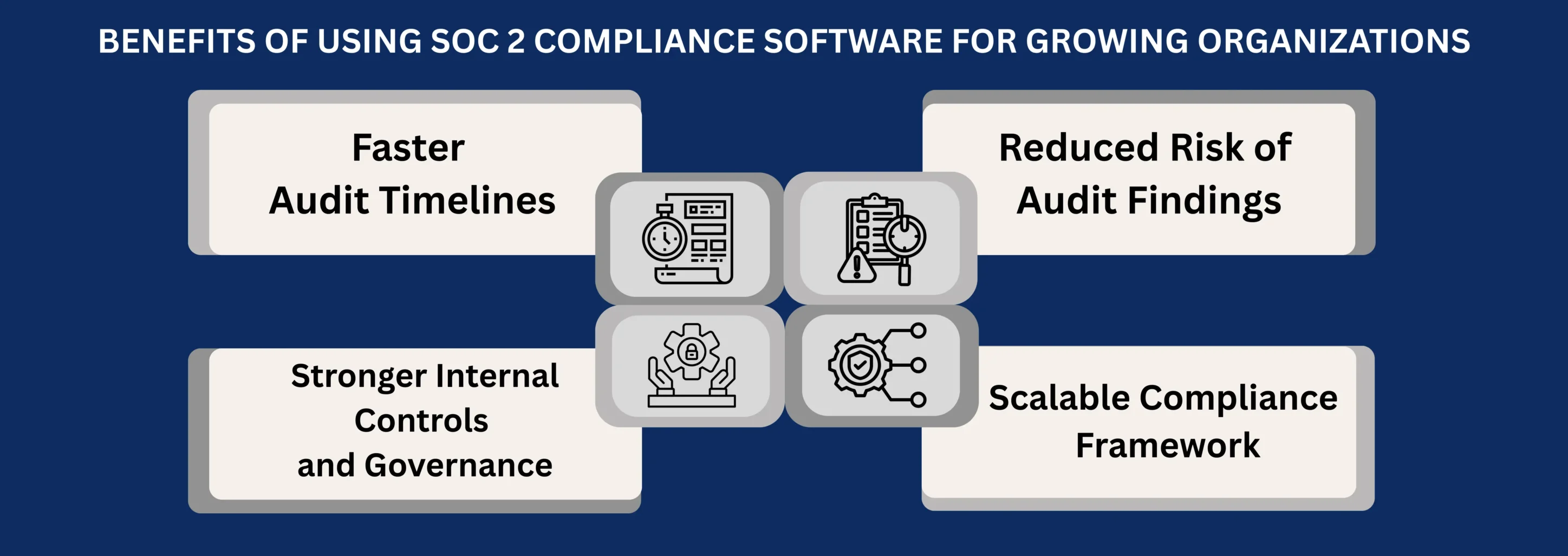
The SOC 2 examination process itself drives improvements in the service organization’s control environment. The requirement to document controls, produce evidence of their operation, and subject them to independent testing creates a discipline of operational consistency that benefits the organization beyond the attestation report. Organizations completing their first SOC 2 audit in Florida frequently report that the examination process identified control gaps — not through a consulting engagement, but through the evidence collection and testing procedures of the formal examination itself.
For Florida SaaS companies and cloud service providers, formalizing change management, access review, and incident response procedures for the SOC 2 examination creates operational infrastructure that reduces the likelihood of security incidents and supports scalable growth. The annual examination cycle reinforces these controls, ensuring that the organization does not allow control discipline to erode between attestation periods. This continuous reinforcement of the control environment represents a practical security benefit that extends well beyond the commercial value of the SOC 2 report itself.
- ✓Operational Control Improvements from the Examination Process
SOC 2 Certification Steps: A Structured Process Guide
The steps involved in obtaining SOC 2 Certification in Florida follow the structured examination methodology defined by AICPA attestation standards. Each step builds on the preceding one, creating a logical progression from engagement initiation through attestation report issuance. The following numbered process describes the SOC 2 certification steps as executed by a Licensed CPA Firm conducting an independent SOC 2 audit.
- Engagement Initiation: The service organization engages a Licensed CPA Firm. Engagement terms, scope boundaries, applicable Trust Services Criteria, and examination type (Type 1 or Type 2) are formally established.
- System Description Preparation: Management prepares the system description covering the services provided, infrastructure components, software, data flows, people, and processes within the examination scope.
- Audit Program Development: The Licensed CPA Firm develops the SOC 2 audit program identifying controls to be tested, evidence procedures, and sampling parameters based on the defined scope and applicable criteria.
- Observation Period Commencement (Type 2): For Type 2 engagements, the observation period begins. Control evidence is generated and retained throughout the period, typically six to twelve months.
- Evidence Collection: Auditors gather documentation, system-generated records, configuration evidence, and personnel records across all in-scope control domains using inquiry, inspection, observation, and re-performance procedures.
- Control Testing: Auditors execute the audit program procedures, testing each control against the applicable Trust Services Criteria. Sampling methodologies are applied to frequency-based controls.
- Exception Identification and Documentation: Any control deviations or exceptions identified during testing are documented, evaluated for risk significance, and communicated to management.
- Draft Report Preparation: The Licensed CPA Firm prepares the draft SOC 2 report, including the system description, auditor’s opinion, description of controls tested, and testing results.
- Management Review: Management reviews the draft report and provides responses to any identified exceptions. Management representations are confirmed and documented.
- Final Report Issuance: The Licensed CPA Firm issues the final SOC 2 attestation report. The report is delivered to the service organization for distribution to customers and relying parties under NDA.
SOC 2 attestation is not a one-time certification — it requires annual renewal to maintain current status. A SOC 2 report is generally considered valid for twelve months from the report date. After twelve months, enterprise customers and regulated-industry relying parties typically treat the report as expired and require an updated examination to confirm continued control effectiveness. Annual recertification examinations cover a new twelve-month observation period and produce an updated attestation report reflecting the current state of the control environment.
The annual SOC 2 audit cycle creates a continuous improvement loop for the control environment. Each examination period surfaces control changes, system updates, personnel changes, or operational deviations that require documentation and testing. Florida organizations that maintain annual SOC 2 audit cycles demonstrate to customers not only that their controls were effective at a point in time, but that they have maintained consistent control discipline across multiple examination periods — a significantly more compelling assurance than a single attestation.
- ✓Annual Recertification and Ongoing Compliance
SOC 2 Compliance Florida: Regulatory Context and Framework Alignment
SOC 2 compliance in Florida operates within a broader regulatory and contractual landscape that includes federal data protection requirements, Florida state privacy statutes, sector-specific regulations, and enterprise contractual security standards. Understanding how SOC 2 aligns with and complements these requirements allows Florida organizations to position the attestation strategically within their overall compliance program. While SOC 2 is not a regulatory mandate in itself, it addresses control requirements that appear across multiple regulatory frameworks applicable to Florida businesses.
Florida’s Technology and Privacy Regulatory Environment
Florida’s regulatory environment for data protection includes the Florida Information Protection Act (FIPA), which requires businesses to take reasonable measures to protect personal information and mandates breach notification within thirty days of discovery. The Florida Consumer Data Privacy Act and various sector-specific requirements create a layered privacy and security compliance environment for Florida technology companies. SOC 2 examination under the Security and Privacy Trust Services Criteria directly addresses many of the control requirements implicit in these obligations, providing documented, independent evidence of security and privacy control effectiveness.
Florida organizations handling payment card data are subject to the Payment Card Industry Data Security Standard (PCI DSS). While SOC 2 and PCI DSS are distinct frameworks with different scope and requirements, they share common control domains including access management, encryption, monitoring, and incident response. Organizations in Florida pursuing both SOC 2 certification and PCI DSS compliance can structure their control environment to address overlapping requirements efficiently, using evidence gathered for one examination to inform testing procedures for the other where control domains intersect.
SOC 2 and HIPAA Alignment for Florida Healthcare Technology
Florida’s healthcare technology sector is substantial, encompassing electronic health record providers, telehealth platforms, health information exchanges, medical device software companies, and healthcare data analytics firms. Organizations in this sector operating as HIPAA business associates must demonstrate security and privacy control effectiveness to covered entities. Florida healthcare technology companies that have completed SOC 2 certification using the Privacy and Security criteria produce attestation reports that address business associate security obligations under HIPAA — supplementing traditional HIPAA compliance programs with independent, third-party verified evidence of control effectiveness.
The HIPAA Security Rule and HIPAA Privacy Rule establish specific administrative, physical, and technical safeguard requirements for organizations handling protected health information. The SOC 2 Privacy Trust Services Criterion aligns with HIPAA Privacy Rule principles including notice, consent, collection limitation, use and disclosure restrictions, and data subject rights. The Security Common Criteria aligns with HIPAA Security Rule requirements for access control, audit controls, integrity, and transmission security. While a SOC 2 report is not a substitute for HIPAA compliance, it provides substantial corroborating evidence of security and privacy control effectiveness for healthcare technology organizations in Florida.
SOC 2 vs. ISO 27001 for Florida Organizations
Florida organizations frequently evaluate whether to pursue SOC 2 certification, ISO 27001 certification, or both. The frameworks differ in origin, structure, and primary use case. SOC 2 is a U.S.-centric attestation standard developed by the AICPA, focused on the Trust Services Criteria and producing a formal CPA-issued report. ISO 27001 is an internationally recognized information security management system standard that produces a certificate issued by an accredited certification body. SOC 2 is the standard required by U.S. enterprise customers and regulated industries, while ISO 27001 carries stronger recognition in international markets — particularly in Europe and Asia-Pacific.
For Florida-based technology companies primarily serving U.S. customers and enterprise markets, SOC 2 certification in Florida should be the priority attestation. Organizations with significant international customer bases or global operational footprints may pursue both certifications to satisfy domestic and international requirements. The two frameworks share overlapping control domains — particularly in access management, risk assessment, incident management, and business continuity — that allow organizations to leverage examination evidence across both frameworks. Organizations considering both certifications should engage with the Licensed CPA Firm conducting the SOC 2 examination early in the planning process to understand how evidence can be structured to serve both frameworks efficiently.
SOC 2 Certification Miami and Key Florida Markets
SOC 2 examination engagements in Florida are conducted across the state’s major metropolitan markets, each characterized by distinct industry concentrations and enterprise customer requirements. Miami, Tampa, Orlando, Jacksonville, and Fort Lauderdale represent the primary centers of technology and professional services activity in Florida, each presenting specific drivers for SOC 2 attestation demand. CertPro conducts SOC 2 examinations across all Florida markets, providing Licensed CPA Firm attestation services to organizations operating throughout the state’s diverse technology and services economy.
Miami: Fintech, International Finance, and Technology
Miami has established itself as a leading U.S. technology hub with particular strength in fintech, international financial services, and enterprise technology. The Miami technology ecosystem includes a high concentration of financial technology companies, payment processing platforms, digital banking providers, and cryptocurrency and blockchain organizations. SOC 2 certification for Florida financial services companies operating in Miami is driven by requirements from banking partners, payment network affiliations, and enterprise customers demanding independent verification of security and processing integrity controls.
Miami’s role as a gateway to Latin American markets adds an additional dimension to SOC 2 attestation demand. International financial institutions and multinational corporations with Miami technology operations often require SOC 2 compliance as a condition of vendor qualification across their global supply chains. For Miami-based technology companies serving both U.S. and international customers, completing a SOC 2 audit in Florida provides a recognized attestation format that satisfies U.S. enterprise requirements while also demonstrating security control maturity to international partners familiar with U.S. attestation standards.
Tampa, Orlando, and Jacksonville Markets
Tampa’s technology sector has grown significantly, driven by financial services, insurance technology, and defense contracting. Major financial institutions and insurance companies headquartered in Tampa require SOC 2 attestation from technology vendors as part of formal third-party risk management programs. Orlando’s technology cluster includes simulation and modeling companies, hospitality technology providers, and a growing healthcare technology sector aligned with the region’s major health systems. Jacksonville’s economy includes logistics technology, financial services, and defense operations that create demand for SOC 2 certified technology vendors.
Across these Florida markets, SOC 2 examination serves as the standard independent attestation mechanism for technology vendor qualification. Organizations operating in multiple Florida markets benefit from a single SOC 2 examination that covers the entire service organization, producing a report that can be distributed to customers across all markets. The Licensed CPA Firm conducts the examination against the organization as a whole rather than on a market-by-market basis, providing a single, authoritative attestation that satisfies customer requirements across Florida’s diverse technology economy.
Who Needs SOC 2 Certification in Florida?
SOC 2 attestation is required or strongly indicated for any Florida service organization that stores, processes, or transmits customer data and serves enterprise, regulated-industry, or government customers. The examination is designed for service organizations whose services affect the information security, processing integrity, confidentiality, or privacy of their customers’ data. The following categories of Florida organizations routinely require SOC 2 certification as a condition of business operations or customer acquisition.
- ✓SaaS companies delivering cloud-based software applications to enterprise customers in Florida and nationally
- ✓Cloud service providers and infrastructure-as-a-service (IaaS) organizations operating Florida data centers
- ✓Managed service providers (MSPs) managing IT infrastructure, networks, or security operations for Florida businesses
- ✓Fintech companies providing payment processing, digital banking, lending, or financial data services
- ✓Healthcare technology organizations acting as HIPAA business associates for Florida health systems
- ✓Cybersecurity firms providing managed detection and response, security operations center, or threat intelligence services
- ✓Data analytics and business intelligence platforms processing customer data for enterprise clients
- ✓Logistics technology companies managing supply chain data and operational systems for Florida distributors and manufacturers
- ✓Aerospace and defense technology contractors operating within DoD and government supply chains in Florida
- ✓Tourism and hospitality technology providers managing reservation systems, customer data, and payment platforms
When SOC 2 Attestation Becomes a Customer Requirement
SOC 2 attestation becomes a customer requirement when enterprise procurement teams, legal departments, or information security teams include SOC 2 compliance as a condition of vendor qualification in their vendor management policies or contractual security requirements. This requirement is typically embedded in vendor questionnaires, data processing agreements, and master service agreements. Florida organizations that have not completed a SOC 2 examination may find that certain enterprise customers will not proceed with onboarding until a current SOC 2 report is provided.
The trigger for pursuing SOC 2 certification in Florida is most commonly a specific customer requirement — either a request from an existing customer for a SOC 2 report, or a requirement encountered during an active sales process with a prospective enterprise customer. Organizations in Florida’s technology sectors should anticipate this requirement as a standard feature of enterprise sales cycles. Proactively initiating a SOC 2 examination engagement with a Licensed CPA Firm before the requirement emerges prevents the certification timeline from becoming a bottleneck in a revenue-critical sales process.
CertPro’s SOC 2 Examination and Attestation Services in Florida
CertPro is a Licensed CPA Firm providing independent SOC 2 examination and attestation services to service organizations across Florida. CertPro’s SOC 2 engagements are conducted exclusively under AICPA attestation standards — AT-C Section 105 and AT-C Section 205 — by qualified CPA professionals with specialized expertise in Trust Services Criteria examinations. CertPro does not provide consulting, advisory, or implementation services. The firm functions exclusively as an independent attestation body, maintaining the independence required by AICPA professional standards throughout every SOC 2 examination engagement.
Licensed CPA Firm Independence and Qualification
The requirement to engage a Licensed CPA Firm for a SOC 2 examination is not merely procedural — it is a professional and legal requirement established by the AICPA. Only CPA firms with valid licensure and independence from the examined organization are authorized to conduct SOC 2 examinations and issue the resulting attestation reports. CertPro maintains full CPA licensure and adheres to AICPA independence standards, including the prohibition on providing non-attest services to examination clients that would impair objectivity. This independence is precisely what gives the SOC 2 report its value to relying parties — customers know the attestation was produced by an independent examiner with no stake in the outcome.
CertPro’s examination teams bring sector-specific knowledge of the control environments typical in Florida’s technology, fintech, healthcare technology, and cloud services industries. This sector knowledge enables precise audit program development, efficient evidence collection, and informed evaluation of control exceptions in the context of industry-standard practices. The firm’s experience across Florida’s key markets — Miami, Tampa, Orlando, Jacksonville, and Fort Lauderdale — ensures that SOC 2 examinations are calibrated to the specific systems, customer commitments, and regulatory contexts relevant to each organization’s operating environment.
CertPro’s Examination Methodology
CertPro conducts SOC 2 examinations using a structured, evidence-driven methodology aligned with AICPA attestation standards and the Trust Services Criteria. The examination methodology encompasses scope definition, audit program development, evidence collection through inquiry, observation, inspection, and re-performance, control testing against applicable criteria, exception documentation, and formal report issuance. CertPro’s examination procedures are designed to produce SOC 2 attestation reports that satisfy the requirements of enterprise customers, financial institution vendor management programs, and regulated-industry procurement processes across Florida and nationally.
CertPro issues both SOC 2 Type 1 and SOC 2 Type 2 reports based on the examination scope and the organization’s requirements. For organizations pursuing SOC 2 certification for the first time, CertPro evaluates the appropriate report type based on control maturity, customer requirements, and examination timeline. The firm’s SOC 2 examination reports are delivered in the standard AICPA-prescribed format — including the system description, the auditor’s report and opinion, the description of the service auditor’s tests of controls, and the results of those tests — providing the complete documentation required by enterprise customers conducting vendor risk evaluations.
Scope of SOC 2 Examination Services
CertPro’s SOC 2 examination services in Florida cover the full range of Trust Services Criteria applicable to service organizations operating in the state’s technology and services economy. Examinations can be scoped to include any combination of the five TSC categories — Security, Availability, Processing Integrity, Confidentiality, and Privacy — based on the service organization’s commitments and customer requirements. CertPro conducts SOC 2 examinations for organizations across all sizes, from early-stage SaaS companies completing their first SOC 2 audit to established technology firms maintaining annual examination cycles for enterprise customer programs.
Securing SOC 2 Certification in Florida: Next Steps
Securing SOC 2 Certification in Florida begins with engaging a Licensed CPA Firm to initiate a formal examination engagement. The initiation process involves confirming the examination scope, selecting the applicable Trust Services Criteria, establishing the examination type (Type 1 or Type 2), and defining the observation period for Type 2 engagements. Organizations that have not previously undergone a SOC 2 examination should ensure that their control environment is operational and documentation is in place before the examination commences — the Licensed CPA Firm tests controls that exist and are operational, not controls that are planned or still in development.
CertPro accepts SOC 2 examination engagements from Florida service organizations across all technology and services sectors. Engagement initiation involves a formal discussion of the organization’s services, the proposed examination scope, the applicable Trust Services Criteria, and the desired examination timeline. CertPro evaluates each engagement independently and establishes formal attestation terms before examination activities commence. Florida organizations seeking SOC 2 attestation should initiate the engagement process with sufficient lead time to accommodate the observation period required for Type 2 reports.
The timeline for completing SOC 2 Certification in Florida depends primarily on the report type selected and the organization’s control documentation maturity. A SOC 2 Type 1 examination can typically be completed within four to eight weeks from engagement initiation, assuming the organization’s system description and control documentation are complete and controls are operational. The Type 1 timeline does not include an observation period — the examination evaluates controls at a point in time, allowing for faster completion when a customer requires an initial attestation on an accelerated timeline.
A SOC 2 Type 2 examination requires a minimum observation period of six months, with twelve months as the industry standard. The total timeline from engagement initiation to report issuance for a twelve-month Type 2 examination typically spans thirteen to fifteen months, accounting for the observation period plus the time required for audit program execution, evidence collection, testing, and report preparation. Florida organizations with active sales cycles requiring a Type 2 report should initiate the SOC 2 examination engagement as early as possible to ensure the report is available within the intended timeframe.
- ✓Timeline Considerations for SOC 2 Certification in Florida
FAQ
▶
What is SOC 2 certification?
▶
What is the difference between SOC 2 certified and SOC 2 compliant?
▶
How long does a SOC 2 examination take in Florida?
▶
How long is a SOC 2 report valid?
▶
What is the difference between SOC 2 and SOC 3?
▶
Which Trust Services Criteria should a Florida company include in its SOC 2 examination?
▶
Can a cybersecurity firm or technology vendor conduct a SOC 2 examination?
▶
Should Florida companies pursue SOC 2 certification or ISO 27001 certification?
SOC 1 VS SOC 2: WHICH REPORT YOUR CUSTOMERS ACTUALLY ASK FOR
If you sell SaaS or provide outsourced services, you have likely been asked for a SOC report. However, the follow-up question is rarely easy to answer…

AICPA Issues New Guidance for Peer Reviewers Evaluating SOC 2 Engagements
AICPA SOC 2 guidance has been issued to help peer reviewers identify quality risks associated with SOC 2 engagements as the use of compliance automati…
SOC 2 Certified: What Does It Mean for Your Business
For companies that handle sensitive data or run cloud-based services, the question “Can you provide your SOC 2 report?” carries enormous weight. Yet, …
Get In Touch
have a question? let us get back to you.