
ISO 27001 Certification in Montreal
ISO 27001 Certification in Montreal is issued by CertPro, a Licensed CPA Firm operating as an independent third-party certification body. CertPro evaluates organizations against the requirements of ISO/IEC 27001:2022 — the internationally recognized standard for Information Security Management Systems (ISMS) — and issues certification upon confirmed conformance. ISO 27001 certification is a formal, evidence-based attestation confirming that an organization has designed, implemented, and operationalized an ISMS that satisfies all mandatory clauses and applicable Annex A controls under the standard.
OUR CLIENTS










What Is ISO 27001 Certification and Why Does It Matter for Montreal Organizations?
ISO 27001 Certification in Montreal is issued by CertPro, a Licensed CPA Firm operating as an independent third-party certification body. CertPro evaluates organizations against the requirements of ISO/IEC 27001:2022 — the internationally recognized standard for Information Security Management Systems (ISMS) — and issues certification upon confirmed conformance. ISO 27001 certification is a formal, evidence-based attestation confirming that an organization has designed, implemented, and operationalized an ISMS that satisfies all mandatory clauses and applicable Annex A controls under the standard.
For Montreal organizations operating in competitive and regulated sectors — including SaaS, fintech, AI, cloud services, healthcare, aerospace, and advanced manufacturing — ISO 27001 Certification in Montreal provides independently verified evidence that information assets are managed within a structured, audited risk framework. This verification signal carries institutional weight with enterprise procurement teams, financial sector clients, government counterparties, and international buyers who require documented evidence of information security governance before entering commercial or data-sharing arrangements.
Montreal’s technology ecosystem includes a dense concentration of AI research organizations, software development companies, cybersecurity firms, e-commerce platforms, gaming studios, and financial services providers — many of which handle sensitive personal, financial, or proprietary information at scale. ISO/IEC 27001:2022, the current version of the standard, was published in October 2022. It introduced a restructured Annex A with 93 controls organized across four domains: Organizational, People, Physical, and Technological. The transition deadline for organizations previously certified to ISO/IEC 27001:2013 is October 31, 2025, as established by accredited certification bodies. Organizations in Montreal that have not yet transitioned must complete their transition audit before this deadline to maintain certification validity.
ISMS certification under ISO 27001 is not a self-declaration — it requires a two-stage audit conducted by an accredited or qualified certification body. The ISO 27001 audit evaluates documented policies, risk assessment outputs, risk treatment decisions, control implementation evidence, internal audit records, management review minutes, and corrective action histories. Organizations that successfully complete both audit stages and address all identified nonconformities receive an ISO 27001 certificate valid for three years, subject to annual surveillance audits. ISO 27001 Certification in Montreal therefore represents a structured, ongoing commitment to information security governance rather than a one-time compliance exercise.
Quebec’s regulatory environment adds further context for Montreal organizations pursuing ISO 27001 compliance. Quebec’s Law 25 — the Act respecting the protection of personal information in the private sector — imposes obligations related to privacy governance, risk assessment, incident notification, and data protection impact assessments on organizations operating in the province. While ISO 27001 certification does not automatically establish compliance with Law 25 or Canada’s federal privacy framework under PIPEDA, the ISMS controls and risk management processes required by ISO/IEC 27001:2022 address many of the same information governance principles. Organizations that pursue ISO 27001 Certification in Montreal therefore build a documented security foundation that supports broader privacy and regulatory accountability requirements relevant to their operating environment.
ISO/IEC 27001:2022 — The Current Standard
ISO/IEC 27001:2022 is the version of the standard currently used as the basis for ISMS certification. It supersedes ISO/IEC 27001:2013 and introduces a harmonized high-level structure aligned with other ISO management system standards, including ISO 9001 and ISO 22301. The 2022 version restructured Annex A from 114 controls across 14 domains to 93 controls across four domains, and introduced 11 new controls addressing areas such as threat intelligence, cloud service information security, data masking, and ICT readiness for business continuity. Organizations seeking ISO 27001 Certification in Montreal must demonstrate conformance with the 2022 version of the standard in all current certification audits.
Who Requires ISO 27001 Certification in Montreal?
ISO 27001 certification is required or expected by a growing range of enterprise clients, procurement frameworks, and sectoral programs in Montreal and across Canadian and international markets. Financial institutions, insurance companies, and regulated entities in Quebec frequently include ISO 27001 compliance in vendor qualification criteria for technology and data processing suppliers. Federal and provincial government procurement programs may reference ISO 27001 as a baseline security requirement for cloud service providers and data processors. International enterprise buyers — particularly in the United States, United Kingdom, and European Union — routinely require ISO 27001 certification as a condition of data processing agreements. Montreal-based SaaS providers, AI companies, fintech firms, healthcare technology organizations, and cybersecurity businesses seeking to expand into these markets increasingly treat ISMS certification as a commercial prerequisite rather than a discretionary credential.

ENQUIRE NOW
Related Resources
Related Services in Montreal
ISO 27001 Standard Requirements — Clauses 4 Through 10
ISO/IEC 27001:2022 is structured around ten clauses. Clauses 1 through 3 cover scope, normative references, and terms and definitions. Clauses 4 through 10 contain the mandatory requirements that organizations must satisfy to achieve ISO 27001 certification. Each clause imposes specific obligations on how the ISMS is established, documented, operated, monitored, and improved. During an ISO 27001 audit, the certification body examines conformance with every mandatory clause through document review, personnel interviews, and evidence sampling.
Clause 4 requires the organization to define its internal and external context, identify interested parties and their requirements, and establish the scope of the ISMS. Clause 5 places responsibility on top management to demonstrate leadership commitment, establish an information security policy, and assign roles and responsibilities for ISMS governance. Clause 6 covers planning — including the information security risk assessment methodology, risk treatment process, and the setting of information security objectives. These three clauses establish the governance foundation that all subsequent ISMS activities must reference. During the ISO 27001 audit, auditors examine whether scope boundaries are clearly defined, the risk methodology is documented and consistently applied, and objectives are measurable and linked to organizational strategy.
Clause 7 addresses the resources, competence, awareness, communication, and documented information required to support the ISMS. Clause 8 covers operational planning and control, including the execution of risk assessments and risk treatment plans. Clause 9 requires performance evaluation through monitoring, measurement, internal audit, and management review. Clause 10 mandates continual improvement through nonconformity management and corrective action. Together, these clauses establish the operational and governance cycle — often described as Plan-Do-Check-Act — that the ISMS must demonstrate in practice. ISO 27001 assessment auditors review evidence across all four clauses to confirm that the ISMS is not merely documented but actively operated and improved over time.
| Clause | Topic | Key Audit Focus |
|---|---|---|
| Clause 4 | Context of the Organization | ISMS scope definition, interested party requirements, context analysis |
| Clause 5 | Leadership | Top management commitment, information security policy, roles and responsibilities |
| Clause 6 | Planning | Risk assessment methodology, risk treatment plan, measurable objectives |
| Clause 7 | Support | Resources, competence evidence, documented information management |
| Clause 8 | Operation | Risk assessment execution, risk treatment implementation and records |
| Clause 9 | Performance Evaluation | Internal audit program, management review outputs, monitoring and measurement |
| Clause 10 | Improvement | Nonconformity handling, corrective action records, continual improvement evidence |
- ✓Clauses 4 to 6 — Context, Leadership, and Planning
- ✓Clauses 7 to 10 — Support, Operation, Performance, and Improvement
Annex A Controls — ISO 27001:2022 Control Domains
Annex A of ISO/IEC 27001:2022 provides a reference set of 93 information security controls organized across four domains. These controls are not automatically mandatory — organizations must select applicable controls based on their risk assessment and risk treatment decisions, then document their selections and justifications in the Statement of Applicability (SoA). The Annex A controls function as a structured control catalogue that ensures the ISMS addresses the full range of information security risks relevant to the organization’s scope and context. Selecting and implementing the right controls is a central focus of every ISO 27001 assessment.
The Four Annex A Control Domains
The 2022 restructuring of Annex A consolidated 14 control categories from the 2013 version into four domains. Organizational controls (37 controls) cover policies, roles, asset management, supplier relationships, and incident management. People controls (8 controls) address employment screening, terms and conditions, awareness, training, and disciplinary processes. Physical controls (14 controls) govern physical security perimeters, entry controls, equipment protection, and clear desk and screen policies. Technological controls (34 controls) encompass access management, cryptography, network security, secure development, vulnerability management, and monitoring. Montreal organizations in technology-intensive sectors — such as AI, cloud services, and fintech — are typically most engaged with the Technological and Organizational control domains during an ISO 27001 assessment.
New Controls Introduced in ISO/IEC 27001:2022
ISO/IEC 27001:2022 introduced 11 new controls not present in the 2013 version. These additions reflect the evolution of the information security threat landscape and the expansion of cloud and digital operations. New controls include threat intelligence (5.7), information security for use of cloud services (5.23), ICT readiness for business continuity (5.30), physical security monitoring (7.4), configuration management (8.9), information deletion (8.10), data masking (8.11), data leakage prevention (8.12), web filtering (8.23), secure coding (8.28), and monitoring activities (8.16). For Montreal technology companies and fintech organizations operating cloud-native or distributed infrastructure, several of these new controls are directly relevant to their operational risk profile and will be evaluated during the ISO 27001 audit.
Risk Assessment and Risk Treatment Under ISO 27001
Risk assessment and risk treatment are the operational core of ISO/IEC 27001:2022. The standard does not prescribe a specific risk assessment methodology — it requires that the organization define and apply a consistent, repeatable approach that produces comparable and reproducible results. This methodology must identify information security risks, analyze their likelihood and potential impact, evaluate risks against defined acceptance criteria, and generate a risk treatment plan specifying how each risk will be addressed. A well-executed risk assessment process is foundational to achieving ISO 27001 compliance.
Information Security Risk Assessment Requirements
The ISO 27001 risk assessment process must be documented and repeatable. Organizations must identify assets, threats, and vulnerabilities within the ISMS scope; assign ownership of each identified risk; analyze the potential consequences and likelihood of risk scenarios; and evaluate each risk against the organization’s defined risk acceptance criteria. The risk assessment must be conducted at planned intervals and whenever significant changes occur within the ISMS scope. During the ISO 27001 audit, CertPro auditors examine the documented risk assessment methodology, the risk register outputs, and whether the analysis is consistent, traceable, and aligned with the organization’s information security objectives and asset inventory.
Risk Treatment Options and the Risk Treatment Plan
ISO/IEC 27001:2022 requires organizations to select appropriate risk treatment options for each identified risk. The standard recognizes four treatment options: modifying the risk (implementing controls), retaining the risk (accepting it within defined tolerance), avoiding the risk (ceasing the activity that generates it), or sharing the risk (transferring it to a third party through insurance or contractual arrangements). For each risk selected for modification, the organization must identify applicable Annex A controls, document the justification in the Statement of Applicability, and produce a risk treatment plan assigning responsibilities and implementation timelines. The risk treatment plan is a primary document reviewed during ISO 27001 assessment to confirm that control selection decisions are evidence-based and traceable to risk outputs.
Statement of Applicability — Definition, Structure, and Role in Certification
The Statement of Applicability (SoA) is a mandatory document under ISO/IEC 27001:2022 and one of the most scrutinized records during an ISO 27001 audit. The SoA lists all 93 Annex A controls, indicates whether each control is applicable or not applicable to the organization, provides justification for each inclusion or exclusion, and records the implementation status of each applicable control. The SoA links the risk assessment outputs to control selections, creating a traceable chain from identified risks to operational security measures — making it a cornerstone of ISO 27001 compliance documentation.
Structure and Content of the SoA
A complete SoA document includes a reference to each of the 93 Annex A controls from ISO/IEC 27001:2022, a determination of applicability with documented rationale, the justification for any excluded controls (which must demonstrate that associated risks are accepted or addressed through alternative means), and the current implementation status of each included control. The SoA must be reviewed and updated whenever the risk assessment is repeated, when new controls are implemented, or when previously applicable controls become inapplicable due to scope changes. During Stage 2 of the ISO 27001 audit, auditors verify that the SoA accurately reflects the organization’s actual control environment and that implementation status claims are supported by objective evidence.
SoA as a Certification Audit Reference Document
The SoA serves as the primary reference document for the certification audit scope. Auditors use the SoA to plan their Stage 2 audit sampling strategy — selecting controls for testing based on risk significance, implementation complexity, and the organization’s stated implementation status. For Montreal organizations in data-intensive sectors, the SoA frequently reflects a broad set of applicable Technological controls (particularly access management, cryptography, network security, and vulnerability management) alongside a full set of Organizational controls governing policy, supplier relationships, and incident response. A well-structured SoA that clearly connects risk assessment outputs to control selections and accurately reflects implementation status strengthens the ISO 27001 assessment process and supports more efficient audit execution.
ISMS Scope Definition and Documentation Requirements
ISMS scope definition is a foundational requirement of ISO/IEC 27001:2022 and a critical determinant of certification audit boundaries. The scope document specifies which parts of the organization, which information assets, which locations, and which processes fall within the ISMS boundary. The scope must consider internal and external context, interested party requirements, and interfaces and dependencies between in-scope activities and those outside the ISMS boundary. An accurately defined scope ensures that the ISO 27001 audit covers all relevant information security risks and that the resulting certificate accurately represents the organization’s certified activities.
Montreal organizations operating across multiple business units, geographic locations, or cloud environments must carefully define ISMS boundaries to ensure the scope accurately captures all information assets and processes subject to information security risk. A SaaS provider in Montreal might define its ISMS scope to include cloud infrastructure, software development operations, customer data processing, and customer support functions — while explicitly excluding unrelated corporate administrative functions. A fintech organization might define its scope around its payment processing platform and associated data flows. Scope boundaries must be documented clearly, available as documented information, and consistently referenced throughout the ISMS documentation set. During the ISO 27001 audit, auditors verify that the scope is realistic, covers all significant information security risks, and that out-of-scope exclusions are justified and do not create gaps in control coverage.
ISO/IEC 27001:2022 specifies a defined set of documents and records that must be maintained as part of the ISMS. Required documented information includes the information security policy, ISMS scope document, risk assessment methodology and results, risk treatment plan, Statement of Applicability, information security objectives, competence evidence, monitoring and measurement results, internal audit program and results, management review outputs, and records of nonconformities and corrective actions. Organizations may maintain additional documented information determined necessary for ISMS effectiveness. During the Stage 1 ISO 27001 audit, CertPro auditors conduct a systematic review of the documented information to confirm completeness and readiness for Stage 2 assessment.
- ✓Defining ISMS Boundaries for Montreal Organizations
- ✓Mandatory ISMS Documentation Under ISO/IEC 27001:2022
ISO 27001 Audit Process — Stage 1 and Stage 2
The ISO 27001 audit process follows a structured two-stage methodology conducted by CertPro as the independent certification body. ISO 27001 audit engagements for Montreal organizations proceed through defined evaluation phases, each with specific objectives, evidence requirements, and outputs. The two-stage audit structure ensures that both the documentation foundation and the operational implementation of the ISMS are independently verified before certification is granted.
The Stage 1 ISO 27001 audit is a documentation-focused evaluation conducted to determine whether the organization’s ISMS is sufficiently developed and documented to proceed to Stage 2. During Stage 1, CertPro auditors review the ISMS scope document, information security policy, risk assessment methodology and outputs, risk treatment plan, Statement of Applicability, internal audit results, and management review records. The Stage 1 audit also confirms that the organization understands its own ISMS requirements and has identified and planned the implementation of applicable controls. Where the Stage 1 audit identifies significant gaps in documentation or conceptual understanding, the organization must address these before Stage 2 proceeds. The Stage 1 audit typically results in a written report identifying findings and observations, including any areas requiring attention prior to Stage 2.
The Stage 2 ISO 27001 audit is an on-site or remote operational evaluation that tests whether the ISMS is effectively implemented and operating as documented. CertPro auditors conduct structured interviews with personnel across relevant functions, examine objective evidence of control operation (such as access control logs, vulnerability scan reports, training completion records, and incident response records), and test whether documented procedures are followed in practice. The Stage 2 audit evaluates conformance with all mandatory clauses (4 through 10) and tests a risk-based sample of the Annex A controls listed in the Statement of Applicability. Identified nonconformities — classified as major or minor — must be addressed through documented corrective actions before certification can be issued. Major nonconformities represent failures to satisfy mandatory ISMS requirements and must be resolved and verified before the certificate is granted.
- Scope definition and audit program determination by the certification body
- Stage 1 audit — review of ISMS documented information and readiness confirmation
- Stage 1 audit report — identification of findings and areas requiring attention
- Stage 2 audit — operational conformance evaluation, personnel interviews, and control evidence testing
- Nonconformity identification — classification as major or minor, documented corrective action required
- Corrective action verification — confirmation that nonconformities have been addressed
- Certification decision — review of audit findings and issuance of ISO 27001 certificate
- Certificate issuance — valid for three years subject to annual surveillance audits
- ✓Stage 1 Audit — Documentation Review and Readiness Assessment
- ✓Stage 2 Audit — Implementation and Conformance Evaluation
Certification Lifecycle — Surveillance Audits and Recertification
ISO 27001 certification is valid for a three-year certification cycle. Maintaining certification requires annual surveillance audits and a full recertification audit at the end of the three-year period. The certification lifecycle structure ensures that the ISMS remains effective and conformant over time — not merely at the point of initial certification. Organizations that fail to complete surveillance audits within the required timeframe risk suspension or withdrawal of their ISO 27001 certificate.
Annual Surveillance Audits
Surveillance audits are conducted annually — typically at 12-month and 24-month intervals following initial certification — to verify that the ISMS continues to operate effectively and that the organization maintains ISO 27001 compliance with ISO/IEC 27001:2022. Surveillance audits are narrower in scope than the initial certification audit. They focus on areas identified as significant during prior audits, ISMS changes since the last audit, management review outputs, internal audit results, corrective action effectiveness, and the organization’s progress toward information security objectives. Surveillance audits also verify that previously identified nonconformities remain closed and that no new systemic gaps have emerged. Montreal organizations are expected to maintain complete and current ISMS documentation and operational records between surveillance visits to support efficient audit execution.
Recertification Audit at Year Three
At the end of the three-year certification cycle, organizations must complete a full recertification audit to renew their ISO 27001 certificate. The recertification audit is comparable in scope to the initial Stage 2 audit — it evaluates the full ISMS for continued conformance with all mandatory clauses, reviews the effectiveness of the ISMS over the certification period, and assesses the organization’s continual improvement performance. The recertification audit also confirms that the organization is operating against the current version of the standard. Organizations that transition from ISO/IEC 27001:2013 to ISO/IEC 27001:2022 must complete their transition audit before October 31, 2025. Following successful recertification, a new three-year certificate is issued and the surveillance audit cycle resets.
ISO 27001 and Montreal’s Regulatory Environment — PIPEDA and Law 25
Montreal organizations operating under Canadian federal and Quebec provincial privacy law must navigate multiple overlapping regulatory frameworks governing the protection of personal information. ISO 27001 compliance supports information security governance practices that are structurally consistent with several regulatory requirements — however, ISO 27001 certification does not constitute or substitute for legal compliance with PIPEDA, Quebec’s Law 25, or sector-specific regulatory obligations. Understanding the relationship between ISO 27001 and these regulatory frameworks helps Montreal organizations assess the practical value of certification within their broader compliance environment.
Quebec’s Law 25 and Information Security Governance
Quebec’s Law 25 — formally the Act respecting the protection of personal information in the private sector — came into full effect in September 2023. It imposes obligations on Quebec private-sector organizations regarding the appointment of a privacy officer, publication of a privacy policy, completion of privacy impact assessments for high-risk projects, mandatory breach notification to the Commission d’accès à l’information (CAI), and data governance accountability. The ISMS controls required under ISO/IEC 27001:2022 — including information classification, access management, incident management, supplier security, and documented governance structures — address many of the same operational risk areas covered by Law 25. Organizations pursuing ISO 27001 Certification in Montreal therefore build documented security governance that provides a structured foundation for privacy program development, though formal Law 25 compliance analysis remains a separate legal determination.
PIPEDA and Federal Privacy Considerations
Canada’s Personal Information Protection and Electronic Documents Act (PIPEDA) applies to federal works, undertakings, and businesses that collect, use, or disclose personal information in the course of commercial activity across provincial borders. For Montreal organizations engaged in cross-provincial or cross-border data processing — including fintech platforms, e-commerce providers, and cloud service operators — PIPEDA establishes accountability, consent, and safeguard obligations that align conceptually with ISO 27001’s risk-based control framework. ISO 27001 assessment evaluates the technical and organizational controls that protect information from unauthorized access, use, and disclosure — controls directly relevant to meeting PIPEDA’s safeguard principle. Montreal organizations in regulated sectors frequently reference their ISO 27001 certification as evidence of information security diligence in regulatory submissions, procurement responses, and data processing agreements with Canadian and international counterparties.
Benefits of ISO 27001 Certification for Montreal Organizations
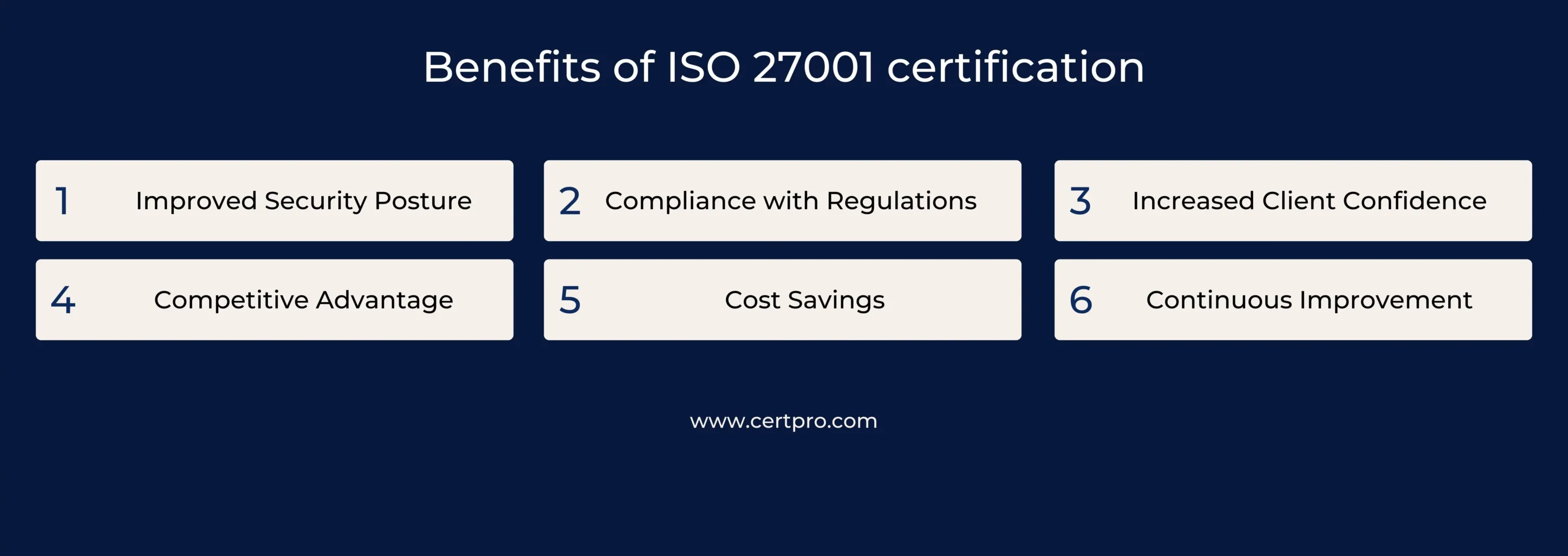
ISO 27001 Certification in Montreal delivers independently verified, measurable outcomes across commercial, operational, and governance dimensions. Organizations that complete the certification process gain structured evidence of information security maturity that can be referenced in enterprise procurement, regulatory submissions, client due diligence processes, and contract negotiations. The benefits extend beyond the certificate itself — the ISMS framework established through the certification process creates durable operational improvements in risk awareness, control documentation, and incident response capability.
ISO 27001 certification for Montreal companies operating in enterprise B2B markets, regulated industries, or cross-border commercial relationships provides a credentialed security posture that addresses third-party risk management requirements from procurement teams and enterprise clients. Financial institutions in Quebec and federally regulated entities frequently require technology suppliers and data processors to hold ISO 27001 certification or equivalent security credentials. International enterprise buyers — particularly in US financial services, European healthcare, and global SaaS markets — treat ISO 27001 certification as a baseline vendor qualification requirement. Montreal technology companies, AI organizations, and cybersecurity firms that hold ISO 27001 certification reduce the friction associated with security questionnaires, due diligence reviews, and contract negotiations by providing independently attested conformance evidence that procurement teams can evaluate objectively.
The ISMS established through the ISO 27001 certification process creates structured operational improvements in information security governance. Organizations develop documented risk assessment processes that systematically identify and prioritize information security risks. Asset inventories, access control policies, incident response procedures, and supplier security requirements become documented, reviewed, and consistently applied. Management review processes create executive-level accountability for information security performance, while internal audit functions generate objective evidence of control effectiveness. These governance structures — directly required by ISO/IEC 27001:2022 — improve the organization’s ability to detect, respond to, and recover from information security incidents. They also reduce the likelihood of security breaches attributable to inadequate controls and create documented accountability trails relevant to regulatory inquiries and insurance assessments.
- ✓Independently verified evidence of ISMS conformance for enterprise procurement and contract qualification
- ✓Reduced vendor qualification friction with enterprise clients requiring ISO 27001 compliance in Montreal
- ✓Structured risk assessment and risk treatment framework applied consistently across the ISMS scope
- ✓Documented Annex A control implementation supporting regulatory and contractual security obligations
- ✓Management review and internal audit processes creating executive accountability for information security
- ✓Incident response and corrective action documentation supporting regulatory notification obligations
- ✓Three-year certification credential with annual surveillance validation maintaining ongoing credibility
- ✓Alignment with Quebec’s Law 25 information security governance expectations
- ✓Commercial and Market Access Benefits
- ✓Operational and Governance Benefits
Requirements for ISO 27001 Certification
Achieving ISO 27001 certification requires an organization to satisfy all mandatory requirements of ISO/IEC 27001:2022, demonstrate conformance through an independent two-stage audit, and address all identified nonconformities before the certification decision is made. The requirements span documentation, operational controls, governance structures, and organizational processes — and must be evidenced through objective records rather than assertions. Organizations pursuing ISO 27001 Certification in Montreal are evaluated against the same international standard requirements regardless of their size, sector, or ISMS scope.
ISO/IEC 27001:2022 specifies a defined set of mandatory documented information that must be maintained and available for audit review. Required documentation includes the ISMS scope statement, information security policy, risk assessment process documentation, risk register, risk treatment plan, Statement of Applicability, information security objectives, competence records, operational control documentation, internal audit program and reports, management review records, and corrective action records. Additional documented information — such as asset inventories, access control matrices, supplier agreements with security requirements, and incident logs — must also be available to support audit evidence requests. All documented information must be controlled, version-managed, and accessible to relevant personnel. During the Stage 1 ISO 27001 audit, the completeness and structure of the documentation set is the primary evaluation focus.
Beyond documentation, ISO 27001 compliance requires that the ISMS operates as documented in practice. Applicable Annex A controls must be implemented and evidenced through operational records — access logs, change management tickets, vulnerability scan outputs, training completion records, supplier assessment results, and backup test reports, among others. Top management must demonstrate active leadership engagement with the ISMS, including participation in management reviews and allocation of resources to information security functions. Internal audits must be conducted at planned intervals by competent personnel independent of the areas being audited, and findings must be reported to management. The organization must also demonstrate a pattern of continual improvement — identifying nonconformities, implementing corrective actions, and monitoring their effectiveness over time. These operational requirements are verified during Stage 2 of the ISO 27001 audit through personnel interviews, system access demonstrations, and document sampling.
- ✓Documentation Requirements
- ✓Operational and Governance Requirements
Steps for Obtaining ISO 27001 Certification in Montreal
ISO 27001 Certification in Montreal follows a structured sequence of activities that begin with ISMS design and culminate in certificate issuance following a successful two-stage audit. The steps below describe the certification pathway for organizations engaging with CertPro as their certification body. Each step produces documented outputs that form part of the ISMS evidence base and audit record.
The first phase of the certification pathway involves establishing the ISMS in conformance with ISO/IEC 27001:2022. This requires defining the ISMS scope, completing a context analysis, identifying interested parties and their requirements, conducting a formal information security risk assessment, selecting risk treatment options and applicable Annex A controls, developing the Statement of Applicability, implementing selected controls, and producing all required documented information. Once the ISMS has been operational for a sufficient period to generate audit-ready evidence — typically a minimum of three months — the organization conducts an internal audit and management review to evaluate ISMS performance and address identified gaps before the certification audit. Internal audit and management review records are reviewed by CertPro auditors during both Stage 1 and Stage 2 of the ISO 27001 audit.
Organizations pursuing ISO 27001 Certification in Montreal engage CertPro directly as the independent certification body to schedule and execute the two-stage audit. CertPro determines the audit program — including planned scope, audit team composition, timeline, and audit methods — based on the organization’s ISMS scope, size, complexity, and applicable risk profile. The Stage 1 audit is scheduled once the organization confirms that its documented information is complete and ready for review. Following the Stage 1 audit report, the organization addresses any identified areas requiring attention before Stage 2 is scheduled. The Stage 2 audit is typically conducted within a few months of Stage 1. Following successful Stage 2 completion and verification of corrective actions, CertPro issues the ISO 27001 certificate — completing the initial certification cycle and initiating the three-year surveillance and recertification schedule.
- Define the ISMS scope and conduct organizational context analysis per Clause 4
- Complete the information security risk assessment using a documented, repeatable methodology
- Select risk treatment options and applicable Annex A controls; complete the Statement of Applicability
- Implement selected controls and produce required documented information across all mandatory clauses
- Operate the ISMS for a minimum period sufficient to generate audit-ready operational evidence
- Conduct internal audit and management review; address identified nonconformities
- Engage CertPro to schedule Stage 1 audit and submit documented information for review
- Complete Stage 2 audit; address all identified nonconformities through documented corrective actions
- Receive ISO 27001 certificate upon certification decision; maintain ISMS for annual surveillance audits
- ✓ISMS Design, Implementation, and Internal Evaluation
- ✓Engaging CertPro for the Certification Audit
ISO 27001 Certification for Montreal Technology and Financial Services Sectors
ISO 27001 Certification in Montreal is pursued by technology companies, financial institutions, and regulated organizations whose information security risk profiles reflect the specific characteristics of Montreal’s dominant industry sectors. The certification standard is sector-neutral — it applies equally to organizations of any size or industry — but the risk assessment outputs, control selections, and audit focus areas differ meaningfully across sectors based on the nature of information assets, threat environments, and regulatory contexts involved.
ISO 27001 Certification for Montreal Fintech and Financial Services
ISO 27001 certification pursued by Montreal financial services and fintech organizations typically reflects ISMS scopes that include payment processing systems, customer financial data environments, trading platforms, and digital banking infrastructure. ISO 27001 compliance for Montreal fintech organizations covers access management for privileged financial system accounts, cryptographic controls protecting transaction data, network security controls governing financial data flows, and incident response procedures aligned with financial regulatory notification expectations. The ISO 27001 assessment for financial services organizations also evaluates supplier security management — a critical control domain for fintech platforms that rely on third-party payment processors, cloud providers, and API partners. Federally regulated financial institutions in Montreal that operate technology subsidiaries or engage fintech vendors frequently reference ISO 27001 certification as a vendor qualification baseline in their third-party risk management programs.
ISO 27001 Certification for Montreal Technology, AI, and Cloud Service Companies
ISO 27001 certification for Montreal technology companies — including SaaS providers, AI research organizations, cloud infrastructure operators, and cybersecurity firms — addresses information security risks specific to multi-tenant software environments, AI model training data, cloud-native infrastructure, and software supply chains. For AI and machine learning organizations in Montreal, the ISO 27001 risk assessment must address threats to training datasets, model integrity, inference infrastructure, and API access controls. Cloud service providers pursuing ISO 27001 Certification in Montreal must address the new ISO/IEC 27001:2022 control for information security for use of cloud services (5.23), which governs the security requirements for cloud services used within the ISMS scope. Gaming and software development companies in Montreal typically focus ISMS controls on secure software development lifecycle (Annex A controls 8.25–8.31), vulnerability management, and intellectual property protection — reflecting their primary information security risk exposure.
FAQ
▶
What is ISO 27001 certification in Montreal requires an organization to establis…
▶
What is ISO 27001 certification and what does it confirm?
▶
How long does the ISO 27001 audit process take in Montreal?
▶
What is the difference between a Stage 1 and Stage 2 ISO 27001 audit?
▶
Does ISO 27001 certification establish compliance with Quebec’s Law 25?
▶
How many Annex A controls are required under ISO/IEC 27001:2022?
▶
How long is an ISO 27001 certificate valid?
▶
What is the transition deadline from ISO 27001:2013 to ISO 27001:2022?
Get In Touch
have a question? let us get back to you.