
ISO 27001 Certification in Manila
ISO 27001 certification in Manila is the process by which an organization’s Information Security Management System (ISMS) is independently audited and formally certified against the requirements of ISO/IEC 27001:2022 — the internationally recognized standard published jointly by the International Organization for Standardization (ISO) and the International Electrotechnical Commission (IEC). CertPro, a Licensed CPA Firm, delivers ISO 27001 certification and audit services to Manila-based organizations across BPO, fintech, IT services, outsourcing, and data-intensive sectors.
OUR CLIENTS










What Is ISO 27001 and Why It Applies to Manila Organizations
ISO 27001 certification in Manila is the process by which an organization’s Information Security Management System (ISMS) is independently audited and formally certified against the requirements of ISO/IEC 27001:2022 — the internationally recognized standard published jointly by the International Organization for Standardization (ISO) and the International Electrotechnical Commission (IEC). CertPro, a Licensed CPA Firm, delivers ISO 27001 certification and audit services to Manila-based organizations across BPO, fintech, IT services, outsourcing, and data-intensive sectors.
An Information Security Management System (ISMS) is a documented framework of policies, procedures, and controls designed to systematically manage information security risks within a defined organizational scope. ISO 27001 is an audit-based certification standard — not a compliance checklist — that requires organizations to demonstrate conformity through independently verified evidence of risk management, control implementation, and continual improvement. The current version, ISO/IEC 27001:2022, supersedes the 2013 edition and introduces 93 controls across four domains, with a mandatory transition deadline of October 31, 2025, as established by accredited certification bodies globally.
The ISO 27001 standard is structured into two primary components. First, Clauses 4 through 10 define the mandatory management system requirements governing organizational context, leadership accountability, planning and risk treatment, operational support, performance evaluation, and continual improvement. Second, Annex A provides a reference set of 93 information security controls organized across four domains: Organizational Controls (37 controls), People Controls (8 controls), Physical Controls (14 controls), and Technological Controls (34 controls). Organizations select applicable Annex A controls based on their risk assessment outcomes and document their selections in a Statement of Applicability (SoA).
The Four Annex A Domains of ISO 27001:2022
| Annex A Domain | Control Count | Scope of Coverage |
|---|---|---|
| Organizational Controls | 37 | Policies, roles, asset management, supplier relations, incident management |
| People Controls | 8 | Screening, terms of employment, awareness, training, disciplinary process |
| Physical Controls | 14 | Physical security perimeters, equipment security, clear desk/screen |
| Technological Controls | 34 | Access control, cryptography, network security, secure development, monitoring |
ISO 27001 certification governs the confidentiality, integrity, and availability of information assets — commonly referred to as the CIA triad. Confidentiality ensures that information is accessible only to those with authorized access. Integrity ensures that information remains accurate and unaltered by unauthorized parties. Availability ensures that information and associated systems are accessible when required by authorized users. Manila organizations that achieve ISO 27001 certification formally demonstrate that their ISMS addresses all three dimensions across their defined certification scope.
ISO 27001:2022 vs. ISO 27001:2013 — Key Structural Changes
The ISO/IEC 27001:2022 revision introduced significant structural changes from its 2013 predecessor. The number of Annex A controls was reduced from 114 to 93, with controls reorganized from 14 clauses into 4 thematic domains. Eleven new controls were introduced in the 2022 version, including threat intelligence, information security for cloud services, ICT readiness for business continuity, physical security monitoring, configuration management, data masking, data leakage prevention, monitoring activities, web filtering, and secure coding. Organizations certified under the 2013 standard must transition to ISO/IEC 27001:2022 before the October 31, 2025 deadline to maintain valid certification status.

ISO 27001 Certification in Manila — Industry Context and Local Relevance
Manila is one of Southeast Asia’s most significant hubs for business process outsourcing, information technology services, financial technology, and shared services operations. Organizations operating in Manila’s data-intensive sectors process large volumes of personally identifiable information, financial records, healthcare data, and proprietary client data on behalf of multinational clients. This operational profile creates direct exposure to information security risks and establishes concrete demand for ISO 27001 certification as both a market qualification and a regulatory compliance mechanism.
ISO 27001 for Manila BPO Companies
Business process outsourcing companies in Manila operate under contractual data security requirements imposed by international clients across financial services, healthcare, insurance, and technology sectors. ISO 27001 certification for Manila BPO companies serves as the primary mechanism for satisfying client due diligence requirements related to data handling, access control, and incident management. Multinational clients headquartered in the United States, United Kingdom, Australia, and European Union routinely require ISO 27001 certification as a contractual prerequisite for vendor qualification and contract renewal. BPO organizations in the Manila metropolitan area that hold ISO 27001 certification demonstrate a documented, audited ISMS that addresses the specific risk profile of outsourced data processing environments.
ISO 27001 audit services for Manila BPO companies evaluate controls across all four Annex A domains, with particular focus on Technological Controls governing access management, network security, and endpoint protection, as well as Organizational Controls addressing supplier relationships, incident response, and information classification. The certification audit produces a formal attestation of conformity that BPO organizations can present to current and prospective clients as independent, third-party verification of their information security posture.
ISO 27001 for Manila Fintech and Financial Services Organizations
Fintech companies and financial services organizations operating in Manila face a convergence of regulatory and market pressures that make ISO 27001 certification a strategic necessity. The Bangko Sentral ng Pilipinas (BSP) has issued circulars establishing information security and technology risk management requirements for banks, electronic money issuers, and payment service providers operating in the Philippines. BSP Circular 982 and subsequent technology risk management frameworks explicitly reference international information security standards as benchmarks for compliance. ISO 27001 certification provides Manila fintech organizations with a structured, auditable framework that directly addresses BSP technology risk management requirements.
The Philippine Data Privacy Act of 2012 (Republic Act No. 10173) and its implementing rules establish mandatory data protection obligations for personal information controllers and processors operating in the Philippines. The National Privacy Commission (NPC) recognizes ISO 27001 certification as evidence of organizational commitment to data protection standards, and ISO 27001-certified organizations in Manila are better positioned to demonstrate compliance with NPC registration requirements, privacy impact assessment obligations, and breach notification protocols. ISO 27001 certification is not a substitute for Data Privacy Act compliance, but the two frameworks are structurally compatible and share common control objectives.
ISO 27001 for Manila IT Services and Technology Companies
Information technology service providers, managed service providers, software development firms, and cloud service companies operating in Manila increasingly encounter ISO 27001 certification requirements from enterprise clients and public sector procurement processes. ISO 27001 certification for Manila technology companies establishes a formally audited security baseline that addresses the specific risk profile of software development, cloud hosting, managed IT services, and technical support operations. Technology companies pursuing international expansion from Manila use ISO 27001 certification as a market entry credential for clients in regulated industries requiring supply chain security assurance.
ISO 27001 Standard Requirements — Clauses 4 Through 10 and Annex A
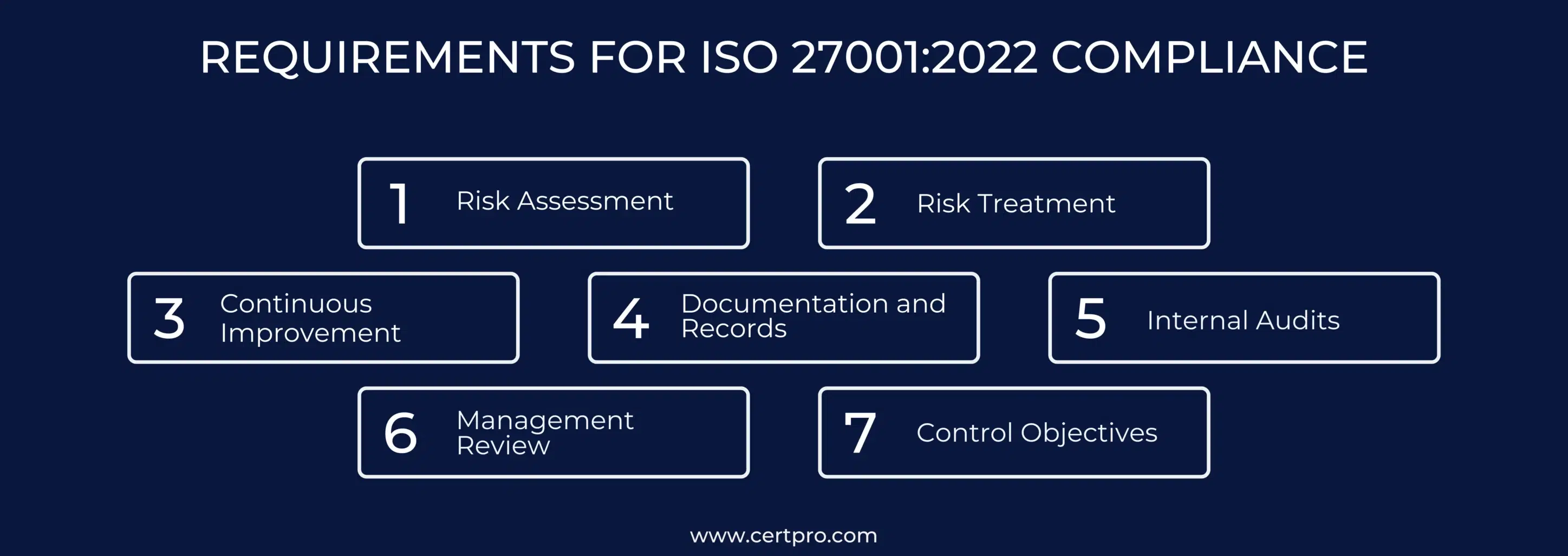
ISO 27001 certification requires organizations to demonstrate conformity with all mandatory clauses of the standard (Clauses 4 through 10) and to implement applicable Annex A controls based on documented risk assessment outcomes. The clause requirements establish the management system architecture, while Annex A controls address specific technical, organizational, physical, and personnel-level security measures. Conformity with both components is verified during the Stage 2 certification audit conducted by the accredited certification body.
- Clause 4 — Context of the Organization: Requires identification of internal and external issues relevant to the ISMS purpose, determination of interested parties and their requirements, and formal definition of the ISMS scope.
- Clause 5 — Leadership: Requires top management commitment, establishment of an information security policy, assignment of roles and responsibilities, and integration of ISMS requirements into organizational processes.
- Clause 6 — Planning: Requires a documented risk assessment process (Clause 6.1.2), a risk treatment process (Clause 6.1.3), a Statement of Applicability (SoA), a Risk Treatment Plan (RTP), and defined information security objectives.
- Clause 7 — Support: Requires adequate resources, competence, awareness, communication protocols, and documented information management across the ISMS.
- Clause 8 — Operation: Requires implementation and control of planned processes, documented risk assessment results, and documented risk treatment outcomes.
- Clause 9 — Performance Evaluation: Requires monitoring and measurement of the ISMS, internal audit programs, and management review processes with defined inputs and outputs.
- Clause 10 — Improvement: Requires processes for identifying and addressing nonconformities, implementing corrective actions, and demonstrating continual improvement of the ISMS.
ISO 27001 certification requires organizations to produce and maintain specific documented information as evidence of ISMS implementation and operation. Mandatory documented information includes: the ISMS scope statement, information security policy, risk assessment methodology, risk assessment results, risk treatment results, Statement of Applicability, Risk Treatment Plan, information security objectives, evidence of competence, results of monitoring and measurement, internal audit program and results, management review results, and records of nonconformities and corrective actions. All documented information must be controlled, version-managed, and accessible for review during certification and surveillance audits.
The Statement of Applicability (SoA) is a mandatory document under Clause 6.1.3 of ISO 27001. The SoA lists all 93 Annex A controls, states whether each control is applicable or not applicable to the organization’s defined ISMS scope, provides justification for inclusion or exclusion of each control, and records the implementation status of applicable controls. The SoA directly links the risk assessment and risk treatment process to the selected controls, establishing a documented, auditable chain of evidence from identified risks to implemented security measures. The SoA is a primary audit artifact reviewed during both Stage 1 and Stage 2 certification audits.
Clause 6.1.2 requires organizations to conduct a risk assessment that identifies information security risks associated with the loss of confidentiality, integrity, or availability of information within the ISMS scope. The risk assessment process must be repeatable, produce consistent and comparable results, and be documented. Risk assessment outputs serve as the primary input for Annex A control selection: identified risks are mapped to applicable controls, and the Risk Treatment Plan (RTP) documents the actions, owners, timelines, and resources assigned to treat each accepted risk through the application of selected controls. Controls that are determined not applicable must be justified in the SoA with documented rationale.
- ✓Clauses 4–10: Management System Requirements
- ✓Documentation Requirements for ISO 27001 Certification
- ✓Annex A Control Selection and Applicability
Benefits of ISO 27001 Certification for Manila Organizations
ISO 27001 certification delivers measurable, documented outcomes for Manila organizations across multiple dimensions of business performance, regulatory compliance, and market positioning. The certification is issued following an independent audit that verifies the existence, effectiveness, and ongoing operation of a conformant ISMS — providing clients, regulators, and contractual partners with objective assurance of an organization’s information security posture.
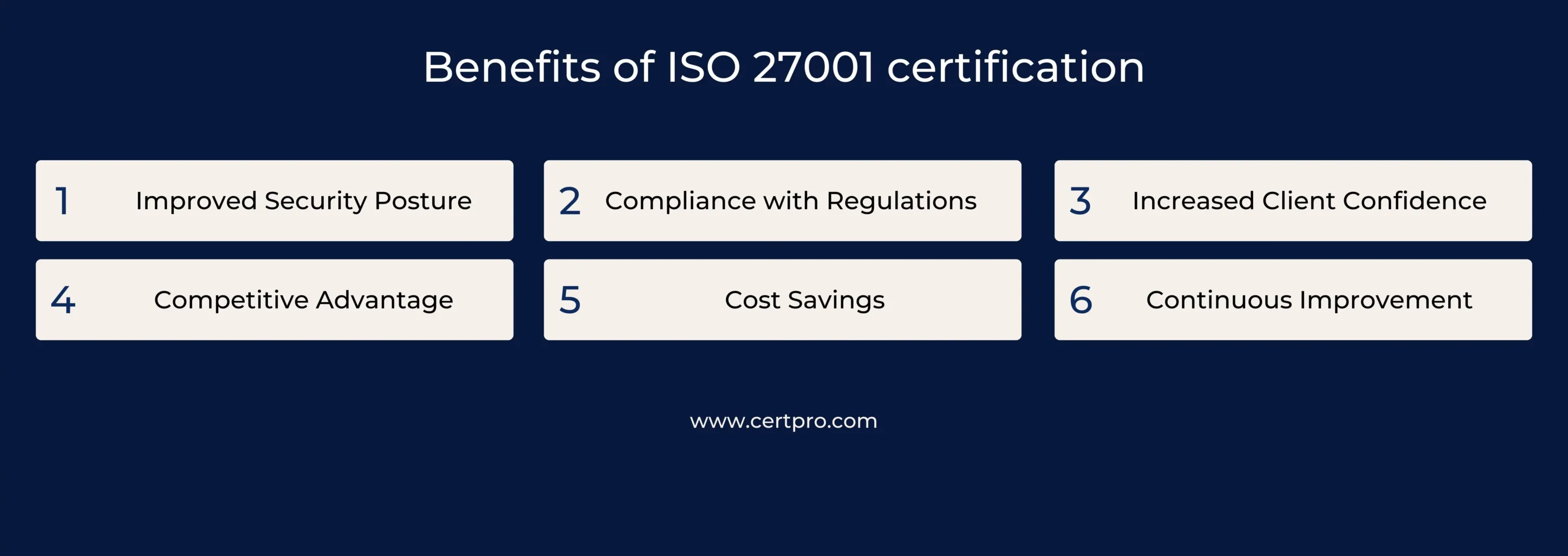
- ✓Client Trust and Contract Qualification: ISO 27001 certification provides multinational clients with independent, third-party verification of an organization’s information security controls, satisfying vendor qualification requirements across financial services, healthcare, and technology sectors.
- ✓Regulatory Alignment: ISO 27001 certification helps Manila organizations map controls to Philippine Data Privacy Act obligations, BSP technology risk management requirements, and international data protection regulations including GDPR.
- ✓Competitive Differentiation in the BPO Market: ISO 27001-certified BPO companies in Manila hold a verifiable competitive advantage in procurement processes where certification status is a mandatory or scored evaluation criterion.
- ✓Reduced Data Breach Probability: Organizations with a certified ISMS implement controls across all four Annex A domains, reducing the attack surface and decreasing the probability of successful data breaches, unauthorized access, and information leakage.
- ✓Improved Incident Response Capability: ISO 27001 requires documented incident management procedures, defined response timelines, and evidence of management review — improving the organization’s ability to detect, respond to, and recover from security incidents.
- ✓Supply Chain and Vendor Risk Management: Annex A Organizational Controls include supplier relationship management requirements that enable certified Manila organizations to extend their ISMS protections to third-party vendors and subcontractors.
- ✓Improved Security Posture: Implementing ISO 27001 standards contributes to a strong ISMS through defined controls addressing access management, network security, asset management, and business continuity.
- ✓Demonstrated Commitment to Information Security: ISO 27001 certification signals to stakeholders — clients, investors, regulators, and employees — that the organization has made a verifiable, audited commitment to protecting information assets.
- ✓Operational Efficiency Through Structured Controls: The ISMS framework establishes documented policies and procedures that reduce security-related operational inconsistencies and provide a structured basis for security governance.
- ✓Facilitated Market Entry: Manila organizations pursuing contracts in the United States, European Union, and Australian markets use ISO 27001 certification as a recognized credential that satisfies client security due diligence requirements without requiring custom security assessments for each engagement.
ISO 27001 Risk Management Process
ISO 27001 risk management is a structured, documented process governed by Clause 6 of the standard. The risk management process is not a one-time activity — it is a continual, cyclical process that is reviewed at defined intervals and whenever significant changes occur within the ISMS scope. The risk management process produces documented outputs that serve as primary audit evidence during certification and surveillance audits.
The ISO 27001 risk assessment methodology requires organizations to establish and apply a consistent, repeatable process for identifying, analyzing, and evaluating information security risks. The methodology must define criteria for risk acceptance and criteria for performing risk assessments. Asset identification involves cataloguing all information assets within the ISMS scope — including data, hardware, software, personnel, and facilities — and assigning ownership. Threat and vulnerability analysis identifies threat actors and threat events that could exploit vulnerabilities in identified assets, and assesses the likelihood and impact of each identified risk scenario.
Risk evaluation compares the analyzed risk levels against the organization’s established risk acceptance criteria to determine which risks require treatment. Risks that exceed the defined acceptance threshold must be addressed through one of four risk treatment options: mitigate (implement controls to reduce likelihood or impact), accept (formally document acceptance within defined tolerance parameters), transfer (shift risk to a third party through insurance or contractual mechanisms), or avoid (eliminate the risk by discontinuing the activity that generates it). Each treatment decision must be documented in the Risk Treatment Plan with assigned ownership, implementation timelines, and resource requirements.
The Statement of Applicability (SoA) and the Risk Treatment Plan (RTP) are the two primary outputs of the ISO 27001 risk management process. The SoA documents the applicability status and justification for all 93 Annex A controls relative to the organization’s identified risks and ISMS scope. The RTP documents the specific actions to be taken to implement applicable controls, including responsible owners, target completion dates, and required resources. Both documents are living records that must be updated whenever the risk assessment is revised, the ISMS scope changes, or new threats are identified. During certification audits, auditors verify that the SoA and RTP are complete, current, and consistent with each other and with the risk assessment results.

- ✓Risk Assessment Methodology
- ✓Statement of Applicability and Risk Treatment Plan
ISO 27001 Certification Process — Stage 1 and Stage 2 Audits
ISO 27001 certification is obtained through a structured, multi-stage audit process conducted by an accredited certification body. CertPro, as a Licensed CPA Firm, conducts ISO 27001 audits in Manila following a defined engagement methodology that evaluates ISMS conformity against all mandatory requirements of ISO/IEC 27001:2022. The certification process produces a formal certificate of conformity valid for three years, subject to annual surveillance audits.
The Stage 1 audit is a documentation review conducted to evaluate the organization’s readiness for the Stage 2 implementation audit. During Stage 1, the auditor reviews the ISMS scope statement, information security policy, Statement of Applicability, risk assessment methodology, risk treatment plan, and all mandatory documented information required by Clauses 4 through 10. The Stage 1 audit identifies areas where the documented ISMS does not meet standard requirements, producing a list of concerns and nonconformities that must be addressed before the Stage 2 audit proceeds. Stage 1 is typically conducted on-site or remotely, depending on the certification body’s procedures and the organization’s operational context.
The Stage 1 audit output is a formal audit report documenting the review findings, identified concerns, and a determination of whether the organization is ready to proceed to Stage 2. Organizations with significant Stage 1 findings must address documented nonconformities and provide evidence of resolution before the Stage 2 audit date is confirmed. The interval between Stage 1 and Stage 2 audits is typically between 6 weeks and 3 months, depending on the scope of Stage 1 findings and the organization’s remediation timeline.
The Stage 2 audit is an on-site implementation audit that verifies the organization has implemented and is operating its ISMS in conformity with ISO/IEC 27001:2022 requirements. Auditors evaluate the effectiveness of implemented controls by reviewing operational evidence — including access control logs, security incident records, internal audit reports, management review minutes, training records, risk assessment documentation, and physical security measures. The Stage 2 audit examines a representative sample of controls across all four Annex A domains to confirm that the ISMS operates as documented and that controls are functioning as intended within the defined scope.
The Stage 2 audit produces a formal audit report identifying any major or minor nonconformities, observations, and opportunities for improvement. Major nonconformities — defined as the absence of a required element or a systemic failure of an implemented control — must be resolved before certification can be issued. Minor nonconformities must be addressed within the certification cycle. Where no major nonconformities exist and minor nonconformities are documented with a credible corrective action plan, the certification body issues a recommendation for certification. The ISO 27001 certificate is then issued, valid for three years from the certification decision date.
ISO 27001 certification is maintained through annual surveillance audits conducted in Year 1 and Year 2 of the three-year certification cycle. Surveillance audits verify that the certified ISMS continues to operate in conformity with ISO/IEC 27001:2022 requirements. Surveillance audits review a subset of ISMS elements — typically including management reviews, internal audit results, corrective action records, and a selection of Annex A controls not fully evaluated in the previous audit cycle. A surveillance audit that identifies major nonconformities may result in suspension or withdrawal of the ISO 27001 certificate until the nonconformity is resolved.
Recertification audits are conducted in Year 3 of the certification cycle, prior to the expiry of the current certificate. The recertification audit is a full re-evaluation of the ISMS, similar in scope to the original Stage 2 audit. Successful completion of the recertification audit results in issuance of a new ISO 27001 certificate for a further three-year period. Organizations that allow their certificate to lapse must undergo a full initial certification process to restore certified status.
| Audit Stage | Timing | Primary Focus | Output |
|---|---|---|---|
| Stage 1 Audit | Initial certification | Documentation review and ISMS readiness evaluation | Audit report; identification of concerns and nonconformities |
| Stage 2 Audit | After Stage 1 clearance | Implementation verification and control effectiveness | Audit report; certification recommendation or nonconformity findings |
| Surveillance Audit 1 | Year 1 of 3-year cycle | Ongoing ISMS operation and selected control review | Surveillance audit report; continued certification or suspension |
| Surveillance Audit 2 | Year 2 of 3-year cycle | Ongoing ISMS operation and expanded control sampling | Surveillance audit report; continued certification or suspension |
| Recertification Audit | Year 3, before certificate expiry | Full ISMS re-evaluation against current standard requirements | New 3-year ISO 27001 certificate upon successful completion |
- ✓Stage 1 Audit — Documentation Review
- ✓Stage 2 Audit — Implementation Verification
- ✓Surveillance Audits and Recertification
Steps to Obtain ISO 27001 Certification in Manila
Obtaining ISO 27001 certification in Manila follows a defined sequence of activities that establishes the ISMS, demonstrates operational conformity, and concludes with a formal third-party audit. The following steps represent the standard pathway to ISO 27001 certification for Manila-based organizations.
- Define the ISMS Scope: Identify the organizational units, locations, assets, processes, and technologies to be included within the ISMS. The scope definition is documented as a mandatory artifact under Clause 4.3 and determines the boundaries of the certification.
- Conduct a Risk Assessment: Apply the organization’s documented risk assessment methodology to identify and evaluate information security risks within the defined ISMS scope. Document asset inventories, threat and vulnerability analyses, risk levels, and risk acceptance decisions.
- Develop the Statement of Applicability: Review all 93 Annex A controls, determine applicability based on risk assessment outcomes, document justifications for inclusion or exclusion of each control, and record implementation status.
- Develop the Risk Treatment Plan: Document selected controls, assigned ownership, implementation timelines, and required resources for addressing all risks that exceed the organization’s defined acceptance criteria.
- Implement ISMS Policies and Procedures: Develop, approve, and communicate all mandatory ISMS documentation required by Clauses 4 through 10, including the information security policy, access control procedures, incident response procedures, and business continuity plans.
- Implement Annex A Controls: Execute the Risk Treatment Plan by implementing the selected technical, organizational, physical, and personnel controls within the defined ISMS scope and timeline.
- Conduct Internal Audits: Execute the internal audit program required by Clause 9.2 to evaluate ISMS conformity against ISO 27001 requirements. Document audit findings, nonconformities, and corrective actions.
- Conduct Management Review: Conduct the management review process required by Clause 9.3, evaluating ISMS performance, audit results, risk treatment outcomes, and continual improvement opportunities. Document review minutes and decisions.
- Engage a Certification Body: Select an accredited certification body to conduct the Stage 1 and Stage 2 certification audits. CertPro conducts ISO 27001 certification audits in Manila as a Licensed CPA Firm.
- Complete Stage 1 and Stage 2 Audits: Undergo the formal certification audit process, address identified nonconformities with documented corrective actions, and receive the certification decision.
- Maintain Certification Through Surveillance Audits: Sustain ISMS operation, conduct annual internal audits and management reviews, and undergo annual surveillance audits in Years 1 and 2 to maintain ISO 27001 certification validity.
ISO 27001 Certification Cost in Manila
ISO 27001 certification costs in Manila are determined by a defined set of organizational and operational factors. CertPro provides fixed pricing for ISO 27001 certification audit services in Manila, with costs structured according to the specific parameters of each engagement. The primary factors governing certification audit pricing are organization size (measured by employee count and number of sites within scope), the complexity of the defined ISMS scope, the number of Annex A controls applicable to the organization’s risk profile, and the audit day requirement determined by the certification body’s audit time calculation methodology.
Factors That Determine Certification Audit Pricing
Certification audit pricing for ISO 27001 in Manila is calculated based on the International Accreditation Forum (IAF) Mandatory Document MD 5, which establishes minimum audit time requirements for management system certification audits. The IAF MD 5 audit time calculation considers the number of employees within the ISMS scope, the presence of multi-site operations, the complexity of information technology environments, and the number of applicable Annex A controls. Organizations with larger employee populations, multiple physical locations, complex cloud or network environments, or a high number of applicable controls require proportionally greater audit time, which directly affects certification cost.
Additional cost components in the ISO 27001 certification engagement include Stage 1 audit fees, Stage 2 audit fees, certificate issuance fees, annual surveillance audit fees, and recertification audit fees at the end of the three-year cycle. For Manila-based organizations, travel and accommodation costs for on-site audit activities may apply. CertPro provides itemized, fixed pricing for each component of the ISO 27001 certification engagement prior to engagement commencement, enabling organizations to plan certification budgets accurately.
CertPro ISO 27001 Certification Services in Manila
CertPro is a Licensed CPA Firm delivering ISO 27001 certification and audit services to organizations in Manila and across the Philippines. CertPro’s ISO 27001 audit services are conducted by qualified lead auditors with demonstrated competence in information security management system auditing. CertPro performs Stage 1 documentation audits, Stage 2 implementation audits, surveillance audits, and recertification audits in accordance with ISO/IEC 27001:2022 and applicable accreditation requirements.
Scope of ISO 27001 Audit Services
CertPro’s ISO 27001 audit scope covers all mandatory elements of ISO/IEC 27001:2022, including full evaluation of Clauses 4 through 10 management system requirements and assessment of implemented Annex A controls across all four domains. Audit activities include structured interviews with personnel at all organizational levels within the ISMS scope, review of mandatory and supporting documented information, observation of physical security measures, technical review of access control configurations and monitoring systems, and verification of operational records including incident logs, internal audit reports, and management review documentation.
CertPro issues formal audit reports for each stage of the certification engagement, documenting all audit findings, nonconformity classifications, and the auditor’s determination of ISMS conformity. Upon successful completion of Stage 2 audit activities and resolution of any major nonconformities, CertPro issues the ISO 27001 certificate of conformity. The certificate is issued in the name of the certified organization, specifying the ISMS scope, the applicable standard (ISO/IEC 27001:2022), the certification date, and the validity period of three years. All CertPro-issued ISO 27001 certificates are registered in a publicly accessible certificate register for client and stakeholder verification.
Engagement Model and Deliverables
CertPro’s ISO 27001 certification engagement model is structured around defined deliverables at each audit stage. For Stage 1, deliverables include the Stage 1 audit plan, the completed Stage 1 audit report with documented findings and readiness determination, and a list of concerns or nonconformities requiring resolution before Stage 2. For Stage 2, deliverables include the Stage 2 audit plan, the completed Stage 2 audit report with nonconformity classifications and audit findings, a certification recommendation, and, upon successful completion, the ISO 27001 certificate of conformity. Annual surveillance audits produce surveillance audit reports documenting the continuing conformity determination and any nonconformities identified during the surveillance review period.
ISO 27001 and Related Standards — Comparisons and Relationships
Manila organizations considering ISO 27001 certification frequently evaluate the standard in relation to other information security and privacy frameworks. Understanding the structural relationships and distinct purposes of these frameworks enables organizations to make informed decisions about certification scope and sequencing.
ISO 27001 vs. ISO 27701 — ISMS and PIMS
ISO 27701:2019 is a privacy extension to ISO 27001 that specifies requirements for a Privacy Information Management System (PIMS). ISO 27701 cannot be certified as a standalone standard — it requires an existing, certified ISO 27001 ISMS as its foundation. Organizations that hold ISO 27001 certification can extend their certification scope to include ISO 27701 by implementing additional privacy-specific controls governing the processing of personally identifiable information. For Manila organizations subject to the Philippine Data Privacy Act, ISO 27701 certification provides an additional layer of documented, audited privacy management that directly maps to data protection obligations. The key distinction is that ISO 27001 addresses information security risks broadly, while ISO 27701 specifically addresses privacy risks associated with personal data processing activities.
ISO 27001 vs. SOC 2 — Certification vs. Attestation
SOC 2 is an attestation report issued under AICPA auditing standards, evaluating a service organization’s controls against the Trust Services Criteria (TSC). ISO 27001 is a management system certification issued under ISO/IEC accreditation requirements. The two frameworks differ in several structural dimensions: ISO 27001 produces a certificate of conformity valid for three years, while SOC 2 produces a point-in-time (Type I) or period-of-time (Type II) attestation report. ISO 27001 is recognized internationally and is commonly required by clients in Europe, Asia-Pacific, and the Middle East. SOC 2 is the dominant framework for North American clients, particularly in the United States. Manila BPO and technology companies serving clients in both markets often pursue both certifications to satisfy the full spectrum of client security assurance requirements.
ISO 27001 and the Philippine Data Privacy Act
The Philippine Data Privacy Act of 2012 (RA 10173) requires personal information controllers and processors to implement appropriate organizational, physical, and technical security measures to protect personal data. ISO 27001 certification provides a structured, audited framework that addresses many of the security measure requirements established by the NPC. However, ISO 27001 certification does not constitute Data Privacy Act compliance in itself — NPC registration, privacy impact assessments, privacy notices, and data subject rights management are distinct obligations governed by RA 10173 and its implementing rules. Manila organizations that implement an ISO 27001-certified ISMS are better positioned to demonstrate the ‘appropriate security measures’ requirement of the Data Privacy Act, but must address all NPC requirements through separate compliance activities.
FAQ
▶
How long does ISO 27001 certification take in Manila?
▶
What industries in Manila require ISO 27001 certification?
▶
What is the difference between ISO 27001 certification and ISO 27001 compliance?
▶
What is a surveillance audit and when is it conducted?
▶
How does ISO 27001 relate to the Philippine Data Privacy Act?
▶
What is the Statement of Applicability (SoA) in ISO 27001?
▶
What is the difference between ISO 27001 and ISO 27701?
▶
What are the 93 Annex A controls in ISO 27001:2022?
HOW COMPLIANCE AUDIT SOFTWARE IMPROVES AUDIT READINESS
Today, most companies deal with a growing number of compliance regulations. From data privacy standards to security frameworks like SOC 2 and ISO 2700…

THE ROLE OF GRC IN ISO 27001, SOC 2, AND OTHER FRAMEWORKS
The term GRC stands for Governance Risk and Compliance. It’s a system of integrated and centralized approaches used by organizations. This system comb…
HOW TO PREPARE FOR A MULTI-STANDARD AUDIT (SOC 2, ISO 27001, HIPAA) WITHOUT OVERLAPPING EFFORTS
The current regulatory landscape is no less than a proving ground for global businesses. Organizations are struggling to comply with the complex regul…
Get In Touch
have a question? let us get back to you.