
ISO 27001 Certification in Philippines
CertPro is a Licensed CPA Firm conducting formal ISO 27001 certification audits in the Philippines. ISO/IEC 27001:2022 is the international standard specifying requirements for an Information Security Management System (ISMS). CertPro evaluates organizational conformance against ISO 27001 clauses and Annex A controls, issuing certificates recognized across regulated industries and international supply chains operating in the Philippines.
OUR CLIENTS










What Is ISO 27001 Certification?
ISO 27001 certification is the formal process by which an accredited certification body evaluates an organization’s Information Security Management System (ISMS) against the requirements defined in ISO/IEC 27001:2022. Certification confirms that an organization has established, implemented, maintained, and continually improved a documented ISMS that systematically identifies, assesses, and treats information security risks. The certificate is issued only after a qualified auditor verifies that the ISMS conforms to all mandatory clauses and applicable Annex A controls.
ISO/IEC 27001:2022 is published jointly by the International Organization for Standardization (ISO) and the International Electrotechnical Commission (IEC). The 2022 revision superseded the 2013 edition and reduced the number of Annex A controls from 114 to 93, reorganized across four control categories: Organizational, People, Physical, and Technological. Organizations certified under ISO 27001:2013 must transition to the 2022 standard by October 31, 2025, as mandated by accreditation bodies globally.
ISO 27001 vs. ISO 27002: Key Distinction
ISO 27001 is the certifiable standard — it defines the requirements an organization must meet to obtain certification. ISO 27002 is a supplementary guidance document that provides detailed implementation guidance for the controls listed in ISO 27001 Annex A. Organizations are certified against ISO 27001, not ISO 27002. ISO 27002 informs how controls can be implemented, but conformance is evaluated exclusively against ISO 27001 requirements during a formal certification audit.
The ISMS framework follows the Plan-Do-Check-Act (PDCA) model, which structures continuous improvement across information security operations. The Plan phase establishes the ISMS scope and risk assessment methodology. The Do phase implements selected controls and risk treatment plans. The Check phase monitors, measures, and evaluates ISMS performance. The Act phase applies corrective and preventive actions to nonconformities identified during internal audits or management reviews.
Core Terminology: ISMS, Annex A, Statement of Applicability, and Nonconformity
An Information Security Management System (ISMS) is the set of policies, processes, procedures, and controls that an organization uses to manage information security risks systematically. The Statement of Applicability (SoA) is a mandatory document that lists all Annex A controls, declares which are applicable to the organization, and justifies any exclusions. Annex A is the normative reference within ISO 27001 that enumerates 93 controls across four categories. A nonconformity is a failure to meet a stated ISO 27001 requirement, identified during audit and subject to formal corrective action before certification is issued or maintained.

Why ISO 27001 Matters in the Philippines
The Philippines operates one of Asia-Pacific’s largest business process outsourcing (BPO) sectors and is home to a growing fintech ecosystem, multinational shared service centers, and government-linked IT service providers. Organizations in these sectors routinely handle sensitive personal data, financial records, and health information on behalf of international clients. ISO 27001 certification in the Philippines has become a contractual prerequisite for organizations supplying services to clients in the European Union, United States, Australia, and Japan, where data security standards are externally mandated.
Alignment with the Data Privacy Act of 2012
The Data Privacy Act of 2012 (Republic Act 10173) requires all personal information controllers and processors in the Philippines to implement reasonable and appropriate organizational, physical, and technical security measures to protect personal data. The National Privacy Commission (NPC) enforces these obligations and expects organizations to demonstrate documented security controls. ISO 27001 certification provides a structured, internationally recognized mechanism for satisfying these security measure obligations under RA 10173, because the ISMS maps directly to the NPC’s requirements for documented policies, access control, incident response, and regular security reviews.
ISO 27001 Clause 4.2 requires organizations to identify interested parties and their requirements. For Philippine organizations, the NPC, clients operating under GDPR or HIPAA, and contractual partners qualify as interested parties whose security expectations must be documented within the ISMS scope. Annex A controls such as A.5.34 (Privacy and protection of personal identifiable information) and A.5.36 (Compliance with policies) directly address DPA 2012 obligations. Organizations that achieve ISO 27001 certification can demonstrate regulatory alignment to the NPC through the ISMS documentation record rather than through ad hoc compliance submissions.
Contract Eligibility and International Market Access
International enterprises increasingly require ISO 27001 certification as a supplier qualification criterion. Philippine BPO organizations tendering for data processing contracts with EU-based clients must demonstrate GDPR-aligned security controls; ISO 27001 certification provides this evidence through an independent audit record. Fintech firms pursuing partnerships with global payment networks, banking institutions, or insurance carriers frequently encounter ISO 27001 as a mandatory criterion in due diligence questionnaires. Certification removes contractual barriers that would otherwise require organizations to submit to multiple client-specific security assessments annually.
Philippine government agencies and state-owned enterprises involved in digital services are subject to the Department of Information and Communications Technology (DICT) cybersecurity policies, which reference international security frameworks including ISO 27001. Organizations serving the public sector in Manila, Makati, BGC Taguig, Cebu, and other major business centers can use ISO 27001 certification to satisfy government supplier security requirements. The certification is also recognized by the Bangko Sentral ng Pilipinas (BSP) as evidence of sound information security governance for supervised financial institutions.
Scope Definition for ISO 27001 Certification in the Philippines
Scope definition is the first and most structurally important step in ISO 27001 certification. ISO 27001 Clause 4.3 requires organizations to define the boundaries and applicability of the ISMS, taking into account the organization’s context, interested parties, and interfaces with external systems. A poorly defined scope will result in audit findings that expand the certification boundary during Stage 2, extending timelines and increasing audit effort. The scope document must identify which organizational units, locations, information assets, processes, and technologies fall within the ISMS boundary.
Defining ISMS Boundaries for Philippine Organizations
For a Philippine BPO organization, the ISMS scope might encompass the data processing centers, customer interaction platforms, and HR systems handling employee personal data across offices in Makati and BGC Taguig, while explicitly excluding retail branch networks not involved in client data processing. For a fintech firm, the scope typically includes the core banking or payment processing application, cloud infrastructure, and the IT operations team, but may exclude marketing functions. The scope statement must be documented, retained as evidence, and made available to the certification auditor during Stage 1 review.
Interfaces and dependencies that cross the ISMS boundary must also be documented. ISO 27001 Clause 8.1 requires organizations to plan and control processes, products, and services supplied externally that affect information security within the scope. Philippine organizations that rely on cloud service providers — such as AWS, Microsoft Azure, or Google Cloud — must document supplier security arrangements within the ISMS and reference applicable Annex A controls for supplier relationships (A.5.19 through A.5.23). The audit evaluates whether external dependencies have been identified and controlled, not merely listed.
ISO 27001 Requirements and Clauses
ISO/IEC 27001:2022 is structured in ten clauses. Clauses 1 through 3 cover scope, normative references, and terms. Clauses 4 through 10 contain the auditable requirements that an organization must satisfy to achieve certification. Each clause represents a functional dimension of the ISMS that the auditor evaluates through document review and implementation evidence during the certification audit.
| Clause | Title | Key Requirement |
|---|---|---|
| Clause 4 | Context of the Organization | Define ISMS scope, identify internal/external issues, and document interested parties and their requirements |
| Clause 5 | Leadership | Top management must demonstrate commitment, assign roles, establish information security policy |
| Clause 6 | Planning | Conduct risk assessment, define risk treatment plan, set information security objectives |
| Clause 7 | Support | Provide resources, ensure competence, manage awareness, document and control ISMS records |
| Clause 8 | Operation | Execute risk treatment plan, manage operational processes, control externally provided services |
| Clause 9 | Performance Evaluation | Monitor, measure, analyze, and evaluate ISMS performance; conduct internal audits and management reviews |
| Clause 10 | Improvement | Address nonconformities with corrective actions; continually improve ISMS effectiveness |
Clause 6.1 requires organizations to identify information security risks, assess their likelihood and impact, and determine appropriate risk treatment options. The risk assessment process must be documented, repeatable, and consistently applied across the ISMS scope. Risk treatment options under ISO 27001 are: accept (tolerate the risk within defined criteria), avoid (discontinue the activity causing the risk), transfer (shift risk to a third party, such as through cyber insurance or outsourcing), and mitigate (implement controls to reduce likelihood or impact to an acceptable level). The treatment option selected for each identified risk must be documented in the Risk Treatment Plan.
Clause 6.1.3 requires that Annex A controls selected in the Risk Treatment Plan be referenced in the Statement of Applicability (SoA). The SoA must confirm that each applicable control has been implemented, provide justification for any excluded controls, and serve as the primary linking document between risk assessment outputs and audit evidence. Auditors verify that the SoA accurately reflects implemented controls and that no material exclusions exist without documented justification. For Philippine organizations, controls related to data privacy (A.5.34), legal compliance (A.5.36), and incident response (A.5.26) are typically non-excludable given DPA 2012 obligations.
Clause 9.2 mandates that organizations conduct internal audits at planned intervals to evaluate whether the ISMS conforms to the organization’s own requirements and to ISO 27001. Internal audit findings must be documented, reported to management, and retained as evidence. The internal audit program must define the audit criteria, scope, frequency, and methods. For Philippine organizations preparing for initial certification, internal audits must be completed before the Stage 2 external audit, and the audit reports must be available for the certification auditor’s review.
Clause 9.3 requires top management to conduct a management review of the ISMS at planned intervals. The management review must consider internal and external audit results, changes in the context of the organization, feedback from interested parties, nonconformity status, and risk treatment plan effectiveness. Management review minutes must be documented and retained. Auditors treat management review records as direct evidence of leadership commitment under Clause 5, making this document set critically important to the certification outcome.
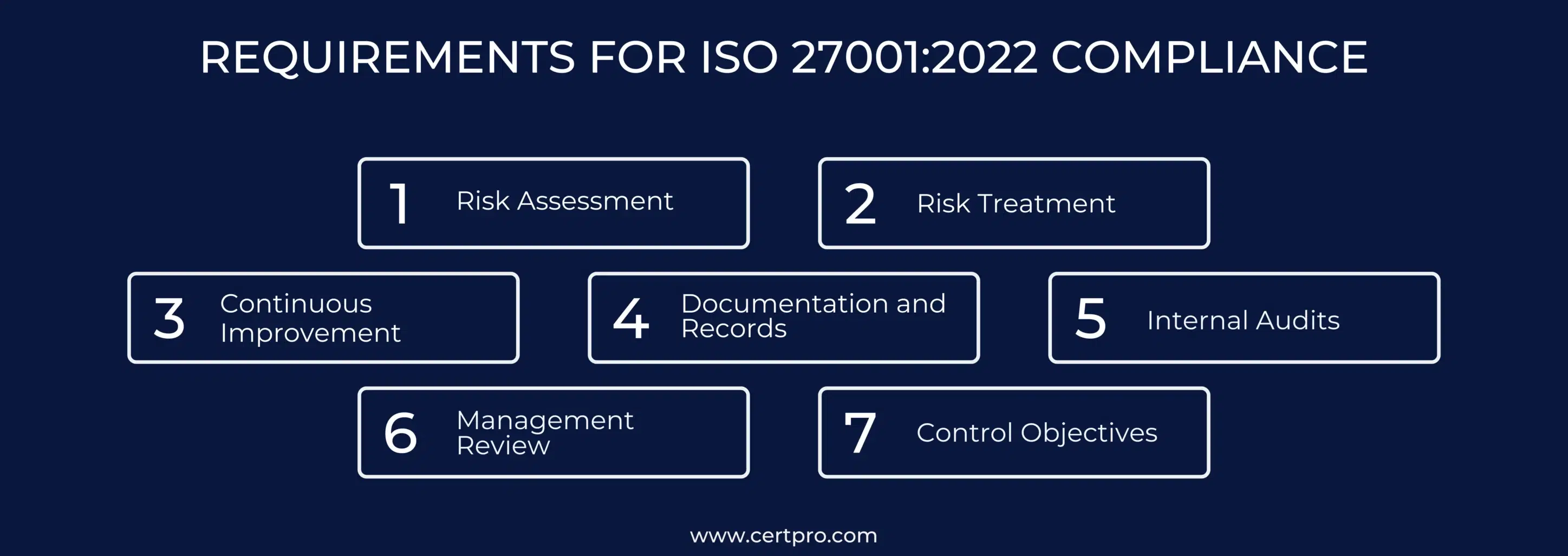
- ✓Clause 6: Planning — Risk Assessment and Treatment
- ✓Clause 9: Performance Evaluation — Internal Audit and Management Review
Annex A Controls: Categories and Key Requirements
ISO/IEC 27001:2022 Annex A contains 93 controls organized across four categories: Organizational (37 controls), People (8 controls), Physical (14 controls), and Technological (34 controls). The Annex A controls are normative — organizations must evaluate each control for applicability and document their determination in the Statement of Applicability. Controls are not all mandatory, but any exclusion must be justified by the absence of an associated risk, not by implementation difficulty or cost.
Organizational controls govern policies, roles, responsibilities, and processes that frame information security across the organization. Key organizational controls include A.5.1 (Policies for information security), which requires a documented information security policy approved by management; A.5.9 (Inventory of information and other associated assets), which mandates a maintained asset register; and A.5.23 (Information security for use of cloud services), a new control introduced in the 2022 revision specifically addressing cloud service governance. For Philippine BPO and fintech organizations, A.5.19 through A.5.23 (supplier relationship controls) are typically applicable due to reliance on third-party platforms and offshore data centers.
- ✓A.5.1 — Policies for information security: Management-approved policy communicating information security requirements
- ✓A.5.9 — Inventory of information and associated assets: Maintained register identifying information assets and owners
- ✓A.5.14 — Information transfer: Rules and controls for data transfer within and outside the organization
- ✓A.5.19 — Information security in supplier relationships: Defined security requirements for all supplier agreements
- ✓A.5.23 — Information security for use of cloud services: Controls for cloud service acquisition, use, and termination
- ✓A.5.26 — Response to information security incidents: Planned procedures for incident detection, response, and recovery
- ✓A.5.34 — Privacy and protection of PII: Controls addressing personal data protection obligations
- ✓A.5.36 — Compliance with policies, rules, and standards: Procedures for verifying ongoing compliance
People controls (A.6.1 – A.6.8) address security obligations of personnel throughout the employment lifecycle. A.6.1 requires security screening of all staff before appointment. A.6.3 mandates information security awareness, education, and training. A.6.5 requires responsibilities and duties that remain after termination of employment to be defined. For Philippine organizations with high staff turnover in BPO sectors, people controls are consistently high-risk areas that auditors scrutinize for documented evidence of onboarding procedures, training records, and exit management processes.
Physical controls (A.7.1 – A.7.14) govern the security of physical environments including offices, data centers, and equipment. A.7.1 (Physical security perimeters) and A.7.2 (Physical entry) require documented access control mechanisms for secure areas. Technological controls (A.8.1 – A.8.34) address technical measures such as user endpoint devices (A.8.1), privileged access rights (A.8.2), information access restriction (A.8.3), secure development (A.8.25–A.8.31), and data masking (A.8.11). The 2022 revision introduced A.8.16 (Monitoring activities) and A.8.23 (Web filtering) as new controls reflecting the current cyber threat landscape. Philippine organizations operating 24/7 data center or cloud environments are expected to demonstrate continuous monitoring capabilities under A.8.16.
- ✓Organizational Controls (A.5.1 – A.5.37)
- ✓People, Physical, and Technological Controls
Risk Assessment Methodology for ISO 27001 Compliance in the Philippines
ISO 27001 Clause 6.1.2 requires organizations to define and apply a documented information security risk assessment process. The methodology must produce consistent, valid, and comparable results each time it is applied. Organizations must define risk acceptance criteria before conducting the assessment. The risk assessment is a foundational ISMS document; auditors treat its absence or inadequacy as a major nonconformity that prevents certification from proceeding.
Risk Assessment Steps
- Asset Identification: Identify all information assets within the ISMS scope, including data, systems, hardware, software, and personnel. Assign an asset owner responsible for each identified asset.
- Threat and Vulnerability Analysis: For each asset, identify plausible threats (e.g., unauthorized access, ransomware, insider misuse) and existing vulnerabilities (e.g., unpatched systems, weak authentication, inadequate physical controls).
- Likelihood and Impact Scoring: Assign likelihood and impact ratings to each threat-vulnerability pair using a defined scoring scale (e.g., 1–5 or Low/Medium/High/Critical). Document the scoring rationale for auditor review.
- Risk Level Calculation: Multiply or combine likelihood and impact scores to produce a risk level for each identified risk. Classify risks as acceptable or requiring treatment based on pre-defined acceptance criteria.
- Risk Treatment Selection: For each risk above the acceptance threshold, select a treatment option — accept, avoid, transfer, or mitigate — and assign responsibility and target completion dates.
- Control Selection and SoA Mapping: Map selected mitigating controls to the relevant Annex A control references. Record all selections in the Statement of Applicability with implementation status.
- Risk Treatment Plan Documentation: Compile all treatment decisions, responsible parties, timelines, and resource requirements into a formally approved Risk Treatment Plan retained for audit evidence.
Philippine organizations in the financial services sector face heightened threat landscapes due to the frequency of targeted phishing campaigns, business email compromise (BEC), and ransomware attacks. The Bangko Sentral ng Pilipinas (BSP) has issued circulars requiring supervised financial institutions to document cyber risk assessments. ISO 27001’s risk assessment methodology satisfies BSP expectations and produces audit-ready documentation that can be submitted to regulators. The risk register produced through this process also forms the basis for annual surveillance audit evidence, as auditors will compare current risk profiles against those documented in prior cycles.
ISO 27001 Audit Process and Stages
The ISO 27001 certification audit follows a structured, sequential process governed by ISO/IEC 17021-1 (requirements for certification bodies) and ISO/IEC 27006-1 (specific requirements for ISO 27001 certification bodies). The process is conducted exclusively by qualified auditors and results in an independently issued certificate upon successful completion. The following stages define the certification sequence for organizations in the Philippines.
The Stage 1 Audit is a documentation review conducted to determine whether the organization’s ISMS documentation is sufficiently developed to proceed to Stage 2. The auditor reviews the ISMS scope statement, information security policy, risk assessment, risk treatment plan, Statement of Applicability, and internal audit reports. The Stage 1 audit typically requires 1–3 days and can be conducted on-site or remotely. At the conclusion, the auditor produces a Stage 1 report identifying areas of concern, confirmed readiness for Stage 2, and any documentation gaps that must be addressed before Stage 2 commences.
Stage 1 findings classified as major documentation gaps will delay Stage 2 until the organization addresses them. Minor concerns are noted as observations and do not block Stage 2 progression, but the auditor will verify their resolution during Stage 2 evidence collection. Organizations must retain all documentation reviewed in Stage 1 and ensure version control is maintained so that the auditor can confirm documents have not been altered post-review. For Philippine organizations undergoing initial certification, Stage 1 typically occurs 4–8 weeks after ISMS implementation is substantially complete.
The Stage 2 Audit is the main certification audit. The auditor evaluates whether the ISMS is effectively implemented and operating in conformance with ISO 27001 requirements and the organization’s own documented policies. Stage 2 involves structured interviews with process owners, technical walkthroughs of implemented controls, observation of operational procedures, and sampling of records such as access logs, incident reports, training records, and change management tickets. The Stage 2 audit typically requires 2–5 days depending on scope size, organizational complexity, and personnel count within the ISMS boundary.
At the conclusion of Stage 2, the auditor issues an audit report documenting conformities, observations, and any nonconformities. Minor nonconformities require the organization to submit a corrective action plan and supporting evidence within a defined timeframe — typically 30–90 days. Major nonconformities require full resolution and re-audit of the affected control area before certification can be issued. If no major nonconformities remain open, the auditor recommends certification to the certification body’s review committee, which makes the final certification decision.
Corrective actions for nonconformities must demonstrate root cause analysis, implemented remediation, and evidence that the corrective action has been effective. Organizations that submit corrective action documentation without evidence of effectiveness — such as updated procedures with no proof of staff re-training or system configuration changes without screenshots — will have their corrective actions rejected. The certification body reviews the auditor’s recommendation alongside all nonconformity evidence before issuing the certificate. Certificate issuance typically occurs 2–4 weeks after all nonconformities are closed satisfactorily.
| Audit Stage | Purpose | Typical Duration | Key Documents Reviewed |
|---|---|---|---|
| Stage 1 Audit | Documentation readiness review | 1–3 days | ISMS scope, SoA, risk assessment, internal audit reports |
| Stage 2 Audit | Implementation conformance assessment | 2–5 days | Control evidence, process records, incident logs, training records |
| Nonconformity Resolution | Corrective action verification | 30–90 days | Root cause analysis, corrective action evidence |
| Surveillance Audit (Year 1, Year 2) | Ongoing conformance verification | 1–2 days per cycle | Updated risk register, management review records, new incidents |
| Recertification Audit (Year 3) | Full ISMS re-evaluation | 2–4 days | Full documentation set, 3-year performance records |

- ✓Stage 1 Audit: Documentation Review
- ✓Stage 2 Audit: Implementation Assessment
- ✓Nonconformity Resolution and Certification Decision
ISO 27001 Certification Lifecycle
ISO 27001 certification follows a three-year certification cycle. Initial certification is valid for three years from the date of certificate issuance. Maintaining certification requires successful completion of annual surveillance audits in years one and two, followed by a recertification audit in year three. Failure to complete a surveillance audit within the required window, or failure to satisfactorily close major nonconformities identified during surveillance, can result in certificate suspension or withdrawal.
Annual Surveillance Audits
Surveillance audits are conducted at least once per calendar year during the certification cycle, typically within 12 months of the previous audit conclusion date. Surveillance audits are narrower in scope than the initial certification audit and focus on selected clauses and controls rather than the full ISMS. The auditor typically evaluates Clause 9 (internal audit and management review), Clause 10 (corrective actions), changes to the organization’s context or risk profile, and any high-risk Annex A control areas identified in the prior cycle. Surveillance audits require 1–2 audit days and produce an updated audit report.
Organizations must be prepared to provide evidence of ongoing ISMS operation at each surveillance audit. This includes management review minutes from the preceding 12 months, internal audit reports, an updated risk register reflecting any changes since the last audit, records of information security incidents and their resolution, and evidence of continued security awareness training for personnel. Philippine organizations that experience significant changes — such as a merger, entry into a new market, or adoption of a new cloud platform — must update their ISMS scope and risk assessment and notify the certification body before the next surveillance audit.
Recertification and Certificate Validity Conditions
The recertification audit is conducted in year three before the certificate’s expiration date. It is a comprehensive re-evaluation of the full ISMS and is comparable in scope to the initial Stage 2 audit. Recertification confirms that the ISMS has been consistently maintained, continuously improved, and remains appropriate to the organization’s current context and risk profile. Successful recertification resets the three-year cycle. ISO 27001 certificates that expire without completed recertification audits are invalid and cannot be presented to clients or regulators as evidence of current conformance.
Certificate suspension occurs when an organization fails to complete a required surveillance audit, fails to close major nonconformities within the agreed timeframe, or fails to make the ISMS available for audit. A suspended certificate cannot be used to demonstrate conformance. Certificate withdrawal is the permanent revocation of certification following sustained noncompliance or voluntary surrender. Organizations that allow their certificates to lapse must undergo a full initial certification audit cycle — including Stage 1 and Stage 2 — to reinstate certification status.
Documentation Requirements for ISO 27001 Certification
ISO 27001 specifies both mandatory documented information (documents and records the standard explicitly requires) and organizational documentation that supports ISMS operation. Auditors verify the existence, completeness, and operational use of required documentation throughout Stage 1 and Stage 2. Missing mandatory documents are classified as major nonconformities. The following lists define the minimum documentation set required for ISO 27001 certification.
- ✓ISMS Scope Statement (Clause 4.3): Defines the boundaries and applicability of the ISMS, including locations, processes, and assets covered
- ✓Information Security Policy (Clause 5.2): Management-approved statement of information security objectives and direction
- ✓Risk Assessment Process Documentation (Clause 6.1.2): Describes the methodology, criteria, and procedures used to assess information security risks
- ✓Risk Assessment Results (Clause 8.2): The documented output of risk assessments, including identified risks, likelihood/impact ratings, and risk levels
- ✓Risk Treatment Plan (Clause 6.1.3 / 8.3): Documents selected treatment options, responsible parties, and timelines for each identified risk
- ✓Statement of Applicability (Clause 6.1.3d): Lists all Annex A controls with applicability status, implementation status, and exclusion justifications
- ✓Information Security Objectives (Clause 6.2): Documented measurable objectives for ISMS performance aligned to the information security policy
- ✓Competence Evidence (Clause 7.2): Training records, qualifications, and role-specific security awareness documentation for ISMS personnel
- ✓Internal Audit Programme and Results (Clause 9.2): Audit schedule, individual audit reports, and nonconformity records from internal audits
- ✓Management Review Records (Clause 9.3): Minutes or records documenting top management’s review of ISMS performance
- ✓Nonconformity and Corrective Action Records (Clause 10.1): Documented nonconformities, root cause analyses, corrective actions taken, and effectiveness verification
Beyond the mandatory documented information, ISO 27001 certification auditors expect operational documentation that demonstrates implemented controls are functioning as intended. This includes access control matrices, asset inventory records, supplier agreements with security clauses, incident response logs, business continuity and disaster recovery plans, and security configuration baselines for key systems. These records are not explicitly listed as mandatory by the standard but are required to demonstrate conformance with specific Annex A controls during Stage 2 evidence collection.
Document control procedures must be in place to ensure that all ISMS documents are version-controlled, approved before use, reviewed periodically, and protected from unauthorized modification. Clause 7.5 requires organizations to determine the format, storage medium, retention period, and disposal method for all documented information within the ISMS. Philippine organizations subject to DPA 2012 retention obligations must align ISMS document retention schedules with NPC requirements, particularly for records related to personal data processing activities and incident notifications.
- ✓Mandatory Documented Information
- ✓Operational and Control Documentation
Industries Served: ISO 27001 Certification for Philippine Organizations
ISO 27001 certification applies to any organization that handles, processes, stores, or transmits information assets — regardless of size, sector, or ownership structure. In the Philippines, specific industries demonstrate consistent demand for ISO 27001 certification based on regulatory requirements, client contract obligations, and the nature of the data they process.
BPO and IT-BPM Sector
The Philippine IT-Business Process Management (IT-BPM) sector employs over 1.4 million people and generates approximately USD 29 billion in annual revenue. BPO organizations handle customer data, financial records, healthcare information, and legal documents on behalf of US, UK, Australian, and European clients. International clients routinely require ISO 27001 certification as a contractual prerequisite before awarding data processing agreements. BPO organizations in Metro Manila, Clark, Cebu, and Davao are primary candidates for ISO 27001 certification due to the volume and sensitivity of information they process under service contracts.
Financial Services and Fintech
Philippine banks, digital banks, e-money issuers, and fintech platforms are subject to Bangko Sentral ng Pilipinas (BSP) cybersecurity regulations, including BSP Circular 982 (Technology Risk Management) and Circular 1140 (Enhanced Information Security Framework). ISO 27001 certification provides a structured mechanism for demonstrating compliance with BSP’s information security governance requirements. Digital banks and mobile payment operators seeking to partner with international financial institutions or access cross-border payment networks are frequently required to present valid ISO 27001 certificates during due diligence processes.
Healthcare, Government, and Shared Service Centers
Healthcare organizations processing patient records, telemedicine platforms, and hospital information systems handle sensitive health data subject to DPA 2012 and Department of Health (DOH) circulars. ISO 27001 certification demonstrates that health information is protected under a documented and audited ISMS. Philippine government agencies operating digital services, electronic public procurement platforms, and citizen data systems are subject to DICT cybersecurity guidelines that align with ISO 27001 principles. Multinational shared service centers (SSCs) operating in the Philippines — covering finance, HR, procurement, and IT functions for global parent companies — are typically required to maintain ISO 27001 certification as a condition of their global enterprise security policy.
| Industry Sector | Primary ISO 27001 Driver | Key Regulatory Reference |
|---|---|---|
| BPO / IT-BPM | International client contract requirement | GDPR, HIPAA, UK DPA 2018 client obligations |
| Banking and Fintech | BSP cybersecurity compliance | BSP Circular 982, Circular 1140 |
| Healthcare | Patient data protection | Data Privacy Act 2012, DOH Health Information Guidelines |
| Shared Service Centers | Global enterprise security policy compliance | Parent company ISMS governance requirements |
| Government IT Agencies | DICT cybersecurity framework alignment | DICT National Cybersecurity Plan 2023–2028 |
ISO 27001 Certification Cost in the Philippines
The cost of ISO 27001 certification in the Philippines is determined by multiple factors, including the size and complexity of the organization, the number of locations within the ISMS scope, the number of employees covered, and the maturity of the existing information security program. Larger organizations with multiple offices, complex IT infrastructure, and high-volume data processing environments require more audit days, which directly increases certification cost. No standardized public pricing exists for ISO 27001 certification — certification bodies issue quotes based on scope-specific assessments.
The total investment in ISO 27001 certification encompasses certification body audit fees, internal preparation costs (staff time, training, documentation development), and any technology or control implementation expenditures required to meet identified control gaps. Annual surveillance audit fees are typically lower than initial certification fees due to the narrower scope. Organizations should budget for recertification audit costs in year three, which are comparable to initial certification. Philippine organizations that engage a Licensed CPA Firm with established ISO 27001 audit competence can reduce total elapsed time from ISMS development to certificate issuance by benefiting from structured, efficient audit management.
Why CertPro for ISO 27001 Certification in the Philippines
CertPro is a Licensed CPA Firm conducting formal ISO 27001 certification audits in the Philippines. CertPro’s audit practice operates under ISO/IEC 17021-1 and ISO/IEC 27006-1 requirements for certification body competence. Audit engagements are conducted by qualified information security auditors with demonstrated competence in ISO/IEC 27001:2022, risk assessment methodologies, and Philippine regulatory frameworks including the Data Privacy Act of 2012 and BSP cybersecurity circulars.
CertPro conducts ISO 27001 certification audits across all major business centers in the Philippines, including Metro Manila, Makati, BGC Taguig, Pasig, Quezon City, Cebu, and Davao. Audit delivery is structured to accommodate organizations of all sizes — from small fintech startups operating under a defined ISMS scope to large multinational BPO organizations with multi-site, multi-country ISMS boundaries. The audit process is executed with institutional rigor, producing audit reports and certificates that satisfy international client requirements and regulatory scrutiny.
Audit Competence and Institutional Authority
CertPro auditors hold recognized information security credentials and have direct experience auditing ISMS implementations in BPO, financial services, healthcare, and technology sectors within the Philippine market. Audit findings are grounded in evidence — interviews, document examination, technical verification, and observation — rather than subjective assessment. CertPro’s institutional positioning as a Licensed CPA Firm ensures that certification decisions are made through a formal, independent review process, not through a single auditor’s judgment. This structure provides auditees and their clients with confidence in the reliability and impartiality of the certification outcome.
Organizations seeking ISO 27001 certification through CertPro initiate the process by submitting a certification application that describes the intended ISMS scope, organizational structure, number of employees, locations, and information asset categories. CertPro conducts an application review and issues an audit plan specifying the Stage 1 date, estimated Stage 2 schedule, and required documentation for review. The application and planning process typically requires 1–3 weeks from submission to audit program confirmation, subject to the completeness of the application information provided.
FAQ
▶
What is ISO 27001 certification and why is it required in the Philippines?
▶
How long does ISO 27001 certification take in the Philippines?
▶
What is the difference between ISO 27001 and ISO 27002?
▶
How does ISO 27001 align with the Data Privacy Act of 2012 in the Philippines?
▶
How often are surveillance audits required after ISO 27001 certification?
▶
Which Philippine organizations are required to obtain ISO 27001 certification?
▶
What is the ISO 27001:2022 transition deadline?
▶
What documents must be available before the Stage 1 audit?
HOW COMPLIANCE AUDIT SOFTWARE IMPROVES AUDIT READINESS
Today, most companies deal with a growing number of compliance regulations. From data privacy standards to security frameworks like SOC 2 and ISO 2700…

THE ROLE OF GRC IN ISO 27001, SOC 2, AND OTHER FRAMEWORKS
The term GRC stands for Governance Risk and Compliance. It’s a system of integrated and centralized approaches used by organizations. This system comb…
HOW TO PREPARE FOR A MULTI-STANDARD AUDIT (SOC 2, ISO 27001, HIPAA) WITHOUT OVERLAPPING EFFORTS
The current regulatory landscape is no less than a proving ground for global businesses. Organizations are struggling to comply with the complex regul…
Get In Touch
have a question? let us get back to you.