
ISO 27001 Certification in New Zealand
ISO 27001 Certification in New Zealand is relevant to any organisation that creates, processes, stores, or transmits sensitive information and requires independent verification of its information security management practices. While no single New Zealand law universally mandates ISO 27001 certification, market expectations, contractual requirements, and sector-specific procurement standards have made it a practical necessity for a broad range of organisations across the country.
OUR CLIENTS










What Is ISO 27001 Certification?
ISO 27001 Certification in New Zealand is issued under the ISO/IEC 27001:2022 standard — the internationally recognised framework specifying requirements for establishing, implementing, maintaining, and continually improving an Information Security Management System (ISMS). Certification is granted following an independent third-party audit conducted by a qualified certification body, confirming that an organisation’s ISMS meets all mandatory clauses of the standard and that its information security controls are appropriately designed, documented, and operating effectively.
CertPro CPA LLC, a Licensed CPA Firm, conducts ISO 27001 certification audits for organisations operating across New Zealand. Each ISO 27001 audit evaluates ISMS scope, risk assessment methodology, control implementation, and ongoing conformance with ISO/IEC 27001:2022 requirements — providing independently verified assurance to customers, partners, and regulators.
ISO/IEC 27001:2022 and the ISMS Framework
ISO/IEC 27001:2022 is structured around a Plan-Do-Check-Act (PDCA) cycle that governs how organisations establish and operate their Information Security Management Systems. The standard comprises mandatory clauses — Clauses 4 through 10 — covering organisational context, leadership commitment, planning, support, operation, performance evaluation, and continual improvement.
Annex A of ISO/IEC 27001:2022 references 93 information security controls organised across four domains: Organisational Controls, People Controls, Physical Controls, and Technological Controls. The 2022 revision reduced the control set from 114 controls in the 2013 edition and introduced 11 new controls addressing threat intelligence, cloud security, data masking, and information security for cloud services.
The transition deadline for organisations certified under ISO/IEC 27001:2013 is 31 October 2025, after which only the 2022 version of the standard will be recognised by accredited certification bodies. Organisations pursuing ISO 27001 Certification in New Zealand should ensure all audit activities reference the current ISO/IEC 27001:2022 requirements.
Why ISO 27001 Certification Matters for New Zealand Organisations
For organisations operating in New Zealand, ISO 27001 Certification provides independently verified evidence of information security governance and risk management discipline. New Zealand’s digital economy spans SaaS providers, fintech firms, financial institutions, healthcare technology companies, government technology providers, cloud service providers, data centres, agritech companies, e-commerce businesses, telecommunications providers, AI businesses, and cybersecurity firms — all of which handle sensitive data and face increasing scrutiny from customers, regulators, and procurement teams.
ISO 27001 Certification in New Zealand demonstrates that an organisation’s ISMS has been evaluated by an independent third party against a globally recognised standard. This provides a level of assurance that internal attestations cannot replicate. Organisations serving Australian, United States, and international markets also benefit from ISO 27001 certification as recognised evidence of information security maturity across multiple jurisdictions.
ISO 27001 and New Zealand Regulatory Context
ISO 27001 Certification in New Zealand operates within a regulatory environment shaped by the New Zealand Privacy Act 2020 and its 13 Information Privacy Principles, the Health Information Privacy Code 2020 applicable to health sector organisations, and cybersecurity expectations relevant to government and critical infrastructure providers.
While ISO 27001 certification does not automatically establish compliance with the Privacy Act 2020 or any other regulation, the ISMS framework provides a structured mechanism for identifying applicable legal and regulatory obligations and mapping controls to those obligations. Organisations in regulated sectors — including financial services, health technology, and government supply chains — frequently use ISO 27001 certification as part of a broader compliance posture.
New Zealand Government procurement guidelines and vendor assurance requirements increasingly reference ISO 27001 as a recognised information security benchmark for technology suppliers, reinforcing the practical value of ISO 27001 compliance for organisations operating across the public and private sectors.

ENQUIRE NOW
Related Resources
Related Services in New Zealand
ISO 27001 Requirements in New Zealand
Achieving ISO 27001 Certification requires organisations to demonstrate conformance with all mandatory clauses of ISO/IEC 27001:2022 and to produce a defined set of documented information supporting the ISMS. These requirements apply uniformly regardless of organisation size, sector, or geography. However, the scope, complexity, and number of applicable Annex A controls will vary based on each organisation’s risk profile, operational context, and the boundaries of its ISMS.
Understanding these requirements in full before beginning the ISO 27001 certification audit process helps organisations prepare efficiently and avoid common nonconformities that delay certification.
ISO/IEC 27001:2022 mandates specific documented information that organisations must produce, maintain, and retain as evidence of ISMS operation. Required documents include the ISMS scope statement, information security policy, risk assessment process documentation, risk treatment plan, Statement of Applicability (SoA), information security objectives, and records of management review.
The Statement of Applicability is a particularly critical document. It lists all 93 Annex A controls, identifies which are applicable to the organisation’s ISMS, justifies the inclusion or exclusion of each control, and records implementation status. During the ISO 27001 certification audit, auditors review the SoA in detail to verify that control selection is appropriately justified against identified risks.
Incomplete or poorly evidenced documentation is one of the most common sources of nonconformities identified during Stage 1 and Stage 2 audits — making thorough documentation preparation essential to achieving ISO 27001 Certification in New Zealand efficiently.
ISO/IEC 27001:2022 requires organisations to establish and apply a formal information security risk assessment process that produces consistent, valid, and comparable results. The risk assessment must identify information security risks associated with the loss of confidentiality, integrity, and availability of information assets within the ISMS scope. Risk owners must be assigned, and risks must be analysed and evaluated against defined criteria for risk acceptance.
Following assessment, organisations must implement a risk treatment plan identifying selected treatment options — including applying Annex A controls, accepting, avoiding, or transferring risks — and documenting the rationale for each decision. Risk assessments must be repeated at planned intervals and whenever significant changes occur within the organisation or its operational environment.
During the ISMS Audit, auditors verify both the process design and evidence of its consistent application. A well-documented, repeatable risk assessment process is a core indicator of ISMS maturity during the ISO 27001 certification audit.
Annex A of ISO/IEC 27001:2022 provides a reference set of 93 information security controls across four domains. Organisational Controls (37 controls) address policies, roles, responsibilities, threat intelligence, information security in supplier relationships, and incident management. People Controls (8 controls) cover screening, terms of employment, awareness, and disciplinary processes. Physical Controls (14 controls) address physical security perimeters, equipment maintenance, and clear desk and screen policies. Technological Controls (34 controls) include access control, cryptography, secure coding, configuration management, data masking, data leakage prevention, and monitoring.
Organisations are not required to implement all 93 controls. They must implement those identified as applicable through the risk assessment process and documented in the Statement of Applicability. Controls that are excluded must be clearly justified in the SoA to the satisfaction of the ISO 27001 certification audit team. This principle ensures that ISO 27001 compliance is proportionate to each organisation’s actual risk environment.
| ISO/IEC 27001:2022 Control Domain | Number of Controls | Key Areas Covered |
|---|---|---|
| Organisational Controls | 37 | Policies, threat intelligence, supplier security, incident management |
| People Controls | 8 | Screening, awareness, terms of employment, disciplinary processes |
| Physical Controls | 14 | Physical perimeters, equipment security, clear desk policies |
| Technological Controls | 34 | Access control, cryptography, monitoring, secure coding, data masking |
- ✓Mandatory ISMS Documentation Requirements
- ✓Risk Assessment and Risk Treatment Requirements
- ✓Annex A Controls and Control Domains
Who Needs ISO 27001 Certification in New Zealand?
ISO 27001 Certification in New Zealand is relevant to any organisation that creates, processes, stores, or transmits sensitive information and requires independent verification of its information security management practices. While no single New Zealand law universally mandates ISO 27001 certification, market expectations, contractual requirements, and sector-specific procurement standards have made it a practical necessity for a broad range of organisations across the country.
Technology and Cloud Service Sectors
SaaS providers, cloud service providers, and data centre operators across Auckland, Wellington, and Christchurch represent the most active segment pursuing ISO 27001 Certification in New Zealand. These organisations typically handle customer data across multiple tenancies and face contractual requirements from enterprise clients, government agencies, and international customers demanding evidence of third-party verified information security controls.
AI businesses and cybersecurity firms operating in New Zealand also pursue ISO 27001 certification to demonstrate that their own information security practices meet internationally recognised standards — a particularly relevant consideration when these organisations have access to sensitive client environments or data. Telecommunications providers and e-commerce businesses with large customer data repositories similarly benefit from ISO 27001 certification as an independently verifiable assurance mechanism that reduces reliance on self-attestation.
Financial Services, Fintech, and Regulated Industries
ISO 27001 certification for New Zealand financial services organisations — including banks, insurance companies, investment managers, and fintech firms — has grown significantly as the Reserve Bank of New Zealand and Financial Markets Authority have increased their expectations around operational resilience and third-party risk management. ISO 27001 compliance that New Zealand fintech organisations demonstrate enables them to satisfy due diligence requirements from institutional partners and international clients.
Healthcare technology organisations and health information processors subject to the Health Information Privacy Code 2020 use ISO 27001 certification to provide structured evidence of controls protecting health information. Government technology providers and suppliers to central and local government agencies in Wellington, Auckland, and across New Zealand increasingly encounter ISO 27001 certification requirements in procurement processes as agencies apply vendor assurance frameworks to technology supply chains.
Agritech, E-Commerce, and Emerging Sectors
New Zealand’s agritech sector — encompassing precision agriculture platforms, supply chain traceability systems, and rural data services — handles commercially sensitive production data and increasingly connects with international agribusiness customers who require evidence of data security governance. ISO 27001 Certification in New Zealand provides agritech organisations with the independently verified assurance these customers expect.
E-commerce businesses managing payment card data, customer records, and fulfilment system integrations also encounter customer and partner expectations around ISO 27001 certification. The standard applies equally to organisations in Hamilton, Dunedin, and regional New Zealand centres where technology businesses operate across domestic and export markets. Any organisation that processes personal information at scale, operates digital infrastructure, or provides technology services to enterprise or government clients will find ISO 27001 certification relevant to its market positioning and risk management obligations.
ISO 27001 Certification Audit Process in New Zealand
The ISO 27001 certification audit process follows a structured sequence of evaluation stages, from initial application through certification issuance and ongoing surveillance. Each stage involves independent assessment by qualified auditors who evaluate documented evidence, conduct interviews, observe operational controls, and test the effectiveness of the ISMS.
The ISO 27001 certification audit process administered by CertPro follows this defined methodology for all New Zealand engagements — ensuring consistent, evidence-based evaluation at every stage of the certification lifecycle.
The Stage 1 audit — also referred to as the documentation review or readiness review — is the first formal evaluation conducted by the certification body. During Stage 1, auditors assess the organisation’s ISMS documentation against the requirements of ISO/IEC 27001:2022, with particular attention to the ISMS scope, information security policy, risk assessment process, Statement of Applicability, and documented evidence of management review and internal audit.
The Stage 1 audit identifies areas where the organisation’s documented ISMS does not meet mandatory requirements, producing a list of findings that the organisation must address before the Stage 2 audit proceeds. Stage 1 is typically conducted remotely for New Zealand organisations, with document packages reviewed by the audit team. The outcome of Stage 1 determines whether the organisation is ready to proceed to the Stage 2 on-site assessment, and the auditor confirms the planned Stage 2 ISO 27001 audit program based on findings and ISMS scope.
The Stage 2 audit is the primary conformance evaluation, assessing whether the ISMS is implemented effectively and operating in accordance with ISO/IEC 27001:2022 requirements. Auditors conduct on-site or remote interviews with personnel across relevant functions, review records of operational controls, test the implementation of selected Annex A controls, and verify that risk treatment measures are functioning as documented.
The Stage 2 ISO 27001 audit involves systematic sampling of control evidence across the domains identified in the Statement of Applicability, with particular focus on controls addressing the organisation’s highest-rated risks. Nonconformities identified during Stage 2 are classified as major or minor. Major nonconformities must be resolved before certification can be issued, while minor nonconformities are tracked through corrective action plans with defined timelines. The Stage 2 audit report forms the basis of the certification decision made by the certification body’s independent review function.
ISO 27001 certification is valid for three years from the date of issue, subject to satisfactory completion of annual surveillance audits. Surveillance audits are conducted at defined intervals — typically at 12 and 24 months following initial certification — and assess the continued operation and improvement of the ISMS, corrective action closure, management review outputs, and any significant changes to the organisation’s information security environment.
The ISMS Audit conducted during surveillance is narrower in scope than the initial Stage 2 assessment but must cover key ISMS processes, internal audit results, and Annex A control areas identified as higher risk or subject to change. At the end of the three-year certification cycle, organisations undergo a full recertification audit equivalent in scope to the initial Stage 2 assessment. Continuous improvement obligations under Clause 10 of ISO/IEC 27001:2022 require organisations to address nonconformities and enhance ISMS performance between audit cycles.
| Audit Stage | Scope | Typical Timing |
|---|---|---|
| Stage 1 (Documentation Review) | ISMS documentation, scope, SoA, risk assessment process | Initial certification cycle |
| Stage 2 (Operational Assessment) | ISMS implementation, control effectiveness, nonconformity review | Following Stage 1 clearance |
| Surveillance Audit 1 | ISMS operation, corrective actions, selected control domains | 12 months post-certification |
| Surveillance Audit 2 | ISMS operation, management review, continual improvement | 24 months post-certification |
| Recertification Audit | Full ISMS reassessment equivalent to Stage 2 | 36 months post-certification |
- ✓Stage 1 Audit: Documentation and Readiness Review
- ✓Stage 2 Audit: ISMS Operational Effectiveness Assessment
- ✓Surveillance Audits and Recertification
Benefits of ISO 27001 Certification for New Zealand Organizations
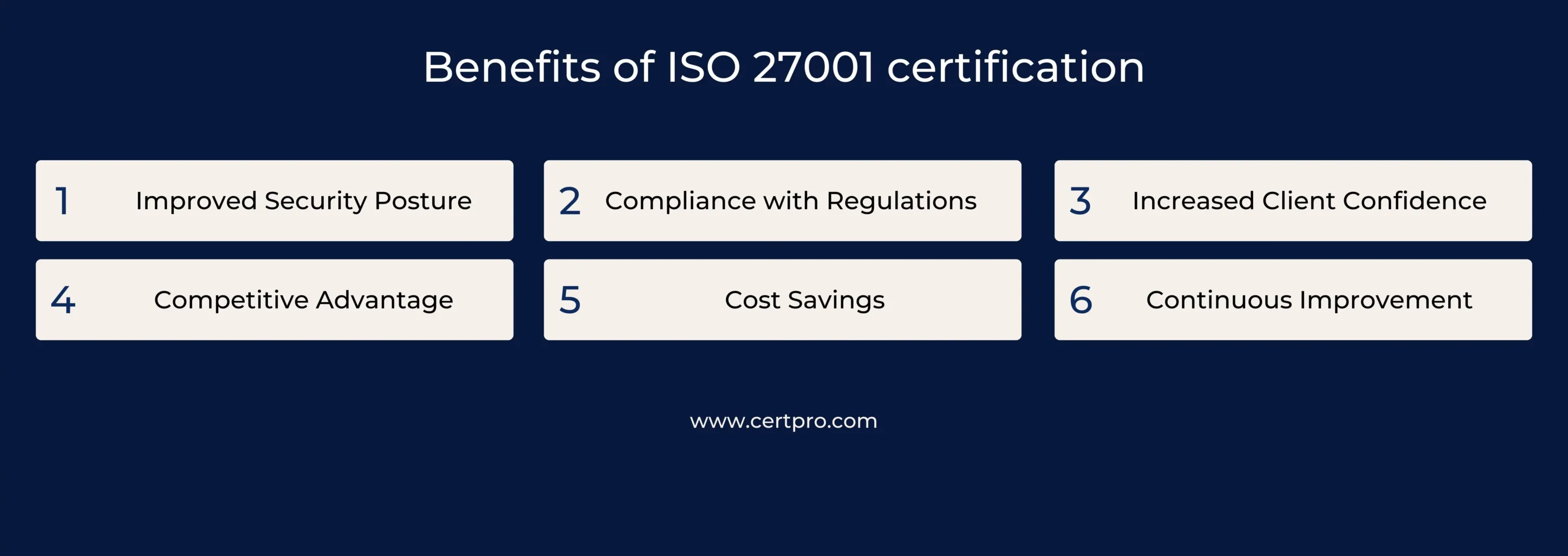
ISO 27001 Certification delivers measurable operational, commercial, and regulatory benefits for organisations across New Zealand. The value of certification extends beyond the certificate itself — the process of establishing, auditing, and maintaining an ISMS produces structural improvements to information security governance that reduce risk exposure and strengthen organisational resilience. For organisations pursuing ISO 27001 Certification in New Zealand, these benefits are realised across both the initial audit cycle and the ongoing surveillance period.
ISO 27001 Certification in New Zealand provides organisations with independently verified evidence of information security maturity that supports enterprise sales cycles, government procurement bids, and international market entry. Organisations certified under ISO/IEC 27001:2022 can present their certification to prospective customers, partners, and regulators as objective third-party confirmation that their ISMS has been evaluated against globally recognised requirements.
For New Zealand companies competing for contracts with Australian, United States, United Kingdom, and European clients — where ISO 27001 certification is frequently a mandatory vendor qualification criterion — certification removes a significant procurement barrier. ISO 27001 certification New Zealand financial services and fintech organisations maintain also delivers improved due diligence outcomes and reduced audit burden from institutional clients, representing a direct and measurable commercial return on the investment in ISO 27001 compliance.
The ISO 27001 certification process requires organisations to conduct formal risk assessments, implement risk treatment plans, and operate controls addressing identified information security risks. This structured approach produces a measurable improvement in security posture by ensuring that control selection is driven by documented risk evidence rather than ad hoc decisions.
Organisations that have undergone ISO 27001 certification audits consistently report greater visibility into their information asset inventory, access control practices, incident detection capabilities, and third-party risk exposure. The internal audit and management review requirements under Clauses 9.2 and 9.3 of ISO/IEC 27001:2022 create accountability mechanisms that sustain security improvements between external ISMS Audit cycles. ISO 27001 compliance also provides a structured framework for mapping obligations arising from the New Zealand Privacy Act 2020 and sector-specific requirements to documented controls.
- ✓Independently verified evidence of ISMS conformance for customer and partner assurance
- ✓Removal of procurement barriers in government and enterprise supply chains
- ✓Structured risk assessment and treatment process reducing unmanaged information security exposure
- ✓Formal documentation of security controls supporting regulatory and contractual obligations
- ✓Improved incident detection and response capability through operational control requirements
- ✓Competitive differentiation in New Zealand, Australian, and international markets
- ✓Reduced customer security questionnaire burden through certification-based assurance
- ✓Demonstrated continual improvement through the annual surveillance ISMS Audit cycle
- ✓Commercial and Market Access Benefits
- ✓Risk Management and Security Posture Improvements
ISO 27001 Compliance in New Zealand
ISO 27001 compliance in New Zealand refers to an organisation’s ongoing conformance with the requirements of ISO/IEC 27001:2022, as evaluated through the ISMS Audit process. Compliance is not a one-time achievement — it requires sustained operation of the ISMS, regular internal audits, management reviews, corrective action processes, and demonstrated continual improvement across the full certification period. Maintaining ISO 27001 compliance is therefore an active, ongoing commitment rather than a milestone reached at initial certification.
Internal Audit and Management Review Obligations
Clause 9.2 of ISO/IEC 27001:2022 requires organisations to conduct internal audits of the ISMS at planned intervals to determine whether it conforms to the organisation’s own requirements and to the mandatory clauses of the standard. Internal auditors must be objective and impartial — personnel cannot audit their own work. Internal audit findings must be reported to relevant management and documented, with corrective actions tracked to closure.
Clause 9.3 requires top management to review the ISMS at planned intervals, considering inputs including audit results, security performance metrics, risk assessment outputs, nonconformity status, and changes to the organisation’s context. Management review outputs must include decisions on ISMS improvement opportunities and any required changes to the ISMS. These internal processes provide the evidence base that external auditors evaluate during surveillance and recertification audits to confirm the ongoing ISO 27001 compliance that New Zealand organisations are required to demonstrate throughout the certification lifecycle.
Continual Improvement and Nonconformity Management
Clause 10 of ISO/IEC 27001:2022 establishes continual improvement as a mandatory ISMS obligation. When nonconformities are identified — whether through internal audits, surveillance audits, incident investigations, or management reviews — organisations must take corrective action by determining the root cause, implementing appropriate remediation, and verifying the effectiveness of the corrective action taken. Evidence of corrective action closure must be retained as documented information available for auditor review.
ISO 27001 compliance requires organisations to treat nonconformities not merely as isolated findings but as inputs to systemic ISMS improvement. Organisations that demonstrate mature corrective action processes and measurable security performance improvement over successive audit cycles provide stronger evidence of ISMS effectiveness. The ISMS Audit conducted during each surveillance visit specifically evaluates corrective action closure and evidence of improvement since the preceding audit cycle — making continual improvement a directly assessed element of maintaining ISO 27001 Certification in New Zealand.
ISO 27001 Certification Cost in New Zealand
The investment associated with obtaining ISO 27001 Certification in New Zealand is determined by factors intrinsic to each organisation’s ISMS scope and operational complexity. Understanding the primary variables that influence ISO 27001 certification audit scope enables organisations to approach the process with accurate expectations and plan resources accordingly.
Factors Influencing Audit Scope and Engagement Scale
The primary factors determining the scope of an ISO 27001 certification audit — and consequently the scale of the engagement — include the number of personnel within the ISMS scope, the number and complexity of locations or data processing environments covered, the breadth of applicable Annex A controls identified in the Statement of Applicability, the complexity of the organisation’s technology infrastructure, and the number and criticality of third-party supplier relationships included within ISMS scope.
SaaS providers and cloud service companies with distributed infrastructure and multiple customer environments typically have broader ISMS scopes than organisations with concentrated, on-premise data processing. For organisations operating across Auckland, Wellington, Christchurch, and other New Zealand locations, multi-site ISMS scopes require audit coverage across each included facility or processing environment. ISO 27001 compliance in New Zealand is assessed proportionately to the defined and documented ISMS scope — ensuring that the ISO 27001 audit is appropriately sized to the organisation’s actual operational footprint.
Certification Validity and Ongoing Audit Obligations
ISO 27001 certification remains valid for three years from the date of issue, provided the organisation successfully completes annual surveillance audits at the 12-month and 24-month intervals. Each surveillance audit involves an ISMS Audit of a defined subset of the ISMS, focusing on corrective action status, management review outputs, internal audit results, and selected Annex A control domains.
At the conclusion of the three-year cycle, a full recertification audit is required to renew certification for a further three years. Organisations should plan for the ongoing audit obligations associated with maintaining ISO 27001 Certification in New Zealand — the annual ISMS Audit cycle is a mandatory component of certification, not an optional service. Organisations that allow their certification to lapse must recommence the full certification process, including a new Stage 1 and Stage 2 audit, before a new certificate can be issued.
Steps for Obtaining ISO 27001 Certification in New Zealand
Obtaining ISO 27001 Certification in New Zealand follows a defined sequence of steps from ISMS establishment through certification audit and issuance. The following steps reflect the structured process that organisations must complete to achieve and maintain ISO 27001 certification under ISO/IEC 27001:2022. Each step builds on the previous, and readiness at each stage directly influences the efficiency of the ISO 27001 certification audit.
- Define ISMS scope — identify the organisational boundaries, locations, processes, and information assets included within the ISMS, documented in the formal scope statement required by Clause 4.3.
- Conduct information security risk assessment — identify, analyse, and evaluate information security risks to assets within ISMS scope using a repeatable, documented methodology consistent with Clause 6.1.2.
- Develop and implement risk treatment plan — select treatment options and applicable Annex A controls, document the rationale in the Statement of Applicability, and implement risk treatment measures across the organisation.
- Establish ISMS documentation — produce all mandatory documented information required by ISO/IEC 27001:2022, including policies, procedures, risk assessment records, SoA, and evidence of management review and internal audit.
- Operate the ISMS — implement information security controls, conduct awareness activities, manage incidents, monitor performance metrics, and maintain the ISMS in active operation for a sufficient period prior to the ISO 27001 certification audit.
- Conduct internal audit — perform an objective internal audit of the ISMS against ISO/IEC 27001:2022 requirements and address identified nonconformities before the external certification audit proceeds.
- Complete Stage 1 (documentation review) — submit ISMS documentation to the certification body for review; address findings and confirm readiness to proceed to Stage 2 of the ISO 27001 audit.
- Complete Stage 2 (operational assessment) — undergo on-site or remote ISO 27001 certification audit assessing ISMS implementation and control effectiveness; resolve major nonconformities to proceed to the certification decision.
Following the issuance of ISO 27001 certification, organisations must maintain the ISMS in active operation and comply with the ongoing obligations of ISO/IEC 27001:2022. This includes conducting internal audits at planned intervals, performing annual management reviews, monitoring information security objectives, managing nonconformities and corrective actions, and preparing for annual surveillance audits.
Significant changes to the ISMS scope, organisational structure, technology environment, or risk profile must be communicated to the certification body and may require unplanned audit activity. The certification body retains the right to conduct unannounced audits or to suspend or withdraw certification where continued conformance with ISO/IEC 27001:2022 cannot be confirmed. The ISO 27001 certification audit that New Zealand organisations undergo annually through the surveillance cycle is designed to confirm that the ISMS has not deteriorated and that identified nonconformities have been addressed through verified corrective action — sustaining the value of ISO 27001 compliance over the full certification period.
- ✓Post-Certification Maintenance Requirements
CertPro ISO 27001 Certification Services in New Zealand
CertPro CPA LLC is a Licensed CPA Firm providing independent ISO 27001 certification audit and assessment services for organisations across New Zealand. CertPro conducts ISO 27001 certification audits under ISO/IEC 27001:2022, evaluating ISMS conformance through structured Stage 1 documentation reviews, Stage 2 operational assessments, annual surveillance audits, and recertification audits.
CertPro’s ISO 27001 audit methodology is evidence-based and evaluation-focused. No consulting, advisory, or implementation services are provided — positioning CertPro strictly as an independent third-party certification body committed to maintaining auditor objectivity throughout every engagement.
Audit Methodology and Independence Standards
CertPro’s ISO 27001 audit methodology is structured around the mandatory requirements of ISO/IEC 27001:2022 and the audit principles governing independent third-party certification bodies. Auditors evaluate documented evidence, conduct structured interviews with ISMS-relevant personnel, test the operational effectiveness of implemented controls, and assess risk assessment and treatment records for completeness and consistency.
The ISMS Audit process includes review of the Statement of Applicability against risk assessment outputs, verification of internal audit and management review records, and assessment of corrective action effectiveness. CertPro maintains auditor independence by separating certification audit functions entirely from advisory and consulting activities. Auditors engaged in ISO 27001 certification audit engagements across New Zealand do not provide implementation guidance, policy templates, or remediation recommendations. All certification decisions are made by a review function independent of the audit team that conducted the assessment — upholding the integrity of ISO 27001 compliance determinations.
Sectors and Organisations Served Across New Zealand
CertPro conducts ISO 27001 certification audits for organisations across New Zealand’s technology, financial services, healthcare technology, government supply chain, and enterprise sectors. Clients include SaaS providers and software companies in Auckland and Wellington, fintech firms and payment processors, cloud infrastructure and data centre operators, cybersecurity companies, health technology organisations subject to the Health Information Privacy Code 2020, government technology suppliers operating under New Zealand procurement frameworks, agritech platforms, e-commerce businesses, and telecommunications providers.
ISO 27001 Certification in New Zealand for companies seeking to qualify for Australian, United States, and international contracts is a particularly active area of engagement. CertPro’s certification, issued by a Licensed CPA Firm, is recognised across multiple jurisdictions and procurement frameworks. Organisations in Christchurch, Hamilton, Dunedin, and regional New Zealand centres are served through structured remote and on-site ISO 27001 audit programs tailored to ISMS scope and organisational complexity.
FAQ
▶
What is ISO 27001 certification in New Zealand typically requires 6 to?
▶
What is ISO 27001 certification and what does it confirm?
▶
How long does the ISO 27001 certification audit process take in New Zealand?
▶
How long is ISO 27001 certification valid?
▶
What is a Statement of Applicability in ISO 27001?
▶
Does ISO 27001 certification establish compliance with the New Zealand Privacy Act 2020?
▶
What is an ISMS Audit and how does it differ from the initial certification audit?
▶
Which New Zealand organisations are most commonly required to obtain ISO 27001 certification?
Get In Touch
have a question? let us get back to you.