
ISO 27001 Certification in France
CertPro CPA LLC is a Licensed CPA Firm operating as an independent third-party certification body. CertPro evaluates ISMS implementations against the normative requirements of ISO/IEC 27001:2022 and issues certification decisions based solely on audit evidence. The firm does not provide consulting, implementation, policy development, or control design services. This strict independence ensures that ISO 27001 Certification issued by CertPro carries the institutional credibility required by enterprise procurement teams, regulatory bodies, and contractual counterparties operating in French and European markets.
OUR CLIENTS





What Is ISO 27001 Certification in France?
ISO 27001 Certification in France is the formal, third-party attestation issued by an independent certification body confirming that an organization’s Information Security Management System (ISMS) conforms to the requirements of ISO/IEC 27001:2022. Certification is issued following a structured audit process conducted by qualified auditors who evaluate documented policies, implemented controls, risk assessment outputs, risk treatment decisions, and evidence of continual improvement. For organizations operating across Paris, Lyon, Toulouse, Marseille, Lille, Bordeaux, and the broader French technology and business ecosystem, ISO 27001 Certification provides independently verified evidence that information security governance meets internationally recognized criteria.
ISO/IEC 27001:2022 is the current edition of the standard, published in October 2022. It supersedes ISO/IEC 27001:2013 and introduces a restructured Annex A control set, reducing the total number of controls from 114 to 93 across four thematic domains: Organizational Controls, People Controls, Physical Controls, and Technological Controls. Organizations certified to the 2013 version were required to transition to the 2022 standard by October 31, 2025, as mandated by accredited certification bodies. ISO 27001 Certification in France issued by CertPro CPA LLC references the 2022 edition exclusively, reflecting the current state of the standard and its updated control framework.
CertPro CPA LLC is a Licensed CPA Firm operating as an independent third-party certification body. CertPro evaluates ISMS implementations against the normative requirements of ISO/IEC 27001:2022 and issues certification decisions based solely on audit evidence. The firm does not provide consulting, implementation, policy development, or control design services. This strict independence ensures that ISO 27001 Certification issued by CertPro carries the institutional credibility required by enterprise procurement teams, regulatory bodies, and contractual counterparties operating in French and European markets.
Demand for ISO 27001 Certification in France is driven by a convergence of regulatory expectations, enterprise vendor assurance requirements, and sector-specific information security mandates. French technology companies, SaaS providers, fintech firms, financial institutions, healthcare and life sciences organizations, pharmaceutical companies, AI businesses, cloud service providers, telecommunications operators, e-commerce businesses, data center operators, and aerospace and industrial technology companies across France increasingly encounter ISO 27001 compliance requirements within tender documents, enterprise procurement frameworks, and financial services due diligence processes. Organizations seeking to serve clients across the European Union, the United States, and international markets are further motivated by the standard’s global recognition and the structured risk management discipline it requires.
The French regulatory environment creates important additional context for ISMS certification. The EU General Data Protection Regulation (GDPR), the French Data Protection Act (Loi Informatique et Libertés), CNIL guidance on information security obligations, the NIS2 Directive, and the Digital Operational Resilience Act (DORA) each establish information security obligations relevant to French organizations. ISO 27001 Certification does not automatically establish compliance with these laws and regulations. However, an organization’s ISMS documentation and control implementation—when structured around ISO/IEC 27001:2022—frequently provides substantive evidence relevant to regulatory audits, supervisory inquiries, and contractual due diligence. The structured nature of ISMS certification creates an auditable record that supports broader governance and accountability objectives across French enterprises.

ENQUIRE NOW
Related Resources
Related Services in France
ISO 27001 Certification Audit Process in France
The ISO 27001 certification audit process in France follows a structured, multi-stage methodology. CertPro CPA LLC conducts each ISO 27001 audit in accordance with ISO/IEC 17021-1 and ISO/IEC 27006 requirements, which govern the competence and procedural obligations of ISMS certification bodies. The process is divided into distinct phases, each producing documented findings that contribute to the final certification decision. Organizations seeking ISMS certification in France must demonstrate conformity across all normative clauses of ISO/IEC 27001:2022 (Clauses 4 through 10) and the applicable controls identified in their Statement of Applicability.
The Stage 1 audit is a documentation-focused review conducted to assess whether the organization’s ISMS documentation meets the structural and content requirements of ISO/IEC 27001:2022. The auditor examines the ISMS scope statement, information security policy, risk assessment methodology, risk treatment plan, Statement of Applicability (SoA), and management review records. The Stage 1 audit determines whether the organization is sufficiently prepared to proceed to Stage 2 and identifies any areas where documentation is incomplete, inconsistent, or insufficiently aligned with the standard’s requirements. Stage 1 findings are documented in a formal audit report shared with the organization before Stage 2 commences.
During the Stage 1 ISO 27001 audit, particular attention is directed to the completeness and logic of the risk assessment process. ISO/IEC 27001:2022 requires organizations to define risk assessment criteria, identify information security risks, analyze and evaluate those risks against established criteria, and document the results. The Stage 1 review verifies that the risk assessment methodology is documented, consistently applied, and produces outputs that logically inform the risk treatment plan and the control selections recorded in the Statement of Applicability. Any deficiencies identified at this stage must be addressed before the Stage 2 ISO 27001 certification audit proceeds.
The Stage 2 ISO 27001 certification audit is conducted on-site or remotely and evaluates whether the ISMS has been effectively implemented and is operating in conformity with ISO/IEC 27001:2022. Auditors examine objective evidence across all applicable Annex A controls identified in the Statement of Applicability, test the operation of key processes, interview personnel at relevant organizational levels, and assess records demonstrating control operation over time. The ISO 27001 audit France engagement evaluates conformity across all mandatory clauses—including context of the organization, leadership commitment, planning, support, operational controls, performance evaluation, and improvement.
Stage 2 findings are classified as major nonconformities, minor nonconformities, or observations. A major nonconformity indicates a systemic failure or complete absence of a required element and must be resolved before certification is issued. Minor nonconformities require corrective action within a defined timeframe following certification. Observations are recorded for the organization’s awareness but do not prevent certification. Following closure of all major nonconformities, the lead auditor submits findings to the certification decision function, which issues an independent decision based solely on the audit record. ISO 27001 Certification in France is issued upon a positive certification decision.
ISO 27001 Certification is issued for a three-year certification cycle. During this cycle, CertPro conducts annual surveillance audits to verify that the ISMS continues to operate in conformity with ISO/IEC 27001:2022. Surveillance audits are scoped to cover a representative sample of ISMS processes, internal audit results, management review records, corrective actions, and any significant changes to the organization’s information security environment. French organizations operating in rapidly evolving sectors—such as fintech, cloud services, and AI—must ensure that ISMS updates and change management processes are documented and reflected in the certification record.
Recertification audits are conducted at the end of the three-year cycle and involve a full reassessment of the ISMS against the current version of ISO/IEC 27001:2022. Recertification evaluates whether the ISMS has continued to evolve appropriately, whether risk assessments remain current, and whether control effectiveness has been maintained or improved. Organizations that have implemented significant changes to their ISMS scope, organizational structure, or technology environment since initial certification must ensure these changes are reflected in updated ISMS documentation prior to the recertification ISO 27001 audit.
- ✓Stage 1 Audit: Documentation and Readiness Review
- ✓Stage 2 Audit: Implementation and Control Effectiveness
- ✓Surveillance Audits and Recertification
ISMS Requirements Under ISO/IEC 27001:2022
ISO/IEC 27001:2022 establishes mandatory requirements across ten clauses (Clauses 4–10) that define the structural and operational obligations of a conforming ISMS. Organizations pursuing ISMS certification in France must demonstrate documented conformity with each of these clauses, supported by objective evidence gathered during the ISO 27001 certification audit. The standard’s requirements apply to organizations of all sizes and sectors. The ISMS scope can be defined to cover the entire organization or a defined subset of its information assets, processes, and locations.
Clause 4 requires organizations to define the internal and external context relevant to the ISMS, identify interested parties and their requirements, and establish the ISMS scope. Clause 5 establishes leadership obligations, including the issuance of an information security policy, the assignment of ISMS roles and responsibilities, and demonstrated management commitment. Clause 6 addresses planning, requiring a documented risk assessment process, a risk treatment plan, information security objectives, and a Statement of Applicability that records all Annex A controls considered—whether selected or excluded—with documented justification for each decision.
The Statement of Applicability is a critical ISMS document that auditors examine in detail during the ISO 27001 certification audit France engagement. It must map directly to the risk treatment plan outputs, reference each of the 93 Annex A controls in ISO/IEC 27001:2022, and provide documented rationale for all exclusions. French organizations in regulated sectors such as financial services, healthcare, and telecommunications often find that risk assessments produce a high density of applicable controls, given the sensitivity of information assets involved and the regulatory obligations under GDPR, DORA, and the NIS2 Directive.
Clause 7 addresses support requirements, including the provision of adequate resources, competence of ISMS personnel, awareness programs, communication processes, and documented information management. Clause 8 requires organizations to plan and control ISMS operations, including the execution of risk assessments and risk treatment plans. Clause 9 establishes performance evaluation obligations—specifically internal audits conducted at planned intervals, management reviews that assess ISMS performance against defined inputs and outputs, and monitoring and measurement of ISMS processes against established criteria. Each of these clauses generates documentary evidence examined during the ISO 27001 compliance audit engagement in France.
Clause 10 requires continual improvement of the ISMS, including the management of nonconformities and corrective actions. Organizations must document identified nonconformities, analyze root causes, implement corrective actions, and evaluate the effectiveness of those actions. The corrective action process is a key indicator of ISMS maturity and is evaluated during both surveillance audits and recertification assessments. French enterprises operating complex information environments across multiple business units, data centers, or cloud service providers must demonstrate that the corrective action process captures findings from across the full ISMS scope and is managed centrally by accountable personnel.
ISO/IEC 27001:2022 Annex A contains 93 controls organized across four domains: Organizational Controls (37 controls), People Controls (8 controls), Physical Controls (14 controls), and Technological Controls (34 controls). New controls introduced in the 2022 edition include threat intelligence, information security for use of cloud services, ICT readiness for business continuity, physical security monitoring, configuration management, information deletion, data masking, data leakage prevention, monitoring activities, web filtering, and secure coding. These additions reflect the current technology and threat landscape directly relevant to French organizations operating digital infrastructure, cloud environments, and AI-driven platforms.
| Annex A Domain | Number of Controls | Examples of Controls |
|---|---|---|
| Organizational Controls | 37 | Threat intelligence, Information security policies, Supplier relationships |
| People Controls | 8 | Screening, Information security awareness, Confidentiality agreements |
| Physical Controls | 14 | Physical security perimeter, Equipment maintenance, Secure disposal |
| Technological Controls | 34 | Access control, Cryptography, Secure coding, Data leakage prevention |
- ✓Organizational Context, Leadership, and Planning
- ✓Support, Operations, and Performance Evaluation
- ✓Annex A Controls and the 2022 Control Framework
ISO 27001 Certification Requirements in France
Achieving ISO 27001 Certification in France requires organizations to satisfy a defined set of documentation, operational, and governance requirements prior to and during the certification audit. These requirements apply uniformly regardless of the organization’s industry sector, size, or geographic location within France. The following sections outline the principal requirement categories that auditors evaluate during the ISMS certification France engagement.
ISO/IEC 27001:2022 mandates a defined set of documented information that must be maintained and retained as evidence of ISMS operation. Mandatory documented information includes the ISMS scope, information security policy, risk assessment process and results, risk treatment plan, Statement of Applicability, information security objectives, evidence of competence, internal audit program and results, management review results, and records of nonconformities and corrective actions. Organizations must ensure that documented information is controlled, versioned, accessible to authorized personnel, and protected from unauthorized modification. During the ISO 27001 audit, auditors request and review this documented information as primary evidence of clause-level conformity.
Beyond mandatory documented information, organizations typically maintain additional procedural documentation covering operational processes, access control procedures, incident response plans, business continuity plans, supplier agreements containing information security clauses, and records of training and awareness activities. While the standard does not prescribe the format or volume of procedural documentation, auditors evaluate whether documentation is sufficient to support consistent and effective ISMS control operation as selected in the Statement of Applicability. French organizations serving multiple client sectors often maintain more extensive documentation to address the range of contractual and regulatory ISO 27001 compliance requirements they manage.
Risk assessment is the foundation of the ISO/IEC 27001:2022 ISMS. Organizations must define and apply a repeatable risk assessment process that identifies information security risks associated with the loss of confidentiality, integrity, and availability of information assets within the ISMS scope. The risk assessment must analyze identified risks by estimating likelihood and impact, evaluate risks against defined risk acceptance criteria, and produce documented results retained as evidence. Risk assessments must be conducted at planned intervals and whenever significant changes occur to the information security environment, organizational structure, or technology landscape.
The risk treatment plan documents the organization’s decisions regarding how identified risks above the acceptance threshold will be addressed. ISO/IEC 27001:2022 permits four risk treatment options: modification (implementing controls to reduce risk), retention (accepting residual risk within defined criteria), avoidance (ceasing the activity that gives rise to the risk), and sharing (transferring risk through insurance or contractual mechanisms). The selection of Annex A controls to address treatment decisions must be recorded in the Statement of Applicability, with each control’s inclusion or exclusion justified by reference to the risk treatment outputs. This logical chain—from risk assessment through risk treatment to control selection—is a primary focus of the ISO 27001 certification audit France process.
- ✓Internal audits must be conducted at planned intervals covering the full ISMS scope
- ✓Internal auditors must be independent of the processes they audit
- ✓Audit programs must define objectives, scope, frequency, methods, and reporting responsibilities
- ✓Management reviews must occur at defined intervals and assess ISMS performance against defined inputs
- ✓Management review inputs include audit results, nonconformity status, risk assessment updates, and changes affecting the ISMS
- ✓Management review outputs must include decisions on improvement opportunities, changes to the ISMS, and resource needs
- ✓Records of internal audits and management reviews must be retained as mandatory documented information
- ✓Documentation Requirements
- ✓Risk Assessment and Risk Treatment Requirements
- ✓Internal Audit and Management Review Requirements
Steps to Obtain ISO 27001 Certification in France
The process of obtaining ISO 27001 Certification in France follows a structured sequence of activities that organizations must complete prior to and during the certification audit engagement. The steps below describe the path from initial ISMS scoping through certification issuance, reflecting the requirements of ISO/IEC 27001:2022 and the audit procedures applied by CertPro CPA LLC as an independent certification body.
- Define the ISMS scope, identifying organizational units, locations, assets, processes, and technologies within the certification boundary
- Establish the information security policy with documented approval from top management and communication to all relevant personnel
- Conduct a risk assessment using a documented methodology that identifies, analyzes, and evaluates information security risks across the defined scope
- Develop and document the risk treatment plan, selecting Annex A controls to address identified risks above the acceptance threshold
- Prepare the Statement of Applicability recording all 93 Annex A controls, their applicability status, implementation status, and justification for any exclusions
- Implement selected controls and generate objective evidence of their operation over a defined period prior to the Stage 2 audit
- Conduct internal audits across the ISMS scope and document findings, nonconformities, and corrective actions
- Conduct a management review and document outputs including decisions on ISMS improvements and resource allocations
- Submit ISMS documentation to CertPro CPA LLC for Stage 1 ISO 27001 audit review and address any identified documentation deficiencies
- Complete the Stage 2 ISO 27001 certification audit France engagement and resolve any major nonconformities identified by the audit team
ISO 27001 Certification Cost Factors in France
The scope of ISO 27001 Certification in France and the associated audit effort are determined by factors including organizational size, number of employees within the ISMS scope, complexity of the information security environment, number of physical locations, volume of applicable Annex A controls, and the diversity of technology systems and data processing activities covered by the ISMS. These factors collectively determine the audit duration required to obtain sufficient evidence for a certification decision under ISO/IEC 27006 audit day calculation requirements.
Organizational Scope and Complexity
Organizations with larger employee populations within the ISMS scope, multiple operational sites across Paris, Lyon, Toulouse, Marseille, or other French cities, and complex multi-cloud or hybrid technology environments require more extensive audit engagement than smaller, single-site organizations. Similarly, organizations in sectors subject to elevated information security obligations—such as financial services firms, healthcare data processors, and regulated cloud service providers pursuing ISO 27001 Certification in France—typically maintain larger control populations and more extensive documented information, both of which increase audit scope. The number of interfaces between the certified ISMS and third-party suppliers, outsourced service providers, and cloud platforms also influences audit duration.
Multi-site organizations operating across France must ensure that their ISMS scope documentation clearly defines which sites fall within the certification boundary and that controls are implemented consistently across all included locations. Auditors conduct site visits or remote assessments of included locations to verify that documented controls are operating as described. French enterprises with distributed operations across regional offices, data centers, and cloud environments must demonstrate centralized ISMS governance alongside location-specific control implementation evidence. ISO 27001 compliance assessments for multi-site organizations are structured to provide representative coverage of all sites within the scope.
Audit Cycle and Ongoing Certification Obligations
ISO 27001 Certification operates on a three-year cycle consisting of the initial certification audit (Stage 1 and Stage 2), two annual surveillance audits, and a recertification audit at the conclusion of the cycle. Each audit event in the cycle generates an independent evaluation of ISMS conformity and produces a formal audit report. Surveillance audits are typically scoped at a reduced level compared to the initial certification audit, focusing on high-risk processes, prior nonconformity closure, internal audit results, and any significant organizational or technology changes since the previous audit. Organizations must budget for all audit events within the three-year cycle when planning their ISMS certification France program.
Benefits of ISO 27001 Certification for France-Based Organizations
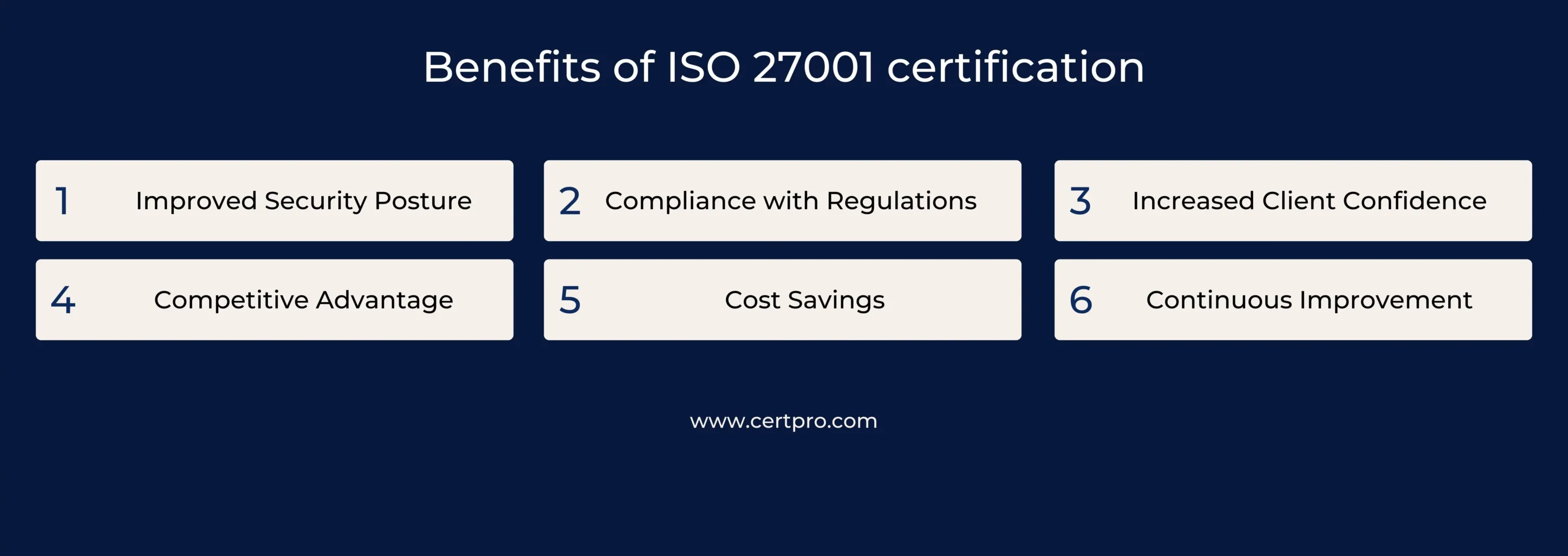
ISO 27001 Certification in France delivers measurable, verifiable benefits across commercial, regulatory, and operational dimensions. For French organizations competing in European and international markets, ISMS certification provides third-party validated evidence of structured information security governance that cannot be replicated through self-declaration or internal attestation alone. The benefits outlined below reflect the practical outcomes of ISO 27001 compliance programs across diverse industry sectors in France.
ISO 27001 Certification in France is increasingly referenced as a mandatory or preferred qualification in enterprise procurement frameworks, public sector tender requirements, and financial services vendor onboarding processes. French technology companies, SaaS providers, and fintech organizations that hold valid ISMS certification are able to demonstrate independently verified security governance in response to vendor security questionnaires—reducing the time and resource burden associated with repeated due diligence assessments. Certification status provides a consistent, auditable response to security inquiries from enterprise customers, financial institution partners, and regulatory counterparties.
For organizations pursuing ISO 27001 certification in Paris and other major French business centers, certification differentiates service providers in competitive tender processes where information security is a stated evaluation criterion. This is particularly relevant for French cloud service providers, managed service organizations, data processors, and technology firms serving clients in regulated industries such as banking, insurance, healthcare, and the public sector. The certification mark—accompanied by an unambiguous certification scope statement—communicates the boundary and nature of the ISMS that has been independently assessed and found conformant with ISO/IEC 27001:2022.
An ISMS implemented in conformity with ISO/IEC 27001:2022 produces structured documentation of information security risks, control decisions, and governance processes that is frequently relevant to regulatory examinations and supervisory inquiries. While ISO 27001 Certification does not establish legal compliance with GDPR, the French Data Protection Act, NIS2 Directive, or DORA, the documented risk assessments, control implementations, incident response procedures, and supplier security management practices produced within the ISMS are directly relevant to obligations under these regulatory frameworks. CNIL guidance on technical and organizational security measures references structured risk management approaches that align closely with the ISO 27001 framework.
From an operational risk management perspective, ISO 27001 compliance disciplines organizations to maintain current risk assessments, test controls against defined criteria, manage suppliers with documented security requirements, and operate formal incident response and business continuity programs. These disciplines reduce the likelihood and impact of information security incidents, data breaches, and operational disruptions. For France-based companies operating critical infrastructure or processing large volumes of personal data, the structured risk management framework embedded in the ISMS provides a defensible, evidence-based approach to security governance that withstands external scrutiny.
- ✓Third-party validated evidence of ISMS conformity with ISO/IEC 27001:2022 for use in commercial due diligence
- ✓Improved positioning in enterprise procurement and public sector tender processes across France and the EU
- ✓Structured framework for identifying, assessing, and treating information security risks systematically
- ✓Documented control implementation and operating effectiveness evidence for regulatory and contractual inquiries
- ✓Reduced burden from repeated vendor security questionnaires and customer due diligence requests
- ✓Certification currency maintained through annual surveillance audits and three-year recertification cycles
- ✓Alignment with the current ISO/IEC 27001:2022 control framework including updated technological and organizational controls
- ✓Commercial and Procurement Advantages
- ✓Regulatory Alignment and Risk Management Benefits
- ✓Key Benefits Summary
France Industry Sectors and ISO 27001 Certification Applications
ISO 27001 Certification in France is pursued by organizations across a broad range of industry sectors, each driven by distinct combinations of regulatory obligations, customer requirements, and information security risk profiles. The following section describes the principal sectors and the specific ISO 27001 compliance considerations that apply to each within the French market.
Financial Services, Fintech, and Technology Sectors
ISO 27001 Certification for France-based financial services organizations—including banks, insurance companies, asset managers, payment processors, and fintech firms—is increasingly relevant under DORA, which establishes binding ICT risk management, incident reporting, and third-party risk requirements for financial entities across the EU. An ISMS certified to ISO/IEC 27001:2022 provides a structured foundation for DORA ICT risk management obligations and generates the documentation and control evidence that DORA supervisory assessments require. French fintech companies operating across Paris and other major technology hubs frequently seek ISO 27001 certification as both a commercial differentiator and a mechanism for aligning with DORA requirements ahead of mandatory compliance deadlines.
French technology companies, SaaS providers, AI businesses, and cloud service providers pursuing ISO 27001 certification in Paris and other technology centers operate in competitive markets where ISMS certification is a standard procurement requirement from enterprise and financial services customers. The ISO/IEC 27001:2022 Annex A controls covering threat intelligence, cloud service security, data leakage prevention, and secure development lifecycle are directly applicable to the technology stacks and operational models of French digital businesses. For AI companies processing large datasets or operating machine learning infrastructure, the risk assessment process embedded in the ISMS framework provides a structured mechanism for identifying and treating information security risks specific to AI system operation and data governance.
Healthcare, Life Sciences, and Critical Infrastructure
French healthcare organizations, life sciences companies, and pharmaceutical businesses processing health data, clinical trial information, and regulated personal data face information security obligations under GDPR, French health data hosting regulations (HDS—Hébergeur de Données de Santé), and CNIL guidance. ISO 27001 Certification in France provides these organizations with a structured ISMS framework for managing information security risks across clinical, administrative, and research information environments. The ISMS control implementation and audit evidence generated through the ISO 27001 certification audit engagement supports both regulatory compliance documentation and contractual security obligations with institutional clients, public health agencies, and international research partners.
Telecommunications providers, aerospace and industrial technology companies, data center operators, and critical infrastructure organizations in France operate under NIS2 Directive obligations that require appropriate technical and organizational security measures, incident reporting, and supply chain security management. ISO 27001 compliance certifications provide NIS2-regulated entities with independently verified evidence of structured security governance, risk management, and control implementation directly relevant to NIS2 supervisory assessments. French organizations designated as essential or important entities under NIS2 benefit from the alignment between ISO/IEC 27001:2022 control requirements and the security measures prescribed by the NIS2 implementing acts and ANSSI (Agence nationale de la sécurité des systèmes d’information) guidance.
CertPro’s ISO 27001 Certification Services for France
ISO 27001 Certification in France issued by CertPro CPA LLC is the output of an independent third-party audit engagement conducted by a Licensed CPA Firm with documented expertise in information security management systems and ISO/IEC 27001:2022 audit methodology. CertPro operates exclusively as a certification body—evaluating ISMS implementations against the normative requirements of the standard and issuing certification decisions based on objective audit evidence. CertPro does not provide implementation services, consulting engagements, or advisory activities to organizations seeking ISO 27001 certification.
Independent Audit Methodology and Institutional Positioning
CertPro CPA LLC’s ISO 27001 certification audit France engagements are conducted in accordance with ISO/IEC 17021-1, ISO/IEC 27006, and ISO/IEC 27007 requirements for ISMS audit and certification bodies. Audit teams are composed of qualified lead auditors with sector-specific competence relevant to the organization’s industry and risk profile. Each certification engagement includes a formal audit plan, a structured evidence collection process, documented audit findings, a nonconformity register, and a certification decision issued by a function independent of the audit team. The independence of the certification decision function from the audit team is a fundamental structural requirement that distinguishes third-party ISMS certification from internal or second-party assessments.
CertPro issues ISO 27001 Certification in France with a defined scope statement, certification validity period, and audit basis reference. The certification document identifies the certified organization, the ISMS scope, the standard version against which conformity was assessed (ISO/IEC 27001:2022), the certification date, and the expiry date of the current certification cycle. This structured certification output provides the unambiguous, independently verifiable documentation that enterprise procurement teams, regulatory bodies, and contractual counterparties require as evidence of ISMS certification conformity in France.
Sector Coverage and Geographic Reach in France
CertPro conducts ISO 27001 audit France engagements for organizations across all major French business and technology centers—including Paris, Lyon, Toulouse, Marseille, Lille, and Bordeaux—as well as for organizations with distributed operations across France and cross-border operations within the European Union. Remote audit capabilities enable CertPro to serve French organizations efficiently, with on-site audit components conducted as required by the scope and complexity of the ISMS. Sector coverage includes financial services, technology, SaaS, cloud services, healthcare, life sciences, pharmaceuticals, telecommunications, e-commerce, aerospace, industrial technology, cybersecurity, and data center operations.
| Organization Type | Primary ISO 27001 Drivers | Key Annex A Control Areas |
|---|---|---|
| Fintech / Financial Services | DORA, contractual vendor requirements, enterprise procurement | Threat intelligence, ICT continuity, access control, incident management |
| Healthcare / Life Sciences | GDPR, HDS regulations, CNIL guidance, clinical data obligations | Data classification, access control, physical security, supplier management |
| Cloud / SaaS Providers | Enterprise customer requirements, NIS2, vendor due diligence | Cloud security, data leakage prevention, secure development, cryptography |
| Telecommunications / Critical Infrastructure | NIS2 Directive, ANSSI requirements, supply chain security | Network security, change management, business continuity, incident response |
| Aerospace / Industrial Technology | Export control, supply chain assurance, government contracts | Physical security, asset management, secure disposal, supplier security |
FAQ
▶
What is ISO 27001 Certification and what does it certify?
▶
Is ISO 27001 Certification mandatory in France?
▶
How long does it take to complete the ISO 27001 certification audit process?
▶
What is the difference between Stage 1 and Stage 2 of the ISO 27001 audit?
▶
How long is ISO 27001 Certification valid in France?
▶
Does ISO 27001 Certification confirm GDPR compliance?
▶
What is a Statement of Applicability in the context of ISO 27001?
▶
What version of the ISO 27001 standard applies to certification audits today?
Get In Touch
have a question? let us get back to you.