
ITALY
ISO CERTIFICATION IN ITALY
In order to align enterprises and organizations with the standards defined by the International Organization for Standardization (ISO), ISO certification is a crucial step in Italy. This impartial organization is committed to setting standards that guarantee the effectiveness, safety, and quality of goods and services anywhere in the world. In order to validate conformity with ISO standards and ensure the efficacy and efficiency of offers, certification is a crucial step in Italy.
Italy, a country in southern Europe, is well known for its rich cultural history and dynamic way of life. It is vital for Italian companies to undergo ISO certification in order to guarantee the quality of their goods and services and to comply with international standards. Manufacturing, agriculture, and services are all part of Italy’s varied economic environment. In these industries, ISO certification is essential for increasing a company’s competitiveness both domestically and globally. Following ISO standards improves manufacturing’s general dependability and efficiency. The service sector, which makes up a sizable portion of Italy’s GDP, emphasizes the significance of ISO certification for maintaining high standards in a competitive global market. Italy has an economic impact on research and development, especially in the fields of aviation and space exploration. In these domains, ISO certification plays a crucial role in Italy by guaranteeing adherence to global norms while building aeronautical technologies.
The nation’s nearly 99% literacy rate and high emphasis on knowledge and skill development demonstrate its dedication to education. ISO certifies Italy’s educational institutions, demonstrating their commitment to upholding the highest standards in research and development. In order to stay credible in the cutthroat market and to conform with international standards, ISO certification in Italy is essential for companies and organizations operating in a variety of industries. Italy’s industrial and commercial landscape is heavily reliant on ISO certification due to the country’s commitment to efficiency and quality.






WHY ISO CERTIFICATION IN ITALY?
Obtaining ISO certification is crucial for Italian companies looking to maximize productivity, guarantee excellence, and foster trust. In Italy, an organization’s ISO accreditation attests to its unwavering commitment to maintaining strict standards in a variety of Italian industries. Especially, the importance of ISO 9001 certification is evident, highlighting quality control and empowering Italian businesses to generate dependable, client-focused products and services.
ISO 14001 plays an equally important part in environmental management, which is an important factor for a nation like Italy that is trying to achieve sustainable development in the midst of fast industrial growth. With Italy undergoing a digital revolution, ISO certification—in particular, ISO 27001—becomes increasingly relevant, providing increased security for sensitive data in the ever-changing digital space.
These certificates become even more important in Italy’s heterogeneous economy, enhancing client confidence and giving companies a competitive advantage in the global arena. An ISO certification denotes a dedication to strict guidelines, improving the dependability of products, cutting waste, and optimizing workflows to promote higher productivity and lower expenses.
Numerous ISO certification bodies are located in Italy, and they are all able to help firms successfully navigate the certification process by providing certification services, advice, and evaluation. In essence, ISO certification in Italy gives companies the capacity to build strong frameworks, follow international best practices, and actively promote excellence, sustainability, and security—all of which advance the nation.
UNDERSTANDING ISO CERTIFICATION IN ITALY
Obtaining ISO 9001 certification in Italy demonstrates a business’s commitment to providing dependable and excellent goods and services. The ISO 14001 standard is becoming more and more important as Italy’s industrial landscape changes, with an emphasis on sustainable growth and resolving environmental concerns. Data security is in line with ISO 27001, which is a key component of Italy’s digital transformation efforts. ISO certification has a significant positive impact on Italy’s diversified market by boosting customer confidence and empowering businesses to compete globally. Beyond demonstrating adherence to strict standards, ISO certification improves efficiency, reduces waste, and streamlines operations to increase product reliability
Related Links
SOC 2 in Italy
ISO 27701 in Italy
GDPR in Italy
ISO 27018 in Italy
HIPAA in Italy
CCPA in Italy
PIPEDA in Italy
ISO 17025 in Italy
ISO 13485 in Italy
CE Mark in Italy
GDP in Italy
GLP in Italy
ISO 9001 in Italy
ISO 14001 in Italy
ISO 45001 in Italy
ISO 22000 in Italy
HACCP in Italy
ISO 22301 in Italy
ISO 21001 in Italy
ISO 41001 in Italy
ISO 20000-1 in Italy
Companies in Italy are able to create strong frameworks that are in line with international best practices thanks to ISO certification. Businesses that put quality, sustainability, and security first benefit Italy’s reputation abroad in addition to their own. Through ISO certification, the International Organization for Standardization (ISO) formally attests that a business’s management system, practices, products, or services fulfill set criteria. ISO is a globally acknowledged autonomous organization that develops and distributes standards to guarantee effectiveness, safety, and quality in a range of sectors. The broad use of ISO standards gives Italian companies more credibility when they enter other markets. Businesses that are ISO certified may demonstrate their dedication to quality and continuous improvement, giving them a competitive advantage. The focus Italy places on environmental management and sustainability is consistent with ISO 14001 accreditation. Customer requirements are often highlighted in ISO standards, which improve retention and satisfaction. ISO certification is crucial for Italian suppliers that are involved in global supply networks. The ISO certification’s continuous improvement component helps Italian businesses streamline operations and stay competitive. In the end, ISO certification strengthens a company’s image by confirming compliance with global quality standards and encouraging trust among customers and partners.

THE ESSENTIAL STEPS OF THE ISO CERTIFICATION PROCESS IN ITALY INCLUDE THE FOLLOWING:
Preparation and Awareness: The initial stage involves gaining a comprehensive comprehension of the specific ISO standard relevant to your industry and business goals. Acquire knowledge about the advantages, prerequisites, and procedures involved in implementing the standard.
Planning: Develop a comprehensive strategy that delineates the necessary steps to align your processes with the ISO standard. Formulate an implementation schedule and allocate responsibilities appropriately.
Documentation: Generate or revise essential documentation, encompassing policies, procedures, work instructions, and records, to ensure their alignment with the specifications of the ISO standard.
Implementation: Incorporate your organization’s documented processes and procedures seamlessly across the entire structure. To ensure a successful implementation, closely monitor the proceedings and make any necessary adjustments.
Internal Audit: Perform an internal audit to identify any non-conformities and evaluate the effectiveness of the implemented processes. Address these issues and make the necessary adjustments accordingly.
Management Review: Evaluate the progress, effectiveness, and relevance of the ISO management system implementation through a management review. Ascertain whether any changes or improvements are necessary.
Certification Body Selection: Choose a trustworthy certifying body to conduct the external assessment. The certifying body will thoroughly review your policies, practices, and execution to determine your readiness for certification.
Stage 1 Audit (Document Review): The certification organization’s initial assessment of your documentation and procedures verifies that they adhere to the standards of the ISO standard.
Stage 2 Audit (On-Site Audit): To validate the implementation of your ISO management system and evaluate the adherence of your processes to the standard standards, the certification authority conducts an on-site audit.
Certification Decision: The certification body determines whether to issue certification based on the audit findings. If your business aligns with the standards set by the standard, it will be granted an ISO certificate.
Surveillance Audits: To ensure ongoing adherence to the ISO standard, the certifying body conducts regular surveillance audits. These audits typically occur annually.
Throughout the entire process, strict adherence to the certification organization’s criteria and maintaining close communication with them are crucial.
POPULAR ISO STANDARDS IN ITALY
Italy’s many industries widely embrace numerous ISO standards, playing a crucial role in elevating the benchmarks for effectiveness, security, and quality. The importance of ISO 9001:2015 lies in its focus on putting quality management systems in place to guarantee the continual provision of dependable products and services. In keeping with Italy’s dedication to sustainability, ISO 14001:2015 covers environmental management systems and promotes moral behavior in the midst of the country’s continuous industrial growth.
In light of Italy’s continuous digital revolution, ISO 27001:2013 has become increasingly crucial for guaranteeing data security. By helping businesses protect sensitive data, this standard supports Italy’s efforts in digital security. To improve road safety, the automotive industry depends on ISO 26262 to guarantee the functional safety of electrical and electronic systems. ISO 45001:2018 emphasizes occupational health and safety, which fits in well with Italy’s commitment to worker well-being. ISO 22000:2018 covers food safety management systems in the food business to ensure the protection of consumers. Energy management is the main focus of ISO 50001:2018, which is in line with Italy’s dedication to sustainable energy policies.
These ISO standards reflect Italy’s technological innovations, adherence to laws, and developmental goals. As such, they are essential to the advancement of industry standards and the achievement of a worldwide reputation for Italian businesses.
BENEFITS OF ISO CERTIFICATION IN ITALY
In Italy, ISO certification guarantees that goods and services fulfill global quality standards, boosting client happiness and giving companies a competitive advantage. Furthermore, by guaranteeing the precise execution of procedures, ISO certification reduces the chance of company failure. Italian businesses benefit greatly from the ISO certification process, which fosters improved operational excellence, growth, and legitimacy.
Above all, ISO certification enhances a business’s standing in the marketplace by proving that it follows international standards, which in turn encourages more client trust. The increased dependability leads to increased client retention and loyalty, strengthening the business’s standing in the marketplace. By lowering trade obstacles, creating a recognized quality norm, and enabling easier participation in international trade, ISO certification helps Italy enter the global market. This is especially advantageous for Italian companies looking to expand internationally and take advantage of new commercial prospects. Furthermore, ISO-certified Italian businesses acquire a competitive advantage in the marketplace by setting themselves apart from rivals and drawing in prospective customers and business partners with their dedication to effectiveness, excellence, and ongoing development.
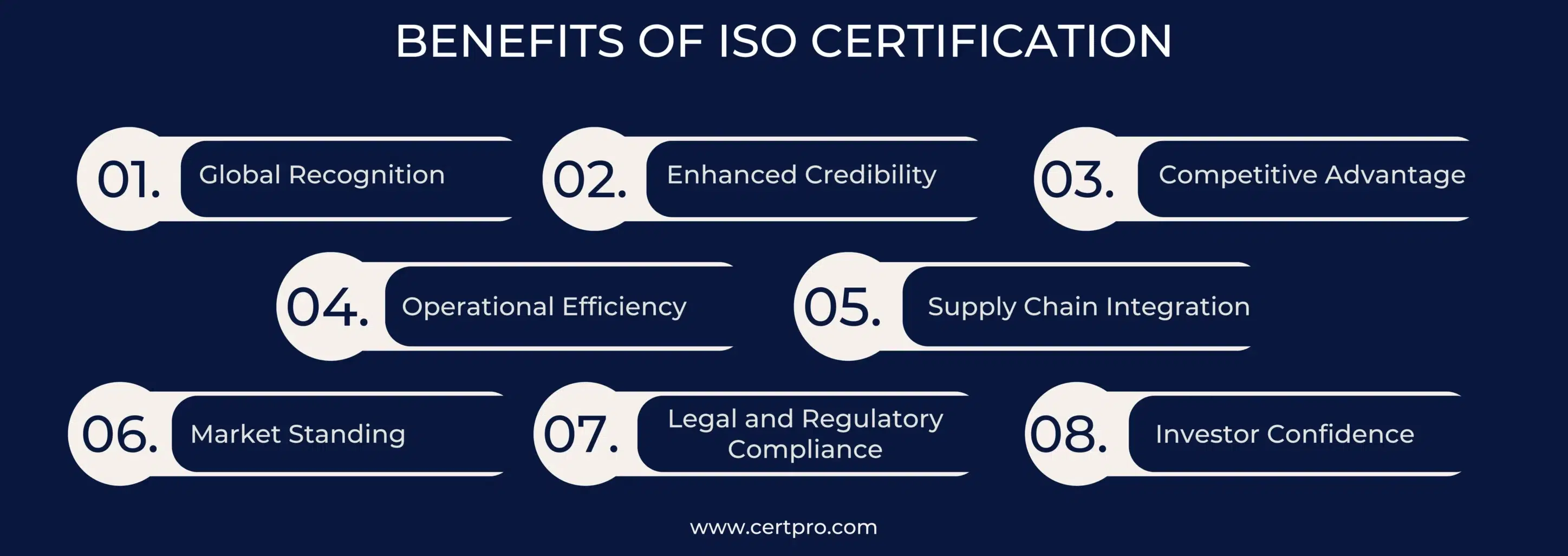
- Global Recognition: The worldwide recognition of ISO certification provides opportunities for Italian businesses, allowing them to engage in international trade and expand their market presence overseas. This acknowledgement grants Italian companies a substantial competitive edge, empowering them to conduct business authentically and trustworthily in foreign markets.
- Enhanced Credibility: It enhances the credibility and trust of clients, partners, and investors, both domestically and internationally.
- Competitive Advantage: Businesses possessing ISO certification stand out from their competitors by demonstrating their commitment to excellence and quality.
- Operational Efficiency: Enhancements in processes contribute to an overall improvement in operational effectiveness.
- Supply Chain Integration: ISO accreditation is vital for numerous international supply chains, providing opportunities to participate in collaborations with partners abroad.
- Market Standing: Achieving ISO certification enhances a company’s market reputation, attracts more clients, and expands business opportunities.
- Legal and Regulatory Compliance: ISO certification simplifies adherence to both national and international laws.
- Investor Confidence: Demonstrating a commitment to optimal methodologies amplifies investor trust.
ISO certification in Italy enables businesses to excel in a competitive landscape, establish confidence in global markets, uphold ethical and sustainable business practices, and consistently enhance operations for enduring success.
ISO CERTIFICATION BODIES IN ITALY
The ACCREDIA (Italian Accreditation Body) serves as the national accrediting agency for certification bodies in Italy. Various certifying bodies in Italy have the authorization to confer ISO certification under the jurisdiction of the ACCREDIA. These accredited entities conduct audits of businesses to verify adherence to different ISO standards. Now, let’s explore some of the prominent ISO certification bodies in Italy.
Autenticert S.r.l.: Autenticert is an accredited certification body by ACCREDIA, specializing in various sectors and gender equality. They leverage the extensive experience of senior auditors and stay attuned to rapid changes in digitization. With longstanding connections to diverse associations and highly qualified evaluators, Autenticert addresses certification needs for management systems and conformity assessment. Their strength lies in a collaborative approach, leading to direct representation in Italy with accreditations as signatories of mutual recognition agreements (IAF/MLA).
SA CERTIFICATION S.r.l.: SA Certification holds the distinction of being the first accredited certification body in Italy for healthcare professionals under UNI EN ISO 17024:2012. Additionally, it is accredited for UNI PdR 125:2022, Gender Equality, adhering to UNI EN ISO 17021:2015 standards. This recognition underscores SA Certification’s commitment to maintaining high-quality standards in healthcare and promoting gender equality. Accreditation in both areas positions them as a reliable entity for certifying professionals and organizations, contributing to enhanced trust and credibility in the healthcare sector, and advocating for gender equality in compliance with established standards.
SI CERT ITALY S.r.l.: SI Cert, our entity, was established to avoid imposing perspectives and recognizes that audits, rooted in the Latin verb AUDêRE meaning “to listen,” involve assessing efficiency, performance, and compliance. SI Cert’s mission is to convey that adopting standards enhances, rather than constrains, creativity and development. Certification, to us, celebrates uniqueness rather than enforcing standardization. Swiss Italy certifications reflect our commitment to tailored assessments across industries, encouraging a dynamic and collaborative approach to business excellence.
ESQ CERT Ltd.: is an independent certification body offering certification and inspection services aligned with national and international regulations, including ISO and EEC directives. Specializing in business management systems certifications like quality (UNI ISO 9001), environmental management (UNI EN ISO 14001), and occupational health and safety (OHSAS 18001), ESQ Cert extends its expertise to certifying other services based on customer requests. The certification process involves a thorough conformity assessment, resulting in certificates valid for three years, with regular visits to ensure continuous compliance. ESQ Cert stands out as an independent system that serves as both an auditor and a supporter, prioritizing client organization interests and development.
TUV Thuringen Italia S.r.l.: TÜV Thuringen Italia, an impartial and independent organization, addresses sustainability, quality, and safety challenges for knowledge, assets, organizations, and individuals. With over 20 years in Italy collaborating with 3000+ clients, it offers inspections, certifications, training, and expert evaluations nationally and internationally. Focused on ISO 9001, ISO 14001, and OHSAS 18001 certifications, TÜV Thüringen employs a diverse, highly qualified technical team. Developing inspection systems and methodologies based on international standards like ISO 20121 and ISO 29990, it actively participates in Europe Aid projects and an international network for skills certification, partnering with organizations like Les Compagnons du Devoir, IB, and ETP’s Cairo.
INDUSTRIES THAT BENEFIT FROM ISO CERTIFICATION IN ITALY
Given the numerous advantages that ISO certification brings, with a significant impact on various industries across the nation, many Italian companies now recognize its crucial role in ensuring their success. Beyond mere status symbols, these certifications signify a strong commitment to quality, security, and sustainability. The manufacturing industry in Italy, for instance, experiences improved product quality and increased operational efficiency through ISO 9001 accreditation. By fostering a culture of continuous improvement, this certification enhances customer satisfaction, providing companies with a competitive edge. Consumers view ISO accreditation as a hallmark of reliability.
In Italy, the IT industry finds ISO 27001 certification indispensable, considering the increasing value of data in today’s world. This accreditation strengthens risk management and data security processes, allowing the sector to leverage technological advancements while safeguarding confidential information. Its importance extends beyond commercial success, playing a crucial role in building client trust across all contexts. Meanwhile, the ISO/TS 16949 standard, tailored for the automotive sector, reinforces Italy’s reputation as a premier global manufacturer of high-quality cars, ensuring the durability and safety of vehicles. The nation’s healthcare system benefits from enhanced precision, legal compliance, and adherence to high standards.
The impact of these certifications goes beyond individual companies, fostering sustainable construction practices and advancing environmental building technologies. Italian businesses enlist the assistance of ISO consultants in Italy to ensure compliance with ISO standards, guiding them through the certification process. This commitment encompasses certifications that reinforce data security, privacy, and healthcare standards in Italy. Notable among these are ISO 27001 Certification in Italy, SOC 2 Certification in Italy, GDPR Certification in Italy, HIPAA Certification in Italy, and PIPEDA Certification in Italy. Pursuing ISO certification in Italy signifies a dedication to broader societal and environmental well-being alongside corporate success. The involvement of ISO consultants underscores the strategic guidance companies seek to navigate the certification landscape effectively.
FAQ
What is ISO certification, and why is it important in Italy?
ISO certification in Italy is a confirmation of adherence to international standards set by the International Organization for Standardization (ISO). It is crucial for Italian organizations as it ensures operational efficiency, quality assurance, and trust in the competitive global market.
How can a company in Italy obtain ISO certification?
To obtain ISO certification in Italy, a company must undergo processes such as certification preparation, applying ISO standards, internal audits, choosing a certification body, and concluding external audits. The certification body, such as ACCREDIA, plays a crucial role in the certification process.
What benefits does ISO certification offer in Italy?
ISO Certification in Italy offers benefits including increased reputation, better market access, operational efficiency, customer trust, regulatory compliance, and alignment with sustainable practices. It enhances a company’s standing in the market and gives it a competitive advantage both domestically and globally.
Why is ISO certification essential for different industries in Italy?
ISO certification is essential for various industries in Italy, such as manufacturing, IT, automotive, and healthcare, as it improves product quality, operational efficiency, data security, and adherence to high standards. It also fosters sustainable practices and environmental building technologies.
What is the ISO certification process in Italy?
The ISO certification process in Italy involves preparation and awareness, planning, documentation, implementation, internal audit, management review, certification body selection, stage 1 and stage 2 audits, certification decisions, and surveillance audits to ensure ongoing adherence to ISO standards.
IS SOC 2 THE SAME AS ISO 27001?
In today's digital landscape, ensuring the safeguarding of client data is paramount for businesses. Adhering to recognized compliance standards is vital to meeting this demand. ISO 27001 vs. SOC 2 represent two prominent benchmarks in the realm of data security with...
WHO NEEDS ISO 27001 CERTIFICATION AND WHY?
The esteemed ISO 27001 security framework is designed to evaluate the effectiveness of an organization's Information Security Management System (ISMS) in safeguarding its data. Obtaining ISO 27001 certification is a practical way for a corporation to demonstrate its...
IS ISO 27001 RISK ASSESSMENT VITAL FOR SECURITY MEASURES?
The ISO 27001 standard provides a framework for information security, highlighting the importance of a thorough risk assessment procedure. Organizations use the methodical and complex ISO 27001 risk assessment process to identify and assess information security...