
vietnam
ISO CERTIFICATION IN VIETNAM
Vietnam, a country in Southeast Asia, deliberately incorporates ISO certification into its structure to demonstrate its unwavering dedication to upholding strict quality standards. Vietnam’s diverse topography, which includes both long coastlines and lush mountains, serves as the backdrop for the significance of ISO certification to emerge. Vietnam, a country renowned for its depth of cultural diversity and history, is quickly becoming a significant force in the economy.
Vietnam’s economy is growing, thanks in large part to a thriving manufacturing sector, especially in textiles, electronics, and agriculture. In this ever-changing economic environment, ISO certification becomes important in guaranteeing that Vietnamese enterprises meet, if not exceed, global standards for productivity and quality. One of the main drivers of Vietnam’s economic growth is the textile industry, which greatly benefits from ISO certification, which demonstrates the industry’s adherence to international quality standards.
Another important pillar of Vietnam’s economic strength is the electronics sector, which mostly depends on ISO certification to demonstrate its commitment to manufacturing high-quality electronic components. At the same time, ISO certification is widely used in the agriculture industry to ensure that farming methods meet strict guidelines and promote ethical and sustainable methods of producing food.
Beyond industry sectors, the influence of ISO certification permeates Vietnam’s educational system. The inclusion of ISO certification in educational settings demonstrates the country’s commitment to knowledge and skill development. Vietnam does this in order to bring its educational system into line with international best practices and prepare its workforce for the challenges of a world that is becoming more linked and competitive. Vietnam’s aggressive implementation of ISO certification in education and industry not only increases its economic competitiveness internationally but also establishes the nation as a responsible and progressive player in the global arena.





WHY ISO CERTIFICATION IN SOUTH AFRICA?
Acquiring ISO certification is critical for Vietnamese firms looking to maximize productivity, guarantee quality, and foster trust. The organization’s ISO accreditation demonstrates its unwavering commitment to maintaining strict standards across various industries in Vietnam. The ISO 9001 certification is particularly important since it enables Vietnamese businesses to concentrate on quality management and create dependable, customer-focused goods and services.
For Vietnam, which is striving for sustainable development in the midst of fast industrial expansion, the importance of ISO 14001 in addressing environmental management is equally critical. The significance of ISO certification—in particular, ISO 27001—in terms of protecting sensitive data in the dynamic digital environment is growing as Vietnam continues its digital revolution.
In Vietnam’s diverse market environment, these certifications are highly valued, as they boost consumer trust and give companies a global competitive advantage. An ISO certification denotes a dedication to strict guidelines, increasing the dependability of products, cutting waste, and optimizing processes to increase output while cutting expenses.
Vietnam is home to multiple ISO certification bodies that help firms successfully traverse the certification process by providing certification services, advice, and evaluations. To put it simply, Vietnam’s ISO certification enables companies to build strong frameworks, conform to international standards, and actively promote quality, sustainability, and security—all of which advance the country tremendously.
UNDERSTANDING ISO CERTIFICATION IN VIETNAM
Obtaining Vietnam’s ISO 9001 certification demonstrates a business’s steadfast commitment to providing dependable and excellent goods and services. As Vietnam’s industrial landscape changes, the ISO 14001 standard—which emphasizes sustainable growth and addresses environmental concerns—becomes increasingly important. One of the main goals of ISO 27001 is data security, which is in line with Vietnam’s current digital revolution. In Vietnam’s diversified market, ISO certification becomes a valuable asset that enhances customer confidence and facilitates worldwide competitiveness. Beyond demonstrating compliance with strict standards, ISO certification improves product reliability by streamlining workflows, cutting waste, and getting rid of inefficiencies.
Related Links
SOC 2 in Vietnam
ISO 27701 in Vietnam
GDPR in Vietnam
ISO 27018 in Vietnam
HIPAA in Vietnam
CCPA in Vietnam
PIPEDA in Vietnam
ISO 17025 in Vietnam
ISO 13485 in Vietnam
CE Mark in Vietnam
GDP in Vietnam
GLP in Vietnam
ISO 9001 in Vietnam
ISO 14001 in Vietnam
ISO 45001 in Vietnam
ISO 22000 in Vietnam
HACCP in Vietnam
ISO 22301 in Vietnam
ISO 21001 in Vietnam
ISO 41001 in Vietnam
ISO 20000-1 in Vietnam
Companies in Vietnam are able to set up strong frameworks that comply with international best practices thanks to ISO certification. Companies that put quality, sustainability, and security first not only improve their own bottom line but also enhance Vietnam’s reputation abroad. Through ISO certification, the International Organization for Standardization (ISO) formally acknowledges adherence to predetermined standards in a business’s management system, practices, products, or services. This internationally recognized independent organization creates and distributes standards to guarantee effectiveness, safety, and quality in a range of sectors. The extensive use of ISO standards makes it easier for Vietnamese enterprises to enter foreign markets with greater credibility. Businesses with ISO certifications frequently obtain a competitive advantage by showcasing their dedication to quality and ongoing development. Vietnam’s emphasis on environmental management and sustainability is in line with ISO 14001 certification. ISO standards improve retention and satisfaction by highlighting client requirements. An important consideration for Vietnamese suppliers involved in global supply chains is ISO certification. Vietnamese businesses can streamline procedures and maintain their competitiveness by implementing continuous improvement, which is essential to ISO certification. In the end, ISO certification improves a company’s standing with customers and partners by confirming compliance with global quality standards.

THE ESSENTIAL STEPS OF THE ISO CERTIFICATION PROCESS IN VIETNAM INCLUDE THE FOLLOWING:
Preparation and Awareness: Begin by acquiring a comprehensive understanding of the specific ISO standard relevant to your industry and business goals. Familiarize yourself with the advantages, prerequisites, and implementation procedures associated with the standard.
Planning: Develop a comprehensive strategy detailing the necessary actions to align your processes with the ISO standard. Formulate an implementation schedule and assign responsibilities appropriately to ensure a smooth integration of ISO compliance measures.
Documentation: Generate or revise essential documentation, encompassing policies, procedures, work instructions, and records, to ensure they align with the stipulations of the ISO standard.
Implementation: Incorporate your organization’s documented processes and procedures seamlessly across the entire structure. Ensure a successful implementation by closely monitoring the processes and making necessary adjustments as needed.
Internal Audit: Perform an internal audit to identify any non-conformities and evaluate the effectiveness of the implemented processes. Address these issues and make the necessary adjustments.
Management Review: Evaluate the progress, effectiveness, and relevance of the ISO management system implementation through a management review. Determine whether any changes or improvements are necessary.
Certification Body Selection: Choose a reputable certifying body to conduct the external assessment. The certifying body will thoroughly examine your policies, practices, and execution to assess your readiness for certification.
Stage 1 Audit (Document Review): The certification organization’s initial assessment of your documentation and procedures affirms their compliance with the ISO standards.
Stage 2 Audit (On-Site Audit): To validate the implementation of your ISO management system and evaluate the adherence of your processes to standard standards, the certification authority performs an on-site audit.
Certification Decision: The certification body determines whether to confer certification based on the audit findings. If your business adheres to the standards set by the ISO standard, it will receive an ISO certificate.
Surveillance Audits: To ensure ongoing compliance with the ISO standard, the certifying body conducts regular surveillance audits. Typically, these audits occur annually.
Consistent adherence to the certification organization’s criteria and maintaining close communication with them are vital throughout the entire process.
POPULAR ISO STANDARDS IN VIETNAM
Many ISO standards are essential to Vietnam’s industries, raising the bar for effectiveness, security, and quality. One noteworthy one is ISO 9001:2015, which emphasizes the use of QMSs to guarantee the provision of dependable products and services. As the country’s industrial sector expands, ISO 14001:2015, which is in line with Vietnam’s commitment to sustainability, deals with environmental management systems.
The significance of ISO 27001:2013 for data security increases in the context of Vietnam’s continuous digital transformation, hence helping the nation’s digital security goals. In the automotive industry, ISO 26262 is significant because it guarantees the electrical systems’ functional safety, which improves road safety.
The focus on occupational health and safety in ISO 45001:2018 is consistent with Vietnam’s commitment to worker welfare. Protecting consumer interests, ISO 22000:2018 focuses on food safety management systems. Energy management is given top priority in ISO 50001:2018, which is consistent with Vietnam’s dedication to sustainable energy practices.
When taken as a whole, these ISO standards demonstrate Vietnam’s advancements in technology, regulatory compliance, and developmental goals. As such, they are essential for driving industry advancements and gaining Vietnamese businesses international recognition. Notably, ISO 45001, ISO 27001, ISO 14001, ISO 22000, ISO 9001, HACCP, and GMP certifications are among the most widely held ISO certifications in Vietnam.
BENEFITS OF ISO CERTIFICATION IN VIETNAM
In Vietnam, ISO certification serves as a guarantee that goods and services align with international quality standards, enhancing consumer satisfaction and providing businesses with a competitive advantage. Beyond this, ISO certification mitigates the risk of company failure by ensuring the precise implementation of processes. The ISO certification process brings significant advantages to Vietnamese organizations, including heightened growth, enhanced credibility, and operational excellence.
Primarily, ISO certification elevates a business’s market position in Vietnam, underscoring its adherence to global standards and subsequently building client trust. This heightened trustworthiness fosters increased customer loyalty and retention, fortifying the company’s position in the marketplace.
ISO certification facilitates global market entry for Vietnamese businesses by minimizing trade barriers, establishing a recognized quality benchmark, and streamlining entry into international trade. This proves particularly beneficial for Vietnamese enterprises seeking overseas expansion and exploring business opportunities. Moreover, ISO-certified Vietnamese companies gain a competitive edge in the marketplace, standing out and attracting potential clients and business partners through their commitment to efficiency, quality, and continual improvement.
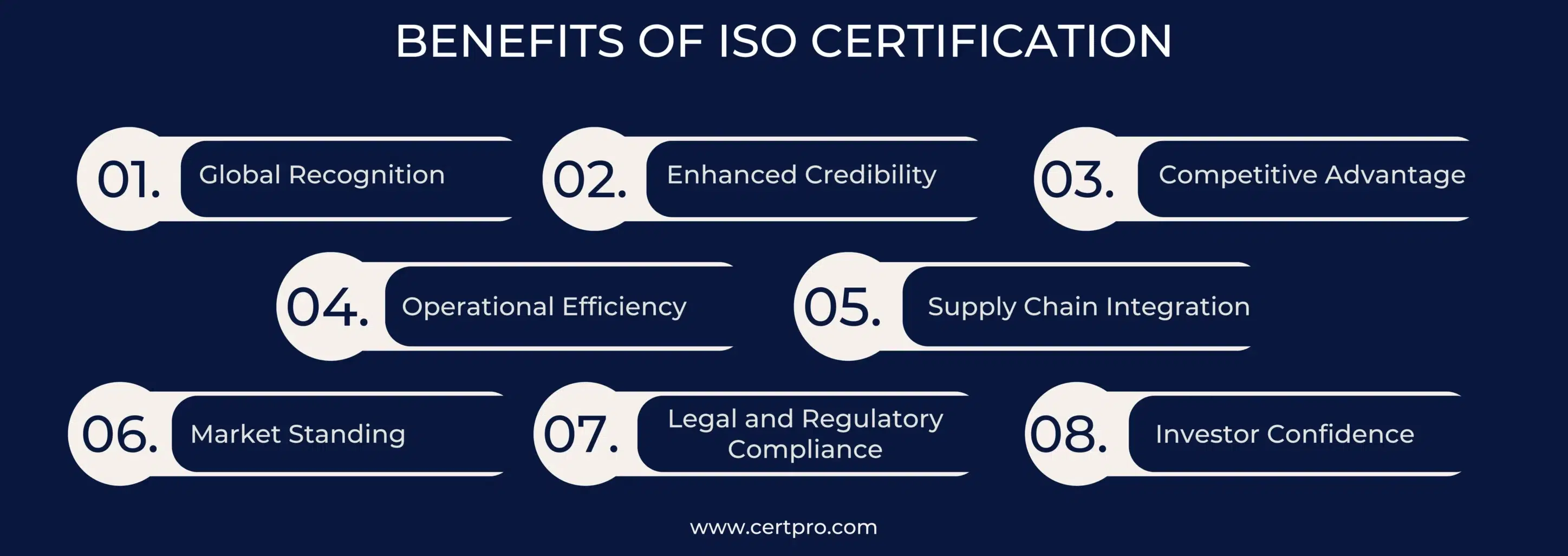
- Global Recognition: The worldwide recognition of ISO certification provides opportunities for Vietnamese businesses, allowing them to engage in international trade and expand their market presence globally. This acknowledgement grants Vietnamese companies a notable competitive edge, enabling them to conduct business with authenticity and trustworthiness in foreign markets.
- Enhanced Credibility: It enhances the credibility and trust of clients, partners, and investors both domestically and internationally.
- Competitive Advantage: ISO-certified companies surpass their competitors by demonstrating a commitment to excellence and quality.
- Operational Efficiency: Enhancements in processes contribute to an overall improvement in operational effectiveness.
- Supply Chain Integration: Many global supply chains depend on ISO accreditation, which presents chances for foreign partners to collaborate.
- Market Standing: Obtaining ISO certification enhances a business’s standing in the marketplace, draws in new customers, and expands its range of commercial prospects.
- Legal and Regulatory Compliance: The ISO certification simplifies the observance of domestic and global legal requirements.
- Investor Confidence: Displaying a commitment to best practices enhances investor confidence.
Thriving in a competitive environment, establishing trust in international markets, upholding ethical and sustainable business practices, and continually enhancing operations for long-term success are achievable through ISO certification in Vietnam.
ISO CERTIFICATION BODIES IN VIETNAM
The VIETNAM CERTIFICATION ACCREDITATION SCHEME (VICAS) serves as the national accrediting agency for certification bodies in Vietnam. Numerous certifying bodies in Vietnam are authorized to issue ISO certification under the jurisdiction of the VICAS. These accredited organizations conduct audits of businesses to verify their adherence to various ISO standards. Let’s explore some of the prominent ISO certification bodies in Vietnam:
1. PQI VIETNAM COMPANY LIMITED: PQI Vietnam Company Limited, operating since 2006, is a prominent certification management system organization in Vietnam. With a focus on management system audits, industrial goods inspections, and more, it has served over 800 enterprises. Specializing in certifying management systems registered with Vietnam’s Ministry of Science and Technology, PQI Vietnam emphasizes alignment with established criteria. Organizations seeking certification should assess PQI Vietnam’s specialization and accreditation scope. Engaging directly with official sources and consulting accreditation bodies is crucial for obtaining the most accurate and current information on PQI Vietnam’s services and expertise.
2. EFC INTERNATIONAL CERTIFICATION AND INSPECTION CORPORATION: The corporate dedication to quality that drives EFC International Certification and Inspection Corporation creates an atmosphere that supports its expansion. The business places a strong emphasis on a corporate quality mindset, aiming for defect-free products through methodical supplier assessment and procedures that put prevention ahead of discovery. EFC has demonstrated its commitment to quality by obtaining ISO 9001:2015 certification, establishing strategic alliances with leading manufacturers, and putting cutting-edge technologies like SAP-CRM and fully automated warehousing procedures into place. These steps demonstrate EFC’s commitment to providing exceptional product and service quality.
3. ISOCERT: The ISO certificate authentication service offered includes independent certification and ISO 9001 international standards certification services provided by an assessment body. Renowned for its excellent reputation in the industry, this service offers competitive, cost-effective, and impartial certification for businesses of all sizes. The process encompasses initial screening, assessment, and registration, with a focus on problem-solving. The approach involves regular monitoring at standard fees, along with low-cost plans tailored for small businesses. The service is well-versed in various industries, providing customer management systems with national and international recognition. Certification spans ISO standards such as ISO 9001, ISO 14001, ISO 9100, ISO 22000, OHSAS 18001, ISO 27001, ISO 20000, ISO 29001, ISO 10002, ISO 13485, ISO 22716, and CE Marking.
4. SAIGONCERT CERTIFICATION AND INSPECTION JOINT STOCK COMPANY: SAIGONCERT CERTIFICATION AND INSPECTION JOINT STOCK COMPANY, specializing in the services sector, particularly testing laboratories. Evaluating the corporate structure, management skills, and financial ratios is crucial for assessing the company’s business commitment. CRIF’s database currently holds financial statements from 2022, and upon request, a fresh investigation can retrieve financials for the past 3 years. Additionally, CRIF’s database encompasses a rating and a comprehensive organizational structure for SAIGONCERT CERTIFICATION AND INSPECTION JOINT STOCK COMPANY.
5. BVQA Certification Company Limited: BVQA, or BVQA Certification Company Limited, is an international certification body accredited by national accreditation bodies and members of the IAF (International Accreditation Forum). With offices in Europe, North America, and Asia, BVQA offers certification services across various audit criteria. This includes ISO 9001 for quality management systems applicable to all organizations, TL9000 for the telecommunications industry, AS9100, AS9003, AS9110, and AS9120 for suppliers to the aerospace industry, ISO 13485 for medical devices, IATF 16949 for automotive production, ISO 14001 for environmental management, EMAS for organizations in the European Union, OHSAS 18001/ISO 45001 for occupational health and safety, HACCP & ISO 22000 for food safety, ISO/IEC 27001 for information security, BS 25999-2 for business continuity, product standards, and technical personal competency standards such as certification for Oil Firing Technicians (OFTEC) and Gas Fitting Operatives. BVQA’s scope covers a wide range of industries and standards.
INDUSTRIES THAT BENEFIT FROM ISO CERTIFICATION IN VIETNAM
Many Vietnamese companies have realized that ISO certification is essential to their development because of the many advantages it offers to the nation’s different industries. These certifications represent a strong commitment to sustainability, quality, and security and go beyond simple status symbols. In the manufacturing industry, ISO 9001 certification greatly improves both product quality and operational effectiveness. This certification gives you a competitive edge and improves client satisfaction by promoting a culture of continuous improvement. For Vietnam’s expanding IT sector, ISO 27001 is essential because it protects sensitive data and improves risk management. ISO/TS 16949 strengthens Vietnam’s position as a leading global automaker, as it is specifically designed for the automotive industry, ensuring the longevity and safety of vehicles. ISO certificates improve accuracy, adherence to the law, and high standards in healthcare, which benefits the country’s health care system.
By supporting environmentally friendly building technology and sustainable construction methods, these certifications have an impact that goes beyond specific businesses. Vietnamese companies go to ISO consultants in Vietnam for assistance in navigating the certification process and guaranteeing compliance with ISO standards. This dedication includes holding certifications such as ISO 27001 certification in Vietnam, SOC 2 certification in Vietnam, GDPR certification in Vietnam, HIPAA certification in Vietnam, and PIPEDA certification in Vietnam, which strengthen data security, privacy, and healthcare standards in Vietnam. In Vietnam, pursuing ISO certification demonstrates a commitment to both business success and greater social and environmental well-being. The engagement of ISO consultants demonstrates the strategic direction businesses look for in order to successfully traverse the certification terrain.
FAQ
What is ISO certification in Vietnam, and why is it important for businesses in the country?
How can a company in Vietnam obtain ISO certification?
What are the benefits of ISO certification for businesses in Vietnam?
Which ISO standards are widely held in Vietnam, and why are they significant?
What are the essential steps in the ISO certification process for businesses in Vietnam?
IS SOC 2 THE SAME AS ISO 27001?
In today's digital landscape, ensuring the safeguarding of client data is paramount for businesses. Adhering to recognized compliance standards is vital to meeting this demand. ISO 27001 vs. SOC 2 represent two prominent benchmarks in the realm of data security with...
WHO NEEDS ISO 27001 CERTIFICATION AND WHY?
The esteemed ISO 27001 security framework is designed to evaluate the effectiveness of an organization's Information Security Management System (ISMS) in safeguarding its data. Obtaining ISO 27001 certification is a practical way for a corporation to demonstrate its...
IS ISO 27001 RISK ASSESSMENT VITAL FOR SECURITY MEASURES?
The ISO 27001 standard provides a framework for information security, highlighting the importance of a thorough risk assessment procedure. Organizations use the methodical and complex ISO 27001 risk assessment process to identify and assess information security...