
Austria
ISO CERTIFICATION IN AUSTRIA
Austria is a country in Central Europe with a beautiful landscape and a rich cultural history. Austria is a nation that is committed to high standards of quality, which is why ISO certification is mandatory. Austria has emerged as a center for companies looking to obtain ISO certification thanks to its advantageous location in Europe.
Austria has an important role in the region because it borders many other European nations. The stunning Alps and the Danube River are only two examples of the varied landscape of the nation, which appeals to a wide range of enterprises. In Austria, obtaining ISO certification is essential to guaranteeing excellence and compliance in corporate operations. The manufacturing, services, and technology industries have propelled the Austrian economy’s notable expansion. Austria now occupies a prominent place in the European market due to this economic transition. Because ISO certification upholds high standards across industries, it is essential to the nation’s economic initiatives.
Austria’s R&D projects demonstrate the country’s dedication to innovation. The nation makes significant investments in science, with a particular emphasis on technology, medical research, and environmental sustainability. For companies conducting cutting-edge research in Austria, ISO accreditation is essential for guaranteeing that they follow global standards. Austrian society places a high value on education and emphasizes academic achievement. The nation is well known for the caliber of its educational institutions and has a high rate of literacy. Austria’s education system has received ISO certification, demonstrating the country’s commitment to upholding high standards in learning and development. Austria’s strategic location, strong economy, and dedication to innovation highlight the value of ISO certification in the nation. Austria, a prominent country in Europe, is known for its ability to create high standards in a variety of industries; hence, ISO certification is essential to its economic environment.






WHY ISO CERTIFICATION IN AUSTRIA?
Obtaining ISO certification is crucial for Austrian companies looking to maximize productivity, guarantee excellence, and foster trust. The ISO accreditation is evidence of the organization’s unwavering dedication to maintaining strict standards in a variety of Austrian industries. Especially, the importance of ISO 9001 certification is emphasized since it helps Austrian businesses develop dependable, client-focused goods and services by emphasizing quality control.
ISO 14001 plays an equally important part in environmental management, which is an important factor for a nation like Austria that is trying to achieve sustainable development in the midst of fast industrial growth. ISO certification—in particular, ISO 27001—becomes more and more important as Austria continues its digital transformation in terms of protecting sensitive data in the ever-changing digital environment.
These certificates are essential in the diversified Austrian market because they boost consumer confidence and give companies a competitive advantage in the international arena. An ISO certification indicates a commitment to strict standards, ultimately enhancing product reliability and minimizing waste. It also simplifies procedures, which promotes higher output and lower expenses.
Numerous ISO certification bodies are based in Austria and provide certification services, advice, and assessments to help firms successfully navigate the certification process. In essence, ISO certification in Austria gives companies the capacity to build strong frameworks, conform to international best practices, and actively promote quality, security, and sustainability in order to actively support national development.
UNDERSTANDING ISO CERTIFICATION IN AUSTRIA
Obtaining ISO 9001 certification in Austria is indicative of a company’s commitment to providing dependable and excellent goods and services. The ISO 14001 standard, which addresses environmental concerns and promotes sustainable growth, is becoming more and more popular as Austria’s industrial landscape develops. The ISO 27001 standard is essential for protecting sensitive data and is in line with Austria’s digital transformation ambitions. By enhancing client confidence and empowering businesses to compete globally, ISO certification makes a substantial contribution to the diverse Austrian market. Beyond demonstrating compliance with strict standards, ISO certification improves product reliability by streamlining workflows, cutting waste, and getting rid of inefficiencies.
Related Links
SOC 2 in Austria
ISO 27701 in Austria
GDPR in Austria
ISO 27018 in Austria
HIPAA in Austria
CCPA in Austria
PIPEDA in Austria
ISO 17025 in Austria
ISO 13485 in Austria
CE Mark in Austria
GDP in Austria
GLP in Austria
ISO 9001 in Austria
ISO 14001 in Austria
ISO 45001 in Austria
ISO 22000 in Austria
HACCP in Austria
ISO 22301 in Austria
ISO 21001 in Austria
ISO 41001 in Austria
ISO 20000-1 in Austria
Companies in Austria are able to create strong frameworks that adhere to international best practices thanks to ISO certification. Companies that put quality, sustainability, and security first not only boost their own bottom line but also improve Austria’s reputation abroad. Through ISO certification, the International Organization for Standardization (ISO) formally recognizes that a business’s management system, practices, products, or services fulfill set criteria. This internationally renowned, independent organization creates and distributes standards to guarantee effectiveness, safety, and quality in a range of sectors. The extensive use of ISO standards makes it easier for Austrian companies to enter foreign markets with greater legitimacy. Businesses that display their dedication to quality and ongoing development by obtaining ISO certification frequently obtain a competitive advantage. The ISO 14001 accreditation is consistent with Austria’s focus on environmental management and sustainability. Customer requirements are often highlighted in ISO standards, which improve customer retention and satisfaction. ISO certification is important for Austrian suppliers in international supply chains. Continuous improvement is a critical component of ISO certification, helping Austrian businesses maintain their competitiveness and streamline operations. In the end, ISO certification enhances a company’s standing by proving compliance with global quality standards and building trust with customers and partners.

THE ESSENTIAL STEPS OF THE ISO CERTIFICATION PROCESS IN AUSTRIA INCLUDE THE FOLLOWING:
Preparation and Awareness: Begin by gaining a comprehensive understanding of the specific ISO standard relevant to your industry and business goals. Familiarize yourself with the advantages, prerequisites, and procedures involved in implementing the standard.
Planning: Develop a comprehensive strategy that delineates the necessary actions for aligning your processes with the ISO standard. Formulate an implementation schedule and assign responsibilities accordingly.
Documentation: Generate or revise the essential documentation, encompassing policies, procedures, work instructions, and records, to ensure they align with the stipulations of the ISO standard.
Implementation: Incorporate the documented processes and procedures of your organization seamlessly across the entire structure. To ensure a successful implementation, closely monitor proceedings and make any necessary adjustments.
Internal Audit: Perform an internal audit to identify any non-conformities and evaluate the effectiveness of the implemented processes. Address these issues and make the necessary adjustments accordingly.
Management Review: Evaluate the progress, effectiveness, and suitability of the ISO management system implementation through a management review. Ascertain whether any changes or enhancements are necessary.
Certification Body Selection: Choose a reputable certifying body to conduct the external assessment. The certifying body will thoroughly review your policies, practices, and implementation to determine your readiness for certification.
Stage 1 Audit (Document Review): The certification organization’s initial assessment of your documentation and procedures verifies that they adhere to the standards of the ISO standard.
Stage 2 Audit (On-Site Audit): To confirm the implementation of your ISO management system and evaluate the adherence of your processes to standard standards, the certification authority conducts an on-site audit.
Certification Decision: The certification body determines whether to grant certification based on the audit findings. If your business complies with the standards of the ISO, it will be awarded an ISO certificate.
Surveillance Audits: To maintain continuous adherence to the ISO standard, the certifying body performs regular surveillance audits, typically on an annual basis.
Throughout the entire process, strict adherence to the certification organization’s criteria and close communication with them are crucial.
POPULAR ISO STANDARDS IN AUSTRIA
Austria’s different sectors rely heavily on a number of ISO standards to improve quality, safety, and efficiency. The implementation of quality management systems to guarantee the consistent delivery of dependable goods and services is a notable feature that sets ISO 9001:2015 apart. Consistent with Austria’s dedication to sustainability, ISO 14001:2015 discusses environmental management systems and encourages moral behavior in the face of the country’s continuous industrial growth.
The importance of ISO 27001:2013 has increased in the context of Austria’s ongoing digital transformation, with a focus on data security to bolster the nation’s digital security activities. In order to improve road safety, the automobile industry heavily depends on ISO 26262 to guarantee the functional safety of electrical and electronic systems.
The occupational health and safety standards of ISO 45001:2018 are highly relevant to Austria, which is in line with its commitment to employee welfare. In order to protect consumers, ISO 22000:2018 addresses food safety management systems in the food business. According to ISO 50001:2018, energy management is prioritized, which is consistent with Austria’s dedication to sustainable energy methods. These ISO standards align with Austria’s technological progress, regulatory observance, and development goals when considered collectively. As a result, they are essential to improving business procedures and gaining reputation for Austrian enterprises worldwide.
BENEFITS OF ISO CERTIFICATION IN AUSTRIA
Getting ISO certified in Austria guarantees that products and services meet global quality standards, increasing customer satisfaction and giving companies a competitive edge. In addition, ISO certification reduces the chance of a company failing by guaranteeing proper process execution. For Austrian enterprises, the ISO certification process has several benefits, such as increased growth, legitimacy, and operational excellence.
Above all, ISO certification improves a company’s standing in the marketplace by proving that it follows international standards, which in turn fosters customer confidence and enhances the company’s image. This enhanced credibility strengthens the company’s position in the market by encouraging more client loyalty and retention.
By lowering trade obstacles, creating a recognized quality benchmark, and promoting a smoother entry into international trade, ISO certification in Austria opens access to the global market. This is especially advantageous for Austrian companies looking to grow internationally and take advantage of global commercial prospects. Furthermore, Austrian businesses with ISO certifications have an advantage over rivals in the market because of their dedication to effectiveness, quality, and ongoing development. This helps them stand out from the competition and draw in new customers and business partners.
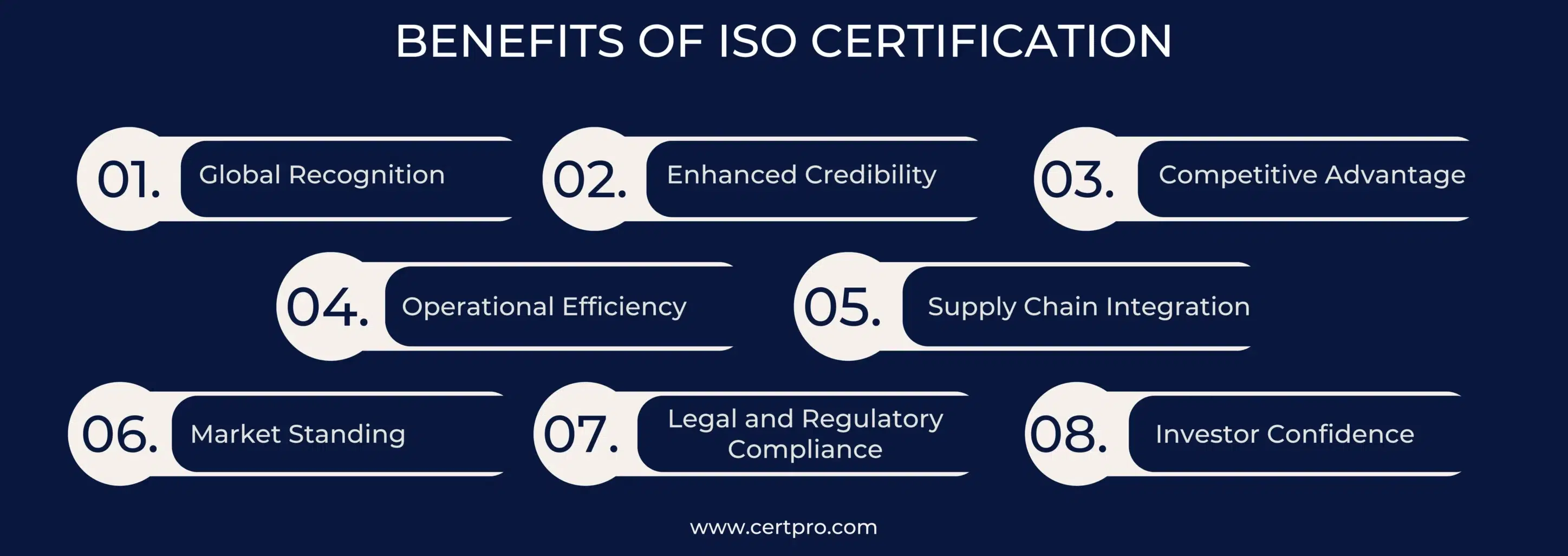
- Global Recognition: The worldwide recognition of ISO certification provides opportunities for Austrian businesses, allowing them to engage in international trade and expand their market presence overseas. This acknowledgment grants Austrian companies a substantial competitive edge, enabling them to conduct business credibly and reliably in foreign markets.
- Enhanced Credibility: It enhances the trust and credibility of clients, partners, and investors both domestically and internationally.
- Competitive Advantage: Businesses with an ISO certification distinguish themselves from rivals by showcasing their dedication to excellence and quality.
- Operational Efficiency: Enhancements in processes contribute to an overall improvement in operational effectiveness.
- Supply Chain Integration: ISO accreditation is vital for numerous international supply chains, providing opportunities to establish collaborations with partners abroad.
- Market Standing: Achieving ISO certification enhances a company’s market reputation, attracts more clients, and expands business opportunities.
- Legal and Regulatory Compliance: ISO certification facilitates adherence to both domestic and international legal requirements.
- Investor Confidence: Showing a dedication to best practices increases investor confidence.
Achieving ISO certification in Austria enables businesses to excel in a competitive landscape, instill confidence in global markets, uphold ethical and sustainable business practices, and continually enhance operations for sustained success.
ISO CERTIFICATION BODIES IN AUSTRIA
In Austria, the national accrediting body for certification bodies is “Akkreditierung Austria.”. Under Akkreditierung Austria’s supervision, a number of certifying bodies in Austria are authorized to grant ISO certification. These approved organizations audit companies to make sure they follow different ISO standards. Let’s review a few of Austria’s well-known ISO certification organizations:
1. Akkreditierung Austria: Akkreditierung Austria serves as the national accreditation body in Austria, offering internationally recognized accreditation services to conformity assessment bodies across various schemes. It exclusively accredits entities with Austrian legal status whose headquarters for the (to-be) accredited services are located in Austria. This accreditation ensures that conformity assessment bodies meet established international standards, contributing to the reliability and acceptance of their services both nationally and internationally.
2. TÜV AUSTRIA CERT GMBH: “TÜV AUSTRIA CERT GMBH” is a certification body based in Austria. TÜV AUSTRIA CERT focuses on providing certification services, particularly in areas such as quality management, environmental management, occupational health and safety, and various industry-specific standards. As a certification body, TÜV AUSTRIA CERT conducts assessments and audits to verify that organizations comply with established standards and regulations. This certification process helps businesses demonstrate their commitment to quality and conformity to international standards. For specific details about the services offered by TÜV AUSTRIA CERT, it is recommended to refer to official sources or contact the organization directly.
3. CIS-Certification & Information Security Services GmbH: CIS—Certification and Information Security Services Company—specializes in a variety of fields, including information security, cloud computing, IT services, computing centers, key infrastructures, and business continuity management. CIS is widely recognized as a leading authority in various disciplines, having gained recognition on a national and worldwide level. Its sole concentration on these specific fields is largely responsible for its reputation throughout the world. In order to provide its clients with the highest caliber of services, CIS emphasizes the importance of having a high degree of experience in these sectors.
4. Quality Austria – Trainings, Zertifizierungs und Begutachtungs GmbH: Quality Austria – Trainings, Certifications, and Assessments GmbH is an organization specializing in quality management services. They provide training programs to enhance professionals’ skills, focusing on quality management principles. As a certification body, they conduct assessments and audits to ensure businesses comply with established standards, including ISO. This contributes to improved quality, efficiency, and competitiveness across various industries. Quality Austria plays a pivotal role in promoting and facilitating the implementation of quality management practices, fostering continuous improvement, and aiding organizations in meeting international standards.
5. Austrian Standards Plus GmbH: Austrian Standards Plus GmbH is a company based in Austria that likely provides services related to standards development, certification, and conformity assessment. The exact nature of its offerings would depend on its specific business focus and industry. Austrian standards organizations typically contribute to the development and maintenance of national and international standards, ensuring uniformity and quality across various sectors. The “plus” in the company name suggests an additional dimension or specialization, which could include extended services beyond traditional standards development, such as training, certification, or consulting. For precise details, referring to official sources or contacting the company directly is recommended.
INDUSTRIES THAT BENEFIT FROM ISO CERTIFICATION IN AUSTRIA
Many Austrian businesses understand that ISO certification plays a critical role in attaining success and that it has a big impact on a variety of industries throughout the nation. These certificates represent a strong dedication to sustainability, quality, and security, in addition to acting as status symbols. Accreditation under ISO 9001 improves operational efficiency and product quality in the industrial sector. This certification gives businesses a competitive edge and increases customer satisfaction by promoting a culture of continuous development. Customers view ISO certification as a sign of dependability.
Given the growing value of data in today’s world, ISO 27001 accreditation is crucial for Austria’s IT business. This accreditation is crucial for utilizing technological innovations and protecting sensitive information, which improves risk management and data security procedures. Beyond just being profitable, it is essential for establishing client trust in a variety of settings. The ISO/TS 16949 standard, crafted specifically for the automotive sector to ensure the durability and security of automotive goods, bolsters Austria’s standing as a global leader in the production of luxury cars. The assurance of accuracy, legal compliance, and adherence to high standards aids the country’s healthcare system.
These certifications extend their impact beyond individual companies, promoting sustainable construction practices and advancing environmental building technologies. Austrian businesses enlist the support of ISO consultants in Austria to ensure adherence to ISO standards, guiding them through the certification journey. This commitment encompasses certifications that reinforce data security, privacy, and healthcare standards in Austria. Noteworthy among these are ISO 27001 Certification in Austria, SOC 2 Certification in Austria, GDPR Certification in Austria, HIPAA Certification in Austria, and PIPEDA Certification in Austria. Pursuing ISO certification in Austria signifies a commitment to broader societal and environmental well-being alongside corporate success. The involvement of ISO consultants underscores the strategic guidance companies seek to navigate the certification landscape effectively.
FAQ
What is the significance of ISO certification in Austria?
ISO certification in Austria is crucial for organizations seeking operational efficiency, quality assurance, and trust in the competitive global market. It is a testament to a company’s commitment to maintaining high standards.
How can a company in Austria get ISO certified?
To obtain ISO certification in Austria, a company must undergo processes such as certification preparation, applying ISO standards, internal audits, choosing a certification body, and concluding external audits.
How does ISO certification contribute to sustainability in Austria?
ISO certification promotes sustainable practices by encouraging adherence to environmental management standards (ISO 14001) and ensuring ethical behavior in the face of industrial growth.
What role does ISO certification play in Austria's digital transformation?
ISO 27001 certification is increasingly important in Austria’s digital transformation, safeguarding sensitive data and supporting digital security initiatives.
How does ISO certification benefit different sectors in Austria?
ISO certification benefits various sectors in Austria, including manufacturing, IT, automotive, healthcare, and construction, by ensuring adherence to global standards and fostering continuous improvement.

IS SOC 2 THE SAME AS ISO 27001?
In today's digital landscape, ensuring the safeguarding of client data is paramount for businesses. Adhering to recognized compliance standards is vital to meeting this demand. ISO 27001 vs. SOC 2 represent two prominent benchmarks in the realm of data security with...
WHO NEEDS ISO 27001 CERTIFICATION AND WHY?
The esteemed ISO 27001 security framework is designed to evaluate the effectiveness of an organization's Information Security Management System (ISMS) in safeguarding its data. Obtaining ISO 27001 certification is a practical way for a corporation to demonstrate its...

IS ISO 27001 RISK ASSESSMENT VITAL FOR SECURITY MEASURES?
The ISO 27001 standard provides a framework for information security, highlighting the importance of a thorough risk assessment procedure. Organizations use the methodical and complex ISO 27001 risk assessment process to identify and assess information security...