

Australian businesses that aim to perform business in the European Union must comply with the EU General Data Protection Regulation (GDPR). The law was introduced in 2018 to provide customers greater autonomy over their data and utilization of the data. In addition, it imposes strict rules on organizations regarding customer data security and utilization. GDPR compliance in Australia signifies that the organization lets customers know about their data. However, the Australian Privacy Act 1988 and GDPR have certain similarities. The only right to be forgotten was missing in the Australian acts. The globalization of business enhances the necessity of GDPR certification in Australian companies because negligence can cause significant penalties.
This article will delve into the GDPR law and find out how GDPR compliance in Australia helps in business growth in the global market.

Tl; DR:
Concern: GDPR compliance is mandatory for companies dealing with EU customers. It ensures the data security and privacy of EU citizens. Therefore, Australian companies that deal with EU customers must comply with GDPR for their business enhancement.
Overview: It helps businesses deal with transparency and support clients’ rights. Startups can use this process to stand out and explore possibilities in the EU market.
Solution: For Australian businesses, achieving GDPR compliance is an essential process that can help in business expansion. Read the blog to learn more about how GDPR compliance in Australia can help startups grow their businesses and opportunities. CertPro helps Australian companies comply with GDPR.
WHAT IS GDPR?
The General Data Protection Regulation (GDPR) is an EU law ensuring businesses correctly handle and process data to protect privacy. The law was established by the European Union (EU) to control how businesses gather, use, and safeguard the personal information of EU citizens. GDPR is a legally enforceable regulation that took effect on May 25, 2018. By granting data subjects authority over collecting, using, and sharing their personal information, it aims to improve their right to privacy. The primary objectives of GDPR are establishing and defending people’s fundamental right to privacy. Organizations that break the GDPR’s privacy and security rules will have to pay huge fines—damages that can reach tens of millions of euros.
Data privacy and security are serious issues with GDPR privacy rights. Therefore, what does personal data mean? If you know someone’s name, IP location, or political or religious views, you can use that information to identify them. This comes when more people put their data in the cloud, and breaches occur customarily.
WHO NEEDS THE GDPR COMPLIANCE IN AUSTRALIA?
Australian companies that use the Australian Privacy Act may have to follow the GDPR if they have a location in the EU (even if they do not handle personal data), offer goods or services in the EU but do not have a location in the EU; The GDPR may apply to Australian businesses with an office in the EU, a website targeting customers or users in the EU, or allowing EU customers to order products in a European language (not English) or pay in euros.
WHAT INFORMATION IS AFFECTED BY THE GDPR?
The GDPR covers personal data, any information about a person who can be recognized or located. This is the same as personal information in the Privacy Act.GDPR compliance in Australia has many identifiers, such as personal data. Some examples are an online identifier, location data, or traits specific to a person’s cultural, economic, genetic, mental, physical, physiological, or social identity.
Extra safeguards for handling special personal data categories include racial or ethnic information, political views, religious or philosophical beliefs, biometric data, or health information. Two essential things keep the GDPR from applying outside of the EU. The GDPR does not apply when people process personal data for themselves while doing something personal or household-related that has nothing to do with their job or business. The second exception is for companies with fewer than 250 workers. Article 30 (5) of GDPR states that if the organization has less than 250 employees, it is exempted from keeping records of processing data. However, the rules are nullified if the organization possess a risk to the right of data and fails under GDPR requirements. The rule does not entirely free organizations of this size from their record-keeping duties, but it does so in most situations.
WHAT DOES GDPR COMPLIANCE IN AUSTRALIA SIGNIFY?
GDPR is an EU law, and it is safe to say that businesses in Australia do not have to overthink the importance of following it. GDPR does not affect businesses in the EU and any company that handles people’s data in the EU, no matter where they are. In other words, GDPR will apply to your business if you are in Australia and have European users. GDPR may still apply to your business even if you do not directly take personal data from people in the EU. This is because of agreements you have with suppliers or customers.
Think about it this way: if you do business with companies in the EU, your contracts will probably include specific terms that mirror GDPR rules (as required by GDPR). While your EU corporate customers could face consequences for not following the rules, they are likely to take steps, if they haven’t already, to make sure that your business and all service providers in your supply chain are also following the rules. If your company can’t stay in line, you may no longer be able to work together.
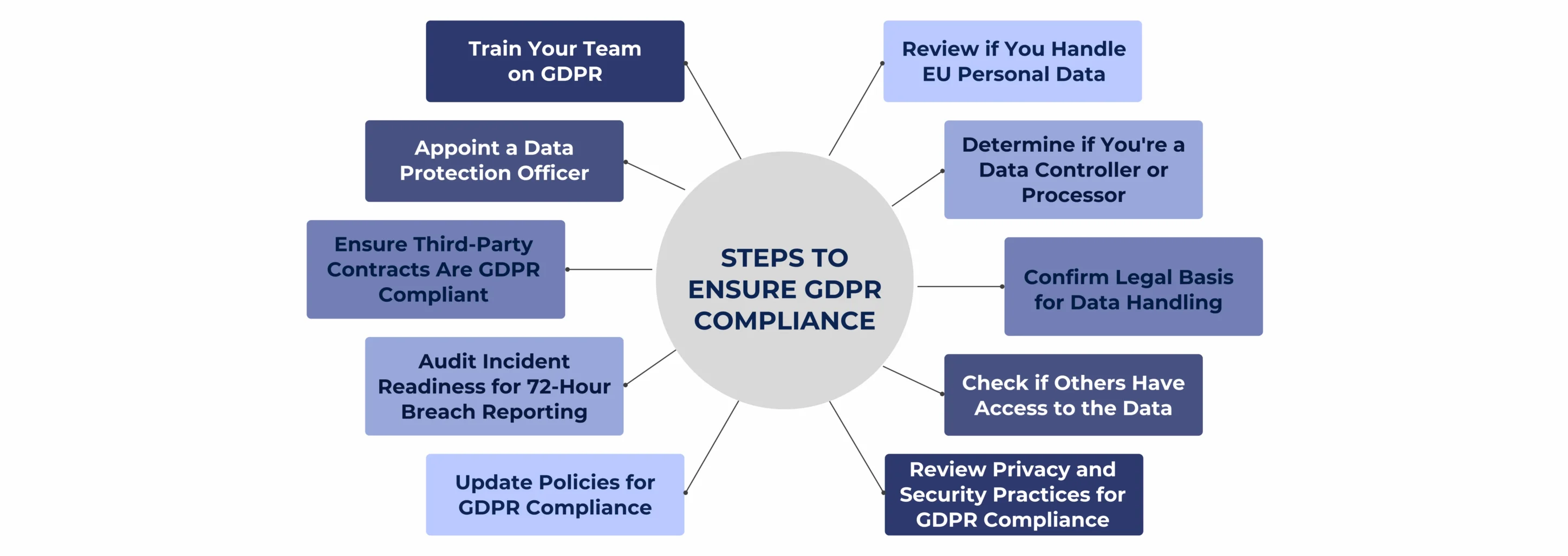
As you can see, GDPR compliance in Australia could have a prominent effect on Australian businesses. What does this mean for your company? To stay aligned with GDPR compliance in Australia, you must ensure that your business follows several essential rules. These rules cover everything from how you handle personal data to when you have to report data breaches. We have made a list of businesses in Australia to ensure they follow GDPR:
- Check to review if you handle the personal data of people from the EU.
- Discover whether you handle data as a data controller or a data processor.
- Ensure you have a legal reason to handle this personal information.
- Find out if anyone else has access to this information.
- Check your privacy and security practices for data to ensure they follow GDPR rules.
- Change your policies and processes to confirm they are GDPR compliant.
- Audit how ready you are to handle an incident (including your ability to meet the 72-hour breach reporting window).
- Ensure that the wording in your contracts with third parties is GDPR compliant.
- Choose and register a Data Protection Officer who can manage the whole process.
- Give your team training on GDPR rules.
WHAT ARE THE PENALTIES FOR GDPR NON-COMPLIANCE IN AUSTRALIA?
GDPR does apply outside of Europe, and companies that do not follow the rules. Penalties for serious violations of the rule can be up to 4% of your company’s global annual sales from the previous year or €20 million, whichever is higher. In addition, the EU requires all organizations not based in the EU to name a representative to handle all data security issues. If your business does not follow the rules, it can increase the risk of GDPR penalties.
GDPR Vs. Australia’s Privacy Act
The Privacy Act of 1988 is Australia’s own set of rules about how to handle personal information. The Privacy Regulation 2013 and the Privacy Amendment (Notifiable Data Breaches) Act 2017 added new parts. The Australian Privacy Principles (APPs) are a set of rules from the Privacy Act. They cover things like data security, privacy, and direct marketing. There are some key differences between GDPR and Australia’s Privacy Act, even though both data security rules cover many of the same grounds. The GDPR has stricter rules about privacy than the Privacy Act. For example, apps only need “implied” or “express” permission to store, share, or use your personal information, but the GDPR requires “express” permission.
With GDPR compliance in Australia, you have more rights over your personal information. For example, you have the right to be forgotten. It is also essential to know that GDPR has stricter rules for companies to follow when protecting their customers’ personal information. Simply put, it is unacceptable to think you are safe because your business follows the Privacy Act.
FINAL THOUGHTS
GDPR compliance in Australia is a touchy subject, and many businesses are still getting used to what the law says they have to do. Firms need to step up now and do something. Therefore, take help from an expert like CertPro for GDPR certification. If you do not follow the rules, you could face significant problems. You can protect yourself and your customers by ensuring you know where all your data is stored, that you are working it in a way that follows GDPR rules, that you control who can see the data, and that it is safe from possible threats.
FAQ
What impact has the GDPR had on EU consumers?
The GDPR has given EU consumers more control over their personal data. It ensures transparency, strengthens privacy rights, and allows individuals to access, correct, or delete their data held by organizations.
Does Australia have GDPR adequacy?
No, Australia does not currently have GDPR adequacy. This means the European Union has not recognized Australia’s data protection laws as equivalent to GDPR standards.
What are the GDPR rules in Australia?
Australia follows the Privacy Act 1988, which aligns with some GDPR principles. These include ensuring fair data collection, transparency, and allowing consumers to access their data. However, it is not fully GDPR-compliant.
How does GDPR affect international businesses?
GDPR requires international businesses to follow strict data protection rules when processing EU residents’ data. Compliance includes transparency, proper data handling, and implementing safeguards to avoid fines for breaches.
Does the GDPR apply to Australian government agencies?
The GDPR applies to Australian government agencies only if they process the personal data of EU residents. If targeting or monitoring EU individuals, they must comply with GDPR requirements.

About the Author
SUBBAIAH KU
Subbaiah Ku is the Regional Director for CertPro in Oman, bringing a wealth of expertise in process and system auditing. As a seasoned lead assessor, Subbaiah is dedicated to ensuring the highest standards in compliance and security. His unique blend of technical acumen, rooted in Mechanical Engineering, is complemented by a diverse range of certifications and extensive training.

GDPR BASICS FOR SAAS: REQUIREMENTS, PRINCIPLES & COMPLIANCE GUIDE

DATA MAPPING FOR GDPR: BUILDING A COMPLIANCE-READY INVENTORY
Have you ever tried to answer a simple question like “Where’s our customer data stored?” Most probably, you would have found yourself hopping across five different tools and six spreadsheets. Despite all the research work, you might still get a negative signal from...

10-STEP GDPR CHECKLIST: A COMPLETE GUIDE
In the current global economy, businesses are heavily dependent on customer data. This helps them in enhancing business operations and providing customized services. However, this dependency also comes with the responsibility of protecting the data. One of the most...