
ISO 42001 Certification in USA
ISO 42001 Certification in USA is issued by accredited, independent third-party certification bodies — including Licensed CPA Firms — that evaluate an organization’s Artificial Intelligence Management System (AIMS) against the requirements of ISO/IEC 42001:2023. Certification confirms that documented AI governance controls, risk management processes, and accountability structures meet internationally recognized standards for responsible AI development and deployment. ISO 42001 Certification applies across U.S. public and private sector organizations of all sizes and industries.
OUR CLIENTS


What Is ISO 42001 Certification?
ISO 42001 is the international standard published by the International Organization for Standardization (ISO) and the International Electrotechnical Commission (IEC) in 2023. Its full designation is ISO/IEC 42001:2023, and it establishes requirements for implementing, maintaining, and continually improving an Artificial Intelligence Management System. ISO 42001 Certification is the formal process through which an accredited third-party body independently evaluates and attests that an organization’s AIMS conforms to these requirements. It is the first global benchmark specifically designed for managing AI systems throughout their full lifecycle — from initial design and data acquisition through deployment, monitoring, and decommissioning.
ISO 42001 Certification in USA applies to any organization that develops, provides, or uses AI-based products and services, regardless of size or sector. This includes technology companies, financial institutions, healthcare providers, defense contractors, government agencies, and enterprise software vendors. The standard is structured around a Plan-Do-Check-Act (PDCA) management system framework, consistent with other widely adopted ISO standards such as ISO 27001 for information security and ISO 9001 for quality management. This structural alignment allows organizations already holding other ISO certifications to integrate AIMS controls into their existing management system infrastructure efficiently.
Core Scope of ISO/IEC 42001:2023
The scope of ISO 42001 compliance encompasses the governance, risk management, and operational controls applied across an organization’s AI systems. The standard addresses AI-specific risks including bias, lack of transparency, insufficient human oversight, safety failures, and privacy violations. Organizations must define the scope of their AIMS, identify AI-related objectives aligned with organizational strategy, document AI system inventories, and establish processes for AI risk assessment and treatment. ISO AIMS certification under this standard confirms that these requirements have been independently verified through a structured audit program.
ISO 42001 is structured across ten clauses. Clauses 4 through 10 contain the normative requirements organizations must satisfy for certification. Clause 4 covers organizational context and stakeholder needs. Clause 5 addresses leadership and AI governance commitment. Clause 6 specifies planning requirements including AI risk and impact assessments. Clause 7 covers support structures including competence, awareness, and documentation. Clause 8 addresses operational controls for AI lifecycle management. Clause 9 requires performance evaluation through internal audits and management reviews. Clause 10 mandates continual improvement processes. ISO AIMS certification confirms conformance with all applicable clauses through documented evidence reviewed during the ISO 42001 audit.
Relationship to Other ISO Standards and AI Governance Frameworks
ISO 42001 shares its high-level structure (Annex SL) with ISO 27001, ISO 9001, ISO 14001, and ISO 31000. This means organizations with existing management systems can integrate AIMS requirements without constructing entirely new frameworks. Risk management processes from ISO 31000, security controls from ISO 27001, and quality management approaches from ISO 9001 can be mapped and extended to satisfy ISO 42001 compliance requirements. This integration reduces duplication of effort, streamlines documentation, and supports unified management reviews across multiple standards. For U.S. organizations subject to multiple compliance obligations, this harmonization delivers measurable efficiency in audit preparation and ongoing governance activities.
ISO 42001 also aligns with the NIST AI Risk Management Framework (AI RMF), the OECD AI Principles, and the EU AI Act’s requirements for high-risk AI systems. In the U.S. context, organizations that have implemented the NIST AI RMF — which maps across four functions: Govern, Map, Measure, and Manage — will find substantial overlap with ISO 42001’s risk assessment and control requirements. ISO 42001 Certification in USA therefore functions as third-party evidence that an organization’s AI governance posture meets globally recognized standards. This relevance is growing as federal procurement bodies, financial regulators, and healthcare oversight agencies develop AI-specific expectations for vendors and service providers.
Who Requires ISO 42001 Certification in the USA?
ISO 42001 Certification for USA companies is relevant to any organization whose operations involve the design, deployment, procurement, or governance of AI technologies. This includes AI software developers building machine learning models or large language model (LLM)-based products, cloud platform providers offering AI services, financial institutions using algorithmic decision-making for credit scoring or fraud detection, and healthcare organizations deploying AI-assisted diagnostics. Defense contractors integrating AI into operational systems also benefit significantly. ISO 42001 Certification is equally applicable to enterprises that procure AI solutions from third-party vendors, as it supports third-party risk management obligations under frameworks such as the OCC’s model risk guidance and HIPAA‘s security requirements.
- ✓AI software developers and machine learning platform providers
- ✓Cloud computing and SaaS companies deploying AI-enabled services
- ✓Financial institutions using AI for credit scoring, fraud detection, or trading
- ✓Healthcare technology companies deploying AI-assisted diagnostics or clinical decision support
- ✓Defense contractors and government technology vendors integrating AI into operational systems
- ✓Enterprises managing third-party AI vendor risk in regulated sectors
- ✓Academic and research institutions conducting AI system deployment
- ✓Legal technology and automated document processing providers
- ✓Retail and supply chain organizations using AI-driven demand forecasting or pricing
- ✓Human resources technology providers using AI for recruitment or performance evaluation

ISO 42001 Certification Requirements
ISO 42001 compliance requires organizations to satisfy a defined set of management system requirements across leadership, planning, operational controls, and evaluation activities. These requirements are not prescriptive about which AI technologies must be used or which specific controls must be implemented. Instead, the standard defines outcomes the AIMS must achieve, allowing organizations to design controls appropriate to their specific AI context, scale, and risk profile. ISO 42001 assessment activities conducted during certification evaluate the adequacy and effectiveness of these controls against the standard’s requirements.
Clause 5 of ISO 42001 requires top management to demonstrate active commitment to the AIMS. This includes establishing an AI policy that articulates the organization’s AI governance principles, assigning clear roles and responsibilities for AIMS oversight, and integrating AI governance objectives into organizational strategy. The AI policy must define commitments to responsible AI use, transparency, human oversight, and continual improvement. Top management must also ensure that AIMS objectives are established, necessary resources are allocated, and the importance of effective AI governance is communicated throughout the organization.
During an ISO 42001 audit, auditors evaluate evidence of leadership commitment by reviewing the documented AI policy, organizational charts showing AIMS roles, meeting minutes from management reviews, and records of resource allocation decisions. Top management may be interviewed directly to assess their understanding of AIMS scope, AI risk posture, and governance objectives. In U.S. organizations, this leadership requirement aligns with board-level AI governance expectations emerging from SEC disclosure frameworks, OCC model risk guidance, and federal contractor AI accountability requirements.
Clause 6 of ISO 42001 requires organizations to establish and maintain documented AI risk assessment processes. These processes must identify AI-specific risks including bias, unfair outcomes, privacy violations, safety failures, security vulnerabilities, and transparency deficits. The risk assessment must evaluate both the likelihood and potential impact of identified risks across the AI system lifecycle. Risk treatment plans must document selected controls, responsible parties, and timelines for implementation. Organizations must also conduct AI impact assessments where AI systems may produce significant effects on individuals or communities.
ISO 42001 assessment activities related to Clause 6 examine the completeness of the organization’s AI risk register, the methodology used for risk evaluation, and the traceability between identified risks and implemented controls. Auditors verify that risk assessments are conducted at defined intervals and that significant changes to AI systems trigger reassessment activities. For U.S. organizations in regulated sectors, documented AI risk assessments also help satisfy related requirements under the FTC’s algorithmic accountability expectations, the FDA’s AI/ML software as a medical device framework, and FINRA’s model risk management obligations.
Clause 7 requires organizations to maintain documented information sufficient to demonstrate AIMS conformance. This includes the AI policy, the AIMS scope, risk assessment records, treatment plans, competence and training records, and records of communication activities. Clause 8 addresses operational controls, requiring organizations to implement and control processes across the AI system lifecycle. These controls cover AI system design and development, data acquisition and management, testing and validation, deployment and monitoring, and decommissioning. Each process must have documented criteria, assigned responsibilities, and records demonstrating execution.
Annex A of ISO 42001 provides a reference set of controls organized into four categories: AI policies, AI resources, AI lifecycle processes, and AI-specific impact assessment. Organizations are not required to implement every Annex A control. Instead, they must document their control selection rationale in a Statement of Applicability (SoA), which identifies applicable controls, justifications for inclusion or exclusion, and implementation status. The SoA is a primary document reviewed during ISO 42001 audit activities and is central to the overall ISO 42001 assessment process.
Clause 9 requires organizations to monitor, measure, analyze, and evaluate AIMS performance. Internal audit programs must be established to evaluate conformance with ISO 42001 requirements at planned intervals. Management review meetings must evaluate AIMS performance, consider audit findings, assess achievement of AI objectives, and identify opportunities for improvement. Clause 10 requires organizations to address nonconformities identified during audits or operational activities, implement corrective actions, and evaluate their effectiveness. Certification bodies evaluate evidence of these activities during both the initial certification audit and subsequent surveillance audits.
| ISO 42001 Clause | Requirement Area | Key Evidence Evaluated During Audit |
|---|---|---|
| Clause 4 | Organizational Context | AIMS scope document, stakeholder analysis, AI system inventory |
| Clause 5 | Leadership & AI Policy | Signed AI policy, role assignments, management review records |
| Clause 6 | AI Risk Planning | Risk register, impact assessments, treatment plans, SoA |
| Clause 8 | Operational Controls | AI lifecycle process records, testing and validation documentation |
| Clause 9 | Performance Evaluation | Internal audit reports, management review minutes, KPI records |
- ✓Leadership and Governance Requirements
- ✓AI Risk Assessment and Treatment Requirements
- ✓Documentation and Operational Control Requirements
- ✓Performance Evaluation and Continual Improvement Requirements
ISO 42001 Certification Audit Process in USA
The ISO 42001 audit process in USA follows a structured sequence of evaluation stages conducted by an accredited certification body. The process is designed to provide independent assurance that an organization’s AIMS satisfies the normative requirements of ISO/IEC 42001:2023. Each stage generates documented findings that inform the certification decision. The following sections describe the full audit sequence — from initial scope determination through certification issuance and ongoing surveillance.
The ISO 42001 audit process begins with a formal scope definition activity in which the certification body and the organization establish the boundaries of the AIMS to be certified. The scope identifies which AI systems, business units, geographic locations, and operational processes are included within the AIMS. A clearly defined scope is essential because ISO 42001 Certification applies only to the AI systems and organizational functions explicitly included. The audit program — covering the schedule, audit team composition, and resource requirements — is determined based on scope, the number and complexity of AI systems, and the organization’s risk profile.
During this phase, auditors review available AIMS documentation to assess organizational readiness for a full certification audit. This preliminary documentation review identifies major gaps — such as an absent AI policy, an incomplete scope statement, or a missing Statement of Applicability — that would prevent progression to Stage 2 evaluation. Findings from Stage 1 are communicated to the organization formally. The audit program is then confirmed or adjusted accordingly before Stage 2 activities commence.
Stage 2 of the ISO 42001 audit constitutes the primary conformance assessment. Auditors conduct on-site or remote evaluation activities to verify that the AIMS is implemented as documented and that controls are operating effectively. Control testing activities include interviews with personnel responsible for AI governance, risk assessment, and AI system operations; review of AI system records, testing logs, and incident reports; observation of operational processes; and examination of documented evidence supporting the Statement of Applicability. The ISO 42001 assessment at Stage 2 evaluates all applicable clauses and determines whether the AIMS meets certification requirements.
Auditors categorize findings as major nonconformities, minor nonconformities, or observations. A major nonconformity indicates a failure to implement a required AIMS element or a significant breakdown in control effectiveness that precludes certification until resolved. A minor nonconformity identifies a specific control gap or documentation deficiency that does not prevent certification but must be addressed within a defined timeframe. Observations are advisory notes that do not affect the certification decision but highlight areas for improvement. The ISO 42001 audit USA process requires that all major nonconformities be resolved before the certification decision is issued.
Following Stage 2 field activities, the audit team prepares a formal audit report documenting all findings, evidence reviewed, and the basis for each finding. Where major nonconformities are identified, the organization must submit a corrective action plan addressing root causes and remediation activities. The certification body reviews corrective action evidence before issuing the certification decision. The certification decision is made by a qualified reviewer independent of the audit team, ensuring objectivity in the determination of conformance. This separation between auditing and certification decision-making is a fundamental requirement of ISO/IEC 17021-1, the standard governing management system certification bodies.
Upon a positive certification decision, the certification body issues an ISO 42001 certificate valid for a three-year certification cycle. The certificate specifies the organization’s name, the scope of the certified AIMS, the standard version, and the certificate validity period. Surveillance audits are conducted at least annually during the three-year cycle to verify that the AIMS continues to operate effectively. Any changes to AI systems, organizational structure, or risk profile must be reflected in updated AIMS documentation and controls. Surveillance audits are narrower in scope than initial certification audits but must cover internal audit results, management reviews, and any significant changes to the AIMS.
Recertification audits are conducted at the end of the three-year cycle and constitute a full reassessment of the AIMS against ISO 42001 requirements. Recertification confirms that the AIMS has been maintained and improved over the certification period. Organizations that experience significant AI system expansions, major incidents, or structural changes during the certification period may be subject to unscheduled special audits. ISO AIMS certification USA is maintained only as long as surveillance requirements are satisfied and continued conformance is confirmed through the certification body’s ongoing monitoring program.
- Scope Definition: Establish AIMS boundaries, identify AI systems, and determine audit program parameters
- Stage 1 Audit: Documentation review to assess AIMS readiness and identify major gaps before field assessment
- Stage 2 Assessment: On-site or remote control testing, personnel interviews, and evidence evaluation across all applicable ISO 42001 clauses
- Nonconformity Classification: Categorize findings as major nonconformities, minor nonconformities, or observations
- Corrective Action Review: Evaluate submitted corrective action evidence for major nonconformities before certification decision
- Certification Decision: Independent review and determination of conformance by qualified reviewer separate from audit team
- Certificate Issuance: Issue ISO 42001 certificate specifying scope, standard version, and three-year validity period
- Annual Surveillance Audits: Conduct at least two surveillance audits during the three-year certification cycle
- Recertification Audit: Full AIMS reassessment at the end of the three-year cycle to renew certification
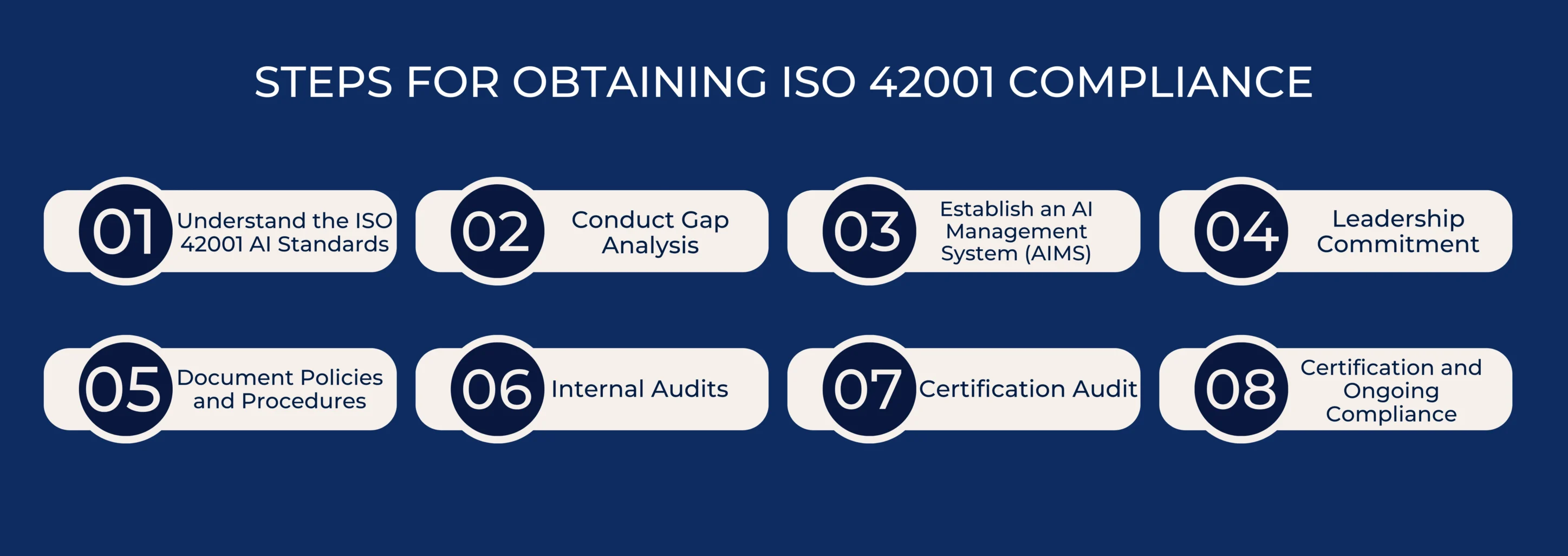
- ✓Stage 1: Scope Definition and Audit Program Determination
- ✓Stage 2: AIMS Assessment and Control Testing
- ✓Nonconformity Review and Certification Decision
- ✓Certification Issuance, Surveillance, and Recertification
Benefits of ISO 42001 Certification for USA-Based Organizations
ISO 42001 Certification in USA delivers measurable organizational benefits across governance, market positioning, regulatory alignment, and risk management. For U.S. organizations operating in competitive, regulated, or government-facing markets, third-party certification provides independently verified evidence of responsible AI governance that cannot be achieved through self-declaration alone. The following sections describe the primary categories of benefit associated with ISO AIMS certification for organizations across the U.S. technology, financial services, healthcare, and defense sectors.
ISO 42001 Certification provides customers, investors, regulators, and business partners with independent, third-party verification that an organization’s AI systems are governed through documented, auditable controls. This assurance is particularly significant in the U.S. market, where AI-related trust deficits are a documented barrier to enterprise AI adoption. Research cited in Stanford University’s AI Index indicates that enterprise decision-makers frequently identify lack of transparency and accountability in AI systems as primary concerns when evaluating AI vendors and partners. ISO 42001 Certification directly addresses these concerns by providing independently verified evidence of governance maturity.
For publicly traded U.S. companies, ISO AIMS certification USA supports SEC disclosure obligations related to material risk factors. Organizations with certified AI governance frameworks are better positioned to satisfy investor and analyst expectations for responsible AI stewardship. For private companies and startups, ISO 42001 Certification supports venture capital due diligence processes and customer procurement requirements that increasingly include AI governance assessment criteria. The certification provides a standardized, internationally recognized evidence base that stakeholders across geographic boundaries and industry sectors can evaluate consistently.
ISO 42001 compliance USA supports alignment with multiple U.S. regulatory frameworks simultaneously. The NIST AI Risk Management Framework’s Govern, Map, Measure, and Manage functions map substantially to ISO 42001’s risk assessment, control implementation, and monitoring requirements. For organizations subject to FDA oversight of AI/ML-based Software as a Medical Device (SaMD), the ISO 42001 framework provides documented evidence of AI lifecycle management controls that satisfy elements of the FDA’s predetermined change control plan requirements. For financial services organizations, ISO 42001’s documented risk assessments and model oversight controls align with OCC Model Risk Management guidance (SR 11-7) and CFPB expectations for algorithmic fairness in consumer lending.
Organizations operating in multiple jurisdictions benefit from ISO 42001’s alignment with the EU AI Act’s requirements for high-risk AI systems, including risk management documentation, data governance, transparency measures, human oversight mechanisms, and post-market monitoring. Because ISO 42001 is a globally recognized standard, a single certification assessment provides evidence relevant to compliance evaluations across multiple regulatory jurisdictions. This reduces the cost and administrative burden associated with fragmented, jurisdiction-specific compliance activities — a particularly valuable advantage for U.S. multinational technology companies, financial institutions, and SaaS providers operating in both the United States and European markets.
ISO 42001 Certification for USA companies provides a documented, audited basis for differentiation in procurement evaluations, partner selection processes, and market positioning. As AI governance requirements become embedded in enterprise procurement criteria — including those of federal agencies, Fortune 500 companies, and regulated industry buyers — ISO 42001 Certification functions as a qualification threshold rather than merely a differentiator. Organizations without certified AI governance frameworks face increasing risk of exclusion from procurement processes that require demonstrated AI risk management maturity.
U.S. AI companies competing for contracts with the Department of Defense, Department of Health and Human Services, or other federal agencies face AI governance requirements embedded in contract terms and solicitation criteria. ISO 42001 Certification in USA provides documented evidence that satisfies these requirements and reduces the administrative burden of demonstrating AI governance maturity through custom questionnaires and audit requests from multiple buyers simultaneously. In competitive enterprise sales cycles, ISO 42001 Certification reduces the time and cost associated with security and governance due diligence activities, accelerating procurement decisions.
- ✓Third-party verified evidence of responsible AI governance for customers, investors, and regulators
- ✓Alignment with NIST AI RMF, FDA AI/ML SaMD framework, and OCC model risk guidance
- ✓Cross-border compliance evidence for EU AI Act and global regulatory requirements
- ✓Competitive qualification in federal, enterprise, and regulated sector procurement processes
- ✓Structured AI risk management framework reducing liability exposure from AI failures
- ✓Enhanced brand credibility and market positioning in AI-driven industry segments
- ✓Reduced vendor due diligence burden for enterprise sales cycles
- ✓Board-level AI governance documentation supporting SEC disclosure obligations
- ✓Integration with existing ISO 27001 or ISO 9001 management systems for efficiency
- ✓Demonstrated continual improvement commitment through annual surveillance audit cycles
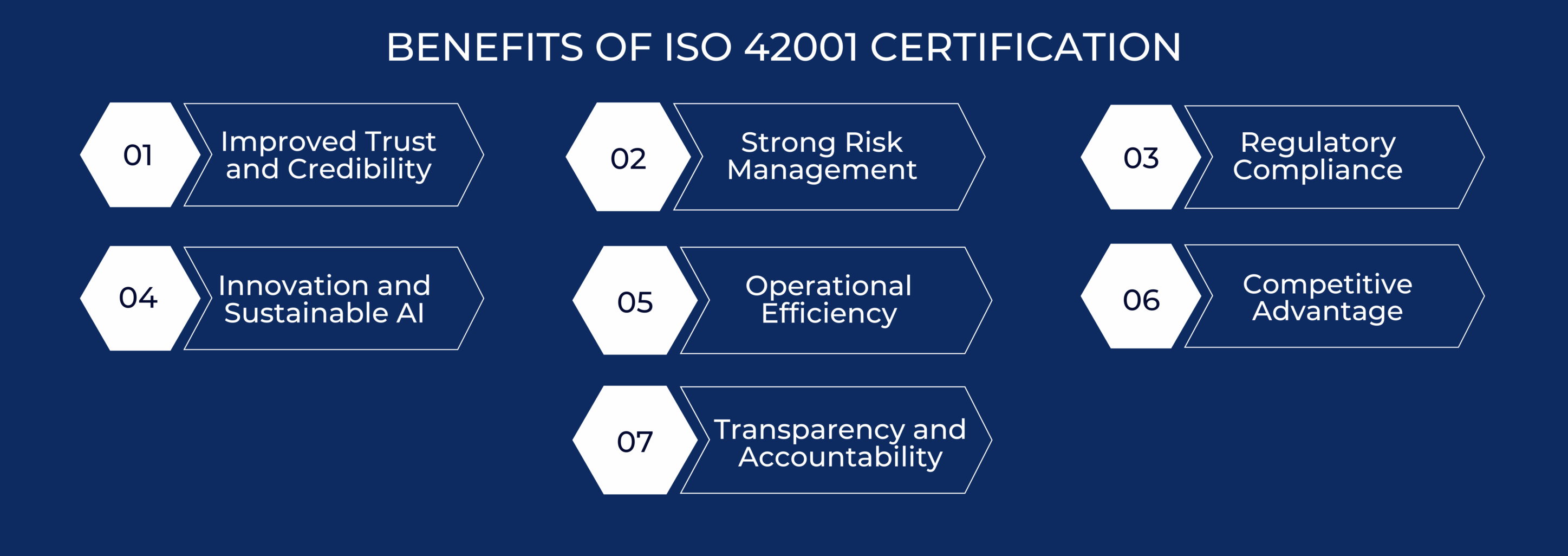
- ✓Independent Assurance and Stakeholder Trust
- ✓Regulatory Alignment and Compliance Efficiency
- ✓Competitive Differentiation in AI-Driven Markets
ISO 42001 and AI Governance Integration with US Compliance Frameworks
ISO 42001 Certification in USA does not operate in isolation from the broader U.S. regulatory and governance landscape. The standard’s requirements align with and complement multiple established U.S. compliance frameworks across cybersecurity, privacy, financial regulation, and government AI policy. Organizations that map ISO 42001 controls to their existing compliance obligations can achieve integrated governance outcomes that satisfy multiple regulatory expectations from a single documented AIMS framework.
Alignment with NIST AI Risk Management Framework
The NIST AI RMF, published in January 2023, provides a voluntary framework for managing AI risks across four core functions: Govern, Map, Measure, and Manage. ISO 42001 compliance requirements align substantially with these functions. The Govern function — addressing organizational practices, policies, and accountability structures — corresponds to ISO 42001’s Clause 4 (organizational context), Clause 5 (leadership), and Clause 6 (planning) requirements. The Map function, which covers AI context establishment and risk identification, aligns with ISO 42001’s AI risk assessment requirements. The Measure function corresponds to ISO 42001’s performance evaluation activities. The Manage function maps to ISO 42001’s treatment plan implementation and continual improvement requirements.
Organizations that have implemented the NIST AI RMF can use their existing documentation as evidence during ISO 42001 assessment activities, provided it satisfies ISO 42001’s specific requirements for documented information, defined processes, and management system structure. Conversely, ISO 42001 Certification provides formally audited assurance of NIST AI RMF implementation that self-assessed NIST conformance cannot deliver. For U.S. federal contractors and agencies where the NIST AI RMF is increasingly referenced in procurement and policy contexts, ISO 42001 Certification provides third-party corroboration of NIST-aligned AI governance practices.
Integration with ISO 27001 and Cybersecurity Frameworks
ISO 42001 shares its high-level structure with ISO 27001:2022, which governs Information Security Management Systems (ISMS). Organizations holding ISO 27001 certification can extend their existing management system infrastructure to incorporate AIMS requirements, reusing policies, roles, document control processes, internal audit procedures, and management review structures. AI-specific risks — including adversarial attacks on AI models, data poisoning, model theft, and inference attacks — are addressed within ISO 42001’s Annex A controls. These can be integrated with ISO 27001’s information security control set to produce a unified security and AI governance framework that reduces overhead for both certifications.
For U.S. organizations subject to the NIST Cybersecurity Framework (CSF), SOC 2, FedRAMP, or CMMC requirements, ISO 42001 adds an AI-specific governance layer that these frameworks do not fully address. AI system security controls — such as model integrity verification, training data provenance documentation, and AI system access controls — can be incorporated into existing FedRAMP security assessment packages or SOC 2 Type II audit programs. ISO 42001 Certification provides complementary, AI-specific assurance. This layered approach enables organizations to present a comprehensive, multi-standard evidence base to government customers and enterprise buyers with complex compliance requirements.
Alignment with U.S. Executive Orders and Federal AI Policy
Executive Order 14110 on Safe, Secure, and Trustworthy Artificial Intelligence, issued in October 2023, established U.S. federal policy expectations for AI safety, security, privacy, equity, and civil rights. The order directed federal agencies to develop AI governance standards, established reporting requirements for frontier AI model developers, and set expectations for AI risk assessment across government procurement. ISO 42001 compliance directly addresses the governance, risk management, and transparency requirements embedded in this executive order and subsequent agency guidance. This makes ISO AIMS certification relevant to federal contractors, AI system vendors, and government technology partners seeking to demonstrate alignment with federal AI policy.
| U.S. Framework / Regulation | ISO 42001 Alignment Area | Certification Benefit |
|---|---|---|
| NIST AI RMF (2023) | Govern, Map, Measure, Manage functions | Third-party assurance of NIST-aligned AI risk governance |
| FDA AI/ML SaMD Framework | AI lifecycle management, change control | Documented evidence for predetermined change control plans |
| OCC Model Risk Guidance (SR 11-7) | AI model risk assessment and oversight | Audited model governance framework for financial institutions |
| Executive Order 14110 | AI safety, transparency, accountability | Certified governance posture aligned with federal AI policy |
| EU AI Act (cross-border) | High-risk AI requirements, risk management | Single certification supporting multi-jurisdictional compliance |
ISO 42001 for Fintech and Financial Services in the USA
The U.S. financial services sector represents one of the highest-density deployment environments for AI technologies globally. From algorithmic trading and credit scoring to fraud detection, anti-money laundering, and customer service automation, AI systems are deeply integrated into financial operations across banks, credit unions, insurance companies, investment managers, payment processors, and fintech startups. ISO 42001 Certification in USA financial services organizations provides audited assurance of AI governance controls that regulators, institutional partners, and consumers increasingly expect as AI deployment scales.
AI Risk Management in Financial AI Systems
Financial AI systems introduce specific risk categories that ISO 42001’s risk assessment requirements are designed to address. Algorithmic bias in credit scoring models can produce discriminatory lending outcomes subject to Fair Housing Act and Equal Credit Opportunity Act enforcement. Model drift in fraud detection systems can increase both false positive rates — imposing friction on legitimate customers — and false negative rates — enabling fraudulent transactions to proceed undetected. Opacity in AI-driven underwriting decisions creates challenges for regulatory examination and consumer dispute resolution. ISO 42001 assessment activities evaluate whether financial organizations have implemented controls addressing these specific AI risk categories.
ISO 42001 compliance requirements for AI risk treatment in financial services include documented model validation processes, bias testing and monitoring procedures, explainability requirements for high-stakes AI decisions, data quality and provenance controls, and defined thresholds for model performance deterioration that trigger reassessment or remediation. These controls align with OCC Model Risk Management guidance expectations for model inventory, validation independence, and ongoing monitoring. ISO 42001 Certification provides financial regulators with independently verified evidence of model governance maturity that supports examination efficiency and reduces regulatory inquiry burden.
Fintech and AI Governance Certification Requirements
U.S. fintech companies seeking bank partnerships, payment network participation, or institutional investment increasingly encounter AI governance due diligence requirements from counterparties. Established financial institutions conducting vendor risk assessments for fintech partners routinely request evidence of AI governance frameworks, model risk management procedures, and data handling controls. ISO 42001 Certification for USA fintech companies provides a standardized, independently audited evidence package that satisfies these due diligence requirements across multiple institutional relationships simultaneously. This reduces the administrative overhead of responding to custom questionnaires from individual bank partners or investors.
Additionally, fintech companies operating under Bureau of Consumer Financial Protection (CFPB) oversight face expectations for explainability in adverse action notices related to AI-assisted credit decisions. ISO 42001’s transparency and explainability controls support the implementation of documented processes for generating and communicating adverse action reasons derived from AI models. For buy-now-pay-later providers, digital lending platforms, and robo-advisory services, ISO AIMS certification demonstrates governance maturity to both regulators and institutional funding sources at a critical stage of business development and regulatory scrutiny.
ISO 42001 Certification for Healthcare Technology and Life Sciences
Healthcare technology is among the most consequential deployment environments for AI in the United States, with applications spanning radiology AI, clinical decision support, diagnostic algorithms, drug discovery, genomics, hospital operations, and patient engagement systems. According to Stanford’s AI Index, U.S. private investment in healthcare AI reached record levels in 2023, reflecting accelerating adoption of AI-driven clinical and operational tools. ISO 42001 Certification in USA healthcare technology organizations provides audited evidence of AI lifecycle governance controls aligned with the FDA’s oversight framework for AI/ML-based software as a medical device.
FDA AI/ML SaMD Framework Alignment
The FDA’s regulatory framework for AI/ML-based Software as a Medical Device requires manufacturers to demonstrate controls over AI model design, training data management, performance monitoring, and change management. The FDA’s proposed requirements for predetermined change control plans (PCCPs) specify that AI/ML SaMD developers must document anticipated AI modifications, performance boundaries within which modifications may occur without new regulatory submission, and the monitoring and risk assessment processes governing change decisions. ISO 42001’s Clause 8 operational controls and Annex A lifecycle controls directly address these PCCP requirements.
ISO 42001 Certification for medical AI developers demonstrates to FDA reviewers that AI governance controls are not merely documented but have been independently verified by an accredited third party. This independent assurance is consistent with the FDA’s quality system regulation (QSR) approach and supports pre-submission discussions regarding AI governance maturity. Healthcare organizations procuring AI-assisted diagnostic tools also benefit from ISO 42001 Certification held by vendors, as it supports due diligence required under HIPAA’s business associate agreement framework and hospital credentialing processes for clinical AI tools.
Patient Safety and AI Accountability in Clinical Settings
In clinical settings, AI governance failures can directly affect patient safety. Algorithmic bias in AI-assisted diagnostic tools can produce disparate diagnostic accuracy across demographic groups, leading to missed diagnoses or inappropriate treatment recommendations for underrepresented patient populations. Model drift in clinical AI systems can degrade performance over time as patient population characteristics, clinical practices, or data collection methods diverge from original training conditions. ISO 42001’s requirements for ongoing monitoring, bias assessment, and human oversight controls provide the governance infrastructure needed to detect and address these clinical AI risks before they result in patient harm.
ISO 42001 assessment activities in healthcare settings evaluate whether clinical AI systems have defined human oversight requirements, including protocols for clinician review of AI-generated recommendations, escalation procedures when AI confidence thresholds are not met, and training programs ensuring clinical users understand AI system limitations. These oversight requirements align with FDA guidance on human factors engineering for AI/ML SaMD and with The Joint Commission’s emerging standards for AI in accredited healthcare organizations. ISO AIMS certification provides healthcare systems and digital health companies with documented, audited evidence of these clinical AI governance controls.
ISO 42001 Certification Requirements for Defense and Government Technology
The U.S. defense and government technology sector represents a high-stakes environment for AI governance, where AI system failures can affect national security, military operations, and public safety at scale. The Department of Defense AI Strategy and the DoD’s Responsible AI guidelines establish expectations for AI system safety, security, reliability, and governability that align substantially with ISO 42001 compliance requirements. ISO 42001 Certification in USA defense and government technology organizations provides audited assurance of AI governance controls relevant to DoD procurement, government contract compliance, and responsible AI deployment in sensitive operational contexts.
The DoD’s Responsible AI framework articulates five principles: responsible, equitable, traceable, reliable, and governable. These principles map directly to ISO 42001 control requirements. Responsibility aligns with ISO 42001’s accountability and role assignment requirements. Equitability aligns with bias assessment and fairness controls. Traceability corresponds to documentation and audit trail requirements across the AI lifecycle. Reliability maps to testing, validation, and performance monitoring controls. Governability aligns with human oversight mechanisms and AI system decommissioning controls. Defense contractors and government technology vendors pursuing ISO 42001 Certification can demonstrate DoD Responsible AI principle conformance through their AIMS documentation and audit evidence.
CMMC (Cybersecurity Maturity Model Certification) requirements for defense industrial base contractors establish cybersecurity controls that can be integrated with ISO 42001 AIMS controls in a unified management system. Organizations pursuing both CMMC certification and ISO 42001 Certification can leverage shared documentation infrastructure, integrated internal audit programs, and unified management review processes to reduce certification overhead. ISO 42001 assessment activities evaluate the AI-specific governance controls that CMMC does not address, making the two certifications complementary rather than duplicative for defense technology contractors.
Federal acquisition regulations are increasingly incorporating AI governance requirements into solicitation criteria and contract terms. The Office of Management and Budget’s AI policy framework for federal agency AI use establishes expectations for AI risk management, transparency, and accountability that government technology vendors must satisfy. ISO 42001 certification body USA assessments provide an independently verified evidence base that satisfies these procurement requirements more efficiently than custom self-assessment questionnaires. For AI vendors competing for General Services Administration schedule contracts, Defense Information Systems Agency authorizations, or agency-specific procurement programs, ISO AIMS certification provides documented governance maturity evidence that procurement officers can evaluate against established standards.
State and local government technology procurement is also increasingly incorporating AI governance requirements as state legislatures enact AI-specific regulations. States including California, Colorado, Illinois, and New York have enacted or proposed AI governance requirements applicable to government AI system procurement and use. ISO 42001 Certification in USA provides a nationally consistent, internationally recognized evidence base for demonstrating AI governance maturity across multiple state procurement requirements simultaneously. This significantly reduces the compliance burden associated with responding to fragmented, state-specific AI governance criteria.
- ✓DoD Responsible AI and ISO 42001 Alignment
- ✓Government Procurement and ISO 42001 Certification
ISO 42001 Certification Cost and Timeline in the USA
The timeline and resource requirements for achieving ISO 42001 Certification in USA depend on the organization’s existing AI governance maturity, the scope and complexity of the AIMS, the number and types of AI systems included in scope, and the organization’s prior experience with ISO management system certifications. Organizations with established ISO 27001 or ISO 9001 management systems can typically leverage existing infrastructure to accelerate ISO 42001 implementation. Organizations implementing a formal management system for the first time require more extensive preparation before the certification audit.
Typical Certification Timeline
For organizations with limited prior management system experience, achieving ISO 42001 Certification typically requires six to twelve months of preparation, implementation, and internal audit activities before the external certification audit. This timeline includes establishing AIMS documentation, conducting AI risk assessments, developing the Statement of Applicability, implementing controls, executing at least one complete internal audit cycle, and conducting an initial management review. Organizations with existing ISO 27001 ISMS infrastructure can typically reduce this timeline to three to six months, as core management system components can be extended rather than built from scratch.
The Stage 1 audit typically takes one to three days depending on AIMS scope and organization size. The Stage 2 certification audit may range from two to five days for organizations with moderate AI system portfolios, and longer for large enterprises with multiple AI systems, complex data environments, or multi-site operations. Following Stage 2 audit completion, nonconformity resolution and certification decision activities typically require two to eight additional weeks, depending on the number and nature of findings identified. ISO 42001 assessment USA timelines should be planned to accommodate this post-audit resolution period before the target certification date.
Factors Affecting Certification Scope and Audit Duration
Factors that increase the scope and duration of the ISO 42001 audit include the number of distinct AI systems within the AIMS scope, the complexity and risk classification of those AI systems, the number of organizational sites and business units covered, the maturity of existing documentation and process controls, and the organization’s prior experience with third-party management system audits. Organizations with large AI system portfolios — common in U.S. cloud platform providers, financial institutions, and healthcare systems — may require multi-day, multi-site audit programs to provide sufficient coverage for certification assurance.
| Organization Profile | Estimated Preparation Timeline | Typical Audit Duration |
|---|---|---|
| Small AI startup, single product, no prior ISO certification | 9–12 months | 2–3 days (Stage 1 + Stage 2) |
| Mid-size technology company, existing ISO 27001 certification | 3–6 months | 3–5 days (Stage 1 + Stage 2) |
| Large enterprise, multiple AI systems, multi-site | 6–12 months | 5–10 days (Stage 1 + Stage 2) |
| Healthcare or defense contractor, regulated AI systems | 6–18 months | 5–12 days (Stage 1 + Stage 2) |
Why ISO 42001 Certification Matters for US Enterprises
The United States is the world’s largest AI market by investment, deployment scale, and commercial application diversity. U.S. private AI investment exceeded $109 billion in the most recent measurement year, representing a concentration of AI development activity that places U.S. enterprises at the forefront of both AI opportunity and AI governance responsibility. As AI systems become embedded in consequential decisions across financial services, healthcare, employment, housing, education, and public safety, the demand for independently verified AI governance assurance is growing from regulators, enterprise customers, institutional investors, and civil society stakeholders simultaneously.
Board-Level AI Governance and Certification
AI governance has become a board-level responsibility in U.S. enterprises. Institutional investors including major asset managers have identified AI governance as a material ESG (Environmental, Social, and Governance) factor, incorporating AI risk management maturity into proxy voting guidelines and portfolio company engagement frameworks. SEC rules requiring cybersecurity governance disclosure have established precedents that AI governance disclosure may follow, increasing board accountability for AI risk oversight. ISO 42001 Certification provides boards with independently verified evidence of management-level AI governance controls that supports oversight responsibilities and documents the organizational commitment to responsible AI governance.
For organizations that have experienced AI-related incidents — including algorithmic bias investigations, AI-enabled fraud, or AI safety failures — ISO 42001 Certification provides structured remediation evidence. The ISO 42001 audit process evaluates whether corrective actions taken in response to prior incidents are embedded in the AIMS and whether monitoring controls are adequate to prevent recurrence. This structured remediation documentation is relevant to regulatory investigations, litigation defense, and reputational recovery efforts following AI-related incidents in U.S. organizations.
Generative AI and Large Language Model Governance
The rapid adoption of generative AI and large language model (LLM) technologies across U.S. enterprises introduces AI governance challenges that ISO 42001 is specifically designed to address. Generative AI systems — including LLM-based chatbots, content generation tools, code generation assistants, and multimodal AI systems — present governance challenges including hallucination risks, intellectual property concerns, privacy exposure from training data, and content safety requirements. ISO 42001’s AI lifecycle controls, impact assessment requirements, and human oversight mechanisms provide a governance framework applicable to generative AI deployment that is consistent with emerging U.S. AI policy expectations.
Organizations deploying generative AI in customer-facing applications, employee productivity tools, or high-stakes decision support contexts can use ISO 42001 Certification to document their AI governance framework. This demonstrates to customers, regulators, and partners that generative AI risks are managed through audited controls. This is particularly relevant for enterprises deploying AI in regulated contexts — such as legal document generation, medical information services, or financial advice provision — where AI output accuracy, accountability, and transparency are subject to professional liability and regulatory scrutiny.
CertPro: Licensed CPA Firm for ISO 42001 Certification in the USA
CertPro is a Licensed CPA Firm providing independent ISO 42001 Certification audit services across the United States. As an accredited certification body, CertPro conducts structured ISO 42001 audits evaluating organizational AIMS conformance with ISO/IEC 42001:2023 requirements. CertPro’s audit methodology follows ISO/IEC 17021-1 requirements for management system certification bodies, ensuring that certification activities maintain the independence, impartiality, and technical competence required for internationally recognized ISO 42001 Certification in USA.
CertPro’s ISO 42001 Audit Methodology
CertPro’s ISO 42001 audit methodology is structured around the standard’s normative requirements and the ISO 42001 assessment framework applicable to AI governance evaluation. The audit program is designed to evaluate leadership commitment, AI risk management processes, operational controls across the AI lifecycle, documentation completeness, internal audit effectiveness, and management review activities. CertPro’s audit teams include professionals with domain expertise in AI systems, information security, risk management, and sector-specific AI applications relevant to the U.S. technology, financial services, healthcare, and defense markets.
CertPro conducts ISO 42001 audit USA engagements using a risk-based sampling approach that prioritizes high-risk AI systems and critical AIMS processes within the defined certification scope. Audit activities include documentation reviews, personnel interviews, process observations, and control testing evidence evaluation. CertPro issues formal audit reports documenting findings, evidence reviewed, and the basis for nonconformity classifications. Certification decisions are made by qualified reviewers independent of the audit team, consistent with ISO/IEC 17021-1 impartiality requirements. CertPro issues ISO 42001 certificates valid for three-year certification cycles with annual surveillance audit requirements.
ISO 42001 Certification Services for U.S. Organizations
CertPro provides ISO 42001 Certification audit services to organizations across all U.S. sectors deploying or developing AI systems. This includes initial certification audits for organizations seeking ISO 42001 Certification for the first time, surveillance audits for organizations maintaining existing certifications, and recertification audits at the conclusion of three-year certification cycles. CertPro also conducts scope extension audits for organizations that have expanded their AI system portfolios or organizational boundaries beyond the scope of an existing ISO 42001 certificate. All CertPro ISO 42001 certification activities are conducted as independent evaluation services distinct from management system consulting or advisory services.
CertPro’s experience with ISO 42001 assessment USA engagements spans technology companies, financial institutions, healthcare organizations, government contractors, and enterprise software providers. CertPro’s sector-specific audit expertise enables audit teams to evaluate AI governance controls in the context of the regulatory and operational environment relevant to the organization’s industry. This produces audit findings that reflect both ISO 42001 requirements and sector-specific AI governance expectations. Organizations seeking ISO 42001 Certification in USA through CertPro receive independently verified certification that satisfies procurement requirements, regulatory inquiries, and stakeholder assurance needs.
Introduction to ISO 42001 Certification in the USA
ISO 42001 Certification in USA represents the formal recognition that an organization has established, implemented, and maintained an Artificial Intelligence Management System meeting the requirements of ISO/IEC 42001:2023. The United States — as the global leader in AI investment, research, and commercial deployment — faces a growing imperative for structured AI governance across public and private sector organizations. ISO 42001 Certification provides the independent, third-party assurance framework that satisfies this imperative by establishing auditable controls across the full AI system lifecycle.
The U.S. AI landscape encompasses a diverse spectrum of organizations, from early-stage AI startups developing novel machine learning applications to multinational technology corporations deploying AI at global scale. Across this spectrum, ISO 42001 Certification provides a consistent, internationally recognized basis for demonstrating AI governance maturity. For organizations navigating the intersection of rapid AI adoption and increasing regulatory scrutiny, ISO 42001 assessment by an accredited certification body delivers documented assurance that AI systems are governed through structured, auditable processes aligned with global expectations for responsible AI development and deployment.
CertPro, as a Licensed CPA Firm, conducts ISO 42001 Certification audits for U.S. organizations across industry sectors, applying structured audit methodology grounded in ISO/IEC 17021-1 requirements and sector-specific AI governance expertise. ISO 42001 Certification in USA through an accredited certification body such as CertPro provides organizations with internationally recognized attestation of AIMS conformance. This satisfies procurement requirements, regulatory inquiries, and stakeholder assurance expectations across the full range of U.S. commercial and government markets.
FAQ
▶
What is ISO 42001 certification?
▶
What is ISO 42001 certification and what does it certify?
▶
How long does the ISO 42001 audit process take in the USA?
▶
What is the difference between ISO 42001 and the NIST AI Risk Management Framework?
▶
Does ISO 42001 certification cover generative AI and large language models?
▶
Can an organization with ISO 27001 certification integrate ISO 42001 requirements into its existing management system?
▶
What is the Statement of Applicability in ISO 42001 certification?
▶
How often are surveillance audits required for ISO 42001 certification?
ISO 42001 CERTIFIED: WHY AI GOVERNANCE CERTIFICATION IS BECOMING A BOARD-LEVEL REQUIREMENT
ISO 42001 Certified: Board-Level AI Governance Guide | CertPro CPA LLC HERO ══════════════════════════════ –> src=”https://certpro.com/wp-content/uplo…

MindSec Launches AI Compliance for Law 25 & ISO 42001
Excerpt from Barchart Article, Published on December 3, 2025 Today, Canadian organizations face increasing pressure to comply with stringent privacy a…
Get In Touch
have a question? let us get back to you.