
ISO 42001 Certification in Vietnam
CertPro is a Licensed CPA Firm conducting ISO 42001 certification audits for organizations operating AI systems across Vietnam. Audit engagements evaluate AI Management System (AIMS) conformance against ISO/IEC 42001:2023 requirements, covering risk classification, accountability structures, transparency controls, and continual improvement obligations for enterprises, financial institutions, and technology providers operating in Vietnam.
OUR CLIENTS






Introduction to ISO 42001 Certification in Vietnam
ISO 42001 certification in Vietnam represents the formal recognition that an organization’s Artificial Intelligence Management System (AIMS) conforms to the requirements established under ISO/IEC 42001:2023 — the first internationally published standard dedicated exclusively to the governance and responsible management of artificial intelligence. Published by the International Organization for Standardization in 2023, this standard provides organizations across Vietnam with a structured framework for designing, deploying, monitoring, and continuously improving AI systems in a manner that is ethical, accountable, and demonstrably compliant.
Vietnam’s technology sector has expanded at a significant pace over the past decade, with the country emerging as a key destination for software development outsourcing, AI-driven fintech platforms, healthcare informatics, and digital government services. Organizations operating in these sectors — from Hanoi-based technology firms to Ho Chi Minh City fintech providers — face increasing pressure from international partners, regulators, and customers to demonstrate that their AI systems operate within defined ethical and governance boundaries. ISO 42001 certification addresses this requirement by establishing a universally recognized benchmark for AIMS conformance.
The standard applies to any organization that develops, deploys, or utilizes AI systems as part of its operational or service delivery processes. This includes multinational corporations with Vietnamese operations, domestic technology companies, financial institutions using AI-driven credit scoring or fraud detection, healthcare providers deploying diagnostic algorithms, and government agencies using automated decision-making tools. ISO 42001 certification audit engagements evaluate whether an organization’s documented AIMS policies, risk controls, and operational practices conform to the clauses and annexes specified within ISO/IEC 42001:2023.
What Is ISO/IEC 42001:2023?
ISO/IEC 42001:2023 is the international standard that specifies requirements for establishing, implementing, maintaining, and continually improving an Artificial Intelligence Management System within the context of an organization. The standard follows the High-Level Structure (HLS) common to ISO management system standards, which means its clause architecture aligns with frameworks such as ISO 27001 for information security and ISO 9001 for quality management. This architectural alignment enables organizations that hold existing ISO certifications to integrate AIMS requirements into their existing management system infrastructure without constructing entirely separate control environments.
The standard contains ten primary clauses addressing the organizational context, leadership commitment, planning for risks and opportunities, support and resource allocation, operational controls, performance evaluation, and continual improvement. Annex A of the standard provides a reference set of controls spanning AI system impact assessment, data governance, transparency documentation, human oversight mechanisms, and incident response protocols. Annex B provides guidance on implementing these controls, while additional annexes address AI system objectives, AI risk treatment concepts, and the standard’s relationship with other governance frameworks. For Vietnamese organizations, conformance to these clauses forms the evidentiary basis of a certification audit.
ISO 42001 and Vietnam’s AI Governance Landscape
Vietnam’s regulatory environment governing artificial intelligence and data management has evolved considerably in recent years. The Law on Cybersecurity (Law No. 24/2018/QH14), the Decree on Personal Data Protection (Decree 13/2023/ND-CP), and various sector-specific circulars issued by the State Bank of Vietnam and the Ministry of Information and Communications collectively establish a compliance landscape that intersects directly with ISO 42001 requirements. Organizations that implement a conforming AIMS under ISO 42001 are positioned to address obligations related to data subject rights, cross-border data transfer controls, AI transparency disclosures, and algorithmic accountability that emerge from these Vietnamese regulatory instruments.
Vietnam’s National Strategy for Research, Development, and Application of Artificial Intelligence to 2030, issued under Decision No. 127/QD-TTg, identifies AI governance and responsible deployment as strategic national priorities. This strategy creates institutional alignment with the objectives of ISO 42001, as both frameworks emphasize the importance of structured risk assessment, human oversight of automated systems, and transparent AI decision-making processes. Vietnamese organizations that achieve ISO 42001 certification demonstrate alignment not only with international best practice but also with the directional priorities established by the Vietnamese government for national AI development.
Scope of ISO 42001 Certification Engagements
An ISO 42001 certification engagement evaluates an organization’s AIMS against the normative requirements of ISO/IEC 42001:2023 within a defined certification scope. The certification scope describes the organizational units, AI systems, geographic locations, and business functions covered by the AIMS. For Vietnamese organizations, the certification scope may encompass a single AI application — such as a loan origination algorithm used by a fintech company in Ho Chi Minh City — or extend across an entire enterprise AI portfolio operated by a large technology conglomerate with offices in multiple Vietnamese cities. The scope must be clearly documented and defensible based on the organization’s AI system inventory and operational boundaries.

Why Do Organizations in Vietnam Need ISO 42001 Certification?
The necessity of ISO 42001 certification for Vietnamese organizations derives from converging pressures across regulatory, commercial, reputational, and operational dimensions. As AI systems become embedded in core business functions across Vietnam’s financial services, healthcare, manufacturing, and technology sectors, the absence of a structured governance framework exposes organizations to legal liability, customer attrition, and systemic operational failures. ISO 42001 certification provides a formally audited attestation that an organization’s AI management practices meet internationally recognized requirements, which addresses these exposures in a documented and verifiable manner.
Vietnamese organizations engaged in cross-border business activities — including software exporters, BPO providers, and AI solution vendors serving clients in the European Union, United States, Japan, Singapore, and South Korea — face procurement requirements from international clients that increasingly mandate evidence of AI governance conformance. ISO 42001 certification provides the most credible and universally recognized form of such evidence. Without it, Vietnamese technology companies risk exclusion from international contracts, particularly as the EU AI Act and equivalent regulatory frameworks in other jurisdictions create downstream vendor due diligence obligations for international buyers.
Regulatory Compliance Drivers for Vietnamese Organizations
Vietnam’s Decree 13/2023/ND-CP on Personal Data Protection establishes obligations for organizations that process personal data using automated systems, including AI. These obligations include requirements for data subject consent, impact assessment documentation for high-risk processing activities, and accountability mechanisms that align directly with ISO 42001 Annex A controls. Organizations that implement a conforming AIMS are positioned to demonstrate compliance with these personal data protection obligations through the same governance structures evaluated during an ISO 42001 certification audit, reducing duplication of compliance effort and centralizing accountability documentation.
The State Bank of Vietnam’s regulatory circulars governing fintech operations, digital banking, and AI-assisted financial services create sector-specific governance expectations for financial institutions deploying algorithmic credit scoring, anti-money laundering detection systems, and automated customer service platforms. ISO 42001 certification provides these institutions with a structured framework for documenting AI system risk classifications, human oversight protocols, and model validation procedures in a manner consistent with both international standards and Vietnamese financial regulatory expectations. Certification audit findings also provide regulators with independent verification of AIMS conformance.
Commercial and Reputational Imperatives
Vietnam’s AI startup ecosystem, concentrated primarily in Hanoi’s West Lake technology district and Ho Chi Minh City’s Saigon Hi-Tech Park, competes globally for investment, talent, and customer contracts. Institutional investors and enterprise customers conducting due diligence on Vietnamese AI companies increasingly request evidence of formal AI governance structures. ISO 42001 certification provides a standardized, auditor-verified response to these due diligence inquiries, reducing the time and cost associated with custom compliance documentation requests and demonstrating organizational maturity in AI risk management to potential investors and enterprise clients.
Reputational risk associated with AI failures — including algorithmic bias incidents, AI-driven data breaches, and automated decision errors that adversely affect customers — presents significant financial and operational exposure for Vietnamese organizations. An ISO 42001-conforming AIMS includes structured incident response protocols, bias monitoring controls, and human oversight mechanisms that reduce the probability of these failures and provide a documented response framework when they occur. Certification demonstrates to customers, regulators, and the public that an organization has subjected its AI governance practices to independent third-party audit scrutiny.
Operational Risk Management for AI-Intensive Organizations
Organizations across Vietnam’s manufacturing sector — particularly those operating in industrial automation, predictive maintenance, and quality control using machine vision systems — face operational risks that are amplified when AI systems operate without structured governance controls. ISO 42001 certification requires organizations to establish AI risk assessment methodologies, document control environments for AI system lifecycle management, and implement monitoring processes that detect performance degradation or unintended system behavior. These requirements directly reduce operational risk associated with AI system failures in production environments, which is particularly relevant for Vietnamese manufacturers competing in precision-sensitive industries.
Benefits of ISO 42001 Certification for Vietnamese Organizations
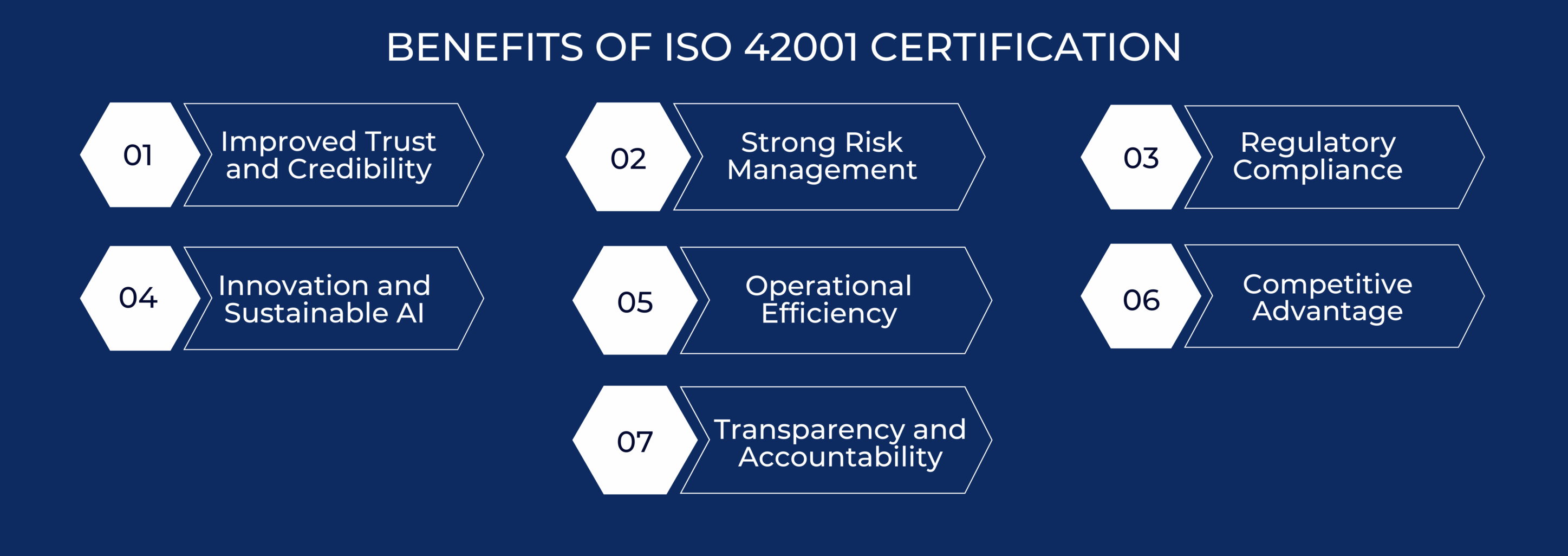
ISO 42001 certification in Vietnam delivers documented, measurable benefits across strategic, operational, commercial, and regulatory dimensions. Organizations that achieve certification through a third-party audit engagement receive an internationally recognized attestation of AIMS conformance that creates verifiable value across multiple stakeholder relationships. The following benefits reflect outcomes that are directly attributable to implementing and maintaining a conforming AIMS as evaluated during ISO 42001 certification audits.
- ✓Third-party audited attestation of AIMS conformance against ISO/IEC 42001:2023 requirements, providing verifiable evidence for client due diligence, regulatory inquiries, and tender submissions
- ✓Structured AI risk classification framework that enables systematic identification, assessment, and treatment of risks associated with AI system design, deployment, and operation
- ✓Enhanced market access to international contracts from clients in the EU, US, Japan, Singapore, and South Korea that require vendor AI governance documentation as a procurement condition
- ✓Alignment with Vietnam’s Decree 13/2023/ND-CP on Personal Data Protection through AIMS controls that address automated processing accountability and data subject rights obligations
- ✓Documented human oversight mechanisms and escalation procedures that reduce exposure to regulatory enforcement actions related to automated decision-making without adequate human review
- ✓Integration capability with existing ISO 27001 and ISO 9001 management systems through shared High-Level Structure architecture, reducing duplication of policies, roles, and audit activities
- ✓Competitive differentiation in Vietnam’s technology sector, particularly for software exporters, outsourcing providers, and fintech companies competing for international enterprise clients
- ✓Strengthened investor confidence through demonstrable organizational maturity in AI governance, relevant for Vietnamese AI startups pursuing Series A and later-stage funding rounds
- ✓Continual improvement obligations embedded in the AIMS cycle that drive systematic enhancement of AI system performance, fairness monitoring, and bias mitigation practices
- ✓Incident response and nonconformity management protocols that reduce the financial and reputational consequences of AI system failures, data incidents, or algorithmic errors
Vietnam exported approximately USD 9 billion in software and IT services in 2023, with AI-enabled solutions representing a growing share of this export portfolio. Vietnamese technology companies providing AI-driven software products, data analytics platforms, and intelligent automation solutions to international clients face increasingly stringent vendor qualification requirements from buyers in regulated industries. ISO 42001 certification enables Vietnamese technology exporters to satisfy these qualification requirements with a single internationally recognized attestation rather than responding individually to each client’s bespoke due diligence questionnaire, reducing the commercial overhead associated with international business development.
The EU AI Act, which entered into force in August 2024 and will impose binding requirements on AI systems sold into or operating within the European Union, creates specific governance obligations for providers of high-risk AI systems. Vietnamese technology companies exporting AI solutions to EU markets are classified as providers under the EU AI Act and must maintain technical documentation, risk management systems, and post-market monitoring procedures that align closely with ISO 42001 AIMS requirements. Achieving ISO 42001 certification positions Vietnamese exporters to demonstrate substantial alignment with EU AI Act compliance expectations, reducing the burden of regulatory compliance for EU market access.
An ISO 42001-conforming AIMS introduces structured governance disciplines across the AI system lifecycle — from initial design and data selection through deployment, monitoring, and decommissioning — that reduce the incidence of uncontrolled AI system behavior, model drift, and data quality failures. For Vietnamese organizations operating AI systems at scale, these governance disciplines translate directly into measurable operational benefits: reduced model retraining costs driven by earlier detection of performance degradation, lower incident remediation costs through proactive risk controls, and improved auditability of AI system decisions that reduces legal exposure from automated decision disputes.
- ✓Strategic Benefits for Vietnamese Technology Exporters
- ✓Operational Benefits Through Structured AI Governance
ISO 42001 Certification Requirements in Vietnam
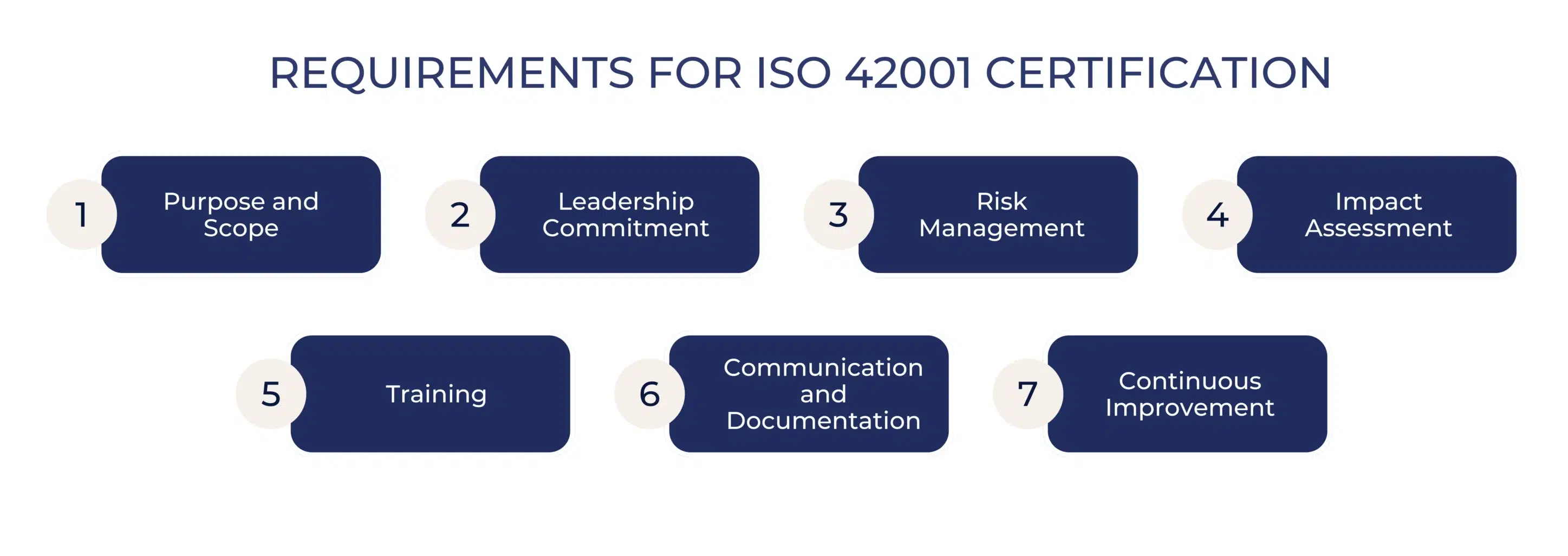
ISO 42001 certification requires an organization to demonstrate conformance with all normative clauses of ISO/IEC 42001:2023 within the defined certification scope. The requirements span organizational context assessment, leadership commitment documentation, risk and opportunity planning, resource provision, operational control implementation, performance monitoring, and management review processes. Each requirement must be evidenced through documented policies, procedures, records, and observable practices that an independent audit team can evaluate against the standard’s criteria.
Clause 4 of ISO/IEC 42001:2023 requires organizations to document their organizational context, including internal and external factors that affect their ability to achieve AIMS objectives, the needs and expectations of interested parties (including customers, regulators, employees, and affected communities), and the boundaries and applicability of the AIMS. For Vietnamese organizations, the organizational context documentation must address Vietnam-specific regulatory requirements, industry sector obligations, and stakeholder expectations relevant to AI system deployment in the Vietnamese market. The certification scope statement must precisely define which AI systems, organizational units, and geographic locations are covered by the AIMS.
Organizations must also document an AI system inventory that identifies each AI system within the certification scope, describes its intended purpose and operational context, classifies its risk level based on the impact assessment methodology specified in Annex A, and records the organizational roles responsible for each system’s governance. This AI system inventory serves as the foundational reference document for the AIMS and is reviewed during Stage 1 audit activities to verify that the certification scope accurately reflects the organization’s AI operational landscape. Gaps between the AI system inventory and the certification scope constitute a significant audit finding.
Clause 5 of ISO/IEC 42001:2023 establishes requirements for top management commitment to the AIMS, including the establishment of an AI policy that is appropriate to the organization’s purpose, aligned with its strategic direction, and includes commitments to satisfying applicable requirements and achieving continual improvement. Top management must also assign responsibility for AIMS performance to designated roles and ensure that these roles are adequately resourced and empowered to maintain AIMS conformance. For Vietnamese organizations, AI policy documentation must address ethical AI principles, accountability structures, and human oversight obligations that are relevant to the organization’s specific AI deployment context.
The standard requires organizations to establish an AI governance structure with clearly defined roles, responsibilities, and authorities for AI system oversight. This includes designation of an AI management representative or equivalent function, establishment of cross-functional AI governance committees where appropriate, and documented escalation pathways for AI incidents, ethical concerns, and compliance violations. Audit evaluations of leadership requirements assess whether the documented governance structure is operationally functional — meaning that designated individuals are actually performing assigned AIMS responsibilities — rather than merely documented in organizational charts without corresponding operational activity.
Clause 6 of ISO/IEC 42001:2023, read in conjunction with Annex A controls A.6 through A.8, requires organizations to establish a documented AI risk assessment process that identifies risks and opportunities associated with their AI systems, evaluates the potential impacts of AI system failures or misuse on individuals, groups, and society, and determines risk treatment options commensurate with the identified risk levels. The standard introduces the concept of AI system impact assessment — a structured evaluation of the potential consequences of an AI system’s outputs on affected parties — as a core AIMS requirement. For Vietnamese organizations, impact assessments must consider local social, economic, and cultural contexts relevant to AI system deployment.
Risk treatment documentation must specify selected controls from Annex A or justified alternatives, document the rationale for control selection and exclusion, and establish a Statement of Applicability that maps organizational controls to the Annex A reference control set. This Statement of Applicability is a mandatory certification deliverable that audit teams review to verify the completeness and defensibility of the organization’s control selection decisions. Organizations must also maintain risk treatment records that demonstrate the implementation and operational effectiveness of selected controls throughout the certification cycle.
Clause 8 of ISO/IEC 42001:2023 requires organizations to plan, implement, control, and maintain the processes needed to meet AIMS requirements and implement the actions determined during planning. This includes documented operational procedures for AI system development and acquisition, data governance practices, AI system testing and validation protocols, deployment authorization procedures, and ongoing monitoring activities. Documentation must be maintained at sufficient detail to enable consistent execution by personnel and to provide audit evidence of process conformance. Records of operational activities — including AI system testing results, incident reports, and monitoring outputs — must be retained for the periods specified in the AIMS documentation.
| ISO 42001 Clause | Requirement Area | Key Documentation Required |
|---|---|---|
| Clause 4 | Organizational Context | AIMS scope statement, AI system inventory, interested party register |
| Clause 5 | Leadership & Accountability | AI policy, governance structure, role assignments |
| Clause 6 | Risk & Opportunity Planning | AI risk assessment records, impact assessments, Statement of Applicability |
| Clause 8 | Operational Controls | AI lifecycle procedures, data governance protocols, monitoring records |
| Clause 9 | Performance Evaluation | Internal audit records, management review minutes, KPI data |
- ✓Organizational Context and Scope Documentation Requirements
- ✓Leadership and Accountability Requirements
- ✓Risk Management and AI Impact Assessment Requirements
- ✓Operational Control and Documentation Requirements
ISO 42001 Certification Cost in Vietnam
The cost of ISO 42001 certification in Vietnam varies based on multiple organizational and scope-specific factors that determine the audit effort required for a complete and defensible certification evaluation. Understanding the primary cost drivers enables Vietnamese organizations to budget appropriately for certification engagement and make informed decisions about certification scope boundaries.
Primary Cost Determinants for ISO 42001 Certification
The primary cost determinants for ISO 42001 certification in Vietnam include the number of AI systems within the certification scope, the complexity of those systems (measured by technical architecture, data inputs, decision outputs, and integration points), the number of organizational sites included in the scope, the number of employees engaged in AIMS-relevant roles, and the organization’s prior experience with ISO management system certification. Organizations with multiple complex AI systems operating across multiple Vietnamese locations require more audit time than organizations certifying a single AI application with a small number of AIMS personnel, resulting in correspondingly higher certification fees.
Sector-specific complexity also influences certification costs. Financial institutions operating AI systems subject to State Bank of Vietnam regulatory requirements, healthcare providers deploying AI diagnostic tools under Ministry of Health jurisdiction, and technology companies managing AI systems with complex data supply chains typically require more detailed audit procedures than organizations operating simpler AI applications in lower-regulated contexts. The audit team’s sector expertise and the depth of technical evaluation required for high-risk AI systems contribute to the overall engagement cost.
Cost Components of ISO 42001 Certification Engagements
ISO 42001 certification engagement costs comprise several distinct components: Stage 1 audit fees covering documentation review and scope evaluation, Stage 2 audit fees covering on-site or remote implementation evaluation, certification registration fees, and annual surveillance audit fees for years one and two of the certification cycle. Some certification bodies apply separate fees for nonconformity follow-up visits or remote verification activities. Travel and accommodation costs for on-site audit activities at Vietnamese locations are typically itemized separately and vary based on the number of audit sites and the audit team’s location.
| Organization Profile | AI System Complexity | Indicative Audit Duration | Cost Range (USD) |
|---|---|---|---|
| Small organization (under 50 employees) | Single AI application, low risk | 3-5 audit days | 3,000 – 8,000 |
| Medium organization (50-250 employees) | Multiple AI systems, moderate complexity | 5-10 audit days | 8,000 – 18,000 |
| Large enterprise (250+ employees) | Complex AI portfolio, multi-site | 10-20 audit days | 18,000 – 45,000 |
| Financial institution or regulated sector | High-risk AI systems, regulatory overlay | 15-25 audit days | 25,000 – 60,000 |
Organizations that hold existing ISO 27001 or ISO 9001 certifications may qualify for integrated audit approaches that evaluate AIMS requirements alongside existing management system obligations in combined audit engagements, potentially reducing total audit days and associated costs compared to standalone ISO 42001 certification audits. The feasibility and cost savings available through integrated audits depend on the alignment between existing management system scopes and the intended ISO 42001 certification scope, and should be discussed with the certification body during scope definition activities.
ISO 42001 and Related Governance Frameworks in Vietnam
ISO 42001 certification does not exist in isolation but operates within a broader ecosystem of governance frameworks, regulatory requirements, and complementary management system standards that Vietnamese organizations must navigate. Understanding the relationships between ISO 42001 and these adjacent frameworks enables organizations to design integrated governance architectures that satisfy multiple compliance obligations efficiently through shared controls and unified documentation structures.
ISO 42001 and ISO 27001 Integration
ISO 42001 and ISO 27001 share the ISO High-Level Structure, which means their clause architectures follow the same organizational pattern across context, leadership, planning, support, operation, performance evaluation, and improvement. This shared structure enables organizations that hold ISO 27001 certification to integrate AIMS requirements into their existing Information Security Management System (ISMS) infrastructure by extending existing policies, risk assessment processes, and management review activities to cover AI-specific dimensions rather than constructing a separate parallel management system. Vietnamese technology companies that have already invested in ISO 27001 certification are well-positioned to leverage this integration for ISO 42001 certification.
The integration between ISO 42001 and ISO 27001 is particularly relevant for Vietnamese fintech and software companies where AI system security and information security governance are closely interrelated. AI systems that process personal data, handle financial transactions, or access sensitive organizational information require security controls that span both frameworks. An integrated management system that addresses both ISMS and AIMS requirements through unified control documentation, combined internal audit programs, and consolidated management review processes reduces administrative burden while maintaining comprehensive governance coverage across both certification scopes.
ISO 42001 Alignment with the EU AI Act
The EU AI Act, which entered into force on August 1, 2024, establishes legally binding requirements for AI systems developed, deployed, or used within the European Union. Vietnamese technology companies that export AI-enabled software products or services to EU markets, or that provide AI systems to EU-based organizations through outsourcing arrangements, are subject to the EU AI Act as providers of AI systems placed on the EU market. The technical requirements of the EU AI Act for high-risk AI systems — including risk management systems, technical documentation, data governance, transparency measures, human oversight, accuracy, robustness, and cybersecurity — align substantially with the AIMS controls specified in ISO 42001 Annex A.
ISO 42001 certification is expected to be recognized by EU regulators as evidence of conformance with certain EU AI Act requirements for high-risk AI systems, as the European Commission’s standardization mandate (M/570) directed European standardization organizations to develop standards supporting EU AI Act compliance, and ISO 42001 is positioned as a primary international reference for AI management system governance. Vietnamese technology companies achieving ISO 42001 certification are therefore in a stronger position to demonstrate EU AI Act compliance than those without a certified AIMS, reducing regulatory risk associated with EU market operations.
ISO 42001 and Vietnam’s Data Protection Framework
Vietnam’s Decree 13/2023/ND-CP on Personal Data Protection, which took effect on July 1, 2023, establishes requirements for organizations that process personal data of Vietnamese individuals, including obligations related to automated processing activities using AI systems. Specifically, the Decree requires organizations to document the purposes of personal data processing, implement appropriate technical and organizational measures to protect personal data, conduct impact assessments for high-risk processing activities, and establish accountability mechanisms for data controllers and processors. These obligations map directly to ISO 42001 AIMS requirements for AI system impact assessment, data governance controls, transparency documentation, and organizational accountability structures.
Organizations that implement a conforming AIMS under ISO 42001 can leverage their AIMS documentation — including AI system inventories, impact assessments, data governance procedures, and accountability role assignments — as evidence of compliance with relevant provisions of Decree 13/2023/ND-CP. This cross-framework evidence utility reduces the duplication of compliance documentation effort and enables Vietnamese organizations to demonstrate both ISO 42001 AIMS conformance and Vietnamese data protection compliance through a unified governance infrastructure. The alignment between ISO 42001 and Decree 13 is particularly relevant for financial institutions, e-commerce platforms, healthcare providers, and other organizations that process large volumes of personal data through AI systems.
Industries in Vietnam Prioritizing ISO 42001 Certification
ISO 42001 certification in Vietnam is pursued by organizations across a diverse range of industries that deploy AI systems as core components of their operational or service delivery models. The following industry sectors represent the primary certification demand areas in Vietnam, each driven by distinct combinations of regulatory requirements, commercial pressures, and operational risk considerations.
Financial Services and Fintech
Vietnam’s financial services sector is among the most active adopters of AI technology in the country, with commercial banks, digital payment platforms, insurance companies, and fintech startups deploying AI systems across credit scoring, fraud detection, customer service automation, investment analytics, and regulatory reporting. The State Bank of Vietnam’s Circular 09/2020/TT-NHNN and subsequent regulatory guidance on digital banking operations create governance expectations for AI systems used in licensed financial activities. ISO 42001 certification provides Vietnamese financial institutions with a structured framework for documenting AI governance practices in a manner that satisfies both the State Bank’s supervisory expectations and international correspondent banking partner requirements.
Vietnam’s rapidly growing fintech sector, represented by companies such as MoMo, VNPay, ZaloPay, and numerous smaller payment and lending platforms, operates AI systems that make automated decisions affecting millions of Vietnamese consumers. The fairness, transparency, and accountability requirements embedded in ISO 42001 are particularly relevant for these organizations, as AI-driven credit and payment decisions create significant consumer protection obligations. ISO 42001 certification demonstrates that fintech operators have implemented structured controls for bias monitoring, explainability, and human oversight of automated decisions that affect Vietnamese financial consumers.
Technology, Software, and IT Outsourcing
Vietnam’s technology and IT services sector — which includes major software development companies such as FPT Software, NashTech, KMS Technology, and Axon Active, as well as thousands of smaller software development firms — represents a significant portion of ISO 42001 certification demand. These organizations develop and deploy AI-enabled software products for domestic and international clients, operate AI development infrastructure for outsourced AI development engagements, and integrate AI capabilities into enterprise software platforms sold globally. ISO 42001 certification enables Vietnamese technology companies to demonstrate AI governance maturity to international enterprise clients that require vendor qualification evidence as a condition of AI-related contracts.
AI startups in Vietnam’s innovation ecosystem — concentrated in Hanoi’s National Innovation Centre and Ho Chi Minh City’s Startup Zone — develop AI solutions across computer vision, natural language processing, predictive analytics, and autonomous systems domains. These organizations face investor due diligence requirements and early customer qualification processes that increasingly include AI governance documentation requests. ISO 42001 certification provides Vietnamese AI startups with a credible, independently audited governance attestation that differentiates them from competitors and accelerates investor and customer confidence assessments during fundraising and sales cycles.
Healthcare and Life Sciences
Vietnam’s healthcare sector is increasingly deploying AI systems for medical image analysis, diagnostic decision support, patient risk stratification, and hospital operations management. Healthcare AI deployments involve high-stakes automated decisions that directly affect patient outcomes, creating significant ethical and regulatory governance obligations. The Ministry of Health’s regulatory framework for medical devices and digital health applications creates registration and quality management requirements for AI-enabled medical devices that align with ISO 42001 AIMS controls for high-risk AI system governance. ISO 42001 certification provides healthcare organizations with a structured framework for demonstrating that AI systems used in clinical contexts operate within defined safety, accuracy, and oversight parameters.
Manufacturing and Industrial Automation
Vietnam’s manufacturing sector — which encompasses electronics, textiles, food processing, automotive components, and industrial goods — is undergoing digital transformation through AI-enabled quality control systems, predictive maintenance platforms, supply chain optimization tools, and automated production line management. International manufacturers operating in Vietnam, including Samsung, Intel, LG, and numerous Japanese and Korean industrial companies, apply global supplier qualification standards that increasingly incorporate AI governance requirements. Vietnamese manufacturing suppliers that achieve ISO 42001 certification demonstrate compliance with these international quality and governance standards, strengthening their position in global supply chains and reducing qualification friction with international manufacturing partners.
Why Choose CertPro for ISO 42001 Certification in Vietnam?
CertPro is a Licensed CPA Firm that conducts ISO 42001 certification audits for organizations operating AI systems across Vietnam. CertPro’s certification audit engagements are conducted by qualified auditors with demonstrated competence in AI system governance, management system auditing, and Vietnam-specific regulatory contexts. CertPro’s audit methodology follows internationally established certification audit protocols and is designed to provide Vietnamese organizations with a rigorous, evidence-based evaluation of AIMS conformance against ISO/IEC 42001:2023 requirements.
CertPro’s Certification Audit Methodology
CertPro’s ISO 42001 certification audit methodology encompasses structured Stage 1 documentation review activities, comprehensive Stage 2 implementation and effectiveness evaluation, systematic nonconformity identification and classification, and an independent certification decision process that is separated from audit execution functions. Audit teams assigned to Vietnamese engagements include personnel with sector-specific expertise relevant to the client organization’s industry — including financial services, technology, healthcare, and manufacturing — ensuring that audit evaluations reflect the specific AI deployment contexts and risk profiles relevant to each organization’s certification scope.
CertPro maintains audit schedules and reporting timelines that are designed to provide Vietnamese organizations with timely certification decisions without compromising audit rigor. Stage 1 reports are issued within five business days of documentation review completion. Stage 2 audit reports are issued within ten business days of fieldwork completion. Certification decisions are communicated within fifteen business days of the submission of corrective action evidence for any identified nonconformities. These commitments reflect CertPro’s institutional positioning as a certification body that combines thoroughness with operational efficiency for Vietnamese client organizations.
Local Presence and Vietnam-Specific Expertise
CertPro maintains operational presence in Vietnam, with audit personnel and coordination resources available in both Hanoi and Ho Chi Minh City. This local presence enables CertPro to conduct on-site audit activities at Vietnamese organizational locations without the travel coordination delays and costs associated with international audit teams conducting remote engagements. Local presence also supports communication in Vietnamese for organizations that prefer to conduct audit discussions and documentation reviews in their primary business language, with formal audit reports issued in English as required for international certification recognition purposes.
CertPro’s Vietnam-specific expertise encompasses familiarity with the regulatory landscape governing AI system operations in Vietnam, including Decree 13/2023/ND-CP, the Law on Cybersecurity, State Bank of Vietnam circulars relevant to financial AI applications, and Ministry of Information and Communications regulations affecting digital service providers. This regulatory familiarity enables CertPro’s audit teams to contextualize AIMS conformance evaluations within the specific legal environment in which Vietnamese organizations operate, providing audit findings that reflect not only ISO 42001 standard requirements but also the regulatory context that shapes compliance obligations for Vietnamese AI operators.
Integrated Certification Services Across Management System Standards
CertPro offers integrated audit engagement structures for Vietnamese organizations seeking certification against multiple ISO management system standards in coordinated audit programs. Organizations holding or pursuing ISO 27001 (information security), ISO 9001 (quality management), ISO 22301 (business continuity), or SOC 2 certifications alongside ISO 42001 can request integrated audit scheduling that evaluates overlapping management system elements in combined audit activities. Integrated audit programs reduce the total audit burden on operational personnel, minimize business disruption associated with multiple separate audit engagements, and enable cost efficiencies through shared audit infrastructure across certification scopes.
Securing ISO 42001 Certification in Vietnam with CertPro
ISO 42001 certification in Vietnam establishes a formally audited, internationally recognized attestation that an organization’s Artificial Intelligence Management System conforms to the requirements of ISO/IEC 42001:2023. For Vietnamese organizations operating AI systems across financial services, technology, healthcare, manufacturing, and other sectors, this certification provides verifiable evidence of AI governance maturity that satisfies regulatory inquiries, commercial due diligence requirements, and stakeholder accountability expectations.
CertPro’s certification audit engagements provide Vietnamese organizations with the independent third-party evaluation required to achieve and maintain ISO 42001 certification. CertPro’s structured audit methodology, Vietnam-specific regulatory expertise, local operational presence, and institutional positioning as a Licensed CPA Firm provide the evidentiary foundation for certification decisions that are credible to international clients, Vietnamese regulators, and other stakeholders who review ISO 42001 certificates as part of their organizational due diligence processes.
Organizations in Vietnam that are operating AI systems and have not yet established a conforming AIMS should initiate the certification planning process by defining their AI system scope, assessing current AIMS documentation against ISO/IEC 42001:2023 clause requirements, and engaging CertPro to discuss certification scope, audit structure, and engagement timelines. CertPro accepts certification audit inquiries from Vietnamese organizations across all sectors and sizes, and provides scope-specific quotations based on the organization’s AI system profile, geographic footprint within Vietnam, and existing management system certification status.
FAQ
▶
What is ISO 42001 certification and what does it certify?
▶
Which Vietnamese organizations are required to obtain ISO 42001 certification?
▶
How long does ISO 42001 certification take in Vietnam?
▶
What is the structure of the ISO 42001 certification audit?
▶
How does ISO 42001 relate to Vietnam’s Decree 13/2023 on Personal Data Protection?
▶
Can ISO 42001 certification be integrated with an existing ISO 27001 certification in Vietnam?
▶
What AI systems are required to be included in the ISO 42001 certification scope?
▶
Does ISO 42001 certification in Vietnam provide evidence of EU AI Act compliance?

MindSec Launches AI Compliance for Law 25 & ISO 42001
Excerpt from Barchart Article, Published on December 3, 2025 Today, Canadian organizations face increasing pressure to comply with stringent privacy a…

UNDERSTANDING ISO 42001: A GUIDE FOR RESPONSIBLE AI MANAGEMENT SYSTEMS
The invention of artificial intelligence (AI) has changed the operational processes of many industries. However, the rapid growth of technology increa…
ENSURING AI DATA PRIVACY COMPLIANCE WITH ISO 42001
According to Stanford’s AI report, the private AI investment in the U.S. alone reached more than $109 billion last year, which is equal to 12 times th…
Get In Touch
have a question? let us get back to you.