
ISO 27001 Certification in Vietnam
Executive Summary: CertPro is a Licensed CPA Firm delivering independent ISO 27001 certification audits for organizations operating in Vietnam. Audit engagements evaluate Information Security Management Systems (ISMS) against ISO/IEC 27001:2022 requirements, covering all 93 controls across 4 domains. CertPro issues internationally recognized ISO 27001 certificates to Vietnamese organizations upon successful audit completion.
OUR CLIENTS










ISO 27001 Certification in Vietnam: An Overview
ISO 27001 certification in Vietnam is the formal recognition that an organization has established, implemented, and maintained an Information Security Management System (ISMS) that meets the requirements of the ISO/IEC 27001:2022 international standard. CertPro, operating as a Licensed CPA Firm, conducts independent certification audits for Vietnamese businesses across all major industries, including technology, financial services, fintech, manufacturing, healthcare, and government sectors.
Vietnam has emerged as one of Southeast Asia’s fastest-growing technology and digital services hubs. Ho Chi Minh City and Hanoi host hundreds of IT companies, software development firms, data centers, and fintech organizations that process sensitive information on behalf of domestic and international clients. As Vietnamese companies increasingly serve global markets, ISO 27001 certification has become a baseline requirement for demonstrating compliance with international information security standards.
What Is ISO/IEC 27001:2022?
ISO/IEC 27001:2022 is the current version of the international standard for Information Security Management Systems, published jointly by the International Organization for Standardization (ISO) and the International Electrotechnical Commission (IEC). The 2022 revision replaced ISO/IEC 27001:2013 and introduced significant structural updates, reducing the number of controls from 114 to 93 across 4 main domains: Organizational Controls, People Controls, Physical Controls, and Technological Controls.
The standard defines a systematic framework for identifying, assessing, treating, and monitoring information security risks. ISO 27001 requires organizations to implement a documented ISMS that covers people, processes, and technology. Certification bodies globally, including accredited bodies operating in Vietnam, require organizations to transition to the 2022 version by the deadline of October 31, 2025, after which ISO 27001:2013 certificates will no longer be valid.
Scope of ISO 27001 Certification for Vietnamese Organizations
ISO 27001 certification scope defines the boundaries of the ISMS subject to audit. Vietnamese organizations may certify their entire enterprise or specific business units, geographic locations, service lines, or information assets. Common certification scopes in Vietnam include IT service management, software development, cloud infrastructure operations, financial data processing, and customer data management for e-commerce platforms.
Scope definition directly affects the certification audit program, timeline, and overall cost. A narrowly defined scope targeting a single department or service line requires fewer controls to be evaluated than an enterprise-wide ISMS scope. CertPro’s audit teams work within the defined scope boundaries established by each client organization and documented in the audit engagement plan prior to Stage 1 assessment commencement.
ISO 27001 and Vietnam’s Regulatory Landscape
Vietnam’s regulatory environment increasingly aligns with international information security expectations. The Law on Cybersecurity (Law No. 24/2018/QH14), the Law on Information Technology, and Decree 13/2023/ND-CP on Personal Data Protection establish legal obligations for data localization, breach notification, and security controls. ISO 27001 certification maps directly to these regulatory requirements, providing Vietnamese organizations with a structured framework for demonstrating legal compliance through documented controls and audit evidence.
The State Bank of Vietnam (SBV) and the Ministry of Information and Communications (MIC) have issued circulars and directives requiring financial institutions and telecommunications operators to maintain robust information security programs. ISO 27001 certification serves as verifiable evidence of compliance with these directives. Additionally, Vietnamese businesses operating with EU clients must align with GDPR requirements, and ISO 27001 certification provides documented controls that support GDPR compliance mapping.

Why ISO 27001 Certification Is Required for Vietnam Companies
ISO 27001 certification in Vietnam is required by customers, regulators, and contractual partners as verifiable proof of an organization’s information security posture. The need for ISO 27001 certification stems from multiple converging pressures: growing cyber threat volumes targeting Vietnamese businesses, regulatory mandates, international client requirements, and the increasing value of sensitive data processed by Vietnamese technology and financial services companies.
Customer and Contractual Requirements
International clients contracting Vietnamese technology companies, BPO providers, and software development firms routinely require ISO 27001 certification as a contractual prerequisite. This requirement is standard across clients in the United States, European Union, Australia, Japan, and Singapore. Vietnamese companies without ISO 27001 certification are increasingly excluded from competitive tenders, enterprise procurement processes, and long-term service agreements with multinational corporations.
ISO 27001 certification demonstrates to clients that the Vietnamese organization has implemented independently verified security controls covering access management, incident response, business continuity, cryptography, supplier security, and asset management. The certification certificate, issued by an accredited certification body such as CertPro, provides clients with third-party assurance that exceeds the value of self-reported security questionnaires or internal attestations.
Risk Management and Cyber Threat Context in Vietnam
Vietnam ranks among the most targeted countries for cyberattacks in Southeast Asia. Reports from the Vietnam Authority of Information Security (VAIS) document thousands of cybersecurity incidents annually, including ransomware attacks, phishing campaigns, and data breaches targeting financial institutions, government agencies, and technology companies. ISO 27001 requires organizations to implement a formal risk assessment process that identifies and treats these threats through documented controls.
ISO 27001’s risk treatment framework requires organizations to address identified vulnerabilities and reduce the likelihood of security incidents and their operational impacts. The standard mandates ongoing risk monitoring, periodic internal audits, and management reviews to ensure the ISMS remains effective as the threat landscape evolves. This continuous improvement model, based on the Plan-Do-Check-Act (PDCA) cycle, ensures Vietnamese organizations maintain security controls that respond to emerging threats rather than relying on static security documentation.
Regulatory Compliance Alignment
ISO 27001 helps Vietnamese organizations map legal and regulatory requirements to documented controls. The standard’s Annex A controls and Statement of Applicability (SoA) structure allows organizations to explicitly link each implemented control to the regulatory obligation it satisfies. This mapping is directly applicable to Vietnam’s Decree 13/2023/ND-CP on Personal Data Protection, the State Bank of Vietnam’s information security circulars, and international frameworks including GDPR and HIPAA.
Financial institutions in Vietnam, including banks, insurance companies, and fintech platforms, face specific requirements from the State Bank of Vietnam regarding information security governance. ISO 27001 certification provides these institutions with a structured, auditable framework that satisfies SBV directives while simultaneously meeting requirements from international financial partners, payment networks, and regulatory bodies. ISO 27001 compliance Vietnam fintech companies pursue typically covers payment data protection, access control, and incident response capabilities.
ISO 27001 Certification Requirements
ISO/IEC 27001:2022 specifies mandatory requirements that organizations must satisfy to achieve and maintain certification. These requirements apply regardless of organization size, industry, or geographic location. For Vietnamese organizations, fulfilling these requirements demonstrates that the ISMS is operational, documented, and capable of protecting information assets against identified risks.
ISO 27001 certification requires a comprehensive set of documented information that auditors evaluate during Stage 1 and Stage 2 assessments. Mandatory documentation includes the ISMS scope statement, information security policy, risk assessment methodology, risk treatment plan, Statement of Applicability (SoA), and records of internal audits and management reviews. The SoA is a critical document that lists all 93 ISO 27001:2022 controls, states whether each control is applicable, and justifies any exclusions.
Supporting documentation must be kept ready and accessible for audits and internal reviews. This includes operational procedures for security incident management, business continuity plans, asset inventories, access control policies, cryptography procedures, supplier security agreements, and training records. Documentation must be version-controlled, reviewed regularly, and approved by authorized personnel. CertPro auditors assess the completeness, accuracy, and operational relevance of all documented information during the certification audit.
ISO 27001:2022 requires organizations to implement and operate 93 controls organized across 4 domains. Understanding how many controls in ISO 27001 are mandatory depends on the organization’s risk assessment and Statement of Applicability. Controls that are identified as applicable based on the risk assessment must be implemented and demonstrably operational. The 4 control domains in ISO 27001:2022 are: Organizational Controls (37 controls), People Controls (8 controls), Physical Controls (14 controls), and Technological Controls (34 controls).
Technical requirements for ISO 27001 certification include implemented access management systems with documented access review procedures, network security controls including firewalls and intrusion detection, encryption for data at rest and in transit, vulnerability management programs with documented patching cycles, security event logging and monitoring, and secure software development practices for technology companies. Vietnamese IT companies and software developers must demonstrate that these technical controls are operational and auditable, not merely documented in policy without implementation evidence.
ISO 27001 certification requires demonstrated commitment from top management through an approved information security policy, defined ISMS roles and responsibilities, allocated resources, and documented management review records. Top management must review the ISMS at planned intervals and document decisions and actions arising from those reviews. Evidence of management review, including meeting minutes and action logs, is examined by CertPro auditors during the certification assessment.
The internal audit program is a mandatory component of ISO 27001 certification requirements. Organizations must conduct internal audits at planned intervals to assess whether the ISMS conforms to both the organization’s own requirements and ISO 27001 standard requirements. Internal audit results, including nonconformity findings and corrective actions, must be documented and retained. At least one complete internal audit cycle must be completed before the Stage 2 certification audit. Internal auditors must be independent from the activities they audit to ensure objectivity.
| ISO 27001:2022 Control Domain | Number of Controls | Examples of Key Controls |
|---|---|---|
| Organizational Controls | 37 | Policies, risk management, supplier relations, incident management |
| People Controls | 8 | Security awareness, training, background verification, remote work |
| Physical Controls | 14 | Physical access, equipment security, clear desk/screen policy |
| Technological Controls | 34 | Access management, encryption, logging, vulnerability management |
ISO 27001 requires organizations to establish and apply a documented information security risk assessment process. This process must define risk acceptance criteria, identify risks associated with the loss of confidentiality, integrity, and availability of information assets, analyze and evaluate identified risks against defined criteria, and produce a risk register with documented risk owners. The risk assessment must be repeated at planned intervals or when significant changes occur to the organization’s information environment.
Risk treatment requirements mandate that organizations select appropriate treatment options for each identified risk: applying ISO 27001 controls from Annex A, accepting risks that fall within tolerance, avoiding risk by discontinuing risky activities, or transferring risk through insurance or contractual arrangements. The risk treatment plan must document selected controls, residual risk levels, and risk owner approvals. These controls must follow the risk assessment results and meet legal, regulatory, and contractual obligations applicable to the Vietnamese operating environment.
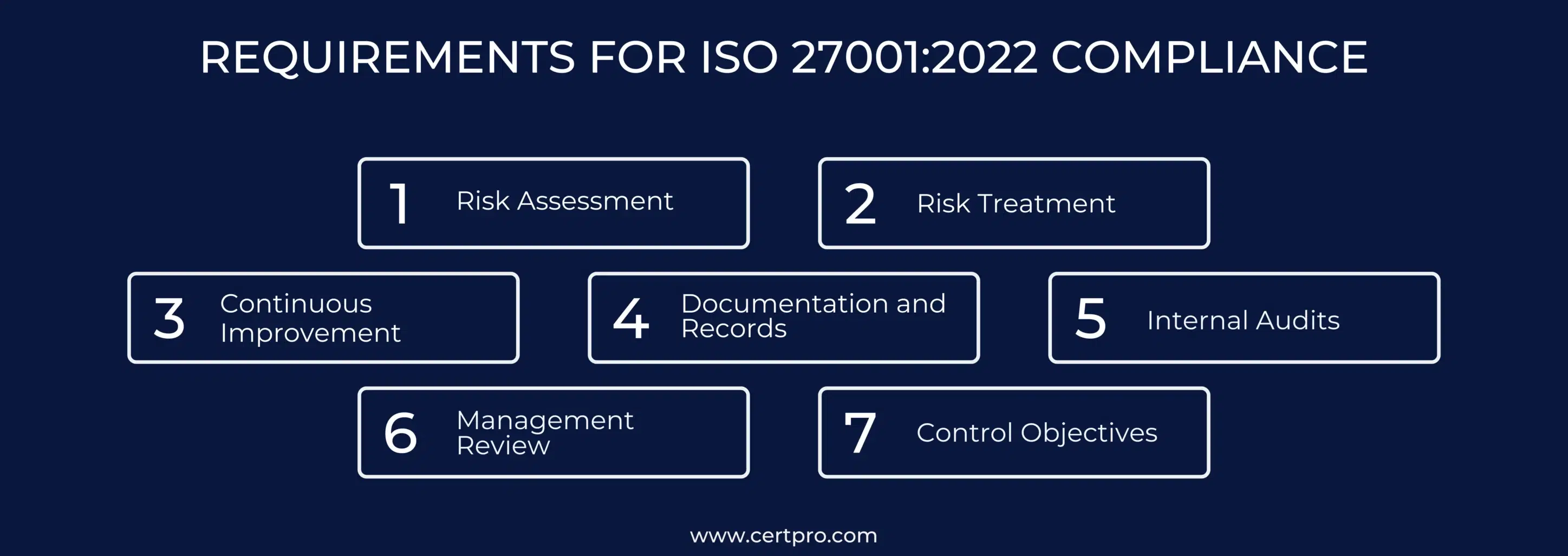
- ✓Documentation Requirements
- ✓Technical and Operational Control Requirements
- ✓Management System Requirements
- ✓Risk Assessment and Treatment Requirements
ISO 27001 Certification Process in Vietnam
The ISO 27001 certification process in Vietnam follows a structured audit program administered by an accredited certification body. CertPro, as a Licensed CPA Firm, conducts ISO 27001 certification audits through a defined sequence of evaluation stages. Each stage produces documented audit findings that inform the certification decision. The process from scope definition through certificate issuance typically spans 6 to 12 months depending on the organization’s size, ISMS maturity, and defined scope.
The ISO 27001 certification process begins with formal scope definition, during which the organization and CertPro establish the boundaries of the ISMS subject to audit. The audit program is then determined based on the defined scope, the number of information assets covered, the geographic locations included, and the complexity of the organization’s information processing activities. This stage produces the audit engagement plan, which documents audit objectives, criteria, scope, schedule, and assigned audit team members.
Stage 1 audit evaluation focuses on the organization’s ISMS documentation. CertPro auditors assess whether the organization has established mandatory documented information required by ISO 27001:2022, including the ISMS scope statement, information security policy, risk assessment results, Statement of Applicability, risk treatment plan, and internal audit records. Stage 1 findings determine whether the organization is ready for Stage 2 evaluation and identify any areas requiring attention before proceeding to on-site control testing.
Stage 2 is the main certification audit, during which CertPro auditors conduct on-site evaluation of the organization’s ISMS implementation. Auditors test the operational effectiveness of controls declared applicable in the Statement of Applicability. Control testing involves document review, personnel interviews, observation of processes, and technical testing of implemented security measures. For Vietnamese organizations, on-site audits can be conducted at facilities in Ho Chi Minh City, Hanoi, Da Nang, or other operational locations covered by the ISMS scope.
During Stage 2 control testing, CertPro auditors evaluate evidence demonstrating that each applicable control has been implemented and is operating effectively. Evidence types include configuration screenshots, access logs, training completion records, incident response test results, supplier audit records, and management review minutes. Auditors assess whether the ISMS conforms to all mandatory clauses of ISO 27001:2022 (Clauses 4 through 10) and whether Annex A controls are implemented as documented in the Statement of Applicability.
Audit findings are classified as major nonconformities, minor nonconformities, or observations. A major nonconformity indicates the absence of a required process or a systematic failure of a control that materially impacts ISMS effectiveness. Major nonconformities must be resolved and verified before certification can be granted. A minor nonconformity indicates a single lapse or weakness that does not represent a systematic failure. Minor nonconformities require documented corrective action plans with defined timelines for resolution.
The nonconformity review stage requires the organization to submit a root cause analysis and corrective action plan for each identified nonconformity. CertPro evaluates the adequacy of proposed corrective actions before proceeding to the certification decision. Organizations with only minor nonconformities may receive conditional certification pending verification of corrective action completion at the first surveillance audit. This structured review process ensures the certification decision is based on objective audit evidence rather than organizational representation.
The certification decision is made by a qualified CertPro reviewer who was not part of the audit team. This independent review of audit findings and evidence ensures objectivity in the certification decision. Upon a positive certification decision, CertPro issues the ISO 27001 certificate, which states the certified organization’s name, registered address, ISMS scope description, applicable standard (ISO/IEC 27001:2022), certificate number, issue date, and expiry date. ISO 27001 certificates issued by CertPro are valid for 3 years from the certification decision date.
ISO 27001 certification maintenance requires annual surveillance audits conducted in year 1 and year 2 following initial certification. Surveillance audits assess whether the ISMS continues to conform to ISO 27001 requirements and evaluate the effectiveness of corrective actions taken since the previous audit. Surveillance audit scope focuses on changes to the ISMS, progress of identified improvement objectives, ISMS performance metrics, and the organization’s handling of information security incidents since the last audit.
Recertification audits are conducted in year 3 before the certificate expiry date. Recertification involves a comprehensive reassessment of the ISMS equivalent to the initial Stage 2 audit. Successful recertification results in the issuance of a new 3-year certificate. Organizations that fail to undergo surveillance audits within the required timeframes or that demonstrate systematic control failures may have their certification suspended or withdrawn by CertPro pending resolution of identified issues.
- Scope Definition and Audit Program Determination
- Stage 1 Audit: ISMS Documentation Review
- Stage 1 Finding Review and Readiness Confirmation
- Stage 2 Audit: On-Site Control Testing
- Nonconformity Identification and Classification
- Corrective Action Plan Submission and Review
- Independent Certification Decision Review
- ISO 27001 Certificate Issuance
- Year 1 Surveillance Audit
- Year 2 Surveillance Audit
- Year 3 Recertification Audit

- ✓Stage 1: Scope Definition and Documentation Review
- ✓Stage 2: On-Site Control Testing and Conformity Assessment
- ✓Nonconformity Review and Corrective Action
- ✓Certification Decision and Certificate Issuance
- ✓Surveillance Audits and Recertification
ISO 27001 Certification Cost in Vietnam
ISO 27001 certification cost in Vietnam varies based on organization size, ISMS scope complexity, number of locations included in the audit, and the current maturity of the organization’s information security controls. CertPro does not publish fixed pricing for ISO 27001 certification audits because each engagement is scoped individually based on these variables. Organizations requesting a cost estimate receive a formal proposal following scope discussion with CertPro’s audit team.
Factors That Determine Certification Audit Cost
Organization size is the primary cost driver for ISO 27001 certification in Vietnam. Certification body standards for audit duration are based on the number of full-time employees (FTEs) and the number of information assets within scope. Larger organizations with hundreds of employees and complex IT environments require more audit days, which directly increases the certification cost. A small Vietnamese technology startup with 30 employees and a narrowly defined ISMS scope will incur significantly lower audit costs than a financial institution with 500 employees and enterprise-wide scope.
Multi-site certification increases audit costs because each included location must be assessed during the Stage 2 audit. Vietnamese companies operating offices in both Ho Chi Minh City and Hanoi, or those with data center facilities separate from corporate offices, will incur additional audit days for each site included in the ISMS scope. The complexity of the IT environment, including the number of systems, cloud services, third-party integrations, and custom-developed applications, also affects audit duration and cost.
Ongoing Certification Maintenance Costs
ISO 27001 certification in Vietnam involves three-year cost cycles. Initial certification costs include Stage 1 and Stage 2 audit fees. Annual surveillance audit fees are typically lower than initial certification costs, as surveillance audits focus on specific ISMS components rather than full system evaluation. Year 3 recertification audit fees are comparable to initial Stage 2 costs. Organizations should budget for all three years of the certification cycle when evaluating the total cost of ISO 27001 certification.
Internal resource costs represent a significant component of total ISO 27001 certification investment for Vietnamese organizations. These costs include staff time for documentation development and maintenance, internal audit program administration, risk assessment updates, security awareness training delivery, and management review activities. Organizations with dedicated information security personnel will incur lower internal resource costs than organizations that must allocate IT or operations staff away from primary responsibilities to support ISMS activities.
| Organization Size | Audit Duration (Estimated) | Relative Cost Range |
|---|---|---|
| Small (up to 50 FTEs, single site) | 3-5 audit days | Lower range |
| Medium (51-250 FTEs, single/dual site) | 5-10 audit days | Mid range |
| Large (251-500 FTEs, multiple sites) | 10-15 audit days | Upper range |
| Enterprise (500+ FTEs, complex scope) | 15+ audit days | Variable, quoted individually |
Benefits of ISO 27001 Certification for Vietnamese Organizations
ISO 27001 certification delivers measurable benefits for Vietnamese organizations regardless of industry or size. Certification provides third-party verified evidence of information security controls, satisfies regulatory requirements, enables market access, and builds stakeholder confidence. The benefits of ISO 27001 certification extend beyond security improvements to include competitive positioning, operational efficiency, and long-term risk reduction.
Implementing ISO 27001 contributes to a strong ISMS through defined controls that address access management, cryptographic protection, physical security, incident response, and supplier security. ISO 27001 certification requires organizations to systematically identify and treat information security risks rather than responding reactively to incidents. This proactive posture reduces the probability and impact of security incidents, including data breaches, ransomware attacks, unauthorized access, and service disruptions that directly affect Vietnamese businesses and their clients.
ISO 27001’s continuous improvement requirement ensures that security controls evolve with the threat landscape. Vietnamese organizations with ISO 27001 certification maintain documented incident response procedures, conduct regular security awareness training, perform periodic vulnerability assessments, and review risk treatment effectiveness at defined intervals. This operational discipline produces measurably better security outcomes than organizations relying on informal security practices without systematic management frameworks.
ISO 27001 certification in Vietnam enables organizations to compete for contracts that require certified security management systems. Vietnamese IT outsourcing companies, software development firms, and BPO providers with ISO 27001 certification qualify for procurement processes that exclude non-certified vendors. The certification certificate functions as a recognized credential in international business development, eliminating the need for organizations to complete individual security questionnaires for each prospective client.
For Vietnamese fintech companies, ISO 27001 certification provides a competitive differentiator in markets where information security expectations are high. Payment service providers, digital banking platforms, and financial technology companies with ISO 27001 certification can demonstrate security credentials to banking partners, payment networks, and enterprise clients without undergoing repeated proprietary security assessments. This reduces the administrative burden of sales cycles and accelerates contract closure timelines.
ISO 27001 certification provides Vietnamese organizations with documented evidence of regulatory compliance across multiple legal frameworks simultaneously. The standard’s control structure maps to Vietnam’s Personal Data Protection Decree, the Law on Cybersecurity, State Bank of Vietnam information security directives, and international regulations including GDPR and HIPAA. Organizations facing regulatory inquiries or audits can demonstrate compliance through the ISO 27001 certificate and associated audit documentation rather than assembling evidence from disparate sources.
In the event of a security incident, ISO 27001 certified Vietnamese organizations benefit from documented evidence that appropriate security controls were in place and operating. This documented evidence is relevant in regulatory investigations and legal proceedings where organizations must demonstrate that reasonable security measures were implemented. The Statement of Applicability, risk treatment plan, and internal audit records collectively constitute a defensible record of organizational security diligence.
ISO 27001 certification establishes clear information security roles, responsibilities, and procedures across the organization. This structured governance reduces confusion about security accountability, eliminates duplicate or conflicting security processes, and ensures consistent security practices across departments and locations. Vietnamese organizations with multiple business units or diverse IT environments benefit from the unifying effect of a single certified ISMS framework that provides common standards for all personnel.
- ✓Third-party verified proof of information security controls for clients and partners
- ✓Systematic risk identification and treatment reducing security incident probability
- ✓Alignment with Vietnam’s Decree 13/2023/ND-CP on Personal Data Protection
- ✓Qualification for international contracts requiring ISO 27001 certification
- ✓Competitive differentiation in technology outsourcing and fintech markets
- ✓Documented compliance evidence for regulatory inquiries and audits
- ✓Structured governance reducing information security accountability gaps
- ✓Continuous improvement framework maintaining security effectiveness over time
- ✓Supplier security requirements ensuring third-party risk management
- ✓Increased customer and stakeholder trust in organizational security posture
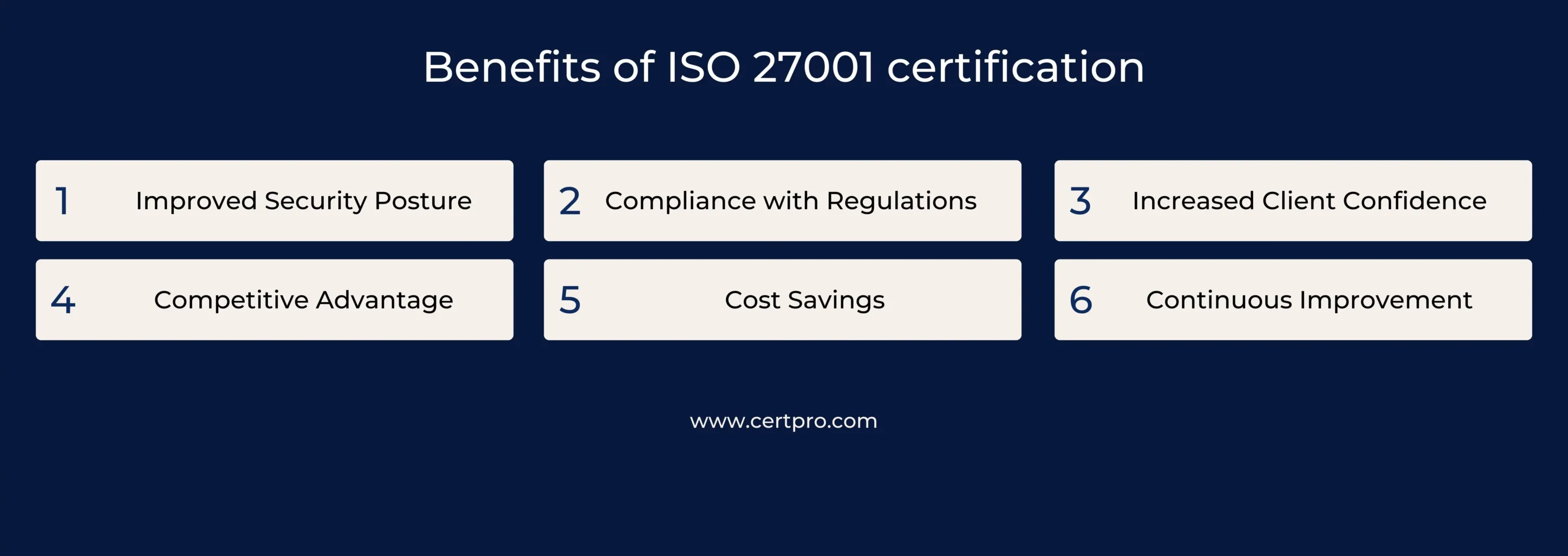
- ✓Improved Information Security Posture
- ✓Market Access and Competitive Differentiation
- ✓Regulatory Compliance and Legal Protection
- ✓Operational Efficiency and Organizational Alignment
ISO 27001 Certification for Specific Industries in Vietnam
ISO 27001 certification applies across all industries in Vietnam that process, store, or transmit sensitive information. However, the standard’s specific relevance varies by industry based on the nature of information assets, applicable regulations, and contractual requirements. Vietnamese organizations in technology, financial services, healthcare, manufacturing, and government sectors each have distinct ISO 27001 implementation contexts that shape audit scope and control priorities.
IT and Software Development Companies
Vietnam’s technology sector is concentrated in Ho Chi Minh City and Hanoi, where thousands of software development companies, IT service providers, and technology outsourcing firms operate. These organizations are primary targets for ISO 27001 certification in Vietnam because their international clients routinely require certification as a condition of contract. ISO 27001 certification for Vietnamese software companies typically covers source code protection, secure development lifecycle controls, access management for development environments, and client data protection.
ISO 27001 certification for IT companies in Vietnam addresses specific risks including unauthorized access to client codebases, intellectual property theft, software supply chain vulnerabilities, and credential compromise in development pipelines. The standard’s technological controls domain includes requirements for secure authentication, network segregation between development and production environments, code review procedures, and patch management that directly address the security risks inherent in software development operations.
Financial Services and Fintech
ISO 27001 certification Vietnam financial services organizations pursue addresses the protection of financial data, transaction records, and personally identifiable information of customers. Vietnamese banks, insurance companies, securities firms, and fintech platforms process high volumes of sensitive financial data that attract sophisticated threat actors. ISO 27001 certification provides these organizations with a structured framework for protecting this data while satisfying State Bank of Vietnam cybersecurity directives and international payment network requirements.
ISO 27001 compliance Vietnam fintech organizations demonstrate covers payment data encryption, fraud detection system security, API security for open banking integrations, mobile application security controls, and cloud security management for infrastructure hosted in Vietnamese or regional data centers. Fintech companies operating in Vietnam’s growing digital payments ecosystem increasingly require ISO 27001 certification to obtain licenses, attract institutional investment, and establish partnerships with traditional financial institutions.
Healthcare and Data Processing Organizations
Healthcare organizations, clinical research companies, and health technology firms operating in Vietnam process sensitive patient data subject to specific legal protections under Vietnamese law and international frameworks including HIPAA for organizations with US clients. ISO 27001 certification for healthcare organizations covers medical record protection, health data access controls, clinical system security, and data transfer security for telemedicine and electronic health record platforms. The standard’s controls for data classification, retention, and secure disposal are particularly relevant for organizations managing health information.
Data Centers and Cloud Service Providers
Vietnam’s growing data center market, driven by data localization requirements under the Law on Cybersecurity and increasing enterprise demand for local cloud infrastructure, creates strong demand for ISO 27001 certification among colocation and cloud service providers. Data center operators with ISO 27001 certification in Vietnam can demonstrate physical security controls, environmental protection measures, access management procedures, and incident response capabilities to enterprise clients evaluating hosting providers.
ISO 27001 certification for cloud service providers in Vietnam complements ISO 27017 (cloud security controls) and ISO 27018 (protection of personal information in cloud services). ISO 27018 is essential for cloud businesses handling personal data, as it outlines rules for data handling, consent management, and privacy protection in cloud environments. Vietnamese cloud providers pursuing ISO 27001 certification alongside ISO 27017 and ISO 27018 demonstrate comprehensive security and privacy governance to enterprise and government clients.
ISO 27001 Audit Process Conducted by CertPro in Vietnam
CertPro conducts ISO 27001 certification audits in Vietnam as a Licensed CPA Firm applying internationally recognized audit standards. The CertPro audit process is structured to evaluate ISMS conformity objectively, produce clear findings, and deliver certification decisions based exclusively on documented audit evidence. CertPro audit teams in Vietnam include qualified lead auditors with ISO 27001 technical expertise and experience across Vietnamese industry sectors.
CertPro ISO 27001 auditors operating in Vietnam hold recognized qualifications including Certified Information Systems Auditor (CISA), ISO/IEC 27001 Lead Auditor certification, and relevant technical credentials in information security. Audit team composition ensures that auditors possess both the technical competence to evaluate information security controls and the auditing skills to assess ISMS management system requirements. Auditor independence is maintained through strict conflict-of-interest policies that prohibit auditors from assessing organizations for which they have provided non-audit services.
CertPro assigns audit team members based on technical competence matching the client organization’s industry and technology environment. Vietnamese financial services organizations receive audit teams with financial sector security expertise; technology companies receive auditors with application security and cloud infrastructure competence. This sector-specific assignment ensures audit findings reflect an accurate assessment of control effectiveness within the specific operational context of each Vietnamese organization.
CertPro auditors collect evidence through four primary methods during ISO 27001 certification audits in Vietnam. Document review examines policies, procedures, risk assessments, audit reports, and management review records for completeness and conformity with ISO 27001 requirements. Personnel interviews assess staff awareness of security procedures, understanding of their ISMS responsibilities, and practical knowledge of implemented controls. Process observation confirms that documented procedures are followed in actual operations. Technical sampling reviews system configurations, access control settings, audit logs, and security monitoring outputs against documented requirements.
Audit evidence is evaluated against the audit criteria defined in the engagement plan, which references ISO/IEC 27001:2022 requirements and the organization’s own documented ISMS requirements. All audit findings are recorded in structured working papers that document the evidence examined, the audit criterion assessed, the finding classification, and the auditor’s objective evaluation. These working papers form the documented basis for the certification decision review and are retained in accordance with CertPro’s audit record retention requirements.
CertPro delivers ISO 27001 certification audits in Vietnam through both on-site and remote audit methodologies, or a combination of both, depending on the audit scope requirements and client operational context. On-site audits are conducted at the organization’s registered facilities in Ho Chi Minh City, Hanoi, Da Nang, or other Vietnamese locations included in the ISMS scope. Remote audit activities cover document review, personnel interviews conducted via secure video conference, and review of system configurations shared through secure screen-sharing tools.
Physical security controls within ISO 27001’s scope, including data center access controls, equipment security, and environmental monitoring systems, require on-site assessment to verify implementation. Technical controls such as network architecture, system configurations, and access management settings may be evaluated through a combination of on-site technical testing and remote review of configuration documentation. The audit plan specifies which activities are conducted on-site versus remotely, ensuring that the audit methodology is appropriate for each element of the ISMS scope.
- ✓Audit Team Qualifications and Independence
- ✓Audit Evidence Collection Methods
- ✓Remote and On-Site Audit Delivery
ISO 27001 vs. Other Information Security Standards Relevant to Vietnam
Vietnamese organizations evaluating information security certifications frequently compare ISO 27001 with other standards including SOC 2, PCI DSS, ISO 27017, ISO 27018, and ISO 27701. Understanding how ISO 27001 differs from and relates to these standards enables organizations to select the most appropriate certification strategy for their specific operational requirements and client obligations.
ISO 27001 vs. SOC 2
ISO 27001 and SOC 2 are both information security assurance frameworks, but they differ in structure, geographic acceptance, and evaluation methodology. ISO 27001 is an internationally recognized management system standard that results in a certificate valid for three years with annual surveillance audits. SOC 2 is an attestation framework developed by the American Institute of Certified Public Accountants (AICPA) that produces a report valid for 12 months. ISO 27001 certification is more widely accepted globally, including in Europe and Asia-Pacific markets. SOC 2 reports are predominantly required by US-based clients.
Vietnamese technology companies serving both US and international clients often pursue both ISO 27001 certification and SOC 2 attestation to satisfy different client requirements. ISO 27001 certification covers a broader set of security domains and requires certification of the entire ISMS, while SOC 2 evaluates controls relevant to defined Trust Services Criteria (security, availability, processing integrity, confidentiality, and privacy). Organizations with both certifications can address the full spectrum of international client security requirements with a single integrated control environment.
ISO 27001 and the ISO 27000 Family
ISO 27001 is the certifiable standard within the ISO/IEC 27000 family of information security standards. ISO 27002 provides detailed implementation guidance for the controls referenced in ISO 27001’s Annex A. ISO 27017 extends ISO 27001 with cloud-specific security controls. ISO 27018 addresses the protection of personal data in cloud environments. ISO 27701 extends ISO 27001 to include privacy information management, creating a Privacy Information Management System (PIMS). Vietnamese organizations operating cloud services or processing personal data benefit from aligning ISO 27001 with these complementary standards.
ISO 27001 also shares foundational principles with ISO 42001, the Artificial Intelligence Management System standard. Both ISO 27001 and ISO 42001 require organizations to manage risk, establish governance frameworks, define policies and roles, and apply the Plan-Do-Check-Act continuous improvement model. Vietnamese technology companies developing or deploying AI systems may find that an existing ISO 27001 ISMS provides a strong foundation for ISO 42001 certification, as many governance and risk management elements are common to both standards.
ISO 27001 and PCI DSS
PCI DSS (Payment Card Industry Data Security Standard) applies specifically to organizations that store, process, or transmit payment card data. ISO 27001 is a broader information security management framework that is not limited to payment data. Vietnamese fintech companies and payment service providers typically require PCI DSS compliance in addition to ISO 27001 certification because payment network rules mandate PCI DSS compliance for all entities handling card data. ISO 27001 and PCI DSS controls have significant overlap, particularly in access management, encryption, network security, and incident response, enabling organizations to build integrated control environments that satisfy both frameworks.
ISO 27001 Certification in Ho Chi Minh City and Hanoi
ISO 27001 certification in Ho Chi Minh City and Hanoi represents the majority of ISO 27001 audit engagements in Vietnam, reflecting the concentration of technology companies, financial institutions, and multinational corporate offices in these two cities. CertPro conducts on-site audit activities at client facilities in both cities, with audit scheduling coordinated to minimize operational disruption while ensuring comprehensive assessment coverage.
Ho Chi Minh City: Technology and Financial Services Hub
Ho Chi Minh City is Vietnam’s primary commercial center and home to the largest concentration of technology companies, fintech startups, and financial institutions in the country. ISO 27001 certification Ho Chi Minh City demand is driven by the city’s large IT outsourcing sector, growing e-commerce platforms, digital payment providers, and the regional headquarters of multinational corporations. Technology parks including Saigon Hi-Tech Park (SHTP) host hundreds of technology companies, many of which pursue ISO 27001 certification to qualify for international contracts.
Financial technology companies headquartered in Ho Chi Minh City operate in a competitive market where ISO 27001 certification differentiates providers in enterprise sales cycles. Vietnamese digital banking platforms, payment aggregators, and lending technology companies in Ho Chi Minh City cite ISO 27001 certification as critical for attracting institutional investors, obtaining payment licenses, and securing partnerships with traditional financial institutions that require certified vendor security management systems.
Hanoi: Government, Defense, and Technology Sector
Hanoi, Vietnam’s capital, hosts government agencies, state-owned enterprises, defense technology companies, and a growing technology sector centered around Hoa Lac Hi-Tech Park. ISO 27001 certification Hanoi demand is driven by government procurement requirements, defense sector security obligations, and the increasing presence of technology companies serving government clients. State-owned enterprises and organizations involved in national critical infrastructure increasingly pursue ISO 27001 certification to comply with Ministry of Information and Communications directives on information security.
Vietnamese technology companies based in Hanoi serving government and public sector clients must demonstrate compliance with information security requirements specified in government procurement frameworks. ISO 27001 certification provides these organizations with recognized credentials that satisfy procurement security requirements without requiring individual security assessments for each government contract. CertPro’s audit teams deliver ISO 27001 certification audits at Hanoi facilities with the same structured evaluation methodology applied nationwide.
How to Obtain ISO 27001 Certification in Vietnam
Obtaining ISO 27001 certification in Vietnam requires organizations to establish a conformant ISMS, complete mandatory documentation, conduct internal audits and management reviews, and successfully complete a two-stage certification audit with an accredited certification body. The following describes the key activities organizations must complete to qualify for ISO 27001 certification audit and achieve successful certification.
Establishing Management Commitment and ISMS Governance
ISO 27001 certification requires demonstrated top management commitment through formal approval and communication of the information security policy, definition of ISMS roles including the appointment of an Information Security Officer or equivalent, allocation of resources required for ISMS operation, and documented management review processes. Organizations seeking ISO 27001 certification in Vietnam must establish this governance structure before ISMS documentation development begins, as all subsequent activities require authorized oversight and approval from designated management roles.
The information security policy must state management’s commitment to satisfying applicable information security requirements and to continually improving the ISMS. The policy must be communicated to all relevant persons within the organization and made available to interested parties as appropriate. Supporting policies covering specific security domains — including access control, cryptography, physical security, supplier relations, and incident management — must be developed, approved, and operationally implemented with staff awareness verified through training records.
Defining ISMS Scope and Conducting Risk Assessment
ISMS scope definition requires organizations to document the boundaries of the ISMS, including the organizational units, locations, assets, processes, and technologies included. The scope statement must address both internal and external factors that affect information security and the requirements of interested parties including clients, regulators, and partners. A clearly defined and documented scope is a prerequisite for ISO 27001 certification audit engagement because the scope determines what CertPro auditors will assess.
The information security risk assessment identifies all relevant information assets within scope, determines the threats and vulnerabilities applicable to each asset, evaluates the likelihood and impact of potential security events, and assigns risk ratings based on documented methodology. Vietnamese organizations must complete a documented risk assessment that covers all information assets within the defined ISMS scope. The risk assessment results must be reviewed and approved by risk owners and retained as evidence for the Stage 1 audit. Risk assessments must be repeated whenever significant changes occur to the ISMS scope or operational environment.
Implementing Controls and Completing Internal Audit
Following risk treatment plan approval, organizations must implement all selected ISO 27001 controls and verify their operational effectiveness. Control implementation must be documented with evidence demonstrating that each control is functioning as intended. Implementation evidence includes system configuration records, training completion logs, physical access control records, incident response test results, and supplier security assessment records. Implementation without corresponding evidence does not satisfy ISO 27001 certification requirements.
Internal audit completion is a mandatory prerequisite for ISO 27001 Stage 2 certification audit. The internal audit program must cover all ISMS requirements and controls within scope. Internal auditors must be independent from the activities they audit and must use documented audit procedures and checklists based on ISO 27001 requirements. Internal audit findings, including identified nonconformities and corrective actions, must be documented and reported to management. At minimum, one complete internal audit cycle producing management review evidence must be completed before CertPro’s Stage 2 audit begins.
- Secure top management commitment and approve information security policy
- Define ISMS scope covering relevant organizational units, locations, and assets
- Conduct information security risk assessment using documented methodology
- Develop risk treatment plan selecting applicable ISO 27001:2022 controls
- Complete Statement of Applicability documenting all 93 controls with applicability justifications
- Implement selected controls and document implementation evidence
- Conduct security awareness training and verify staff completion
- Execute internal audit program covering all ISMS requirements
- Conduct management review with documented decisions and action items
- Engage CertPro for Stage 1 documentation audit
- Address Stage 1 findings and proceed to Stage 2 on-site audit
- Receive certification decision and ISO 27001 certificate issuance
CertPro: ISO 27001 Certification Body in Vietnam
CertPro is a Licensed CPA Firm providing independent ISO 27001 certification audit services to organizations operating in Vietnam. As an ISO 27001 certification body in Vietnam, CertPro delivers audit engagements that evaluate ISMS conformity against ISO/IEC 27001:2022 requirements through structured, evidence-based assessment methodologies. CertPro’s certification services are available to Vietnamese organizations across all industries and all sizes, from technology startups to large enterprise financial institutions.
CertPro’s Audit Methodology and Standards
CertPro conducts ISO 27001 certification audits in Vietnam in accordance with internationally recognized audit standards including ISO/IEC 17021-1 (requirements for bodies providing audit and certification of management systems) and ISO 19011 (guidelines for auditing management systems). These standards govern audit planning, auditor competence requirements, audit evidence collection, finding classification, and certification decision processes. CertPro’s adherence to these meta-standards ensures that ISO 27001 certificates issued to Vietnamese organizations carry internationally recognized credibility.
CertPro’s audit teams possess sector-specific technical expertise covering the full range of Vietnamese industries that pursue ISO 27001 certification. Auditors are assigned to engagements based on demonstrated competence in the client organization’s technology environment and industry sector. All CertPro auditors conducting ISO 27001 certification audits in Vietnam hold ISO 27001 Lead Auditor qualifications and maintain current knowledge of the ISO/IEC 27001:2022 standard requirements and associated guidance documents.
CertPro’s Presence in Vietnam
CertPro delivers ISO 27001 certification audit services across Vietnam, with audit activities conducted at client facilities in Ho Chi Minh City, Hanoi, Da Nang, and other Vietnamese cities as required by the ISMS scope. Remote audit activities supplement on-site assessments where appropriate. CertPro’s Vietnamese audit operations are integrated into its global certification network, ensuring that ISO 27001 certificates issued to Vietnamese organizations are recognized by international clients, regulators, and business partners worldwide.
Organizations seeking ISO 27001 certification audit services from CertPro in Vietnam initiate the engagement by contacting CertPro to discuss ISMS scope, organization size, and certification timeline requirements. CertPro provides a formal audit engagement proposal specifying audit scope, methodology, team composition, timeline, and fees. Upon engagement acceptance, CertPro assigns an audit team and commences the Stage 1 documentation review at the agreed schedule. All audit findings, reports, and certification decisions are delivered in written form with full traceability to audit evidence.
CertPro’s Certification Services Scope
CertPro’s certification audit services in Vietnam cover ISO 27001 initial certification audits, annual surveillance audits, and three-year recertification audits. CertPro also delivers ISO 27001 scope extension audits for organizations seeking to expand their certified ISMS to include additional business units, geographic locations, or service lines. Transfer audits are available for organizations currently certified by another certification body that seek to transfer their certification to CertPro, subject to review of existing audit records and current ISMS conformity assessment.
In addition to ISO 27001, CertPro delivers certification and attestation services for SOC 2, ISO 27017, ISO 27018, ISO 27701, ISO 42001, and other internationally recognized security and privacy frameworks. Vietnamese organizations with multi-framework compliance requirements can consolidate certification audit services with CertPro, enabling coordinated audit scheduling and the efficiency of integrated evidence collection across multiple frameworks. All CertPro certification services are delivered under the strict independence requirements applicable to Licensed CPA Firm operations.
FAQ
▶
What is ISO 27001 certification?
▶
Who needs ISO 27001 certification?
▶
How long does ISO 27001 certification take?
▶
What are the benefits of ISO 27001 certification?
▶
What is the cost of ISO 27001 certification?
▶
How do I prepare for ISO 27001 certification?
▶
What happens after ISO 27001 certification?
HOW COMPLIANCE AUDIT SOFTWARE IMPROVES AUDIT READINESS
Today, most companies deal with a growing number of compliance regulations. From data privacy standards to security frameworks like SOC 2 and ISO 2700…

THE ROLE OF GRC IN ISO 27001, SOC 2, AND OTHER FRAMEWORKS
The term GRC stands for Governance Risk and Compliance. It’s a system of integrated and centralized approaches used by organizations. This system comb…
HOW TO PREPARE FOR A MULTI-STANDARD AUDIT (SOC 2, ISO 27001, HIPAA) WITHOUT OVERLAPPING EFFORTS
The current regulatory landscape is no less than a proving ground for global businesses. Organizations are struggling to comply with the complex regul…
Get In Touch
have a question? let us get back to you.