
ISO 42001 Certification in Copenhagen
ISO 42001:2023 is the first international standard for Artificial Intelligence Management Systems (AIMS). Published by the International Organization for Standardization, it specifies requirements for establishing, implementing, maintaining, and continually improving a structured management framework for AI systems within organizations. ISO 42001 Certification in Copenhagen enables businesses to demonstrate that their AI operations meet globally recognized governance benchmarks — covering transparency, accountability, risk management, and ethical AI deployment.
OUR CLIENTS

What Is ISO 42001 and Why It Matters for Copenhagen Businesses
ISO 42001:2023 is the first international standard for Artificial Intelligence Management Systems (AIMS). Published by the International Organization for Standardization, it specifies requirements for establishing, implementing, maintaining, and continually improving a structured management framework for AI systems within organizations. ISO 42001 Certification in Copenhagen enables businesses to demonstrate that their AI operations meet globally recognized governance benchmarks — covering transparency, accountability, risk management, and ethical AI deployment.
Copenhagen’s AI Economy and the Case for Structured Governance
Copenhagen has established itself as a leading technology and innovation hub in Northern Europe. The city hosts a dense ecosystem of AI startups, fintech enterprises, life sciences companies, and multinational corporations — all of which depend on AI-powered systems for core business functions. As AI adoption accelerates across sectors — from algorithmic trading and predictive analytics to automated customer service and diagnostic tools — the need for a structured, auditable AI management framework becomes operationally critical, not optional.
Copenhagen’s digital infrastructure is among the most advanced in Europe, supported by Denmark’s national AI strategy and sustained investment in data-driven industries. This environment creates both opportunity and regulatory exposure. Organizations deploying AI systems in Copenhagen operate under GDPR requirements enforced by the Danish Data Protection Agency (Datatilsynet), alongside emerging obligations under the EU AI Act, which introduces risk-based classification and compliance requirements for AI systems across all member states. ISO 42001 AI governance frameworks in Copenhagen provide the management structure through which organizations can satisfy these intersecting regulatory demands efficiently.
Regulatory Context: GDPR, the Danish Data Protection Agency, and the EU AI Act
GDPR imposes specific obligations on AI systems that process personal data, including requirements for lawful basis, purpose limitation, data minimisation, and automated decision-making transparency under Article 22. The Danish Data Protection Agency actively enforces these rules and has issued guidance specific to AI-driven profiling and automated processing. Concurrently, the EU AI Act — which came into force in August 2024 with phased obligations through 2026 and 2027 — mandates conformity assessments, transparency documentation, and human oversight for high-risk AI systems. ISO 42001 compliance in Copenhagen provides the systematic documentation and control structure required to demonstrate conformity with both regulatory frameworks simultaneously.
ISO 42001 differs from sector-specific regulations by providing a management system standard — meaning it establishes how an organization manages AI rather than prescribing specific technical outputs. This makes ISO 42001 Certification in Copenhagen applicable across all industries and organization sizes. Certified organizations can present audit-verified evidence of their AI governance practices to regulators, clients, and partners. This reduces the burden of individual regulatory inquiries and strengthens institutional credibility across Copenhagen’s competitive technology market.
Who Needs ISO 42001 Certification in Copenhagen
ISO 42001 Certification is applicable to any organization that develops, deploys, provides, or governs AI-based products and services. In Copenhagen, this includes fintech companies using machine learning for credit scoring, healthcare organizations using AI-assisted diagnostics, logistics firms using predictive routing algorithms, and public sector entities automating administrative decisions. ISO 42001 Certification in Copenhagen is particularly relevant where AI outputs carry legal, financial, or reputational consequences — situations in which documented governance and third-party audit verification provide both operational protection and stakeholder assurance.

ISO 42001 AI Management System (AIMS) Framework — Core Requirements
The ISO 42001 AI Management System (AIMS) framework is structured around the Plan-Do-Check-Act (PDCA) cycle, consistent with other ISO management system standards including ISO 27001 and ISO 9001. This structural alignment enables organizations already certified under related standards to integrate AIMS controls into existing management infrastructure, reducing duplication of governance effort. The AIMS framework defines requirements across context, leadership, planning, support, operations, performance evaluation, and continual improvement — forming a comprehensive governance structure for responsible AI management.
ISO 42001 requires organizations to define the scope of their AIMS by identifying all AI systems under management, the internal and external contexts in which they operate, and the needs and expectations of relevant interested parties — including employees, customers, regulators, and the public. In Copenhagen, this scope definition must account for cross-border data flows subject to GDPR, local regulatory requirements from Datatilsynet, and contractual obligations with EU public sector clients who increasingly mandate AI governance certification as a procurement condition.
The standard also requires a documented AI policy that states the organization’s commitments to responsible AI development, ethical principles, legal compliance, and continual improvement. This policy must be approved by top management, communicated throughout the organization, and made available to relevant external parties. The AI policy serves as the foundational governance document against which all AIMS controls are evaluated during an ISO 42001 audit.
A core operational requirement of ISO 42001 is the conduct of systematic AI risk assessments and AI impact assessments. Risk assessments identify threats to AI system performance, security, fairness, and compliance, and evaluate both likelihood and consequence. AI impact assessments evaluate the potential effects of AI systems on individuals, groups, and society — addressing concerns such as algorithmic bias, privacy intrusion, and erosion of human autonomy. Both assessments must be documented, reviewed at defined intervals, and updated when significant changes occur to AI systems or their operating context.
For Copenhagen organizations subject to the EU AI Act, the AI impact assessment under ISO 42001 maps directly to the conformity assessment and fundamental rights impact assessment requirements for high-risk AI systems. This alignment means that organizations holding ISO 42001 Certification in Copenhagen can leverage existing AIMS documentation to satisfy regulatory assessment obligations — rather than constructing separate compliance evidence from scratch. The ISO 42001 assessment process therefore provides dual-purpose governance value: internal management discipline and external regulatory evidence at the same time.
ISO 42001 specifies operational controls for AI system development and deployment, including requirements for data governance, model validation, human oversight mechanisms, incident response, and supplier management. Annex A of the standard provides a reference set of controls — covering areas such as transparency, accountability, data quality, and system security — from which organizations select applicable controls based on their risk assessment outcomes. Selected controls must be implemented, monitored, and evaluated for effectiveness through internal audit programs and management reviews.
- ✓AI policy development and top management commitment
- ✓Organizational context and interested party analysis
- ✓AI system scope definition and boundary documentation
- ✓AI risk assessment methodology and documented outcomes
- ✓AI impact assessment for ethical, social, and legal effects
- ✓Annex A control selection and Statement of Applicability
- ✓Data governance and training data quality management
- ✓Human oversight and intervention mechanisms
- ✓Internal audit program and management review process
- ✓Nonconformity management and corrective action tracking
- ✓Continual improvement planning and performance metrics
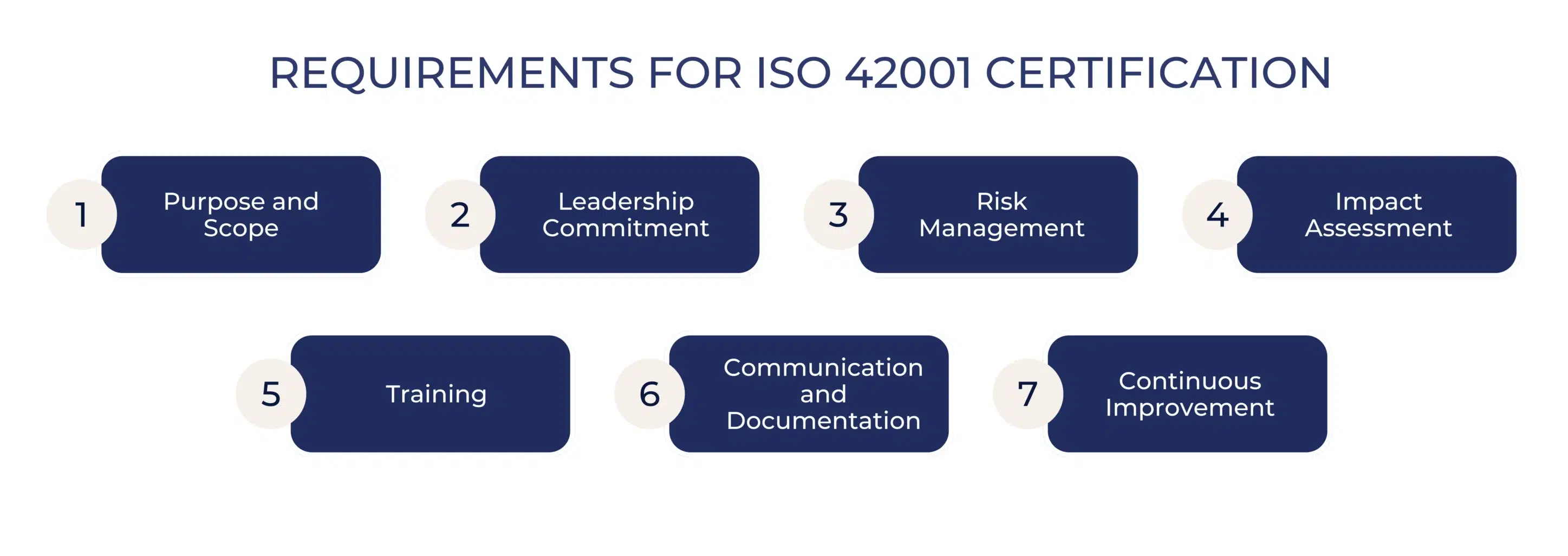
- ✓Scope Definition and Organizational Context
- ✓Risk Assessment and AI Impact Assessment Requirements
- ✓Controls, Performance Evaluation, and Continual Improvement
ISO 42001 Certification Benefits for Copenhagen Organizations
ISO 42001 Certification delivers measurable governance, commercial, and regulatory benefits to organizations operating in Copenhagen’s competitive AI economy. Certification provides third-party verified evidence that an organization’s AI management practices meet international standards — a distinction that carries increasing weight with institutional clients, public procurement authorities, and regulatory bodies. The benefits of ISO 42001 Certification in Copenhagen extend across organizational levels, from board-level risk management to operational AI team practices.
Certification under ISO 42001 demonstrates to clients, partners, investors, and regulators that an organization governs its AI systems with documented accountability and independent audit verification. In Copenhagen’s fintech sector — where AI systems directly influence credit decisions, fraud detection, and customer risk profiling — this trust signal carries direct commercial value. Organizations holding ISO 42001 Certification in Copenhagen can cite it in client contracts, RFP responses, and regulatory submissions as evidence of governance maturity, reducing the time and cost of individual due diligence processes.
For multinational enterprises operating in Copenhagen, ISO 42001 certification supports cross-border partnership agreements by providing a universally recognized governance benchmark. European institutional partners and public sector procurement offices increasingly require AI governance certification as a condition of contract. Certified organizations bypass lengthy individual assessments by presenting their ISO 42001 certificate and supporting audit documentation — accelerating procurement timelines and reducing administrative overhead associated with vendor qualification processes.
ISO 42001 compliance in Copenhagen supports organizations in maintaining documented evidence of AI governance practices that satisfy multiple regulatory requirements simultaneously. GDPR accountability obligations under Article 5(2) require that organizations demonstrate compliance with data protection principles — ISO 42001’s AI impact assessment and data governance controls provide structured evidence for this purpose. Similarly, the EU AI Act’s requirements for technical documentation, transparency, and human oversight of high-risk AI systems are addressed directly by ISO 42001 AIMS controls, creating an integrated compliance posture rather than fragmented regulatory responses.
Organizations holding ISO 42001 Certification can demonstrate to Datatilsynet that AI systems processing personal data are governed by a certified management system with independently verified controls. This documentation significantly strengthens an organization’s position in the event of a regulatory inquiry or data subject complaint involving automated decision-making. Proactive certification under ISO 42001 reduces legal exposure by establishing a documented, audit-verified baseline of responsible AI governance before regulatory scrutiny occurs.
Copenhagen’s AI market is increasingly stratified between certified and uncertified organizations. As enterprise clients, financial institutions, and public sector bodies standardize AI governance requirements in their procurement criteria, ISO 42001 certification functions as a market access credential — distinguishing certified organizations from competitors who have not yet established independently verified governance frameworks. AI management system certification in Copenhagen positions organizations at the forefront of responsible AI adoption, enabling participation in high-value contracts where governance certification is a qualification threshold rather than a differentiating feature.
- ✓Third-party verified AI governance for client and partner assurance
- ✓Structured documentation supporting GDPR accountability compliance
- ✓Evidence base for EU AI Act conformity assessment obligations
- ✓Accelerated procurement qualification in public and enterprise sectors
- ✓Reduced regulatory inquiry risk through certified management practices
- ✓Board-level risk visibility through systematic AI impact assessment
- ✓Operational consistency in AI development and deployment processes
- ✓Strengthened investor confidence through governance transparency
- ✓Cross-border partnership qualification under international AI governance standards
- ✓Continual improvement framework for evolving AI risk environments
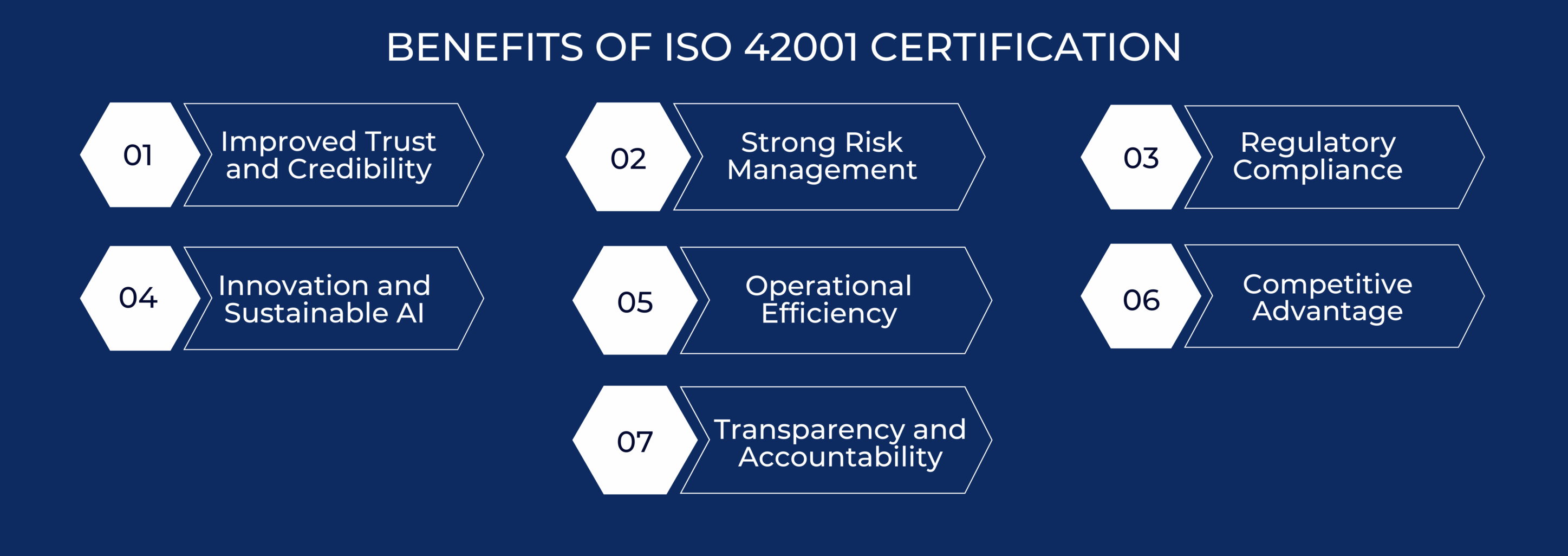
- ✓Trust, Transparency, and Stakeholder Confidence
- ✓Regulatory Readiness and Legal Risk Reduction
- ✓Competitive Advantage in Copenhagen’s AI Market
ISO 42001 Compliance and Regulatory Alignment in Copenhagen
ISO 42001 compliance in Copenhagen operates within a multilayered regulatory environment that includes GDPR, the EU AI Act, sector-specific Danish regulations, and emerging European standards for algorithmic accountability. The AIMS framework is specifically designed to function as an integrating governance layer — connecting technical AI controls to legal obligations, organizational policies, and third-party audit evidence. Understanding how ISO 42001 maps to specific regulatory requirements is essential for Copenhagen organizations seeking a unified compliance posture.
ISO 42001 and GDPR Alignment
GDPR applies directly to AI systems that process personal data, which encompasses the vast majority of machine learning models trained on customer, employee, or user datasets. GDPR Article 22 grants data subjects the right not to be subject to solely automated decisions that produce significant legal or similarly significant effects, with exceptions requiring appropriate safeguards. ISO 42001’s controls for human oversight, transparency, and AI impact assessment directly address the documentation and operational requirements for these GDPR safeguards. Organizations with ISO 42001 Certification in Copenhagen can reference AIMS documentation — including AI impact assessments and human intervention procedures — as evidence of Article 22 compliance measures.
Data minimisation, purpose limitation, and storage limitation principles under GDPR apply to AI training datasets and inference pipelines. ISO 42001’s data governance controls require documented data quality management procedures, data lineage tracking, and dataset review processes — providing the structured documentation Datatilsynet requires when auditing AI systems that process personal data. This overlap makes ISO 42001 an operationally efficient vehicle for demonstrating GDPR accountability, particularly for organizations processing large volumes of personal data within AI systems.
ISO 42001 and EU AI Act Obligations
The EU AI Act classifies AI systems by risk level — unacceptable risk (prohibited), high risk (subject to conformity assessment), limited risk (transparency obligations), and minimal risk (no specific obligations). High-risk AI systems — including those used in credit scoring, employment screening, education assessment, law enforcement, and critical infrastructure management — face mandatory technical documentation, conformity assessment, human oversight, and post-market monitoring requirements. ISO 42001 Certification for Copenhagen financial services and other high-risk AI users provides the documented control framework that directly supports EU AI Act conformity assessments for these system categories.
The EU AI Act requires providers and deployers of high-risk AI systems to establish quality management systems with documented risk management procedures, data governance practices, and transparency documentation — requirements that align structurally with ISO 42001 AIMS requirements. Organizations certified under ISO 42001 have already implemented the management system infrastructure required for EU AI Act compliance, creating significant efficiency advantages over organizations that must construct regulatory documentation without an existing certified framework. The phased implementation timeline of the EU AI Act — with full obligations applying to most high-risk systems from August 2026 — makes ISO 42001 Certification in Copenhagen a timely strategic priority.
| Regulatory Framework | Key Obligation | ISO 42001 AIMS Control Alignment |
|---|---|---|
| GDPR Article 22 | Safeguards for automated decision-making | Human oversight controls and AI impact assessment |
| GDPR Article 5(2) | Accountability for data processing principles | Documented AI policy and management review records |
| EU AI Act — High-Risk Systems | Quality management system and technical documentation | AIMS scope, risk assessment, and Annex A controls |
| EU AI Act — Transparency | Disclosure obligations for certain AI applications | Transparency controls and communication procedures |
| Datatilsynet Guidelines | Documentation of AI processing activities | AIMS audit records and impact assessment documentation |
Integration with ISO 27001 and Other Management Systems
ISO 42001 shares the High-Level Structure (HLS) common to all ISO management system standards, enabling direct integration with ISO 27001 (Information Security), ISO 9001 (Quality Management), and ISO 31000 (Risk Management). Copenhagen organizations already certified under ISO 27001 can integrate AIMS controls into their existing information security management system infrastructure — reusing roles, policies, audit programs, and review processes rather than constructing a parallel governance structure. This integration reduces the incremental cost and administrative effort required to achieve ISO 42001 Certification for organizations with mature ISO 27001 programs.
ISO 42001 Certification Process — Step-by-Step
The ISO 42001 certification process follows a structured sequence of evaluation stages — from initial scope definition through certification issuance and ongoing surveillance. Each stage produces documented evidence that is reviewed and verified by an accredited certification body. CertPro, as a Licensed CPA Firm, conducts ISO 42001 certification audits in Copenhagen according to this defined process, ensuring that each stage meets the requirements of ISO 42001:2023 and applicable accreditation standards.
The certification process begins with formal scope definition — identifying all AI systems, processes, and organizational units included within the AIMS boundary. The scope document must specify the AI systems under management, the organizational context, and the interfaces with external parties including data suppliers, technology providers, and regulatory bodies. The ISO 42001 gap analysis that Copenhagen organizations undergo at this stage establishes the current state of AIMS documentation and controls against the requirements of the standard, identifying areas requiring development before formal audit stages commence.
Stage 1 also includes a comprehensive review of mandatory documentation — including the AI policy, risk assessment records, AI impact assessment documentation, Annex A control selection and Statement of Applicability, and management review minutes. The Stage 1 ISO 42001 audit evaluates whether the AIMS documentation is sufficient and whether the organization is ready to proceed to operational control testing in Stage 2. Significant documentation gaps identified in Stage 1 must be addressed before Stage 2 proceeds. Stage 1 findings are documented in a formal audit report with specific reference to clause requirements.
The Stage 2 audit evaluates the effective implementation and operational effectiveness of AIMS controls in practice. This stage involves direct evidence review — examining AI system documentation, training data records, model validation reports, incident logs, and internal audit records — alongside interviews with personnel responsible for AI governance, development, and operations. The ISO 42001 audit process in Copenhagen at Stage 2 verifies that documented controls are functioning as intended and that the organization’s actual AI governance practices conform to its stated AIMS policies and procedures.
During Stage 2, the certification auditor identifies and classifies any nonconformities — distinguishing major nonconformities (which indicate a fundamental failure of an AIMS requirement and must be resolved before certification is issued) from minor nonconformities (which represent isolated control gaps requiring corrective action within a defined timeframe). The Stage 2 audit report documents all findings, evidence reviewed, and the auditor’s assessment of AIMS effectiveness. Certification is issued only when all major nonconformities have been resolved and verified.
Upon successful completion of Stage 2, CertPro issues an ISO 42001 certificate with a three-year validity period, subject to annual surveillance audits. Surveillance audits — conducted in years one and two of the certification cycle — verify that the AIMS continues to function effectively, that corrective actions from previous audits have been implemented, and that the organization’s AI systems and governance practices remain within the certified scope. Significant changes to AI systems, organizational structure, or regulatory context may trigger additional audit activity outside the standard surveillance schedule.
- Scope Definition — Identify AI systems, organizational units, and AIMS boundaries
- AIMS Documentation Development — AI policy, risk assessments, impact assessments, Statement of Applicability
- Internal Audit — Organization-led review of AIMS controls against ISO 42001 requirements
- Management Review — Top management evaluation of AIMS performance and improvement priorities
- Stage 1 Audit — Certification body review of documentation readiness and scope adequacy
- Stage 2 Audit — Operational control verification and effectiveness assessment
- Nonconformity Resolution — Corrective actions for audit findings before certification decision
- Certification Decision — Issuance of ISO 42001 certificate upon verified conformity
- Surveillance Audit (Year 1) — Ongoing conformity verification and corrective action follow-up
- Surveillance Audit (Year 2) — Continued AIMS effectiveness assessment
- Recertification Audit (Year 3) — Full AIMS re-evaluation for certificate renewal
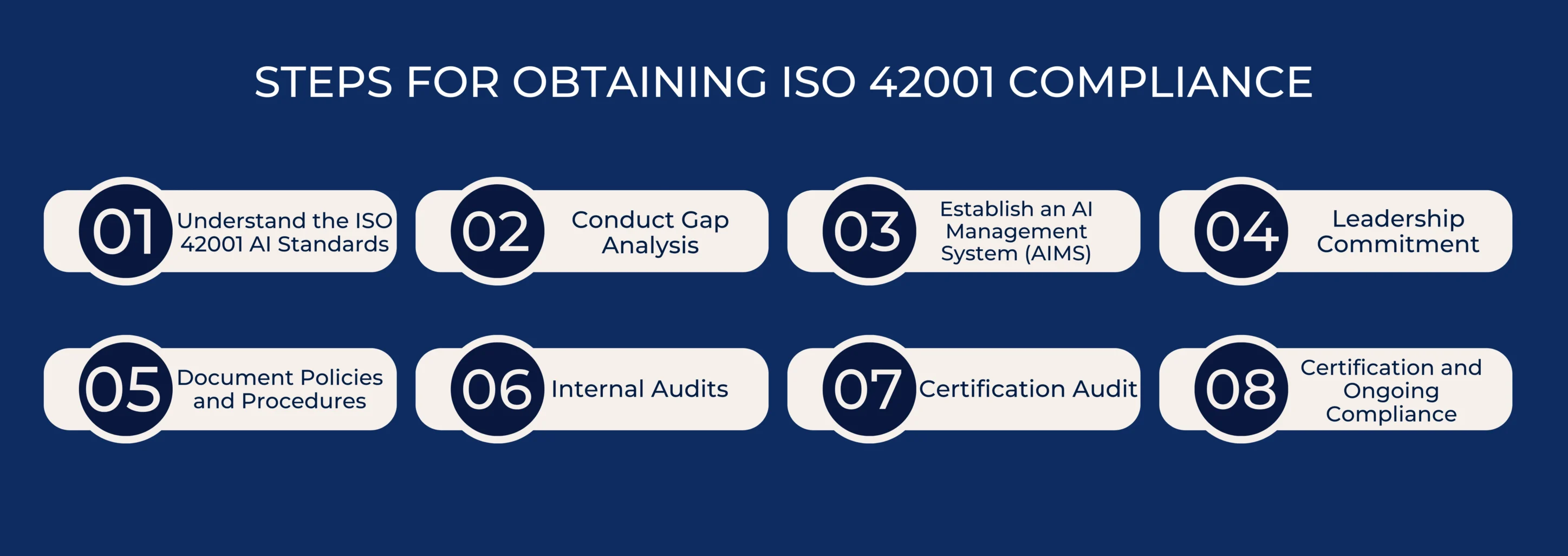
- ✓Stage 1: Scope Definition and Documentation Review
- ✓Stage 2: Operational Audit and Control Verification
- ✓Certification Issuance, Surveillance Audits, and Recertification
ISO 42001 Audit in Copenhagen — What to Expect
An ISO 42001 audit conducted by CertPro in Copenhagen is a systematic, evidence-based evaluation of an organization’s AI Management System against the requirements of ISO 42001:2023. The audit process is structured, transparent, and follows internationally recognized audit standards — ensuring that findings are objective, reproducible, and defensible. Understanding what an ISO 42001 audit involves enables organizations to prepare documentation and operational evidence in advance, reducing disruption to day-to-day AI operations during the audit process.
Audit Scope and Evidence Requirements
The ISO 42001 assessment evaluates AIMS documentation, implementation records, and operational practices across all clauses of the standard. Key evidence categories include: the AI policy and its communication records; risk assessment methodology and documented outcomes; AI impact assessment reports; Annex A control selection documentation and Statement of Applicability; training data governance records; model validation and testing documentation; incident management records; internal audit reports; and management review minutes. Auditors verify that evidence is current, complete, and consistent with the organization’s stated AIMS scope and policies.
The ISO 42001 audit process in Copenhagen also includes personnel interviews with AI system owners, data governance leads, risk management personnel, and executive sponsors. These interviews verify that AIMS requirements are understood and implemented at the operational level — not merely documented in policies that are disconnected from actual practice. The auditor’s assessment of interview responses is combined with documentary evidence to form a complete picture of AIMS effectiveness across the certified scope.
Audit Timeline and Duration
The duration of an ISO 42001 audit in Copenhagen depends on the number of AI systems within scope, organizational complexity, and the maturity of existing documentation. For small and medium-sized organizations with a limited number of AI systems and mature documentation, the combined Stage 1 and Stage 2 audit process typically requires two to four days of auditor time. Larger organizations with complex AI portfolios or multiple business units within scope may require five to ten days of audit activity across the two stages. The total elapsed time from audit initiation to certification issuance typically ranges from eight to sixteen weeks, including time for documentation review, nonconformity resolution, and certification decision processes.
Nonconformity Classification and Resolution
ISO 42001 audit findings are classified according to severity. A major nonconformity indicates the absence of a required AIMS element or a systematic failure in control implementation — for example, the absence of a documented AI impact assessment for a high-risk AI system within scope, or a complete lack of management review records. Major nonconformities must be resolved with verified corrective action before the certification decision proceeds. A minor nonconformity indicates an isolated control gap or procedural inconsistency that does not indicate systematic AIMS failure — these are addressed within a defined timeframe following certification issuance. Observations are non-mandatory improvement suggestions noted by the auditor during the ISO 42001 assessment.
Industries Served in Copenhagen
ISO 42001 Certification in Copenhagen is applicable across all sectors deploying AI systems in business operations, customer interactions, or regulatory-facing activities. Copenhagen’s diverse economy encompasses industries for which AI governance certification carries particular operational and regulatory significance. CertPro conducts ISO 42001 certification audits across the following industry sectors in Copenhagen, each with distinct AI governance requirements and regulatory exposures.
| Industry | Common AI Applications | Key ISO 42001 Governance Requirement |
|---|---|---|
| Financial Services / Fintech | Credit scoring, fraud detection, algorithmic trading | Bias assessment, model validation, human oversight documentation |
| Healthcare / Life Sciences | Diagnostic AI, patient risk stratification, drug discovery | AI impact assessment, data quality governance, clinical oversight records |
| Public Sector | Automated administrative decisions, resource allocation | Transparency documentation, appeal mechanisms, accountability records |
| Logistics / Supply Chain | Predictive routing, demand forecasting, inventory optimization | Data governance, operational risk assessment, supplier AI management |
| Technology / Software | AI product development, SaaS AI features, LLM deployment | Full AIMS implementation, customer transparency, incident response |
ISO 42001 Certification for Copenhagen Fintech and Financial Services
Copenhagen’s fintech sector is one of the most active in Northern Europe, with numerous companies deploying AI systems for credit decisioning, anti-money laundering, fraud detection, and personalized financial product recommendations. ISO 42001 Certification in Copenhagen for financial services organizations provides documented evidence that AI systems influencing financial decisions are governed by structured risk assessment, bias evaluation, and human oversight controls — directly addressing the accountability requirements of both GDPR and the EU AI Act’s high-risk AI classification for credit scoring systems.
Financial regulators and institutional partners in Denmark and across the EU increasingly require evidence of AI governance maturity as part of vendor due diligence and regulatory examination processes. ISO 42001 Certification for Copenhagen companies in the financial services sector provides the standardized, third-party verified documentation that satisfies these requirements efficiently. Certified fintech organizations can present audit reports and certification evidence in lieu of responding to individual due diligence questionnaires — streamlining regulatory interactions and accelerating enterprise sales cycles.
Public Sector and Healthcare AI Governance in Copenhagen
Copenhagen’s public sector organizations — including municipal authorities, healthcare systems, and educational institutions — deploy AI systems for case management, resource allocation, diagnostic support, and administrative automation. These applications frequently involve personal data and decisions with direct impact on citizens’ rights, benefits, and health outcomes, placing them squarely within the high-risk AI categories of the EU AI Act. ISO 42001 compliance for public sector organizations in Copenhagen establishes the documented governance framework required to operate these systems lawfully under both GDPR and the EU AI Act, while building public trust in algorithmic decision-making processes.
Why CertPro for ISO 42001 Certification in Copenhagen
CertPro is a Licensed CPA Firm providing ISO 42001 certification audit services in Copenhagen. CertPro conducts structured, evidence-based AIMS audits according to ISO 42001:2023 requirements and applicable accreditation standards. CertPro’s positioning as a certification body — distinct from consulting or advisory services — ensures that the audit process maintains independence, objectivity, and compliance with international certification body requirements. Organizations seeking ISO 42001 Certification in Copenhagen engage CertPro for the conduct of formal Stage 1 and Stage 2 audits, certification issuance, surveillance audits, and recertification.
Certification Body Authority and Audit Independence
ISO 42001 certification body services provided by CertPro in Copenhagen are delivered in accordance with ISO/IEC 17021-1, the international standard for certification body requirements, which mandates audit impartiality, competence, and consistent application of certification criteria. CertPro auditors conducting ISO 42001 audits in Copenhagen hold demonstrable competence in AI governance, risk management, and the technical domains relevant to the industries served. Audit findings are documented with specific evidence references, enabling organizations to understand exactly which requirements are satisfied and which require corrective action — without ambiguity or interpretive inconsistency.
CertPro’s designation as an ISO 42001 certification body in Copenhagen means that certificates issued are recognized by international accreditation bodies. This enables certified Copenhagen organizations to present their certificates in cross-border commercial and regulatory contexts without requiring re-examination by foreign certification bodies. This recognition is particularly valuable for Copenhagen-based multinational enterprises with AI governance obligations across multiple EU and non-EU jurisdictions, where a single accredited certificate eliminates the need for country-by-country certification duplication.
ISO 42001 Consulting Copenhagen and Audit Services: Understanding the Distinction
A critical distinction governs engagement with CertPro: CertPro provides certification audit services, not ISO 42001 consulting advisory services in Copenhagen. ISO 42001 consulting services — which involve building AIMS documentation, implementing controls, and preparing organizations for audit — are provided by separate specialist firms to maintain auditor independence. Organizations seeking both AIMS implementation support and certification should engage a consulting firm for AIMS development activities and CertPro separately as the independent certification body conducting the formal ISO 42001 audit and issuing the certificate. This separation preserves audit integrity and is required by ISO/IEC 17021-1 impartiality requirements.
CertPro’s Scope of ISO 42001 Audit Services in Copenhagen
CertPro conducts the full spectrum of ISO 42001 audit activities in Copenhagen: Stage 1 documentation review audits, Stage 2 operational implementation audits, certification decision processes, certificate issuance, annual surveillance audits, and three-year recertification audits. CertPro also conducts ISO 42001 assessment activities in Copenhagen for organizations seeking an independent evaluation of AIMS conformity prior to formal certification. This structured evaluation provides audit findings without certificate issuance — a formal tool for organizations validating their AIMS maturity against the standard before entering the certification cycle.
- ✓Licensed CPA Firm with established certification body authority
- ✓ISO/IEC 17021-1 compliant audit processes for AIMS certification
- ✓Auditor competence in AI governance, risk management, and sector-specific applications
- ✓Structured Stage 1 and Stage 2 audit methodology with documented evidence review
- ✓Internationally recognized certification accepted across EU jurisdictions
- ✓Annual surveillance audit program maintaining certificate currency
- ✓ISO 42001 assessment services in Copenhagen for pre-certification evaluation
- ✓Industry expertise across fintech, healthcare, public sector, and technology
- ✓Transparent audit findings with specific clause-referenced evidence documentation
- ✓Recertification audit services for certificate renewal at three-year intervals
ISO 42001 Certification Costs and Pricing in Copenhagen
The cost of ISO 42001 Certification in Copenhagen is determined by a set of structured factors that reflect the scope and complexity of the certification audit required. CertPro provides fixed, transparent pricing based on an assessment of organizational parameters — enabling organizations to obtain definitive cost information before committing to the certification process. Understanding the cost structure enables Copenhagen organizations to budget appropriately and evaluate the return on investment of ISO 42001 Certification against the commercial and regulatory benefits described above.
Primary Cost Factors for ISO 42001 Certification
The primary determinants of ISO 42001 certification cost in Copenhagen are: (1) the number of AI systems within the certification scope — each additional system increases audit complexity and auditor time requirements; (2) organizational size, measured by headcount and the number of personnel involved in AI development and governance; (3) the maturity of existing AIMS documentation and controls — organizations with well-developed documentation require less auditor time than those with nascent governance structures; and (4) the complexity of AI technologies deployed, including whether AI systems include custom-developed models, third-party AI services, or combinations of both.
Additional cost factors include whether the organization is pursuing ISO 42001 as a standalone certification or as an integrated audit alongside existing ISO 27001 or ISO 9001 certification programs. Integrated multi-standard audits provide significant cost efficiencies by combining shared audit activities — such as management review evaluation, internal audit program review, and organizational context assessment — reducing total auditor time compared to separate certification processes. CertPro provides detailed pricing for ISO 42001 certification audits in Copenhagen following an initial scope evaluation, ensuring that organizations receive accurate cost estimates based on their specific AIMS configuration.
Cost Range Guidance for Copenhagen Organizations
| Organization Size | AI Systems in Scope | Estimated Audit Duration | Approximate Certification Cost Range |
|---|---|---|---|
| Small (1–50 employees) | 1–3 AI systems | 2–3 audit days | €3,000 – €8,000 |
| Medium (51–250 employees) | 3–8 AI systems | 3–6 audit days | €8,000 – €18,000 |
| Large (251+ employees) | 8+ AI systems | 6–12 audit days | €18,000 – €40,000+ |
The cost ranges above reflect Stage 1 and Stage 2 audit fees combined and do not include annual surveillance audit fees (typically 30–40% of initial certification cost per year) or recertification audit fees at the three-year mark (typically 70–80% of initial certification cost). Organizations should also budget for internal AIMS development costs — including documentation preparation, internal audit activities, and management review processes — which are incurred prior to engaging CertPro for formal ISO 42001 certification audit services. These internal preparation costs vary significantly based on existing governance infrastructure and are not included in CertPro’s certification pricing.
FAQ
▶
What is ISO 42001 certification?
▶
How long does ISO 42001 certification take in Copenhagen?
▶
What is the cost of ISO 42001 certification in Copenhagen?
▶
Which organizations in Copenhagen need ISO 42001?
▶
How does ISO 42001 relate to GDPR and the EU AI Act?
▶
What does an ISO 42001 audit involve?
▶
What is an ISO 42001 assessment, and how does it differ from certification?
▶
What is the difference between ISO 42001 and ISO 27001 for Copenhagen organizations?

MindSec Launches AI Compliance for Law 25 & ISO 42001
Excerpt from Barchart Article, Published on December 3, 2025 Today, Canadian organizations face increasing pressure to comply with stringent privacy a…

UNDERSTANDING ISO 42001: A GUIDE FOR RESPONSIBLE AI MANAGEMENT SYSTEMS
The invention of artificial intelligence (AI) has changed the operational processes of many industries. However, the rapid growth of technology increa…
ENSURING AI DATA PRIVACY COMPLIANCE WITH ISO 42001
According to Stanford’s AI report, the private AI investment in the U.S. alone reached more than $109 billion last year, which is equal to 12 times th…
Get In Touch
have a question? let us get back to you.