
SOC 2 Certification in Denmark
SOC 2 Certification in Denmark delivers structured, independently verified assurance that supports commercial growth, customer trust, and risk management objectives across multiple dimensions. Danish organizations that hold a current SOC 2 attestation report are positioned to respond to enterprise customer security questionnaires, vendor due diligence assessments, and procurement requirements with auditor-issued documentation rather than self-attested representations. The benefits of SOC 2 Certification extend across sales cycles, regulatory context, internal governance, and market expansion activities.
OUR CLIENTS




What SOC 2 Certification Means for Organizations in Denmark
SOC 2 Certification in Denmark is a formal attestation issued by a Licensed CPA Firm confirming that an organization’s internal controls have been independently examined and found to meet the AICPA Trust Services Criteria (TSC) — covering security, availability, processing integrity, confidentiality, and privacy. The attestation is governed by the American Institute of Certified Public Accountants (AICPA) under AT-C Section 105 and AT-C Section 205, which define the standards applicable to a SOC 2 examination. For Danish organizations, this attestation provides structured, third-party evidence of control effectiveness. It is particularly relevant for entities serving international clients, handling sensitive data, or operating within regulated sectors across Denmark and the European Union. SOC 2 Certification in Denmark is not a regulatory mandate under Danish law, but it functions as a widely recognized standard of control assurance in commercial, contractual, and vendor risk management contexts.
Denmark’s digital economy encompasses a broad range of organizations for which SOC 2 attestation holds direct commercial relevance. SaaS providers headquartered in Copenhagen, fintech firms operating across Aarhus and Odense, cloud infrastructure companies in Aalborg, pharmaceutical and life sciences organizations, healthcare technology providers, cybersecurity firms, telecommunications providers, data center operators, e-commerce businesses, AI companies, and gaming companies each face growing customer expectations around demonstrated control assurance. As Danish organizations expand into the United States, the United Kingdom, and broader European markets, customers and enterprise procurement teams increasingly require a current SOC 2 report as a condition of contract. SOC 2 Certification in Denmark directly addresses these requirements by providing an independently issued attestation report that documents control design, operating effectiveness, and the auditor’s conclusions based on evidence gathered during the examination period.
The Trust Services Criteria established by the AICPA define the control requirements against which a SOC 2 examination is conducted. The Security criterion — also referred to as the Common Criteria — is mandatory for all SOC 2 examinations. Organizations may elect to include additional criteria covering availability, processing integrity, confidentiality, and privacy based on the nature of their services and the commitments made to customers. Danish organizations that process personal data under the EU General Data Protection Regulation (GDPR) or the Danish Data Protection Act (Databeskyttelsesloven) frequently include the Privacy criterion within their SOC 2 scope to demonstrate alignment between their control environment and their data handling commitments. The NIS2 Directive and the Digital Operational Resilience Act (DORA) similarly drive demand for structured, independently verified assurance among Danish financial institutions, critical infrastructure operators, and digital service providers. SOC 2 attestation does not constitute legal compliance with these frameworks, but it provides documented, auditor-verified evidence of a functioning control environment that supports broader governance and risk management programs.
CertPro CPA LLC is a Licensed CPA Firm that conducts independent SOC 2 examinations for organizations operating in Denmark and across international markets. The firm performs SOC 2 audits in accordance with AICPA attestation standards and the Trust Services Criteria, issuing Type 1 and Type 2 attestation reports based on the scope, observation period, and control environment defined for each engagement. The SOC 2 examination conducted by CertPro is an independent audit function — the firm does not provide consulting, implementation, remediation, or advisory services as part of the engagement. Organizations that have developed and operated their control environment are examined against the applicable Trust Services Criteria, with the auditor evaluating evidence, testing control operating effectiveness, and issuing a formal attestation report upon completion of the examination.

ENQUIRE NOW
Related Resources
Related Services in Denmark
What Is SOC 2 Certification?
SOC 2 Certification is the outcome of a SOC 2 examination conducted by a Licensed CPA Firm under the AICPA’s attestation standards. The term “SOC” stands for System and Organization Controls, and a SOC 2 report specifically addresses the controls at a service organization relevant to security, availability, processing integrity, confidentiality, or privacy. The SOC 2 framework is distinct from certification frameworks such as ISO 27001: rather than producing a certificate, it produces an attestation report issued by an independent CPA firm. This report contains the auditor’s opinion on whether the organization’s controls were suitably designed and — in the case of a Type 2 report — operating effectively over a defined observation period. The phrase “SOC 2 Certification” is widely used in commercial and vendor assurance contexts to refer to an organization holding a current, clean SOC 2 attestation report.
SOC 2 Type 1 and SOC 2 Type 2 Reports
SOC 2 Type 1 Denmark engagements assess whether an organization’s controls are suitably designed to meet the applicable Trust Services Criteria as of a specific point in time. The Type 1 report does not include evidence of operating effectiveness over a period — it reflects a design-level evaluation conducted at a single date. SOC 2 Type 1 Denmark reports are commonly used by organizations pursuing SOC 2 attestation for the first time, providing customers with documented evidence that their control environment is formally structured and has been independently evaluated. Type 1 reports are also referenced in procurement and contract discussions where a full Type 2 observation period has not yet been completed.
SOC 2 Type 2 Denmark engagements cover both the design and the operating effectiveness of controls over a defined observation period, typically ranging from six to twelve months. The auditor evaluates whether controls not only exist and are suitably designed, but also whether they functioned as intended throughout the observation period. Evidence is gathered through inquiry, observation, inspection of documentation, and re-performance of control procedures. SOC 2 Type 2 Denmark reports carry significantly greater weight in enterprise vendor assessments, financial services vendor due diligence, and US-market customer requirements than Type 1 reports. This is because they demonstrate sustained control performance rather than a point-in-time design review. Most Danish organizations targeting US enterprise customers, financial services clients, or regulated sector contracts pursue SOC 2 Type 2 attestation.
Trust Services Criteria: The Foundation of SOC 2 Compliance
SOC 2 compliance is structured around the AICPA Trust Services Criteria, which define the control requirements that organizations must satisfy during a SOC 2 examination. The five Trust Services Criteria categories are Security, Availability, Processing Integrity, Confidentiality, and Privacy. The Security category — comprising the Common Criteria — is mandatory for all SOC 2 examinations. It addresses logical and physical access controls, system operations, change management, risk assessment, and monitoring activities. Organizations select additional criteria categories based on the services they provide and the commitments documented in their system description and customer agreements. Danish SaaS providers frequently include Availability and Confidentiality, while organizations processing personal data under GDPR commonly include Privacy as a criterion within their SOC 2 scope.
| Trust Services Criterion | Scope Focus | Relevant Danish Sectors |
|---|---|---|
| Security (Common Criteria) | Access controls, system operations, change management, risk assessment | All sectors — mandatory for every SOC 2 examination |
| Availability | System uptime, performance monitoring, incident response | Cloud providers, SaaS, data centers, telecommunications |
| Processing Integrity | Complete, valid, and authorized system processing | Fintech, payment processors, healthcare technology |
| Confidentiality | Protection of confidential information throughout its lifecycle | Pharmaceutical, legal, financial services, SaaS |
| Privacy | Collection, use, retention, and disposal of personal data | Healthcare, HR tech, e-commerce, AI companies |
SOC 2 Certification Audit Process in Denmark
The SOC 2 audit process in Denmark follows a structured sequence of evaluation stages defined by AICPA attestation standards. Each stage of the SOC 2 examination is conducted by the Licensed CPA Firm acting as the independent auditor. The process begins with scope definition and concludes with the issuance of a formal attestation report. Organizations undergoing a SOC 2 audit in Denmark are responsible for maintaining their control environment, producing evidence of control operation, and cooperating with auditor requests throughout the examination period. The auditor’s role is strictly evaluative — the CPA firm does not design controls, implement systems, or advise on remediation activities.
- Scope Definition: The auditor and organization management define the systems, processes, locations, and Trust Services Criteria categories subject to the SOC 2 examination. System description boundaries are established at this stage.
- Audit Program Determination: The Licensed CPA Firm develops the audit program specifying the control objectives, control activities, and testing procedures applicable to the defined scope and selected Trust Services Criteria.
- System Description Review: Management prepares the system description covering system components, boundaries, principal service commitments, and relevant aspects of the control environment. The auditor evaluates the completeness and accuracy of this description.
- Control Design Evaluation (Type 1): The auditor assesses whether identified controls are suitably designed to meet the applicable Trust Services Criteria as of the evaluation date.
- Observation Period (Type 2): For Type 2 engagements, the auditor conducts control testing across the full observation period — typically six to twelve months — using inquiry, inspection, observation, and re-performance procedures.
- Evidence Collection and Testing: The auditor gathers documentary and system-generated evidence to support conclusions about control design and operating effectiveness. Sampling methodologies are applied in accordance with attestation standards.
- Nonconformity and Exception Review: Identified control exceptions or deviations are documented. Management may provide responses to noted exceptions, and the auditor evaluates the significance of exceptions in forming the attestation opinion.
- Attestation Report Issuance: The Licensed CPA Firm issues the SOC 2 attestation report containing the auditor’s opinion, the system description, the description of tests performed, and the results of testing.
A SOC 2 audit in Denmark requires organizations to produce documented evidence demonstrating that controls operate as described in the system description. Evidence types include access control logs, change management records, security monitoring outputs, incident response documentation, vulnerability scan reports, penetration testing results, vendor assessment records, backup verification logs, and training completion records. For Danish organizations subject to GDPR, data processing agreements, privacy notices, and records of processing activities may also be reviewed where the Privacy criterion is included in scope. The auditor determines the sufficiency and appropriateness of evidence based on the nature of the control and the risk of material misstatement in the attestation. Organizations operating cloud-based infrastructure in Denmark commonly produce system-generated evidence from platforms such as AWS, Microsoft Azure, or Google Cloud, which the auditor evaluates in relation to the applicable Trust Services Criteria.
- ✓Stages of the SOC 2 Examination
- ✓Evidence Requirements in a SOC 2 Audit
Requirements for SOC 2 Certification in Denmark
SOC 2 Certification requirements are defined by the AICPA Trust Services Criteria and the attestation standards governing the examination. Organizations seeking SOC 2 Certification in Denmark must satisfy both the procedural requirements of the examination engagement and the substantive control requirements of the applicable Trust Services Criteria. There is no statutory registration or national approval body in Denmark for SOC 2 — the examination is conducted directly by the Licensed CPA Firm, and the resulting attestation report constitutes the organization’s evidence of certification status.
Organizations pursuing SOC 2 Certification in Denmark must prepare a system description that accurately reflects the services provided, the system components in scope, the boundaries of the system, the principal service commitments and system requirements, and the controls in place to meet the applicable Trust Services Criteria. Management is responsible for asserting that the system description is fairly presented and that the controls described therein were suitably designed — and, for Type 2 engagements, operating effectively throughout the examination period. Danish organizations must maintain documented policies and procedures covering all control areas within scope. These include access management, change control, risk assessment, vendor management, incident response, and business continuity, as applicable to the selected Trust Services Criteria.
The technical requirements of a SOC 2 examination correspond directly to the Common Criteria and any additional Trust Services Criteria included in scope. Under the Security criterion, organizations must demonstrate controls over logical access (including multi-factor authentication, access provisioning, and access reviews), physical security of relevant infrastructure, system monitoring and alerting, vulnerability management, change management, and risk assessment processes. For Danish organizations operating cloud-hosted systems, subservice organization controls — such as those provided by a cloud infrastructure provider — must be addressed in the system description, either through carve-out or inclusive methods. Where subservice organizations provide controls relevant to the Trust Services Criteria, the auditor evaluates the organization’s monitoring controls over those subservice providers as part of the SOC 2 examination.
- ✓Formally documented information security policies covering all in-scope Trust Services Criteria areas
- ✓Logical access controls with evidence of provisioning, de-provisioning, and periodic access reviews
- ✓Multi-factor authentication implemented for privileged and remote access
- ✓Change management procedures with documented approval, testing, and deployment records
- ✓Risk assessment process with documented risk identification, evaluation, and response activities
- ✓Incident response plan with documented detection, response, and recovery procedures
- ✓Vendor and subservice organization management controls with documented assessments
- ✓System monitoring and logging with evidence of alert review and response activities
- ✓Organizational and Documentation Requirements
- ✓Technical and Control Requirements
Benefits of SOC 2 Certification for Denmark-Based Organizations
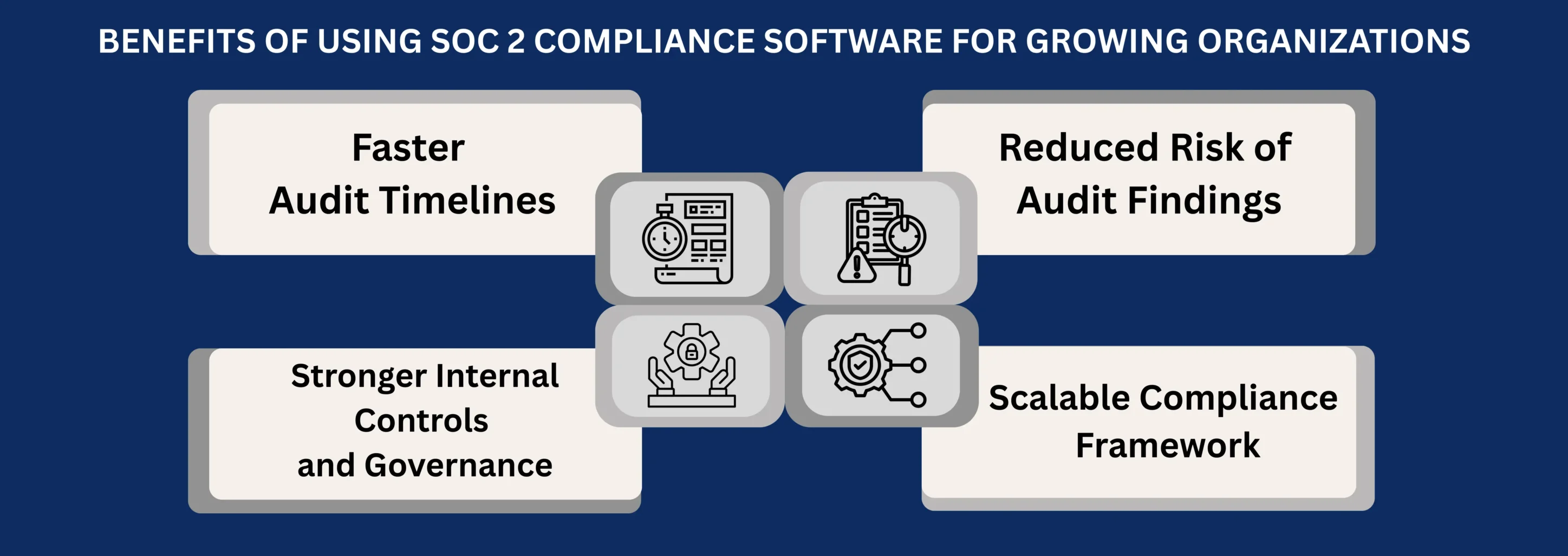
SOC 2 Certification in Denmark delivers structured, independently verified assurance that supports commercial growth, customer trust, and risk management objectives across multiple dimensions. Danish organizations that hold a current SOC 2 attestation report are positioned to respond to enterprise customer security questionnaires, vendor due diligence assessments, and procurement requirements with auditor-issued documentation rather than self-attested representations. The benefits of SOC 2 Certification extend across sales cycles, regulatory context, internal governance, and market expansion activities.
SOC 2 Certification in Denmark is a recognized prerequisite in enterprise sales cycles targeting US-based customers, financial services organizations, healthcare enterprises, and technology companies with formal vendor risk management programs. Danish SaaS providers and cloud service organizations that hold a current Type 2 attestation report can submit the report directly in response to vendor security questionnaires. This reduces the volume of custom security reviews and accelerates contract execution timelines. SOC 2 attestation also functions as a market differentiator in competitive procurement processes, where customers must evaluate multiple vendors and use third-party assurance reports as a basis for vendor selection decisions. For Danish fintech companies and financial institutions subject to DORA’s third-party risk management requirements, a SOC 2 report provided by a technology vendor constitutes auditor-verified evidence relevant to ICT risk assessments.
SOC 2 compliance, as evidenced through a current attestation report, demonstrates that an organization’s control environment has been independently evaluated against a recognized framework. For Danish organizations operating under GDPR and the Danish Data Protection Act, a SOC 2 report that includes the Privacy criterion provides documented, auditor-examined evidence of controls addressing personal data protection. This does not establish legal compliance with GDPR, but it contributes to an organization’s overall accountability documentation. Under the NIS2 Directive, Danish operators of essential and important entities are expected to demonstrate risk management measures and incident handling capabilities. A SOC 2 attestation report covering security and availability controls provides independently verified evidence of these measures. Organizations also benefit internally from the discipline imposed by the annual SOC 2 audit cycle, which drives consistent control documentation, evidence collection, and monitoring practices across the organization.
- ✓Independently verified evidence of control effectiveness issued by a Licensed CPA Firm
- ✓Accelerated enterprise vendor onboarding by reducing security questionnaire cycles
- ✓Demonstrated assurance for US, EU, and international enterprise customer procurement teams
- ✓Supports third-party risk management documentation for customers subject to DORA or NIS2
- ✓Contributes to GDPR accountability documentation where the Privacy criterion is included in scope
- ✓Annual examination cycle drives systematic control documentation and monitoring discipline
- ✓Strengthens competitive positioning in regulated sector and enterprise market segments
- ✓Commercial and Market Access Benefits
- ✓Governance, Risk, and Regulatory Context Benefits
SOC 2 Certification Timeline for Denmark Companies
The SOC 2 certification timeline for Denmark companies depends on the report type selected, the length of the observation period, and the organization’s readiness to produce evidence supporting the examination. Type 1 examinations are completed more rapidly than Type 2 engagements, as they do not require an observation period. Organizations in Denmark should understand the typical timeframes associated with each examination phase to plan customer commitments and commercial timelines accordingly.
Type 1 and Type 2 Examination Timelines
A SOC 2 Type 1 examination in Denmark typically requires four to eight weeks from engagement commencement to report issuance, depending on the complexity of the system in scope, the number of Trust Services Criteria included, and the organization’s ability to produce requested documentation promptly. The examination involves system description review, control design evaluation, evidence assessment, and issuance of the attestation report. A SOC 2 Type 2 examination requires significantly more time because the observation period — typically six to twelve months — must be completed before the auditor can conclude on operating effectiveness. Danish organizations commonly structure their first SOC 2 engagement as a Type 1 report to demonstrate control design to immediate customers, followed by a Type 2 engagement covering a subsequent observation period. Once the Type 2 cycle is established, annual recertification examinations are conducted on a rolling basis to maintain current attestation status.
| Report Type | Observation Period | Typical Total Timeline | Primary Use Case |
|---|---|---|---|
| SOC 2 Type 1 | None (point in time) | 4–8 weeks from engagement start | Initial attestation; design-level customer assurance |
| SOC 2 Type 2 | 6–12 months (minimum 6) | 8–14 months from observation start to report issuance | Enterprise sales; ongoing vendor assurance programs |
| Annual Recertification | 12-month rolling period | Conducted continuously; report issued within 90 days of period end | Maintaining current certified status; customer contract requirements |
Maintaining Current SOC 2 Attestation Status
SOC 2 attestation reports do not carry an indefinite validity period. A SOC 2 Type 2 report covers a specific observation period and is typically considered current for twelve months following the end of that period. Enterprise customers and vendor risk programs commonly require that the SOC 2 report submitted by a vendor reflects an observation period that ended within the preceding twelve months. Danish organizations that have completed an initial SOC 2 Type 2 examination must conduct annual audit cycles to produce a subsequent report covering the following twelve-month period. Failure to maintain a current SOC 2 attestation may result in vendors being removed from customer approved supplier lists, or being required to complete additional security assessments in lieu of a current report. CertPro conducts annual SOC 2 examinations for Danish organizations to support continuous attestation status.
SOC 2 Compliance Denmark: Industry Sectors and Use Cases
SOC 2 compliance Denmark is pursued across a wide range of industry sectors driven by customer requirements, contractual obligations, vendor risk management programs, and market positioning objectives. The sectors most actively pursuing SOC 2 attestation in Denmark reflect the country’s growing technology and services economy, with particularly strong demand among organizations providing cloud-hosted services to enterprise customers in regulated industries.
Technology, SaaS, and Cloud Service Providers
Danish SaaS companies, cloud service providers, and technology platforms represent the largest category of organizations pursuing SOC 2 certification Denmark. Organizations headquartered in Copenhagen’s technology corridor, as well as those operating from Aarhus, Odense, and Aalborg, increasingly encounter US and international enterprise customers that require a current SOC 2 Type 2 report before entering into data processing agreements. Danish AI companies and machine learning platform providers face particular scrutiny over data handling, model training data provenance, and system security — making SOC 2 attestation with the Security and Confidentiality criteria directly responsive to customer assurance needs. Cybersecurity firms operating from Denmark that provide managed detection, threat intelligence, or security operations services to enterprise clients also pursue SOC 2 certification to demonstrate the integrity and security of their own operational environments.
Financial Services, Fintech, and Healthcare Organizations
SOC 2 certification Denmark fintech engagements are driven by the requirements of financial institution customers, payment network rules, and the third-party risk management obligations introduced under DORA for financial entities and their critical ICT service providers. Danish fintech companies providing payment processing, open banking APIs, lending technology, or treasury management platforms to European and US financial institutions must satisfy rigorous vendor assurance requirements. SOC 2 Type 2 attestation provides auditor-issued evidence directly responsive to those requirements. Healthcare technology organizations, pharmaceutical companies, and life sciences firms operating in Denmark that provide systems accessing or processing health data face security requirements from hospital groups, research organizations, and pharmaceutical enterprises — all of which commonly require SOC 2 reports as part of vendor onboarding. Telecommunications providers and data center operators serving enterprise customers in Denmark also pursue SOC 2 attestation with Availability and Security criteria to demonstrate service reliability and robust operational security controls.
SOC 2 Attestation: Understanding the Report and Its Use
SOC 2 attestation produces a formal report issued by the Licensed CPA Firm that conducted the examination. The SOC 2 attestation report is structured according to AICPA reporting standards and contains specific components that users of the report — typically customers, business partners, and vendor risk management teams — evaluate when assessing an organization’s control environment. Understanding the structure and intended use of a SOC 2 attestation report is important for Danish organizations that receive, share, or rely upon these reports in commercial and contractual contexts.
Components of a SOC 2 Attestation Report
A SOC 2 attestation report issued following a SOC 2 examination contains the following components: the independent service auditor’s report (the auditor’s opinion); management’s assertion regarding the system description and the controls described therein; the system description prepared by management; and, for Type 2 reports, a description of the auditor’s tests of controls and the results of those tests. The auditor’s opinion may be unqualified (clean), qualified, adverse, or a disclaimer of opinion, depending on the results of the examination. An unqualified opinion indicates that the auditor found the controls to be suitably designed — and, for Type 2 reports, operating effectively throughout the observation period — with no material exceptions that would alter the overall conclusion. Danish organizations sharing their SOC 2 attestation report with customers should note that the report is typically issued under a usage restriction limiting distribution to existing and prospective customers with a need to know.
SOC 2 Examination vs. SOC 2 Compliance: Key Distinctions
SOC 2 compliance and SOC 2 attestation are related but distinct concepts that Danish organizations should understand when communicating their security posture to customers. An organization is described as SOC 2 compliant when its internal controls conform to the applicable Trust Services Criteria — but this status is unverified without an independent examination. SOC 2 attestation, by contrast, refers specifically to the independent examination conducted by a Licensed CPA Firm and the resulting attestation report. Only organizations that have completed a SOC 2 examination with an independent CPA firm and received an attestation report hold documented SOC 2 Certification. Self-assessed or internally declared compliance without a Licensed CPA Firm examination does not constitute SOC 2 attestation and is not accepted by enterprise customers that require a third-party auditor’s report. The SOC 2 examination is the mechanism through which compliance is independently verified and formally attested.
SOC 2 Certification Process: Step-by-Step for Danish Organizations
The SOC 2 certification process for Danish organizations follows a defined sequence of steps from initial scoping through report issuance. Each step corresponds to a specific audit activity conducted by the Licensed CPA Firm, or a management responsibility fulfilled by the organization under examination. The following steps describe the SOC 2 certification process as it applies to organizations engaging CertPro CPA LLC for a SOC 2 audit in Denmark.
The SOC 2 examination begins with the definition of scope, which determines which systems, services, processes, and infrastructure components are subject to the auditor’s evaluation. Danish organizations must define the system boundaries — including the services provided to customers, the infrastructure supporting those services, the personnel responsible for operating controls, and any subservice organizations (such as cloud providers or co-location facilities) that provide relevant controls. The Trust Services Criteria categories to be included in the examination are selected based on the nature of the services, customer commitments, and the organization’s business objectives. Management then prepares the system description, which documents all of these components and the controls in place to satisfy each applicable criterion. The auditor reviews the system description for completeness and accuracy before proceeding to control evaluation.
Following system description review, the Licensed CPA Firm conducts control design evaluation and — for Type 2 engagements — control operating effectiveness testing across the observation period. Testing procedures include inquiry of personnel responsible for control operation, inspection of documentary evidence, observation of control procedures, and re-performance of control activities where applicable. The auditor applies sampling methodologies consistent with AICPA attestation standards when testing controls that operate with sufficient frequency to require sample-based evaluation. Upon completion of testing, the auditor evaluates the significance of any exceptions identified and communicates findings to management before finalizing the report. The SOC 2 attestation report is then issued by the Licensed CPA Firm, containing the auditor’s opinion, the system description, and — for Type 2 reports — the description of tests and results. Danish organizations receive the final report for distribution to customers in accordance with the report’s usage restriction provisions.
- ✓Scoping and System Description Preparation
- ✓Control Testing and Report Issuance
Why Choose CertPro for SOC 2 Certification and Auditing in Denmark
CertPro CPA LLC conducts independent SOC 2 examinations for organizations across Denmark and international markets as a Licensed CPA Firm operating under AICPA attestation standards. Organizations seeking SOC 2 Certification in Denmark engage CertPro exclusively in the auditor’s capacity — the firm performs the SOC 2 audit, evaluates control design and operating effectiveness, and issues the attestation report. CertPro does not provide consulting, implementation, or advisory services that would impair independence or blur the distinction between the audit function and management responsibilities. This separation ensures that every SOC 2 attestation report CertPro issues carries full professional authority and independence.
Independent Audit Authority and Attestation Standards
CertPro CPA LLC performs SOC 2 examinations in accordance with AT-C Section 105 (Concepts Common to All Attestation Engagements) and AT-C Section 205 (Examination Engagements) issued by the AICPA. The firm’s SOC 2 audit in Denmark is conducted by CPAs with specific competency in the Trust Services Criteria, AICPA attestation standards, and information technology audit methodologies relevant to cloud-hosted systems, SaaS environments, and complex enterprise architectures. CertPro issues SOC 2 Type 1 and SOC 2 Type 2 attestation reports accepted by enterprise customers, financial institutions, and regulated sector procurement teams in the United States, Europe, and international markets. Danish organizations that require a SOC 2 attestation report recognized by US-based enterprise customers will find that reports issued by a Licensed CPA Firm such as CertPro carry the required level of professional authority and independence.
SOC 2 Audit Denmark: Examination Scope and Sector Coverage
CertPro conducts SOC 2 audit Denmark engagements across a range of technology and service sectors, including SaaS providers, cloud infrastructure companies, fintech and payment platforms, healthcare technology organizations, pharmaceutical and life sciences firms, cybersecurity companies, telecommunications providers, data center operators, e-commerce platforms, gaming companies, and AI and machine learning businesses. The firm’s SOC 2 examination methodology covers all five Trust Services Criteria categories, accommodates both carve-out and inclusive subservice organization methods, and addresses the evidence requirements applicable to cloud-native architectures, hybrid environments, and on-premises systems. Organizations operating across multiple Danish cities — Copenhagen, Aarhus, Odense, Aalborg — or with distributed infrastructure across the European Union can engage CertPro for a single SOC 2 examination covering the full scope of their relevant systems and controls.
FAQ
▶
What is SOC 2 certification?
▶
What is SOC 2 Certification and why does it matter for Danish organizations?
▶
What is the difference between SOC 2 Type 1 Denmark and SOC 2 Type 2 Denmark?
▶
How long does a SOC 2 audit in Denmark take to complete?
▶
Which Trust Services Criteria should Danish organizations include in their SOC 2 examination?
▶
Does SOC 2 attestation establish GDPR compliance for Danish organizations?
▶
How often must Danish organizations renew their SOC 2 attestation?
▶
What is the difference between SOC 2 Certification and SOC 2 compliance?
SOC 1 VS SOC 2: WHICH REPORT YOUR CUSTOMERS ACTUALLY ASK FOR
If you sell SaaS or provide outsourced services, you have likely been asked for a SOC report. However, the follow-up question is rarely easy to answer…

AICPA Issues New Guidance for Peer Reviewers Evaluating SOC 2 Engagements
AICPA SOC 2 guidance has been issued to help peer reviewers identify quality risks associated with SOC 2 engagements as the use of compliance automati…
SOC 2 Certified: What Does It Mean for Your Business
For companies that handle sensitive data or run cloud-based services, the question “Can you provide your SOC 2 report?” carries enormous weight. Yet, …
Get In Touch
have a question? let us get back to you.