
ISO 42001 Certification in London
CertPro is a Licensed CPA Firm conducting independent ISO 42001 certification audits for organisations operating AI Management Systems (AIMS) in London. ISO 42001 audit evaluations are scoped to ISO/IEC 42001:2023 requirements, covering AI governance structures, lifecycle controls, risk management frameworks, transparency obligations, and continual improvement mechanisms across regulated and technology-driven enterprises.
OUR CLIENTS










Introduction to ISO 42001 Certification in London
ISO 42001 Certification in London represents a structured, internationally recognised framework for organisations deploying, developing, or integrating artificial intelligence systems into their operations. Formally designated ISO/IEC 42001:2023, this standard establishes requirements for an Artificial Intelligence Management System (AIMS) — a governance infrastructure that organisations must build, operate, monitor, and continually improve. ISO 42001 Certification evaluates whether an organisation has implemented appropriate controls, accountability structures, and oversight mechanisms to ensure AI systems operate responsibly, transparently, and in alignment with applicable regulatory obligations.
London is one of the world’s most concentrated hubs for AI-driven commerce, financial technology, professional services, and regulated enterprise operations. Organisations across the city — from global banks deploying algorithmic trading systems to SaaS providers using machine learning for predictive analytics — face increasing scrutiny regarding how their AI systems are governed. ISO 42001 Certification in London provides a recognised mechanism for demonstrating that AI governance structures are formally assessed, documented, and independently verified by a qualified third-party certification body.
The standard was published in December 2023 by the International Organization for Standardization (ISO) and the International Electrotechnical Commission (IEC). It follows the High Level Structure (HLS) familiar to organisations already certified under ISO 27001 or ISO 9001, which means existing management system frameworks can be aligned and integrated with minimal duplication. ISO 42001 introduces AI-specific elements including AI system impact assessments, responsible AI objectives, transparency controls, human oversight mechanisms, and documentation of AI system purpose, design decisions, and deployment boundaries. CertPro conducts independent ISO 42001 certification audits against these requirements for London-based organisations across all sectors.
What Is an AI Management System (AIMS)?
An AI Management System (AIMS) is the organisational infrastructure — comprising policies, processes, roles, controls, and documentation — through which an organisation governs the development, deployment, monitoring, and decommissioning of AI systems. ISO 42001 defines the requirements that an AIMS must satisfy to be considered compliant. These requirements address leadership accountability, risk and impact assessment processes, data governance within AI workflows, transparency and explainability obligations, and mechanisms for human oversight and intervention. The AIMS is not a software product; it is a management framework embedded in organisational governance.
For London organisations, establishing a functional AIMS is increasingly tied to regulatory expectations. The UK government’s AI governance frameworks, combined with the extraterritorial reach of the EU AI Act for organisations processing EU resident data, mean that AI governance is no longer discretionary. ISO AIMS certification provides independent evidence that the organisation’s AI governance infrastructure meets a globally recognised standard — a distinction that carries weight with regulators, enterprise procurement teams, institutional investors, and boardroom stakeholders responsible for AI risk oversight.
ISO 42001 and Its Relationship to Other Management Standards
ISO 42001 shares structural DNA with ISO 27001 (information security management) and ISO 9001 (quality management), following the same High Level Structure that allows these frameworks to be integrated. Organisations in London that already hold ISO 27001 certification can leverage existing governance infrastructure — including documented risk processes, leadership review mechanisms, and audit programmes — to build their AIMS without duplicating effort. This integration reduces the operational burden of ISO 42001 certification while strengthening the overall governance posture.
ISO 42001 also aligns with ISO 31000 for risk management, enabling organisations to apply existing enterprise risk frameworks to AI-specific scenarios such as algorithmic bias, model drift, data poisoning, and lack of explainability. The standard’s alignment with UK GDPR and the EU AI Act’s requirements for transparency, documentation, and human oversight means that achieving ISO 42001 compliance contributes directly to satisfying overlapping legal obligations. CertPro’s ISO 42001 audit evaluations assess these control integrations as part of the certification scope.
Who Requires ISO 42001 Certification in London?
ISO 42001 Certification in London is relevant to any organisation that develops, deploys, integrates, or relies upon AI systems as part of its core operations. This includes financial institutions using AI for credit decisioning, fraud detection, or algorithmic trading; healthcare providers deploying diagnostic AI tools; legal technology firms using natural language processing for contract analysis; cloud infrastructure providers offering AI-enabled services; and SaaS companies embedding machine learning into their product offerings. London’s concentration of regulated industries makes ISO 42001 Certification particularly significant for organisations subject to FCA oversight, NHS governance, or enterprise procurement requirements that mandate AI governance standards.
Organisations that procure AI systems from third-party vendors also benefit from ISO 42001 Certification, as the standard addresses AI supply chain governance and third-party risk management obligations. For multinational enterprises headquartered in London, certification provides a common governance language across jurisdictions — enabling consistent AI accountability structures regardless of where AI systems are deployed or operated. ISO 42001 compliance is increasingly cited in enterprise supplier qualification frameworks, public sector tender requirements, and institutional due diligence processes.

Benefits of ISO 42001 Certification in London
Obtaining ISO 42001 Certification in London delivers measurable strategic, operational, and regulatory benefits for organisations operating in AI-intensive environments. As London’s position as a global AI and fintech hub intensifies competitive and regulatory pressures, certification provides a verifiable signal of governance maturity. The benefits outlined below reflect the outcomes of independently audited AI Management System certification — not advisory or consulting services.
ISO 42001 compliance provides a structured governance mechanism that aligns directly with UK GDPR obligations, the EU AI Act’s transparency and documentation requirements, and the UK government’s AI regulatory principles of safety, security, fairness, accountability, and contestability. For organisations operating in London’s regulated financial sector, aligning AI governance with an internationally recognised standard reduces the risk of regulatory enforcement action by demonstrating proactive, documented control over AI system risks. The ISO 42001 audit process evaluates the completeness and effectiveness of these controls, producing independent attestation that carries regulatory weight.
Unmanaged AI risks — including algorithmic bias, data privacy violations, model opacity, and lack of human oversight — can expose London organisations to significant financial, legal, and reputational consequences. ISO 42001 certification establishes documented controls that reduce the probability of these adverse outcomes. The standard requires organisations to identify, assess, treat, and monitor AI-specific risks through a structured AIMS. The ISO 42001 audit confirms that these controls are operational and effective, not merely documented in policy.
ISO 42001 Certification in London differentiates certified organisations in competitive procurement processes, enterprise sales cycles, and institutional investment evaluations. As AI governance becomes a standard due diligence criterion — particularly in financial services, healthcare, and public sector procurement — organisations holding independent ISO AIMS certification demonstrate a verifiable governance standard that unverified policy documents cannot match. For London-based technology companies competing for enterprise contracts, certification provides a commercially significant trust signal that accelerates qualification processes.
London fintech companies and SaaS providers seeking to expand into European or North American markets benefit from ISO 42001 Certification as a recognised governance credential that translates across jurisdictions. The standard’s international recognition — covering the EU AI Act’s governance themes, Singapore’s Model AI Governance Framework principles, and the NIST AI Risk Management Framework’s responsible AI concepts — means that a single certification can satisfy multiple market access requirements simultaneously. This reduces compliance overhead for internationally operating London organisations considerably.
AI governance has become a board-level concern for organisations across London’s financial, technology, and professional services sectors. ISO 42001 Certification provides boards, audit committees, and senior leadership teams with independent verification that the organisation’s AIMS meets defined international standards — an accountability mechanism that self-assessment cannot provide. The ISO 42001 audit produces documented evidence of control effectiveness that can be presented to regulators, institutional clients, and governance bodies as proof of responsible AI stewardship.
- ✓Independent verification of AI governance maturity for boardroom and regulatory reporting
- ✓Demonstrated alignment with UK GDPR, EU AI Act, and UK AI regulatory principles
- ✓Reduced exposure to regulatory enforcement action through documented AI risk controls
- ✓Commercial differentiation in enterprise procurement and supplier qualification processes
- ✓Credible AI transparency and accountability signal for clients, partners, and investors
- ✓Structured framework for managing AI system lifecycle risks including bias, drift, and opacity
- ✓Integration with existing ISO 27001 or ISO 9001 management system infrastructure
- ✓Internationally recognised credential supporting cross-border market access
- ✓Continual improvement mechanism ensuring AI governance remains effective over time
- ✓Evidence-based documentation enabling confident AI deployment decisions at enterprise scale
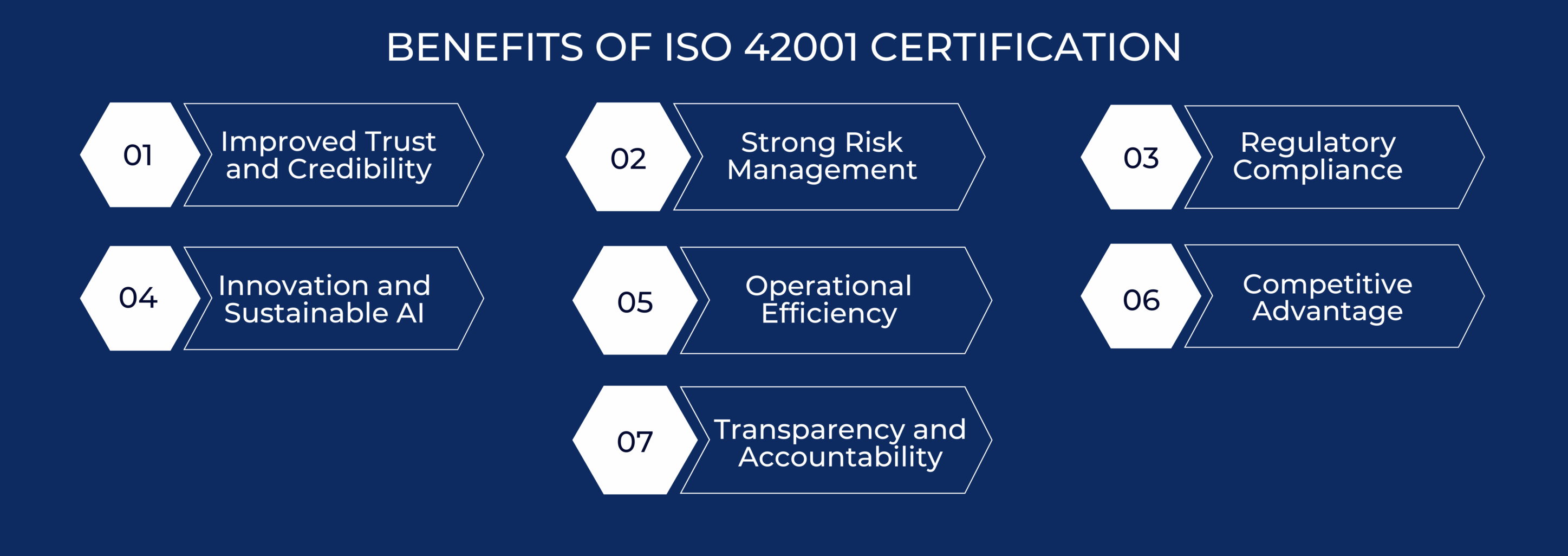
- ✓Regulatory Alignment and Risk Reduction
- ✓Commercial and Market Differentiation
- ✓Stakeholder Trust and Accountability
ISO 42001 Certification Process for London Organizations
The ISO 42001 certification process for London organisations follows a structured audit methodology conducted by CertPro as an independent Licensed CPA Firm. The process is scoped to ISO/IEC 42001:2023 requirements and evaluates the design, implementation, and operational effectiveness of the organisation’s AI Management System. Each stage of the ISO 42001 audit is conducted under defined audit programme criteria, with findings documented and reported in accordance with certification body standards.
The certification process begins with a formal scope definition exercise in which the boundaries of the AIMS are established. CertPro’s audit team evaluates the AI systems, processes, organisational units, and geographical locations that fall within the certification scope. This determination is critical because ISO 42001 certification scope must accurately reflect the AI activities the organisation conducts — including both AI systems developed in-house and those procured from third-party providers where the organisation retains governance responsibility.
The audit programme is then determined based on the defined scope, the organisation’s size and complexity, the risk classification of AI systems in scope, and the maturity of existing documentation. For London organisations operating multiple AI systems across different business units or jurisdictions, the audit programme accounts for this complexity to ensure comprehensive coverage. The audit programme document specifies audit objectives, criteria, methods, and the composition of the audit team assigned to the ISO 42001 assessment.
The Stage 2 audit evaluates the implementation and operational effectiveness of the AIMS against ISO 42001:2023 requirements. CertPro auditors review documentation including AI system registers, impact assessment records, risk treatment plans, governance policies, training records, monitoring logs, and management review documentation. The ISO 42001 audit also includes interviews with personnel responsible for AI governance functions, examination of control evidence, and observation of processes where applicable.
The ISO 42001 audit assesses compliance across all clauses of the standard, including leadership and commitment (Clause 5), planning for AI risks and opportunities (Clause 6), support resources and competence (Clause 7), operational planning and control (Clause 8), performance evaluation (Clause 9), and improvement mechanisms (Clause 10). Annex A controls — covering AI system impact assessment, responsible AI objectives, data governance, and stakeholder engagement — are also evaluated as part of the audit scope. Nonconformities identified during the Stage 2 audit are documented with specific reference to the ISO 42001 clause affected.
Following the Stage 2 audit, CertPro issues a formal audit report documenting conformities, nonconformities, and observations. Major nonconformities — representing significant failures in AIMS requirements — must be resolved before a certification decision is made. Minor nonconformities must be addressed within a defined timeframe following certification issuance. The organisation submits evidence of corrective actions, which CertPro evaluates against the nonconformity requirements before a certification recommendation is issued.
The certification decision is made by CertPro’s independent certification panel, separate from the audit team, based on the complete audit record. Upon a positive certification decision, CertPro issues an ISO 42001 certification attestation specifying the certified scope, the standard version (ISO/IEC 42001:2023), the certification date, and the validity period. ISO 42001 certification is typically valid for three years, with annual surveillance audits conducted in years one and two to verify continued conformance and AIMS operational effectiveness.
Surveillance audits are conducted annually during the three-year certification cycle to verify that the AIMS remains compliant with ISO 42001 requirements and that certified organisations continue to operate effective AI governance controls. Surveillance audits are typically narrower in scope than the initial ISO 42001 audit, focusing on key AIMS control areas, the status of previously identified nonconformities, changes to AI systems within scope, and the functioning of the management review and internal audit processes.
Recertification audits are conducted at the end of the three-year certification cycle and involve a comprehensive reassessment of the complete AIMS scope. Recertification evaluates whether the organisation has maintained and improved its AIMS over the certification period, addressing the requirements of continual improvement under Clause 10 of ISO 42001. London organisations that have expanded their AI system portfolio, changed their business model, or faced significant regulatory changes during the certification cycle should ensure these developments are reflected in updated AIMS documentation ahead of recertification.
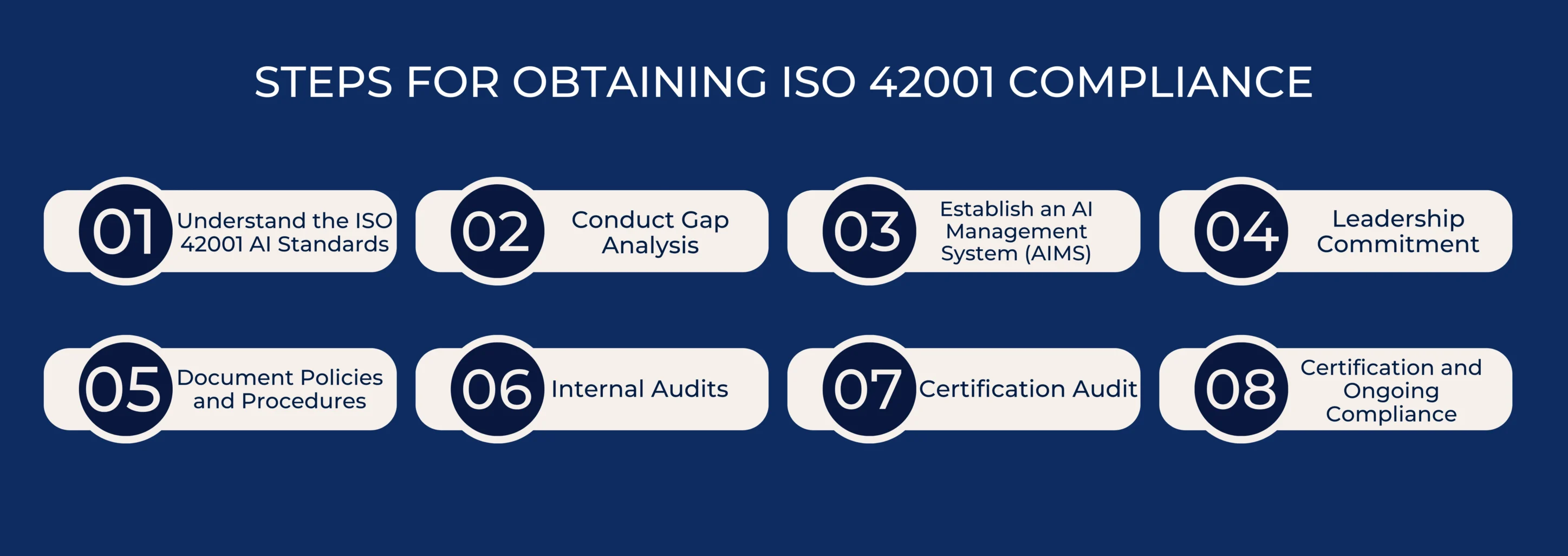
- ✓Stage 1: Scope Definition and Audit Programme Determination
- ✓Stage 2: Documentation Review and System Evaluation
- ✓Stage 3: Nonconformity Review and Certification Decision
- ✓Surveillance Audits and Recertification
ISO 42001 Certification Requirements
ISO 42001 certification requirements are defined across ten clauses of the standard and an Annex A control set. Compliance with these requirements is evaluated during the ISO 42001 audit conducted by CertPro. Organisations in London must demonstrate that each requirement is addressed through documented policies, implemented controls, and verifiable evidence of operational effectiveness. The following sections detail the key requirement areas evaluated during the certification audit.
ISO 42001 Clause 5 requires demonstrable leadership commitment to the AIMS from the organisation’s senior management. This includes the establishment of an AI governance policy that defines the organisation’s responsible AI objectives, the assignment of accountability for AIMS management, and the integration of AI governance requirements into organisational strategy. For London-based organisations, this means boards and executive teams must formally own AI governance — a requirement that reflects growing expectations from regulators, institutional investors, and enterprise clients that AI accountability resides at leadership level.
The governance requirements also specify that organisations must determine relevant internal and external context factors affecting their AIMS, identify interested parties and their requirements, and define the AIMS scope with documented justification for any exclusions. For London’s regulated industries — financial services, healthcare, legal technology — the interested parties analysis must account for regulatory bodies, clients, data subjects, and supply chain partners as stakeholders with legitimate interests in the organisation’s AI governance practices.
ISO 42001 requires organisations to conduct AI system impact assessments to evaluate the potential consequences of AI systems on individuals, groups, and society. These assessments must consider risks related to bias and fairness, privacy and data protection, safety and reliability, transparency and explainability, and human autonomy and oversight. The ISO 42001 audit evaluates the completeness, methodology, and documentation of these impact assessments — including how identified risks have been treated through control implementation or risk acceptance decisions.
Risk treatment planning under ISO 42001 requires organisations to document the controls applied to AI-specific risks, assign accountability for risk treatment implementation, and establish monitoring mechanisms to verify that controls remain effective. For London organisations deploying AI systems in high-risk contexts — such as credit scoring, medical diagnosis, or predictive policing — the risk treatment requirements are particularly stringent. Documented evidence of control design, testing, and ongoing performance monitoring is required. These requirements directly support ISO 42001 compliance with the EU AI Act’s high-risk AI system obligations.
ISO 42001 specifies extensive documentation requirements for AI system governance, including maintained AI system registers that document system purpose, design decisions, training data sources, intended use cases, deployment boundaries, and known limitations. Operational controls must address the complete AI system lifecycle — from initial concept and design through development, validation, deployment, monitoring, and eventual decommissioning. The ISO 42001 audit reviews these documentation artefacts to verify their completeness, accuracy, and currency.
Competence requirements under ISO 42001 mandate that personnel performing AI governance functions possess documented evidence of relevant knowledge and skills. For London organisations, this includes roles responsible for AI risk assessment, data governance, model validation, bias testing, and human oversight implementation. The ISO 42001 audit evaluates whether competence requirements have been defined, whether personnel meet those requirements, and whether training programmes are in place to address identified competence gaps across the AIMS workforce.
| ISO 42001 Clause | Requirement Area | Key Audit Evidence |
|---|---|---|
| Clause 4 | Context and Scope | AIMS scope document, stakeholder analysis, context assessment |
| Clause 5 | Leadership and Policy | AI governance policy, responsibility assignments, management commitment records |
| Clause 6 | Planning and Risk Assessment | AI impact assessments, risk registers, objective documentation |
| Clause 8 | Operational Controls | AI system registers, lifecycle controls, data governance procedures |
| Clause 9 | Performance Evaluation | Internal audit records, monitoring reports, management review minutes |
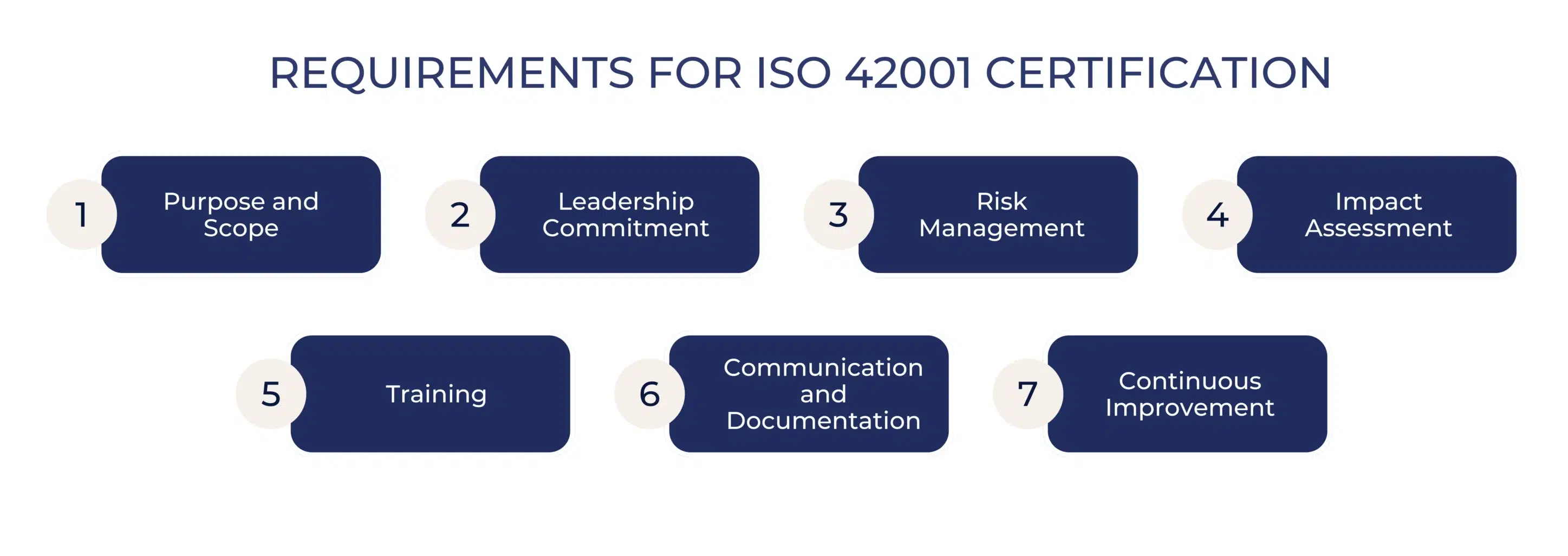
- ✓Leadership and Governance Requirements
- ✓AI Risk and Impact Assessment Requirements
- ✓Documentation and Operational Control Requirements
ISO 42001 Assessment in London: Scope and Methodology
The ISO 42001 assessment conducted by CertPro for London organisations is an independent, evidence-based evaluation of the organisation’s AIMS against ISO/IEC 42001:2023 requirements. The assessment methodology follows internationally recognised audit principles of independence, objectivity, and evidence-based evaluation. CertPro’s audit teams combine expertise in AI governance, management system auditing, and sector-specific regulatory context to deliver ISO 42001 assessments that are both technically rigorous and practically relevant to the organisation’s operating environment.
Pre-Certification Assessment Activities
Prior to the formal certification audit, CertPro conducts a documentation completeness review to assess whether the organisation has produced the mandatory documented information required by ISO 42001. This review examines the presence and adequacy of documented scope, AI governance policy, risk assessment records, AI system registers, operational procedure documentation, and management review records. The documentation review determines audit readiness from a formal completeness standpoint — it does not constitute a substantive evaluation of AIMS effectiveness.
CertPro also conducts a formal audit planning meeting with the organisation’s AIMS representatives to confirm audit scope, agree interview schedules, identify document access requirements, and establish communication protocols for the duration of the ISO 42001 audit. This planning activity ensures the audit is conducted efficiently and that the organisation’s operational continuity is not disrupted by the certification process. For London organisations with distributed AI governance functions across multiple business units, audit planning includes coordination arrangements to ensure all relevant AIMS components are included within the ISO 42001 assessment scope.
Control Testing and Evidence Evaluation
CertPro’s ISO 42001 audit methodology includes substantive testing of AIMS controls to evaluate their operational effectiveness — not merely their documented existence. Control testing activities include review of AI system monitoring logs to verify that performance metrics are tracked and actioned; examination of bias and fairness testing records to confirm that assessment processes are operational; review of human oversight records to verify that intervention mechanisms function as designed; and evaluation of incident management records to assess how AI system failures or unexpected outputs are identified, documented, and resolved.
The ISO 42001 assessment also evaluates the organisation’s internal audit programme for the AIMS, including audit planning records, audit findings, corrective action responses, and evidence of audit programme effectiveness. ISO 42001 requires organisations to conduct internal audits at planned intervals, and the certification audit evaluates whether this requirement is met through documented evidence rather than assertions. CertPro’s auditors apply professional judgment in evaluating the sufficiency and appropriateness of audit evidence across all assessed control areas.
Audit Reporting and Finding Classification
CertPro issues formal audit reports following the completion of each ISO 42001 audit stage. Findings are classified according to their significance: major nonconformities represent failures that prevent the AIMS from achieving its intended purpose or represent systemic control failures; minor nonconformities represent isolated deviations that do not prevent the AIMS from functioning but require correction; and observations represent potential improvement opportunities that do not constitute nonconformities. Each audit report provides a clear, evidence-referenced basis for every finding, enabling the organisation to understand the specific control gap identified and the applicable ISO 42001 requirement.
Why Choose CertPro for ISO 42001 Certification in London
CertPro is a Licensed CPA Firm providing independent ISO 42001 certification audits to organisations across London and the broader UK market. As an independent third-party certification body, CertPro’s audit conclusions are based exclusively on evidence gathered during the ISO 42001 audit process — not on prior advisory relationships, implementation work, or consulting engagements with the audited organisation. This independence is a structural requirement for valid ISO 42001 certification and is essential to the credibility of the certification attestation issued.
Independent Certification Body Positioning
CertPro’s institutional positioning as a Licensed CPA Firm distinguishes its certification services from advisory, consulting, or implementation service providers who offer certification-adjacent support without the authority to issue formal certification attestations. ISO 42001 Certification in London is only meaningful when issued by an independent body with no conflict of interest in the outcome of the assessment. CertPro’s ISO 42001 audit methodology, reporting standards, and certification decision processes reflect this independence as a foundational operating principle.
For London organisations subject to regulatory oversight — particularly those in financial services, healthcare, or critical infrastructure — the independence and credibility of the certification body is a material consideration. Regulators and institutional clients increasingly distinguish between self-certified governance frameworks and independently audited certifications issued by recognised certification bodies. CertPro’s ISO 42001 certification attestations carry the institutional weight of independent professional evaluation, providing a standard of assurance appropriate for regulated enterprise environments.
Sector-Specific Audit Expertise for London’s AI Economy
London’s AI ecosystem spans financial services, fintech, healthtech, legaltech, cloud infrastructure, enterprise software, and public sector digital transformation. CertPro’s ISO 42001 audit teams bring sector-specific knowledge to certification engagements, enabling audit evaluations that are contextually relevant to the organisation’s operating environment and regulatory obligations. For ISO 42001 certification London financial services engagements, this means audit evaluations that account for FCA AI governance expectations, algorithmic accountability requirements, and fair treatment obligations relevant to AI-driven customer outcomes.
ISO 42001 compliance for London fintech organisations faces particular scrutiny regarding AI systems used in credit decisioning, anti-money laundering screening, fraud detection, and customer onboarding. CertPro’s ISO 42001 audit scope for fintech organisations reflects these sector-specific risk areas, ensuring that the assessment addresses the control domains most material to the organisation’s regulatory context. This sector-relevant approach ensures that certification outcomes reflect genuine governance maturity rather than generic management system compliance.
Fixed-Fee Certification Pricing Transparency
CertPro provides transparent, fixed-fee pricing for ISO 42001 certification audits, enabling London organisations to plan certification costs with certainty. Pricing is determined based on the defined AIMS scope, the number of AI systems within scope, the organisation’s size, and audit complexity factors identified during scope definition. There are no variable or success-dependent fee arrangements — audit fees reflect the professional time and resources required to conduct the certification evaluation, independent of the audit outcome. This pricing structure reinforces CertPro’s independence and eliminates any financial incentive to issue favourable certification decisions.
ISO 42001 Certification Cost in London
The cost of ISO 42001 Certification in London is determined by several factors including organisational size, the number and complexity of AI systems within the certification scope, the maturity of existing AIMS documentation, and the sector-specific regulatory context of the organisation’s AI deployments. CertPro determines certification fees following an initial scope definition discussion, ensuring that fee proposals are based on verified scope parameters rather than estimates that may change during the ISO 42001 audit process.
Factors Influencing Certification Costs
Small and medium-sized London organisations with a limited number of AI systems within scope — such as a fintech startup using two or three machine learning models in defined operational contexts — typically incur lower certification costs than large enterprises with extensive AI system portfolios spanning multiple business units. The complexity of the organisational structure also affects audit effort: a London holding company with subsidiary AI operations requires broader audit coverage than a single-entity organisation with a unified governance structure.
The maturity of the organisation’s existing management system infrastructure also influences certification costs. Organisations with established ISO 27001 or ISO 9001 systems can leverage existing documentation, audit programmes, and governance processes when pursuing ISO 42001 certification. This integration reduces the additional audit effort required relative to an organisation building its first management system from a baseline of informal governance practices. CertPro’s scope definition process identifies these integration opportunities to provide accurate cost determinations.
| Organisation Profile | Scope Complexity | Indicative Audit Duration |
|---|---|---|
| Small fintech or SaaS startup | 1–3 AI systems, single entity | 2–3 audit days |
| Mid-size technology company | 4–8 AI systems, multiple departments | 4–6 audit days |
| Large regulated enterprise | 9+ AI systems, multi-unit operations | 7–10 audit days |
| Multinational London HQ | Complex multi-jurisdiction scope | 10+ audit days, phased programme |
Ongoing Certification Costs: Surveillance and Recertification
ISO 42001 certification costs extend beyond the initial certification audit to include annual surveillance audits and a full recertification audit at the three-year mark. Surveillance audit costs are typically lower than the initial ISO 42001 audit, reflecting the narrower scope of annual reviews compared to the comprehensive initial assessment. Recertification audits involve a complete AIMS reassessment and are priced accordingly. London organisations should factor these ongoing costs into their AI governance budgets when planning ISO 42001 certification, treating certification maintenance as a recurring operational expense rather than a one-time investment.
ISO 42001 Compliance in London’s Regulatory Context
ISO 42001 compliance in London operates within a complex and evolving regulatory landscape that includes UK GDPR, the EU AI Act, the FCA’s operational resilience framework, the ICO’s guidance on AI and data protection, and emerging UK government AI governance frameworks. Organisations deploying AI systems in London must navigate these overlapping regulatory obligations while maintaining operationally effective AI governance — a challenge that ISO 42001’s structured AIMS framework is specifically designed to address.
UK GDPR and Data Protection Alignment
ISO 42001 compliance directly supports UK GDPR obligations for AI systems that process personal data. The standard’s requirements for data governance within AI workflows, documentation of data sources and processing purposes, and impact assessment mechanisms align with GDPR’s data protection by design principles and Data Protection Impact Assessment (DPIA) requirements. For London organisations processing personal data in AI training datasets, model inputs, or AI-generated outputs, achieving ISO 42001 compliance provides a structured governance framework that is demonstrably aligned with GDPR compliance obligations.
The ICO’s published guidance on AI and data protection identifies transparency, explainability, fairness, and human oversight as key obligations for organisations using AI to make or influence decisions about individuals. ISO 42001’s Annex A controls directly address each of these themes, providing a structured control environment that supports ICO compliance expectations. London organisations that have completed the ISO 42001 audit and received certification can reference their independent audit findings as evidence of alignment with ICO guidance during regulatory investigations or audit exercises.
EU AI Act Readiness Through ISO 42001
The EU AI Act, which began its phased implementation in 2024, establishes binding requirements for AI systems deployed or affecting EU residents — including those operated by London-based organisations with EU market activity. ISO 42001 compliance provides a documented governance foundation that maps to the EU AI Act’s core requirements for high-risk AI systems, including risk management systems, data governance documentation, technical documentation, transparency measures, human oversight provisions, and accuracy, robustness, and cybersecurity requirements. ISO AIMS certification demonstrates to EU market regulators and enterprise clients that governance controls are independently verified, not self-reported.
For London fintech organisations operating payment systems, credit scoring algorithms, or insurance underwriting AI that affects EU consumers, the EU AI Act’s high-risk classification requirements make ISO 42001 compliance particularly material. The documented AIMS required by ISO 42001, combined with the independent ISO 42001 audit conducted by CertPro, provides a governance record that supports the technical documentation and conformity assessment obligations of the EU AI Act. This alignment reduces the duplicative compliance effort for London organisations managing simultaneous UK and EU regulatory obligations.
FCA and Financial Services AI Governance
The Financial Conduct Authority has published guidance on the use of AI in regulated financial services, emphasising the importance of explainability, fairness, and human oversight in AI-driven financial decisions. London financial services organisations that achieve ISO 42001 certification can demonstrate to the FCA that their AI governance framework meets structured, internationally recognised standards. This is particularly relevant for London’s asset management, retail banking, insurance, and consumer credit sectors, where AI systems increasingly drive customer-facing decisions with regulatory implications for fair treatment and non-discrimination obligations.
Steps to Achieve ISO 42001 Certification in London
Achieving ISO 42001 Certification in London requires organisations to complete a structured sequence of activities that build, document, implement, and verify an effective AI Management System. The following steps outline the formal progression from AIMS development through independent ISO 42001 audit and attestation issuance. These steps reflect the certification process, not implementation advisory — CertPro evaluates completed AIMS implementation during the certification audit.
- Define the AIMS scope: Identify AI systems, business units, geographic locations, and processes within the certification scope, with documented justification for any exclusions.
- Establish AI governance policy: Document the organisation’s responsible AI objectives, commitments, and senior leadership accountability for AIMS performance.
- Conduct AI system impact assessments: Evaluate the potential consequences of each AI system in scope on individuals, groups, and society, with documented risk treatment decisions.
- Build the AI system register: Document each AI system’s purpose, design decisions, training data sources, intended deployment context, known limitations, and ownership accountability.
- Implement operational controls: Establish documented procedures for AI system lifecycle management including development standards, validation requirements, deployment authorisation, monitoring protocols, and decommissioning criteria.
- Establish performance monitoring: Implement mechanisms to track AI system performance metrics, bias indicators, and control effectiveness, with defined thresholds and escalation procedures.
- Conduct internal AIMS audit: Execute a formal internal audit against ISO 42001 requirements, document findings, and complete corrective actions for identified nonconformities.
- Perform management review: Conduct a formal management review of AIMS performance, resource adequacy, and continual improvement objectives, with documented outcomes.
- Engage CertPro for ISO 42001 audit: Submit scope documentation to CertPro and complete the Stage 1 documentation review and Stage 2 on-site certification audit.
- Address audit findings and receive certification: Resolve any nonconformities identified during the ISO 42001 audit and receive the certification attestation upon a positive certification decision.
The AI system register is a foundational documentation artefact for ISO 42001 compliance. It provides a comprehensive inventory of AI systems within the certification scope, capturing the information needed to assess governance obligations, accountability assignments, and risk exposure for each system. Each register entry must document the AI system’s intended purpose and functional description, the data sources used in training and operation, the business process or decision it supports or automates, the personnel accountable for its governance, and any known limitations, failure modes, or bias indicators identified through testing.
For London organisations with legacy AI systems developed before ISO 42001 was published, the AI system register development process often surfaces governance gaps — undocumented models, unclear ownership, or absent monitoring processes. The ISO 42001 audit evaluates register completeness and accuracy as a proxy for the organisation’s overall AIMS governance maturity. Incomplete or inaccurate registers are a common source of nonconformities in initial certification audits for London organisations new to formal AI governance frameworks.
ISO 42001 requires organisations to maintain a formal internal audit programme for the AIMS, conducted at planned intervals by personnel competent in ISO 42001 requirements and independent of the processes being audited. The internal audit must cover all AIMS processes within the certification scope over the course of the audit programme cycle. Internal audit findings must be documented, reported to management, and addressed through corrective action processes that verify root cause resolution rather than symptom correction.
The CertPro certification audit evaluates the effectiveness of the internal audit programme as a key indicator of AIMS maturity. An internal audit programme that has been executed as planned, produced substantive findings, generated appropriate corrective actions, and been reviewed by senior management provides strong evidence of a functioning AIMS governance cycle. Conversely, an internal audit programme that is documented but not executed — or that produces uniformly positive findings without critical evaluation — is a significant red flag during the ISO 42001 certification audit.
- ✓Building the AI System Register
- ✓Internal Audit Requirements for AIMS
ISO 42001 Certification for London’s Technology and Finance Sectors
London’s position as a global technology and financial centre creates a distinctive context for ISO 42001 Certification. The city hosts the highest concentration of financial technology companies in Europe, a rapidly expanding AI startup ecosystem, significant cloud infrastructure operations from hyperscale providers, and the European headquarters of multinational technology companies deploying AI at scale. ISO 42001 certification for London companies across these sectors addresses the specific AI governance challenges and regulatory obligations relevant to each context.
Financial Services and Fintech AI Governance
ISO 42001 certification for London financial services organisations addresses AI governance obligations spanning FCA regulatory expectations, UK GDPR requirements for automated decision-making, and EU AI Act obligations for high-risk financial AI systems. The use of AI in credit scoring, fraud detection, market surveillance, and customer due diligence creates governance obligations that require structured documentation, ongoing monitoring, and human oversight mechanisms — all of which are assessed during the ISO 42001 audit. Certification provides financial institutions with an independent verification mechanism for AI governance controls that is recognised by regulators, auditors, and institutional counterparties.
For London fintech companies pursuing ISO 42001 compliance, certification serves as a market access enabler as well as a governance standard. Enterprise banking and insurance clients increasingly require supplier AI governance certifications as part of third-party risk management programmes. ISO AIMS certification for London tech hub fintech companies provides the credential that satisfies these procurement requirements, reducing the time and cost of enterprise sales qualification while demonstrating governance maturity to potential partners and investors.
Healthcare and Clinical AI Governance
London’s NHS trusts, healthtech companies, and medical device manufacturers deploying AI diagnostic tools face governance obligations that include MHRA medical device regulations, NHS Digital Data Security Standards, and the EU AI Act’s classification of many clinical AI systems as high-risk. ISO 42001 certification provides a structured governance framework that addresses the transparency, explainability, bias assessment, and human oversight requirements applicable to clinical AI systems. The ISO 42001 audit evaluates whether governance controls are adequate to manage the patient safety and regulatory compliance risks associated with AI in clinical settings.
Professional Services and Legal Technology
London’s legal, consulting, and professional services firms are increasingly deploying AI systems for contract analysis, regulatory compliance monitoring, document review, and client risk assessment. These deployments carry professional liability and client confidentiality obligations that intersect directly with AI governance requirements. ISO 42001 certification provides a governance framework that addresses the confidentiality, accuracy, and accountability requirements particularly relevant to AI deployments in professional services contexts — where AI-generated outputs inform professional judgments with legal and commercial significance.
Secure Your ISO 42001 Certification in London with CertPro
ISO 42001 Certification in London is a formal, independent verification of an organisation’s AI governance maturity — one that carries increasing weight with regulators, enterprise clients, institutional investors, and governance stakeholders across London’s technology, financial services, and professional services sectors. As AI deployment accelerates across London’s economy and regulatory obligations intensify, the ability to demonstrate independently audited AI Management System compliance is becoming a foundational requirement for organisations seeking to operate AI systems responsibly and competitively.
CertPro conducts ISO 42001 certification audits as an independent Licensed CPA Firm, evaluating AIMS conformance against ISO/IEC 42001:2023 requirements through a structured, evidence-based ISO 42001 audit methodology. CertPro’s certification engagements for London organisations are scoped to the specific AI systems, organisational boundaries, and regulatory contexts relevant to each client’s AIMS — delivering certification outcomes that accurately reflect governance reality rather than aspirational policy documentation.
Obtaining ISO AIMS certification through CertPro positions London organisations to meet the growing expectations of regulators, enterprise procurement processes, and boardroom governance requirements for responsible AI accountability. The ISO 42001 audit process delivers not only a certification attestation but a documented record of AI governance effectiveness that supports ongoing regulatory engagement, supplier qualification responses, and internal accountability reporting. Organisations ready to initiate the ISO 42001 certification process in London should contact CertPro to schedule a scope definition discussion and audit programme determination.
- ✓Independent ISO 42001 certification audits conducted by a Licensed CPA Firm
- ✓Scope-defined audit programmes tailored to London organisations’ AI system portfolios
- ✓Sector-specific audit expertise across financial services, fintech, healthtech, legaltech, and enterprise technology
- ✓Evidence-based evaluation of AIMS conformance with ISO/IEC 42001:2023 requirements
- ✓Formal certification attestations recognised by regulators, enterprise clients, and institutional stakeholders
- ✓Transparent, fixed-fee pricing based on verified AIMS scope parameters
- ✓Annual surveillance audit programmes maintaining ISO 42001 certification validity across the three-year cycle
- ✓Audit reporting structured to support regulatory engagement, board governance reporting, and procurement qualification
FAQ
▶
What is ISO 42001 certification and why does it matter for London organizations?
▶
How long does the ISO 42001 audit process take in London?
▶
What AI systems must be included in the ISO 42001 certification scope?
▶
Does ISO 42001 certification satisfy EU AI Act requirements?
▶
How does ISO 42001 relate to ISO 27001 for London organizations?
▶
What is the difference between an ISO 42001 audit and a compliance review?
▶
How frequently are surveillance audits required after ISO 42001 certification?
▶
What documentation must be prepared before the ISO 42001 audit?
ISO 42001 CERTIFIED: WHY AI GOVERNANCE CERTIFICATION IS BECOMING A BOARD-LEVEL REQUIREMENT
ISO 42001 Certified: Board-Level AI Governance Guide | CertPro CPA LLC HERO ══════════════════════════════ –> src=”https://certpro.com/wp-content/uplo…

MindSec Launches AI Compliance for Law 25 & ISO 42001
Excerpt from Barchart Article, Published on December 3, 2025 Today, Canadian organizations face increasing pressure to comply with stringent privacy a…

UNDERSTANDING ISO 42001: A GUIDE FOR RESPONSIBLE AI MANAGEMENT SYSTEMS
The invention of artificial intelligence (AI) has changed the operational processes of many industries. However, the rapid growth of technology increa…
Get In Touch
have a question? let us get back to you.