
ISO 27001 Certification in Rotterdam
Achieving ISO 27001 Certification requires Rotterdam organizations to satisfy a defined set of mandatory requirements across documentation, operational controls, internal auditing, and management commitment. These requirements apply uniformly under ISO/IEC 27001:2022 regardless of the organization’s size, industry, or geographic location. The following components represent the core requirements evaluated during the ISO 27001 certification audit.
OUR CLIENTS










ISO 27001 Certification for Rotterdam-Based Financial and Technology Organizations
ISO 27001 Certification in Rotterdam is issued by CertPro CPA LLC, a Licensed CPA Firm operating as an independent third-party certification body. CertPro evaluates organizations against the requirements of ISO/IEC 27001:2022 — the internationally recognized standard for Information Security Management Systems (ISMS) — through a structured ISO 27001 audit methodology that includes a Stage 1 documentation review and a Stage 2 conformity assessment. Certification is issued only upon successful completion of both audit stages, a nonconformity review, and an independent certification decision. CertPro does not provide consulting, implementation, or advisory services; its role is strictly that of an independent auditor and certification body.
Rotterdam’s Information Security Landscape
Rotterdam is one of Europe’s most strategically significant commercial centers. The city hosts the largest seaport in Europe, a dense cluster of logistics and supply-chain technology companies, a growing fintech and SaaS sector, and a broad ecosystem of maritime, energy, and industrial technology businesses. Organizations operating in Rotterdam — from port infrastructure operators in the Rotterdam-Rijnmond region to cloud service providers headquartered in Capelle aan den IJssel and Schiedam — process large volumes of sensitive commercial, financial, and operational data.
The concentration of multinational contracts, cross-border data flows, and third-party vendor relationships creates an information security environment where structured, independently verified risk management is a commercial and contractual necessity. ISO 27001 Certification in Rotterdam addresses this requirement by providing an externally audited attestation that an organization’s ISMS is formally designed, implemented, and monitored.
Regulatory and Contractual Context for Rotterdam Organizations
Rotterdam-based organizations operate within a layered regulatory environment that includes the EU General Data Protection Regulation (GDPR), the Dutch GDPR Implementation Act (Uitvoeringswet AVG), the NIS2 Directive, and — for financial institutions — the Digital Operational Resilience Act (DORA). These frameworks impose obligations around data protection, incident reporting, operational resilience, and third-party risk management.
ISO 27001 compliance supports organizations in structuring their information security controls and documentation in a manner consistent with these obligations, though ISO 27001 certification does not independently establish legal compliance with any specific Dutch or EU regulation. Organizations in financial services, healthcare, logistics technology, and e-commerce increasingly require ISO 27001 certification from vendors, cloud providers, and supply-chain partners as a condition of contract. For Rotterdam companies serving customers across the Netherlands, the broader European Union, the United States, and international markets, ISO 27001 Certification in Rotterdam provides a recognized, auditor-verified signal of information security maturity.
CertPro’s Role as an Independent Certification Body
CertPro CPA LLC is a Licensed CPA Firm registered under the AICPA peer review program. The firm conducts independent ISO 27001 certification audits for organizations across the Netherlands and internationally, evaluating the design, implementation, and operating effectiveness of ISMS controls against the requirements of ISO/IEC 27001:2022. CertPro’s ISO 27001 audit methodology is structured, evidence-based, and fully independent.
The firm does not engage in pre-audit consulting, implementation support, or control design activities for organizations it certifies. This independence is a foundational requirement for credible third-party certification and ensures that the resulting ISO 27001 certificate reflects an objective assessment of the organization’s ISMS — not an advisory engagement outcome. Rotterdam organizations seeking ISO 27001 Certification engage CertPro exclusively for audit and certification services.

The ISO 27001 ISMS Framework: Core Components and Structure
ISO/IEC 27001:2022 specifies requirements for establishing, implementing, maintaining, and continually improving an Information Security Management System. The standard is organized around a Plan-Do-Check-Act (PDCA) management cycle and applies to organizations of any size, sector, or geography. The 2022 revision, which superseded ISO/IEC 27001:2013, introduced a restructured Annex A control set derived from ISO/IEC 27002:2022. This revision reduced the number of controls from 114 to 93 and reorganized them into four thematic categories. Organizations holding certifications under the 2013 standard were required to transition to the 2022 standard by October 31, 2025, as mandated by certification bodies.
ISMS Scope, Context, and Risk Assessment
The ISO 27001 ISMS framework begins with the organization defining the scope of its information security management system — the boundaries within which the ISMS applies, including the organizational units, processes, systems, and physical locations covered. Scope definition is a critical determinant of the ISMS audit’s coverage and must be documented clearly.
Organizations are also required to identify internal and external context factors — including regulatory obligations, contractual requirements, and the interests of relevant parties such as customers, regulators, and supply-chain partners — that affect information security objectives. Risk assessment is the analytical core of the ISMS: organizations must identify information security risks, evaluate the likelihood and impact of those risks, and determine appropriate risk treatment options. The risk assessment methodology must be documented, consistently applied, and produce comparable, reproducible results.
Annex A Controls and the Statement of Applicability
ISO/IEC 27001:2022 Annex A contains 93 information security controls organized across four categories: Organizational Controls (37 controls), People Controls (8 controls), Physical Controls (14 controls), and Technological Controls (34 controls). These controls serve as a reference set from which organizations select applicable controls based on their risk assessment outcomes and treatment decisions.
Organizations are not required to implement every Annex A control. They must, however, document their control selection rationale in a Statement of Applicability (SoA), which identifies which controls are applicable, which are excluded, and the justification for each decision. The SoA is a mandatory ISMS document reviewed during the ISO 27001 certification audit. For Rotterdam organizations in regulated sectors — such as financial services subject to DORA or healthcare organizations subject to NIS2 — the SoA provides a structured mechanism for aligning information security controls with regulatory obligations.
Management Review and Continual Improvement
ISO 27001 requires top management to conduct periodic reviews of the ISMS to assess its continued suitability, adequacy, and effectiveness. Management review inputs must include the results of internal audits, nonconformities and corrective actions, changes in internal and external context, and the achievement of information security objectives. Outputs must include decisions on continual improvement opportunities and any necessary changes to the ISMS.
The standard’s requirement for continual improvement means that ISO 27001 certification is not a one-time achievement but an ongoing commitment to maintaining and enhancing the ISMS. Auditors evaluate the effectiveness of management review processes during both the initial ISO 27001 certification audit and subsequent surveillance audits, assessing whether the organization’s ISMS adapts to evolving risks and operational changes.
ISO 27001 Certification Requirements for Rotterdam Organizations
Achieving ISO 27001 Certification requires Rotterdam organizations to satisfy a defined set of mandatory requirements across documentation, operational controls, internal auditing, and management commitment. These requirements apply uniformly under ISO/IEC 27001:2022 regardless of the organization’s size, industry, or geographic location. The following components represent the core requirements evaluated during the ISO 27001 certification audit.
ISO/IEC 27001:2022 specifies mandatory documented information that organizations must maintain and retain. Mandatory documents include the ISMS scope, information security policy, risk assessment methodology, risk assessment results, risk treatment plan, Statement of Applicability, information security objectives, evidence of competence, results of monitoring and measurement, internal audit program and results, and management review records. Organizations must also retain records of nonconformities identified and the corrective actions taken in response.
Documentation must be controlled — meaning it is appropriately identified, formatted, reviewed, approved, stored, and protected against loss or unauthorized access. During the Stage 1 ISMS audit, the certification auditor reviews this documented information to assess whether the ISMS is sufficiently developed to proceed to the Stage 2 conformity assessment. Gaps in mandatory documentation identified during Stage 1 must be addressed before Stage 2 proceeds.
Beyond documentation, ISO 27001 compliance requires that organizations operationalize their selected Annex A controls and demonstrate that those controls are effectively implemented and functioning. For Rotterdam technology companies and SaaS providers, this typically encompasses access control policies, encryption standards, vulnerability management processes, incident response procedures, and supplier security assessment frameworks. For maritime businesses and port infrastructure operators, physical security controls, operational technology security, and continuity planning are particularly relevant.
Auditors evaluate operational controls by reviewing evidence — logs, configuration records, test results, training records, and supplier contracts — rather than by accepting management assertions. The standard requires organizations to plan, implement, control, and review the operational processes needed to meet information security requirements and to implement risk treatment plans effectively.
ISO 27001 requires organizations to conduct internal ISMS audits at planned intervals to determine whether the ISMS conforms to the organization’s own requirements and to ISO/IEC 27001:2022, and whether it is effectively implemented and maintained. Internal auditors must be selected to ensure objectivity and impartiality — meaning the internal audit function must be independent of the areas being audited. Results of internal audits must be reported to relevant management and retained as documented information.
When nonconformities are identified — whether through internal audits, monitoring, or external feedback — organizations must evaluate the need for corrective action, implement appropriate responses, and verify the effectiveness of those responses. The internal audit program and its results are a primary focus of the ISO 27001 certification audit conducted by the certification body, as they demonstrate the organization’s capacity for self-assessment and continual improvement.
| ISMS Requirement | ISO/IEC 27001:2022 Clause | Audit Evidence Reviewed |
|---|---|---|
| ISMS Scope Definition | Clause 4.3 | Scope statement, boundary documentation |
| Risk Assessment | Clause 6.1.2 | Risk register, assessment methodology, results |
| Statement of Applicability | Clause 6.1.3 | SoA document with control justifications |
| Internal Audit Program | Clause 9.2 | Audit schedule, audit reports, corrective actions |
| Management Review | Clause 9.3 | Meeting minutes, review inputs and outputs |
- ✓Documentation Requirements
- ✓Operational and Technical Control Requirements
- ✓Internal Audit and Nonconformity Management
ISO 27001 Certification Audit Process for Organizations in Rotterdam
The ISO 27001 certification audit process follows a defined sequence of stages, from initial scoping through certification issuance and ongoing surveillance. Each stage serves a specific evaluative purpose and produces documented outputs that inform the certification decision. The process described below reflects CertPro’s audit methodology for ISO 27001 Certification in Rotterdam and aligns with internationally recognized certification body practices under ISO/IEC 17021-1.
The Stage 1 audit is a documentation-focused evaluation in which the certification auditor reviews the organization’s ISMS documentation to determine whether the system is sufficiently developed and ready for the Stage 2 conformity assessment. The auditor examines mandatory documented information specified by ISO/IEC 27001:2022, including the ISMS scope, information security policy, risk assessment methodology, risk treatment plan, Statement of Applicability, and evidence of internal audits and management review.
The Stage 1 ISMS audit also includes a review of the organization’s understanding of the standard’s requirements and an assessment of the planned Stage 2 audit scope. Findings — including any areas requiring further development before Stage 2 — are documented and communicated to the organization. Stage 1 is typically conducted remotely for Rotterdam-based organizations, though on-site review is available where the nature of the ISMS requires it.
The Stage 2 ISO 27001 certification audit is the primary conformity assessment, conducted on-site or through a combination of on-site and remote procedures. The auditor evaluates the implementation and operating effectiveness of the ISMS, including the selected Annex A controls, risk treatment activities, and operational procedures. Evidence collection during Stage 2 includes document review, interviews with personnel responsible for ISMS processes, and observation or testing of technical controls.
The auditor assesses whether the ISMS conforms to all applicable clauses of ISO/IEC 27001:2022 and whether the controls documented in the Statement of Applicability are effectively implemented. Any nonconformities identified are classified as major or minor. Major nonconformities — failures indicating the ISMS does not conform to a requirement of the standard — must be resolved before a certification decision can be made. Minor nonconformities must be addressed within an agreed timeframe following certification issuance.
Following the Stage 2 ISO 27001 audit, the audit findings are reviewed by an independent certification reviewer at CertPro who was not involved in conducting the audit. This structural separation between the auditing function and the certification decision function is a fundamental requirement of third-party certification integrity. Upon a positive certification decision, CertPro issues an ISO 27001 certificate specifying the certified organization, the ISMS scope, the standard version, and the certification validity period.
ISO 27001 certificates are valid for three years from the date of issuance. During the three-year certification cycle, annual surveillance audits are conducted to verify that the ISMS continues to conform to ISO/IEC 27001:2022 requirements and that continual improvement activities are in place. At the end of the three-year cycle, a recertification audit is required to renew the certificate.
- Scope definition and audit program determination
- Stage 1 documentation review and readiness assessment
- Stage 2 on-site conformity assessment and control testing
- Nonconformity identification, classification, and resolution
- Independent certification decision review
- ISO 27001 certificate issuance with defined scope and validity period
- Annual surveillance audits during the three-year certification cycle
- Recertification audit at the end of the three-year period
- ✓Stage 1 Audit: ISMS Documentation Review
- ✓Stage 2 Audit: Conformity Assessment and Control Testing
- ✓Certification Decision, Issuance, and Surveillance Audits
Why Rotterdam Organizations Pursue ISO 27001 Certification
The decision to pursue ISO 27001 Certification in Rotterdam is driven by a combination of contractual requirements, regulatory expectations, market access considerations, and risk management objectives. Rotterdam’s position as a major European commercial hub — with significant activity in port operations, logistics technology, financial services, SaaS, and energy — creates an environment in which information security assurance is a practical business requirement rather than an optional enhancement.
Contractual and Vendor Assurance Requirements
A primary driver of ISO 27001 certification for Rotterdam organizations is the contractual requirement imposed by enterprise customers, public sector procurement processes, and financial services institutions. Large organizations procuring technology services, logistics platforms, or data processing capabilities increasingly require ISO 27001 certification as a minimum vendor qualification standard. In the Netherlands, public tender processes administered under the Public Procurement Act (Aanbestedingswet) may include information security certification as a qualification criterion, particularly for contracts involving sensitive government data or critical infrastructure.
For Rotterdam SaaS providers and cloud service providers serving enterprise clients across the EU or in regulated industries, ISO 27001 compliance demonstrated through third-party certification is often a contractual prerequisite. The certificate provides procurement teams with an independently verified baseline for vendor risk assessment.
Regulatory Alignment and Risk Management
Rotterdam organizations subject to GDPR, the NIS2 Directive, or DORA are required to implement appropriate technical and organizational security measures. ISO 27001 compliance provides a structured framework for identifying, assessing, and treating information security risks in a manner that can support regulatory obligations, though it does not automatically establish compliance with any specific law or regulation. For financial institutions in Rotterdam subject to DORA, ISO 27001 certification provides evidence of a formally managed ICT risk framework that may be referenced in regulatory documentation.
For healthcare organizations or digital infrastructure providers subject to NIS2, the ISMS audit process provides documented evidence of risk assessment and control implementation. Rotterdam organizations that demonstrate ISO 27001 compliance through independently audited certification are better positioned to respond to regulatory inquiries and supervisory examinations from the Dutch Data Protection Authority (Autoriteit Persoonsgegevens) or sector-specific regulators.
Market Access and International Business Development
ISO 27001 Certification in Rotterdam is recognized internationally and provides Rotterdam-based organizations with a market credential understood by customers, partners, and regulators across Europe, the United States, Asia-Pacific, and the Middle East. For Rotterdam logistics technology companies and maritime businesses operating in global supply chains, ISO 27001 certification signals information security maturity to multinational partners and port authority counterparties.
For Rotterdam fintech and AI companies seeking to expand into regulated European markets or attract institutional investment, the certificate demonstrates governance and risk management discipline that sophisticated counterparties expect. The certificate also supports due diligence processes in mergers, acquisitions, and partnership negotiations, providing an independently verified baseline for information security posture assessment.
Benefits of ISO 27001 Certification for Rotterdam-Based Organizations
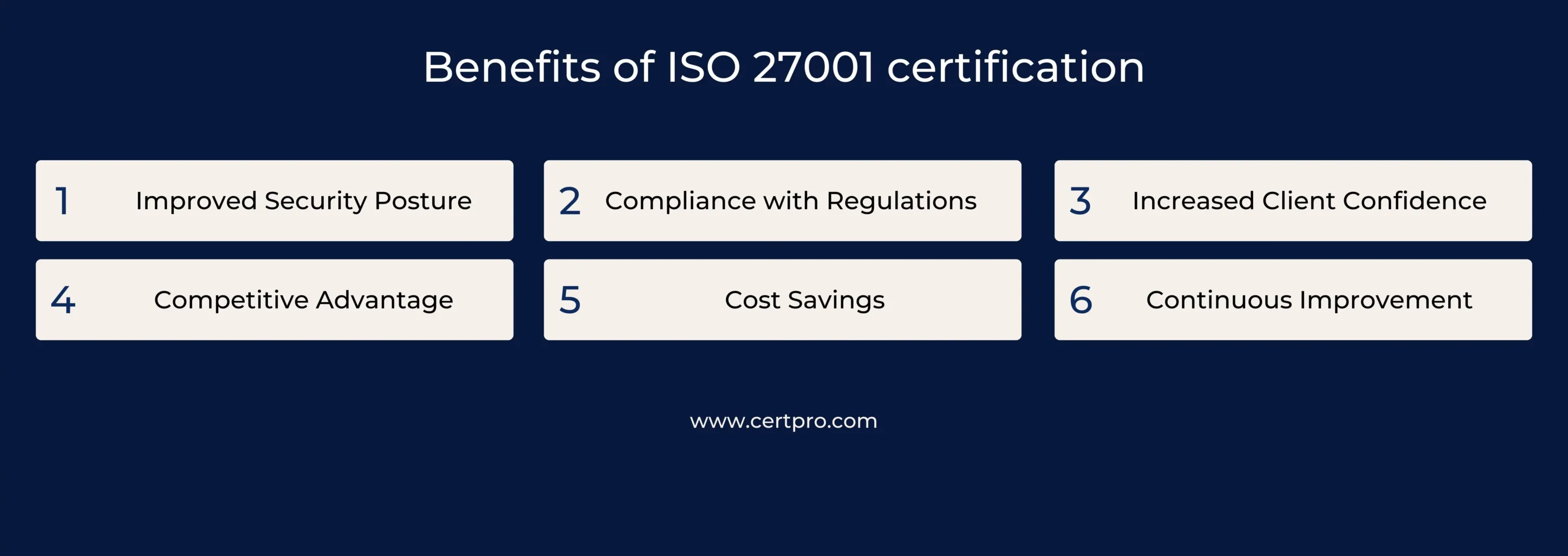
ISO 27001 Certification delivers measurable operational, commercial, and governance benefits for Rotterdam organizations across all industry sectors. The following benefits reflect outcomes directly attributable to the ISMS framework and the certification process, based on the structured requirements of ISO/IEC 27001:2022.
- ✓Independent, third-party verification of ISMS design and operating effectiveness against ISO/IEC 27001:2022
- ✓Structured risk identification, assessment, and treatment framework that reduces the likelihood and impact of information security incidents
- ✓Formally documented information security controls that support vendor assurance, due diligence, and procurement qualification processes
- ✓Demonstrated alignment with GDPR, NIS2, and DORA information security obligations through documented control implementation
- ✓Internationally recognized ISO 27001 certification credential that supports market access across Europe, the United States, and global markets
- ✓Improved internal visibility into information security risks through mandatory internal audit and management review processes
- ✓Reduced exposure to data breaches, unauthorized access, and operational disruptions through systematically managed Annex A controls
- ✓Three-year certification cycle with annual surveillance audits that reinforce ongoing ISMS maintenance and continual improvement
The ISMS framework required by ISO 27001 imposes a systematic approach to identifying and treating information security risks before they materialize into incidents. Organizations that complete the ISO 27001 certification audit process have demonstrated — through independent evaluation — that their risk assessment methodology is documented, consistently applied, and produces actionable risk treatment decisions.
For Rotterdam port infrastructure operators and maritime businesses, this includes operational technology risks, physical security vulnerabilities, and supply-chain information security exposures. For SaaS providers and cloud service companies, it encompasses access control failures, data leakage risks, and third-party vendor security gaps. The ISO 27001 audit process requires evidence of actual control implementation and operating effectiveness — not merely the existence of policies — ensuring that risk reduction is substantive rather than procedural.
ISO 27001 certification establishes formal accountability for information security at the top management level, requiring leadership commitment to the ISMS through defined roles, responsibilities, and resources. The standard’s management review requirement ensures that information security performance is assessed by senior decision-makers at planned intervals, with documented outputs that drive continual improvement.
For Rotterdam organizations with complex governance structures — including financial holding companies, maritime conglomerates, or multi-entity SaaS groups — the ISMS framework provides a mechanism for cascading information security accountability across organizational units and legal entities within the certification scope. The internal audit requirement creates an independent internal check function that complements external certification and supports board-level governance reporting on information security risk.
- ✓Operational Risk Reduction
- ✓Governance and Accountability Structures
Rotterdam Industry Sectors and ISO 27001 Certification Applicability
ISO 27001 Certification in Rotterdam is applicable across a broad range of industry sectors. The standard’s sector-agnostic design means that any organization processing, storing, or transmitting sensitive information can implement and certify an ISMS under ISO/IEC 27001:2022. The following sectors represent the primary applicability areas for ISO 27001 certification for Rotterdam companies and organizations across the Rotterdam-Rijnmond region.
Financial Services, Fintech, and Insurance
ISO 27001 certification for Rotterdam financial services organizations — including banks, insurance companies, asset managers, payment processors, and fintech firms — addresses the information security risk management requirements inherent in financial data processing, digital transaction systems, and customer data protection. Rotterdam’s financial sector, which includes firms operating under the supervision of De Nederlandsche Bank (DNB) and the Authority for the Financial Markets (AFM), faces heightened information security expectations under DORA. DORA requires ICT risk management frameworks, incident reporting procedures, and third-party ICT risk management controls.
ISO 27001 compliance provides a structured basis for documenting ICT risk management activities that can be referenced in DORA compliance programs. ISO 27001 certification audit Rotterdam engagements in financial services typically cover core banking systems, payment processing platforms, customer data repositories, and third-party technology provider relationships.
Logistics, Maritime, and Port Operations
The Port of Rotterdam — the largest seaport in Europe — and the surrounding logistics and maritime ecosystem represent a critical sector for ISO 27001 compliance among Rotterdam logistics companies and port operators. Organizations in this sector process sensitive cargo manifests, customs declarations, vessel tracking data, and commercial contracts that are targets for cyber threats including ransomware, supply-chain attacks, and industrial espionage.
ISO 27001 certification for Rotterdam port sector organizations addresses operational technology security, network segmentation, access control for port management systems, and incident response planning for cyber events affecting port operations. Rotterdam logistics companies participating in international supply chains — including third-party logistics providers, freight forwarders, and customs brokers — increasingly face ISO 27001 certification requirements from multinational shippers and consignees as a condition of supply-chain partnership.
SaaS, Cloud, Healthcare, and Energy Technology
Rotterdam’s technology sector encompasses SaaS providers, cloud service companies, AI businesses, cybersecurity firms, and e-commerce platforms that process customer data, intellectual property, and commercially sensitive information. For these organizations, ISO 27001 certification provides the independently verified security assurance that enterprise customers and institutional partners require before entrusting them with data or system access.
Healthcare organizations in Rotterdam — including hospitals, clinical laboratories, and health technology companies — process special categories of personal data subject to heightened GDPR obligations and NIS2 requirements. ISO 27001 certification supports the documentation of technical and organizational security measures required under these frameworks. Energy and industrial technology companies operating critical infrastructure in the Rotterdam-Rijnmond region face NIS2-driven security obligations for which ISO 27001 certification provides a recognized conformity framework accepted by Dutch and European regulators.
ISO 27001 Certification Scope and Independent Decision Framework
The scope of an ISO 27001 certification defines precisely which parts of an organization, which processes, and which systems are covered by the certified ISMS. Scope determination is the exclusive responsibility of the organization seeking certification. The certification body evaluates whether the defined scope is appropriate, clearly documented, and consistently applied throughout the ISMS — but does not prescribe scope boundaries. For Rotterdam organizations with complex operational structures, scope definition requires careful consideration of organizational boundaries, information asset boundaries, and the interfaces between the certified scope and out-of-scope systems or entities.
Scope Definition Principles and Common Configurations
ISO/IEC 27001:2022 requires that the ISMS scope account for interfaces and dependencies between activities performed by the organization and those performed by external parties. For Rotterdam SaaS providers, this typically means the scope encompasses software development, hosting, and customer support functions, with clear documentation of cloud infrastructure provider relationships in the Statement of Applicability. For financial institutions, the scope may encompass core banking operations, digital channels, and the internal IT infrastructure supporting them, with third-party payment processors and technology vendors addressed through supplier security controls.
Multi-site organizations — such as a logistics technology company with offices in Rotterdam, The Hague, and Delft — must define whether all sites are within scope or whether the ISMS applies to specific operational units. The certified scope statement appears on the issued ISO 27001 certificate and is publicly visible to customers and partners reviewing the certificate.
Independence of the Certification Decision
A defining characteristic of third-party ISO 27001 Certification is the independence of the certification decision from the audit execution. At CertPro, the auditors who conduct the Stage 1 and Stage 2 ISMS audit are distinct from the certification reviewer who makes the certification decision. This structural separation prevents conflicts of interest and ensures that the certificate reflects an objective evaluation of the organization’s ISMS, not the judgment of a single individual.
The certification decision is based on the totality of audit evidence, the classification and resolution of any nonconformities, and the auditor’s findings regarding ISMS conformity with ISO/IEC 27001:2022. Organizations that receive an ISO 27001 certificate from CertPro can represent to customers, regulators, and partners that the certification was issued following an independent, structured ISO 27001 audit process conducted by a Licensed CPA Firm.
CertPro: Independent ISO 27001 Certification Audit Services in Rotterdam
CertPro CPA LLC provides ISO 27001 Certification in Rotterdam as an independent third-party certification body. The firm is a Licensed CPA Firm operating under AICPA peer review standards and conducts ISO 27001 certification audits exclusively — without providing consulting, implementation, or advisory services to audited organizations. CertPro serves organizations across Rotterdam, The Hague, Delft, Schiedam, Capelle aan den IJssel, and the broader Netherlands, as well as internationally.
Audit Methodology and Evidence Standards
CertPro’s ISO 27001 audit methodology is structured around evidence-based evaluation of ISMS design and operating effectiveness. During the Stage 2 ISO 27001 certification audit, auditors collect and evaluate documentary evidence, conduct structured interviews with personnel responsible for ISMS processes, and assess the operational implementation of Annex A controls. The methodology distinguishes between controls that are adequately designed and controls that are operating effectively — both dimensions are required for a positive certification decision.
Auditors apply professional skepticism throughout the engagement, testing the reliability of management representations against independently verifiable evidence. Audit findings are documented in a structured audit report that specifies conformities, nonconformities, observations, and the basis for the certification recommendation.
Certification for Organizations Across the Netherlands
CertPro conducts ISO 27001 audit Rotterdam engagements for organizations across a broad spectrum of industries and sizes. The firm’s ISO 27001 certification services are available to small and mid-sized technology companies seeking their first ISO 27001 certificate, to established financial institutions pursuing recertification or scope expansion, and to multinational organizations seeking consistent ISMS certification across European operations.
CertPro’s auditors have experience across the industry sectors most relevant to Rotterdam’s economy, including ISMS certification Rotterdam engagements for logistics technology providers, port sector organizations, fintech companies, SaaS platforms, healthcare organizations, and energy technology firms. The firm’s geographic coverage spans Rotterdam, the broader Netherlands, and international markets, enabling multi-jurisdictional certification engagements where an organization’s ISMS scope extends across multiple countries.
ISO 27001 Certification Cost and Timeline in Rotterdam
ISO 27001 Certification in Rotterdam involves a structured audit timeline that depends on the organization’s size, the complexity of its ISMS scope, the number of locations included, and the maturity of its existing information security management practices. Understanding the typical timeline and the factors that influence audit duration enables Rotterdam organizations to plan their ISO 27001 certification programs effectively.
Typical Certification Timeline
For a typical small-to-medium Rotterdam organization with a defined ISMS scope covering a single site or a cloud-based SaaS platform, the Stage 1 audit is generally completed within one to two audit days. The Stage 2 ISO 27001 certification audit typically requires two to four audit days. Following Stage 2, the nonconformity resolution and independent certification review process adds additional time before the certificate is issued.
Organizations that enter the Stage 1 audit with complete mandatory documentation and a fully implemented ISMS generally proceed through the certification process more efficiently than those with significant documentation gaps or partially implemented controls. Annual surveillance audits typically require one to two audit days, depending on the scope and any changes to the ISMS since the previous audit. The recertification audit at the end of the three-year cycle is comparable in scope to the original Stage 2 assessment.
Factors Affecting Audit Scope and Duration
The audit scope and duration for ISO 27001 Certification in Rotterdam are influenced by several organizational factors. The number of employees within the ISMS scope, the number of physical and virtual locations included, the complexity of the technology environment, the number of Annex A controls selected in the Statement of Applicability, and the extent of third-party and supplier relationships that require auditor evaluation all affect the total audit effort required.
Organizations in regulated sectors — such as financial services subject to DORA or healthcare organizations subject to NIS2 — may have more extensive documentation requirements that extend the Stage 1 review. Multi-site organizations with offices across Rotterdam, The Hague, Delft, and other Dutch cities may require on-site audit visits to multiple locations. CertPro determines the appropriate audit program based on the organization’s submitted scope documentation and information provided during the pre-audit scoping process.
| Organization Type | Estimated Stage 1 Duration | Estimated Stage 2 Duration | Annual Surveillance |
|---|---|---|---|
| Small SaaS / Cloud Provider (< 50 employees) | 1 audit day | 2 audit days | 1 audit day |
| Mid-size Technology / Fintech (50–200 employees) | 1–2 audit days | 3–4 audit days | 1–2 audit days |
| Large Financial Institution / Port Operator | 2–3 audit days | 4–5 audit days | 2 audit days |
| Multi-site Logistics / Maritime Group | 2–3 audit days | 5+ audit days | 2–3 audit days |
ISO 27001 Assessment: Continual Improvement and Long-Term Certification Value
ISO 27001 certification is not a static achievement. The three-year certification cycle — with annual surveillance audits and a recertification audit at the end of each cycle — is designed to ensure that the ISMS continues to evolve in response to changes in the organization’s risk environment, technology landscape, regulatory obligations, and operational context. The continual improvement requirement embedded in ISO/IEC 27001:2022 means that organizations maintaining ISO 27001 compliance must demonstrate ongoing ISMS development, not merely the preservation of controls that were effective at the time of initial certification.
Surveillance Audits and ISMS Evolution
Annual surveillance audits conducted by CertPro evaluate whether the ISMS continues to conform to ISO/IEC 27001:2022 requirements and whether the organization has addressed any nonconformities or observations from the previous audit. Surveillance audits also assess whether the ISMS has adapted appropriately to significant changes — such as the introduction of new information systems, changes in organizational structure, expansion into new markets, or material shifts in the threat landscape.
For Rotterdam organizations operating in dynamic sectors — such as fintech, AI, or logistics technology — the surveillance audit provides an annual external check on ISMS currency. Surveillance audits typically cover a subset of the ISMS scope, with auditors selecting focus areas based on risk, changes since the last audit, and areas where nonconformities or observations were previously identified.
Recertification and Long-Term ISMS Value
The recertification audit, conducted before the expiry of the three-year ISO 27001 certificate, is a comprehensive reassessment of the ISMS against the current requirements of ISO/IEC 27001:2022. The recertification process evaluates ISMS performance over the full certification cycle, including the results of internal audits, management reviews, corrective actions, and continual improvement activities undertaken since initial certification.
Organizations that maintain active ISMS programs — with regular internal audits, documented management reviews, and ongoing risk assessment activities — typically complete recertification efficiently. For Rotterdam organizations, the long-term value of ISO 27001 Certification in Rotterdam lies not only in the certificate itself but in the systematic risk management discipline, documented control framework, and governance accountability structures that the ISMS embeds into the organization’s operations over successive certification cycles.
FAQ
▶
What is ISO 27001 Certification?
▶
What is ISO 27001 Certification and what does it certify?
▶
How long does the ISO 27001 certification audit process take for a Rotterdam organization?
▶
Is ISO 27001 certification mandatory for Rotterdam organizations?
▶
What is the difference between a Stage 1 and Stage 2 ISO 27001 audit?
▶
How long is an ISO 27001 certificate valid?
▶
Does ISO 27001 certification automatically establish GDPR or NIS2 compliance?
▶
What is the Statement of Applicability in ISO 27001?
Get In Touch
have a question? let us get back to you.