
SOC 2 Certification in Netherlands
SOC 2 Certification in Netherlands is an independent attestation issued by a Licensed CPA Firm confirming that an organization’s controls over security, availability, processing integrity, confidentiality, and privacy meet the AICPA Trust Services Criteria (TSC). The resulting SOC 2 attestation report provides independently verified evidence that an organization’s control environment functions as designed. This standard of assurance is increasingly required by enterprise buyers, institutional clients, and international partners operating across the Netherlands and the broader European market.
OUR CLIENTS










What SOC 2 Certification Means for Organizations in the Netherlands
SOC 2 Certification in Netherlands is an independent attestation issued by a Licensed CPA Firm confirming that an organization’s controls over security, availability, processing integrity, confidentiality, and privacy meet the AICPA Trust Services Criteria (TSC). The resulting SOC 2 attestation report provides independently verified evidence that an organization’s control environment functions as designed. This standard of assurance is increasingly required by enterprise buyers, institutional clients, and international partners operating across the Netherlands and the broader European market.
The Netherlands holds a strategically significant position in the European technology landscape. Amsterdam functions as a major hub for SaaS providers, fintech companies, AI businesses, cloud service providers, and data center operators. Rotterdam and The Hague host financial institutions, cybersecurity firms, logistics technology companies, and government-adjacent enterprises. Utrecht and Eindhoven anchor manufacturing technology, life sciences, and deep-tech ecosystems.
Organizations across all these sectors process sensitive customer data, deliver critical digital services, and operate under contractual obligations that require independently verified security assurances. This is precisely the context in which SOC 2 Certification in Netherlands becomes a business-critical requirement rather than an optional credential.
SOC 2 compliance in the Netherlands operates within a regulatory environment shaped by the EU General Data Protection Regulation (GDPR), the Dutch GDPR Implementation Act (Uitvoeringswet AVG), the NIS2 Directive, and the Digital Operational Resilience Act (DORA). While a SOC 2 examination does not automatically establish compliance with these laws and regulations, the control framework it evaluates directly addresses information security, data handling, and operational resilience practices.
These are areas where Dutch and European regulatory authorities have clear expectations. Enterprise clients and regulated buyers frequently use SOC 2 attestation reports as a core component of their third-party risk management and vendor assurance programs.
SOC 2 Certification in Netherlands is governed by AT-C Section 205 of the AICPA’s attestation standards, which defines the conditions under which a Licensed CPA Firm may express an opinion on subject matter controlled by another party. The examination is conducted against the AICPA Trust Services Criteria, establishing detailed control requirements across five categories: Security (Common Criteria), Availability, Processing Integrity, Confidentiality, and Privacy.
Organizations define their scope by selecting the Trust Services Criteria categories relevant to their service commitments and the data they process on behalf of customers. The resulting report — either a Type 1 or Type 2 SOC 2 report — is issued to the organization and shared with intended users on a restricted-use basis.
For Dutch organizations serving US-based enterprise clients, multinational corporations, or international buyers who require SOC 2 as a procurement condition, SOC 2 Certification in Netherlands provides the independently verified documentation needed to satisfy due diligence requirements. SaaS companies, cloud infrastructure providers, healthcare technology firms, financial data processors, and managed service providers based in the Netherlands increasingly cite SOC 2 attestation as a factor in competitive differentiation and enterprise sales cycles.
CertPro CPA LLC, a Licensed CPA Firm, conducts independent SOC 2 examinations for organizations based in the Netherlands and across the European Union.

ENQUIRE NOW
Related Resources
Related Services in Netherlands
What Is SOC 2 Certification?
SOC 2 Certification is the outcome of a formal attestation engagement conducted by a Licensed CPA Firm under the AICPA’s attestation standards. The term “SOC” stands for System and Organization Controls. The “2” designation distinguishes this framework from SOC 1 — which addresses financial reporting controls — and SOC 3 — which produces a general-use summary report.
A SOC 2 examination evaluates the design and, in the case of a Type 2 report, the operating effectiveness of an organization’s controls relevant to the selected Trust Services Criteria over a defined observation period. Understanding what SOC 2 certification entails is the essential first step for any Dutch organization preparing to pursue independent attestation.
SOC 2 Type 1 vs. Type 2 Reports
A SOC 2 Type 1 report evaluates whether an organization’s controls are suitably designed to meet the applicable Trust Services Criteria as of a specific point in time. It does not test whether those controls operated effectively over a period. A SOC 2 Type 2 report evaluates both the design and the operating effectiveness of controls over an observation period — typically six to twelve months.
Type 2 reports carry substantially greater assurance value and are the standard required by most enterprise buyers, regulated institutions, and US-based clients conducting third-party risk assessments of Dutch service providers. For organizations pursuing SOC 2 Certification in Netherlands, the Type 2 report is generally the target deliverable for long-term enterprise relationships.
| Attribute | SOC 2 Type 1 | SOC 2 Type 2 |
|---|---|---|
| Evaluation Period | Point in time | Defined observation period (typically 6–12 months) |
| Control Design Assessment | Yes | Yes |
| Operating Effectiveness Testing | No | Yes |
| Assurance Level | Lower | Higher |
| Typical Use Case | Initial attestation; early-stage organizations | Enterprise procurement; regulated client requirements |
The Five Trust Services Criteria Categories
The AICPA Trust Services Criteria define five categories against which a SOC 2 examination is conducted. Security — also called the Common Criteria — is mandatory for all SOC 2 engagements. It addresses logical and physical access controls, change management, risk mitigation, and incident response.
The remaining four categories — Availability, Processing Integrity, Confidentiality, and Privacy — are selected based on the organization’s service commitments and the nature of the data it processes. A cloud infrastructure provider in Amsterdam handling uptime-sensitive workloads would typically include Availability. A healthcare data processor in Utrecht handling patient records would include Privacy and Confidentiality. The selection of Trust Services Criteria categories directly shapes the scope and depth of the SOC 2 audit for each Dutch organization.
SOC 2 Certification Requirements in Netherlands
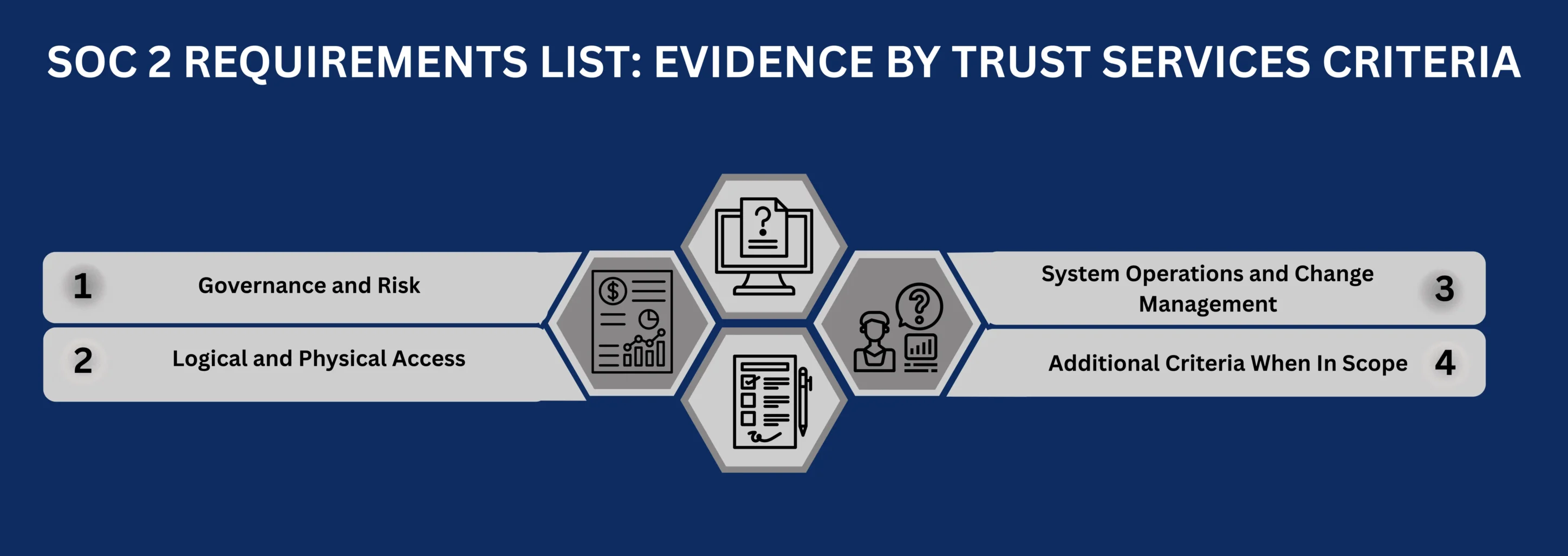
SOC 2 Certification in Netherlands requires organizations to establish a documented control environment that addresses the Trust Services Criteria applicable to their scope. The requirements span organizational governance, technical infrastructure, operational processes, and management accountability. Dutch organizations pursuing SOC 2 certification must satisfy both documentation and technical requirements before and during the audit engagement.
SOC 2 compliance requires organizations to maintain a defined System Description — a formal document that describes the system under examination, the services provided, the system’s boundaries, and the controls in place. Supporting documentation includes written information security policies, access control procedures, change management records, incident response plans, risk assessment documentation, and vendor management policies.
For Dutch organizations, all documentation must accurately reflect the actual operating environment and cannot be created retrospectively for the purpose of the SOC 2 audit. The Licensed CPA Firm conducting the examination evaluates documentation completeness as a core part of the attestation procedure.
Technical requirements for SOC 2 certification address the actual implementation of controls within the organization’s technology environment. These include logical access management with role-based access controls and multi-factor authentication, network security configurations, encryption of data in transit and at rest, vulnerability management programs, centralized logging and monitoring systems, and backup and recovery procedures.
Operational requirements include personnel security practices such as background checks and security awareness training, physical security measures for data centers and office environments, and defined change management processes. Organizations operating cloud infrastructure in the Netherlands must also document controls applicable to shared responsibility models with cloud platform providers such as AWS, Microsoft Azure, or Google Cloud.
- ✓Formal System Description covering services, system boundaries, and control environment
- ✓Written information security policies reviewed and approved by management
- ✓Logical access controls with role-based permissions and multi-factor authentication
- ✓Encryption of data in transit and at rest across all in-scope systems
- ✓Centralized logging and monitoring with defined alert thresholds and review procedures
- ✓Documented incident response plan with defined roles, escalation paths, and communication procedures
- ✓Vendor and subservice organization management policy addressing third-party risk
- ✓Change management process with defined approval workflows and testing requirements
- ✓Documentation and Policy Requirements
- ✓Technical and Operational Control Requirements
The SOC 2 Audit Process in Netherlands
The SOC 2 audit process in Netherlands follows a structured sequence of stages defined by AICPA attestation standards. Each stage produces defined outputs that collectively form the basis for the Licensed CPA Firm’s opinion. The SOC 2 audit process applies equally to Dutch organizations regardless of industry sector, organizational size, or technology architecture.
- Scope Definition: The organization and the Licensed CPA Firm establish which systems, Trust Services Criteria categories, and organizational boundaries are included in the SOC 2 examination.
- Audit Program Determination: The Licensed CPA Firm designs the audit program, specifying control objectives, evidence requirements, and testing procedures applicable to the defined scope.
- System Description Review: The auditor evaluates the organization’s System Description for completeness and accuracy relative to the actual operating environment.
- Stage 1 Audit (Design Assessment): The auditor assesses whether controls are suitably designed to meet the applicable Trust Services Criteria. This stage applies to both Type 1 and Type 2 engagements.
- Observation Period (Type 2 Only): For Type 2 reports, controls are observed and tested over a defined period — typically six to twelve months — to assess operating effectiveness.
- Evidence Collection and Control Testing: The auditor collects evidence through inquiry, observation, inspection of documentation, and re-performance of control procedures.
- Nonconformity Review: Identified exceptions or control deficiencies are evaluated for their impact on the audit opinion. Management provides responses to findings where applicable.
- Attestation Report Issuance: The Licensed CPA Firm issues the SOC 2 attestation report, including the auditor’s opinion, system description, and detailed control testing results.
- Surveillance and Recertification: SOC 2 reports are typically issued annually. Organizations maintain current SOC 2 certification status through continuous control operation and annual audit cycles.
Evidence collection is the operational core of the SOC 2 examination. The Licensed CPA Firm collects evidence through four primary methods: inquiry of personnel responsible for controls, observation of control procedures in operation, inspection of policies, logs, configuration records, and access reports, and re-performance of automated or manual controls.
For a Type 2 SOC 2 audit, the observation period defines the timeframe over which control effectiveness is evaluated. A twelve-month observation period provides the broadest coverage and the most comprehensive assurance to report users. Dutch organizations initiating their first SOC 2 Type 2 engagement typically begin with a six-month observation period to establish an initial audit cycle, then extend to twelve months in subsequent years.
- ✓Stages of the SOC 2 Examination
- ✓Evidence Collection and Observation Period
Benefits of SOC 2 Certification for Netherlands-Based Organizations
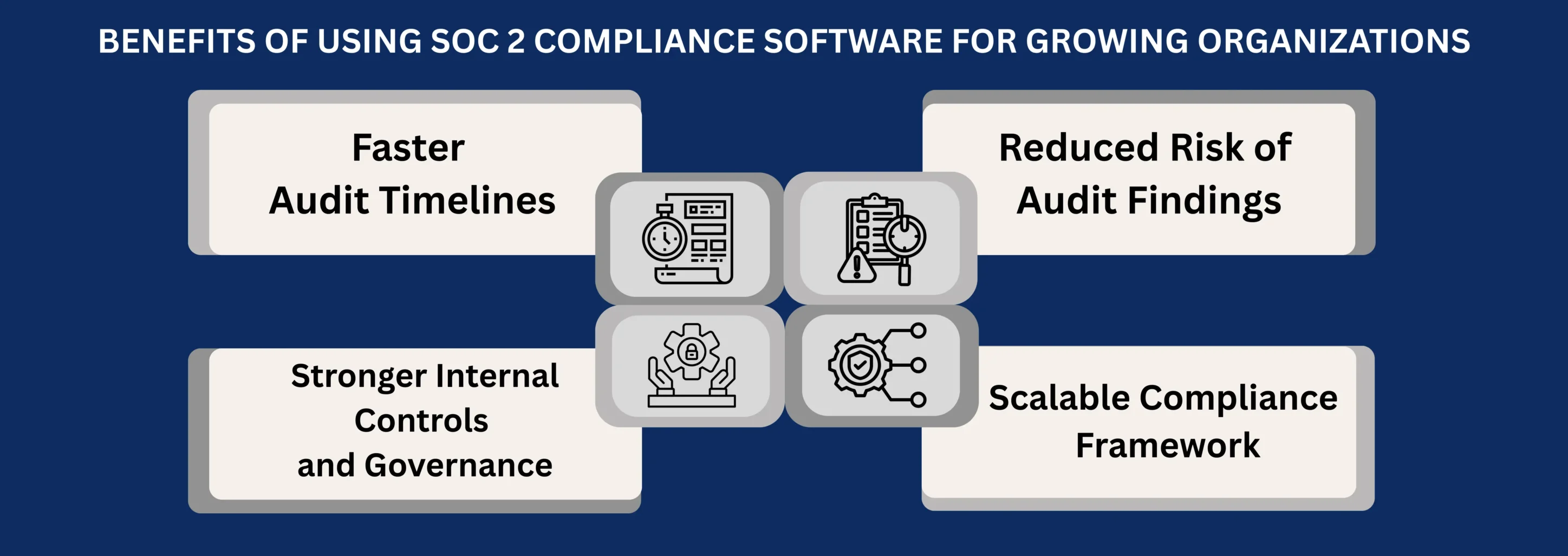
SOC 2 Certification in Netherlands delivers independently verified assurance across multiple dimensions of organizational trust. The benefits extend beyond regulatory documentation to include measurable impacts on enterprise sales cycles, vendor assurance programs, and internal control maturity.
Dutch organizations that have completed SOC 2 certification consistently report improvements in client acquisition timelines, a reduction in customer-initiated security questionnaires, and enhanced positioning in competitive procurement processes.
Enterprise buyers — particularly US-based corporations, multinational financial institutions, and regulated healthcare organizations — require independently verified security assurances before contracting with technology service providers. SOC 2 attestation replaces lengthy security questionnaire processes with a standardized, auditor-verified report that satisfies procurement and vendor risk management requirements.
For Dutch SaaS companies, fintech firms, and cloud providers competing for enterprise contracts in the United States and across the European Union, SOC 2 Certification in Netherlands directly reduces sales friction and accelerates contract execution timelines. The SOC 2 report functions as a trusted third-party attestation that enterprise procurement teams can review without conducting independent security assessments of their own.
The NIS2 Directive and the Digital Operational Resilience Act (DORA) impose supply chain security and third-party risk management obligations on organizations operating across the European Union, including in the Netherlands. While SOC 2 attestation does not establish compliance with these regulations, the independently verified control evidence in a SOC 2 Type 2 report is directly relevant to the due diligence requirements that regulated entities must satisfy.
Financial institutions and essential service operators subject to DORA and NIS2 increasingly require SOC 2 reports from technology providers as a component of their third-party risk frameworks. In this context, SOC 2 compliance in the Netherlands supports both commercial relationships and regulatory due diligence processes.
- ✓Independently verified security assurance satisfying enterprise procurement and vendor risk management requirements
- ✓Reduced time spent on customer security questionnaires and due diligence requests
- ✓Documented control evidence relevant to NIS2 Directive and DORA third-party risk assessments
- ✓Competitive differentiation in enterprise sales cycles for SaaS, fintech, and cloud service providers
- ✓Structured internal control framework supporting operational consistency and risk management
- ✓Annual SOC 2 audit discipline that reinforces ongoing control monitoring and accountability
- ✓Internationally recognized attestation accepted by US, EU, and global enterprise buyers
- ✓Demonstrated alignment with GDPR-relevant data protection and security control expectations
- ✓Enterprise Sales and Client Trust
- ✓Regulatory Context and Third-Party Risk Management
SOC 2 Compliance Netherlands: Industry-Specific Considerations
SOC 2 compliance in Netherlands applies across a broad range of industries and organizational types. The Trust Services Criteria framework is deliberately designed to be sector-agnostic, enabling its application to any organization that processes, stores, or transmits sensitive information on behalf of clients.
The specific Trust Services Criteria categories selected and the controls evaluated during the SOC 2 audit reflect the nature of the services provided and the data handled by each organization. Dutch companies across all major sectors are increasingly pursuing SOC 2 certification to meet client expectations and differentiate their offerings in competitive markets.
Fintech, Financial Services, and Banking
SOC 2 certification for Netherlands fintech and financial services organizations represents one of the most prominent use cases in the Dutch market. Amsterdam’s fintech ecosystem includes payment processors, digital banking platforms, investment technology firms, and financial data aggregators — all of which process sensitive financial information under contractual obligations to institutional clients.
SOC 2 certification for Netherlands financial services organizations provides independently verified documentation of controls over data confidentiality, processing integrity, and security — three Trust Services Criteria categories directly relevant to financial data processing. Financial institutions subject to DORA operational resilience requirements frequently cite SOC 2 Type 2 reports from their technology vendors as evidence satisfying their third-party ICT risk management obligations.
Healthcare, Life Sciences, Cloud, and SaaS
Healthcare technology and life sciences organizations in the Netherlands — including electronic health record systems, clinical data platforms, and medical device software providers — handle patient data subject to strict confidentiality and privacy obligations. A SOC 2 examination for these organizations typically includes the Privacy and Confidentiality Trust Services Criteria in addition to the mandatory Security criteria.
Cloud infrastructure providers and SaaS companies operating from the Netherlands and serving international enterprise clients represent the largest category of SOC 2 certification engagements in the Dutch market. These organizations frequently encounter SOC 2 requirements as a procurement condition from US-headquartered enterprise clients. Obtaining SOC 2 Certification in Netherlands has become a standard step in their international market development strategy.
| Industry Sector | Relevant TSC Categories | Primary Driver |
|---|---|---|
| Fintech & Financial Services | Security, Confidentiality, Processing Integrity | DORA third-party risk; enterprise procurement |
| SaaS & Cloud Providers | Security, Availability | US enterprise client requirements; vendor assurance |
| Healthcare & Life Sciences | Security, Privacy, Confidentiality | Patient data obligations; international client requirements |
| E-Commerce & Data Processors | Security, Confidentiality | GDPR alignment; B2B procurement requirements |
| Cybersecurity & Managed Services | Security, Availability | Client assurance; competitive differentiation |
SOC 2 Certification Cost in Netherlands
The investment associated with SOC 2 Certification in Netherlands reflects the scope of the examination, the number of Trust Services Criteria categories included, the complexity of the organization’s technology environment, and whether the engagement produces a Type 1 or Type 2 report. Dutch organizations evaluating the financial dimensions of SOC 2 certification should consider both the direct audit engagement costs and the organizational effort required to maintain a documented control environment throughout the observation period.
Factors Influencing Audit Scope and Engagement Complexity
Several factors directly affect the scope and complexity of a SOC 2 audit engagement for Dutch organizations. The number of Trust Services Criteria categories selected expands the volume of controls subject to evaluation. The size and complexity of the technology environment — including the number of in-scope systems, cloud platforms, subservice organizations, and personnel — determines the depth of evidence collection required.
The duration of the observation period for Type 2 engagements also affects the volume of evidence reviewed. Organizations with mature, documented control environments and established logging and monitoring infrastructure require less remediation effort during the SOC 2 audit cycle. The use of subservice organizations — including cloud providers such as AWS, Microsoft Azure, or Google Cloud — introduces shared responsibility documentation requirements that the Licensed CPA Firm must evaluate.
Annual Recertification and Ongoing Commitment
SOC 2 attestation reports are issued for a defined period and do not confer indefinite certification status. To maintain current SOC 2 compliance status, organizations must complete annual audit cycles that produce updated Type 2 reports covering a new observation period. Enterprise clients and regulated buyers expect continuously current SOC 2 reports as part of their ongoing vendor assurance programs — a lapsed or expired report may trigger renewed security questionnaire requirements or contract review.
Dutch organizations that integrate SOC 2 control monitoring into their standard operational processes find that annual recertification audit cycles become progressively more efficient as the control environment matures and evidence collection procedures are established.
How to Get SOC 2 Certified in Netherlands
Obtaining SOC 2 Certification in Netherlands begins with engaging a Licensed CPA Firm to conduct the attestation examination. The process follows a defined sequence from scope determination through report issuance. Dutch organizations initiating a SOC 2 engagement for the first time should plan for a total timeline of four to nine months, depending on whether a Type 1 or Type 2 report is the objective and the duration of the observation period selected.
Defining Scope and Selecting Trust Services Criteria
The first decision in a SOC 2 engagement is defining the system boundary and selecting the Trust Services Criteria categories to be included. The system boundary describes which services, infrastructure components, data flows, and organizational functions are subject to the SOC 2 audit. Management is responsible for defining this boundary accurately and completely.
The selection of Trust Services Criteria categories should reflect the commitments made to customers in service agreements and the categories of data processed. Organizations that process data under uptime service level agreements typically include Availability. Organizations processing personal data or sensitive financial information typically include Confidentiality and, where personal information processing is directly addressed, Privacy.
Management Responsibilities During the SOC 2 Examination
Management of the organization under examination bears defined responsibilities throughout the SOC 2 audit process. These responsibilities include preparing and signing the System Description, asserting that controls are suitably designed and — for Type 2 engagements — that they operated effectively during the observation period, making personnel available for auditor inquiries, providing evidence requested during the examination, and responding to findings or exceptions identified during control testing.
The Licensed CPA Firm conducting the SOC 2 examination operates independently and does not design, implement, or operate the controls being evaluated. The attestation opinion issued reflects the auditor’s independent assessment of management’s assertions and the supporting evidence collected during the examination.
SOC 2 Certification vs. Other Frameworks for Netherlands Organizations
Dutch organizations frequently evaluate SOC 2 Certification in Netherlands alongside other information security frameworks, including ISO 27001 and the EU-specific cybersecurity requirements established under NIS2 and DORA. Each framework serves distinct purposes and addresses different aspects of security assurance.
Understanding the differences allows organizations to select the appropriate attestation or certification pathway based on their client base, regulatory obligations, and market positioning. For many Dutch technology companies, SOC 2 certification and ISO 27001 are complementary rather than competing investments.
SOC 2 vs. ISO 27001
SOC 2 and ISO 27001 address overlapping but distinct aspects of information security assurance. ISO 27001 is a globally recognized standard that certifies an organization’s Information Security Management System (ISMS) against a defined set of controls and management requirements. SOC 2, by contrast, is an attestation that evaluates specific controls against the AICPA Trust Services Criteria, with results reported in a detailed auditor’s report shared with intended users.
ISO 27001 certification carries strong recognition across European markets and with European enterprise buyers, while SOC 2 attestation is the dominant standard for US enterprise procurement and vendor risk management. Organizations serving both European and US enterprise clients commonly pursue both frameworks, as they address complementary assurance requirements. The SOC 2 examination is more granular in its control testing focus, documenting specific control exceptions and operating effectiveness evidence in a way that ISO 27001 certification does not.
SOC 2 and GDPR Alignment for Dutch Organizations
The GDPR and the Dutch GDPR Implementation Act (Uitvoeringswet AVG) impose legal obligations on organizations that process personal data of EU residents. SOC 2 attestation is not a GDPR compliance mechanism and does not establish that an organization satisfies GDPR requirements. However, the Privacy Trust Services Criteria within a SOC 2 examination address controls over notice, choice, collection, use, retention, disclosure, and monitoring of personal information — areas that are substantively relevant to GDPR obligations.
Dutch organizations that have implemented GDPR-required technical and organizational security measures frequently find that the controls documented and tested during the SOC 2 audit overlap significantly with their GDPR security documentation. The SOC 2 attestation report provides independently verified evidence of these controls to clients and regulators, though it should not be presented as a substitute for formal GDPR compliance assessments.
CertPro’s SOC 2 Certification Services in Netherlands
CertPro CPA LLC is a Licensed CPA Firm that conducts independent SOC 2 examinations for organizations based in the Netherlands and across the European Union. SOC 2 Certification in Netherlands requires a Licensed CPA Firm to serve as the independent auditor — only a Licensed CPA Firm can issue SOC 2 attestation reports under AICPA attestation standards.
CertPro’s SOC 2 examination services address the full lifecycle of the attestation engagement, from scope determination through evidence collection, control testing, nonconformity review, and attestation report issuance. Dutch organizations partnering with CertPro benefit from a structured, standards-compliant SOC 2 audit process designed to produce reliable, enterprise-ready reports.
Independent Audit and Attestation Scope
CertPro CPA LLC conducts SOC 2 Type 1 and SOC 2 Type 2 examinations for Dutch organizations across all sectors, including SaaS providers, fintech companies, financial institutions, healthcare technology firms, AI businesses, cloud infrastructure providers, cybersecurity companies, e-commerce platforms, data center operators, logistics technology firms, and telecommunications providers.
The SOC 2 audit Netherlands engagement covers all Trust Services Criteria categories applicable to the defined scope — Security (mandatory), and Availability, Processing Integrity, Confidentiality, and Privacy as selected by the organization based on its service commitments and data processing activities. Each SOC 2 examination is conducted in accordance with AT-C Section 205 attestation standards and the AICPA Trust Services Criteria 2017 edition.
Report Issuance and Ongoing Examination Cycles
Upon completion of the SOC 2 examination, CertPro CPA LLC issues the SOC 2 attestation report to the organization. The report includes the Licensed CPA Firm’s opinion, the management-prepared System Description, and the detailed results of control testing — including any exceptions identified and management’s responses. For Type 2 reports, the attestation documents the auditor’s evaluation of operating effectiveness across the full observation period.
Dutch organizations that maintain annual SOC 2 Type 2 certification cycles with CertPro benefit from examination continuity, established evidence collection procedures, and auditor familiarity with the organization’s control environment. All SOC 2 attestation engagements in the Netherlands are conducted under strict independence requirements, ensuring that the attestation report reflects an objective, evidence-based assessment of the organization’s controls.
FAQ
▶
What is SOC 2 certification?
▶
What is the difference between SOC 2 certified and SOC 2 compliant?
▶
How long does the SOC 2 audit process take in the Netherlands?
▶
Which Trust Services Criteria categories are mandatory for SOC 2 certification?
▶
How long is a SOC 2 attestation report valid?
▶
Does SOC 2 certification satisfy GDPR requirements for Dutch organizations?
▶
What is the difference between SOC 2 and SOC 1?
▶
Can Dutch organizations use SOC 2 reports to satisfy NIS2 Directive requirements?
SOC 1 VS SOC 2: WHICH REPORT YOUR CUSTOMERS ACTUALLY ASK FOR
If you sell SaaS or provide outsourced services, you have likely been asked for a SOC report. However, the follow-up question is rarely easy to answer…

AICPA Issues New Guidance for Peer Reviewers Evaluating SOC 2 Engagements
AICPA SOC 2 guidance has been issued to help peer reviewers identify quality risks associated with SOC 2 engagements as the use of compliance automati…
SOC 2 Certified: What Does It Mean for Your Business
For companies that handle sensitive data or run cloud-based services, the question “Can you provide your SOC 2 report?” carries enormous weight. Yet, …
Get In Touch
have a question? let us get back to you.