
ISO 27001 Certification in Netherlands
The ISO 27001 audit process in the Netherlands follows a defined, multi-stage sequence from initial application through certification issuance and ongoing surveillance. Each stage involves structured evaluation activities conducted by independent auditors from CertPro CPA LLC, a Licensed CPA Firm. The ISO 27001 certification audit is not a consultative engagement — auditors evaluate objective evidence of conformance against ISO/IEC 27001:2022 requirements and issue findings, nonconformities, and ultimately certification decisions based solely on auditor-verified evidence.
OUR CLIENTS










What Is ISO 27001 Certification and Why Does It Matter for Organizations in the Netherlands?
ISO 27001 Certification in Netherlands is an independent third-party attestation issued by a Licensed CPA Firm confirming that an organization’s Information Security Management System (ISMS) conforms to the requirements of ISO/IEC 27001:2022. The certification is granted following a structured ISO 27001 certification audit that evaluates the design, implementation, and operational effectiveness of an organization’s information security controls, risk assessment processes, risk treatment plans, and management review activities. For organizations operating across Amsterdam, Rotterdam, The Hague, Utrecht, Eindhoven, and the broader Dutch business ecosystem, ISO 27001 Certification in Netherlands signals that information security risks are systematically identified, assessed, treated, and monitored within a formally audited management framework.
The Netherlands occupies a strategically significant position in the European digital economy. As home to one of Europe’s largest concentrations of data centers, cloud service providers, SaaS platforms, fintech companies, logistics and technology firms, telecommunications providers, and multinational enterprises, the Dutch information security landscape demands internationally recognized standards. ISO 27001 Certification in Netherlands provides organizations with a credential recognized across the European Union, the United States, and international markets. It demonstrates that an independently audited ISMS governs the confidentiality, integrity, and availability of organizational information assets. This credential is increasingly referenced in vendor assurance frameworks, procurement requirements, and financial services due diligence processes throughout the Netherlands and broader EU markets.
ISO 27001 compliance in the Netherlands carries particular relevance in the context of applicable EU and Dutch regulatory frameworks. The EU General Data Protection Regulation (GDPR) and the Dutch GDPR Implementation Act (Uitvoeringswet AVG) establish stringent requirements for the protection of personal data. The NIS2 Directive imposes binding cybersecurity obligations on operators of essential and important entities across critical sectors. The Digital Operational Resilience Act (DORA) introduces ICT risk management requirements for financial entities. While ISO 27001 Certification does not automatically establish compliance with any of these instruments, the structured evidentiary basis it provides — documented risk assessments, Annex A controls, Statement of Applicability, management reviews, and audit records — supports alignment with these regulatory frameworks. It also facilitates productive regulatory discussions with the Dutch Data Protection Authority (Autoriteit Persoonsgegevens) and other competent authorities.
Organizations seeking ISO 27001 Certification in Netherlands must demonstrate conformance with all applicable clauses of ISO/IEC 27001:2022 — the current version of the standard with a mandatory transition deadline of October 31, 2025, as established by international accreditation bodies. The 2022 revision introduced a restructured Annex A containing 93 controls organized across four themes: Organizational, People, Physical, and Technological. This replaces the 114 controls across 14 domains in the 2013 edition. Organizations holding certifications to the earlier standard must complete transition audits before the October 2025 deadline. CertPro CPA LLC, a Licensed CPA Firm, conducts ISO 27001 certification audits in the Netherlands as an independent third-party certification body, evaluating organizational conformance against the full requirements of ISO/IEC 27001:2022 without providing implementation or advisory services.

ENQUIRE NOW
Related Resources
Related Services in Netherlands
What Is ISO 27001 Certification?
ISO 27001 Certification is a formal, accredited attestation that an organization’s ISMS meets the internationally recognized requirements of ISO/IEC 27001:2022, published jointly by the International Organization for Standardization (ISO) and the International Electrotechnical Commission (IEC). The standard defines requirements for establishing, implementing, maintaining, and continually improving an ISMS — a systematic framework for managing information security risks through documented policies, procedures, controls, and management oversight. ISMS certification is the outcome of a structured ISO 27001 audit conducted by an independent third-party certification body. Auditors evaluate objective evidence of conformance rather than organizational intent or self-assessment, ensuring the credential carries genuine assurance weight.
ISO/IEC 27001:2022 Standard Structure
ISO/IEC 27001:2022 is structured around ten clauses, with Clauses 4 through 10 containing the mandatory requirements organizations must satisfy to achieve certification. Clause 4 addresses organizational context and interested party requirements. Clause 5 defines leadership and commitment obligations, including establishment of an information security policy and assignment of ISMS roles and responsibilities. Clauses 6, 7, and 8 cover planning, support, and operation — encompassing risk assessment, risk treatment, the Statement of Applicability (SoA), resource management, awareness, communication, and documented information requirements. Clause 9 addresses performance evaluation through internal audits and management reviews. Clause 10 requires organizations to address nonconformities and demonstrate continual improvement of the ISMS over time.
Annex A of ISO/IEC 27001:2022 contains 93 information security controls organized under four thematic categories: Organizational controls (37), People controls (8), Physical controls (14), and Technological controls (34). Organizations are not required to implement all 93 controls. Rather, they must conduct a risk assessment, select controls appropriate to identified risks, document their selections and exclusions in the Statement of Applicability, and implement the selected controls. The SoA is a mandatory document that every ISO 27001 certification audit examines to verify that control selection decisions are justified by the risk treatment process and that applicable legal, regulatory, and contractual requirements have been incorporated.
ISMS Certification vs. ISO 27001 Compliance
ISMS certification and ISO 27001 compliance are related but distinct concepts. ISO 27001 compliance refers to an organization’s internal determination that its ISMS meets the requirements of the standard, typically through self-assessment or internal audit activities. ISMS certification, by contrast, is an independent third-party attestation issued following an accredited ISO 27001 certification audit conducted by a qualified certification body. Certification carries greater evidentiary weight than self-declared compliance because it is based on objective audit evidence evaluated by auditors who are independent of the organization. For Dutch organizations subject to vendor assurance requirements, regulatory scrutiny, or contractual obligations, an independently issued ISMS certification Netherlands credential provides a verifiable and externally audited assurance level that internal compliance declarations simply cannot replicate.
| Aspect | ISO 27001 Compliance | ISMS Certification |
|---|---|---|
| Assessment Type | Internal or self-declared | Independent third-party ISO 27001 audit |
| Evidentiary Basis | Self-assessment records | Auditor-verified objective evidence |
| Credential Issued | None (internal determination) | Formal ISO 27001 certification certificate |
| Validity Period | Not applicable | 3-year certification cycle with annual surveillance |
| Regulatory Recognition | Limited | Broadly recognized by regulators, customers, and counterparties |
ISO 27001 Requirements and ISMS Framework
The ISO/IEC 27001:2022 standard imposes specific, auditable requirements across organizational, documentation, operational, and performance dimensions. Organizations pursuing ISO 27001 Certification in Netherlands must satisfy each mandatory clause through objective evidence — including documented policies, implemented procedures, completed risk assessments, records of management reviews, and evidence of continual improvement activities. The ISMS framework does not prescribe a single implementation model. Instead, it requires that the chosen approach be appropriate to the organization’s context, scale, risk profile, and information security objectives, making it applicable to a wide range of Dutch businesses and industries.
ISO/IEC 27001:2022 mandates a defined set of documented information that must be maintained and retained as evidence of ISMS conformance. Mandatory documents include the information security policy, ISMS scope definition, risk assessment methodology, risk assessment results, risk treatment plan, Statement of Applicability, information security objectives, competence records, internal audit program and results, management review records, and records of nonconformities and corrective actions. Each document must be controlled — meaning it must be approved, versioned, accessible to relevant personnel, and protected against unauthorized modification. During the ISO 27001 certification audit, auditors examine these documents to verify that the ISMS is formally defined, consistently maintained, and operationally implemented across the certified scope.
Risk assessment is the methodological core of the ISO 27001 ISMS framework. Organizations must define and apply a consistent risk assessment methodology that identifies information security risks associated with the loss of confidentiality, integrity, or availability of information assets. Each identified risk must be analyzed — assessing likelihood and potential consequence — and evaluated against defined risk acceptance criteria. The risk treatment process then determines whether each risk will be modified through controls, avoided by discontinuing the activity, shared through contractual arrangements, or accepted if within tolerance. The risk treatment plan documents the selected treatment option, the Annex A controls applied, and the responsible owner for each action. ISO 27001 audit evaluations in the Netherlands closely examine the logical connection between identified risks, selected controls, and documented treatment decisions to confirm the methodology is applied consistently and not retrospectively.
Clause 9.3 of ISO/IEC 27001:2022 requires that top management conduct periodic reviews of the ISMS to evaluate its continuing suitability, adequacy, and effectiveness. Management review inputs must include the status of actions from previous reviews, changes in external and internal issues relevant to the ISMS, feedback on information security performance including nonconformities and corrective actions, monitoring and measurement results, audit results, and achievement of information security objectives. Outputs must include decisions on continual improvement opportunities and resource needs. Clause 10 requires that organizations identify nonconformities, determine root causes, implement corrective actions, and verify their effectiveness. During the ISO 27001 certification audit, auditors assess management review records and corrective action logs to confirm that top management engagement is substantive and that the ISMS demonstrably improves over time.
- ✓Documentation Requirements
- ✓Risk Assessment and Risk Treatment Requirements
- ✓Management Review and Continual Improvement
Annex A Controls Overview
Annex A of ISO/IEC 27001:2022 provides a reference set of 93 information security controls that organizations may select when treating identified risks. The controls are not mandatory in their entirety. Organizations select applicable controls based on risk assessment outcomes, document their selections in the Statement of Applicability, and justify exclusions of any controls deemed not applicable. ISO 27001 audit evaluations in the Netherlands verify that control selection decisions are traceable to risk treatment requirements and that implemented controls are operationally effective — not merely documented on paper.
Four Thematic Categories of Annex A Controls
| Category | Control Count | Example Controls |
|---|---|---|
| Organizational | 37 | Information security policies, roles, threat intelligence, supplier security, incident management |
| People | 8 | Screening, terms of employment, security awareness, confidentiality agreements, remote working |
| Physical | 14 | Physical security perimeters, clear desk policy, equipment maintenance, secure disposal |
| Technological | 34 | Access control, malware protection, logging, encryption, secure development, vulnerability management |
Statement of Applicability
The Statement of Applicability (SoA) is a mandatory document under ISO/IEC 27001:2022 that records each Annex A control, indicates whether it is applicable or excluded, provides justification for each determination, and references the risk treatment decisions that informed each selection. The SoA serves as the definitive linkage document connecting the risk assessment process to the operational control environment. During the ISO 27001 certification audit, auditors use the SoA as a primary navigation tool — cross-referencing each included control against implemented procedures, technical configurations, and operational records to verify that documented controls are functionally operational and not merely listed. For Dutch organizations operating in regulated sectors such as financial services, healthcare, or critical infrastructure, the SoA also serves as a structured reference document when demonstrating information security control coverage to regulators and counterparties.
New Controls in ISO/IEC 27001:2022
ISO/IEC 27001:2022 introduced 11 new controls not present in the 2013 edition, reflecting the evolution of the threat landscape and contemporary security practices. New controls include threat intelligence (5.7), information security for use of cloud services (5.23), ICT readiness for business continuity (5.30), physical security monitoring (7.4), configuration management (8.9), information deletion (8.10), data masking (8.11), data leakage prevention (8.12), monitoring activities (8.16), web filtering (8.23), and secure coding (8.28). Organizations transitioning from ISO/IEC 27001:2013 must assess these new controls within their risk treatment process, determine applicability, and implement those selected before the October 31, 2025 transition deadline. The ISO 27001 certification audit evaluates whether transitioning organizations have formally addressed all new controls in their updated SoA and risk treatment documentation.
Risk Assessment Methodology
Risk assessment methodology under ISO/IEC 27001:2022 must be defined, documented, and consistently applied across the certified scope. The standard does not prescribe a specific risk assessment approach — organizations may use asset-based, scenario-based, or hybrid methodologies — but the chosen approach must produce comparable and reproducible results. ISO 27001 compliance in the Netherlands requires that the methodology explicitly address the criteria for accepting risks and evaluating information security risks, ensuring that risk owners, likelihood scales, impact scales, and risk scoring calculations are defined before assessments are conducted, not applied retrospectively.
Risk Identification and Analysis
The risk identification phase requires organizations to identify information security risks associated with the loss of confidentiality, integrity, or availability of information within the ISMS scope. Risk identification must consider the organizational context established under Clause 4 — including the technology environment, regulatory obligations, contractual requirements, and the nature of information assets processed. For Dutch technology companies, SaaS providers, and cloud service operators, risk identification commonly addresses risks associated with multi-tenant environments, API security, third-party integrations, cross-border data transfers, and supply chain exposures. Risk analysis then assigns likelihood and consequence ratings to each identified risk, producing a risk level that determines treatment priority. The ISO 27001 audit examines whether risk identification is systematic and whether the analysis methodology is applied uniformly across all identified risks — not selectively applied only to high-priority items.
Risk Treatment and Risk Acceptance
Following risk analysis, each risk must be evaluated against the organization’s defined risk acceptance criteria and a treatment decision recorded. ISO/IEC 27001:2022 recognizes four treatment options: risk modification through control implementation, risk avoidance by discontinuing the risk-generating activity, risk sharing through insurance or contractual arrangements, and risk retention where the risk falls within accepted tolerance. The risk treatment plan documents the selected treatment for each risk, identifies the Annex A controls applied where modification is selected, assigns responsibility to named risk owners, and establishes timelines for treatment implementation. Residual risk — the risk remaining after treatment — must also be evaluated and formally accepted by authorized risk owners. This acceptance record constitutes mandatory documented information reviewed during the ISO 27001 certification audit in the Netherlands to confirm that risk acceptance decisions are deliberate and properly authorized, not undocumented defaults.
ISO 27001 Audit Process in Netherlands
The ISO 27001 audit process in the Netherlands follows a defined, multi-stage sequence from initial application through certification issuance and ongoing surveillance. Each stage involves structured evaluation activities conducted by independent auditors from CertPro CPA LLC, a Licensed CPA Firm. The ISO 27001 certification audit is not a consultative engagement — auditors evaluate objective evidence of conformance against ISO/IEC 27001:2022 requirements and issue findings, nonconformities, and ultimately certification decisions based solely on auditor-verified evidence.
The Stage 1 audit is a documentation-focused evaluation that assesses whether the organization’s ISMS is sufficiently developed and documented to proceed to Stage 2 field evaluation. During Stage 1, auditors review the ISMS scope definition, information security policy, risk assessment methodology, risk assessment results, risk treatment plan, Statement of Applicability, internal audit program, management review records, and key operational procedures. The Stage 1 audit establishes the audit plan for Stage 2 and identifies any significant gaps that must be addressed before Stage 2 commences. It also confirms that the organization understands the ISO/IEC 27001:2022 requirements and has implemented the ISMS beyond a planning-only stage. Stage 1 findings are documented in a formal audit report issued to the organization, and the auditor determines whether Stage 2 may proceed or whether a defined remediation period is required.
The Stage 2 audit is a comprehensive on-site or remote evaluation of the ISMS implementation across the certified scope. Auditors conduct interviews with personnel at multiple organizational levels, observe operational controls and processes, test the implementation of Annex A controls selected in the SoA, and review records demonstrating operational continuity of the ISMS over a sufficient period. Stage 2 findings are classified as major nonconformities — indicating the absence or systematic failure of a required element — minor nonconformities indicating isolated or partial failures, or observations and opportunities for improvement. Organizations must resolve all major nonconformities before certification is issued. Minor nonconformities may be accepted with a documented corrective action plan subject to follow-up verification. The certification decision is made by a qualified certification reviewer independent of the audit team, based on the complete audit record.
Following a favorable certification decision, CertPro CPA LLC issues the ISO 27001 certificate specifying the certified organization, ISMS scope, applicable standard (ISO/IEC 27001:2022), and certification validity dates. The certificate is valid for three years from the date of the certification decision, subject to satisfactory annual surveillance audits. The total elapsed time from initial application to certificate issuance depends on organizational readiness, ISMS scope complexity, and the time required to resolve any nonconformities identified during Stage 1 or Stage 2. For Dutch organizations of moderate complexity — such as a SaaS provider or fintech firm with a defined ISMS scope — the ISO 27001 audit program from Stage 1 commencement to certificate issuance typically spans several weeks. The precise timeline is established in the audit program issued before Stage 1 commences.
- ✓Stage 1 Audit — Documentation Review
- ✓Stage 2 Audit — Implementation and Effectiveness Evaluation
- ✓Certification Issuance and Audit Timeline
Certification Lifecycle and Surveillance Audits
ISO 27001 Certification in Netherlands operates on a three-year certification cycle comprising the initial certification audit, two annual surveillance audits, and a recertification audit in the third year. This lifecycle structure reflects the ISO/IEC 27001:2022 requirement for continual improvement and ensures that the certified ISMS remains operationally effective and conformant throughout the certification period — not only at the point of initial certification. Understanding this ongoing cycle is essential for Dutch organizations planning their information security governance commitments.
Annual Surveillance Audits
Surveillance audits are conducted annually — typically within twelve months of the certification decision date — to verify that the certified ISMS continues to operate effectively and that nonconformities identified during previous audits have been resolved. Surveillance audit scope is narrower than the full certification audit. Auditors focus on high-risk areas, changes to the ISMS or organizational context since the previous audit, internal audit results, management review outcomes, and corrective action effectiveness. Surveillance audits also evaluate the organization’s response to significant changes — such as new systems added to scope, organizational restructuring, mergers, or changes in the regulatory environment affecting ISO 27001 compliance in the Netherlands. Failure to maintain the ISMS in conformance during the surveillance period may result in suspension or withdrawal of the certification.
Recertification Audit
The recertification audit is conducted before the expiry of the three-year certification cycle and involves a comprehensive re-evaluation of the ISMS comparable in scope to the original Stage 2 audit. The recertification audit assesses the continued effectiveness of the ISMS, evaluates the organization’s performance against information security objectives over the certification period, examines the cumulative history of internal audits and management reviews, and considers ISMS changes implemented since the previous certification cycle. A successful recertification audit results in renewal of the ISO 27001 certificate for a further three-year period. Organizations should initiate the recertification process well in advance of the certificate expiry date to avoid lapses in certification status, which can affect contractual obligations, customer confidence, and regulatory standing.
Scope Definition and Documentation Requirements
ISMS scope definition is one of the most consequential decisions in the ISO 27001 certification process. The scope determines which organizational units, processes, systems, locations, and information assets are included within the certified ISMS and, consequently, which risks must be assessed and which controls must be implemented and audited. For ISO 27001 Certification in Netherlands, scope definition must account for the organization’s physical locations — including offices in Amsterdam, Rotterdam, or other Dutch cities — as well as cloud-hosted infrastructure, remote working arrangements, and third-party service providers whose activities fall within the information security boundary.
The ISMS scope must be documented with sufficient precision to enable auditors and interested parties to understand what is included, what is excluded, and the rationale for the boundary decisions. ISO/IEC 27001:2022 Clause 4.3 requires that organizations consider interfaces and dependencies between activities performed within the scope and those performed by external parties. For Dutch SaaS providers, cloud service operators, and technology companies that rely on third-party infrastructure or managed service providers, the scope definition must explicitly address how these external dependencies are managed and controlled within the ISMS. A scope that is intentionally narrow — excluding high-risk processes or systems to simplify certification — will be scrutinized during the ISO 27001 audit to determine whether the exclusions are justifiable and whether material risks fall outside the certified boundary.
- ✓ISMS scope statement defining organizational boundaries and applicability
- ✓Information security policy approved by top management
- ✓Risk assessment methodology documenting criteria for risk identification, analysis, and evaluation
- ✓Risk assessment results including identified risks, likelihood, impact, and risk levels
- ✓Risk treatment plan linking each treated risk to selected Annex A controls and responsible owners
- ✓Statement of Applicability listing all Annex A controls with inclusion and exclusion justifications
- ✓Information security objectives aligned with organizational context and risk treatment outcomes
- ✓Internal audit program, individual audit plans, and completed audit reports
- ✓Defining the ISMS Scope
- ✓Mandatory Documented Information
Netherlands-Specific Context and Industries
The Netherlands presents a distinctive information security certification environment shaped by its digital infrastructure, regulatory alignment with EU frameworks, and the concentration of technology, financial, and logistics sectors. ISO 27001 Certification in Netherlands is particularly relevant for organizations operating in industries where information security is a competitive differentiator, a contractual requirement, or a regulatory expectation. The Dutch government’s adoption of NIS2, DORA, and GDPR enforcement activities by the Autoriteit Persoonsgegevens (AP) have elevated the prominence of independently verified ISMS certification across multiple sectors, making ISO 27001 compliance in the Netherlands a strategic priority for many organizations.
Technology, SaaS, and Cloud Sectors
ISO 27001 certification for Netherlands technology companies — including SaaS providers, cloud infrastructure operators, AI companies, and cybersecurity firms headquartered in Amsterdam, Eindhoven, and Utrecht — is increasingly relied upon to satisfy enterprise customer procurement requirements and EU market access expectations. Dutch cloud service providers hosting data for EU-based customers face particular scrutiny regarding data residency, access controls, encryption practices, and incident response capabilities. ISO 27001 certification audit evaluations in the Netherlands for cloud-scope organizations typically examine cloud-specific controls including information security for use of cloud services (Annex A 5.23), configuration management (8.9), monitoring activities (8.16), and data leakage prevention (8.12) with particular rigor. For AI companies operating in the Netherlands, information security controls over training data, model outputs, and API access are increasingly incorporated into ISMS scope definitions.
Financial Services and Fintech
ISO 27001 certification for Netherlands financial services organizations — including banks, payment processors, insurance firms, and investment management companies operating under the supervision of De Nederlandsche Bank (DNB) and the Autoriteit Financiële Markten (AFM) — addresses dual obligations under DORA and existing financial sector information security requirements. Fintech firms operating in the Amsterdam financial technology ecosystem frequently pursue ISMS certification as a prerequisite for enterprise partnerships, banking integrations, and EU payment services licensing. While ISO 27001 certification does not substitute for DORA compliance, the structured ICT risk management, incident classification, and third-party risk controls documented in an ISO 27001 ISMS provide a substantive evidentiary foundation that supports DORA obligations. ISO 27001 audit engagements for financial services clients in the Netherlands examine controls over access management, cryptographic key management, network security, and supplier information security assessments with particular attention.
Healthcare, Life Sciences, and Logistics
Healthcare and life sciences organizations in the Netherlands — including hospitals, medical device manufacturers, pharmaceutical companies, and electronic health record system providers — handle sensitive patient data subject to GDPR and Dutch health data protection requirements. ISMS certification provides these organizations with a documented, audited framework for protecting health information across complex multi-party data flows. Dutch logistics and technology companies — operating in one of Europe’s most sophisticated supply chain ecosystems, centered on the Port of Rotterdam and Schiphol Airport logistics hub — increasingly incorporate ISO 27001 compliance in the Netherlands into supplier contracts and third-party risk management programs. Data centers and telecommunications providers operating across the Netherlands, many of which serve as critical digital infrastructure for EU operations, use ISO 27001 Certification as a core element of their trust and assurance communications to enterprise customers and regulators.
Benefits of ISO 27001 Certification for Netherlands-Based Organizations
ISO 27001 Certification in Netherlands delivers measurable organizational benefits across regulatory alignment, commercial positioning, operational risk management, and international market access. For organizations operating in the Dutch and broader EU digital economy, ISMS certification in the Netherlands is a recognized indicator of information security maturity that supports business development, regulatory engagement, and internal governance objectives. These benefits extend well beyond the certificate itself, driving lasting improvements in how organizations identify, treat, and monitor information security risks.
ISO 27001 compliance in the Netherlands provides organizations with a structured evidentiary basis for regulatory engagement across multiple EU frameworks. The documented risk assessment process, Annex A controls, and management review records created within the ISMS support alignment with GDPR Article 32 requirements for appropriate technical and organizational security measures. For organizations subject to NIS2, the ISMS framework addresses multiple cybersecurity risk management measures including incident handling, supply chain security, access control, and business continuity. For DORA-regulated financial entities, the ICT risk management, ICT-related incident classification, and third-party ICT risk management documentation within the ISMS intersects with DORA Chapter II and III requirements. ISO 27001 Certification does not establish legal compliance with any of these instruments, but the audit-verified documentation it produces is materially relevant to regulatory discussions and self-assessment obligations.
- ✓Satisfies information security requirements in enterprise procurement processes and vendor due diligence questionnaires
- ✓Supports access to EU public sector tenders and government contracts requiring documented information security controls
- ✓Demonstrates ISMS certification Netherlands credential to international customers across EU, US, and global markets
- ✓Reduces repetitive security questionnaire burden by referencing the certified ISMS scope and controls
- ✓Strengthens negotiating position in data processing agreements and third-party risk management discussions
- ✓Differentiates organizations in competitive markets where ISO 27001 Certification in Netherlands is an evaluated selection criterion
- ✓Supports cyber insurance underwriting and premium determination processes
Beyond external certification value, the ISMS framework established for ISO 27001 compliance in the Netherlands produces internal governance improvements that reduce operational information security risk. The mandatory risk assessment process identifies previously unrecognized exposures in system configurations, third-party integrations, access management practices, and business continuity arrangements. The internal audit program creates a structured mechanism for ongoing ISMS monitoring that is independent of day-to-day operational management. Management review requirements ensure that top management receives regular, structured information on ISMS performance and resource adequacy — elevating information security from a technical concern to a governance priority. Organizations that maintain continual improvement disciplines within their ISMS demonstrate sustained security maturity rather than point-in-time compliance, which is of increasing importance to regulators, auditors, and enterprise customers assessing third-party risk across the Netherlands and EU markets.
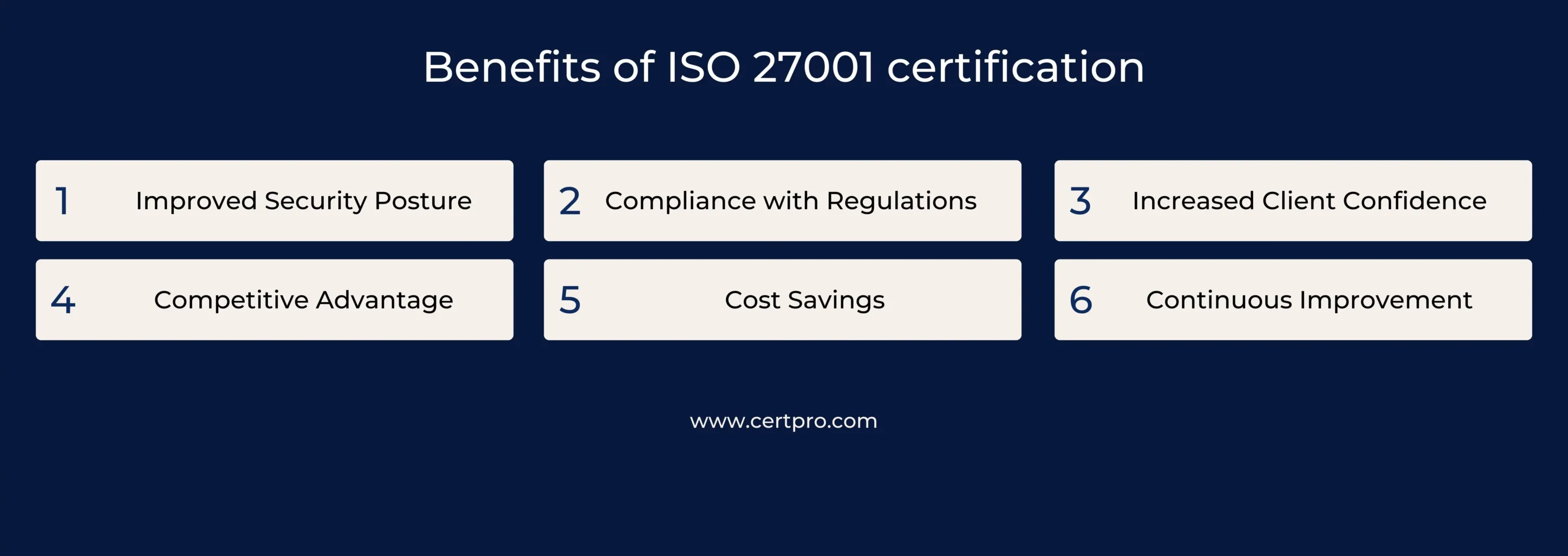
- ✓Regulatory and Compliance Positioning
- ✓Commercial and Competitive Advantages
- ✓Operational Risk and Internal Governance Benefits
Why CertPro for ISO 27001 Certification in Netherlands
CertPro CPA LLC is a Licensed CPA Firm that operates as an independent third-party certification body for ISO 27001 Certification in Netherlands. CertPro conducts ISO 27001 certification audits — including Stage 1 documentation reviews, Stage 2 implementation evaluations, annual surveillance audits, and recertification audits — exclusively as an assessment and certification provider. CertPro does not provide implementation, consulting, or advisory services, ensuring complete independence between the audit function and the certified organization. This independence is fundamental to the integrity and credibility of every ISMS certification credential issued.
Independent Certification Body Positioning
As a Licensed CPA Firm conducting ISO 27001 certification audits, CertPro operates under professional standards that mandate auditor independence, objectivity, and evidence-based evaluation. The ISMS certification Netherlands credential issued by CertPro reflects an objective, third-party assessment of ISMS conformance against ISO/IEC 27001:2022 requirements — not a negotiated outcome or a consultant-facilitated determination. CertPro’s audit methodology follows structured assessment protocols for each ISO 27001 certification audit stage, with certification decisions made by qualified reviewers who are independent of the audit team. This structural independence is a fundamental requirement of credible ISMS certification and is critical for organizations presenting the certificate to enterprise customers, regulators, and counterparties who rely on the certification as an independent assurance signal.
Audit Methodology and Netherlands Coverage
CertPro conducts ISO 27001 audit engagements across all major Dutch business centers, including Amsterdam, Rotterdam, The Hague, Utrecht, and Eindhoven, as well as remote audit modalities for organizations with distributed or cloud-based ISMS scopes. The audit program for each engagement is determined based on the certified scope, organizational size, complexity, and ISMS maturity, in accordance with ISO 19011 guidelines for auditing management systems. CertPro’s auditors evaluate objective evidence across all applicable ISO/IEC 27001:2022 clauses and selected Annex A controls, document findings in structured audit reports, and communicate nonconformities with clear reference to the specific standard requirements at issue. The ISO 27001 certification audit process in the Netherlands conducted by CertPro is designed to provide organizations with an accurate, evidence-based assessment of ISMS conformance — not a threshold-based pass/fail determination disconnected from actual operational practice.
Frequently Asked Questions
What is ISO 27001 Certification in Netherlands?
How long does the ISO 27001 audit process take in the Netherlands?
The ISO 27001 audit timeline in the Netherlands depends on ISMS scope, organizational size, and the time required to resolve any nonconformities identified during Stage 1 or Stage 2. For organizations of moderate complexity, the process from Stage 1 commencement to certificate issuance typically spans several weeks. The precise audit program timeline is established in the engagement agreement before Stage 1 commences, providing organizations with a clear roadmap from the outset.
What is the difference between ISO 27001 Stage 1 and Stage 2 audits?
The Stage 1 audit reviews ISMS documentation to assess readiness for Stage 2. The Stage 2 audit is a comprehensive evaluation of ISMS implementation and operational effectiveness, including interviews, control testing, and records review. Both stages are mandatory components of the ISO 27001 certification audit, and Stage 2 may only proceed following a satisfactory Stage 1 outcome. Together, they form the complete initial certification assessment sequence.
How long is ISO 27001 Certification valid?
ISO 27001 Certification is valid for three years from the date of the certification decision, subject to satisfactory annual surveillance audits in years one and two. A recertification audit is required before the three-year certificate expires to renew the certification for a further cycle. Failure to pass annual surveillance audits may result in suspension or withdrawal of certification, emphasizing the importance of maintaining continuous ISMS conformance.
Does ISO 27001 Certification prove GDPR compliance?
No. ISO 27001 Certification does not automatically establish GDPR compliance or compliance with the Dutch GDPR Implementation Act (Uitvoeringswet AVG). However, the documented risk assessments, Annex A controls, and management review records generated within the ISMS provide a structured evidentiary basis that supports alignment with GDPR Article 32 requirements for appropriate technical and organizational security measures. Organizations should assess GDPR obligations separately and in conjunction with their ISMS program.
What is the Statement of Applicability in ISO 27001?
The Statement of Applicability (SoA) is a mandatory document under ISO/IEC 27001:2022 that lists all 93 Annex A controls, records whether each is applicable or excluded, and provides justification for each determination. The SoA is reviewed during the ISO 27001 certification audit as the primary linkage document connecting risk treatment decisions to implemented controls, making it one of the most important documents in the ISMS.
What is the ISO/IEC 27001:2022 transition deadline?
The mandatory transition deadline from ISO/IEC 27001:2013 to ISO/IEC 27001:2022 is October 31, 2025, as established by international accreditation bodies. Organizations holding 2013-edition certificates must complete a transition audit incorporating the 2022 standard’s requirements — including the 11 new Annex A controls — before this deadline to maintain valid ISMS certification Netherlands status. Organizations are encouraged to begin transition planning well in advance to avoid certification gaps.
Which Dutch industries most commonly pursue ISO 27001 Certification?
ISO 27001 Certification in Netherlands is widely pursued by SaaS providers, fintech companies, financial institutions, cloud service providers, data centers, healthcare and life sciences organizations, telecommunications providers, logistics and technology companies, AI companies, cybersecurity firms, and multinational enterprises. ISO 27001 certification for Netherlands companies is increasingly referenced in Dutch public sector procurement requirements and EU vendor assurance frameworks across these sectors, reflecting the growing importance of independently verified information security credentials in the Dutch digital economy.
FAQ
▶
What is ISO 27001 certification?
▶
What is ISO 27001 Certification in Netherlands?
▶
How long does the ISO 27001 audit process take in the Netherlands?
▶
What is the difference between ISO 27001 Stage 1 and Stage 2 audits?
▶
How long is ISO 27001 Certification valid?
▶
Does ISO 27001 Certification prove GDPR compliance?
▶
What is the Statement of Applicability in ISO 27001?
▶
What is the ISO/IEC 27001:2022 transition deadline?

Get In Touch
have a question? let us get back to you.