
SOC 2 Certification in Michigan
Scope definition is a critical stage because it determines which Trust Services Criteria apply, which controls will be tested, and which organizational units, geographic locations, and infrastructure components fall within the audit boundary. For Michigan-based organizations with distributed operations — such as automotive technology firms with facilities in Detroit and Grand Rapids, or healthcare IT companies serving multiple hospital networks — scope definition requires careful alignment between service commitments and the controls supporting them.
OUR CLIENTS










What SOC 2 Certification Means for Michigan-Based Organizations
SOC 2 Certification in Michigan is a formal, independent attestation issued by a Licensed CPA Firm. It confirms that an organization’s security controls have been examined and found to conform with the AICPA Trust Services Criteria. This is not a self-declaration or a checklist exercise — it is an evidence-based audit conclusion issued after structured evaluation of control design and operating effectiveness.
For Michigan-based organizations operating in automotive technology, healthcare IT, SaaS, and financial services, SOC 2 attestation serves as a recognized third-party validation within enterprise procurement and vendor risk management processes. Achieving SOC 2 Certification in Michigan signals to customers and partners that your security posture has been independently verified.

What Is SOC 2 Certification?
SOC 2 Certification is a formal attestation standard developed and governed by the American Institute of Certified Public Accountants (AICPA). It establishes an independent, structured framework through which a Licensed CPA Firm examines whether a service organization’s controls meet the Trust Services Criteria (TSC) relevant to security, availability, processing integrity, confidentiality, and privacy.
A SOC 2 report is not a certification in the traditional ISO sense — it is an attestation report issued by an independent auditor following a structured examination engagement conducted under AICPA AT-C Section 205 standards. Understanding this distinction is essential for organizations evaluating the SOC 2 audit process for the first time.
The SOC 2 examination evaluates whether an organization’s controls are suitably designed and, in the case of a Type 2 examination, whether those controls operated effectively over a defined observation period. The examination generates a formal attestation report that includes the auditor’s opinion, a description of the system under review, the specific Trust Services Criteria evaluated, and the testing procedures performed.
This structured output is what distinguishes SOC 2 attestation from internal compliance assessments or vendor-issued security questionnaires — making it the preferred standard for enterprise vendor risk programs.
The AICPA Trust Services Criteria Framework
The Trust Services Criteria (TSC) form the evaluative foundation of every SOC 2 examination. The AICPA established five TSC categories, each addressing a distinct dimension of control effectiveness. The Security category — also called the Common Criteria — is mandatory in all SOC 2 engagements. It addresses logical and physical access controls, system operations, change management, and risk mitigation.
The remaining four categories — Availability, Processing Integrity, Confidentiality, and Privacy — are selected based on the nature of services the organization provides and the commitments made to its customers. Selecting the right combination of criteria is a foundational step in scoping any SOC 2 audit.
Availability criteria apply when organizations commit to system uptime or service continuity — particularly relevant to cloud platforms and managed service providers. Processing Integrity criteria evaluate whether system processing is complete, accurate, timely, and authorized, which is a central concern for financial transaction processors and data workflow platforms.
Confidentiality criteria assess whether information designated as confidential is protected throughout its lifecycle. Privacy criteria apply when organizations collect, use, retain, disclose, or dispose of personal information — making them especially relevant for healthcare technology organizations and consumer-facing platforms operating in Michigan.
| TSC Category | Primary Focus | Typical Applicability |
|---|---|---|
| Security (Common Criteria) | Logical and physical access, system operations, risk mitigation | All SOC 2 engagements — mandatory |
| Availability | System uptime, performance monitoring, incident response | Cloud platforms, SaaS providers, MSPs |
| Processing Integrity | Accuracy, completeness, and timeliness of processing | Financial processors, data workflow platforms |
| Confidentiality | Protection of information designated as confidential | B2B SaaS, data analytics, legal tech |
| Privacy | Collection, use, retention, and disposal of personal data | Healthcare IT, consumer apps, HR platforms |
SOC 2 Type 1 Report: Point-in-Time Design Assessment
A SOC 2 Type 1 report addresses the suitability of control design at a specific point in time. The Licensed CPA Firm conducting the SOC 2 audit evaluates whether the controls described by management are designed in a manner that would reasonably be expected to meet the applicable Trust Services Criteria as of the report date.
Type 1 examinations do not include testing of operating effectiveness — they assess whether the controls, as designed, are appropriate for their intended purpose. This report type is often used when an organization is establishing its control environment for the first time and seeks independent validation of its design framework before entering an observation period.
A SOC 2 Type 1 attestation is particularly relevant for Michigan-based organizations entering enterprise procurement processes where customers require evidence of structured control frameworks before extending service agreements. Because Type 1 reports reflect a single date rather than an observation period, they provide immediate attestation value — but are typically followed by a Type 2 examination in subsequent audit cycles.
Enterprises evaluating vendor risk commonly accept Type 1 reports as interim attestations while the vendor completes its observation period for a Type 2 engagement.
SOC 2 Type 2 Report: Operating Effectiveness Over an Observation Period
A SOC 2 Type 2 report extends the examination beyond design to assess whether controls operated effectively throughout a defined observation period. The observation period typically spans six to twelve months. During this time, the Licensed CPA Firm collects and evaluates evidence demonstrating that controls functioned consistently as designed.
The auditor tests control activities through inquiry, observation, inspection of documentation, and re-performance of selected procedures. This multi-month observation window provides a far more substantive basis for evaluating control reliability than a point-in-time assessment.
SOC 2 Type 2 reports are considered the gold standard in vendor risk management and enterprise procurement. For Michigan-based SaaS companies, cloud service providers, and technology-enabled healthcare organizations, a SOC 2 Type 2 attestation demonstrates sustained control effectiveness rather than a one-time snapshot.
Enterprise customers — particularly those in regulated industries such as financial services, automotive manufacturing, and healthcare — frequently require Type 2 reports as a condition of contract execution. The Type 2 examination concludes with the issuance of a formal attestation report covering both control design and operating effectiveness.
SOC 2 Type 1 vs. Type 2: Key Distinctions
| Dimension | SOC 2 Type 1 | SOC 2 Type 2 |
|---|---|---|
| Scope of Opinion | Control design suitability at a point in time | Control design and operating effectiveness over an observation period |
| Observation Period | None — single date assessment | Typically 6 to 12 months |
| Evidence Testing | Design evaluation only | Design and operating effectiveness testing |
| Enterprise Acceptance | Accepted as interim attestation | Standard requirement for enterprise vendor programs |
| Report Validity | Reflects a single date | Covers the full observation period |
SOC 2 Certification Audit Process in Michigan
The SOC 2 audit process in Michigan follows a structured, multi-stage methodology governed by AICPA attestation standards. Each stage of the SOC 2 examination is conducted by a Licensed CPA Firm acting as an independent attestation body. The process is designed to produce an objective, evidence-based audit conclusion that reflects the actual state of controls at the organization being examined.
This is not a consulting engagement or readiness review — it is a formal professional examination. The following stages define the SOC 2 audit process from initial scoping through final report issuance.
The SOC 2 audit process begins with the definition of the system scope — the boundaries of the services, infrastructure, software, personnel, and data management practices that will be included in the examination. Management prepares a System Description that defines the services provided, the components of the system, the principal service commitments, and the controls in place to meet the applicable Trust Services Criteria.
The Licensed CPA Firm reviews this System Description for completeness and accuracy as part of the initial audit stage, ensuring that the scope accurately reflects the organization’s control environment before testing begins.
Scope definition is a critical stage because it determines which Trust Services Criteria apply, which controls will be tested, and which organizational units, geographic locations, and infrastructure components fall within the audit boundary. For Michigan-based organizations with distributed operations — such as automotive technology firms with facilities in Detroit and Grand Rapids, or healthcare IT companies serving multiple hospital networks — scope definition requires careful alignment between service commitments and the controls supporting them.
Following scope definition, the Licensed CPA Firm develops an audit program that specifies the testing procedures, evidence requirements, and sampling methodologies for each control to be evaluated. The audit program is tailored to the specific Trust Services Criteria selected, the nature of the organization’s control environment, and the complexity of the system under review.
Evidence planning identifies what documentary evidence, system-generated logs, configuration records, and personnel inquiry responses will be required to support each test of control — forming the blueprint for all subsequent examination activity.
For organizations pursuing SOC 2 compliance in Michigan, the audit program determination stage establishes the framework for all subsequent testing activity. The audit program is specific to the engagement — it is not a generic checklist but a structured plan designed to gather sufficient, appropriate evidence to support the auditor’s opinion on each relevant Trust Services Criterion.
The program distinguishes between controls tested at a point in time and controls tested over the observation period, which directly shapes evidence collection throughout the entire SOC 2 audit cycle.
Control testing is the substantive phase of the SOC 2 examination. The Licensed CPA Firm applies audit procedures — including inquiry, observation, inspection, and re-performance — to evaluate whether controls are designed appropriately and, for Type 2 examinations, whether they operated effectively throughout the observation period.
Evidence collected during this stage includes access control logs, change management records, incident response documentation, vendor management records, encryption configuration outputs, backup verification logs, and training completion records, among others.
During the SOC 2 audit, the auditor applies sampling methodologies consistent with AICPA attestation standards to select representative evidence across the observation period. For controls that operate frequently — such as daily access reviews or automated monitoring alerts — the auditor selects a statistically appropriate sample from the population of control occurrences.
For controls that operate less frequently — such as quarterly risk assessments or annual business continuity tests — all or most occurrences may be examined. Exceptions identified during testing are evaluated for their impact on the auditor’s opinion and disclosed as findings in the final report.
Following control testing, the Licensed CPA Firm evaluates any exceptions or control deviations identified during the examination. Nonconformities are assessed in the context of the applicable Trust Services Criteria to determine whether they represent isolated occurrences or systemic control failures.
The auditor’s opinion is shaped by the nature, severity, and pervasiveness of identified exceptions. An unqualified opinion indicates that controls met the applicable Trust Services Criteria. Exceptions that are material to the auditor’s overall conclusion may result in a qualified or adverse opinion.
The SOC 2 attestation report is issued following the nonconformity review and the auditor’s independent determination. The report includes the management assertion, the auditor’s opinion, the system description, the description of tests performed, and the results of those tests. For Type 2 reports, the report also specifies the observation period dates.
The attestation report is a formal professional document that can be shared with customers, enterprise procurement teams, and regulated counterparties as evidence of third-party SOC 2 audit completion.
Upon completion of the examination, the Licensed CPA Firm issues the final SOC 2 attestation report. This report becomes the primary deliverable of the SOC 2 audit engagement and is typically shared under NDA with customers, prospects, and enterprise risk teams.
SOC 2 reports do not carry a fixed expiration date, but most enterprise customers treat reports older than twelve months as outdated and require current-period reports for vendor onboarding and renewal processes. Annual audit cycles are therefore standard practice for organizations maintaining active SOC 2 Certification in Michigan.
| Audit Stage | Key Activities | Output |
|---|---|---|
| Scope Definition | System Description review, TSC selection, boundary determination | Agreed audit scope and applicable criteria |
| Audit Program Determination | Testing procedure design, evidence planning, sampling methodology | Structured audit program |
| Control Testing | Inquiry, observation, inspection, re-performance of controls | Evidence portfolio and exception log |
| Nonconformity Review | Exception evaluation, materiality assessment, opinion formation | Auditor’s draft opinion |
| Report Issuance | Final attestation report compilation and delivery | Formal SOC 2 attestation report |
- ✓Stage 1: Scope Definition and System Description Review
- ✓Stage 2: Audit Program Determination and Evidence Planning
- ✓Stage 3: Control Testing and Evidence Collection
- ✓Stage 4: Nonconformity Review and Attestation Decision
- ✓Stage 5: Report Issuance and Ongoing Audit Cycles
SOC 2 Certification Requirements and Evaluation Criteria
SOC 2 compliance in Michigan is evaluated against the AICPA Trust Services Criteria, which establish the control objectives and related control activities that a service organization’s controls must meet. The evaluation framework is not prescriptive in terms of specific technologies or policies — rather, it defines outcomes that controls must achieve.
Organizations are responsible for determining which controls are appropriate to meet those outcomes, and the Licensed CPA Firm evaluates whether the implemented controls are suitably designed and effectively operated to satisfy the applicable criteria.
The SOC 2 examination evaluates controls across five control environment components drawn from the COSO framework: the control environment, risk assessment, control activities, information and communication, and monitoring activities. Each component contributes to the organization’s overall ability to design, implement, and sustain controls that meet the Trust Services Criteria.
The control environment component includes governance structures, organizational authority, and management’s commitment to integrity and ethical values — foundational elements that underpin all other control categories evaluated during a SOC 2 audit.
Documentation requirements in a SOC 2 examination are evidence-driven. The organization must maintain contemporaneous records of control activities — meaning documentation created at the time the control is performed, not reconstructed after the fact. This includes access provisioning and deprovisioning records, security incident logs, change management tickets, vendor risk assessments, business continuity test results, and training completion records.
The Licensed CPA Firm inspects these records during the SOC 2 audit to verify that controls operated as described in the System Description throughout the observation period.
The Security category — the Common Criteria — encompasses the most extensive set of technical control requirements in the SOC 2 framework. It is organized into logical control groups: CC1 (Control Environment), CC2 (Communication and Information), CC3 (Risk Assessment), CC4 (Monitoring of Controls), CC5 (Control Activities), CC6 (Logical and Physical Access Controls), CC7 (System Operations), CC8 (Change Management), and CC9 (Risk Mitigation).
Each group contains specific points of focus that the auditor evaluates during the SOC 2 examination to assess whether controls are appropriately designed and effectively implemented.
Technical controls evaluated under the Common Criteria include multi-factor authentication configurations, role-based access control implementations, network segmentation architectures, encryption standards for data at rest and in transit, vulnerability management processes, patch management cadences, security event logging and monitoring systems, and incident detection and response procedures.
For Michigan-based technology organizations, the SOC 2 audit examines whether these controls are configured, monitored, and maintained in a manner consistent with the security commitments made to customers and the applicable Trust Services Criteria points of focus.
The scope of a SOC 2 examination is defined by the System Description and the applicable Trust Services Criteria. Controls and systems outside the defined scope are not evaluated and are not covered by the auditor’s opinion. Customers reviewing a SOC 2 attestation report should evaluate whether the scope of the examination covers the specific services, data types, and infrastructure relevant to their relationship with the service organization.
Scope limitations are disclosed in the report, and the auditor’s opinion applies only to the system as defined in the System Description.
Conditions that may result in a qualified, adverse, or disclaimer of opinion include: material exceptions to control design or operating effectiveness; scope restrictions that prevent the auditor from gathering sufficient appropriate evidence; or a System Description that is materially misstated by management.
When exceptions are identified but do not rise to the level of material misstatement, they are disclosed as deviations in the report’s test results section. Enterprise customers evaluate the nature and volume of disclosed deviations as part of their vendor risk assessment process.
- ✓Control Environment and Documentation Requirements
- ✓Technical Control Requirements Under the Common Criteria
- ✓Scope of Certification and Conditions for Report Qualification
Michigan Business Sectors Seeking SOC 2 Certification
SOC 2 Certification in Michigan spans a diverse range of industries, driven by the state’s unique economic composition. Michigan is home to one of the most complex industrial and technology ecosystems in the United States — anchored by automotive manufacturing and mobility technology but extending into healthcare systems, financial services, advanced manufacturing, and a growing SaaS and cloud infrastructure sector.
Organizations across these industries face increasing pressure from enterprise customers, regulated counterparties, and institutional investors to demonstrate third-party validated security controls. As a result, SOC 2 attestation has become a central element of vendor qualification processes throughout the state.
Automotive Technology and Mobility Platforms
Michigan’s automotive technology sector represents one of the most data-intensive industrial environments in the country. Technology vendors supplying software platforms to automotive OEMs — including telematics systems, connected vehicle platforms, manufacturing execution systems, and supply chain analytics tools — handle proprietary engineering data, production specifications, and sensitive supplier information.
Enterprise procurement teams at major automotive manufacturers headquartered in the Detroit metropolitan area routinely require SOC 2 Certification in Michigan as a condition of vendor qualification, particularly for platforms with access to production networks or sensitive design data.
Mobility technology companies — including those developing autonomous vehicle software, fleet management platforms, and transportation data analytics tools — face similar vendor security requirements when integrating with automotive OEMs, government transportation agencies, and insurance carriers. SOC 2 attestation in Michigan provides these organizations with a structured, third-party validated basis for demonstrating security control effectiveness.
The SOC 2 audit framework is particularly well-suited to software and data platform organizations because it evaluates controls across the logical access, system operations, and change management dimensions most relevant to software-driven services.
Healthcare IT and Health Technology Organizations
Michigan’s healthcare sector includes a substantial network of hospital systems, health insurance organizations, pharmacy benefit managers, and health information exchanges. Technology vendors serving these organizations — including electronic health record integrators, clinical data analytics platforms, revenue cycle management tools, and telehealth software providers — frequently handle protected health information (PHI) and are subject to HIPAA security and privacy requirements.
SOC 2 attestation in Michigan provides healthcare IT vendors with an independent, evidence-based report that complements HIPAA compliance programs by demonstrating control effectiveness across the AICPA Trust Services Criteria.
Health system procurement and vendor risk management teams in Michigan treat SOC 2 Type 2 reports as evidence of sustained security control performance. While SOC 2 is not a HIPAA substitute, the Security and Privacy Trust Services Criteria directly address control categories relevant to the protection of health information — including access management, encryption, incident response, and data handling practices.
Michigan-based health IT vendors that maintain SOC 2 Certification in Michigan demonstrate that their control environments have been independently examined by a Licensed CPA Firm, satisfying a key element of health system vendor qualification requirements.
Financial Services, Fintech, and Payment Processing
Michigan’s financial services landscape includes regional banks, credit unions, insurance carriers, and a growing fintech sector concentrated in Detroit, Grand Rapids, and Ann Arbor. Technology platforms serving financial institutions — including core banking integrations, payment processing systems, lending platforms, and financial data analytics tools — are subject to rigorous third-party security review requirements imposed by financial regulators and institutional customers.
SOC 2 examination reports are widely recognized within financial services vendor risk programs as evidence of independent control evaluation, making SOC 2 Certification a critical credential for technology providers in this space.
Fintech organizations based in Michigan that process financial transactions, manage customer financial data, or provide banking-as-a-service infrastructure must demonstrate control frameworks aligned with both regulatory expectations and enterprise customer requirements. SOC 2 compliance in Michigan serves as a foundational attestation for fintech vendors navigating bank-imposed vendor due diligence requirements.
The SOC 2 audit framework’s emphasis on logical access controls, change management, and system monitoring directly addresses the control categories most scrutinized in financial services vendor assessments.
SaaS Providers, Cloud Platforms, and Managed Service Providers
Michigan’s SaaS and cloud infrastructure sector has expanded significantly, with technology companies based in Ann Arbor, Detroit, Lansing, and Grand Rapids providing enterprise software, cloud storage, managed security services, and data processing platforms to customers across the United States and internationally. SOC 2 Certification in Michigan is a standard requirement for SaaS companies seeking to serve enterprise customers in regulated industries.
Enterprise procurement teams across sectors — from manufacturing to legal services to government contracting — routinely require SOC 2 Type 2 reports before executing service agreements with cloud and SaaS vendors.
Managed service providers (MSPs) and managed security service providers (MSSPs) based in Michigan frequently serve as technology infrastructure partners for organizations that cannot maintain full internal IT capabilities. These providers handle customer network access, endpoint management, backup and recovery systems, and in many cases have access to customer environments containing sensitive data.
SOC 2 attestation for MSPs and MSSPs provides enterprise customers with independent evidence that the service provider’s internal controls over these elevated-access activities meet the AICPA Trust Services Criteria.
Why Organizations in Michigan Pursue SOC 2 Certification
The demand for SOC 2 Certification in Michigan is driven by specific procurement dynamics, regulatory expectations, and enterprise vendor risk management requirements that have intensified across all major industry sectors. Michigan-based organizations increasingly encounter SOC 2 attestation requirements as a prerequisite for contract execution, renewal, or expansion with enterprise customers.
Understanding why these requirements exist — and what SOC 2 attestation actually communicates to enterprise reviewers — is foundational to understanding the role of SOC 2 within Michigan’s technology and services economy.
Enterprise Vendor Security Reviews and Procurement Requirements
Enterprise vendor security review programs — common at large automotive manufacturers, health systems, financial institutions, and government contractors — require third-party vendors to demonstrate that their security controls have been independently evaluated. SOC 2 attestation in Michigan is the most widely recognized form of third-party security assurance for technology and data services organizations operating in the U.S. market.
When a Michigan-based SaaS company responds to an enterprise RFP or vendor onboarding request, a SOC 2 Type 2 report provides procurement teams with structured evidence that does not require the customer to conduct its own security audit of the vendor.
Consider this practical example: an automotive technology platform serving multiple OEM customers in Michigan may face security assessment requirements from each customer independently. Without SOC 2 Certification, the vendor must respond to multiple, overlapping security questionnaires and may be subject to on-site assessments by each customer’s security team.
A SOC 2 Type 2 report from a Licensed CPA Firm provides a single, authoritative attestation that can be shared with all enterprise customers — reducing administrative burden on the vendor and providing each customer with independently verified evidence of control effectiveness.
Regulated Industry Procurement Expectations
Financial services institutions and healthcare organizations in Michigan operate under regulatory frameworks — including the Gramm-Leach-Bliley Act (GLBA), HIPAA, and state-level data protection requirements — that impose third-party vendor oversight obligations. These institutions are expected by their regulators to conduct due diligence on technology vendors that handle or access sensitive customer or patient data.
SOC 2 attestation provides a recognized format for communicating security control effectiveness in regulated procurement contexts. Regulators such as the FDIC, OCC, and state banking departments have referenced SOC reports as evidence of vendor oversight activity.
For Michigan-based fintech and health IT organizations seeking to expand their customer base within regulated industries, SOC 2 certification functions as a qualification credential that accelerates vendor onboarding timelines. Regulated institutions may reduce or waive extensive security questionnaires when a current SOC 2 Type 2 report is available — the report demonstrates that an independent Licensed CPA Firm has already conducted a structured examination of the relevant controls.
This dynamic creates a measurable procurement advantage for Michigan organizations that maintain current SOC 2 attestation status.
International SaaS Expansion and Cross-Border Vendor Assurance
Michigan-based SaaS companies expanding into international markets — particularly Canada, the United Kingdom, and European Union member states — encounter security assurance expectations from enterprise customers and data protection regulators in those markets. SOC 2 attestation is recognized internationally as a credible form of third-party security assurance.
Many international enterprise customers — particularly those in financial services and healthcare — are familiar with the SOC 2 framework through their U.S.-based affiliates or customers. A SOC 2 Type 2 report from a Licensed CPA Firm can serve as supporting documentation in cross-border vendor due diligence processes, supplementing local compliance frameworks.
Michigan technology companies pursuing international expansion also face questions about data residency, cross-border data transfer controls, and privacy governance — areas addressed within the SOC 2 Privacy Trust Services Criteria and, in broader terms, the Confidentiality criteria. A SOC 2 attestation that includes Privacy and Confidentiality criteria demonstrates to international customers that the organization’s data handling practices have been independently examined.
This is particularly relevant for Michigan-based SaaS providers handling personal data from EU or Canadian data subjects — providing a structured basis for cross-border vendor assurance discussions.
Benefits of SOC 2 Certification for Michigan-Based Organizations
SOC 2 Certification in Michigan delivers measurable, structured outcomes across enterprise procurement, vendor risk management, operational security discipline, and market positioning. The following benefits reflect documented outcomes of SOC 2 attestation engagements rather than marketing claims — each benefit is grounded in the structure and scope of the SOC 2 examination itself.
- ✓Independent third-party validation of security control design and operating effectiveness by a Licensed CPA Firm
- ✓Structured attestation report accepted by enterprise procurement teams across regulated and unregulated industries
- ✓Reduced administrative burden from repetitive customer security questionnaires and vendor assessment processes
- ✓Formal documentation of control environment that supports internal governance and risk management activities
- ✓Demonstrated alignment with AICPA Trust Services Criteria, recognized across U.S. and international markets
- ✓Accelerated vendor onboarding timelines with enterprise customers in financial services, healthcare, and automotive sectors
- ✓Support for cross-border vendor assurance requirements when expanding into international markets
- ✓Ongoing audit cycle discipline that reinforces continuous control monitoring and documentation practices
- ✓Recognition in regulated industry procurement processes — including financial services, healthcare, and government contracting
- ✓Differentiated market positioning relative to competitors without independent third-party security attestation
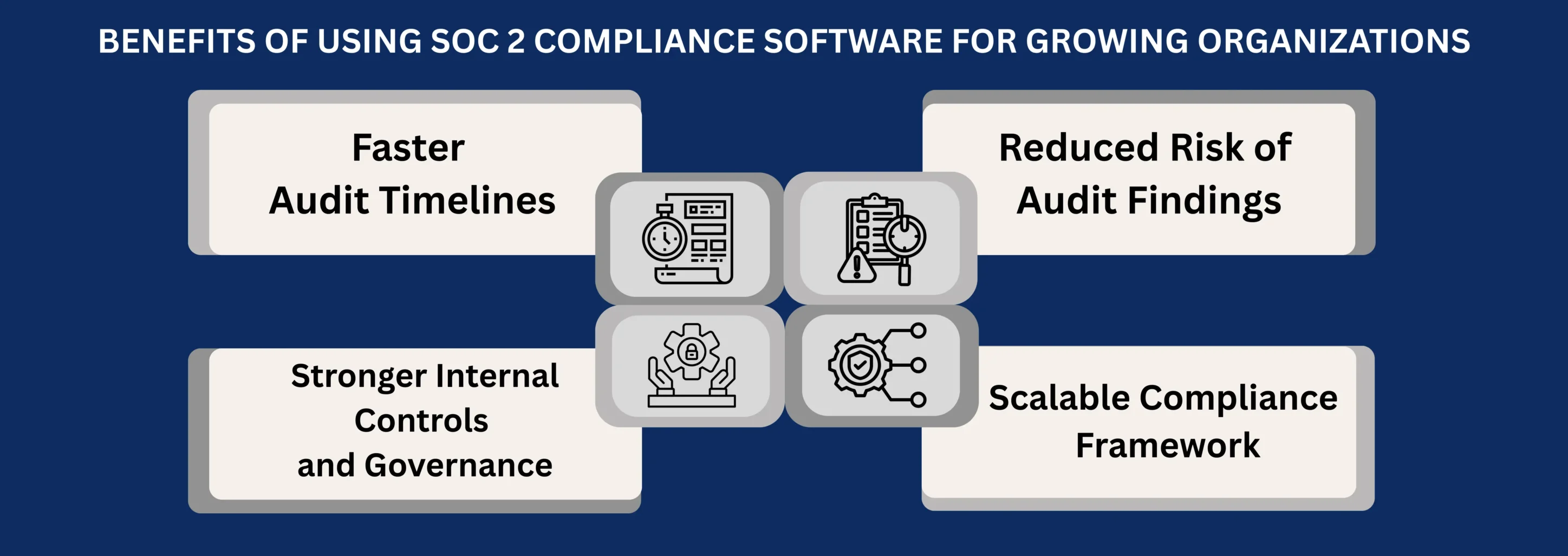
The primary benefit of SOC 2 attestation is independent verification of controls by a Licensed CPA Firm. Unlike self-assessments or vendor-issued security statements, a SOC 2 report reflects the findings of an independent auditor who has examined evidence, tested control activities, and formed an opinion based on that examination. Enterprise customers and regulated counterparties can rely on the auditor’s opinion as an objective assessment of the organization’s control environment — a level of assurance that cannot be achieved through internal compliance activities alone.
For Michigan-based organizations in sectors where data security failures carry significant regulatory, financial, and reputational consequences — such as healthcare IT and financial technology — the independent verification provided by SOC 2 attestation serves as a foundational element of enterprise risk management.
The SOC 2 examination process itself reinforces control discipline by requiring organizations to maintain contemporaneous documentation throughout the observation period, creating an audit trail that supports both the attestation engagement and internal governance activities.
The structured audit methodology of the SOC 2 examination — governed by AICPA AT-C Section 205 and the Trust Services Criteria — provides a repeatable, defensible framework for evaluating security controls on an annual basis. Organizations that complete annual SOC 2 audit cycles develop institutional familiarity with control documentation standards, evidence retention practices, and the testing procedures applied by the Licensed CPA Firm.
This institutional knowledge strengthens overall security governance and reduces examination friction in subsequent audit cycles.
The annual nature of SOC 2 audit cycles also provides ongoing surveillance value — each examination cycle assesses whether controls that operated effectively in prior periods have been maintained through operational changes, technology updates, and organizational growth. For Michigan-based organizations experiencing rapid expansion or significant technology infrastructure changes, the annual SOC 2 examination cycle serves as a structured checkpoint that evaluates whether the control environment has kept pace with organizational evolution.
This ongoing oversight dimension distinguishes SOC 2 attestation from one-time certifications or point-in-time assessments.
- ✓Verification of Control Effectiveness Through Independent Examination
- ✓Structured Audit Methodology and Ongoing Surveillance
SOC 2 Certification vs. Other Security Frameworks Relevant to Michigan Organizations
Michigan-based organizations frequently evaluate SOC 2 Certification alongside other security and compliance frameworks — including ISO 27001, HIPAA, NIST CSF, PCI DSS, and CMMC — when determining which attestations to pursue. Understanding how SOC 2 relates to these frameworks requires clarity about what each framework evaluates, who governs it, and which customer or regulatory contexts recognize it.
SOC 2 attestation is distinct from these other frameworks in its scope, governance, and evidentiary basis — and in many cases, it is the first framework enterprise customers will ask about.
SOC 2 vs. ISO 27001: Distinct Frameworks Serving Different Markets
SOC 2 and ISO 27001 are both recognized security frameworks, but they differ fundamentally in structure, governance, and market recognition. SOC 2 is governed by the AICPA and conducted exclusively by Licensed CPA Firms — it produces an attestation report reflecting an independent auditor’s examination of specific controls against the Trust Services Criteria. ISO 27001 is governed by the International Organization for Standardization (ISO) and conducted by accredited certification bodies — it produces a certificate confirming that the organization’s Information Security Management System (ISMS) conforms to the ISO/IEC 27001 standard.
SOC 2 attestation is the dominant security assurance framework in the U.S. enterprise market, while ISO 27001 carries stronger recognition in European and Asian markets. For Michigan-based organizations primarily serving U.S. enterprise customers — particularly in automotive, healthcare, and financial services — SOC 2 Certification is generally the more immediately relevant framework.
Organizations pursuing international expansion may benefit from pursuing both, as the two frameworks are complementary and their control requirements substantially overlap. The SOC 2 examination evaluates specific controls against TSC points of focus, while ISO 27001 certification evaluates the ISMS against 93 controls organized across four Annex A domains.
SOC 2 and HIPAA: Complementary but Distinct Obligations
SOC 2 and HIPAA address overlapping but distinct security and privacy obligations. HIPAA establishes federal requirements for the protection of protected health information (PHI) and applies to covered entities and business associates. HIPAA compliance is not certified by an independent third party in the same formal sense as SOC 2 — there is no HIPAA certification issued by an independent auditor.
SOC 2 attestation, by contrast, is a formal independent examination by a Licensed CPA Firm that produces a structured attestation report recognized by enterprise customers and regulated counterparties.
For Michigan-based health IT vendors that are subject to HIPAA as business associates, a SOC 2 examination that includes the Privacy and Security Trust Services Criteria provides independent evidence of control effectiveness across areas directly relevant to HIPAA compliance — including access controls, audit logging, incident response, and data encryption.
Health system procurement teams in Michigan frequently request both a Business Associate Agreement (BAA) and a current SOC 2 Type 2 report as part of vendor onboarding. The BAA establishes contractual obligations, while the SOC 2 report provides independent attestation of the vendor’s control environment.
SOC 2 and CMMC: Relevance to Michigan Defense Contractors
Michigan hosts a significant defense industrial base, including prime contractors and subcontractors supporting the U.S. Department of Defense across automotive, aerospace, and advanced manufacturing sectors. The Cybersecurity Maturity Model Certification (CMMC) program establishes cybersecurity requirements for organizations in the defense supply chain that handle Controlled Unclassified Information (CUI).
CMMC and SOC 2 are distinct frameworks — CMMC is a DoD program with specific certification requirements, while SOC 2 is an AICPA attestation standard designed for commercial service organizations.
Michigan-based defense contractors may pursue SOC 2 attestation for their commercial business lines while separately pursuing CMMC certification for their defense work. The two frameworks address different regulatory contexts and are not substitutes for one another.
However, the control disciplines reinforced by a SOC 2 examination — particularly in access management, system monitoring, and incident response — are directly relevant to the NIST SP 800-171 requirements that underpin CMMC Level 2 certification. Organizations that have maintained SOC 2 audit discipline may find that their documentation practices and control maturity support their CMMC assessment preparation.
SOC 2 Compliance Michigan: Internal Control Environment and Monitoring
SOC 2 compliance in Michigan is not a static achievement — it requires sustained control operation and documentation across the observation period and through ongoing annual audit cycles. The SOC 2 examination evaluates the internal control environment across the full audit scope, examining whether controls are not only designed appropriately but are actively monitored, reviewed, and adjusted in response to changing risks and operational conditions.
The monitoring of controls dimension of the COSO framework — which underpins the SOC 2 evaluation structure — requires evidence that management regularly assesses whether controls are functioning as intended.
Centralized Logging and Monitoring as SOC 2 Control Evidence
Centralized logging and monitoring systems are among the most frequently examined technical controls in a SOC 2 audit. The AICPA Trust Services Criteria require evidence that security events are captured, retained, reviewed, and acted upon. CC7.2, for example, requires that organizations monitor system components for anomalies that indicate the occurrence of a security event.
This criterion is evaluated through examination of log management systems, alert configurations, and documented evidence of security event review procedures. Organizations must demonstrate that logs are collected from relevant sources — including servers, network devices, applications, and cloud infrastructure — and retained for a period sufficient to support forensic investigation and audit evidence requirements.
For Michigan-based technology organizations operating hybrid cloud environments — common among automotive technology platforms, healthcare data processors, and financial services SaaS providers — centralized log management must span both on-premises and cloud-hosted infrastructure. The SOC 2 examination evaluates whether the logging and monitoring architecture is sufficiently comprehensive to detect and alert on security events across the full system scope.
Evidence collected during the SOC 2 audit typically includes SIEM configuration documentation, sample alert records, security event review logs, and incident response escalation records demonstrating that detected events were investigated and resolved appropriately.
Vendor Risk Management and Subservice Organization Controls
SOC 2 examinations address not only the organization’s own controls but also the controls of subservice organizations — third-party vendors that provide components of the system infrastructure relevant to the Trust Services Criteria. Organizations that rely on cloud infrastructure providers, payment processors, data center operators, or other technology subservice organizations must evaluate how the controls of those subservice organizations interact with their own control environment.
The SOC 2 examination applies one of two reporting approaches to subservice organizations: the inclusive method or the carve-out method.
Under the carve-out method — the more common approach — the SOC 2 report describes the services provided by subservice organizations and identifies the controls that management assumes the subservice organization has in place, without including those controls in the scope of the examination. The organization must maintain complementary user entity controls that address the risks arising from reliance on subservice organizations.
Michigan-based SaaS organizations relying on AWS, Azure, or Google Cloud as infrastructure providers typically use the carve-out method and reference those providers’ SOC 2 reports as supporting evidence of the underlying infrastructure control environment.
Report Validity and Annual Audit Cycle Management
SOC 2 attestation reports do not expire on a fixed schedule, but the AICPA and enterprise risk management conventions treat reports covering periods ending more than twelve months ago as outdated. Enterprise procurement programs typically require that SOC 2 reports cover an observation period ending within the past twelve months.
Organizations that allow their SOC 2 Certification to lapse face the prospect of re-entering procurement queues or being removed from approved vendor lists while a new examination is completed. Annual audit cycle management is therefore a critical operational discipline for Michigan organizations that depend on SOC 2 attestation for ongoing customer relationships.
Effective annual cycle management involves planning the next audit engagement before the current report period ends, ensuring that evidence collection begins at the start of the new observation period, and scheduling the audit program to allow for report issuance well before the prior period report reaches twelve months of age.
Michigan-based SaaS companies serving enterprise customers commonly establish fixed annual audit windows aligned with their fiscal year or customer contract renewal cycles — ensuring that current SOC 2 reports are available during contract negotiations and procurement reviews.
SOC 2 Attestation Michigan: Understanding the Report Structure
The SOC 2 attestation report is a structured professional document with defined components established by AICPA attestation standards. Understanding the components of a SOC 2 report is essential for both organizations receiving the attestation and enterprise customers reviewing it as part of vendor risk assessment.
The report structure is standardized across all SOC 2 engagements conducted under AT-C Section 205, which allows enterprise reviewers to navigate reports efficiently and extract relevant information for their risk assessment needs.
Components of a SOC 2 Attestation Report
- Independent Service Auditor’s Report — the auditor’s formal opinion on whether controls meet the applicable Trust Services Criteria
- Management’s Assertion — management’s statement affirming that the system description is fairly presented and controls are suitably designed (and, for Type 2, effectively operated)
- System Description — a comprehensive description of the system under examination, including infrastructure, software, people, procedures, and data components
- Description of Tests of Controls (Type 2 only) — the auditor’s description of each test performed, the nature of the test, and the results, including any identified exceptions
- Other Information (optional) — management-provided supplemental information not covered by the auditor’s opinion
- Criteria and Related Controls — a mapping of each applicable Trust Services Criterion to the specific controls the organization has implemented to meet that criterion
Reading the Auditor’s Opinion and Evaluating Exceptions
The auditor’s opinion is the most important section of the SOC 2 attestation report from an enterprise risk assessment perspective. An unqualified opinion indicates that, in the auditor’s professional judgment, the controls described in the System Description were suitably designed and — for Type 2 reports — operated effectively throughout the observation period to meet the applicable Trust Services Criteria.
An unqualified opinion does not mean zero exceptions were identified. It means that any exceptions identified were not, individually or in aggregate, material enough to affect the auditor’s overall conclusion.
Enterprise customers reviewing a SOC 2 attestation report should examine the test results section of a Type 2 report carefully, even when the auditor’s opinion is unqualified. Individual control exceptions are disclosed in this section with a description of the test performed, the exception identified, and management’s response.
Customers assess the nature and frequency of disclosed exceptions relative to the controls most relevant to their specific risk concerns. For example, a Michigan-based healthcare IT vendor’s enterprise customer would pay close attention to exceptions related to access management, encryption, and incident response controls given the sensitivity of health data involved.
SOC 2 Certification in Michigan: Selecting an Independent Audit Firm
The selection of a Licensed CPA Firm to conduct a SOC 2 audit engagement in Michigan is a consequential decision that affects the quality, credibility, and enterprise acceptance of the resulting attestation report. Not all CPA firms maintain the expertise, peer review compliance, and attestation methodology required to conduct rigorous SOC 2 examinations under AICPA standards.
Michigan-based organizations evaluating SOC 2 audit firms should assess prospective auditors on several dimensions relevant to engagement quality and report credibility.
AICPA Peer Review and Attestation Standards Compliance
CPA firms conducting SOC 2 examinations are required to be enrolled in the AICPA’s peer review program, which provides independent oversight of audit quality across member firms. Peer review evaluates whether the firm’s attestation engagements comply with professional standards — including AICPA AT-C Section 205, SSAE 18, and the applicable quality control standards.
AICPA has issued specific guidance for peer reviewers evaluating SOC 2 engagements, particularly in the context of technology-assisted audit workflows and compliance automation platforms. Michigan organizations should verify that their selected SOC 2 audit firm maintains current peer review status and has specifically demonstrated competency in SOC 2 attestation engagements.
The quality of a SOC 2 examination is directly reflected in the detail, structure, and rigor of the resulting attestation report. Enterprise customers with mature vendor risk programs — particularly those in financial services and healthcare — review SOC 2 reports for the specificity of test descriptions, the completeness of control coverage, and the clarity of exception reporting.
Reports produced by CPA firms with demonstrated SOC 2 examination expertise are more likely to satisfy the review standards applied by sophisticated enterprise customers than reports produced by firms without specific attestation practice capabilities.
Industry-Specific Expertise Relevant to Michigan Sectors
SOC 2 examinations conducted for organizations in specialized industries — such as healthcare IT, automotive technology, or financial services — benefit from auditors with domain knowledge in the control environments relevant to those industries. An auditor familiar with the specific systems, data flows, and vendor relationships common in Michigan’s automotive supply chain technology sector is better positioned to evaluate the completeness of the System Description and the appropriateness of control design relative to industry-specific risks.
CertPro is a Licensed CPA Firm providing independent SOC 2 attestation services to Michigan-based organizations across the technology, healthcare IT, financial services, and automotive sectors. SOC 2 Certification in Michigan through CertPro is conducted under AICPA AT-C Section 205 standards, with examination methodology developed to address the specific control environments and industry contexts relevant to Michigan’s economy.
The SOC 2 examination process is structured to produce attestation reports that meet enterprise vendor program requirements across regulated and unregulated industries throughout Michigan and beyond.
Evaluating SOC 2 Audit Firm Michigan: Key Assessment Criteria
- ✓Licensed CPA Firm status with current AICPA peer review enrollment and compliance
- ✓Demonstrated experience conducting SOC 2 examination engagements under AICPA AT-C Section 205
- ✓Familiarity with Michigan-relevant industry sectors including healthcare IT, automotive technology, SaaS, and financial services
- ✓Structured audit methodology with clearly defined evidence collection and testing procedures
- ✓Capacity to conduct both SOC 2 Type 1 and SOC 2 Type 2 audit engagements in Michigan
- ✓Clear engagement scoping process that addresses subservice organization treatment and complementary user entity controls
- ✓Professional report structure that meets enterprise vendor program review standards
- ✓Independence and objectivity — no advisory or consulting services provided in connection with the audit engagement
- ✓Established quality control processes governing engagement supervision, documentation review, and report issuance
- ✓Transparent engagement process with defined evidence request timelines and deliverable milestones
SOC 2 Examination Michigan: Summary and Key Takeaways
SOC 2 Certification in Michigan is an evidence-based attestation standard that provides independent, third-party validation of an organization’s security controls against the AICPA Trust Services Criteria. It is conducted exclusively by a Licensed CPA Firm under AICPA AT-C Section 205 standards and produces a formal attestation report recognized across enterprise procurement programs, regulated industry vendor assessments, and international vendor due diligence processes.
The SOC 2 examination evaluates both control design and — in the case of Type 2 engagements — operating effectiveness over a defined observation period, making it the preferred standard for enterprise vendor qualification throughout Michigan.
For Michigan-based organizations across the automotive technology, healthcare IT, SaaS, cloud services, financial services, and advanced manufacturing sectors, SOC 2 attestation in Michigan serves as a central element of vendor qualification and enterprise procurement processes. The structured, annual audit cycle creates a repeatable framework for demonstrating sustained control effectiveness to enterprise customers and regulated counterparties.
SOC 2 certified companies in Michigan that maintain current attestation status are better positioned in competitive procurement environments and demonstrate measurable security governance discipline to stakeholders across their enterprise relationships.
- ✓SOC 2 Certification in Michigan is issued exclusively by a Licensed CPA Firm following an independent examination under AICPA AT-C Section 205
- ✓The Security (Common Criteria) category is mandatory in all SOC 2 examinations; four additional TSC categories are selected based on service commitments
- ✓SOC 2 Type 1 reports assess control design at a point in time; SOC 2 Type 2 audit reports assess design and operating effectiveness over an observation period
- ✓Enterprise customers in Michigan’s automotive, healthcare, financial services, and SaaS sectors routinely require SOC 2 Type 2 attestation as a vendor qualification condition
- ✓SOC 2 attestation is distinct from SOC 2 compliance — attestation requires completion of an independent examination by a Licensed CPA Firm
- ✓Annual SOC 2 audit cycles are the market standard for maintaining current attestation status recognized by enterprise vendor programs
- ✓The SOC 2 examination report is a confidential document typically shared under NDA with enterprise customers and procurement teams
- ✓SOC 2 differs from ISO 27001, HIPAA, and CMMC — each framework serves distinct regulatory contexts and market requirements
FAQ
▶
What is SOC 2 Certification and who issues it in Michigan?
▶
What is the difference between SOC 2 Type 1 and SOC 2 Type 2?
▶
Which Trust Services Criteria are required for a SOC 2 examination?
▶
How long does the SOC 2 Type 2 observation period need to be?
▶
What industries in Michigan most commonly require SOC 2 attestation from their vendors?
▶
Is SOC 2 the same as SOC 1?
▶
What is the difference between SOC 2 certified and SOC 2 compliant?
▶
How often must a SOC 2 audit be completed to maintain attestation status?
SOC 1 VS SOC 2: WHICH REPORT YOUR CUSTOMERS ACTUALLY ASK FOR
If you sell SaaS or provide outsourced services, you have likely been asked for a SOC report. However, the follow-up question is rarely easy to answer…

AICPA Issues New Guidance for Peer Reviewers Evaluating SOC 2 Engagements
AICPA SOC 2 guidance has been issued to help peer reviewers identify quality risks associated with SOC 2 engagements as the use of compliance automati…
SOC 2 Certified: What Does It Mean for Your Business
For companies that handle sensitive data or run cloud-based services, the question “Can you provide your SOC 2 report?” carries enormous weight. Yet, …
Get In Touch
have a question? let us get back to you.