
SOC 2 Certification in Minnesota
SOC 2 Certification in Minnesota delivers a defined set of organizational outcomes directly tied to the attestation process itself. These outcomes result from independent examination and the formal issuance of a CPA firm’s opinion — not from marketing claims or self-reported assessments. The following represent the primary documented outcomes associated with SOC 2 attestation for Minnesota-based service organizations.
OUR CLIENTS










What SOC 2 Certification Means for Minnesota Organizations
SOC 2 Certification in Minnesota is a formal attestation issued exclusively by a Licensed CPA Firm following an independent examination conducted under AICPA attestation standards — specifically AT-C Section 205. This examination determines whether an organization’s controls are suitably designed and, in the case of a Type 2 examination, have operated effectively over a defined observation period. The attestation is not a self-assessment or an internal declaration of compliance. It is a structured, evidence-based evaluation that produces a written attestation report containing the CPA firm’s opinion on whether the organization’s controls meet the AICPA Trust Services Criteria (TSC).
For Minnesota-based organizations, this distinction carries material weight. Enterprise buyers, regulated institutions, and procurement teams across the state’s technology, healthcare, and financial services sectors treat SOC 2 attestation as a verified, third-party-validated credential — not simply an internal compliance declaration. A SOC 2 report confirms that security controls were not merely documented and implemented, but were independently tested under structured audit conditions and confirmed to function as intended. This level of verification is increasingly required as a prerequisite for vendor approval, contract execution, and ongoing business relationship maintenance across Minnesota’s major industry verticals.
The Trust Services Criteria evaluated during a SOC 2 examination are organized into five categories: Security (Common Criteria), Availability, Processing Integrity, Confidentiality, and Privacy. The Security category — also referred to as the Common Criteria (CC) — is required in every SOC 2 engagement. Organizations select additional categories based on the nature of their services, contractual commitments, and the information types they process. A SaaS provider operating from Minneapolis that hosts customer data on cloud infrastructure may include Availability and Confidentiality. A Rochester-based health technology firm processing protected health information may extend scope to include the Privacy category. Each selected category is evaluated independently through control testing and evidence review, with findings documented in the attestation report.
Minnesota’s technology and business ecosystem creates a broad and active market for SOC 2 Certification. The Minneapolis–Saint Paul metropolitan area hosts a dense concentration of SaaS companies, financial technology firms, insurance organizations, managed service providers, and cloud infrastructure businesses. Rochester is home to a growing health technology sector anchored by major medical institutions and the organizations that serve them. The Twin Cities financial services sector — spanning banking, investment management, payment processing, and insurance — generates significant third-party vendor scrutiny, where SOC 2 attestation is routinely required as part of supplier onboarding and annual vendor review programs. Across all of these sectors, SOC 2 Certification in Minnesota functions as a formal mechanism for demonstrating that an organization’s information security environment has been independently examined by a qualified attestor and found to satisfy defined criteria.
SOC 2 compliance in the Minnesota market is no longer limited to large technology companies. Mid-market SaaS providers, healthcare data analytics firms, cybersecurity companies, AI startups, e-commerce businesses, and enterprises handling sensitive customer or business information are all subject to vendor assurance expectations that require a current, valid SOC 2 attestation report. The SOC 2 examination process, when conducted by a Licensed CPA Firm under applicable attestation standards, produces a report that enterprise customers, regulated entities, and government procurement offices recognize as authoritative evidence of control effectiveness. Organizations without a current SOC 2 report increasingly face barriers at the vendor qualification stage, regardless of the strength of their internal control environment.

What Is SOC 2 Certification?
SOC 2 Certification is a formal attestation issued by a Licensed CPA Firm under AICPA AT-C Section 205, confirming that a service organization’s controls have been independently examined against the Trust Services Criteria. The term “certification” in the SOC 2 context refers specifically to the issuance of a CPA firm’s attestation report — it is not a self-certification, a badge, or a vendor-issued credential. The SOC 2 examination process is governed by the AICPA’s attestation standards and requires that the examining CPA firm hold the qualifications necessary to perform attestation engagements on controls at a service organization. For Minnesota organizations pursuing SOC 2 Certification, selecting a qualified CPA firm with demonstrated experience in AICPA attestation engagements is the essential first step.
SOC 2 Type 1 and Type 2 Reports
SOC 2 engagements produce one of two report types. A Type 1 report evaluates whether an organization’s controls are suitably designed to meet the Trust Services Criteria as of a specific point in time. The examination confirms that controls exist and that their design is appropriate for achieving the stated control objectives. A Type 1 report does not evaluate whether controls operated effectively over a period of time — it is a design-point assessment. Organizations that have recently implemented their control environment frequently begin with a Type 1 examination to establish an initial attestation and document the baseline control structure before progressing to a Type 2 engagement.
A Type 2 report evaluates both the suitability of control design and the operating effectiveness of controls over a defined observation period — typically a minimum of six months, and commonly spanning twelve months. The CPA firm tests controls by examining evidence generated during the observation period. This evidence includes system-generated logs, access review records, incident response documentation, change management approvals, and vendor monitoring records. The Type 2 report is the more demanding of the two SOC 2 report types and is the format most frequently required by enterprise customers and regulated institutions as a condition of vendor approval. Most Minnesota organizations pursuing SOC 2 Certification for commercial purposes target a Type 2 report.
Trust Services Criteria Categories
The AICPA Trust Services Criteria are organized into five categories, each addressing a distinct dimension of control effectiveness. The Security category — comprising the Common Criteria (CC) — is mandatory in every SOC 2 examination and covers logical and physical access controls, risk assessment, change management, monitoring, and incident response. The Availability category addresses whether systems are available for operation and use as committed. Processing Integrity evaluates whether system processing is complete, valid, accurate, timely, and authorized. The Confidentiality category applies where an organization commits to protecting information designated as confidential. The Privacy category governs the collection, use, retention, disclosure, and disposal of personal information in accordance with the organization’s privacy notice and applicable privacy principles.
| Trust Services Category | Scope of Evaluation | Common Applicability |
|---|---|---|
| Security (Common Criteria) | Logical and physical access controls, risk assessment, change management, security monitoring | All SOC 2 engagements — mandatory for every examination |
| Availability | System uptime, performance monitoring, incident recovery and continuity | SaaS providers, cloud infrastructure platforms, managed service providers |
| Processing Integrity | Completeness, accuracy, timeliness, and authorization of system processing | Financial processing platforms, payment systems, data transformation services |
| Confidentiality | Protection of information contractually designated as confidential | Organizations with formal confidentiality commitments to customers or partners |
| Privacy | Collection, use, retention, disclosure, and disposal of personal information | Health technology firms, consumer platforms, and data analytics organizations |
SOC 2 Certification Audit Process in Minnesota
The SOC 2 audit process in Minnesota follows a structured sequence of stages defined by AICPA attestation standards. Each stage produces specific outputs that collectively form the basis for the CPA firm’s attestation opinion. Understanding this sequence is essential for organizations preparing their control environments for formal examination. The process applies uniformly regardless of the organization’s size, industry, or geographic location within Minnesota — though specific evidence requirements and control domains will vary based on the Trust Services Criteria categories included in scope.
The SOC 2 audit process begins with scope definition, during which the boundaries of the examination are formally established. Scope encompasses the systems, infrastructure, data, personnel, and processes relevant to the services covered by the engagement. The CPA firm reviews the organization’s system description — a formal document that describes the nature of services provided, principal service commitments, system components (infrastructure, software, people, procedures, and data), and the controls the organization has implemented. Scope boundaries directly determine which Trust Services Criteria categories apply and which controls will be subject to examination. An organization providing cloud-hosted financial data services to Twin Cities banking institutions, for example, would typically include Security and Confidentiality in scope, with Availability added based on service level commitments.
Following scope definition, the CPA firm develops the audit program — a structured plan that identifies the specific control points to be tested, the evidence types required to satisfy each criterion, and the testing procedures to be applied. The audit program aligns directly to the Trust Services Criteria and the organization’s system description. It specifies which controls address each criterion and defines the sampling methodology and testing frequency. For a Type 2 SOC 2 engagement, the audit program also defines the observation period and evidence generation timeline expectations. The audit program serves as the procedural foundation for both Stage 1 and Stage 2 examination activities and governs the CPA firm’s evaluation throughout the engagement.
The Stage 1 audit focuses on reviewing documentation that supports the organization’s control environment and assessing whether controls are suitably designed to meet the Trust Services Criteria. The CPA firm examines the system description for completeness and accuracy, reviews policies and procedures, evaluates the organizational structure and assigned responsibilities, and assesses the overall design of the control framework. For a Type 1 engagement, the Stage 1 examination constitutes the primary basis for the attestation opinion. For a Type 2 engagement, Stage 1 establishes the design assessment, which is then followed by the Stage 2 operating effectiveness evaluation conducted over the observation period.
The Stage 2 SOC 2 audit involves substantive testing of controls over the observation period. The CPA firm examines evidence generated by the organization’s control environment during the review period — including access provisioning and deprovisioning records, security monitoring logs, vulnerability scanning results, change management tickets, backup and recovery test results, vendor assessment documentation, and incident response records. Controls are tested through inquiry, observation, inspection of documentation, and re-performance where applicable. Deviations identified during testing — referred to as exceptions — are documented and evaluated for their impact on the overall attestation opinion. Nonconformities indicating that controls did not operate effectively are reported in the attestation report, along with the CPA firm’s assessment of their significance.
Following completion of the Stage 2 audit and nonconformity review, the CPA firm issues the SOC 2 attestation report. The report includes the CPA firm’s opinion, the system description prepared by management, the description of tests performed and results, and any exceptions identified during testing. The attestation report is addressed to the organization’s management and specified users — typically the organization’s customers and business partners who rely on the report as evidence of control effectiveness. SOC 2 attestation reports are not publicly disclosed; they are distributed to authorized users under the terms of a non-disclosure agreement or contract provision. The report remains valid for the period covered by the examination, and enterprise customers commonly require an updated report — issued on an annual cycle — as a condition of maintaining ongoing vendor status.
| Audit Stage | Key Activities | Output |
|---|---|---|
| Scope Definition | System description review, Trust Services Criteria selection, examination boundary establishment | Defined examination scope and structured audit program |
| Stage 1 Audit | Documentation review, control design assessment, system description evaluation | Design assessment findings; readiness confirmation for Stage 2 |
| Stage 2 Audit | Evidence collection, control testing, and exception identification over the observation period | Test results, documented exceptions, and nonconformity evaluation |
| Nonconformity Review | Assessment of exceptions and their impact on the attestation opinion | Qualified or unqualified opinion determination |
| Report Issuance | CPA firm issues signed SOC 2 attestation report to management and specified users | SOC 2 Type 1 or Type 2 attestation report |
- ✓Scope Definition and Audit Program Determination
- ✓Stage 1 and Stage 2 Audit Activities
- ✓Attestation Report Issuance and Ongoing Surveillance
SOC 2 Certification Requirements for Minnesota Organizations
SOC 2 examination requirements center on demonstrating that controls exist, are suitably designed, and — for Type 2 examinations — have operated effectively during the observation period. Meeting these requirements is the responsibility of the organization’s management, who must prepare a formal system description, assert that the controls described are suitably designed (and operating effectively for Type 2), and maintain documented evidence of control operation throughout the review period. The CPA firm evaluates these management assertions against the Trust Services Criteria and issues an independent attestation opinion based on the evidence examined. SOC 2 Certification in Minnesota begins with management’s commitment to building and maintaining a control environment that can withstand independent scrutiny.
The SOC 2 examination requires extensive documentation to support the CPA firm’s evaluation of control design and operating effectiveness. Organizations must maintain written policies addressing information security, access management, risk assessment, change management, incident response, business continuity, and vendor management. Each policy must be supported by documented procedures that describe how it is implemented in practice. For the Security category, organizations must demonstrate that a formal risk assessment process exists, that the results of risk assessments are documented, and that identified risks are addressed through control activities. The AICPA Common Criteria require evidence that the risk assessment process is periodic and that control responses are proportionate to the level of risk identified.
Evidence collection is a continuous requirement throughout the observation period for a Type 2 SOC 2 audit. Controls must generate contemporaneous evidence of operation — not retrospective documentation created in anticipation of the audit. Access reviews must be documented at the time they are performed. Security monitoring alerts must be recorded with response actions. Change management approvals must be captured in the system of record at the time the change is authorized and implemented. Vendor assessment records must reflect actual reviews conducted during the period. Organizations that fail to maintain contemporaneous evidence face examination findings that may result in reported exceptions, regardless of whether the underlying controls functioned correctly. Minnesota organizations pursuing SOC 2 compliance must establish evidence collection processes that operate continuously throughout the year — not only in the weeks preceding the audit.
Management bears direct responsibility for the design, implementation, and operation of the controls that are the subject of the SOC 2 examination. Management’s responsibilities include preparing the system description, making the assertion regarding control design and operating effectiveness, maintaining the control environment throughout the observation period, and providing the CPA firm with access to personnel, systems, and documentation required to conduct the examination. The system description must fairly present the system and must identify the controls the organization relies upon to meet each applicable Trust Services Criterion. Where complementary user entity controls (CUECs) are required to achieve the stated control objectives, these must be clearly identified in the system description so that report users understand their own control responsibilities.
- ✓Formal, written information security policy approved by senior management
- ✓Documented risk assessment process with a current risk register and treatment decisions
- ✓Access control procedures covering provisioning, periodic review, and deprovisioning
- ✓Change management process with documented approval and testing requirements
- ✓Incident response plan with documented response records for the observation period
- ✓Vendor management program with documented third-party risk assessments
- ✓Business continuity and disaster recovery plan with documented test results
- ✓Monitoring and logging controls with evidence of alert review and response
- ✓Documentation and Evidence Requirements
- ✓Control Environment and Management Responsibilities
Why Organizations in Minnesota Pursue SOC 2 Certification
The demand for SOC 2 Certification in Minnesota is driven by converging pressures from enterprise vendor qualification processes, regulated industry procurement requirements, and the expectations of institutional customers operating across the state’s major business sectors. Organizations that handle sensitive customer data, operate cloud infrastructure, or deliver technology-enabled services to regulated entities face systematic requirements to demonstrate independent verification of their control environments. SOC 2 attestation provides that verification in a format recognized and accepted across Minnesota’s financial services, healthcare, technology, and government contracting sectors.
Enterprise Vendor Qualification and Procurement Requirements
Large enterprises and regulated institutions in Minnesota routinely require a current SOC 2 Type 2 attestation report as a mandatory element of vendor qualification. A technology company based in Bloomington seeking to provide SaaS services to a Minneapolis-based financial institution, for example, will encounter a formal vendor security review that requires a valid SOC 2 report before the contract can be executed. Similarly, a cloud infrastructure provider serving Rochester health systems or Twin Cities insurance organizations will face annual vendor review cycles that require updated SOC 2 attestation as a condition of maintaining approved vendor status. These procurement requirements are not discretionary — organizations that cannot produce a current attestation report are typically disqualified from the vendor pool, regardless of other qualifications.
The concentration of regulated financial institutions, health systems, insurance companies, and government agencies in the Twin Cities metropolitan area creates a market environment where SOC 2 attestation has become a threshold requirement rather than a differentiating credential. Vendor onboarding questionnaires issued by Minnesota’s major banking organizations, health networks, and insurance carriers typically include explicit requests for a current SOC 2 Type 2 report, along with the report’s observation period dates, scope, and qualified user distribution list. Organizations that maintain a current SOC 2 audit report for Minnesota are positioned to progress through procurement reviews more efficiently than those relying on self-assessed security documentation or security questionnaire responses alone.
Healthcare Technology and Financial Services Demand
Minnesota’s healthcare technology sector — concentrated in Rochester and the broader Twin Cities area — generates significant demand for SOC 2 attestation among organizations that handle protected health information or provide technology services to healthcare organizations. Health technology companies, electronic health record system providers, telehealth platforms, medical data analytics firms, and healthcare IT managed service providers operating in Minnesota frequently encounter contractual requirements from hospital systems and health plans that mandate a current SOC 2 report as evidence of third-party-validated control effectiveness. The intersection of SOC 2 compliance and HIPAA obligations in this sector creates a compliance environment where SOC 2 attestation serves as corroborating evidence of information security program maturity alongside other regulatory requirements.
Minnesota’s financial services and fintech sector — which includes banking institutions, payment processors, investment management firms, and insurance technology companies — drives a separate and equally significant stream of SOC 2 demand. SOC 2 Certification for Minnesota financial services organizations is increasingly required by institutional clients, counterparties, and regulatory examiners as evidence that information security and data protection controls have been independently validated. Fintech companies providing digital banking infrastructure, payment APIs, or data aggregation services to regulated Minnesota financial institutions face particularly rigorous vendor due diligence processes in which SOC 2 compliance verification is treated as a baseline requirement. The SOC 2 audit firm selection process in this sector typically prioritizes CPA firms with demonstrated experience in financial services control environments.
Benefits of SOC 2 Certification for Minnesota-Based Organizations
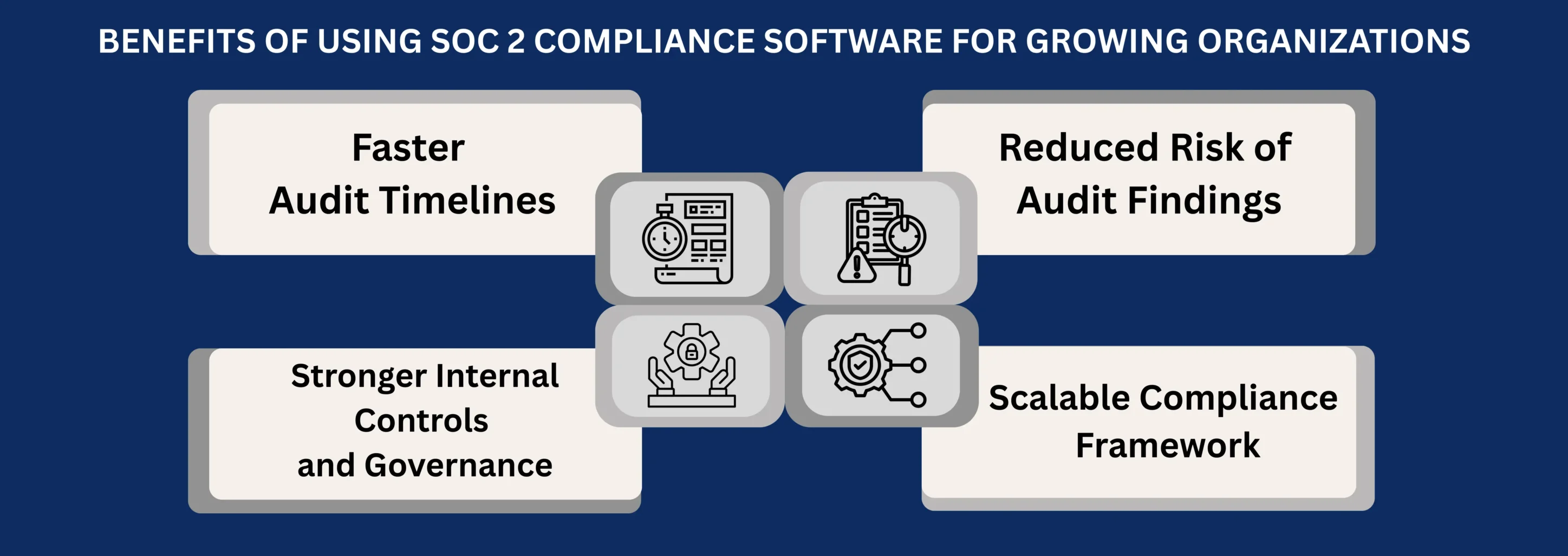
SOC 2 Certification in Minnesota delivers a defined set of organizational outcomes directly tied to the attestation process itself. These outcomes result from independent examination and the formal issuance of a CPA firm’s opinion — not from marketing claims or self-reported assessments. The following represent the primary documented outcomes associated with SOC 2 attestation for Minnesota-based service organizations.
- ✓Independent third-party validation of control design and operating effectiveness by a Licensed CPA Firm
- ✓Formal SOC 2 attestation report recognized by enterprise customers, regulated institutions, and procurement offices across Minnesota
- ✓Structured evidence of control operation over a defined observation period, reducing reliance on self-reported security questionnaires
- ✓Documented alignment with AICPA Trust Services Criteria, providing a consistent and recognized control evaluation framework
- ✓Qualification for vendor approval processes at Minnesota’s major financial institutions, health systems, and government agencies
- ✓Ongoing control monitoring discipline established through the annual SOC 2 audit cycle and evidence collection requirements
- ✓Differentiated market positioning relative to competitors that have not completed an independent SOC 2 examination
- ✓Reduced information security disclosure burden in enterprise RFP and vendor onboarding processes
The primary outcome of a SOC 2 examination is the production of an independent attestation opinion by a Licensed CPA Firm confirming that the organization’s controls were evaluated against the Trust Services Criteria and found to satisfy the stated criteria. This opinion carries a level of credibility that internal assessments, self-reported questionnaire responses, or vendor-issued certifications cannot replicate. The attestation is based on evidence examined by qualified professionals operating under professional standards — including AICPA attestation standards and quality control requirements — rather than on management’s own representations. For Minnesota organizations operating in markets where information security is a material procurement consideration, this independent validation provides a verifiable basis for customer assurance that has regulatory and contractual standing.
The evidence collection and control monitoring requirements of the SOC 2 examination process also produce operational benefits within the organization’s control environment. The requirement to generate and retain contemporaneous evidence of control operation throughout the observation period drives the establishment of consistent, repeatable control processes that document their own effectiveness. Access reviews, change management approvals, incident response records, and vendor assessment documentation maintained for SOC 2 audit purposes also serve as operational records supporting internal risk management, regulatory examination responses, and business continuity planning. The discipline imposed by the annual SOC 2 audit cycle creates a continuous control monitoring environment rather than a point-in-time compliance exercise.
SOC 2 attestation produces measurable commercial outcomes for Minnesota organizations operating in markets where independent security verification is a procurement requirement. Organizations holding a current SOC 2 Type 2 report are able to respond to vendor qualification requirements without delays associated with security review negotiations or additional documentation requests. The attestation report functions as a standardized security disclosure document that procurement teams and vendor risk management functions at enterprise customers can evaluate using established review criteria. For Minnesota SaaS providers and cloud service organizations targeting enterprise accounts or regulated industry customers, SOC 2 Certification eliminates a qualification barrier that would otherwise require extensive bilateral negotiation, security questionnaire completion, and customer site review activities.
- ✓Third-Party Validation and Control Discipline
- ✓Market Access and Commercial Outcomes
SOC 2 Certification for Minnesota Technology and SaaS Sectors
Minnesota’s technology sector encompasses a diverse range of organizations for which SOC 2 Certification is directly relevant. SaaS providers, cloud service platforms, managed service providers, cybersecurity companies, AI and machine learning businesses, data analytics organizations, and software companies handling customer data all operate in an environment where SOC 2 attestation is expected by enterprise buyers and institutional clients. The Minneapolis–Saint Paul technology corridor hosts a particularly active market for SOC 2 examination services, driven by the density of enterprise technology buyers and regulated-industry customers concentrated in the metropolitan area.
SaaS Providers and Cloud Service Organizations
SaaS providers operating from Minnesota face vendor qualification requirements that almost universally include a request for a current SOC 2 Type 2 report. Cloud-hosted software applications that process, store, or transmit customer data are subject to vendor security review processes at enterprise customers that use SOC 2 attestation as the primary mechanism for evaluating third-party control environments. A Minneapolis-based SaaS company providing enterprise resource planning software to manufacturing organizations across the Midwest, for example, will encounter procurement requirements that mandate SOC 2 Certification from each technology vendor in the customer’s supply chain. The Security and Availability Trust Services Criteria categories are most commonly included in SaaS SOC 2 engagements, reflecting the centrality of access control and system uptime to customer service commitments.
Cloud service providers hosting customer data or providing infrastructure-as-a-service to Minnesota organizations face their own SOC 2 attestation requirements — both as service organizations seeking customer approval and as components of their customers’ control environments. When a Minnesota company relies on a cloud infrastructure provider for its production environment, that reliance creates a subservice organization relationship that must be addressed in the primary organization’s SOC 2 system description. The primary organization may either carve out the subservice organization’s controls from scope — with a note that complementary controls are provided by the subservice organization — or include them through an inclusive method, which requires the subservice organization to also hold its own SOC 2 attestation. This layered structure drives SOC 2 Certification requirements through technology supply chains operating in the Minnesota market.
AI, Cybersecurity, and Emerging Technology Organizations
Minnesota’s growing AI and emerging technology sector — including machine learning platforms, data science organizations, and AI-powered business intelligence providers — faces increasing pressure to demonstrate independent verification of their information security and data handling practices. AI organizations that process customer data as part of model training, inference, or analytics workflows are subject to the same SOC 2 examination requirements as traditional SaaS providers, with particular attention to data confidentiality, processing integrity, and privacy controls. Cybersecurity companies operating from Minnesota that provide security monitoring, managed detection and response, or vulnerability management services to enterprise customers also frequently pursue SOC 2 attestation as evidence that their own internal controls — including those governing access to customer security data — have been independently examined.
SOC 2 Certification Scope and Independent Decision Framework
The scope of a SOC 2 examination determines which systems, services, Trust Services Criteria categories, and control domains are subject to the CPA firm’s evaluation. Scope is defined collaboratively between the organization’s management and the examining CPA firm at the outset of the engagement and is documented in the system description. Scope boundaries must be drawn with sufficient precision to ensure that all systems and processes material to the delivery of in-scope services are included, while excluding systems and processes not relevant to the service commitments being attested. Imprecisely defined scope can result in over-inclusion of systems that create unnecessary examination complexity, or under-inclusion of systems that are material to the service — either of which may undermine the validity of the SOC 2 attestation.
Evaluating Control Design and Operating Effectiveness
The CPA firm’s evaluation of control design assesses whether the controls identified in the system description are capable of achieving the stated Trust Services Criteria if they operate as described. Control design evaluation is a qualitative assessment — the CPA firm considers whether the control mechanism, as designed, addresses the risk or requirement identified by the criterion. A control that requires manual access review to be performed monthly, for example, must be designed so that the review process, if performed as described, would identify unauthorized access and produce a documented record. Design deficiencies identified during Stage 1 evaluation are reported and may affect the CPA firm’s opinion on the suitability of design, regardless of whether the control operated during the observation period.
Operating effectiveness testing in a Type 2 SOC 2 examination evaluates whether controls functioned as designed throughout the observation period. The CPA firm selects samples of evidence from the review period and applies testing procedures to determine whether each selected instance demonstrates that the control operated correctly. Sampling methodology is determined by the CPA firm based on professional judgment, the frequency of the control, and the risk associated with the criterion being tested. Controls that operate daily — such as automated security monitoring — will be tested using a larger sample than controls that operate quarterly, such as access review cycles. Exceptions identified during operating effectiveness testing are documented with the specific instance date, the nature of the deviation, and the CPA firm’s assessment of the exception’s impact on the overall attestation opinion.
Report Validity, Maintenance, and Recertification
A SOC 2 attestation report is valid for the period covered by the examination — typically a twelve-month observation period for a Type 2 report. Enterprise customers and regulated institutions typically require an updated report on an annual basis, which means organizations must complete a new SOC 2 examination each year to maintain a current attestation. The recertification examination covers the subsequent observation period and produces an updated attestation report reflecting the CPA firm’s opinion on control effectiveness during that period. Continuous improvement of the control environment between examination cycles — addressing any exceptions identified in the prior report and enhancing controls in response to evolving threats — is reflected in the quality and scope of the subsequent attestation. SOC 2 examination reports in Minnesota that include qualified opinions due to control exceptions may affect customer confidence and vendor qualification decisions until a clean opinion is obtained in a subsequent examination.
SOC 2 Versus Other Information Security Certifications
SOC 2 Certification is one of several independent information security attestation and certification frameworks available to Minnesota organizations. Understanding how SOC 2 differs from alternative frameworks enables organizations to align their certification strategy with the specific requirements of their customer base, industry sector, and contractual obligations. The most frequently compared frameworks are ISO 27001, SOC 1, and HITRUST — each of which serves a distinct purpose and is evaluated against different criteria by enterprise customers and regulatory bodies.
SOC 2 vs. ISO 27001
SOC 2 and ISO 27001 address overlapping but distinct aspects of information security governance. ISO 27001 is an international standard for information security management systems (ISMS) issued by the International Organization for Standardization. ISO 27001 certification is issued by an accredited certification body following a third-party audit and confirms that the organization’s ISMS conforms to the standard’s requirements. SOC 2 Certification is an attestation engagement conducted by a Licensed CPA Firm under AICPA standards, focused specifically on evaluating the effectiveness of controls relevant to the Trust Services Criteria — with an emphasis on controls that directly affect customer data and service delivery. SOC 2 attestation is more directly aligned with the requirements of U.S. enterprise customers and regulated institutions, particularly in the financial services and healthcare sectors, where the AICPA framework is the recognized standard for service organization control reporting.
Minnesota organizations serving U.S.-based enterprise customers predominantly encounter requests for SOC 2 attestation rather than ISO 27001 certification. ISO 27001 is more commonly required in international markets — particularly in Europe and Asia-Pacific — where the ISO framework is the recognized standard for information security management. Organizations targeting both domestic U.S. and international markets may pursue both certifications, as the control environments required to satisfy each framework have significant overlap. However, the specific evidence requirements, evaluation criteria, and report formats differ materially, and each requires an independent examination by a qualified auditor operating under the applicable standards. The SOC 2 examination produces a detailed attestation report on specific control effectiveness, while ISO 27001 certification confirms conformity with a management system standard without providing the same level of control-specific testing detail.
SOC 2 vs. SOC 1 and Other SOC Reports
The SOC reporting framework includes three distinct report types — SOC 1, SOC 2, and SOC 3 — each serving a different purpose and audience. SOC 1 reports address controls at a service organization that are relevant to user entities’ internal control over financial reporting. SOC 1 is the appropriate report type for payroll processors, benefit plan administrators, loan servicers, and other organizations whose services directly affect the financial statements of their customers. SOC 2 reports address controls relevant to security, availability, processing integrity, confidentiality, and privacy — the Trust Services Criteria — and are the appropriate report type for technology service providers, SaaS companies, cloud infrastructure providers, and other organizations whose primary customer concern is information security and data protection rather than financial reporting impact. SOC 3 reports provide a general-use summary of SOC 2 examination conclusions without detailed test results, making them suitable for public disclosure.
FAQ
▶
What is SOC 2 Certification in Minnesota?
▶
Who issues SOC 2 attestation reports in Minnesota?
▶
What is the difference between SOC 2 Type 1 and Type 2?
▶
How long does a SOC 2 audit take for a Minnesota organization?
▶
Which Trust Services Criteria categories are required for SOC 2?
▶
Is SOC 2 compliance the same as SOC 2 certification?
▶
How often must a SOC 2 audit be completed to maintain certification?
▶
What types of Minnesota organizations typically pursue SOC 2 certification?
SOC 1 VS SOC 2: WHICH REPORT YOUR CUSTOMERS ACTUALLY ASK FOR
If you sell SaaS or provide outsourced services, you have likely been asked for a SOC report. However, the follow-up question is rarely easy to answer…

AICPA Issues New Guidance for Peer Reviewers Evaluating SOC 2 Engagements
AICPA SOC 2 guidance has been issued to help peer reviewers identify quality risks associated with SOC 2 engagements as the use of compliance automati…
SOC 2 Certified: What Does It Mean for Your Business
For companies that handle sensitive data or run cloud-based services, the question “Can you provide your SOC 2 report?” carries enormous weight. Yet, …
Get In Touch
have a question? let us get back to you.