
SOC 2 Certification in Ohio
The SOC 2 audit process in Ohio follows a defined sequence of stages established under AICPA attestation standards. Each stage produces specific outputs that feed into the next, culminating in the issuance of a formal attestation report by the Licensed CPA Firm.Understanding the SOC 2 examination process allows Ohio organizations to plan their control environment documentation, evidence collection, and observation periods with precision — reducing delays and supporting a more efficient path to SOC 2 certification.
OUR CLIENTS










Independent SOC 2 Certification by a Licensed CPA Firm in Ohio
SOC 2 Certification in Ohio is issued exclusively by a Licensed CPA Firm conducting an independent examination under AICPA AT-C Section 205 attestation standards. The examination evaluates an organization’s controls against the Trust Services Criteria — Security, Availability, Processing Integrity, Confidentiality, and Privacy — and results in a formal attestation report issued by the CPA Firm.
SOC 2 attestation is not self-certification, a checklist exercise, or a vendor-issued compliance badge. It is a structured, evidence-based examination conducted by an independent third party qualified under AICPA professional standards. Understanding this distinction is essential for Ohio organizations navigating enterprise vendor requirements and regulated industry procurement processes.
What SOC 2 Attestation Means for Ohio Organizations
SOC 2 attestation is a formal examination conducted by a Licensed CPA Firm in which the CPA Firm independently evaluates whether an organization’s controls meet the applicable AICPA Trust Services Criteria. The examination produces a written attestation report — either a Type 1 report assessing control design at a point in time, or a Type 2 report assessing both design and operating effectiveness over a defined observation period.
For Ohio organizations, SOC 2 attestation distinguishes independently verified control effectiveness from self-declared compliance. A SOC 2 report issued by a Licensed CPA Firm carries the weight of professional attestation standards and is recognized across enterprise procurement, financial services vendor due diligence, and healthcare technology supply chain reviews.
The attestation process requires the organization to present documented evidence of its controls. The Licensed CPA Firm then evaluates that evidence against defined Trust Services Criteria — not against the organization’s own internal benchmarks. This independence is the defining characteristic of SOC 2 certification that separates it from internal audits or self-assessments.
Ohio’s Regulatory and Business Context for SOC 2 Examination
Ohio’s technology, healthcare, financial services, and manufacturing sectors create concentrated demand for SOC 2 examination. Columbus, Cleveland, Cincinnati, Dayton, and Akron collectively host a substantial ecosystem of SaaS providers, health technology companies, fintech firms, insurance organizations, automotive technology suppliers, logistics providers, cloud service providers, and cybersecurity firms. All of these organizations routinely encounter vendor assurance requirements that reference SOC 2 compliance.
Ohio-based organizations subject to HIPAA, the Gramm-Leach-Bliley Act, and state-level data protection expectations are increasingly required by enterprise customers, regulated financial institutions, and healthcare systems to present a current SOC 2 attestation report as a condition of vendor onboarding. Ohio’s Data Protection Act, which provides an affirmative defense for organizations adopting recognized cybersecurity frameworks, further incentivizes formal, third-party examination of control environments.
SOC 2 Certification in Ohio does not automatically establish compliance with Ohio, federal, or industry-specific laws and regulations. However, the SOC 2 examination documents a structured, independently verified control environment that is directly relevant to organizations demonstrating information security due diligence across Ohio’s regulated industries.
Trust Services Criteria as the Evaluative Standard
The AICPA Trust Services Criteria (TSC) provide the structured evaluative framework against which an Ohio organization’s controls are assessed during a SOC 2 examination. The Security criterion — also known as the Common Criteria — is mandatory in every SOC 2 audit and addresses logical and physical access controls, system operations, change management, and risk mitigation.
The remaining four criteria — Availability, Processing Integrity, Confidentiality, and Privacy — are included based on the organization’s service commitments, contractual obligations, and the nature of data processed. During the SOC 2 audit, the Licensed CPA Firm maps each control to the applicable Trust Services Criteria, reviews design documentation, and — for Type 2 examinations — tests operating effectiveness through evidence sampling over the defined observation period.
The scope of criteria selected directly determines the depth and breadth of the examination and the information conveyed in the resulting attestation report. Ohio organizations in healthcare technology, financial services, and SaaS commonly include Security plus Confidentiality and Availability to address the full range of enterprise customer expectations.

SOC 2 Certification Audit Process for Ohio Organizations
The SOC 2 audit process in Ohio follows a defined sequence of stages established under AICPA attestation standards. Each stage produces specific outputs that feed into the next, culminating in the issuance of a formal attestation report by the Licensed CPA Firm.
Understanding the SOC 2 examination process allows Ohio organizations to plan their control environment documentation, evidence collection, and observation periods with precision — reducing delays and supporting a more efficient path to SOC 2 certification.
The SOC 2 examination begins with scope definition, during which the Licensed CPA Firm and the organization establish the system boundaries, applicable Trust Services Criteria, and the report type — Type 1 or Type 2. Scope definition identifies the services, infrastructure, software, personnel, and procedures that fall within the examination boundary.
Following scope confirmation, the CPA Firm develops the audit program, documenting the specific control objectives, testing procedures, and evidence requirements for the examination. The Stage 1 review focuses on the organization’s documentation — policies, risk assessments, control descriptions, and system descriptions. The CPA Firm evaluates whether the documented controls are suitably designed to meet the applicable Trust Services Criteria and whether the system description accurately represents the in-scope environment.
Stage 1 outputs include a formal assessment of control design suitability and identification of any documentation deficiencies that must be addressed before Stage 2 testing proceeds. For a SOC 2 Type 1 report, the examination concludes after Stage 1 with issuance of the point-in-time attestation report.
For a SOC 2 Type 2 examination, Stage 2 involves testing control operating effectiveness over the defined observation period — typically a minimum of six months. Twelve-month periods are common for mature control environments and are preferred by many enterprise customers conducting vendor due diligence.
During Stage 2, the Licensed CPA Firm collects and evaluates evidence that controls operated as described throughout the observation period. Evidence types include access logs, change management records, incident response documentation, configuration baselines, training completion records, vendor review documentation, and system monitoring outputs. The CPA Firm applies sampling methodologies consistent with AICPA attestation standards to assess whether controls operated consistently and effectively.
Ohio organizations in SaaS, fintech, healthcare technology, and cloud services typically maintain continuous evidence collection processes to support a twelve-month Type 2 observation period. Enterprise procurement teams in these sectors commonly require full-year coverage. Evidence gaps identified during Stage 2 are documented as exceptions or nonconformities within the final SOC 2 attestation report.
Following Stage 2 testing, the Licensed CPA Firm documents any exceptions, deviations, or nonconformities identified during the examination. The organization reviews the findings, and management provides a written response addressing each exception. The CPA Firm then prepares the draft attestation report, which includes the system description, management’s assertion, the CPA Firm’s opinion, and — for Type 2 reports — the detailed description of controls tested, testing procedures applied, and results of testing.
The certification decision is made by the CPA Firm’s engagement partner based on the totality of evidence collected, exceptions identified, and professional judgment applied under AICPA attestation standards. The final SOC 2 attestation report is issued under the CPA Firm’s letterhead and signature, constituting formal attestation of the organization’s control environment.
SOC 2 Certification in Ohio is only valid when issued by a Licensed CPA Firm. Reports issued by non-CPA entities, consultants, or technology platforms do not constitute formal SOC 2 attestation under AICPA standards and should not be presented as equivalent to a licensed CPA-issued opinion.
| Audit Stage | Key Activities | Output |
|---|---|---|
| Scope Definition & Program Development | Establish system boundaries, select Trust Services Criteria, define Type 1 or Type 2 scope | Signed engagement letter and audit program |
| Stage 1 – Documentation Review | Evaluate control design documentation, system description, policies, and risk assessment records | Design suitability assessment; Stage 1 findings report |
| Stage 2 – Operating Effectiveness Testing | Evidence collection, sampling, and control testing over the SOC 2 observation period | Testing workpapers and exception documentation |
| Nonconformity Review | Document exceptions, receive management responses, evaluate remediation | Exception log with management responses |
| Report Issuance | Draft and finalize attestation report; Licensed CPA Firm issues signed opinion | Formal SOC 2 Type 1 or Type 2 attestation report |
- ✓Scoping, Program Determination, and Stage 1 Review
- ✓Stage 2 Testing, Evidence Collection, and Observation Period
- ✓Nonconformity Review, Certification Decision, and Report Issuance
SOC 2 Type 1 and Type 2 Reports: Distinctions and Applications in Ohio
SOC 2 Certification in Ohio encompasses two distinct report types — Type 1 and Type 2 — each serving different verification purposes and carrying different weight in enterprise due diligence processes. The selection between Type 1 and Type 2 is determined by scope, customer requirements, and the maturity of the organization’s control environment. Understanding the difference between these report types is a critical step for Ohio organizations entering the SOC 2 audit process.
SOC 2 Type 1: Point-in-Time Control Design Assessment
A SOC 2 Type 1 report assesses whether an organization’s controls are suitably designed to meet the applicable Trust Services Criteria as of a specific date. The Licensed CPA Firm reviews the system description and evaluates whether the described controls, if operating as documented, would satisfy the criteria. Type 1 reports do not include an assessment of operating effectiveness — they confirm design intent, not historical performance.
For Ohio organizations that have recently implemented formal control frameworks, a Type 1 report serves as an initial attestation milestone, demonstrating to enterprise customers that a structured control environment exists and that a formal SOC 2 examination is underway. Ohio SaaS providers and technology startups in Columbus and Cincinnati frequently pursue Type 1 reports as a step toward the more comprehensive Type 2 examination.
While Type 1 reports carry less evidential weight than Type 2 reports in enterprise procurement processes, they establish a documented baseline and signal to customers that the SOC 2 certification process is progressing under the oversight of a Licensed CPA Firm.
SOC 2 Type 2: Operating Effectiveness Over an Observation Period
A SOC 2 Type 2 report assesses both the design and operating effectiveness of controls over a defined observation period. The Licensed CPA Firm tests whether controls operated consistently and effectively throughout the period by collecting and evaluating evidence — including access reviews, change management logs, incident records, configuration documentation, and monitoring outputs.
The observation period for a SOC 2 Type 2 examination is typically six to twelve months. Enterprise customers in Ohio’s financial services, healthcare, and government contracting sectors routinely require twelve-month Type 2 reports covering the most recent calendar or fiscal year. SOC 2 Type 2 reports are the standard expected by Ohio-based financial institutions, health systems, and large enterprises evaluating technology vendors through formal third-party risk management programs.
The Type 2 report provides a detailed description of every control tested, the testing procedure applied, and the result — making it a substantive and independently verifiable record of control performance. SOC 2 Certification in Ohio at the Type 2 level represents the most credible and widely recognized form of SOC 2 attestation in the market.
Report Validity, Annual Cycles, and Ongoing SOC 2 Compliance
SOC 2 attestation reports do not carry an indefinite validity period. Enterprise customers, financial institutions, and regulated procurement teams treat SOC 2 reports as current only when they cover the most recent twelve-month period. Organizations must complete annual SOC 2 audit cycles to maintain a current attestation status that satisfies ongoing customer and contractual requirements.
A lapsed SOC 2 report — one covering a period ending more than twelve months prior — is frequently treated by Ohio enterprise customers as insufficient evidence of current control effectiveness. SOC 2 compliance in Ohio is therefore an ongoing discipline, not a one-time certification event.
Ohio organizations that maintain continuous evidence collection processes, monitor control performance between audits, and engage a Licensed CPA Firm on an annual examination cycle sustain the strongest attestation posture. Management responsibilities include maintaining the control environment, ensuring evidence availability throughout the observation period, and addressing any exceptions identified in prior attestation reports before the next examination cycle begins.
SOC 2 Certification Requirements and Control Environment Evaluation
SOC 2 examination requirements center on demonstrating that controls exist, are suitably designed, and — for Type 2 examinations — have operated effectively throughout the observation period. The Licensed CPA Firm evaluates the organization’s control environment across five structural components that directly map to the AICPA Trust Services Criteria. Meeting these requirements is fundamental to achieving and maintaining SOC 2 certification.
The control environment encompasses the organizational structures, policies, and accountability frameworks that support effective control operation. During the SOC 2 audit, the Licensed CPA Firm evaluates management’s tone, the assignment of control ownership, and the adequacy of policies governing information security, access management, incident response, change management, and vendor oversight.
Risk assessment is evaluated as a formal, documented process. The CPA Firm reviews whether the organization has identified risks to achieving its service commitments and whether risk responses are reflected in active controls. Control activities are the specific operational and technical measures implemented to address identified risks.
For Ohio organizations, common control activities include multi-factor authentication enforcement, role-based access control, encryption standards, vulnerability management programs, background check procedures for personnel with privileged access, and documented change management workflows. Each control activity must be mapped to the applicable Trust Services Criteria and supported by evidence demonstrating consistent operation throughout the SOC 2 examination period.
Monitoring activities demonstrate that the organization evaluates control performance on an ongoing basis and responds to identified deficiencies. The SOC 2 examination assesses whether monitoring is continuous, systematic, and documented — including internal audit activities, management reviews, system monitoring alerts, and periodic access recertification processes.
Communication controls address whether relevant information about the control environment, security incidents, and system changes is communicated internally and, where applicable, to external parties such as customers and regulators.
Evidence requirements for SOC 2 compliance in Ohio are specific and document-intensive. The Licensed CPA Firm requires access logs, ticketing system records, policy acknowledgment documentation, training records, vendor due diligence records, board or management meeting minutes addressing security matters, and system configuration documentation. Organizations that implement continuous evidence collection workflows — including automated logging, access reviews, and configuration management — are better positioned to support annual SOC 2 audit cycles and ad hoc evidence requests from enterprise customers conducting security reviews.
The scope of a SOC 2 examination is defined by the system boundary — the specific services, infrastructure components, software applications, data processing activities, and personnel included within the examination. Scope definition directly determines what the attestation report covers and, critically, what it does not cover.
Ohio organizations that process customer data across multiple product lines or geographic regions must define whether each system or service is included within a single examination or examined separately. The Licensed CPA Firm’s attestation opinion applies only to the in-scope system as described.
Conditions that affect the qualification of the attestation report include the identification of exceptions to control operation, restrictions on the scope of testing, or material deviations between the system description and the actual system observed during fieldwork. A qualified opinion in a SOC 2 attestation report signals that exceptions were identified and could not be remediated during the examination period. Ohio organizations receiving qualified opinions are expected by enterprise customers to provide written management responses and remediation plans addressing each exception before the next SOC 2 audit cycle begins.
- ✓Control Environment, Risk Assessment, and Control Activities
- ✓Monitoring, Communication, and Evidence Requirements
- ✓Scope of Certification and Conditions for Qualification
Ohio Business Sectors Pursuing SOC 2 Certification
SOC 2 Certification in Ohio is pursued across a broad range of industries, driven by enterprise customer requirements, regulated sector vendor assurance expectations, and the growing integration of digital and cloud-based systems into critical business operations. Ohio’s diverse economy generates strong demand for SOC 2 examination across the following primary sectors.
SaaS, Cloud Services, and Technology Providers
Ohio’s technology sector is anchored in Columbus, which hosts a substantial concentration of SaaS companies, cloud infrastructure providers, cybersecurity firms, and AI development organizations. Cleveland and Cincinnati add significant depth, with technology services companies, managed service providers, and enterprise software vendors across both metros.
SaaS providers and cloud service organizations are among the most frequent pursuers of SOC 2 Certification in Ohio. Enterprise customer contracts in financial services, healthcare, and government routinely include SOC 2 Type 2 attestation as a vendor onboarding requirement. Technology organizations serving multiple enterprise verticals commonly pursue SOC 2 examinations scoped to Security and Availability criteria, reflecting the service commitments most relevant to uptime, data integrity, and access control.
SOC 2 audit engagements in Ohio for SaaS providers typically involve detailed testing of logical access controls, multi-tenant data segregation, encryption practices, and incident response procedures — all evaluated against the AICPA Trust Services Criteria by a Licensed CPA Firm.
Healthcare Technology, Fintech, and Financial Services
Ohio is home to some of the nation’s largest health systems and health technology ecosystems, with significant concentrations of healthcare IT vendors, electronic health record platform providers, health data analytics organizations, and medical device technology companies operating across Columbus, Cleveland, and Dayton. Health technology organizations handling protected health information routinely pursue SOC 2 Certification alongside HIPAA compliance programs.
SOC 2 attestation provides an independently verified, structured assessment of technical and operational controls that complements — but does not substitute for — HIPAA-specific requirements. Ohio’s financial services and fintech sector, concentrated in Columbus and Cincinnati, generates strong demand for SOC 2 compliance among payment processors, banking technology providers, insurance technology firms, and investment management platforms.
Financial institutions conducting vendor risk assessments and third-party risk management programs routinely require SOC 2 Type 2 attestation from technology vendors handling financial data, customer account information, and transaction processing systems. SOC 2 certification for Ohio companies in these sectors typically includes Security, Confidentiality, and Availability criteria.
Manufacturing, Automotive, and Logistics Technology Organizations
Ohio’s manufacturing, automotive, and logistics sectors have experienced accelerating technology integration. Industrial automation platforms, supply chain management systems, connected vehicle technology providers, and logistics software organizations operate across Dayton, Akron, Toledo, and the broader northeastern Ohio industrial corridor.
Manufacturing and automotive technology suppliers providing software or digital services to large OEMs and Tier 1 manufacturers increasingly encounter SOC 2 attestation requirements embedded in supplier qualification programs and vendor risk management frameworks. Logistics technology organizations handling sensitive customer shipment data, warehouse management systems, and transportation management platforms are evaluated against SOC 2 criteria addressing Security, Processing Integrity, and Availability — criteria that directly reflect the reliability and data accuracy commitments central to logistics operations.
SOC 2 examination engagements in Ohio’s manufacturing and industrial technology sectors require careful scope definition. These organizations frequently operate hybrid IT environments combining cloud-hosted applications with on-premises operational technology systems that must be appropriately bounded within the attestation scope.
Benefits of SOC 2 Certification for Ohio-Based Organizations
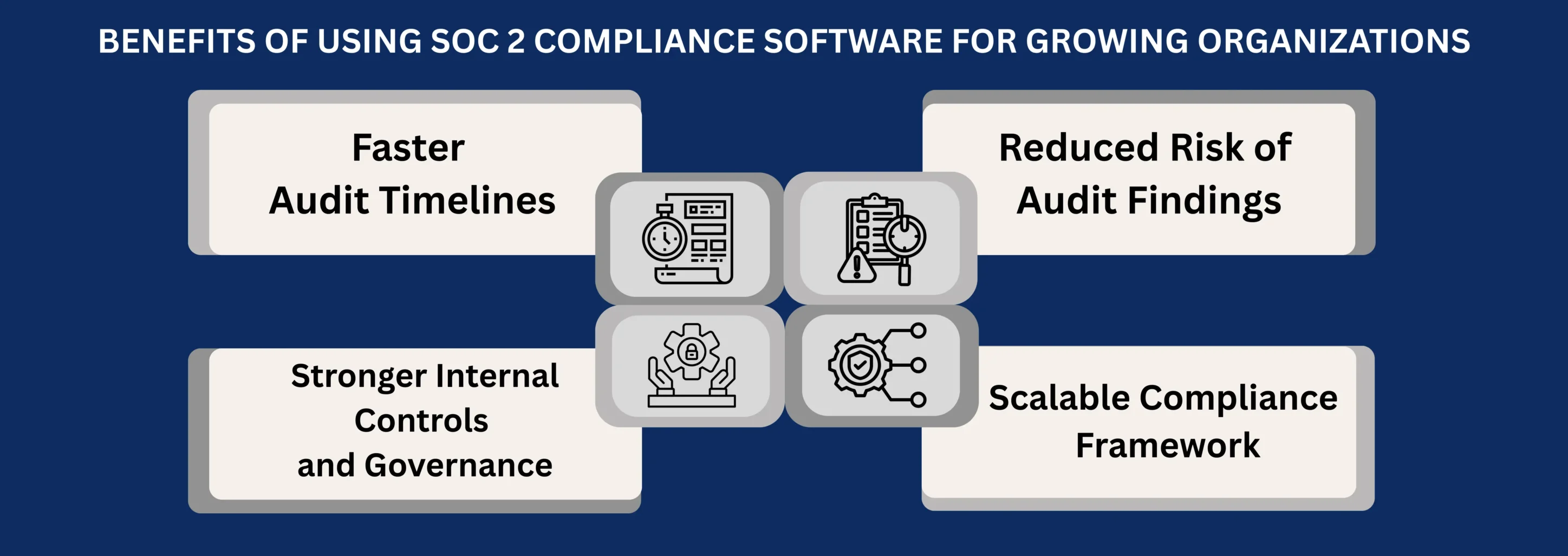
SOC 2 Certification in Ohio delivers a defined set of organizational outcomes directly tied to the attestation process itself. These outcomes result from the independent examination conducted by the Licensed CPA Firm and the verified control environment it documents — not from any advisory or consulting activity. The benefits below reflect the direct impact of achieving and maintaining SOC 2 certification through a formal annual examination cycle.
- ✓Independent verification of control effectiveness by a Licensed CPA Firm under AICPA attestation standards
- ✓Formal SOC 2 attestation report recognized in enterprise procurement, financial sector vendor reviews, and regulated industry supply chains
- ✓Documented evidence of Security, Availability, Processing Integrity, Confidentiality, and Privacy controls evaluated against the AICPA Trust Services Criteria
- ✓Structured SOC 2 audit methodology that identifies control exceptions and supports continuous improvement of the control environment
- ✓Competitive differentiation in Ohio’s SaaS, healthcare technology, fintech, and cloud services markets where SOC 2 compliance is a standard vendor requirement
- ✓Support for third-party risk management programs conducted by Ohio financial institutions, health systems, and enterprise organizations evaluating technology vendors
- ✓Annual SOC 2 examination cycle that maintains ongoing compliance and provides customers with current attestation evidence
- ✓Alignment with Ohio Data Protection Act frameworks and federal regulatory expectations for organizations demonstrating information security due diligence
SOC 2 attestation is the primary mechanism through which Ohio technology vendors demonstrate verified control effectiveness to enterprise customers conducting vendor due diligence. Financial institutions, health systems, insurance companies, and large enterprises in Ohio evaluate technology vendors against security and data protection criteria that directly mirror the AICPA Trust Services Criteria — making SOC 2 certification the most efficient path to satisfying procurement security questionnaires and third-party risk assessments.
A current SOC 2 Type 2 report from a Licensed CPA Firm eliminates or substantially reduces the need for individual security questionnaire responses, on-site vendor assessments, and custom due diligence reviews. The attestation report provides independently verified, detailed evidence of control design and operation that enterprise procurement teams can rely on directly.
Ohio-based organizations pursuing enterprise contracts with Fortune 500 companies headquartered in Columbus, Cleveland, or Cincinnati — or expanding into financial services and healthcare markets nationally — consistently report that SOC 2 attestation status is treated as a threshold qualification in the vendor selection process.
The SOC 2 examination cycle instills organizational discipline around control monitoring, evidence collection, and management accountability for information security. Annual SOC 2 audit cycles require management to maintain documented policies, review access rights regularly, manage vendor relationships with appropriate due diligence, and respond to security incidents in accordance with defined procedures. This cycle creates a structured accountability framework that supports internal governance objectives independently of external customer requirements.
Ohio organizations that maintain continuous control monitoring — automated logging, quarterly access reviews, regular vulnerability scanning, and documented change management — build an evidence base that supports both annual Type 2 examinations and ad hoc customer security inquiries.
Management’s written assertion, included in every SOC 2 attestation report, formally documents leadership’s acceptance of responsibility for the control environment’s design and operation. This establishes clear internal accountability for information security performance throughout the organization and reinforces the ongoing value of SOC 2 compliance beyond the examination itself.
- ✓Enterprise Procurement and Vendor Due Diligence Recognition
- ✓Ongoing Control Monitoring and Management Accountability
SOC 2 vs. Other Information Security Certifications Relevant to Ohio Organizations
Ohio organizations evaluating information security certification options frequently compare SOC 2 Certification with ISO 27001, HITRUST, and FedRAMP. Each framework serves distinct purposes and is recognized differently across market segments. Understanding these distinctions helps Ohio organizations identify the appropriate certification for their specific customer base and regulatory environment — and determine whether pursuing multiple certifications in parallel makes strategic sense.
SOC 2 Certification Compared to ISO 27001
SOC 2 Certification and ISO 27001 certification both address information security controls but differ fundamentally in their governing standards, issuing authorities, and market recognition. SOC 2 attestation is conducted by a Licensed CPA Firm under AICPA AT-C Section 205 standards and is primarily recognized by U.S. enterprise customers, financial institutions, and healthcare organizations. ISO 27001 is issued by an accredited certification body under ISO/IEC 27001 standards and carries broader international recognition, particularly in European and Asia-Pacific markets.
For Ohio organizations serving domestic enterprise customers — particularly in financial services, SaaS, healthcare technology, and cloud services — SOC 2 Certification in Ohio is typically the primary market requirement. Organizations with international customer bases frequently pursue both certifications, as the control frameworks are complementary and can be examined concurrently to reduce total examination effort.
SOC 2 examinations focus on controls relevant to specific Trust Services Criteria, while ISO 27001 addresses a broader information security management system framework covering 93 control domains across Annex A. Selecting between or combining these certifications depends on the geographic distribution and industry composition of the organization’s customer base.
SOC 2 Certification Compared to HITRUST and FedRAMP
HITRUST CSF certification is a healthcare-specific framework widely adopted by Ohio health systems, health insurers, and health technology organizations. HITRUST certification involves a structured assessment against a prescriptive control catalog incorporating HIPAA, NIST, and ISO requirements and is recognized by many large Ohio health systems as a vendor qualification standard.
SOC 2 and HITRUST serve overlapping but distinct purposes. SOC 2 attestation addresses general information systems control effectiveness, while HITRUST addresses healthcare-specific control requirements at greater prescriptive depth. Many Ohio health technology organizations pursue both SOC 2 and HITRUST, as the two certifications are accepted in complementary procurement contexts.
FedRAMP is relevant to Ohio organizations seeking authorization to provide cloud services to U.S. federal agencies and state governments adopting FedRAMP-aligned requirements. SOC 2 examination in Ohio does not produce FedRAMP authorization, but SOC 2 control documentation and audit evidence frequently serve as foundational material supporting FedRAMP authorization packages — reducing duplication of effort for organizations pursuing federal market access.
| Certification | Issuing Authority | Primary Market Recognition | Ohio Sector Relevance |
|---|---|---|---|
| SOC 2 | Licensed CPA Firm (AICPA attestation standards) | U.S. enterprise, financial services, healthcare, SaaS | SaaS, fintech, health tech, cloud, financial services |
| ISO 27001 | Accredited certification body (ISO/IEC standards) | International — Europe, Asia-Pacific, global enterprise | Organizations with international customer bases |
| HITRUST CSF | HITRUST Alliance | U.S. healthcare sector | Health technology, health insurers, clinical IT vendors |
| FedRAMP | Federal authorization body (U.S. federal agencies) | U.S. federal government cloud procurement | GovTech, federal cloud service providers |
Management Responsibilities in the SOC 2 Examination Process
SOC 2 examination places specific obligations on the management of the organization being examined. The Licensed CPA Firm conducts the independent evaluation, but management bears direct responsibility for the accuracy of the system description, the completeness of evidence provided, and the operation of controls throughout the observation period. Fulfilling these responsibilities is essential to a successful SOC 2 audit outcome.
Management’s assertion is a required component of every SOC 2 attestation report. In the assertion, management formally states that the system description is accurate and complete, that the controls described are suitably designed to meet the applicable Trust Services Criteria, and — for Type 2 reports — that those controls operated effectively throughout the observation period.
The accuracy of the system description is critical. It must represent the actual system boundary, infrastructure components, data flows, and control activities that the Licensed CPA Firm will examine. Material inaccuracies — such as omitting significant infrastructure components, underrepresenting data processing activities, or describing controls that do not exist as described — constitute deficiencies that the CPA Firm is required to address in the attestation report.
Ohio organizations undergoing their first SOC 2 audit engagement should invest significant effort in developing an accurate, comprehensive system description that reflects the actual environment. The CPA Firm’s fieldwork will verify the description against observed reality, making precision in this document foundational to a clean SOC 2 certification outcome.
Management is responsible for ensuring that evidence supporting control operation is collected, organized, and made available to the Licensed CPA Firm during fieldwork. Evidence availability failures — where controls are described but no supporting documentation exists — are among the most common causes of exceptions in SOC 2 attestation reports.
Ohio organizations that rely on third-party service providers — cloud infrastructure vendors, co-location data centers, payroll processors, or subcontracted technology services — must address these subservice organizations in the system description. The SOC 2 examination can address subservice organization controls through either the inclusive method, where the subservice organization’s controls are within scope and subject to direct examination, or the carve-out method, where the subservice organization’s controls are excluded from scope and their impact is described separately.
Complementary user entity controls — controls that the customer organization must implement for the examined organization’s controls to be effective — must also be documented and disclosed in the attestation report. Ohio organizations serving regulated industries frequently document complementary controls to properly define shared responsibility boundaries with their customers, reducing ambiguity in enterprise due diligence reviews.
- ✓Management’s Assertion and System Description Accuracy
- ✓Evidence Availability, Subservice Organizations, and Complementary Controls
FAQ
▶
What is SOC 2 Certification in Ohio and who can issue it?
▶
What is the difference between SOC 2 Type 1 and Type 2 reports?
▶
Which Trust Services Criteria should Ohio organizations include in their SOC 2 examination?
▶
How long is a SOC 2 attestation report valid in Ohio?
▶
What is the typical observation period for a SOC 2 Type 2 examination?
▶
Does SOC 2 Certification in Ohio constitute legal compliance with Ohio privacy or cybersecurity laws?
▶
What types of Ohio organizations most commonly pursue SOC 2 Certification?
▶
What does a qualified opinion in a SOC 2 attestation report mean?
SOC 1 VS SOC 2: WHICH REPORT YOUR CUSTOMERS ACTUALLY ASK FOR
If you sell SaaS or provide outsourced services, you have likely been asked for a SOC report. However, the follow-up question is rarely easy to answer…

AICPA Issues New Guidance for Peer Reviewers Evaluating SOC 2 Engagements
AICPA SOC 2 guidance has been issued to help peer reviewers identify quality risks associated with SOC 2 engagements as the use of compliance automati…
SOC 2 Certified: What Does It Mean for Your Business
For companies that handle sensitive data or run cloud-based services, the question “Can you provide your SOC 2 report?” carries enormous weight. Yet, …
Get In Touch
have a question? let us get back to you.