
ISO 27001 Certification in Atlanta
Organizations across Atlanta’s technology, financial services, healthcare, and logistics sectors pursue ISO 27001 Certification in Atlanta for a range of commercially, operationally, and regulatory-relevant reasons. The certification provides independently verified evidence of ISMS conformance — a structured demonstration of information security control effectiveness that supports vendor qualification, client assurance, and enterprise procurement processes across Atlanta’s diverse business ecosystem.
OUR CLIENTS









ISO 27001 Certification for Atlanta-Based Financial and Technology Organizations
ISO 27001 Certification in Atlanta is issued by CertPro, a Licensed CPA Firm operating as an independent third-party certification body. CertPro evaluates whether an organization’s Information Security Management System (ISMS) conforms to the requirements of ISO/IEC 27001:2022, conducting structured audit assessments against Clauses 4 through 10 and the Annex A control domains. The ISO 27001 certification decision is based exclusively on audit evidence gathered through independent assessment — not on advisory services, consulting, or implementation support. This distinction ensures that every certificate issued reflects objective, evidence-based conformance with the international standard.
Atlanta’s Technology and Fintech Ecosystem and ISO 27001 Demand
Metro Atlanta has grown into one of the Southeast’s most significant technology and financial services centers. The city’s ecosystem includes a dense concentration of fintech companies, payment processors, cloud-native SaaS platforms, cybersecurity providers, telecommunications businesses, logistics operators, healthcare technology organizations, AI startups, managed service providers, and e-commerce enterprises operating across Midtown Atlanta, Alpharetta, Sandy Springs, and the broader Metro Atlanta corridor.
This concentration of technology-driven organizations — many handling sensitive customer, financial, healthcare, and proprietary data — creates substantial demand for ISO 27001 Certification in Atlanta. The certification serves as a structured, independently verified demonstration of information security control effectiveness, giving Atlanta-based organizations a credible way to communicate ISMS conformance to clients, partners, and regulators.
Enterprise procurement security requirements and client due diligence assessments across Atlanta’s financial and technology sectors frequently reference ISO 27001 certification status as a baseline vendor security qualification criterion. SaaS providers supplying regulated financial institutions, cloud vendors serving healthcare organizations, and technology companies engaged in government or enterprise contracts routinely encounter ISO 27001 compliance requirements embedded within vendor security review programs, third-party risk management frameworks, and international client due diligence processes.
ISO 27001 Certification in Atlanta provides these organizations with an independently verified signal of ISMS conformance, supporting vendor qualification and procurement decisions across multiple sectors.
Independent Certification Body Positioning Under ISO/IEC 27001:2022
CertPro operates strictly as an independent certification body under ISO/IEC 27001:2022. The ISO 27001 certification audit is conducted against the full normative requirements of the standard, including Clauses 4 through 10 — which govern organizational context, leadership, planning, support, operation, performance evaluation, and continual improvement — and Annex A controls spanning Organizational, People, Physical, and Technological domains.
The evaluation framework encompasses all 93 controls organized across these four domains as introduced in the 2022 revision of the ISO 27001 standard. No consulting, implementation, or advisory services are provided at any stage of the certification evaluation. The final certification decision is made by an independent certification committee based solely on objective audit evidence.
Georgia Regulatory and Data Security Context
Organizations operating in Georgia may be subject to applicable state data security requirements, federal regulations such as HIPAA for healthcare entities and GLBA for financial institutions, and sector-specific cybersecurity frameworks including NIST CSF and PCI DSS. Georgia’s data breach notification law (O.C.G.A. § 10-1-910 et seq.) establishes disclosure obligations for entities experiencing security incidents involving personal information.
ISO 27001 certification documents ISMS conformance against the international standard and does not independently establish compliance with Georgia, U.S., or industry-specific legal obligations. Organizations may reference ISO 27001 compliance as a structured framework for managing information security risks relevant to their regulatory context, but independent legal and regulatory analysis remains necessary to determine specific compliance obligations.

What Is ISO 27001 Certification?
ISO 27001 Certification is a formal, independent third-party attestation confirming that an organization’s Information Security Management System conforms to the requirements of the ISO/IEC 27001 standard. The ISO 27001 standard was first published in 2005, substantively revised in 2013, and most recently updated as ISO/IEC 27001:2022. The current version introduced a restructured Annex A control set organized into four domains — Organizational, People, Physical, and Technological — comprising 93 controls, compared to 114 controls in the 2013 version.
Organizations previously certified under the 2013 standard were required to transition to ISO/IEC 27001:2022 by October 31, 2025, as established by accreditation bodies internationally. ISO 27001 Certification in Atlanta is conducted exclusively under the 2022 version of the standard, ensuring that all assessments reflect the most current requirements.
ISMS Requirements Under ISO/IEC 27001:2022
The ISO 27001 standard requires organizations to establish, implement, maintain, and continually improve an Information Security Management System. The ISMS must be designed in the context of the organization’s internal and external environment, the needs and expectations of interested parties, and the defined information security scope.
Core ISMS documentation requirements include an information security policy, a risk assessment methodology and results, a risk treatment plan, and a Statement of Applicability (SoA). The SoA identifies applicable Annex A controls, provides justification for their inclusion or exclusion, and records their implementation status. Auditors review the SoA during the ISO 27001 certification audit to verify alignment between identified risks, selected controls, and actual implementation evidence — making it one of the most critical documents in the certification process.
Risk Assessment and Risk Treatment Framework
The ISO/IEC 27001:2022 standard mandates a structured information security risk assessment process. Organizations must define risk assessment criteria, identify information security risks associated with the loss of confidentiality, integrity, and availability of information assets within scope, and analyze and evaluate those risks against established criteria before selecting appropriate risk treatment options.
Risk treatment options include applying Annex A controls, accepting residual risks within defined tolerance levels, transferring risks through contractual or insurance mechanisms, or avoiding risks by discontinuing specific activities. The risk treatment plan must document decisions, assigned responsibilities, and implementation timelines. The risk assessment and treatment process must be performed at planned intervals and whenever significant changes occur within the ISMS scope — forming the evidence basis for ISO 27001 compliance assessments conducted during the certification audit.
Annex A Control Domains in ISO/IEC 27001:2022
Annex A of ISO/IEC 27001:2022 provides a reference set of 93 information security controls organized across four domains. The Organizational domain includes 37 controls addressing policies, roles, responsibilities, asset management, supplier relationships, and incident management. The People domain includes 8 controls covering personnel screening, terms of employment, information security awareness, and disciplinary processes. The Physical domain includes 14 controls addressing physical security perimeters, entry controls, equipment security, and secure disposal. The Technological domain includes 34 controls covering user authentication, access management, cryptography, secure development, vulnerability management, network security, and data masking.
During the ISO 27001 certification audit, auditors assess whether the organization’s Statement of Applicability accurately reflects control selection decisions and whether implemented controls operate effectively within the defined ISMS scope.
| Annex A Domain | Number of Controls | Key Control Areas |
|---|---|---|
| Organizational | 37 | Policies, roles, asset management, supplier security, incident management |
| People | 8 | Screening, terms of employment, awareness, disciplinary processes |
| Physical | 14 | Physical perimeters, entry controls, equipment security, secure disposal |
| Technological | 34 | Access management, cryptography, secure development, vulnerability management |
ISO 27001 Certification Audit Process for Organizations in Atlanta
The ISO 27001 certification audit process for Atlanta-based organizations follows a structured, multi-stage evaluation methodology conducted by CertPro as an independent certification body. The process encompasses application review, audit program determination, Stage 1 and Stage 2 audits, nonconformity review, certification committee decision, and an ongoing surveillance and recertification cycle.
Each stage is conducted based on audit evidence and documented findings. No consulting, advisory, or implementation services are integrated into the certification evaluation at any point — preserving the independence and objectivity that make ISO 27001 Certification in Atlanta a credible signal of ISMS conformance for enterprise clients and procurement teams.
The Stage 1 audit involves a structured review of the organization’s ISMS documentation to assess whether the management system has been designed and documented in conformance with ISO/IEC 27001:2022 requirements. Auditors review the information security policy, scope statement, risk assessment results, risk treatment plan, Statement of Applicability, and management system records to determine whether the organization is prepared for Stage 2 assessment. Stage 1 findings identify areas requiring attention before the on-site Stage 2 audit proceeds.
The Stage 2 audit constitutes the primary conformity assessment, in which auditors evaluate the implementation and operational effectiveness of the ISMS across the defined scope. Stage 2 includes interviews with personnel, review of records and logs, observation of processes, and testing of selected Annex A controls to gather objective evidence of conformance. This ISO 27001 audit stage is the most intensive and forms the primary basis for the certification committee’s decision.
Following the Stage 2 ISO 27001 audit, the audit team documents findings including any nonconformities identified during the assessment. Nonconformities are reported to the organization and must be addressed through root cause analysis and corrective action documentation before the certification decision is made.
The certification committee — operating independently of the audit team — reviews audit evidence, findings, and corrective action responses to make an objective certification determination. ISO 27001 Certification in Atlanta is issued upon a positive certification committee decision confirming ISMS conformance with ISO/IEC 27001:2022. The resulting certificate is valid for a three-year certification cycle, subject to annual surveillance audits.
ISO 27001 certification is maintained through annual surveillance audits conducted during the three-year certification cycle. Surveillance audits verify that the ISMS continues to conform to ISO/IEC 27001:2022 requirements, that corrective actions from prior audits have been effectively implemented, and that the management system demonstrates continual improvement.
Surveillance audits assess a subset of ISMS elements, including internal audit results, management review outputs, changes to the ISMS scope, and the continued effectiveness of selected controls. At the end of the three-year cycle, a recertification audit is conducted to renew the ISO 27001 certification for a subsequent three-year period. The recertification audit evaluates the full ISMS against the standard’s requirements, consistent with the original certification assessment scope and methodology.
| Audit Stage | Key Activities | Output |
|---|---|---|
| Application Review | Scope confirmation, audit program determination, auditor assignment | Audit plan and program |
| Stage 1 Audit | ISMS documentation review, readiness assessment, findings identification | Stage 1 report and readiness determination |
| Stage 2 Audit | On-site conformity assessment, control testing, personnel interviews, records review | Stage 2 audit report with findings |
| Nonconformity Review | Root cause analysis, corrective action documentation, evidence submission | Corrective action closure confirmation |
| Certification Decision | Independent committee review of audit evidence and findings | ISO 27001 certificate (3-year validity) |
| Surveillance Audit | Annual ISMS conformance verification, continual improvement assessment | Surveillance audit report |
| Recertification Audit | Full ISMS reassessment against ISO/IEC 27001:2022 | Certificate renewal for subsequent 3-year cycle |
- ✓Stage 1 and Stage 2 Audit Methodology
- ✓Nonconformity Review and Certification Decision
- ✓Surveillance Audits and Recertification
Why Atlanta Organizations Pursue ISO 27001 Certification
Organizations across Atlanta’s technology, financial services, healthcare, and logistics sectors pursue ISO 27001 Certification in Atlanta for a range of commercially, operationally, and regulatory-relevant reasons. The certification provides independently verified evidence of ISMS conformance — a structured demonstration of information security control effectiveness that supports vendor qualification, client assurance, and enterprise procurement processes across Atlanta’s diverse business ecosystem.
Enterprise Vendor Security Reviews and Procurement Requirements
Enterprise organizations across Atlanta’s financial district and technology corridors in Midtown and Alpharetta routinely conduct vendor security assessments as part of third-party risk management programs. These assessments evaluate the information security posture of SaaS providers, cloud vendors, managed service providers, and technology suppliers before awarding or renewing contracts.
ISO 27001 Certification in Atlanta is recognized by financial services procurement teams as a structured, independently verified qualification criterion. It frequently reduces the scope or frequency of bespoke vendor security questionnaire processes. A SaaS platform certified under ISO/IEC 27001:2022 can reference the certification as direct evidence of ISMS conformance, supporting faster vendor onboarding and due diligence cycles within Atlanta’s enterprise technology market.
Financial Services and Fintech Sector Demand in Atlanta
Atlanta is home to a significant concentration of financial technology companies, payment processors, and financial services organizations. ISO 27001 compliance that Atlanta fintech companies pursue reflects the sector’s heightened sensitivity to information security risk, client data protection expectations, and contractual security requirements embedded within financial institution vendor agreements.
Payment processing organizations handling cardholder data, fintech platforms managing customer financial accounts, and technology providers supplying banking institutions frequently encounter ISO 27001 certification requirements through enterprise procurement processes, regulatory examiner expectations, and institutional client due diligence frameworks. ISO 27001 Certification in Atlanta provides these organizations with structured, audit-based documentation of ISMS conformance directly relevant to financial sector security expectations.
Healthcare Technology and SaaS Platform Considerations
Atlanta’s healthcare technology sector includes electronic health record vendors, health information exchange platforms, patient engagement applications, clinical decision support providers, and medical device software organizations. The ISO 27001 audit that Atlanta healthcare technology companies pursue supports documentation of information security controls relevant to protected health information (PHI) handling, though ISO 27001 certification does not independently establish HIPAA compliance.
SaaS platforms serving healthcare organizations can reference ISO 27001 certification as structured evidence of ISMS implementation alongside HIPAA-specific technical and administrative safeguard documentation. For Atlanta companies in the health technology space, ISO 27001 Certification in Atlanta also supports third-party risk management due diligence conducted by covered entities and business associates evaluating technology vendor security posture.
ISO 27001 Certification Requirements and Evaluation Criteria
ISO 27001 certification requires organizations to demonstrate conformance with all normative requirements of ISO/IEC 27001:2022 within the defined ISMS scope. The evaluation covers management system requirements specified in Clauses 4 through 10 and the information security controls referenced in Annex A.
The ISO 27001 certification audit evaluates both the design adequacy of the ISMS — assessing whether controls and management processes are appropriately structured to address identified risks — and the operational effectiveness of implemented controls within the defined scope and certification period. Both dimensions must be evidenced through objective documentation and observation before certification can be issued.
ISO/IEC 27001:2022 specifies mandatory documented information requirements that auditors review during the ISO 27001 certification audit. Required documentation includes the ISMS scope definition, information security policy, risk assessment process and results, risk treatment process and plan, Statement of Applicability, information security objectives, competence records, operational planning and control documentation, internal audit program and results, management review records, and documented nonconformities and corrective actions.
The Statement of Applicability is particularly significant: it must identify all 93 Annex A controls, document whether each control is applicable or excluded, provide justification for inclusion or exclusion decisions, and reference the implementation status of applicable controls. Incomplete or inconsistent SoA documentation is among the most common findings during Stage 1 audits of Atlanta technology companies pursuing initial ISO 27001 certification.
The management system requirements of ISO/IEC 27001:2022 are organized across seven clauses. Clause 4 requires organizations to understand their internal and external context and identify interested parties and their requirements. Clause 5 establishes leadership obligations including top management commitment, policy establishment, and organizational role assignments. Clause 6 addresses planning — covering risk assessment, risk treatment, and information security objective setting. Clause 7 covers support requirements including resources, competence, awareness, communication, and documented information management.
Clause 8 addresses operational planning, risk assessment execution, and risk treatment implementation. Clause 9 requires performance evaluation through monitoring, measurement, internal audit, and management review. Clause 10 mandates continual improvement through nonconformity identification, root cause analysis, corrective action, and systematic ISMS enhancement. Auditors assess conformance with all seven clauses during the ISO 27001 audit to determine ISO 27001 certification eligibility.
The defined ISMS scope determines which information assets, business processes, systems, locations, and organizational units are subject to ISO 27001 certification audit assessment. Organizations may define scope at the enterprise level — encompassing all operations — or at a service or product level, limiting certification to a specific business unit, geographic location, or service offering.
Atlanta technology companies frequently pursue initial certification with a scope limited to a specific SaaS product line or cloud service environment, then expand scope coverage in subsequent certification cycles. The scope statement must be documented, reflect the organization’s context and stakeholder requirements, and be supported by appropriate boundary definitions. Auditors evaluate scope adequacy to ensure that boundary definitions do not inappropriately exclude high-risk information assets or systems integral to the certified service’s delivery.
- ✓ISMS Documentation Requirements
- ✓Management System Requirements: Clauses 4 Through 10
- ✓Certification Scope Definition and Boundary Considerations
Benefits of ISO 27001 Certification for Atlanta-Based Organizations
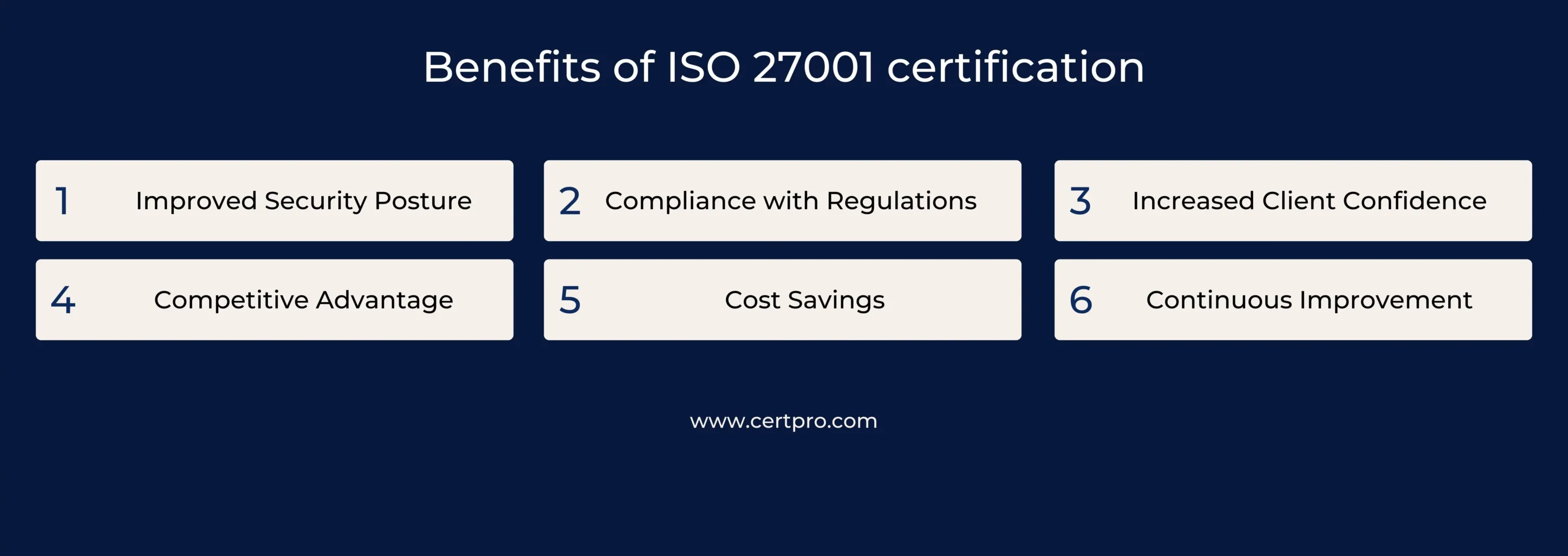
ISO 27001 Certification in Atlanta provides organizations with independently verified documentation of information security management system conformance. The benefits of certification are grounded in the structured audit methodology applied during the ISO 27001 certification audit and the independent nature of CertPro’s evaluation — not in advisory services or consulting outcomes. The following represent the primary recognized benefits of ISO 27001 certification for Atlanta companies across technology, financial services, healthcare, and related sectors.
- ✓Independent, third-party verification of ISMS conformance with ISO/IEC 27001:2022, providing auditable evidence for enterprise procurement and vendor qualification processes
- ✓Structured documentation of information security controls across Organizational, People, Physical, and Technological domains, supporting client assurance and due diligence reviews
- ✓Recognition in enterprise vendor security review programs operated by Atlanta’s financial institutions, healthcare organizations, and large technology enterprises
- ✓Demonstrated ISO 27001 compliance supporting contractual obligations embedded within customer agreements, partnership contracts, and government or enterprise procurement requirements
- ✓Systematic risk assessment and risk treatment documentation providing an auditable foundation for information security governance and executive reporting
- ✓Annual surveillance audit oversight maintaining ongoing ISMS conformance verification throughout the three-year certification cycle
- ✓Support for international market access where ISO 27001 certification is referenced in client due diligence, regulatory expectations, or procurement qualification criteria
- ✓Structured framework for managing information security incidents, access controls, supplier relationships, and business continuity within a formally audited management system
ISO 27001 Certification in Atlanta frequently serves as a market access enabler for technology companies competing in enterprise and international sales environments. Technology buyers — particularly in financial services, healthcare, and regulated industries — increasingly reference ISO 27001 certification status in vendor qualification requirements, request-for-proposal scoring criteria, and security review processes.
ISO 27001 certification for Atlanta companies competing in these markets provides a structured response to security due diligence requests, reducing the time and administrative burden associated with custom security questionnaires. Alpharetta-based SaaS providers serving financial institutions and Midtown Atlanta cloud infrastructure companies supplying healthcare technology platforms are among the organizations that most frequently cite ISO 27001 Certification in Atlanta commercial contexts to support contract award and renewal processes.
Organizations subject to multiple regulatory frameworks may reference ISO 27001 compliance as a component of broader compliance documentation strategies. The ISO 27001 standard’s control framework can be mapped to requirements of NIST CSF, HIPAA Security Rule, PCI DSS, SOC 2 Trust Services Criteria, and GDPR technical and organizational measures — though such mapping does not constitute compliance with any of these frameworks independently.
Third-party risk management programs at Atlanta’s major financial institutions and healthcare networks evaluate vendor security posture across multiple dimensions. ISO 27001 audit results and a current, valid certification provide structured, independently verified evidence that risk management teams can incorporate into vendor assessments without requiring custom evaluation of individual control implementations.
- ✓ISO 27001 Certification and Atlanta Technology Company Market Access
- ✓Alignment with Regulatory Frameworks and Third-Party Risk Management
Industries Pursuing ISO 27001 Certification in Atlanta
ISO 27001 Certification in Atlanta is pursued across a broad range of industry sectors reflecting the city’s diverse technology and financial services economy. The following sectors represent the primary organizational categories pursuing ISO 27001 audit assessments and certification across the Metro Atlanta region, including organizations headquartered in Midtown Atlanta, Alpharetta, Sandy Springs, and surrounding areas within the Atlanta metropolitan statistical area.
Financial Services, Fintech, and Payment Processing Organizations
Atlanta is recognized as a global payment processing hub, home to major payment network operators, card processing companies, merchant services providers, and financial technology platforms. ISO 27001 compliance that Atlanta fintech organizations pursue reflects the payment sector’s exposure to cardholder data security requirements, financial institution vendor security expectations, and international client due diligence standards.
Organizations handling electronic fund transfers, card payment authorization, digital wallet services, and banking-as-a-service platforms encounter ISO 27001 certification requirements through enterprise financial institution agreements, card network compliance programs, and international market access requirements. The ISO 27001 standard that Atlanta payment companies reference in client and regulatory contexts provides independently verified documentation of ISMS conformance across information security domains directly relevant to financial data handling.
Cloud Infrastructure, SaaS, and Managed Service Providers
ISO 27001 Certification in Atlanta is a structured response to enterprise client security requirements for cloud infrastructure providers, SaaS platforms, and managed service providers operating in the region. Cloud service providers operating data centers and hosting infrastructure in the Metro Atlanta area encounter ISO 27001 certification requirements from enterprise clients conducting vendor security assessments across technology supply chains.
SaaS providers supplying workflow automation, CRM, ERP, or data analytics platforms to regulated industries frequently receive ISO 27001 certification requirements embedded within enterprise software procurement processes. Managed service providers delivering network management, security operations, or IT infrastructure services to Atlanta-area businesses face client expectations that reference the ISO 27001 standard as a baseline security management qualification criterion across service provider vendor assessment frameworks.
Healthcare Technology, Logistics, Telecommunications, and AI Organizations
Beyond financial services and cloud technology, the ISO 27001 audit that Atlanta healthcare technology organizations pursue supports documentation of technical and organizational security measures relevant to health data protection frameworks. Atlanta’s logistics and transportation technology sector — encompassing supply chain management platforms, fleet telematics providers, and freight technology companies — encounters ISO 27001 certification requirements from enterprise shipper and retailer clients managing third-party technology risk.
Telecommunications providers operating network infrastructure and connectivity services in the Atlanta metro area face enterprise client vendor security requirements referencing the ISO 27001 standard. AI startups and machine learning platform providers developing models trained on sensitive organizational data pursue ISO 27001 Certification in Atlanta to demonstrate structured information security governance relevant to data handling transparency and enterprise client security due diligence requirements.
ISO 27001 Standard: Key Concepts and Definitions
Understanding the ISO 27001 standard requires familiarity with its foundational concepts, terminology, and structural elements. The following definitions and explanations are drawn from ISO/IEC 27001:2022 and the associated vocabulary standard ISO/IEC 27000, providing a structured reference for organizations in Atlanta evaluating certification requirements and ISO 27001 audit scope considerations.
Information Security Management System (ISMS) Definition
An Information Security Management System (ISMS) is defined by ISO/IEC 27000 as a set of policies, procedures, guidelines, and associated resources and activities, collectively managed by an organization to protect its information assets. The ISMS encompasses the organization’s approach to managing information security risks — including the policies and objectives established to address those risks, the controls implemented to treat identified risks, the processes for measuring and evaluating control effectiveness, and the management structures providing oversight and continual improvement direction.
Under ISO/IEC 27001:2022, the ISMS must be scoped to defined information assets, systems, processes, and organizational boundaries, and must demonstrate conformance with all normative requirements across Clauses 4 through 10 during the ISO 27001 certification audit evaluation conducted by CertPro as an independent certification body.
Confidentiality, Integrity, and Availability: The CIA Triad in ISO 27001
The ISO 27001 standard defines information security as the preservation of confidentiality, integrity, and availability of information. Confidentiality refers to the property that information is not made available or disclosed to unauthorized individuals, entities, or processes. Integrity refers to the accuracy and completeness of information and processing methods. Availability refers to being accessible and usable upon demand by an authorized entity.
The risk assessment process required under Clause 6 of ISO/IEC 27001:2022 evaluates threats to and vulnerabilities affecting the confidentiality, integrity, and availability of information assets within the defined ISMS scope. Risk treatment decisions and Annex A control selections are then evaluated by auditors during the ISO 27001 certification audit to verify that identified CIA risks are addressed through implemented and operating controls.
Differences Between ISO 27001 and Other Information Security Frameworks
ISO 27001 certification differs from other information security frameworks in several important respects. Unlike NIST CSF — a voluntary framework without formal third-party certification — ISO 27001 Certification is issued by an independent accredited certification body following a structured ISO 27001 audit assessment. Unlike SOC 2 attestation, which evaluates controls against the AICPA’s Trust Services Criteria over a specified period, ISO 27001 certification evaluates ISMS conformance against an international standard and is issued with a three-year validity subject to annual surveillance.
Unlike PCI DSS compliance, which focuses specifically on cardholder data security, the ISO 27001 standard addresses the full scope of organizational information security risk management across all information asset categories within the defined ISMS scope. ISO 27001 Certification in Atlanta is particularly valuable for organizations engaged in cross-border business, international client relationships, and global supply chain vendor qualification processes where the standard’s international recognition carries commercial weight.
CertPro: Licensed CPA Firm and Independent ISO 27001 Certification Body in Atlanta
CertPro operates as a Licensed CPA Firm and independent third-party certification body, conducting ISO 27001 audit assessments and issuing ISO 27001 Certification in Atlanta and across the United States. CertPro’s positioning as a Licensed CPA Firm distinguishes its evaluation methodology as structured, evidence-based, and fully independent from the organizations it assesses. No consulting, advisory, implementation, or remediation services are provided at any stage. The ISO 27001 certification evaluation is conducted exclusively through objective audit methodology applied against the normative requirements of ISO/IEC 27001:2022.
Independence and Objectivity in Certification Assessment
CertPro’s independence as a certification body is foundational to the reliability and market recognition of ISO 27001 Certification in Atlanta. The certification body maintains organizational and operational separation between the audit team conducting assessment activities and the certification committee making the final certification decision. Auditors assigned to an ISO 27001 certification audit do not have prior advisory, consulting, or implementation relationships with the assessed organization.
The certification committee independently reviews audit evidence and findings to make an objective determination of conformance or nonconformance with ISO/IEC 27001:2022. This independence structure ensures that every issued ISO 27001 certificate reflects an unbiased, evidence-based conformance determination — a requirement recognized by enterprise procurement programs and client due diligence frameworks across Atlanta’s financial and technology sectors.
Audit Evidence Standards and Documentation Review
The ISO 27001 audit methodology applied by CertPro requires that all conformance determinations be based on objective audit evidence. Audit evidence includes documented information reviewed during the assessment — such as policies, risk assessment records, risk treatment plans, control implementation documentation, training records, and audit logs — as well as evidence gathered through interviews with personnel performing information security roles and through direct observation of implemented controls and operational processes.
The auditor documents evidence gathered, findings identified, and conformance or nonconformance determinations for each clause and applicable Annex A control within scope. ISO 27001 compliance determinations are made based on the totality of evidence gathered during Stage 1 and Stage 2 audit activities — not on self-reported organizational representations or pre-audit preparation activities conducted independently of the certification assessment.
FAQ
▶
What is ISO 27001 Certification and who issues it in Atlanta?
▶
How long does the ISO 27001 certification audit process take for Atlanta organizations?
▶
What is the difference between ISO 27001 certification and ISO 27001 compliance?
▶
How long is an ISO 27001 certificate valid?
▶
Does ISO 27001 certification establish HIPAA or GLBA compliance for Atlanta organizations?
▶
What is the Statement of Applicability in ISO 27001 certification?
▶
Which Atlanta industries most commonly pursue ISO 27001 certification?
▶
Can ISO 27001 certification scope be limited to a specific service or product?
Get In Touch
have a question? let us get back to you.