
SOC 2 Certification in San Diego
SOC 2 Certification requirements are defined by the AICPA Trust Services Criteria and the attestation standards governing the examination. Organizations seeking SOC 2 Certification in San Diego must satisfy a defined set of prerequisites related to control implementation, documentation, system description preparation, and evidence availability before and during the examination. The following requirements represent the foundational elements the Licensed CPA Firm evaluates during the SOC 2 audit.
OUR CLIENTS










SOC 2 Certification for San Diego’s Technology, Biotech, and Financial Organizations
SOC 2 Certification in San Diego is issued exclusively by a Licensed CPA Firm following an independent examination conducted under the American Institute of Certified Public Accountants (AICPA) attestation standards — specifically AT-C Section 205. The examination evaluates whether an organization’s controls are suitably designed and, in the case of a Type 2 report, whether those controls operated effectively over a defined observation period. The resulting SOC 2 attestation report provides objective, third-party evidence of control effectiveness. Procurement teams, enterprise clients, and regulated institutions rely on this evidence before entering into vendor relationships involving access to sensitive systems or data.
San Diego ranks among California’s most significant technology and regulated-industry centers. The region’s economy encompasses SaaS providers, cloud infrastructure companies, AI and machine learning startups, cybersecurity firms, biotech and life sciences organizations headquartered in La Jolla and Torrey Pines, healthcare technology companies, defense and aerospace technology businesses operating across Sorrento Valley and Carlsbad, fintech platforms, financial services firms, and telecommunications providers. Each of these sectors faces increasing vendor assurance demands from enterprise clients, government agencies, and regulated institutions. These stakeholders require independently verified evidence of security and data protection controls before authorizing access to their networks, systems, or sensitive information — making SOC 2 Certification in San Diego a foundational business requirement across the region.
The AICPA Trust Services Criteria (TSC) framework governs the evaluation standards applied during a SOC 2 examination. The TSC defines the criteria against which an organization’s controls are assessed across five categories: Security, Availability, Processing Integrity, Confidentiality, and Privacy. Security — referred to as the Common Criteria — is required in every SOC 2 engagement. Organizations select additional criteria categories based on their service commitments, contractual obligations, and the nature of the data they process or store. A Licensed CPA Firm determines the scope of the examination, evaluates evidence, and issues the SOC 2 attestation report independently of the organization under examination.
California’s regulatory environment — including the California Consumer Privacy Act (CCPA) and the California Privacy Rights Act (CPRA) — establishes data protection requirements that apply to many organizations operating in San Diego. While SOC 2 attestation does not automatically establish statutory compliance with the CCPA, CPRA, or other applicable regulations, the controls evaluated during a SOC 2 examination frequently address privacy and data security practices relevant to these regulatory frameworks. Organizations in San Diego’s technology and regulated-industry sectors treat SOC 2 Certification as a foundational element of their broader information security and vendor assurance programs. The attestation report documents control effectiveness through an independent examination — distinct from self-assessment, internal audit, or voluntary compliance declarations — and provides procurement stakeholders with structured, verifiable evidence issued by an independent Licensed CPA Firm.
Consider a representative scenario illustrating demand for SOC 2 Certification in San Diego: a local SaaS provider serving a major financial institution is required by that institution’s vendor security review process to produce a current SOC 2 Type 2 report before contract execution. The report — issued by an independent Licensed CPA Firm following a formal SOC 2 examination — gives the procurement team objective evidence that the vendor’s controls were suitably designed and operated effectively over the observation period. This satisfies the institution’s third-party risk management requirements without requiring direct access to the vendor’s internal systems, development environments, or operational infrastructure. This procurement scenario is representative across San Diego’s financial services, healthcare technology, defense contracting, and enterprise SaaS sectors.

What Is SOC 2 Certification?
SOC 2 Certification refers to the outcome of an independent SOC 2 examination conducted by a Licensed CPA Firm under AICPA attestation standards. The term describes the status of an organization that has received a SOC 2 attestation report — either Type 1 or Type 2 — following an examination of its controls against the AICPA Trust Services Criteria. Unlike regulatory certifications issued by government bodies, SOC 2 attestation is a professional attestation engagement performed by an independent CPA firm authorized to conduct such examinations. The report documents the Licensed CPA Firm’s conclusions about control design suitability and, for Type 2 reports, operational effectiveness over a specified period. SOC 2 compliance alone — without an independently issued attestation report — does not constitute SOC 2 Certification.
SOC 2 Type 1 and Type 2 Reports
A SOC 2 Type 1 report evaluates whether an organization’s controls are suitably designed to meet the applicable Trust Services Criteria as of a specific point in time. The SOC 2 examination assesses the design of controls — whether the controls, if operating as described, would reasonably meet the stated criteria — but does not evaluate whether those controls operated effectively over a period. A SOC 2 Type 1 report is typically the first step for organizations seeking initial SOC 2 Certification. It establishes a documented baseline of control design before committing to the longer observation period required for a Type 2 report.
A SOC 2 Type 2 report is more comprehensive. It evaluates both the design suitability and the operating effectiveness of controls over a defined observation period — typically a minimum of six months and commonly twelve months. During this period, the Licensed CPA Firm collects and evaluates evidence demonstrating that controls functioned as described and continued to meet the applicable Trust Services Criteria throughout the period. Enterprise procurement requirements in San Diego’s financial services, healthcare technology, and defense sectors frequently specify a current SOC 2 Type 2 report as a mandatory vendor qualification criterion. As a result, Type 2 is the standard attestation target for most San Diego technology organizations serving regulated clients.
| Report Type | Evaluation Focus | Time Dimension | Typical Use Case |
|---|---|---|---|
| SOC 2 Type 1 | Control design suitability | Point in time | Initial SOC 2 Certification baseline |
| SOC 2 Type 2 | Design suitability + operating effectiveness | Defined observation period (min. 6 months) | Enterprise vendor qualification and ongoing assurance |
AICPA Trust Services Criteria Framework
The AICPA Trust Services Criteria define the evaluation framework applied during a SOC 2 examination. The five TSC categories — Security, Availability, Processing Integrity, Confidentiality, and Privacy — each contain specific criteria describing the controls an organization must demonstrate. Security (the Common Criteria) is mandatory in every SOC 2 engagement and covers logical and physical access controls, risk assessment, change management, monitoring, and incident response. Organizations select additional TSC categories based on their service commitments and the categories of data they process. For example, a San Diego cloud infrastructure provider would typically include Availability criteria, while a healthcare technology organization processing protected health information would commonly include Confidentiality and Privacy criteria alongside the required Security criteria.
SOC 2 Compliance vs. SOC 2 Certification
SOC 2 compliance refers to an organization’s internal implementation of controls aligned with the Trust Services Criteria — a self-assessed state that does not involve independent verification. SOC 2 Certification, by contrast, refers to the independently attested status confirmed through a formal SOC 2 examination conducted by a Licensed CPA Firm. The distinction is material in procurement contexts. Enterprise clients and regulated institutions in San Diego’s financial, healthcare, and defense sectors require the independently attested SOC 2 report — not a self-declared compliance posture. Organizations that state they are SOC 2 compliant without a current attestation report from a Licensed CPA Firm are not SOC 2 certified, regardless of the controls they have implemented.
SOC 2 Certification Audit Process in San Diego
The SOC 2 audit process in San Diego follows a defined sequence of stages established under AICPA attestation standards. Each stage produces specific outputs that feed into the subsequent stage, culminating in the issuance of a SOC 2 attestation report by the Licensed CPA Firm. The process is structured to ensure independence, objectivity, and rigorous evidence evaluation. Organizations in San Diego pursuing SOC 2 Certification should understand each stage and its evidence requirements. The audit methodology is consistent across all organizations regardless of industry sector or size.
The SOC 2 examination begins with scope definition. During this stage, the Licensed CPA Firm and the organization determine which systems, services, and infrastructure components fall within the boundary of the examination. Scope boundaries define which systems are evaluated and which Trust Services Criteria categories apply. For a San Diego SaaS provider, scope typically encompasses the production environment, data centers or cloud infrastructure, access management systems, incident response procedures, and change management processes. The SOC 2 audit program — the specific procedures the Licensed CPA Firm will perform — is then determined based on the defined scope and the applicable TSC categories selected by the organization.
Scope definition is a critical stage in the SOC 2 audit process because it directly affects which controls are evaluated and what evidence the Licensed CPA Firm will require. Organizations that define scope too narrowly risk producing a report that does not satisfy enterprise procurement requirements. Those that define scope too broadly may face evidence collection challenges during the examination. The Licensed CPA Firm reviews the organization’s system description — a management-prepared document describing the services provided, system components, and relevant controls — as a foundational input to audit program determination.
During the SOC 2 examination, the Licensed CPA Firm collects and evaluates evidence demonstrating that the organization’s controls exist, are suitably designed, and — for Type 2 reports — operated effectively throughout the observation period. Evidence collection methods include document review, configuration inspection, population sampling, inquiry, and observation. For a San Diego fintech organization, evidence may include access provisioning and deprovisioning records, security monitoring logs, vulnerability assessment reports, encryption configuration documentation, change management tickets, and vendor management documentation. The Licensed CPA Firm applies professional judgment in evaluating whether the evidence demonstrates that each applicable Trust Services Criterion is met.
Control testing during a SOC 2 audit in San Diego involves evaluating both the design and operating effectiveness of controls. Design effectiveness testing assesses whether a control, if operating as described, would reasonably prevent or detect a material control failure. Operating effectiveness testing — required for Type 2 reports — assesses whether the control actually functioned as designed throughout the observation period, using population sampling and evidence inspection. Deviations identified during testing are documented, and the Licensed CPA Firm evaluates whether those deviations represent isolated exceptions or systemic control failures affecting the overall conclusion for the applicable criterion.
Following the completion of control testing and evidence evaluation, the Licensed CPA Firm issues the SOC 2 attestation report. The report includes the firm’s opinion — either unqualified (clean) or qualified — on whether the organization’s controls meet the applicable Trust Services Criteria. It also includes a description of the system prepared by management, a description of the tests performed, the results of those tests, and any exceptions identified. The SOC 2 Type 2 report issued by a Licensed CPA Firm is the primary deliverable of the examination and serves as the independently verified evidence of control effectiveness that enterprise procurement processes require.
| Audit Stage | Key Activities | Output |
|---|---|---|
| Scope Definition | System boundary identification, TSC category selection, system description review | Defined audit scope and audit program |
| Stage 1 Assessment | Documentation review, control environment evaluation, system description assessment | Readiness determination, audit program finalization |
| Evidence Collection | Document review, configuration inspection, population sampling, inquiry, observation | Evidence repository supporting control evaluation |
| Control Testing | Design and operating effectiveness evaluation, deviation assessment | Test results and identified exceptions |
| Report Issuance | Opinion formulation, SOC 2 attestation report preparation and issuance | SOC 2 Type 1 or Type 2 attestation report |
- ✓Scope Definition and Audit Program Determination
- ✓Evidence Collection and Control Testing
- ✓Report Issuance and Attestation
Why Organizations in San Diego Pursue SOC 2 Certification
SOC 2 Certification in San Diego is pursued by organizations across multiple industry sectors in response to specific demand drivers — enterprise vendor security reviews, regulated-sector procurement requirements, contractual obligations, and international SaaS expansion requirements. Demand for independently attested SOC 2 reports has grown significantly across San Diego’s technology, biotech, healthcare technology, defense, and financial services sectors. Enterprise clients and government agencies have formalized third-party risk management programs that specify SOC 2 attestation as a prerequisite for vendor qualification, making SOC 2 Certification a competitive necessity for organizations serving regulated markets.
Enterprise Vendor Security Reviews and Financial Sector Procurement
San Diego’s financial services and fintech sector — including institutions headquartered in and around downtown San Diego and the UTC corridor — routinely require SOC 2 Type 2 reports from technology vendors as a condition of vendor onboarding and contract execution. Financial institutions subject to federal and state regulatory requirements, including OCC guidance on third-party risk management, must evaluate the controls of technology vendors with access to their systems or customer data. A current SOC 2 Type 2 report from a Licensed CPA Firm satisfies this requirement by providing objective evidence of control design and operating effectiveness — without requiring the financial institution to conduct direct assessments of the vendor’s internal systems. SOC 2 Certification in San Diego’s fintech sector is accordingly one of the most active segments of SOC 2 examination demand in the region.
Healthcare technology organizations in San Diego — including those operating in the La Jolla and Torrey Pines life sciences and biotech cluster — face vendor assurance requirements from hospital systems, health plans, and pharmaceutical companies that process protected health information. While HIPAA compliance and SOC 2 attestation are distinct frameworks, enterprise healthcare clients frequently require SOC 2 Type 2 reports as part of their vendor risk management programs, alongside or in addition to Business Associate Agreements. SOC 2 compliance for San Diego healthcare technology providers is a material procurement qualification requirement across the region’s health system and life sciences ecosystem.
Defense, Aerospace, and Government Technology Sector Demand
San Diego’s defense and aerospace technology corridor — encompassing organizations in Sorrento Valley, Carlsbad, and surrounding areas — includes a significant population of technology contractors and subcontractors serving the U.S. Department of Defense and other federal agencies. SOC 2 Certification for San Diego defense contractors is increasingly relevant as prime contractors and federal agencies incorporate vendor security assurance requirements into subcontractor selection criteria. While CMMC (Cybersecurity Maturity Model Certification) governs controlled unclassified information requirements, SOC 2 attestation is evaluated in parallel by many prime contractors assessing the information security posture of technology subcontractors that handle sensitive but unclassified data, proprietary research, or commercial technology supporting defense programs.
SaaS and Cloud Provider Expansion Requirements
San Diego’s SaaS and cloud services ecosystem — centered around downtown San Diego and the UTC technology corridor — includes a large population of software providers serving enterprise clients across the United States and internationally. San Diego tech companies pursuing enterprise sales cycles frequently encounter procurement questionnaires, security review processes, and contractual requirements that specify a current SOC 2 Type 2 report as a condition of contract execution. International expansion further amplifies this requirement. Organizations seeking to serve enterprise clients in Europe, Asia-Pacific, and other regions where data protection frameworks require demonstrated third-party verification of security controls increasingly produce SOC 2 attestation reports — either alongside ISO 27001 certificates or independently as the primary control assurance mechanism.
SOC 2 Trust Services Criteria and Certification Scope
The scope of a SOC 2 examination is defined by the Trust Services Criteria categories selected for evaluation and the systems and services included within the examination boundary. The Licensed CPA Firm evaluates the organization’s controls against each applicable criterion within the selected TSC categories, assessing both control design and — for Type 2 examinations — operating effectiveness over the defined period. Scope determination is a formal step in the SOC 2 audit process in San Diego and directly determines the content and applicability of the resulting SOC 2 attestation report.
The Security category — also referred to as the Common Criteria — is mandatory in every SOC 2 examination. The Common Criteria address logical and physical access controls, system operations, change management, risk mitigation, and monitoring. They provide the foundational control framework against which all organizations are evaluated, regardless of which additional TSC categories are included in scope. The Common Criteria are organized around the COSO internal control framework, which structures evaluation across the control environment, risk assessment, control activities, information and communication, and monitoring components. Every SOC 2 attestation engagement in San Diego evaluates the Common Criteria as a baseline, with additional categories selected based on the organization’s specific service commitments.
The Availability criteria evaluate whether systems are available for operation and use as committed by the service organization. This category is particularly relevant for San Diego cloud infrastructure providers, managed service providers, and SaaS organizations that make uptime and availability commitments to their clients. The Processing Integrity criteria assess whether system processing is complete, valid, accurate, timely, and authorized — relevant for organizations processing financial transactions, healthcare claims, or other data where accuracy is a material service commitment. The Confidentiality criteria evaluate controls protecting confidential information from unauthorized access or disclosure. The Privacy criteria assess controls governing the collection, use, retention, disclosure, and disposal of personal information.
During a SOC 2 examination, management is responsible for preparing the system description that defines the scope of the engagement, identifying the applicable Trust Services Criteria, implementing and maintaining the controls subject to examination, and providing evidence requested by the Licensed CPA Firm. Evidence commonly required during a SOC 2 audit includes access control policies, security monitoring configurations, vulnerability management records, incident response documentation, change management records, vendor management agreements, encryption configuration evidence, backup and recovery testing records, and personnel security training documentation. Management is also responsible for providing a written assertion — included in the SOC 2 report — stating that the system description is fairly presented and that controls meet the applicable criteria.
A SOC 2 Type 2 report covers a specific observation period and reflects the state of an organization’s controls during that period. Enterprise clients and procurement teams typically require reports that cover a period ending within the preceding twelve months, as controls and operating environments can change materially over time. Organizations maintaining current SOC 2 Certification in San Diego undergo annual examination cycles, with each new cycle covering a twelve-month observation period and producing a new attestation report. Annual recertification maintains the currency of the SOC 2 attestation and ensures that the report presented to enterprise clients, auditors, and regulators reflects the organization’s current control environment — rather than a historical snapshot that may no longer be representative.
- ✓Security (Common Criteria) and Additional TSC Categories
- ✓Evidence Requirements and Management Responsibilities
- ✓Report Validity and Recertification
SOC 2 Certification Requirements for San Diego Organizations
SOC 2 Certification requirements are defined by the AICPA Trust Services Criteria and the attestation standards governing the examination. Organizations seeking SOC 2 Certification in San Diego must satisfy a defined set of prerequisites related to control implementation, documentation, system description preparation, and evidence availability before and during the examination. The following requirements represent the foundational elements the Licensed CPA Firm evaluates during the SOC 2 audit.
Documentation requirements for a SOC 2 examination include a formally prepared system description, written information security policies, risk assessment documentation, access control procedures, incident response plans, change management procedures, vendor management policies, and business continuity and disaster recovery plans. The system description must accurately represent the services provided by the organization, the system components within scope, the controls implemented to meet the applicable Trust Services Criteria, and any subservice organizations or complementary user entity controls relevant to the system’s operation. All documentation must be current, formally approved, and maintained in a manner that allows the Licensed CPA Firm to verify that documented controls reflect actual operational practice.
- ✓Formally prepared system description covering in-scope services and system components
- ✓Information security policy approved by management and communicated to all personnel
- ✓Risk assessment documentation identifying threats, vulnerabilities, and control responses
- ✓Access control procedures covering provisioning, deprovisioning, and periodic access review
- ✓Incident response plan with defined roles, escalation paths, and documentation requirements
- ✓Change management procedures governing system and configuration changes
- ✓Vendor and subservice organization management documentation
- ✓Business continuity and disaster recovery plans with documented testing records
Technical control requirements evaluated during a SOC 2 examination encompass logical access controls, network security configurations, encryption implementations, vulnerability management processes, security monitoring and logging, and system hardening configurations. Logical access controls must demonstrate that access to systems and data is restricted to authorized personnel, that access rights are provisioned based on the principle of least privilege, and that access is reviewed and deprovisioned promptly when personnel changes occur. Network security configurations must demonstrate that systems are protected against unauthorized access through appropriate segmentation, firewall rules, and intrusion detection or prevention controls. Encryption must be implemented for data at rest and in transit, consistent with the organization’s security commitments and applicable Trust Services Criteria.
Vulnerability management controls must demonstrate that the organization identifies, evaluates, and remediates security vulnerabilities within defined timeframes consistent with the risk level of each vulnerability. Security monitoring and logging controls must demonstrate that security-relevant events are captured, retained, and reviewed by appropriate personnel. For San Diego cybersecurity firms and AI companies handling large volumes of sensitive data, these technical controls represent the most heavily tested elements of the SOC 2 examination. The Licensed CPA Firm evaluates technical controls through a combination of configuration inspection, log review, population sampling of access records and vulnerability management tickets, and personnel inquiry.
- ✓Documentation and Policy Requirements
- ✓Technical Control Requirements
Benefits of SOC 2 Certification for San Diego-Based Organizations
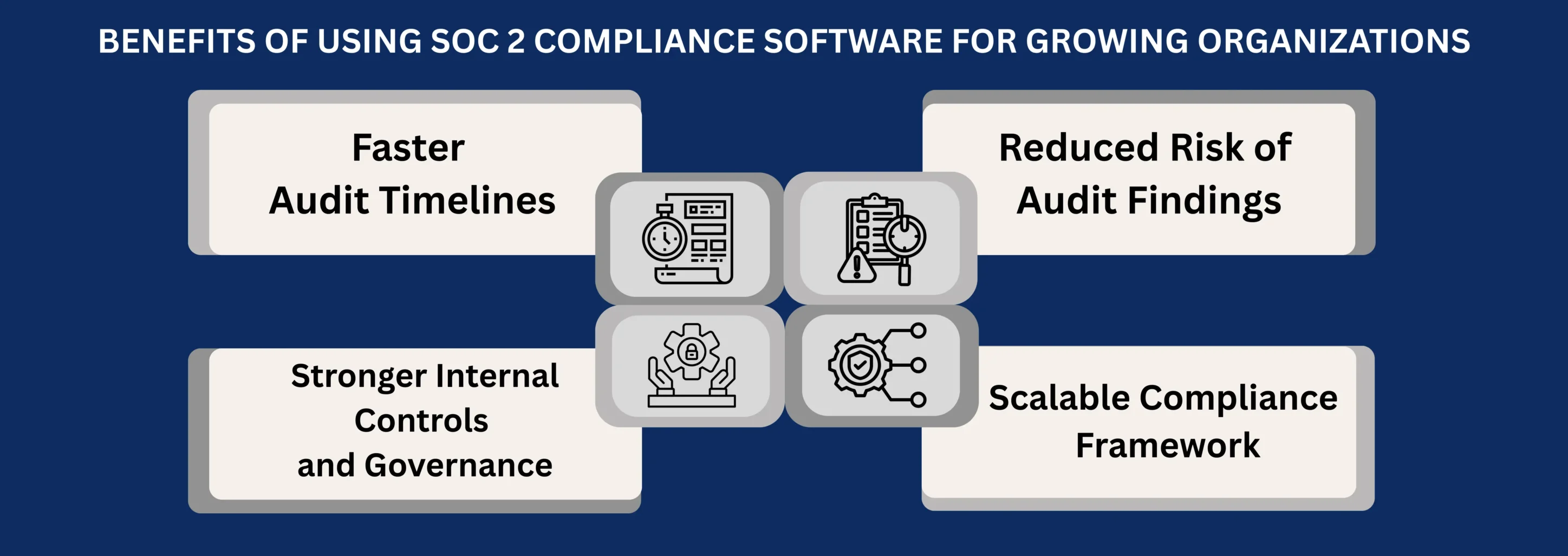
SOC 2 Certification delivers a defined set of organizational outcomes directly tied to the attestation process. These outcomes result from the independent SOC 2 examination itself — not from self-assessed compliance or internal security programs. For organizations operating in San Diego’s technology, biotech, healthcare, defense, and financial services sectors, the independently attested SOC 2 report provides structured, verifiable evidence of control effectiveness. This evidence supports enterprise sales processes, regulatory engagement, and ongoing risk management programs across all major industry sectors in the region.
A current SOC 2 Type 2 report from a Licensed CPA Firm satisfies the vendor assurance requirements of enterprise procurement processes across San Diego’s regulated industries. Financial institutions, healthcare systems, government contractors, and large enterprise technology buyers routinely specify SOC 2 attestation as a prerequisite for vendor qualification, contract execution, and ongoing vendor relationship management. Organizations holding a current SOC 2 attestation report can respond to vendor security questionnaires and procurement due diligence requirements by sharing the report — rather than completing individual questionnaires for each client. This represents a material efficiency gain in high-volume enterprise sales environments. The SOC 2 attestation report provided by San Diego organizations carries the authority of independent third-party examination, distinct from self-reported security questionnaire responses.
The SOC 2 examination provides independent, third-party verification that an organization’s controls are suitably designed and, for Type 2 reports, operated effectively over the defined observation period. This verification is materially different from internal audit findings or self-assessed SOC 2 compliance declarations. It is conducted by a Licensed CPA Firm under AICPA attestation standards and carries the professional accountability of the issuing firm. For San Diego biotech and life sciences organizations handling proprietary research data and partnering with pharmaceutical companies or academic research institutions, the independently verified SOC 2 report provides a structured basis for demonstrating research data protection controls to collaborators, investors, and regulatory stakeholders — without requiring disclosure of internal security configurations.
The SOC 2 examination cycle — conducted annually for organizations maintaining current certification — establishes a structured rhythm of independent control evaluation that supports ongoing control monitoring programs. The annual SOC 2 audit cycle in San Diego creates defined evidence collection requirements, control documentation standards, and review procedures that organizations maintain throughout the year in anticipation of the next examination. This structured methodology supports management’s ability to identify and address control gaps before they are identified during the examination, maintain current documentation, and demonstrate continuous improvement in control effectiveness across successive examination periods. For San Diego organizations operating in rapidly evolving technology environments, the annual SOC 2 examination cycle provides a consistent framework for evaluating controls against the established Trust Services Criteria baseline.
- ✓Independently attested evidence of control design suitability and operating effectiveness
- ✓Qualification for enterprise vendor onboarding processes in regulated sectors
- ✓Structured evidence of control effectiveness for investor due diligence and M&A processes
- ✓Reduction of individual vendor security questionnaire burden in enterprise sales cycles
- ✓Annual independent SOC 2 examination establishing a baseline for continuous control improvement
- ✓Recognition in financial sector, healthcare, defense, and government procurement frameworks
- ✓Formal SOC 2 attestation report issued by a Licensed CPA Firm under AICPA standards
- ✓Documented observation period evidence supporting contractual security commitments
- ✓Enterprise Procurement Qualification and Vendor Assurance
- ✓Independent Verification of Control Effectiveness
- ✓Structured Audit Methodology and Ongoing Control Monitoring
SOC 2 Certification Across San Diego’s Industry Sectors
SOC 2 Certification in San Diego is pursued across a broad range of industry sectors reflecting the city’s diverse technology and regulated-industry economy. The sectors below represent the primary demand segments for SOC 2 attestation in the San Diego region, each driven by specific client, regulatory, or contractual requirements that specify independently attested control effectiveness reports.
SaaS Providers, Cloud Companies, and AI Organizations
San Diego’s SaaS provider and cloud services community — concentrated in the UTC, downtown San Diego, and Sorrento Valley areas — represents the highest-volume segment of SOC 2 examination demand in the region. SaaS organizations processing customer data on behalf of enterprise clients are evaluated by those clients’ vendor risk management programs, which routinely require a current SOC 2 Type 2 report from a Licensed CPA Firm. AI and machine learning companies in San Diego that process large volumes of sensitive customer, operational, or research data are similarly subject to enterprise procurement requirements specifying SOC 2 attestation. The Security and Confidentiality TSC categories are most commonly included in SOC 2 examinations for San Diego’s SaaS and AI sector organizations, with Availability criteria added for organizations with defined uptime commitments.
Biotech, Life Sciences, and Healthcare Technology Organizations
San Diego’s Torrey Pines and La Jolla biotech and life sciences cluster — one of the most significant in the United States — includes organizations that generate, process, and store highly sensitive research data, clinical trial data, genomic information, and proprietary scientific data. Healthcare technology organizations in San Diego that process protected health information, support clinical workflows, or provide technology services to health systems and health plans face vendor assurance requirements that commonly include SOC 2 Type 2 attestation. The Privacy and Confidentiality TSC categories are frequently included in SOC 2 examination scopes for these organizations, reflecting the sensitivity of the data they handle and the expectations of their pharmaceutical, hospital system, and health plan clients.
Fintech, Financial Services, and Telecommunications Organizations
San Diego’s fintech and financial services sector — including payment technology companies, lending platforms, wealth management technology providers, and financial data analytics organizations — operates in an environment of heightened regulatory scrutiny regarding data security and third-party risk. SOC 2 attestation for San Diego fintech organizations is frequently required by banking partners, payment networks, and enterprise financial services clients as a condition of partnership and contract execution. Telecommunications providers and managed service organizations in San Diego that handle customer communications data, network infrastructure, or enterprise technology services also pursue SOC 2 Certification as a response to enterprise client vendor security requirements and as a competitive differentiator in the managed services marketplace.
SOC 2 Examination Standards and Independent CPA Firm Requirements
A SOC 2 examination must be conducted by a Licensed CPA Firm — a certified public accounting firm licensed to perform attestation engagements under AICPA standards. The examination is governed by AICPA AT-C Section 205 (Examination Engagements) and AICPA attestation standards for Trust Services engagements. The Licensed CPA Firm conducting the SOC 2 examination must maintain independence from the organization under examination, as required by professional standards governing attestation engagements. Organizations in San Diego evaluating Licensed CPA Firms for SOC 2 examination services should confirm the firm’s AICPA membership, attestation standards compliance, and demonstrated experience conducting SOC 2 audits under the Trust Services Criteria framework.
AICPA attestation standards require that the Licensed CPA Firm conducting a SOC 2 examination maintain independence from the organization under examination. Independence requirements prohibit the firm from having financial, employment, or consulting relationships with the examined organization that would impair objectivity. This independence requirement is foundational to the reliability of the SOC 2 attestation report. Enterprise clients, procurement teams, and regulated institutions rely on the report as objective third-party evidence precisely because it is issued by an independent Licensed CPA Firm — rather than the organization itself or a consulting firm engaged to provide advisory services. Every SOC 2 examination in San Diego is conducted exclusively by firms that satisfy these independence and professional standards requirements.
Licensed CPA Firms conducting SOC 2 examinations are subject to AICPA peer review requirements, which mandate periodic external review of the firm’s attestation practice quality. The AICPA has issued specific guidance for peer reviewers evaluating SOC 2 engagements, reflecting the increasing volume and complexity of SOC 2 attestation engagements and the quality risks associated with technology-enabled audit workflows. Peer review evaluates whether the Licensed CPA Firm’s SOC 2 engagements comply with applicable attestation standards, whether evidence is appropriately documented, and whether the firm’s conclusions are supported by the evidence collected. Organizations seeking SOC 2 Certification in San Diego should confirm that the Licensed CPA Firm they engage is current with AICPA peer review requirements and maintains a quality control system consistent with professional standards for attestation engagements.
- ✓Independence Requirements and Attestation Standards
- ✓Peer Review and Quality Control Requirements
FAQ
▶
What is SOC 2 Certification in San Diego?
▶
Who can issue a SOC 2 attestation report in San Diego?
▶
What is the difference between a SOC 2 Type 1 and Type 2 report?
▶
How long does a SOC 2 Type 2 observation period typically last?
▶
Which Trust Services Criteria categories does a SOC 2 examination evaluate?
▶
Does SOC 2 attestation establish compliance with California’s CCPA or CPRA?
▶
How often must a SOC 2 examination be conducted to maintain current certification?
▶
What types of San Diego organizations most commonly pursue SOC 2 Certification?
SOC 1 VS SOC 2: WHICH REPORT YOUR CUSTOMERS ACTUALLY ASK FOR
If you sell SaaS or provide outsourced services, you have likely been asked for a SOC report. However, the follow-up question is rarely easy to answer…

AICPA Issues New Guidance for Peer Reviewers Evaluating SOC 2 Engagements
AICPA SOC 2 guidance has been issued to help peer reviewers identify quality risks associated with SOC 2 engagements as the use of compliance automati…
SOC 2 Certified: What Does It Mean for Your Business
For companies that handle sensitive data or run cloud-based services, the question “Can you provide your SOC 2 report?” carries enormous weight. Yet, …
Get In Touch
have a question? let us get back to you.