
ISO 27001 Certification in San Jose
ISO 27001 Certification in San Jose is issued by CertPro CPA LLC, a Licensed CPA Firm operating as an independent third-party certification body. CertPro evaluates Information Security Management Systems against the requirements of ISO/IEC 27001:2022 and issues certification to organizations that demonstrate conformance through a structured, evidence-based audit process. ISO 27001 Certification is internationally recognized as the definitive standard for information security governance, applicable to organizations of any size and sector that manage sensitive data, digital infrastructure, or information assets.
OUR CLIENTS










What Is ISO 27001 Certification?
ISO 27001 Certification in San Jose is issued by CertPro CPA LLC, a Licensed CPA Firm operating as an independent third-party certification body. CertPro evaluates Information Security Management Systems against the requirements of ISO/IEC 27001:2022 and issues certification to organizations that demonstrate conformance through a structured, evidence-based audit process. ISO 27001 Certification is internationally recognized as the definitive standard for information security governance, applicable to organizations of any size and sector that manage sensitive data, digital infrastructure, or information assets.
ISO/IEC 27001:2022 is the current version of the standard, published by the International Organization for Standardization (ISO) and the International Electrotechnical Commission (IEC). It specifies requirements for establishing, implementing, maintaining, and continually improving an Information Security Management System — commonly referred to as an ISMS. An ISMS is a documented, risk-driven management framework through which an organization systematically identifies, assesses, and treats information security risks across people, processes, and technology.
The standard is structured around Clauses 4 through 10, which govern the management system requirements, and Annex A, which provides a reference set of 93 information security controls organized across four domains: Organizational, People, Physical, and Technological.
For San Jose-based organizations operating within Silicon Valley’s technology ecosystem, ISO 27001 Certification in San Jose provides independently verified evidence that an organization’s ISMS conforms to internationally recognized requirements. Certification is achieved through independent third-party audit — not through self-declaration or internal assessment.
CertPro, as a Licensed CPA Firm, conducts ISO 27001 certification audits under structured audit programs governed by ISO/IEC 27001:2022 requirements. The audit process evaluates the design and operating effectiveness of the ISMS across all applicable clauses and controls, culminating in a certification decision made by an independent certification committee.
ISO 27001 compliance is increasingly required in enterprise vendor procurement processes, regulated industry supply chains, and international commercial engagements. Organizations in San Jose’s technology sector — including SaaS providers, cloud platforms, AI startups, fintech firms, semiconductor companies, and enterprise software developers — frequently encounter ISO 27001 certification requirements in customer security reviews, vendor onboarding questionnaires, and contractual agreements.
ISMS certification San Jose serves as a structured mechanism through which organizations demonstrate the presence, design, and operational effectiveness of their information security controls to customers, regulators, and business partners.
The ISO/IEC 27001:2022 standard introduced significant updates from its predecessor, ISO/IEC 27001:2013. The 2022 revision reduced the total number of Annex A controls from 114 to 93 and reorganized them into four control domains, replacing the previous 14-domain structure. Eleven new controls were introduced, addressing emerging information security areas including threat intelligence, cloud service security, data masking, physical security monitoring, and ICT readiness for business continuity.
Organizations certified under the 2013 version were required to transition to ISO/IEC 27001:2022 by October 31, 2025, as established by international certification bodies. All ISO 27001 certification audits conducted by CertPro are performed against ISO/IEC 27001:2022 requirements.
The Information Security Management System (ISMS) Defined
An Information Security Management System is the core subject of ISO 27001 Certification. The ISMS is not a single software product or policy document — it is a comprehensive management framework that governs how an organization identifies information security risks, selects and applies controls to treat those risks, monitors control performance, and continually improves its security posture over time.
Under ISO/IEC 27001:2022, the ISMS must cover a defined scope specifying the organizational units, locations, assets, and processes included within certification. The ISMS scope is a foundational element reviewed during every ISO 27001 audit. Documented ISMS elements include the information security policy, risk assessment records, risk treatment plans, the Statement of Applicability, and evidence of management review and internal audit activities.
ISO/IEC 27001:2022 requires organizations to establish and follow a structured risk assessment methodology. This methodology must define criteria for evaluating information security risks, including risk acceptance criteria and the basis for risk evaluation. Organizations must identify information assets within the ISMS scope, identify relevant threats and vulnerabilities, and assess the likelihood and potential impact of identified risks.
The outputs of the risk assessment directly inform the risk treatment plan, which documents how identified risks will be addressed — through control implementation, risk acceptance, risk transfer, or risk avoidance. The risk treatment plan and the associated Statement of Applicability are two of the most critical documents assessed during an ISO 27001 certification audit.
ISO/IEC 27001:2022 Clauses 4 Through 10
ISO/IEC 27001:2022 structures its management system requirements across Clauses 4 through 10. Clause 4 requires organizations to understand the internal and external context relevant to the ISMS, including interested parties and their requirements. Clause 5 addresses leadership and management commitment, requiring top management to demonstrate active involvement in the ISMS and assign clear roles and responsibilities for information security.
Clause 6 governs planning, covering risk assessment, risk treatment, and the establishment of information security objectives. Clause 7 addresses support requirements including resources, competence, awareness, communication, and documented information. Clause 8 covers operational planning and control. Clause 9 requires performance evaluation through monitoring, internal audit, and management review. Clause 10 mandates continual improvement, requiring organizations to address nonconformities and systematically improve the ISMS over time. An ISO 27001 audit assesses conformance with all applicable requirements across Clauses 4 through 10.

ISO 27001 Certification Requirements for San Jose Organizations
ISO 27001 Certification requires organizations to demonstrate conformance with the full set of management system requirements in Clauses 4 through 10 of ISO/IEC 27001:2022, as well as the applicable controls selected through the risk treatment process and documented in the Statement of Applicability. Certification is not based on self-assessment — it requires independent third-party verification through a structured audit conducted by a licensed certification body.
The following overview outlines the core documentation and system requirements evaluated during an ISO 27001 certification audit conducted for organizations in San Jose and throughout Silicon Valley.
ISO/IEC 27001:2022 specifies a defined set of documented information that organizations must maintain as part of their ISMS. The four foundational documents assessed in every ISO 27001 certification audit are:
(1) The Information Security Policy, which defines the organization’s commitment to information security and establishes the framework for setting security objectives. (2) The Risk Assessment, which documents the methodology, process, and results of the organization’s evaluation of information security risks. (3) The Risk Treatment Plan, which records decisions about how identified risks will be addressed and which Annex A controls have been selected or excluded. (4) The Statement of Applicability (SoA), which provides a complete inventory of all 93 Annex A controls with justifications for inclusion or exclusion and the implementation status of selected controls.
These documents form the audit evidence baseline for Stage 1 and Stage 2 assessment activities in every ISO 27001 certification audit.
Beyond these four core documents, ISO/IEC 27001:2022 requires organizations to maintain documented information across multiple operational areas. These include records of information security objectives and plans to achieve them, evidence of competence for individuals performing information security roles, internal audit programs and results, management review records and outputs, and records of nonconformities and corrective actions taken.
Documented procedures must cover the ISMS operational processes defined in Clause 8, including asset management, access control, incident management, and business continuity measures. The completeness and accessibility of this documented information is assessed during the Stage 1 documentation review conducted as part of the ISO 27001 certification audit process.
Annex A of ISO/IEC 27001:2022 provides a reference set of 93 information security controls organized across four domains. The Organizational controls domain (A.5.1–A.5.37) covers policies, roles, responsibilities, threat intelligence, information security in project management, and supplier relationships. The People controls domain (A.6.1–A.6.8) addresses employment screening, terms of employment, awareness, training, and remote working security.
The Physical controls domain (A.7.1–A.7.14) governs physical security perimeters, entry controls, equipment security, and clear desk and screen policies. The Technological controls domain (A.8.1–A.8.34) covers access control, cryptography, network security, secure development, vulnerability management, and cloud service security. Organizations are not required to implement all 93 controls — selections are based on risk assessment results. However, any exclusion must be documented and justified in the Statement of Applicability.
| Annex A Domain | Control Count | Key Topics Covered |
|---|---|---|
| Organizational Controls | 37 | Policies, roles, threat intelligence, supplier security, incident management |
| People Controls | 8 | Screening, employment terms, security awareness, remote working security |
| Physical Controls | 14 | Physical perimeters, entry controls, equipment security, clear desk policies |
| Technological Controls | 34 | Access control, cryptography, network security, secure development, cloud security |
The Statement of Applicability is one of the most scrutinized documents in an ISO 27001 certification audit. The SoA must list all 93 Annex A controls and state, for each control, whether it is applicable or excluded, the justification for that determination, and the current implementation status of applicable controls.
For San Jose technology organizations — particularly SaaS providers, cloud platforms, and fintech firms — Annex A controls in the Technological domain are frequently applicable in their entirety, given the information-intensive nature of their operations. The SoA must be consistent with the risk treatment plan: every control selected in the risk treatment process must appear as applicable in the SoA, and every exclusion must be substantiated with documented justification. Auditors verify this consistency during both Stage 1 and Stage 2 audit activities in the ISO 27001 certification audit process.
- ✓Core ISMS Documentation Requirements
- ✓Annex A Controls and the Statement of Applicability
ISO 27001 Certification Audit Process in San Jose
The ISO 27001 certification audit process conducted by CertPro follows a structured, multi-stage methodology aligned with ISO/IEC 27001:2022 and applicable audit standards. The process provides an objective, evidence-based evaluation of an organization’s ISMS and culminates in an independent certification decision. The following stages describe the ISO 27001 certification audit process for organizations in San Jose and the broader Silicon Valley region.
The Stage 1 audit is a documentation review conducted to assess whether the organization’s ISMS documentation meets ISO/IEC 27001:2022 requirements and whether the organization is ready to proceed to Stage 2. During Stage 1, the auditor reviews the ISMS scope definition, information security policy, risk assessment methodology and results, risk treatment plan, Statement of Applicability, and evidence of internal audit and management review activities.
The Stage 1 audit evaluates whether the documented ISMS is sufficiently developed to support a meaningful Stage 2 evaluation. If significant documentation gaps or nonconformities are identified, the Stage 2 audit may be postponed until those issues are addressed. The output of Stage 1 is a documented audit report identifying findings and confirming Stage 2 readiness.
The Stage 1 audit typically includes an assessment of the ISMS scope to confirm it accurately reflects the organizational boundaries, locations, assets, and processes included within certification. Auditors also assess whether the risk assessment process has been applied consistently within the defined scope and whether the resulting risk treatment decisions are traceable to Annex A control selections documented in the SoA.
For ISO 27001 audit San Jose engagements, Stage 1 may be conducted on-site at the organization’s San Jose or Silicon Valley facilities, or remotely where the ISMS and its documentation can be effectively evaluated through virtual means. Stage 1 is a distinct phase from Stage 2 and must be completed before Stage 2 activities commence.
The Stage 2 audit is an on-site or virtual assessment of the ISMS in operation. It verifies that the controls and processes documented in the ISMS are implemented, operational, and effective across the defined scope. Auditors collect and evaluate evidence through interviews with personnel, observation of processes, review of operational records, system configuration reviews, and inspection of physical security measures where applicable.
The Stage 2 assessment covers all applicable Annex A controls identified in the Statement of Applicability, all management system processes required by Clauses 4 through 10, and the organization’s internal audit and management review records. Organizations pursuing ISO 27001 compliance in San Jose must demonstrate that controls are not only documented but actively implemented and consistently followed in day-to-day operations.
Nonconformities identified during the Stage 2 audit are classified and reported to the organization. The organization must document the nature of each nonconformity, conduct a root cause analysis, develop and implement corrective actions, and provide evidence that corrective actions have been effectively implemented. Major nonconformities — representing a significant failure of the ISMS to meet ISO/IEC 27001:2022 requirements — must be resolved before certification can be issued.
Minor nonconformities must be addressed within a defined timeframe agreed with the certification body. Once corrective actions are satisfactorily resolved, audit findings are submitted to CertPro’s independent certification committee for the final certification decision. The committee operates independently of the audit team to ensure objectivity.
ISO 27001 Certification is valid for a three-year certification cycle, subject to successful surveillance audits in Year 1 and Year 2, and a recertification audit in Year 3. Surveillance audits are narrower in scope than the initial certification audit and are designed to verify that the ISMS continues to conform to ISO/IEC 27001:2022 requirements and remains effective.
Surveillance audits assess areas including internal audit and management review activities, progress on corrective actions from prior audits, changes to the ISMS scope or organizational context, and the continued operation of key Annex A controls. Surveillance audits must be conducted at least once per year during the certification cycle. Failure to complete a required surveillance audit may result in suspension or withdrawal of the ISO 27001 certificate.
The recertification audit conducted in Year 3 is a comprehensive reassessment of the entire ISMS, comparable in scope to the initial certification audit. It evaluates whether the ISMS continues to meet ISO/IEC 27001:2022 requirements, whether the organization has maintained continual improvement over the three-year cycle, and whether the ISMS remains relevant to the organization’s current risk environment and operational context.
Successful completion of the recertification audit results in the issuance of a new three-year ISO 27001 certificate. For ISO 27001 certification audit San Jose engagements, CertPro schedules surveillance and recertification audit activities in coordination with the certified organization’s operational calendar to minimize disruption to business operations.
| Audit Stage | Key Activities | Output |
|---|---|---|
| Stage 1 Audit | ISMS documentation review, scope assessment, SoA and risk treatment plan evaluation | Stage 1 audit report; Stage 2 readiness determination |
| Stage 2 Audit | Control implementation verification, evidence collection, Clauses 4–10 assessment | Nonconformity report; certification recommendation |
| Certification Decision | Independent committee review of audit findings and corrective action evidence | ISO 27001 certificate issued or withheld |
| Surveillance Audit (Year 1 & 2) | Ongoing ISMS conformance verification, corrective action follow-up, scope change review | Surveillance audit report; certificate continuation |
| Recertification Audit (Year 3) | Full ISMS reassessment against ISO/IEC 27001:2022 requirements | New three-year ISO 27001 certificate |
- ✓Stage 1 Audit: Documentation Review and Readiness Evaluation
- ✓Stage 2 Audit: Implementation Verification and Control Assessment
- ✓Surveillance Audits, Recertification, and the Three-Year Certification Cycle
Why San Jose Organizations Pursue ISO 27001 Certification
ISO 27001 Certification in San Jose reflects the unique demands of Silicon Valley’s information-intensive commercial environment. San Jose is home to one of the highest concentrations of technology companies in the world, spanning enterprise software, cloud infrastructure, semiconductors, artificial intelligence, fintech, and cybersecurity. Organizations in these sectors face heightened information security expectations from enterprise customers, institutional investors, regulatory bodies, and international commercial partners.
ISO 27001 Certification provides independently verified evidence that an organization’s ISMS is designed and operating effectively — a credential that carries significant weight in vendor due diligence processes, contract negotiations, and regulatory inquiries across Silicon Valley and beyond.
Enterprise Vendor Due Diligence and Procurement Requirements
Enterprise organizations across financial services, healthcare, government, and telecommunications routinely require ISO 27001 Certification as a condition of vendor onboarding. For San Jose SaaS providers, cloud vendors, and managed service organizations, ISO 27001 Certification in San Jose — attained through CertPro — serves as documented evidence of information security maturity that can be presented during procurement reviews without requiring access to internal system configurations or proprietary operational data.
The ISO 27001 certificate, combined with the audit report, provides procurement teams with structured, independently verified information about the vendor’s information security controls. This replaces lengthy security questionnaire processes or on-site vendor assessments. ISO 27001 Certification maintained by San Jose tech companies can significantly accelerate enterprise sales cycles by satisfying security due diligence requirements at the outset of procurement discussions.
Financial services institutions based in San Jose and throughout the broader Bay Area impose stringent vendor security requirements on technology providers. ISO 27001 compliance demonstrated by San Jose fintech organizations provides a structured basis for satisfying these requirements. Banks, investment managers, insurance carriers, and payment processors frequently list ISO 27001 Certification as a preferred or required credential in vendor security questionnaires and third-party risk management programs.
ISO 27001 Certification obtained by San Jose financial services organizations positions those firms as demonstrably aligned with internationally recognized information security requirements — a differentiator that supports enterprise customer acquisition and institutional partnership discussions.
International Market Access and Cross-Border Requirements
San Jose technology companies serving international markets encounter ISO 27001 Certification requirements across multiple jurisdictions. In the European Union, organizations processing personal data of EU residents under the General Data Protection Regulation (GDPR) are increasingly expected to demonstrate information security controls aligned with recognized standards — ISO 27001 Certification provides structured evidence of such controls.
In markets including the United Kingdom, Australia, Singapore, Japan, South Korea, and the Gulf Cooperation Council states, ISO 27001 Certification is either required by regulation, expected by government procurement bodies, or mandated by enterprise customers as a vendor qualification standard. ISMS certification San Jose organizations achieve through CertPro is recognized internationally, supporting cross-border commercial engagements and regulatory documentation requirements across these jurisdictions.
Benefits of ISO 27001 Certification for San Jose-Based Organizations
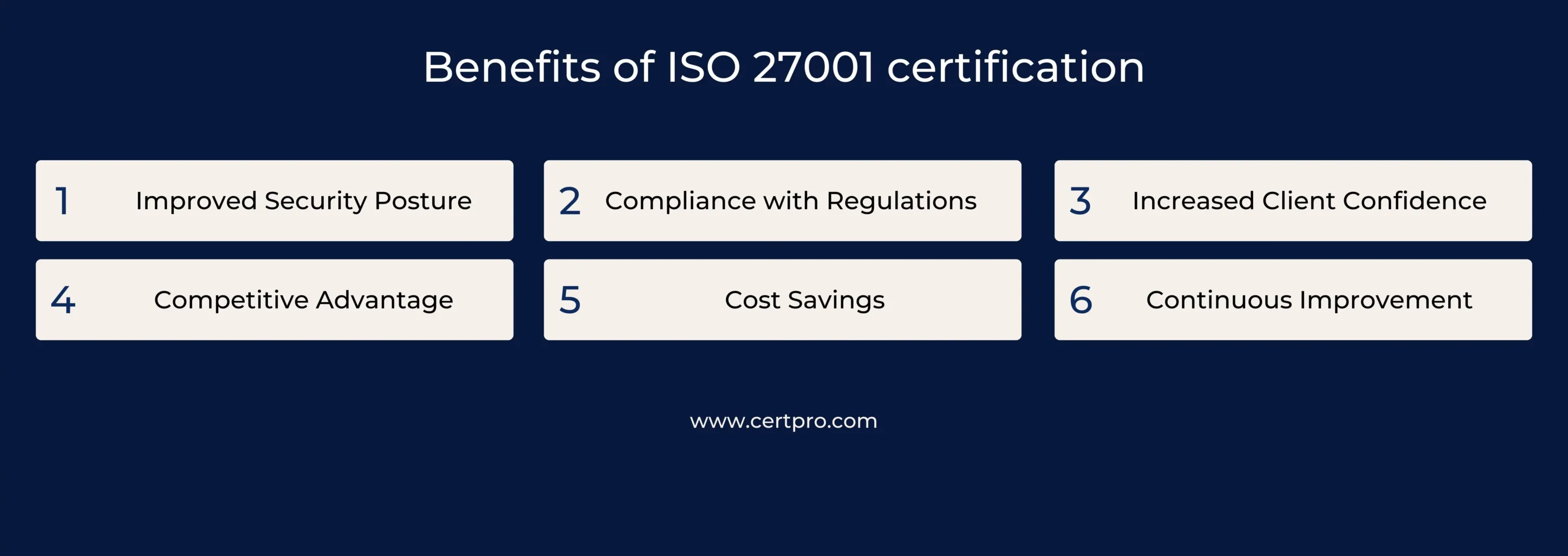
ISO 27001 Certification in San Jose delivers measurable organizational benefits through independent verification of ISMS effectiveness. The following benefits reflect the independently assessed outcomes of ISO 27001 Certification — not consulting projections or self-reported improvements, but verifiable results of a structured third-party certification audit process.
- ✓Independent third-party verification of ISMS design and operating effectiveness against ISO/IEC 27001:2022 requirements
- ✓Documented evidence of information security governance for enterprise vendor due diligence, RFP responses, and contract negotiations
- ✓Structured risk assessment and treatment framework providing a systematic basis for information security decision-making
- ✓Recognition in regulated industry procurement processes across financial services, healthcare, government, and critical infrastructure sectors
- ✓Demonstrated ISO 27001 compliance with internationally recognized information security requirements supporting cross-border market access
- ✓Annual surveillance audit oversight confirming ongoing ISMS effectiveness throughout the three-year certification cycle
- ✓Structured basis for mapping information security controls to applicable regulatory requirements including CCPA, CPRA, and sector-specific frameworks
- ✓Credentialed status as an ISO 27001 certified organization, verifiable by customers and business partners through certificate registries
ISO 27001 Certification establishes a documented, audited information security governance structure within the certified organization. The requirements of ISO/IEC 27001:2022 — particularly those governing management review, internal audit, and continual improvement under Clauses 9 and 10 — create a structured accountability framework for information security performance.
Organizations that have achieved ISO 27001 Certification operate with defined roles and responsibilities for information security, documented processes for identifying and responding to security incidents, and a scheduled internal audit program that systematically evaluates ISMS performance. These governance structures are independently verified through the ISO 27001 audit process and are subject to ongoing assessment during annual surveillance audits — providing a continuous improvement mechanism that self-assessment programs cannot replicate.
For San Jose organizations in sectors where information security incidents carry significant reputational and financial consequences — including cloud service providers processing enterprise data, fintech platforms handling financial transactions, and AI companies managing large datasets — the governance framework established through ISO 27001 Certification provides a structured mechanism for maintaining and demonstrating security control effectiveness over time.
The three-year certification cycle with annual surveillance audits ensures that the ISMS is treated as an active, continuously monitored management system rather than a static documentation exercise. Customers and business partners can rely on the certification status as evidence of ongoing, independently verified information security management — not merely a point-in-time snapshot.
- ✓Operational and Governance Benefits of ISMS Certification
ISO 27001 Certification Scope, Risk Assessment, and Risk Treatment
The ISMS scope, risk assessment process, and risk treatment framework are three interconnected elements that form the technical foundation of any ISO 27001 certification engagement. Each element is evaluated during the ISO 27001 certification audit to verify that the ISMS is appropriately bounded, that risks are systematically identified and assessed, and that control selections are traceable to documented risk treatment decisions.
Defining the ISMS Scope for Certification
The ISMS scope defines the boundaries and applicability of the Information Security Management System within the organization. Under ISO/IEC 27001:2022 Clause 4.3, organizations must determine the scope by considering external and internal issues identified through context analysis, the requirements of interested parties, and the interfaces and dependencies between organizational activities and those performed by other organizations. The scope must be documented and available as documented information.
For ISO 27001 compliance among San Jose technology organizations, the scope commonly encompasses specific product lines, cloud service platforms, data centers, development environments, customer support operations, or corporate infrastructure — depending on where information security risks are concentrated and where customer or regulatory requirements apply.
The scope definition is a critical determinant of the ISO 27001 audit’s breadth and depth. A narrowly defined scope that excludes significant operational areas may not satisfy customer or regulatory requirements. Conversely, an unnecessarily broad scope may increase the complexity and resource intensity of the audit without proportionate benefit.
Auditors assess the scope for reasonableness during Stage 1, verifying that stated boundaries are consistent with the organization’s operational context and that significant information processing activities are not arbitrarily excluded. Any exclusions from the scope must be justified and must not affect the organization’s ability to conform to the requirements of ISO/IEC 27001:2022.
Risk Assessment Methodology and Risk Treatment Planning
ISO/IEC 27001:2022 Clause 6.1.2 requires organizations to define and apply an information security risk assessment process. The risk assessment process must establish criteria for evaluating risks — including risk acceptance criteria — and must be applied consistently to produce comparable, reproducible results. Organizations must identify information assets and associated risks, analyze the likelihood and consequence of those risks, and evaluate risks against established criteria to determine which require treatment.
The risk assessment must be documented and retained as evidence. During an ISO 27001 audit, auditors evaluate the risk assessment methodology for consistency and completeness, and verify that the assessment has been applied across all in-scope assets and processes. Traceability of risk assessment results to control selections in the risk treatment plan is a specific audit evaluation point.
The risk treatment plan, required under ISO/IEC 27001:2022 Clause 6.1.3, documents how the organization has decided to address each identified risk. Risk treatment options include applying controls to reduce risk likelihood or impact, accepting risks within defined risk acceptance criteria, transferring risk through insurance or contractual arrangements, or avoiding risk by ceasing the activity that generates it.
For risks treated through control application, the risk treatment plan must reference the specific Annex A controls selected, and those selections must be reflected in the Statement of Applicability. The internal consistency of the risk assessment, risk treatment plan, and SoA is a primary focus of ISO 27001 certification audits, as these documents collectively demonstrate that the organization’s control framework is risk-driven rather than arbitrarily constructed.
ISO 27001 Audit Methodology and Evidence-Based Assessment
The ISO 27001 audit methodology employed by CertPro is structured around evidence-based assessment practices aligned with ISO/IEC 27001:2022 and applicable audit standards. The objective of every ISO 27001 audit is to independently evaluate whether the organization’s ISMS conforms to the standard’s requirements and whether the controls documented in the SoA are implemented and operating effectively. Audit evidence is collected through multiple methods to provide a comprehensive picture of ISMS performance across the defined scope.
Evidence Collection Methods in ISO 27001 Audits
ISO 27001 auditors collect evidence through three primary methods: document review, interviews, and observation. Document review involves examination of ISMS documentation — including policies, procedures, risk assessments, risk treatment plans, the Statement of Applicability, internal audit records, management review minutes, and operational logs — to verify that required documented information exists and is consistent. Interviews are conducted with personnel across organizational levels, including senior management, information security managers, IT administrators, and operational staff, to assess awareness of information security roles, responsibilities, and procedures.
Observation involves direct review of operational processes, system configurations, physical security measures, and access controls to verify that documented controls are implemented as described. For ISO 27001 audit San Jose engagements involving cloud-based infrastructure, technical configuration reviews may be conducted through secure remote access to system management consoles.
The audit program for each ISO 27001 certification engagement is developed based on the ISMS scope, the organization’s risk profile, the results of the Stage 1 audit, and findings from any prior surveillance audits. The audit program defines the areas, processes, and controls to be assessed during each audit activity, the audit criteria against which evidence will be evaluated, and the roles and responsibilities of the audit team.
Audit findings are documented in structured audit reports that identify conformances, minor nonconformities, major nonconformities, and observations. The audit report is provided to the organization following each audit activity and forms the basis for the certification committee’s independent review and determination.
Nonconformity Review and Corrective Action Verification
When nonconformities are identified during an ISO 27001 audit, the organization is required to document the nature of the nonconformity, conduct a root cause analysis, develop and implement corrective actions to address the root cause, and provide evidence that corrective actions have been effectively implemented. Major nonconformities represent a failure of a key ISMS requirement and must be resolved before certification can be issued or maintained.
The corrective action evidence submitted by the organization is reviewed by the audit team for adequacy before findings are escalated to the certification committee. This review process ensures that the certification decision is based on verified evidence of conformance — not on the organization’s assertions alone. ISO 27001 compliance maintained by San Jose organizations across the certification cycle is subject to ongoing nonconformity tracking through surveillance audits.
Management Review and Continual Improvement Under ISO 27001
ISO/IEC 27001:2022 Clauses 9 and 10 establish requirements for performance evaluation, management review, and continual improvement that are evaluated during every ISO 27001 certification audit. These requirements reflect the standard’s commitment to the ISMS as a living management system — one that evolves in response to changes in the organization’s risk environment, operational context, and information security performance data.
Internal Audit and Management Review Requirements
Clause 9.2 of ISO/IEC 27001:2022 requires organizations to conduct internal audits of the ISMS at planned intervals to provide information on whether the ISMS conforms to the organization’s own requirements and those of the standard, and is effectively implemented and maintained. The internal audit program must be planned with consideration for the importance of the processes concerned and the results of previous audits. Internal auditors must be selected to ensure objectivity and impartiality — they must not audit their own work.
The results of internal audits must be reported to management and retained as documented information. During an ISO 27001 certification audit, external auditors review the internal audit program, schedules, reports, and management responses to assess whether the internal audit function is operating effectively as a monitoring and improvement mechanism.
Clause 9.3 requires top management to review the ISMS at planned intervals to ensure its continuing suitability, adequacy, and effectiveness. The management review must consider the status of actions from previous reviews, changes in external and internal issues relevant to the ISMS, information security performance data including nonconformity statistics and audit results, feedback from interested parties, risk assessment results, and the status of the risk treatment plan.
The outputs of management review must include decisions on continual improvement opportunities and any changes needed to the ISMS. Management review records are a mandatory audit evidence item in every ISO 27001 certification audit, and the quality and completeness of these records directly reflects the organization’s commitment to active ISMS governance.
Continual Improvement Requirements Under ISO/IEC 27001:2022
ISO/IEC 27001:2022 Clause 10 requires organizations to continually improve the suitability, adequacy, and effectiveness of the ISMS. Continual improvement is demonstrated through documented nonconformity and corrective action records showing the organization has identified failures, investigated root causes, implemented corrective measures, and verified their effectiveness. Improvement is also demonstrated through ISMS updates in response to changes in the organization’s risk environment, management review results, internal audit findings, and external audit observations.
For organizations pursuing ISO 27001 Certification in San Jose across multiple certification cycles, the recertification audit assesses whether genuine continual improvement has occurred over the three-year cycle — not simply whether the ISMS has been maintained in a static configuration since initial certification.
ISO 27001 and the Regulatory Context for San Jose Organizations
San Jose organizations operate within a regulatory environment shaped by California state privacy law, federal information security requirements, and industry-specific regulatory frameworks. ISO 27001 compliance demonstrated by San Jose organizations through third-party certification provides a structured reference point for evaluating information security control coverage relative to applicable regulatory requirements.
However, ISO 27001 Certification does not automatically establish compliance with California, U.S. federal, or industry-specific laws and regulations. This distinction must be clearly understood by organizations evaluating ISO 27001 Certification as part of a broader regulatory compliance program.
CCPA, CPRA, and ISO 27001 Control Alignment
The California Consumer Privacy Act (CCPA), as amended by the California Privacy Rights Act (CPRA), establishes requirements for the protection of personal information of California residents, including security obligations applicable to businesses that collect, process, or share personal data. ISO 27001 Annex A controls — particularly those in the Organizational, Physical, and Technological domains — address many of the information security practices relevant to CCPA and CPRA security requirements, including access control, encryption, incident response, vendor management, and data classification.
Organizations that have implemented an ISMS conforming to ISO/IEC 27001:2022 may find that their information security control framework addresses significant portions of the technical security measures referenced in CCPA and CPRA compliance programs. However, ISO 27001 Certification is not a substitute for legal analysis of CCPA and CPRA obligations, and organizations must independently confirm that their compliance programs satisfy the specific requirements of applicable California privacy law.
Beyond CCPA and CPRA, San Jose organizations in regulated industries may be subject to additional information security requirements including the Health Insurance Portability and Accountability Act (HIPAA) Security Rule for healthcare technology companies, the Payment Card Industry Data Security Standard (PCI DSS) for payment processing organizations, the Federal Risk and Authorization Management Program (FedRAMP) for cloud service providers serving federal agencies, and the Cybersecurity Maturity Model Certification (CMMC) for defense industrial base contractors.
ISO 27001’s Annex A control framework provides a structured reference that can be mapped against these regulatory and industry requirements, but each framework has specific requirements that extend beyond those addressed by ISO 27001 Certification. ISO 27001 Certification should be understood as one component of an organization’s regulatory compliance posture — not as a comprehensive substitute for sector-specific regulatory assessments.
ISO 27001 as a Baseline for Information Security Governance in California
California’s regulatory environment — including the CPRA’s establishment of the California Privacy Protection Agency (CPPA) and its rulemaking authority — reflects an ongoing trajectory toward more rigorous information security governance requirements for organizations operating in the state. ISO 27001 Certification in San Jose positions certified organizations with a documented, independently audited ISMS that provides a structured baseline for responding to regulatory inquiries, data breach notifications, and security incident investigations.
While ISO 27001 Certification does not confer legal compliance status under any specific California statute, the documented ISMS — including risk assessments, treatment plans, internal audit records, and management review documentation — provides evidence of systematic information security governance that may be relevant in regulatory and legal proceedings involving information security failures.
Industry Sectors in San Jose Pursuing ISO 27001 Certification
ISO 27001 Certification in San Jose is pursued across a wide range of technology and information-intensive industry sectors. The following sectors represent the primary categories of San Jose and Silicon Valley organizations that engage CertPro for ISO 27001 certification audit services. Each sector has distinct drivers for pursuing certification, reflecting the specific information security demands of its commercial and regulatory environment.
Technology, SaaS, and Cloud Service Providers
SaaS providers and cloud service companies headquartered in San Jose and the broader Silicon Valley region — including those operating platforms for enterprise resource planning, customer relationship management, human resources, collaboration, and data analytics — frequently pursue ISO 27001 Certification to satisfy enterprise customer security requirements. ISO 27001 Certification in San Jose obtained by SaaS organizations through CertPro provides customers with independently verified assurance that the platform’s information security controls are designed and operating effectively.
Cloud infrastructure providers processing data on behalf of regulated industry customers — including healthcare, financial services, and government — encounter ISO 27001 certification requirements as part of cloud service procurement standards. AI and machine learning companies in San Jose that process large volumes of sensitive training data and customer datasets are increasingly encountering ISO 27001 Certification expectations in enterprise AI deployment agreements.
Cybersecurity companies based in San Jose — including firms providing endpoint security, threat intelligence, identity and access management, and security operations services — frequently pursue ISO 27001 Certification to demonstrate that their own information security management practices meet the same standards they promote to their customers. Semiconductor and hardware companies operating in the Silicon Valley region pursue ISO 27001 Certification to address intellectual property protection requirements and to satisfy the information security expectations of their enterprise and government customers.
Telecommunications companies and network infrastructure providers in the San Jose area pursue ISMS certification San Jose as part of their vendor qualification programs for regulated industry customers in financial services, healthcare, and government sectors.
Financial Services and Fintech Organizations
ISO 27001 compliance demonstrated by San Jose fintech organizations reflects the stringent information security requirements of the financial services sector. Fintech companies operating in San Jose — including payment processors, digital banking platforms, lending technology providers, and cryptocurrency and blockchain organizations — process sensitive financial data subject to regulatory oversight and enterprise customer security scrutiny. ISO 27001 Certification provides these organizations with a recognized, independently verified credential demonstrating ISMS effectiveness.
Financial services organizations including investment managers, insurance companies, and banking technology providers based in the South Bay financial corridor pursue ISO 27001 Certification as part of their vendor risk management programs and to satisfy regulatory guidance on third-party technology risk. ISO 27001 Certification maintained by San Jose financial services organizations supports their positioning as security-conscious technology partners in institutional financial relationships.
| Industry Sector | Primary ISO 27001 Driver | Key Annex A Areas |
|---|---|---|
| SaaS and Cloud Providers | Enterprise vendor due diligence, customer security requirements | Technological controls, supplier management, access control |
| Fintech and Financial Services | Regulatory guidance, institutional procurement requirements | Organizational controls, cryptography, incident management |
| AI and Machine Learning | Enterprise AI deployment requirements, data governance | Data classification, access control, cloud security |
| Cybersecurity Firms | Customer credibility, security posture demonstration | All four Annex A domains |
| Semiconductor and Hardware | IP protection, government and enterprise customer requirements | Physical controls, access management, secure development |
FAQ
▶
What is ISO 27001 certification and what does it certify?
▶
How long is ISO 27001 certification valid?
▶
What is the difference between a Stage 1 and Stage 2 ISO 27001 audit?
▶
What is the Statement of Applicability in ISO 27001?
▶
Does ISO 27001 certification confirm compliance with CCPA or CPRA?
▶
Which San Jose industries require ISO 27001 certification?
▶
What are the four Annex A control domains in ISO/IEC 27001:2022?
▶
What is CertPro’s role in ISO 27001 certification for San Jose organizations?
Get In Touch
have a question? let us get back to you.