
SOC 2 Certification in Philadelphia
SOC 2 Certification for Philadelphia companies provides structured, independently verified assurance over an organization’s control environment. The benefits of SOC 2 attestation extend across vendor qualification processes, customer trust, regulatory alignment considerations, and internal control discipline. The following summarizes the primary benefits recognized by organizations that have obtained SOC 2 Certification in Philadelphia’s technology, financial services, healthcare, and related sectors.
OUR CLIENTS










SOC 2 Certification for Philadelphia-Based Financial and Technology Organizations
SOC 2 Certification in Philadelphia is pursued by organizations across a broad range of industry sectors, including SaaS providers, fintech companies, financial institutions, healthcare technology organizations, biotechnology and life sciences firms, pharmaceutical businesses, insurance companies, cloud service providers, cybersecurity companies, education technology platforms, e-commerce businesses, and enterprises handling sensitive customer, financial, clinical, or proprietary data.
CertPro CPA LLC is a Licensed CPA Firm that conducts independent SOC 2 examinations under AICPA attestation standards — specifically AT-C Section 205. The SOC 2 examination evaluates whether an organization’s controls over security, availability, processing integrity, confidentiality, and privacy satisfy the AICPA Trust Services Criteria. CertPro issues SOC 2 attestation reports solely on the basis of audit evidence collected during formal examination and does not provide consulting, advisory, implementation, or remediation services.
Philadelphia is a significant financial, technology, healthcare, and life sciences hub within the Mid-Atlantic region. Organizations headquartered across Center City, University City, the Navy Yard innovation district, King of Prussia, and the broader Greater Philadelphia metropolitan area frequently encounter SOC 2 attestation requirements through enterprise customer procurement processes, regulated industry vendor assessments, and international business development activities.
Philadelphia’s concentration of healthcare systems, academic medical centers, biotechnology research organizations, and financial institutions creates a local market environment in which SOC 2 Certification in Philadelphia serves as a recognized third-party control verification mechanism — evaluated routinely during third-party risk management reviews. The Pennsylvania Breach of Personal Information Notification Act and related state-level data security expectations reinforce the broader risk management context in which Philadelphia organizations operate. However, SOC 2 attestation does not automatically establish compliance with Pennsylvania, U.S. federal, or industry-specific laws and regulations.
SOC 2 Certification in Philadelphia is conducted by a Licensed CPA Firm acting as an independent third party. The CPA firm evaluates an organization’s controls against the AICPA Trust Services Criteria without involvement in control design, implementation, or remediation activities. This independence is a foundational requirement of the SOC 2 attestation framework.
The resulting SOC 2 attestation report provides enterprise customers, regulated institutions, healthcare procurement offices, and financial services organizations with independent verification of control effectiveness. Organizations across Philadelphia’s technology corridor — spanning University City, the Navy Yard, and King of Prussia — routinely present SOC 2 attestation reports during vendor due diligence reviews conducted by enterprise customers, healthcare systems, and regulated financial institutions. The examination scope, selected Trust Services Criteria categories, and report type are all determined based on organizational systems, services, and applicable control commitments before the examination begins.
Philadelphia’s Technology and SaaS Ecosystem
Philadelphia’s technology ecosystem spans University City, the Navy Yard innovation district, King of Prussia, and the broader Delaware Valley technology corridor. This ecosystem hosts a growing concentration of SaaS providers, cloud-native platforms, fintech organizations, health technology companies, and AI-driven enterprises.
These organizations routinely encounter SOC 2 attestation requirements from enterprise customers conducting vendor security reviews, healthcare system procurement offices evaluating third-party data handlers, and regulated financial institutions assessing cloud service providers. SOC 2 audit engagements in Philadelphia for SaaS and cloud-native organizations typically focus on the Security Trust Services Criterion as the mandatory baseline, with Availability and Confidentiality criteria commonly added based on service commitments and customer contract requirements. As Philadelphia grows as a technology hub, SOC 2 compliance requirements are increasingly embedded within enterprise sales cycles for organizations targeting regulated sectors.
Healthcare, Life Sciences, and Financial Services Context
Philadelphia’s healthcare technology, biotechnology, pharmaceutical, and life sciences organizations — many affiliated with academic medical institutions in University City and across the broader Delaware Valley — handle sensitive patient, clinical, research, and proprietary data. Financial institutions, insurance organizations, and fintech firms headquartered across Center City and Greater Philadelphia operate in environments where SOC 2 attestation is a recognized control verification mechanism evaluated during third-party risk management reviews and vendor security assessments.
SOC 2 compliance requirements in Philadelphia’s healthcare technology sector frequently include the Privacy and Confidentiality Trust Services Criteria categories in addition to Security, reflecting the sensitivity of data handled by health IT vendors. Financial services organizations and their technology providers across Philadelphia similarly encounter SOC 2 attestation requirements embedded within vendor due diligence frameworks maintained by regulated institutions under applicable financial services regulatory expectations.
Independent Certification Body Positioning
A SOC 2 examination conducted by a Licensed CPA Firm produces an independent attestation report under AT-C Section 205 of the AICPA attestation standards. The CPA firm functions as an independent third party, evaluating controls against the Trust Services Criteria without any involvement in control design, implementation, or remediation. This independence is a foundational requirement of the SOC 2 attestation framework and clearly distinguishes a SOC 2 examination from internal assessments, self-certification, or consulting-led compliance reviews.
SOC 2 attestation engagements in Philadelphia conducted by CertPro are based exclusively on audit evidence collected during formal examination procedures. The attestation report issued following the examination reflects the CPA firm’s independent opinion on the fairness of the service organization’s system description and the suitability of control design and operating effectiveness — evaluated against criteria established by the AICPA Trust Services Criteria.

What Is SOC 2 Certification?
SOC 2 Certification refers to the process by which a service organization undergoes an independent examination conducted by a Licensed CPA Firm to evaluate controls over the security, availability, processing integrity, confidentiality, and privacy of customer data. The examination is governed by the AICPA’s Trust Services Criteria and conducted under AT-C Section 205 attestation standards.
The outcome is a SOC 2 attestation report — a formal, independently issued document that provides stakeholders with structured assurance over an organization’s internal control environment. SOC 2 differs from ISO 27001 and other certification frameworks in that it is specifically designed for service organizations that process, store, or transmit customer data. The report is issued by a Licensed CPA Firm rather than a general certification body, and the SOC 2 examination focuses on controls directly relevant to customer data security and service commitments.
Trust Services Criteria and Scope Categories
The AICPA Trust Services Criteria define five categories against which a SOC 2 examination may evaluate an organization’s controls. Security is the only mandatory criterion and must be included in every SOC 2 examination. The Security criterion addresses logical and physical access controls, risk assessment, change management, monitoring, and incident response.
The four additional criteria — Availability, Processing Integrity, Confidentiality, and Privacy — are included in the examination scope based on the organization’s service commitments, contractual obligations, and the nature of data handled. For example, a SaaS provider with uptime service level agreements would typically include the Availability criterion, while an organization handling personal health information may include the Privacy criterion. The selection of applicable Trust Services Criteria is determined during the scoping phase of the SOC 2 examination and reflects the specific systems and services subject to audit.
| Trust Services Criterion | Focus Area | Commonly Included By |
|---|---|---|
| Security | Access controls, risk management, monitoring, and incident response | All organizations (mandatory) |
| Availability | System uptime, performance, and recovery capabilities | SaaS providers, cloud platforms, and data hosting organizations |
| Processing Integrity | Accuracy, completeness, and timeliness of data processing | Fintech firms, payment processors, and financial data platforms |
| Confidentiality | Protection of confidential information throughout its lifecycle | B2B SaaS, financial services, and healthcare technology organizations |
| Privacy | Collection, use, retention, and disposal of personal information | Health technology vendors, consumer platforms, and data processors |
SOC 2 Type 1 and Type 2 Reports
SOC 2 examinations produce two report types: Type 1 and Type 2. A SOC 2 Type 1 report evaluates the design suitability of controls at a specific point in time, addressing whether controls are appropriately designed to meet the applicable Trust Services Criteria as of the report date.
A SOC 2 Type 2 report evaluates both the design suitability and the operating effectiveness of controls over a defined observation period — typically six to twelve months. The Type 2 report is generally preferred by enterprise customers, financial institutions, and regulated organizations because it demonstrates that controls operated consistently over time, not merely that they were correctly designed at a single point. For organizations pursuing SOC 2 Certification in Philadelphia for the first time, a Type 1 report may precede a Type 2 examination to establish a baseline assessment of control design before the observation period begins.
SOC 2 Compliance vs. SOC 2 Certification
SOC 2 compliance and SOC 2 certification are distinct concepts. SOC 2 compliance refers to an organization’s internal adherence to controls aligned with the Trust Services Criteria, without independent external verification. SOC 2 certification — more precisely described as SOC 2 attestation — refers to the formal outcome of an independent examination conducted by a Licensed CPA Firm, resulting in an issued attestation report.
Unlike compliance self-assessments, SOC 2 attestation provides stakeholders with independent third-party verification of control effectiveness. Enterprise customers, regulated institutions, and financial services organizations generally require SOC 2 attestation reports — not self-declared compliance statements — as evidence of control effectiveness during vendor due diligence and third-party risk management reviews. Organizations must complete annual SOC 2 audit cycles to maintain current attestation status and meet ongoing customer and contractual expectations.
SOC 2 Certification Audit Process for Organizations in Philadelphia
The SOC 2 audit process for organizations in Philadelphia follows a structured sequence of examination stages defined by AICPA attestation standards. Each stage is conducted by the Licensed CPA Firm independently, without advisory involvement in control design or remediation. The process begins with scope definition and progresses through documentation review, control testing, evidence assessment, nonconformity identification, and issuance of the attestation report.
For Philadelphia organizations subject to enterprise procurement timelines, financial sector vendor review cycles, or healthcare system due diligence requirements, understanding the structured stages of the SOC 2 audit process supports effective examination scheduling and evidence preparation. The SOC 2 audit process described below applies to both Type 1 and Type 2 engagements, with the primary distinction being the inclusion of an observation period for Type 2 examinations.
The SOC 2 examination follows a defined sequence of stages. Scope definition establishes the systems, services, infrastructure, and Trust Services Criteria categories subject to examination. The audit program determination identifies the specific procedures, evidence requirements, and testing approaches applicable to the defined scope.
The Stage 1 review evaluates documentation, system descriptions, and control narratives to assess whether the organization’s system description is fairly presented. The Stage 2 examination involves detailed control testing — including inquiry, observation, inspection of evidence, and re-performance — to evaluate both control design and operating effectiveness over the applicable period. Following testing, identified nonconformities and exceptions are documented and reported. The certification decision and issuance of the SOC 2 attestation report follow the completion of all examination procedures and the resolution of any outstanding documentation requirements.
| Audit Stage | Key Activities | Output |
|---|---|---|
| Scope Definition | Identify systems, services, and applicable Trust Services Criteria | Defined examination scope and selected criteria |
| Stage 1 Review | Evaluate system description, documentation, and control narratives | Documentation assessment findings |
| Observation Period (Type 2) | Monitor control operation over six to twelve months | Evidence of sustained control effectiveness over time |
| Stage 2 Control Testing | Inquiry, inspection, observation, and re-performance of controls | Control testing results and exception identification |
| Attestation Report Issuance | Licensed CPA Firm issues independent SOC 2 attestation report | Signed SOC 2 Type 1 or Type 2 attestation report |
During the SOC 2 examination, the Licensed CPA Firm collects audit evidence through multiple procedures: inquiry of personnel responsible for control operation, inspection of policy documents and system configuration records, observation of control procedures in practice, and re-performance of selected control activities to verify outcomes.
Evidence collection spans the full observation period for Type 2 engagements, meaning controls must be demonstrated as operating consistently throughout the period — not only at specific audit dates. For Philadelphia organizations in technology-intensive sectors — including SaaS providers, cloud platforms, and health IT companies — evidence commonly includes access control logs, change management records, vulnerability scanning outputs, incident response documentation, vendor management records, and backup and recovery test results. The CPA firm evaluates all collected evidence against the applicable Trust Services Criteria to form the basis of the attestation opinion.
The SOC 2 Type 2 observation period typically spans six to twelve consecutive months, during which the Licensed CPA Firm evaluates the consistent operation of controls over time. The resulting attestation report covers this defined period and is generally considered current for twelve months following the period end date.
Enterprise customers and regulated institutions commonly require current SOC 2 attestation reports — typically dated within the previous twelve months — as a condition of vendor approval or ongoing vendor relationship maintenance. Organizations maintaining SOC 2 Certification in Philadelphia therefore engage in annual examination cycles to ensure report currency. The recertification examination follows the same structured process as the initial engagement, with the observation period for the subsequent Type 2 report commencing immediately after the prior report period end date to avoid gaps in attestation coverage.
- ✓Examination Stages: From Scope Definition to Report Issuance
- ✓Evidence Collection and Control Testing Methodology
- ✓Observation Period, Report Validity, and Recertification
SOC 2 Certification Requirements and Evaluation Criteria
SOC 2 Certification requirements are defined by the AICPA Trust Services Criteria and the attestation standards governing the examination. Organizations seeking SOC 2 attestation must demonstrate that controls relevant to their selected Trust Services Criteria categories are both suitably designed and — for Type 2 reports — operating effectively over the observation period.
The SOC 2 examination does not evaluate compliance with external laws or regulations; it evaluates internal control effectiveness against the AICPA Trust Services Criteria. Understanding the specific documentation, technical, and management requirements associated with SOC 2 compliance in Philadelphia allows organizations to structure their control environments appropriately before the examination begins.
SOC 2 examination documentation requirements include a written description of the service organization’s system — covering services provided, infrastructure components, software, personnel, data, and procedures relevant to the in-scope systems. Supporting documentation evaluated during the examination includes information security policies, access control procedures, risk assessment records, change management documentation, vendor management policies, incident response plans, and business continuity and disaster recovery plans.
For organizations in Philadelphia’s regulated sectors — including healthcare technology, financial services, and pharmaceutical businesses — documentation requirements may also encompass records demonstrating alignment with applicable regulatory frameworks. The SOC 2 examination evaluates controls against Trust Services Criteria rather than regulatory compliance directly. Documentation must be current, formally approved, and consistently applied across the in-scope control environment to support a successful examination.
Technical controls evaluated during a SOC 2 examination span logical access management, network security architecture, encryption practices, vulnerability management, system monitoring and logging, change management, and data backup and recovery capabilities. Under the mandatory Security Trust Services Criterion, technical controls must address unauthorized access prevention, detection of anomalous activity, and response to security incidents.
Organizations in Philadelphia’s SaaS, fintech, and cloud service sectors typically maintain technical control evidence including access provisioning and deprovisioning logs, multi-factor authentication configurations, intrusion detection system outputs, patch management records, penetration testing results, and encryption key management documentation. During a SOC 2 audit engagement in Philadelphia, the CPA firm evaluates the design and operation of these technical controls against the applicable Trust Services Criteria point-of-focus requirements.
Management of the service organization bears responsibility for the design, implementation, and operation of controls relevant to the SOC 2 examination scope. This includes establishing a defined control environment, conducting formal risk assessments, maintaining documented control activities, monitoring control performance, and communicating relevant information to personnel responsible for control operation.
Management is also responsible for the system description included in the SOC 2 report, which must fairly present the organization’s system and controls as of the report date. For Type 2 examinations, management must demonstrate that controls operated throughout the observation period without material lapses. During the SOC 2 examination, the Licensed CPA Firm evaluates management’s assertions regarding control design and effectiveness against evidence collected during testing, forming an independent opinion that is reflected in the issued attestation report.
- ✓Documentation and Policy Requirements
- ✓Technical Control Requirements
- ✓Management Responsibilities and Control Environment
Why Organizations in Philadelphia Pursue SOC 2 Certification
SOC 2 Certification in Philadelphia is pursued in response to specific demand drivers arising from the city’s technology, financial services, healthcare, and life sciences ecosystem. Enterprise customers conducting vendor security reviews, regulated institutions managing third-party risk, and international organizations evaluating U.S.-based service providers consistently require SOC 2 attestation as a condition of vendor engagement.
Philadelphia organizations across multiple sectors encounter these requirements through formal vendor due diligence processes, contract negotiations, and regulatory oversight frameworks applicable to their customers and partners. The SOC 2 audit process provides independently verified assurance that meets these expectations in a structured, recognized format.
Enterprise Vendor Security Reviews and Financial Sector Procurement
Enterprise customers across Philadelphia’s financial services, healthcare, insurance, and large corporate sectors maintain formal vendor security review programs that require SOC 2 attestation from technology service providers, cloud platforms, and data processors. A Philadelphia-based SaaS provider serving financial institutions in Center City — or a fintech company supporting payment processing for Greater Philadelphia businesses — would routinely be required to present a current SOC 2 Type 2 attestation report as part of the customer’s vendor onboarding and annual review process.
SOC 2 Certification demand in Philadelphia’s financial services sector is reinforced by third-party risk management frameworks maintained by regulated financial institutions under guidance from federal banking regulators and applicable financial services oversight bodies. The SOC 2 attestation report provides an independently verified basis for the customer’s vendor risk assessment, replacing self-completed security questionnaires with auditor-examined evidence.
Healthcare System Procurement and Health Technology Vendor Assessment
Philadelphia’s concentration of major healthcare systems, academic medical centers, and health insurance organizations creates significant demand for SOC 2 attestation among health technology vendors, electronic health record platforms, health data analytics companies, and clinical research technology providers. Healthcare system procurement offices evaluate third-party technology vendors handling patient data, clinical information, or administrative health information through structured vendor security assessments that frequently require SOC 2 attestation reports.
SOC 2 compliance requirements in Philadelphia’s health technology sector often include the Privacy and Confidentiality Trust Services Criteria categories in addition to the mandatory Security criterion, reflecting the sensitivity of protected health information handled by vendors. The SOC 2 attestation report gives healthcare system procurement offices independent evidence of vendor control effectiveness, rather than relying solely on vendor-completed questionnaires or contractual representations.
International Expansion and Cross-Border Vendor Due Diligence
Philadelphia-based organizations pursuing international market expansion or serving multinational enterprise customers encounter SOC 2 attestation requirements as part of cross-border vendor due diligence processes. European organizations evaluating U.S.-based SaaS providers, cloud platforms, and data processors frequently request SOC 2 Type 2 reports alongside other information security certifications as part of their vendor assessment frameworks.
Philadelphia fintech organizations targeting European financial services customers — or pharmaceutical companies conducting cross-border clinical research technology evaluations — benefit from presenting SOC 2 attestation reports that provide internationally recognized, independently verified evidence of control effectiveness. The SOC 2 attestation report’s structured format — covering system description, applicable criteria, testing procedures, and auditor opinion — supports efficient extraction of relevant control information by international procurement and risk management teams conducting cross-border assessments.
Benefits of SOC 2 Certification for Philadelphia-Based Organizations
SOC 2 Certification for Philadelphia companies provides structured, independently verified assurance over an organization’s control environment. The benefits of SOC 2 attestation extend across vendor qualification processes, customer trust, regulatory alignment considerations, and internal control discipline. The following summarizes the primary benefits recognized by organizations that have obtained SOC 2 Certification in Philadelphia’s technology, financial services, healthcare, and related sectors.
- ✓Independent third-party verification of control design and operating effectiveness, replacing self-declared compliance with auditor-examined evidence
- ✓Recognition in enterprise procurement processes across financial services, healthcare, insurance, and technology sectors in Philadelphia and nationally
- ✓Structured SOC 2 audit methodology that evaluates controls against the AICPA Trust Services Criteria, providing a recognized framework for control assessment
- ✓Demonstration of control effectiveness to international customers and partners conducting cross-border vendor due diligence
- ✓Support for third-party risk management programs maintained by regulated financial institutions and healthcare organizations in the Greater Philadelphia region
- ✓Annual SOC 2 examination cycle that promotes ongoing control monitoring, documentation discipline, and risk management accountability within the organization
- ✓Independently issued SOC 2 attestation report accepted by enterprise customers as evidence of security and data protection control effectiveness
- ✓Differentiation in competitive vendor qualification processes where SOC 2 attestation is required or preferred over self-completed security questionnaires
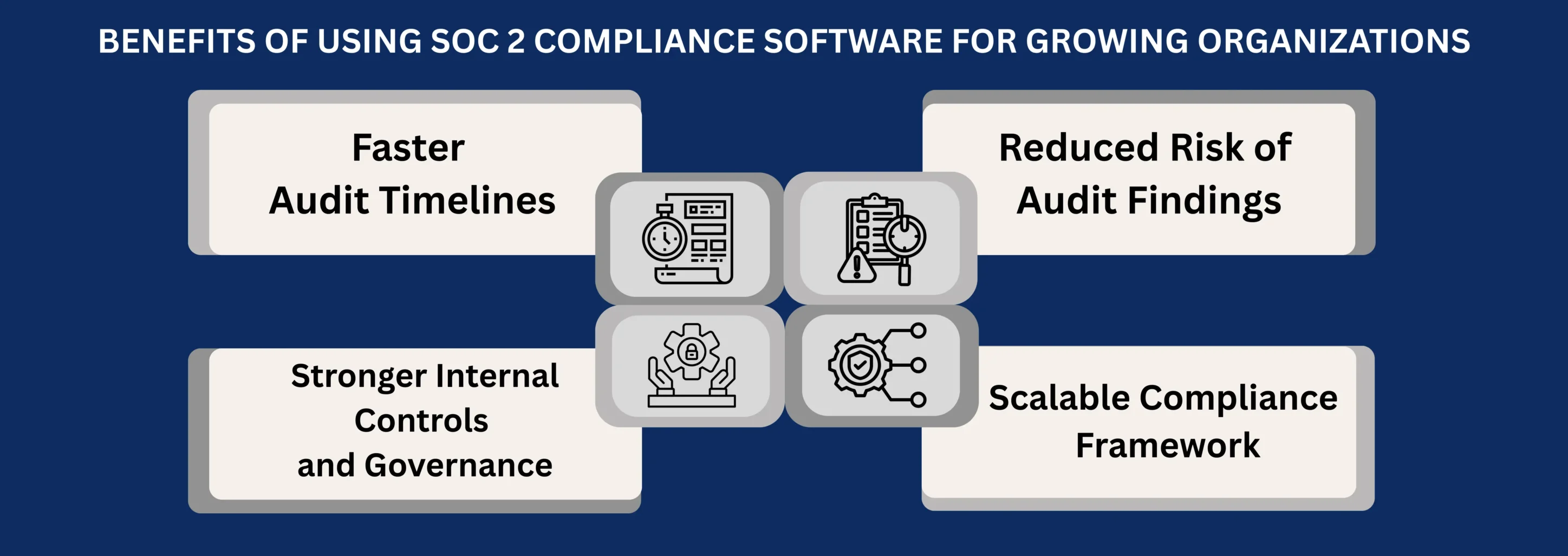
Organizations with SOC 2 attestation in Philadelphia report that presenting a current SOC 2 Type 2 report during enterprise sales cycles accelerates vendor qualification timelines. Rather than completing lengthy, organization-specific security questionnaires for each prospective customer, an organization with a current SOC 2 attestation report can direct procurement teams to the independently examined documentation of control effectiveness.
This is particularly relevant for Philadelphia-based SaaS providers and cloud service organizations targeting financial institutions, healthcare systems, and large enterprises that maintain formal vendor approval programs requiring documented security assurance. The SOC 2 attestation report addresses a broad range of control areas — including access management, change control, monitoring, and incident response — that enterprise procurement teams routinely assess, reducing the redundant effort associated with responding to multiple customer-specific security reviews.
The SOC 2 examination process reinforces internal control discipline by establishing documented requirements for control design, evidence collection, and ongoing monitoring. Organizations undergoing annual SOC 2 audit cycles develop structured approaches to access management, change control, vendor oversight, and incident response that contribute to overall information security maturity.
For Philadelphia organizations in regulated sectors — including pharmaceutical companies, biotechnology firms, and financial institutions — the control discipline associated with annual SOC 2 compliance examination cycles aligns with broader organizational risk management objectives and regulatory expectations relevant to their specific industries. The examination process also identifies control exceptions and nonconformities, providing management with structured findings that inform internal improvement priorities independent of the attestation outcome. This ongoing oversight mechanism supports sustained control effectiveness between examination periods.
- ✓Vendor Qualification and Sales Acceleration
- ✓Internal Control Discipline and Risk Management
SOC 2 Certification Scope and Independent Decision Framework
The scope of a SOC 2 examination determines which systems, processes, controls, and Trust Services Criteria categories are subject to the auditor’s evaluation. Scope definition is a critical early step in the SOC 2 audit process and directly influences the coverage, relevance, and utility of the resulting attestation report.
For organizations pursuing SOC 2 Certification in Philadelphia, scope decisions reflect the specific services delivered to customers, the infrastructure and software components supporting those services, and the Trust Services Criteria categories applicable to service commitments and data handling practices. Carefully defined scope boundaries ensure that the SOC 2 attestation report provides meaningful, targeted assurance to enterprise customers and regulated stakeholders.
Defining the System and In-Scope Boundaries
The SOC 2 system description — a management-prepared document included in the attestation report — defines the boundaries of the in-scope system. This description covers infrastructure components (servers, networks, cloud environments), software applications, data categories processed or stored, personnel responsible for control operation, and operational procedures relevant to the in-scope services.
For Philadelphia SaaS providers, the system description typically encompasses the production application environment, supporting infrastructure, data center or cloud hosting arrangements, and relevant third-party service providers included within the system boundary. Subservice organizations — third-party vendors whose services are part of the in-scope system — may be addressed using the inclusive method (including subservice organization controls within the examination) or the carve-out method (excluding subservice organization controls and noting their existence). The approach selected affects the coverage and completeness of the SOC 2 attestation report.
Independent Certification Decision and Nonconformity Review
The SOC 2 attestation opinion is formed independently by the Licensed CPA Firm based exclusively on audit evidence collected during examination. The CPA firm evaluates whether controls are suitably designed to meet the applicable Trust Services Criteria and, for Type 2 engagements, whether they operated effectively throughout the observation period.
Where examination procedures identify control exceptions, nonconformities, or instances of control failure, these are documented within the attestation report. The presence of exceptions does not automatically result in an adverse opinion; the materiality and nature of identified exceptions are evaluated in the context of the overall control environment. The independent certification decision reflects the CPA firm’s professional judgment applied to the totality of evidence collected, without influence from management or advisory relationships. SOC 2 examination engagements in Philadelphia conducted by CertPro adhere strictly to this independence requirement throughout all examination phases.
Conditions for Modified Opinions and Report Limitations
A SOC 2 attestation report may contain an unmodified opinion — reflecting that controls are suitably designed and, for Type 2, operating effectively — or a modified opinion where material deficiencies in control design or operation are identified. Modified opinions include qualified opinions (where deficiencies are limited in scope), adverse opinions (where deficiencies are pervasive), or disclaimers of opinion (where the auditor is unable to obtain sufficient evidence).
The SOC 2 attestation report is intended for use by the service organization’s customers and their auditors, and is not a public document. Distribution of the report is typically restricted to specified parties with a legitimate need to evaluate the organization’s controls. Organizations maintaining SOC 2 Certification in Philadelphia should clearly communicate report distribution restrictions and usage limitations to customers and partners who receive copies of the attestation report.
Industries Pursuing SOC 2 Certification in Philadelphia
SOC 2 Certification in Philadelphia spans a broad range of industry sectors reflecting the city’s diverse technology, financial, healthcare, and life sciences economy. The sectors below represent the primary concentrations of SOC 2 audit activity across the Greater Philadelphia region, driven by specific customer requirements, regulatory expectations, and vendor qualification standards applicable to each sector.
Technology, SaaS, and Cloud Service Providers
SaaS providers, cloud-native platforms, data hosting organizations, cybersecurity firms, education technology companies, and AI-driven technology businesses operating across Philadelphia’s technology ecosystem — including University City, the Navy Yard, King of Prussia, and Center City — represent a significant concentration of SOC 2 attestation activity. These organizations encounter SOC 2 Certification requirements during enterprise customer procurement, investor due diligence, and partnership qualification processes.
SOC 2 audit engagements for technology sector clients in Philadelphia typically focus on Security and Availability Trust Services Criteria, with Confidentiality and Processing Integrity criteria commonly included based on the specific services and customer data handled. Cloud service providers handling data for regulated industries — including financial services, healthcare, and pharmaceutical organizations — frequently include multiple Trust Services Criteria categories to address the breadth of customer control expectations.
Financial Services, Fintech, and Insurance Organizations
Philadelphia’s financial services sector — encompassing banking institutions, asset management firms, insurance companies, payment processors, and fintech organizations — represents a significant segment of SOC 2 compliance activity in the region. Fintech organizations providing payment technology, lending platforms, or financial data analytics services to regulated financial institutions are routinely required to present SOC 2 Type 2 attestation reports as part of the financial institution’s vendor risk management program.
Insurance technology companies supporting claims processing, policy administration, or actuarial data analytics for Philadelphia-area insurance organizations similarly encounter SOC 2 attestation requirements embedded within insurance sector vendor qualification frameworks. SOC 2 compliance engagements in Philadelphia’s fintech sector frequently include the Processing Integrity Trust Services Criterion to address accuracy and completeness of financial data processing, in addition to the mandatory Security criterion.
Healthcare Technology, Pharmaceutical, and Life Sciences Organizations
Healthcare technology vendors, electronic health record platforms, clinical research technology providers, pharmaceutical data management organizations, and biotechnology companies operating across Philadelphia and the broader Delaware Valley pursue SOC 2 Certification in Philadelphia to satisfy procurement requirements from healthcare systems, academic medical centers, pharmaceutical sponsors, and research institutions.
The Privacy Trust Services Criterion is frequently included in SOC 2 examinations for health technology organizations handling personal health information, clinical trial data, or patient-identifiable records. Pharmaceutical and life sciences organizations managing proprietary research data, clinical trial results, or regulatory submission systems include the Confidentiality criterion to protect commercially sensitive and scientifically proprietary information. SOC 2 attestation in these sectors provides healthcare and life sciences customers with independently verified evidence of vendor control effectiveness over data security, privacy, and processing integrity.
FAQ
▶
What is SOC 2 certification?
▶
Who needs SOC 2 certification?
▶
How long does SOC 2 certification take?
▶
What are the benefits of SOC 2 certification?
▶
What is the cost of SOC 2 certification?
▶
How do I prepare for SOC 2 certification?
▶
What happens after SOC 2 certification?
▶
How long does the SOC 2 certification process take?
SOC 1 VS SOC 2: WHICH REPORT YOUR CUSTOMERS ACTUALLY ASK FOR
If you sell SaaS or provide outsourced services, you have likely been asked for a SOC report. However, the follow-up question is rarely easy to answer…

AICPA Issues New Guidance for Peer Reviewers Evaluating SOC 2 Engagements
AICPA SOC 2 guidance has been issued to help peer reviewers identify quality risks associated with SOC 2 engagements as the use of compliance automati…
SOC 2 Certified: What Does It Mean for Your Business
For companies that handle sensitive data or run cloud-based services, the question “Can you provide your SOC 2 report?” carries enormous weight. Yet, …
Get In Touch
have a question? let us get back to you.