
SOC 2 Certification in Miami
The SOC 2 audit process follows a structured sequence of stages governed by AICPA attestation standards. Each stage produces defined outputs that collectively form the basis for the Licensed CPA Firm’s attestation opinion. For organizations pursuing SOC 2 Certification in Miami, this process is consistent with AICPA requirements regardless of industry or organizational size. The specific controls evaluated and evidence collected will vary based on the defined audit scope and applicable Trust Services Criteria categories.
OUR CLIENTS










SOC 2 Certification for Miami-Based Financial and Technology Organizations
SOC 2 Certification in Miami is conducted by a Licensed CPA Firm under AICPA attestation standards, evaluating an organization’s control environment against the Trust Services Criteria (TSC). CertPro CPA LLC issues independent SOC 2 attestation reports for organizations across Miami, Brickell, Downtown Miami, Coral Gables, Doral, Miami Beach, and the broader South Florida metropolitan area. These reports serve organizations that store, process, or transmit sensitive customer, financial, healthcare, or proprietary data — providing independently verified assurance that enterprise clients and regulated counterparties require.
Miami occupies a singular position in the U.S. economy. Brickell’s banking corridor anchors a dense concentration of domestic and international financial institutions rivaling major global financial centers. Coral Gables hosts the Latin American headquarters of multinational corporations, insurance groups, and professional services organizations. Doral supports one of the most active logistics and international trade ecosystems in the Western Hemisphere — a critical node for goods moving between North America, Latin America, and the Caribbean.
Meanwhile, Downtown Miami and Miami Beach have emerged as home to a rapidly expanding technology sector. This ecosystem encompasses SaaS platforms, fintech companies, cryptocurrency and digital asset businesses, AI companies, cybersecurity firms, healthcare technology organizations, e-commerce providers, and cloud service providers. All routinely handle sensitive customer and transactional data that enterprise clients and regulated counterparties subject to rigorous vendor security review — making SOC 2 Certification in Miami a practical necessity across the region.
Within this business environment, organizations pursuing SOC 2 compliance in Miami face concentrated demand for independent third-party assurance. Enterprise procurement processes, financial sector vendor due diligence frameworks, healthcare data sharing agreements, and international business counterparties increasingly specify SOC 2 attestation as a prerequisite for vendor approval.
A SOC 2 report issued by a Licensed CPA Firm serves as independent, evidence-based confirmation that the audited organization’s controls are appropriately designed. Where a Type 2 report is issued, it further confirms that those controls operated effectively over a defined observation period — giving report recipients a level of assurance that no self-assessment can provide.
SOC 2 Certification in Miami is relevant across a broad range of industries and organizational types. Financial services organizations subject to enterprise vendor security reviews, SaaS providers serving regulated customers, healthcare technology companies handling protected health information, insurance organizations managing policyholder data, logistics and trade businesses operating across international data flows, and cloud service providers delivering infrastructure to regulated sectors all pursue SOC 2 examination to demonstrate the integrity and security of their control environments.
The applicable Trust Services Criteria categories — Security, Availability, Processing Integrity, Confidentiality, and Privacy — allow each SOC 2 audit scope to be defined in alignment with the specific nature of the services provided and the corresponding customer commitments.
Florida’s regulatory environment adds further context to SOC 2 attestation demand for organizations operating in Miami. The Florida Information Protection Act (FIPA) establishes data breach notification obligations for covered entities, and the Florida Digital Bill of Rights introduces consumer data privacy rights applicable to certain businesses.
While SOC 2 attestation does not independently establish legal compliance with FIPA, the Florida Digital Bill of Rights, HIPAA, PCI DSS, or other applicable laws and regulations, an evaluated SOC 2 control environment addresses substantive areas of operational risk that overlap with these regulatory expectations. This includes documented security policies, access controls, incident response procedures, data classification frameworks, and privacy controls. Organizations should obtain qualified legal counsel regarding their specific regulatory obligations separately from their SOC 2 audit engagement.

What Is SOC 2 Certification?
Definition and Governing Standards
SOC 2 Certification is the term commonly applied to the process by which an organization undergoes an independent SOC 2 examination conducted by a Licensed CPA Firm under the American Institute of Certified Public Accountants (AICPA) attestation standards — specifically AT-C Section 205 (Examination Engagements). The examination evaluates whether the organization’s controls relevant to the Trust Services Criteria are suitably designed and, in the case of a Type 2 report, operating effectively over a specified observation period.
The resulting SOC 2 report constitutes the attestation output of the examination and is issued exclusively by the Licensed CPA Firm performing the audit. The Trust Services Criteria published by the AICPA address five categories: Security (the Common Criteria), Availability, Processing Integrity, Confidentiality, and Privacy. Security is included in every SOC 2 examination; the remaining four categories are included based on the scope of services provided and the commitments made to customers.
SOC 2 Type 1 vs. SOC 2 Type 2 Reports
A SOC 2 Type 1 report reflects an auditor’s evaluation of whether an organization’s controls are suitably designed to meet the applicable Trust Services Criteria as of a specific point in time. A SOC 2 Type 2 report covers both the design and the operating effectiveness of those controls over an observation period — typically a minimum of six months and commonly twelve months.
The Type 2 report is the more widely recognized and requested format in enterprise procurement processes, vendor security reviews, and financial sector due diligence. It provides evidence-based assurance over time rather than at a single date. For organizations pursuing SOC 2 Certification in Miami for the first time, a Type 1 report may serve as an interim milestone while the organization accumulates the observation period required for a full Type 2 SOC 2 examination. Both report types are issued by a Licensed CPA Firm following an independent SOC 2 audit.
| Report Type | Evaluation Focus | Point in Time or Period | Typical Use Case |
|---|---|---|---|
| SOC 2 Type 1 | Control design suitability | Specific date | Initial vendor qualification, interim assurance milestone |
| SOC 2 Type 2 | Control design and operating effectiveness | Observation period (6–12 months) | Enterprise procurement, ongoing vendor management, financial sector due diligence |
| SOC 2 + Privacy | Security + Privacy TSC | Period-based | Organizations handling personal data under FIPA or similar privacy frameworks |
| SOC 2 + Availability | Security + Availability TSC | Period-based | SaaS and cloud service providers with uptime commitments |
Trust Services Criteria and Scope Determination
The scope of a SOC 2 examination is defined by the Trust Services Criteria categories selected and the systems, processes, and organizational units brought within the audit boundary. The Security category — also called the Common Criteria — forms the mandatory foundation of every SOC 2 examination. It covers logical and physical access controls, system monitoring, change management, risk mitigation, and incident response.
Organizations then elect additional TSC categories based on the nature of their services and customer commitments. A Miami-based cloud hosting provider may include Availability; a healthcare data management firm may include Confidentiality and Privacy; a payment processing organization may include Processing Integrity. Scope determination is a critical step conducted at the outset of the SOC 2 audit. It defines which controls are subject to examination, what evidence the auditor will require, and what assurances the resulting SOC 2 attestation report communicates to report recipients.
SOC 2 Certification Audit Process for Organizations in Miami
The SOC 2 audit process follows a structured sequence of stages governed by AICPA attestation standards. Each stage produces defined outputs that collectively form the basis for the Licensed CPA Firm’s attestation opinion. For organizations pursuing SOC 2 Certification in Miami, this process is consistent with AICPA requirements regardless of industry or organizational size. The specific controls evaluated and evidence collected will vary based on the defined audit scope and applicable Trust Services Criteria categories.
| Audit Stage | Key Activities | Output |
|---|---|---|
| Scope Definition | Identify systems, services, TSC categories, and organizational boundaries subject to SOC 2 examination | Defined audit scope and criteria |
| Audit Program Determination | Develop testing procedures aligned with applicable Trust Services Criteria | Audit program documentation |
| Stage 1 — Documentation Review | Review system description, policies, procedures, and control documentation for completeness and alignment with TSC requirements | Documented observations; readiness determination |
| Stage 2 — Control Testing | Test design and operating effectiveness of controls through inspection, inquiry, observation, and re-performance | Control testing workpapers and findings |
| Nonconformity Review | Evaluate identified exceptions or deviations against materiality thresholds and TSC criteria | Exception report and management response |
| Attestation Report Issuance | Licensed CPA Firm issues SOC 2 attestation report including auditor’s opinion, system description, and testing results | Signed SOC 2 Type 1 or Type 2 report |
The SOC 2 audit begins with scope definition, during which the Licensed CPA Firm and the organization’s management establish the boundaries of the examination. This includes identifying the systems and services subject to audit, the Trust Services Criteria categories applicable to those services, the organizational units within scope, and the infrastructure components — including cloud environments, data centers, and third-party service providers — that support the in-scope services.
Following scope agreement, the Stage 1 documentation review evaluates the organization’s system description, information security policies, risk assessment documentation, vendor management records, and control procedure documentation against the applicable TSC requirements. The Stage 1 review determines whether the organization’s documented control environment is sufficiently developed to proceed to control testing. It also identifies areas where documentation gaps or control design concerns require management attention before the SOC 2 examination proceeds.
Stage 2 constitutes the substantive testing phase of the SOC 2 examination. The Licensed CPA Firm applies audit procedures — including inspection of documentary evidence, observation of control activities, inquiry of relevant personnel, and re-performance of selected control procedures — to evaluate whether controls are designed suitably and operating effectively throughout the observation period.
For a SOC 2 Type 2 examination, the observation period is typically a minimum of six months. During this time, the auditor collects time-stamped evidence demonstrating that controls functioned consistently. Evidence reviewed during a SOC 2 audit in Miami may include access control logs, change management tickets, security monitoring reports, encryption configuration records, incident response documentation, background check confirmations, employee security training completion records, and third-party vendor assessment reports. All evidence is evaluated against the specific Trust Services Criteria sub-criteria applicable to the controls under examination.
Following completion of control testing, the Licensed CPA Firm evaluates any exceptions or deviations identified during the examination. Where control deficiencies are identified, they are documented in the SOC 2 report, and management is given the opportunity to provide a response describing corrective actions taken or planned.
The auditor’s opinion — unqualified, qualified, adverse, or disclaimer — reflects the overall conclusions of the examination relative to the applicable Trust Services Criteria. Upon completion of the nonconformity review, the Licensed CPA Firm issues the signed SOC 2 attestation report. This report includes the auditor’s opinion, the system description prepared by management, a description of the tests of controls performed, and the results of those tests.
SOC 2 reports do not carry a formal expiration date, but most enterprise customers and procurement processes treat a SOC 2 report as current for twelve months from the end of the examination period. This creates a practical annual audit cycle for organizations that maintain ongoing SOC 2 compliance commitments in Miami and across South Florida.
- ✓Stage 1 — Scope Definition and Documentation Review
- ✓Stage 2 — Control Testing and Evidence Collection
- ✓Nonconformity Review, Attestation Report Issuance, and Ongoing Maintenance
Why Organizations in Miami Pursue SOC 2 Certification
Enterprise Vendor Security Reviews and Procurement Requirements
Enterprise organizations across financial services, healthcare, insurance, and regulated technology sectors conduct structured vendor security reviews as part of third-party risk management programs. These reviews routinely require service providers to demonstrate the effectiveness of their information security controls through independent attestation. A SOC 2 examination report, issued by a Licensed CPA Firm, satisfies this requirement by providing independently verified evidence that the audited organization’s control environment meets the applicable Trust Services Criteria.
For Miami-based SaaS providers, fintech companies, and cloud service organizations serving enterprise customers in Brickell’s banking corridor or Coral Gables’ international business district, SOC 2 attestation is frequently a stated prerequisite in master service agreements, data processing agreements, and vendor onboarding questionnaires. Without a current SOC 2 report, organizations may be excluded from vendor approval processes regardless of the actual quality of their control environment.
Financial Sector and Fintech Demand Drivers in Miami
SOC 2 Certification pursued by Miami fintech organizations reflects concentrated demand from regulated financial institution customers. Banks, broker-dealers, investment managers, insurance companies, and payment processors operating in Miami’s financial services ecosystem are subject to regulatory expectations — including OCC guidelines, FFIEC cybersecurity frameworks, and Florida Office of Financial Regulation requirements — that require them to assess and document the security controls of technology vendors with access to their systems or customer data.
A SOC 2 Type 2 report from a Licensed CPA Firm provides the documented third-party assurance these institutions require. Miami fintech companies and technology vendors serving the financial sector — including those operating in cryptocurrency and digital asset markets, wealth management technology, and trade finance platforms concentrated in Brickell and Downtown Miami — routinely identify SOC 2 Certification as a foundational requirement for entering and maintaining enterprise financial services relationships.
Healthcare Technology, International Business, and Cross-Sector Demand
Beyond financial services, SOC 2 Certification in Miami is equally relevant for healthcare technology firms, international business operators, logistics companies, and e-commerce platforms across the broader South Florida metropolitan area. Healthcare technology organizations and health information exchanges handling protected health information (PHI) use SOC 2 attestation to demonstrate the security and confidentiality controls that covered entity customers require of business associates under HIPAA — noting that SOC 2 does not independently satisfy HIPAA compliance requirements.
Miami’s position as the gateway to Latin America generates substantial international business activity involving cross-border data flows. SOC 2 examination is a recognized mechanism for demonstrating control standards to international counterparties who may be unfamiliar with U.S.-specific regulatory frameworks but recognize AICPA attestation standards as an internationally understood assurance mechanism. Logistics and trade organizations in Doral handling sensitive shipper, customer, and trade finance data similarly pursue SOC 2 compliance to satisfy enterprise customer vendor requirements.
SOC 2 Certification Requirements and Control Environment Evaluation
SOC 2 Certification requirements are defined by the AICPA Trust Services Criteria and the attestation standards governing the examination. Organizations seeking SOC 2 Certification in Miami must establish and document a control environment that addresses the applicable TSC requirements across multiple control domains.
The Security (Common Criteria) category requires controls addressing logical access management, physical and environmental security, system monitoring and alerting, change management, risk assessment and mitigation, vendor management, and incident identification and response. Documentation requirements include a formal information security policy, risk assessment records, a risk treatment plan, access control policies, user provisioning procedures, change management records, incident response plans, and business continuity and disaster recovery documentation. Controls must be documented at a level of specificity that allows the auditor to assess their design and test their operation through inspection, observation, and re-performance during the SOC 2 audit.
A required component of every SOC 2 examination is the system description prepared by management. This document describes the nature of the services provided, the principal service commitments and system requirements, the components of the system — including infrastructure, software, people, procedures, and data — and the controls the organization has implemented to address the applicable Trust Services Criteria.
Management bears responsibility for the accuracy and completeness of the system description, for the design and operation of the controls described therein, and for providing the auditor with access to records, personnel, and facilities necessary to complete the examination. The Licensed CPA Firm evaluates the system description for consistency with the actual control environment observed during the SOC 2 audit. Inaccuracies or omissions in the system description are addressed as part of the examination, and significant inconsistencies may affect the auditor’s attestation opinion.
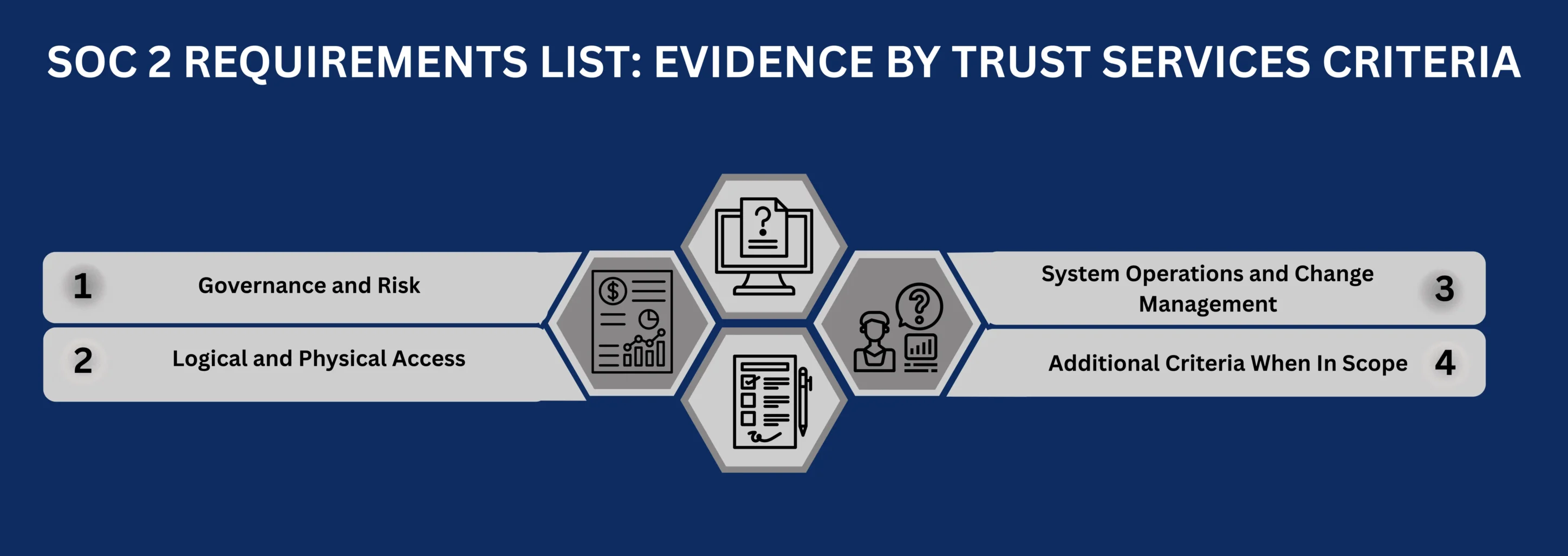
The evidence required to support a SOC 2 audit varies by Trust Services Criteria category and the controls under examination. For the Security category, evidence typically includes access provisioning and de-provisioning records, multi-factor authentication configuration documentation, firewall and network segmentation records, vulnerability scanning and penetration testing reports, security awareness training completion logs, and incident response records.
For the Availability category, evidence includes monitoring system outputs, uptime metrics, capacity planning documentation, and disaster recovery test results. For Processing Integrity, transaction processing logs, error detection and correction records, and data validation procedure documentation are relevant. For Confidentiality, data classification policies, encryption configuration evidence, and data retention and disposal records are examined. For Privacy, privacy notice documentation, consent records, data subject request handling procedures, and data flow mapping documentation are assessed. The auditor selects evidence samples appropriate to the examination period and the frequency of each control activity.
- ✓Information security policy and supporting control policies
- ✓Risk assessment documentation covering threats, vulnerabilities, and likelihood evaluations
- ✓Access control records including user provisioning, de-provisioning, and periodic access reviews
- ✓Change management records demonstrating authorization and testing of system changes
- ✓Incident response plan and documented incident log covering the SOC 2 observation period
- ✓Vendor and subservice organization management records and assessments
- ✓Security awareness training completion records for relevant personnel
- ✓Business continuity and disaster recovery plans with documented test results
- ✓Trust Services Criteria and Control Documentation Requirements
- ✓System Description and Management Responsibilities
- ✓Evidence Requirements Across Trust Services Criteria Categories
SOC 2 Certification Scope and the Independent Decision Framework
Defining and Bounding the SOC 2 Examination Scope
The scope of a SOC 2 examination determines which systems, processes, controls, and Trust Services Criteria categories are subject to the auditor’s evaluation. Scope definition requires the organization’s management and the Licensed CPA Firm to identify the principal services covered by the report, the system components supporting those services, the Trust Services Criteria categories applicable to the service commitments, and the organizational and geographic boundaries of the examination.
For Miami-based organizations with complex operating environments — including companies with offices spanning Brickell, Coral Gables, and Doral, or organizations utilizing multiple cloud service providers and third-party subservice organizations — scope definition is a substantive activity that directly affects the comprehensiveness and usefulness of the resulting SOC 2 attestation report. Subservice organizations may be included in scope under the inclusive method or excluded and described under the carve-out method, with corresponding implications for how the auditor addresses their controls in the SOC 2 examination.
Independent Certification Decision and Attestation Opinion
The SOC 2 attestation opinion is determined independently by the Licensed CPA Firm based on the results of the examination procedures applied. The auditor’s opinion is not influenced by the organization’s commercial interests or the outcome desired by management. An unqualified opinion indicates that, in the auditor’s professional judgment, controls are suitably designed and — for a Type 2 SOC 2 examination — operating effectively, and that the system description presents the system fairly in all material respects.
A qualified opinion, adverse opinion, or disclaimer of opinion indicates that material exceptions were identified, or that the auditor was unable to obtain sufficient appropriate evidence. The independence of the attestation opinion is fundamental to the value of the SOC 2 report as an assurance mechanism. Report recipients rely on the Licensed CPA Firm’s professional standing and objectivity to conclude that the attestation reflects an objective evaluation rather than a management self-assessment.
Report Validity, Ongoing Monitoring, and Recertification
A SOC 2 report does not carry a defined expiration date, but the practical expectation in enterprise procurement and vendor management is that a report remains current for twelve months from the end of its examination period. Organizations that require ongoing SOC 2 compliance status in active customer relationships across Miami typically conduct annual SOC 2 Type 2 examinations to ensure a current report is available at all times.
Between examinations, management is responsible for maintaining the control environment described in the report, monitoring control operation for deviations, and addressing changes in the system environment that may affect the accuracy of the prior report’s system description. Significant changes to in-scope systems, infrastructure, or service offerings may necessitate a supplemental examination or an expanded scope in the subsequent annual SOC 2 audit. Control monitoring responsibility between examinations rests with the organization’s management, not the Licensed CPA Firm.
Benefits of SOC 2 Certification for Miami-Based Organizations
SOC 2 Certification provides independently verified evidence that an organization’s controls address the applicable Trust Services Criteria. Unlike self-assessments or questionnaire-based vendor reviews, a SOC 2 examination conducted by a Licensed CPA Firm applies structured audit procedures — inspection, inquiry, observation, and re-performance — to verify that controls are not merely documented but actually operating as described.
For Miami technology companies, SOC 2 Certification validates the control environment against an objective external standard. This enables organizations to respond to enterprise vendor questionnaires with a single comprehensive report rather than repeated ad hoc security reviews. The independently verified attestation is directly extractable and verifiable by enterprise procurement teams, reducing the time and administrative burden of vendor security review cycles for both the organization and its customers.
SOC 2 Certification for Miami companies seeking to serve enterprise, financial services, or regulated-sector customers provides a structured mechanism for demonstrating security and operational control standards that procurement processes recognize and accept. In markets where multiple competing vendors offer technically comparable services, a current SOC 2 Type 2 report — evidencing a full observation period of operating effectiveness — differentiates the organization from competitors that lack independent attestation.
For Miami fintech companies targeting bank and credit union customers, healthcare technology organizations pursuing hospital system contracts, and SaaS providers seeking to onboard Fortune 500 clients, SOC 2 attestation serves as a qualification threshold enabling entry into procurement processes that would otherwise be inaccessible. The report also reduces the volume of one-off security questionnaires and custom due diligence requests from existing customers, streamlining ongoing vendor relationship management.
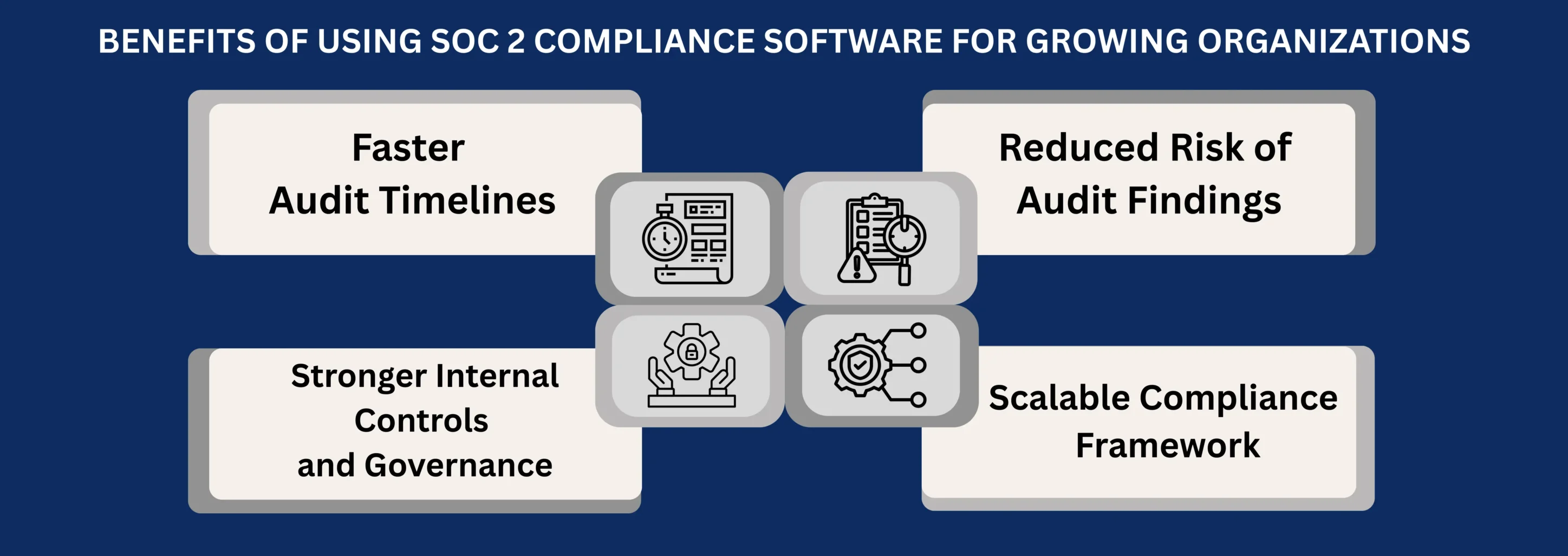
- ✓Independent evidence-based validation of control design and operating effectiveness against AICPA Trust Services Criteria
- ✓Recognition in enterprise vendor security review and procurement qualification processes
- ✓Reduction of ad hoc vendor security questionnaire burden through a single transferable SOC 2 attestation report
- ✓Structured documentation of information security controls supporting internal governance and oversight
- ✓Alignment with financial sector vendor due diligence requirements applicable to organizations serving regulated institutions
- ✓Demonstrated privacy and confidentiality control structure relevant to FIPA and international data protection expectations
- ✓Ongoing SOC 2 audit cycle establishing a continuous improvement framework for control monitoring and maintenance
- ✓Support for international business development through recognition of AICPA attestation standards by global counterparties
- ✓Independent Third-Party Validation of Control Effectiveness
- ✓Competitive Positioning in Enterprise and Financial Sector Markets
Industries and Business Sectors in Miami Seeking SOC 2 Certification
Financial Services, Fintech, and Digital Asset Organizations
Financial services organizations, fintech platforms, and cryptocurrency and digital asset businesses operating in Brickell, Downtown Miami, and the broader South Florida financial ecosystem are among the most active seekers of SOC 2 Certification in Miami. Payment technology companies, wealth management platforms, lending technology providers, digital banking infrastructure organizations, and cryptocurrency exchanges all handle high volumes of sensitive financial and personal data.
Regulated counterparties — including banks, broker-dealers, and investment advisers — are required to protect this data through structured vendor oversight. A SOC 2 examination provides the independent attestation these counterparties need to document their vendor oversight activities. Organizations in the digital asset and blockchain technology space also pursue SOC 2 audit engagements in Miami as institutional investors and custodians apply equivalent vendor security standards to digital asset service providers as they do to traditional financial technology vendors.
Healthcare Technology, SaaS, Cloud, and Logistics Organizations
Healthcare technology companies operating across Miami-Dade County — including health information exchanges, electronic health record platforms, telehealth providers, and revenue cycle management organizations — pursue SOC 2 attestation to document the security and confidentiality controls protecting patient data. SaaS organizations and cloud service providers serving enterprise and regulated-sector customers across Miami Beach, Doral, and Coral Gables commonly include SOC 2 examination as a standard component of their vendor qualification package.
Logistics and international trade organizations in Doral — a primary logistics hub for Latin American and Caribbean commerce — handle sensitive shipper, importer, and trade finance data that supply chain counterparties and customs authorities require to be protected under structured information security programs. E-commerce organizations, AI companies, cybersecurity firms, and insurance technology organizations across Miami similarly pursue SOC 2 compliance as a standard element of enterprise customer onboarding and regulatory alignment.
SOC 2 vs. Other Security Certifications for Miami Organizations
SOC 2 vs. ISO 27001
SOC 2 and ISO 27001 are both recognized information security frameworks, but they differ in structure, governance, and market application. SOC 2 is an attestation standard governed by the AICPA, applicable specifically to service organizations, and evaluated by a Licensed CPA Firm through an examination engagement under AT-C Section 205. The resulting SOC 2 report is specific to the services examined and the Trust Services Criteria applied.
ISO 27001 is an international management system standard governed by ISO and evaluated by an accredited certification body through a certification audit, resulting in a certificate of conformance applicable to the organization’s information security management system. For Miami-based organizations serving North American enterprise customers, SOC 2 examination is typically the primary requirement. Organizations expanding into European markets or serving international counterparties may find ISO 27001 certification additionally recognized. The two standards are not mutually exclusive — some organizations pursue both simultaneously, designing a single control environment that satisfies the requirements of each framework.
SOC 2 vs. SOC 1 and SOC 3 Reports
The SOC report suite issued under AICPA standards includes SOC 1, SOC 2, and SOC 3 reports, each serving a distinct assurance purpose. A SOC 1 report addresses controls relevant to a user entity’s internal controls over financial reporting (ICFR) — it applies to service organizations whose services directly affect how their customers’ financial statements are prepared. A SOC 2 report addresses controls relevant to the Trust Services Criteria and is applicable to service organizations handling customer data, supporting technology systems, or delivering cloud services.
A SOC 3 report covers the same subject matter as a SOC 2 report but is formatted for general public distribution and does not include the detailed control testing descriptions found in a full SOC 2 report. For most Miami technology companies and service organizations handling sensitive customer data, SOC 2 examination is the applicable standard. SOC 1 is relevant only where services directly affect a user entity’s financial reporting, and SOC 3 serves as a public-facing summary that may accompany a SOC 2 report but does not replace it for procurement purposes.
FAQ
▶
What is SOC 2 Certification and who issues SOC 2 reports in Miami?
▶
What is the difference between a SOC 2 Type 1 and a SOC 2 Type 2 report?
▶
Which Trust Services Criteria categories should a Miami organization include in its SOC 2 scope?
▶
How long does a SOC 2 Type 2 examination take for a Miami organization?
▶
Does SOC 2 attestation establish compliance with Florida’s FIPA or the Florida Digital Bill of Rights?
▶
How often must a SOC 2 audit be conducted to maintain current attestation status?
▶
What types of organizations in Miami require SOC 2 certification?
▶
Is a SOC 2 report publicly available or restricted to specific recipients?
SOC 1 VS SOC 2: WHICH REPORT YOUR CUSTOMERS ACTUALLY ASK FOR
If you sell SaaS or provide outsourced services, you have likely been asked for a SOC report. However, the follow-up question is rarely easy to answer…

AICPA Issues New Guidance for Peer Reviewers Evaluating SOC 2 Engagements
AICPA SOC 2 guidance has been issued to help peer reviewers identify quality risks associated with SOC 2 engagements as the use of compliance automati…
SOC 2 Certified: What Does It Mean for Your Business
For companies that handle sensitive data or run cloud-based services, the question “Can you provide your SOC 2 report?” carries enormous weight. Yet, …
Get In Touch
have a question? let us get back to you.