
ISO 27001 Certification in Miami
ISO 27001 Certification in Miami is issued by CertPro CPA LLC, a Licensed CPA Firm operating as an independent third-party certification body. CertPro evaluates organizations against the requirements of ISO/IEC 27001:2022 and issues certification based on objective audit findings — functioning strictly as a certification body, not as a consulting or advisory firm. Certification decisions are made by an independent certification committee following a structured two-stage ISO 27001 audit process.
OUR CLIENTS









ISO 27001 Certification for Miami-Based Financial and Technology Organizations
ISO 27001 Certification in Miami is issued by CertPro CPA LLC, a Licensed CPA Firm operating as an independent third-party certification body. CertPro evaluates organizations against the requirements of ISO/IEC 27001:2022 and issues certification based on objective audit findings — functioning strictly as a certification body, not as a consulting or advisory firm. Certification decisions are made by an independent certification committee following a structured two-stage ISO 27001 audit process.
Miami’s position as a major financial center, international trade hub, and emerging technology ecosystem creates structured demand for ISO 27001 ISMS certification across a broad range of organizations. Banks, fintech companies, SaaS providers, healthcare technology organizations, insurance businesses, cloud service providers, AI companies, cryptocurrency and digital asset firms, telecommunications providers, logistics and international trade businesses, e-commerce companies, and cybersecurity organizations operating across Brickell, Downtown Miami, Miami Beach, Coral Gables, Doral, and the broader South Florida metropolitan area seek ISO 27001 Certification in Miami to demonstrate independent verification of their information security controls to clients, enterprise procurement teams, and regulated counterparties.
ISO 27001 certification is based on the ISO/IEC 27001:2022 standard published by the International Organization for Standardization (ISO) and the International Electrotechnical Commission (IEC). The standard specifies requirements for establishing, implementing, maintaining, and continually improving an Information Security Management System (ISMS). The ISMS framework addresses the confidentiality, integrity, and availability of information assets through a structured, risk-based approach.
Annex A of ISO/IEC 27001:2022 contains 93 controls organized across four domains: Organizational controls (37), People controls (8), Physical controls (14), and Technological controls (34). Certification is achieved when an independent audit body confirms that an organization’s ISMS conforms to all requirements set out in Clauses 4 through 10 of the standard, and that applicable Annex A controls are addressed in the Statement of Applicability.
Miami’s financial sector — anchored in Brickell’s banking district, which hosts international banks, private equity firms, wealth management organizations, and fintech companies serving Latin American and Caribbean markets — creates specific expectations for ISO 27001 compliance among vendors and technology service providers. Enterprise procurement processes in Miami’s financial services sector increasingly require ISO 27001 certification audit evidence from SaaS providers, cloud service vendors, managed service providers, and technology firms before awarding contracts or granting system access.
ISO 27001 Certification in Miami provides an independently verified, internationally recognized credential that satisfies these procurement requirements and demonstrates conformance with ISO/IEC 27001:2022 to enterprise clients, regulators, and international counterparties.
Florida’s regulatory environment adds further context for organizations pursuing ISO 27001 compliance in Miami. The Florida Information Protection Act (FIPA) establishes data breach notification requirements and information security obligations for organizations handling personal information of Florida residents. The Florida Digital Bill of Rights introduces additional privacy requirements for certain organizations.
While ISO 27001 certification does not automatically establish compliance with FIPA, the Florida Digital Bill of Rights, HIPAA, PCI DSS, or other applicable laws and regulations, the structured ISMS framework that ISO 27001 certification requires organizations to implement is directly relevant to managing data security obligations under these regulatory requirements. Organizations in Miami’s healthcare technology, financial services, insurance, telecommunications, and digital commerce sectors frequently pursue ISO 27001 Certification in Miami as a foundation for demonstrating information security governance to regulators, enterprise clients, and international business partners.

ISO 27001 Certification Audit Process for Organizations in Miami
The ISO 27001 certification audit process follows a defined sequence of stages — from initial application through certification issuance and ongoing surveillance — that applies consistently to all organizations seeking ISO 27001 Certification in Miami. Each stage produces documented outputs that collectively form the basis for the certification committee’s independent decision.
CertPro conducts each stage under an evidence-based, audit-framed methodology that evaluates conformance with ISO/IEC 27001:2022 requirements without providing consulting, implementation, or advisory services at any point in the process.
The Stage 1 audit is a structured review of the organization’s ISMS documentation against the requirements of ISO/IEC 27001:2022. At this stage, the auditor evaluates the scope of the ISMS, the information security policy, the risk assessment methodology and documented results, the risk treatment plan, the Statement of Applicability (SoA), and the supporting documentation required by Clauses 4 through 10.
The Stage 1 audit determines whether the organization’s documented ISMS is sufficiently developed to proceed to the Stage 2 audit and identifies any areas where the documentation does not yet meet the standard’s requirements. Stage 1 audit findings are documented and communicated to the organization prior to the Stage 2 scheduling decision.
For organizations pursuing ISO 27001 Certification in Miami, the Stage 1 audit reviews documentation that must address the specific information assets, threat landscape, and risk environment relevant to the organization’s operations. Miami-based financial institutions, fintech firms, and healthcare technology organizations typically maintain ISMS documentation that reflects the regulatory environment, data types, third-party relationships, and technology infrastructure relevant to their sector.
The Stage 1 audit does not assess control implementation or operational effectiveness — those evaluations occur during the Stage 2 ISO 27001 audit. However, the Stage 1 review determines whether the documented risk assessment has identified risks appropriate to the organization’s context and whether the Statement of Applicability accurately reflects control selection decisions based on the risk treatment plan.
The Stage 2 audit evaluates the implementation and operational effectiveness of the organization’s ISMS controls against the requirements of ISO/IEC 27001:2022. Auditors review evidence of control implementation across the four Annex A control domains — Organizational, People, Physical, and Technological — and assess whether the controls identified in the Statement of Applicability are operating as designed.
The Stage 2 audit includes interviews with relevant personnel, review of operational records and control evidence, and observation of implemented processes. Nonconformities identified during the Stage 2 audit are classified and documented in the audit report. Major nonconformities must be resolved before certification can be issued; minor nonconformities must be addressed within a defined corrective action timeframe.
The Stage 2 ISO 27001 audit for Miami-based organizations evaluates controls across the specific operational context of each organization — including cloud infrastructure configurations, remote access controls, vendor management processes, physical security at Miami office and data center locations, access management for financial or healthcare data systems, and incident response procedures.
For organizations in sectors such as cryptocurrency and digital assets, AI, telecommunications, or international trade logistics, the audit scope addresses the specific information assets and risk treatment decisions documented in the organization’s ISMS. The Stage 2 audit concludes with a detailed audit report that forms the basis for the certification committee’s review and decision.
Following the Stage 2 audit and resolution of any major nonconformities, the audit report is reviewed by CertPro’s independent certification committee. The committee evaluates the audit findings and determines whether the organization’s ISMS conforms to all requirements of ISO/IEC 27001:2022. Certification is issued for a three-year period, subject to annual surveillance audits.
The ISO 27001 certification audit decision is made independently of the audit team and is based solely on documented audit evidence. The issued certificate specifies the certified ISMS scope, the certification standard, and the certification validity period.
Surveillance audits are conducted annually during the three-year certification cycle to verify that the certified ISMS continues to conform to ISO/IEC 27001:2022 requirements. Surveillance audits are less extensive than the initial certification audit but must cover key ISMS elements — including management review, internal audit results, corrective actions, and any significant changes to the organization’s information security environment.
At the end of the three-year certification cycle, a recertification audit is conducted to renew the certificate for a further three-year period. Organizations that have not yet transitioned from ISO/IEC 27001:2013 to the current 2022 version of the standard face a transition deadline of October 31, 2025, after which only certifications issued against the 2022 standard remain valid.
| Audit Stage | Key Activities | Output |
|---|---|---|
| Application Review | Scope confirmation, audit program determination, conflict of interest check | Audit program and scheduling confirmation |
| Stage 1 Audit | ISMS documentation review, SoA and risk assessment evaluation, Clauses 4–10 review | Stage 1 audit report with findings |
| Stage 2 Audit | Control implementation review, evidence assessment, Annex A control evaluation, nonconformity identification | Stage 2 audit report with nonconformity classification |
| Certification Committee Review | Independent review of audit findings, nonconformity resolution confirmation, ISO 27001 certification decision | ISO 27001 certificate (3-year validity) |
| Surveillance Audit (Annual) | ISMS maintenance review, corrective action verification, change management assessment | Surveillance audit report and continued certification status |
| Recertification Audit | Full ISMS re-evaluation against ISO/IEC 27001:2022 requirements | Renewed certificate for further 3-year period |
- ✓Stage 1 Audit: Documentation and Readiness Review
- ✓Stage 2 Audit: ISMS Implementation and Control Effectiveness
- ✓Certification Decision, Surveillance Audits, and Recertification
ISO 27001 ISMS Requirements Evaluated During Certification
ISO 27001 certification requires an organization to demonstrate conformance with the ISMS requirements specified in ISO/IEC 27001:2022, Clauses 4 through 10, and to address applicable controls from Annex A. The ISO 27001 certification audit evaluates both the design adequacy of the ISMS — whether it is structured to address the organization’s identified risks — and the operational effectiveness of implemented controls.
The following sections describe the core ISMS requirements evaluated during ISO 27001 certification audits for organizations in Miami.
ISO/IEC 27001:2022 requires organizations to maintain documented information that supports the operation and effectiveness of the ISMS. Core mandatory documentation includes the ISMS scope statement, the information security policy, the risk assessment methodology and documented results, the risk treatment plan, and the Statement of Applicability (SoA).
The SoA is a critical document that lists all Annex A controls, identifies which controls are applicable to the organization’s ISMS, provides justification for the inclusion or exclusion of each control, and confirms the implementation status of applicable controls. For organizations in Miami’s financial services, healthcare technology, and technology sectors, the SoA typically addresses a broad set of Annex A controls relevant to cloud infrastructure security, access management, vendor management, incident response, and business continuity.
In addition to the core mandatory documents, ISO/IEC 27001:2022 requires organizations to retain documented evidence of ISMS operations. This includes records of management reviews, internal audit programs and results, training and competence records, corrective action records, and evidence of monitoring and measurement activities.
The ISO 27001 certification audit evaluates whether the organization maintains and retains documented information at the level of detail required to demonstrate effective ISMS operation. Documented information may be maintained in any format or medium — paper, electronic records, or integrated information security management platforms — provided that appropriate controls govern the integrity, confidentiality, and availability of the documentation itself.
ISO/IEC 27001:2022 requires organizations to establish and apply a documented information security risk assessment process. The risk assessment must identify information security risks associated with the organization’s information assets, assess the likelihood and potential consequences of identified risks, and evaluate the risks against defined risk acceptance criteria. The risk assessment process must produce comparable and reproducible results and must be conducted at planned intervals or whenever significant changes occur in the organization’s information security environment.
For Miami-based organizations managing financial data, healthcare information, personal data of Florida residents, or sensitive client information, the risk assessment must address the specific threat landscape relevant to those information types and the organization’s operational context. This is a key focus area in any ISO 27001 compliance review for Miami organizations.
Following the risk assessment, ISO/IEC 27001:2022 requires the organization to implement a risk treatment process that selects appropriate risk treatment options — typically risk modification through the application of controls, risk acceptance, risk avoidance, or risk sharing. The risk treatment plan documents the selected controls, the information security risk owners, and the implementation status of each control.
The relationship between the risk treatment plan, the selected controls, and the Annex A controls listed in the Statement of Applicability must be traceable and auditable. During the ISO 27001 certification audit, the auditor evaluates whether the risk treatment plan addresses all identified risks, whether control selection decisions are justified, and whether implemented controls effectively reduce risks to an acceptable level consistent with the organization’s documented risk acceptance criteria.
ISO/IEC 27001:2022 Annex A contains 93 information security controls organized across four control domains. Organizational controls (37 controls) address policies, roles and responsibilities, asset management, supplier relationships, incident management, business continuity, and compliance. People controls (8 controls) address security requirements for personnel before, during, and after employment. Physical controls (14 controls) address physical security of premises, equipment, and supporting infrastructure. Technological controls (34 controls) address access management, cryptography, network security, vulnerability management, configuration management, data masking, data leakage prevention, monitoring, and web filtering, among other areas.
During the ISMS certification audit, auditors evaluate the organization’s implementation of applicable controls from each domain as documented in the Statement of Applicability.
- ✓Organizational controls (37): Information security policies, roles, asset management, supplier security, incident management, business continuity planning, and compliance management
- ✓People controls (8): Pre-employment screening, terms and conditions of employment, security awareness training, disciplinary processes, and post-employment responsibilities
- ✓Physical controls (14): Physical security perimeters, entry controls, securing offices and facilities, equipment protection, clear desk and screen policies, and physical media handling
- ✓Technological controls (34): Access management, authentication, cryptography, network security, secure development, vulnerability management, configuration management, data leakage prevention, and security monitoring
- ✓ISMS Documentation Requirements
- ✓Risk Assessment and Risk Treatment Requirements
- ✓Annex A Control Domains: Organizational, People, Physical, and Technological
Why Organizations in Miami Pursue ISO 27001 Certification
Organizations in Miami pursue ISO 27001 Certification in Miami for a range of interconnected reasons tied to the city’s specific business ecosystem, regulatory environment, and competitive landscape. Miami’s role as a gateway to Latin American and Caribbean markets — combined with the concentration of international financial institutions in Brickell and the growth of the technology and innovation sector in areas such as Wynwood, Coral Gables, and Doral — creates structured demand for independently verified information security credentials.
Enterprise clients, financial sector procurement teams, government contractors, and international business partners increasingly require ISO 27001 compliance evidence from vendors and service providers before engaging in business relationships involving sensitive data or critical system access.
Enterprise Vendor Security Reviews and Procurement Requirements
Financial institutions, healthcare organizations, insurance companies, and large enterprises operating in Miami routinely conduct vendor security reviews as part of their third-party risk management programs. SaaS providers, cloud service vendors, managed service providers, and technology firms that cannot demonstrate ISO 27001 certification audit evidence may be excluded from enterprise vendor lists or required to complete extensive, time-consuming security questionnaires for each client engagement.
ISO 27001 Certification in Miami provides a standardized, independently verified credential that satisfies the information security due diligence requirements of enterprise procurement processes across multiple client relationships simultaneously — significantly reducing the repetitive burden of client-by-client security assessments.
Miami’s Brickell financial district hosts a significant concentration of international banks, private banks, asset management firms, and fintech companies serving Latin American institutional and high-net-worth clients. These organizations frequently require ISO 27001 certification from technology vendors as a baseline security assurance standard — particularly for vendors handling financial data, customer information, or transaction processing systems.
Similarly, Miami-based healthcare technology organizations and digital health companies providing services to hospitals, health systems, and insurance organizations face procurement requirements that include ISO 27001 compliance verification as part of vendor onboarding processes. ISO 27001 certification for Miami companies in these sectors provides an objective basis for satisfying procurement requirements without requiring client-specific security assessments for each new engagement.
International SaaS Expansion and Cross-Border Business Requirements
Miami’s position as a Latin American business hub means that many Miami-based technology companies, SaaS providers, and fintech organizations operate across multiple jurisdictions with varying information security regulatory requirements. ISO 27001 certification is internationally recognized and accepted in procurement processes across North America, Europe, Latin America, and the Asia-Pacific region.
For Miami-based organizations expanding into European markets, ISO 27001 Certification in Miami provides evidence of a structured ISMS that supports GDPR compliance documentation — though ISMS certification does not independently establish GDPR compliance. Similarly, Miami fintech companies expanding into regulated Latin American financial markets frequently cite ISO 27001 certification as a credential that supports regulatory authorization applications and enterprise client due diligence in those markets.
Cryptocurrency, AI, and Emerging Technology Sectors in Miami
Miami has emerged as a significant hub for cryptocurrency and digital asset businesses, AI companies, and blockchain technology organizations. These sectors handle sensitive financial, transactional, and personal data in environments that present distinct information security risks — including smart contract vulnerabilities, digital wallet security, private key management, and AI model data security.
Organizations in these sectors pursue ISO 27001 Certification in Miami to demonstrate that their information security controls have been independently assessed against a recognized international standard. ISO 27001 compliance among Miami cryptocurrency and AI organizations signals structured risk management and control implementation to institutional investors, exchange partners, regulated financial counterparties, and enterprise clients who require independent security assurance before engaging with organizations in these emerging sectors.
Benefits of ISO 27001 Certification for Miami-Based Organizations
ISO 27001 Certification in Miami provides independently verified evidence that an organization’s Information Security Management System has been assessed against the requirements of ISO/IEC 27001:2022 by a Licensed CPA Firm operating as an independent certification body. The following benefits reflect the objective outcomes of achieving and maintaining ISMS certification — not advisory claims or promotional representations.
ISO 27001 certification provides an independently verified attestation that the organization’s ISMS controls have been assessed by a qualified third-party certification body against the requirements of ISO/IEC 27001:2022. This independent validation is distinct from self-assessments, internal audits, or vendor-provided security ratings — it represents a structured ISO 27001 audit conclusion by an external body with no financial interest in the outcome of the certification decision.
For Miami-based organizations operating in sectors such as financial services, healthcare technology, insurance, and cloud services, this independent third-party validation carries significantly more weight in enterprise client due diligence and regulatory assessments than self-reported compliance claims or internal security attestations.
The structured audit methodology applied in the ISO 27001 certification audit evaluates control design adequacy and operational effectiveness through review of documented evidence, personnel interviews, and observation of implemented processes. This methodology produces a documented audit report that identifies any nonconformities with ISO/IEC 27001:2022 requirements and confirms areas where the ISMS conforms to the standard.
Organizations that have achieved ISMS certification in Miami can reference the issued certificate and audit scope in responses to client security questionnaires, regulatory inquiries, procurement due diligence requests, and contractual representations regarding information security standards — providing an objective, audited basis for those representations.
ISO 27001 certification requires organizations to implement and maintain a structured, risk-based approach to information security management. The risk assessment and risk treatment requirements of ISO/IEC 27001:2022 establish a documented framework for identifying, evaluating, and addressing information security risks on an ongoing basis — not as a one-time exercise.
Annual surveillance audits conducted as part of the three-year ISMS certification cycle verify that the certified ISMS continues to address the organization’s evolving risk environment, incorporates corrective actions for identified nonconformities, and reflects significant changes in the organization’s technology environment, business operations, or threat landscape.
ISO 27001 certification is recognized in enterprise procurement processes across Miami’s financial services, healthcare, insurance, technology, and government contractor sectors as an independently verified baseline security credential. Organizations holding a current ISO 27001 certificate issued by an independent certification body can reference it in vendor qualification processes, request for proposal (RFP) responses, contract security schedules, and regulatory submissions.
For Miami-based technology companies, SaaS providers, and managed service organizations competing for contracts with regulated financial institutions, health systems, or government entities, ISO 27001 Certification in Miami provides a documented credential that satisfies baseline information security requirements — without requiring additional client-specific security assessments for each opportunity.
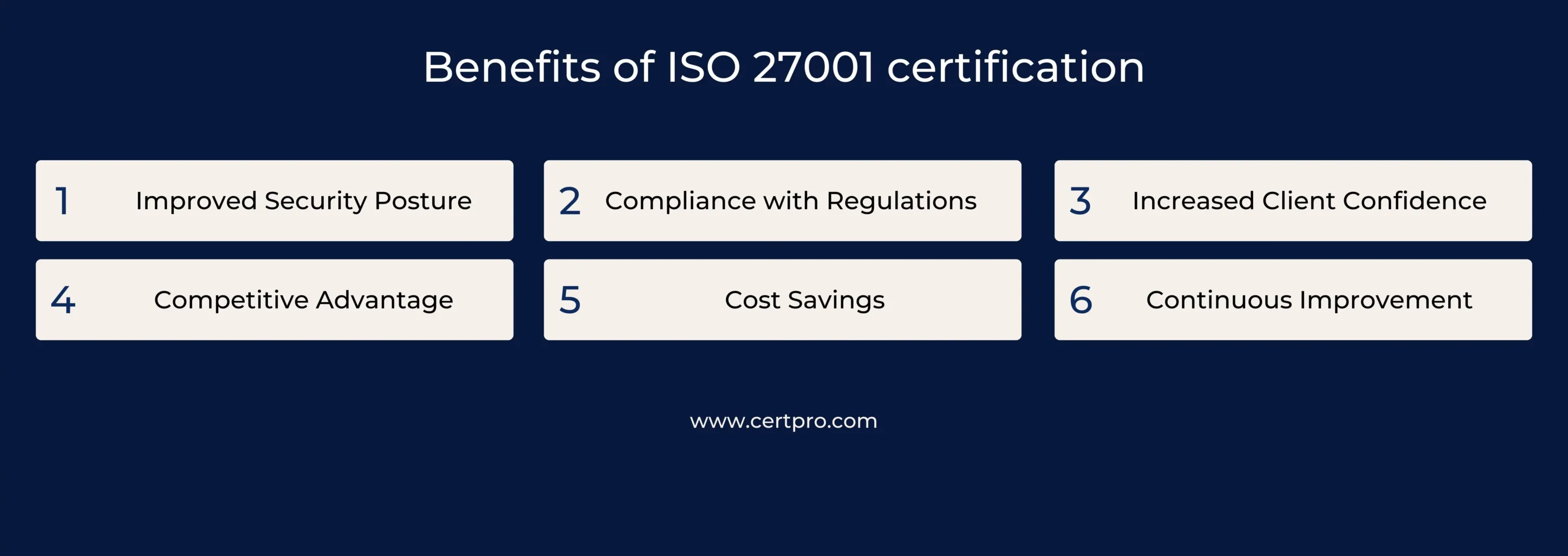
- ✓Independently verified evidence of ISMS conformance with ISO/IEC 27001:2022 issued by a Licensed CPA Firm
- ✓Satisfaction of enterprise vendor security review and procurement due diligence requirements across multiple client relationships
- ✓Internationally recognized ISO 27001 certification credential supporting cross-border business development in Latin American, European, and North American markets
- ✓Structured risk management framework that addresses information security risks relevant to Miami’s financial, healthcare, technology, and digital asset sectors
- ✓Annual surveillance audit oversight that verifies ongoing ISMS conformance and addresses changes in the organization’s risk environment
- ✓Documented audit basis for contractual representations regarding information security standards and control implementation
- ✓Reduced repetitive burden of client-by-client security questionnaire completion for vendor onboarding processes
- ✓Objective third-party validation through ISO 27001 compliance that distinguishes certified organizations from self-assessed competitors in enterprise procurement evaluation
- ✓Independent Third-Party Validation of Information Security Controls
- ✓Structured Risk Management and Ongoing Surveillance Oversight
- ✓Recognition in Financial Sector and Enterprise Procurement Processes
ISO 27001 Certification Scope and Independent Decision Framework
The scope of ISO 27001 Certification in Miami is defined by the organization and reviewed during the certification audit to confirm that it accurately represents the boundaries and applicability of the ISMS. The certification scope statement specifies the organizational units, processes, locations, and information assets included within the ISMS.
The audit evaluates whether the defined scope is appropriate — neither artificially narrow to exclude significant information security risks nor so broad that the ISMS documentation and controls do not adequately cover all included elements. For Miami-based organizations with multiple office locations across Brickell, Downtown Miami, Coral Gables, Doral, or additional regional offices, the certification scope must address information security controls at all locations included within the defined ISMS boundary.
Evidence-Based Assessment and Nonconformity Review
The ISO 27001 certification audit is conducted using an evidence-based assessment methodology. Auditors evaluate conformance with ISO/IEC 27001:2022 requirements by reviewing documented information, interviewing personnel responsible for ISMS controls, and observing the operation of implemented processes. Audit conclusions are based on objective evidence — records, configurations, procedures, training logs, audit trails, and other documented information — rather than representations or assertions by the organization.
Nonconformities identified during the ISO 27001 audit are documented with reference to the specific requirement of ISO/IEC 27001:2022 that has not been met, along with the objective evidence supporting the nonconformity finding. Major nonconformities must be resolved with documented corrective actions and verified evidence before the certification committee can issue the certificate.
Minor nonconformities identified during the ISO 27001 audit must be addressed within a defined corrective action timeframe specified in the audit report. The organization must provide evidence of corrective actions taken and their effectiveness. The certification committee reviews the audit report — including all identified nonconformities and documented corrective action status — before making the certification decision.
The certification committee operates independently of the audit team to ensure that the certification decision is made objectively based on documented audit evidence. The issued ISO 27001 certificate specifies the certified ISMS scope, the certification standard (ISO/IEC 27001:2022), and the three-year certification validity period.
Conditions for Suspension, Withdrawal, and Recertification
ISO 27001 certification may be suspended or withdrawn if the certified organization fails to maintain conformance with ISO/IEC 27001:2022 requirements between certification audit cycles. Conditions that may result in suspension include failure to undergo scheduled surveillance audits, failure to resolve major nonconformities identified during surveillance audits within the required timeframe, significant breaches of the certified ISMS scope, or voluntary request for suspension by the organization.
Withdrawal of certification may occur when suspension is not resolved within a specified period, or when the organization no longer meets the fundamental requirements for ISMS certification. Organizations whose certifications have been suspended or withdrawn must undergo a new certification audit process before a certificate can be re-issued.
ISO 27001 Compliance and Florida Regulatory Context for Miami Organizations
ISO 27001 compliance in Miami operates within a specific regulatory context shaped by Florida state law, federal regulations applicable to financial services and healthcare organizations, and international data protection standards relevant to Miami’s cross-border business activities. Understanding the relationship between ISO 27001 certification and applicable regulatory requirements is important for organizations evaluating the role of ISMS certification within their broader compliance and governance framework.
Florida Information Protection Act (FIPA) and Florida Digital Bill of Rights
The Florida Information Protection Act (FIPA) requires organizations that collect or maintain personal information of Florida residents to implement reasonable measures to protect that information from unauthorized access, acquisition, or disclosure. FIPA also establishes data breach notification requirements that mandate timely notification to affected individuals and the Florida Department of Legal Affairs in the event of a qualifying security breach. The Florida Digital Bill of Rights, which became effective January 1, 2024, introduces additional privacy rights for Florida consumers and obligations for qualifying data controllers and processors.
ISO 27001 compliance pursued by Miami organizations as a structured information security management framework is directly relevant to implementing and documenting the reasonable security measures referenced in FIPA — though ISO 27001 certification does not independently establish FIPA compliance or eliminate FIPA obligations.
For Miami-based healthcare technology organizations, the HIPAA Security Rule establishes specific administrative, physical, and technical safeguard requirements for protected health information (PHI). ISO 27001’s Annex A control domains address many of the same safeguard categories required by the HIPAA Security Rule — including access management, audit controls, integrity controls, and transmission security — making ISO 27001 certification audit evidence relevant to HIPAA compliance documentation.
Similarly, Miami-based financial services organizations subject to the Gramm-Leach-Bliley Act (GLBA) Safeguards Rule may reference ISO 27001 certification as evidence of a structured information security program. However, ISO 27001 certification does not independently establish compliance with HIPAA, GLBA, PCI DSS, or other applicable federal regulations. Organizations remain responsible for specific regulatory compliance independently of their ISMS certification status.
ISO 27001 and Sector-Specific Regulatory Alignment in Miami
Miami’s diverse business ecosystem spans multiple regulated sectors with distinct information security regulatory requirements. Financial institutions supervised by the Florida Office of Financial Regulation, the Federal Reserve, the OCC, or the FDIC face information security examination requirements that may reference NIST frameworks, FFIEC guidance, or ISO standards as benchmarks for evaluating information security program adequacy. ISO 27001 certification audit evidence is recognized in regulatory examinations and supervisory inquiries in the financial sector as evidence of structured information security governance.
For Miami’s insurance sector, the NAIC Insurance Data Security Model Law — adopted in Florida — requires licensed insurers to implement information security programs that include risk assessments, safeguard implementation, and incident response plans. These are areas directly addressed by the ISO/IEC 27001:2022 ISMS requirements, making ISO 27001 compliance particularly relevant for insurance organizations operating in Miami.
ISO 27001 Certification for Miami’s Key Business Sectors
ISO 27001 Certification in Miami is relevant across a broad range of business sectors that operate in the Miami metropolitan area and handle sensitive information in their daily operations. The following overview describes the specific relevance of ISO 27001 certification for key sectors in Miami’s economy — including the information security considerations most important to each sector’s operational context.
| Business Sector | Miami Concentration | Primary ISO 27001 Relevance |
|---|---|---|
| Financial Services and Fintech | Brickell, Downtown Miami | Client financial data protection, transaction processing security, regulatory vendor due diligence, ISO 27001 certification for Miami financial services organizations |
| Healthcare Technology and Digital Health | Miami Medical District, Doral | Protected health information (PHI), HIPAA alignment, health system vendor onboarding and ISO 27001 compliance requirements |
| SaaS and Cloud Service Providers | Coral Gables, Wynwood, Doral | Multi-tenant data security, enterprise client procurement requirements, cross-border data handling, ISO 27001 certification audit evidence |
| Cryptocurrency and Digital Assets | Miami, Downtown | Digital wallet security, key management, exchange partner due diligence, institutional investor ISO 27001 compliance requirements |
| Logistics and International Trade | Miami Port area, Doral | Supply chain data security, customs information protection, cross-border partner ISO 27001 compliance and security requirements |
| Insurance Organizations | Coral Gables, Miami | NAIC Model Law alignment, policyholder data protection, third-party vendor security management through ISO 27001 certification |
Fintech, Financial Services, and ISO 27001 Compliance Miami
ISO 27001 certification pursued by Miami financial services organizations reflects the specific information security expectations of Miami’s Brickell banking ecosystem and the broader South Florida financial sector. Fintech companies providing payment processing, lending technology, wealth management platforms, or digital banking services to financial institutions in Miami face vendor security review requirements that include ISO 27001 certification as a baseline credential.
ISO 27001 compliance demonstrated by Miami fintech organizations positions them more competitively in enterprise procurement processes with regulated financial institutions that require independently verified security credentials from technology vendors handling financial data, customer information, or system integrations with core banking infrastructure.
ISO 27001 Certification for Miami Technology Companies
ISO 27001 certification pursued by Miami technology companies supports enterprise client acquisition, contract retention, and competitive differentiation in Miami’s growing technology sector. SaaS providers, cloud infrastructure organizations, managed service providers, AI companies, and cybersecurity firms operating in Miami’s technology ecosystem increasingly encounter ISO 27001 certification requirements in enterprise RFP processes, vendor qualification programs, and contract security schedules.
ISO 27001 Certification in Miami provides technology companies with an independently verified credential that reduces the time and resources required for client-specific security due diligence — establishing a documented, audited information security baseline that can be referenced across multiple client relationships. For technology companies seeking to expand from Miami into international markets — particularly in Latin America, Europe, or North America — ISO 27001 certification provides a recognized security credential that supports market entry and enterprise client engagement across multiple jurisdictions.
FAQ
▶
What is ISO 27001 certification and what does it certify?
▶
Who provides ISO 27001 Certification in Miami?
▶
What is the ISO 27001 audit process for Miami organizations?
▶
What documentation is required for ISO 27001 certification?
▶
How long is ISO 27001 certification valid?
▶
Does ISO 27001 certification establish compliance with FIPA or HIPAA?
▶
What is the Statement of Applicability and why is it important?
▶
What is the transition deadline for ISO/IEC 27001:2022?
Get In Touch
have a question? let us get back to you.