
SOC 2 Certification in Salt Lake City
SOC 2 Certification in Salt Lake City is conducted by CertPro, a Licensed CPA Firm operating exclusively as an independent third-party audit and attestation body. CertPro performs SOC 2 examinations evaluated against the AICPA Trust Services Criteria (TSC), producing formal attestation reports that deliver objective, third-party verification of an organization’s control environment. CertPro does not provide consulting, advisory, or implementation services — its role is strictly that of an independent certification and attestation authority.
OUR CLIENTS










SOC 2 Certification for Salt Lake City’s Silicon Slopes Technology and Financial Ecosystem
SOC 2 Certification in Salt Lake City is conducted by CertPro, a Licensed CPA Firm operating exclusively as an independent third-party audit and attestation body. CertPro performs SOC 2 examinations evaluated against the AICPA Trust Services Criteria (TSC), producing formal attestation reports that deliver objective, third-party verification of an organization’s control environment. CertPro does not provide consulting, advisory, or implementation services — its role is strictly that of an independent certification and attestation authority.
Salt Lake City serves as the operational hub of the Silicon Slopes technology corridor — one of the most concentrated technology ecosystems in the western United States. The region hosts a dense cluster of SaaS providers, enterprise software companies, fintech platforms, healthcare technology firms, cybersecurity organizations, and venture-backed startups. All of these organizations process, store, or transmit sensitive customer data subject to enterprise vendor security requirements. As Salt Lake City’s technology sector matures and expands into national and international enterprise markets, SOC 2 attestation has become a standard vendor qualification requirement across procurement, third-party risk management, and regulatory alignment processes.
SOC 2 Certification is issued through a SOC 2 examination performed under the AICPA’s attestation standards — specifically AT-C Section 205, which governs examination engagements within the broader attestation framework underpinning SOC reporting. The examination evaluates whether an organization’s controls are designed and, for Type 2 reports, operating effectively over a defined period. The resulting attestation report is addressed to specified parties — typically enterprise customers, institutional clients, or regulators — seeking independent verification of a service organization’s control environment.
Organizations across Salt Lake City’s financial services, cloud infrastructure, SaaS, and healthcare technology sectors pursue SOC 2 compliance to satisfy enterprise procurement requirements, fulfill third-party risk management expectations, and demonstrate control effectiveness to regulated institutional clients. SOC 2 Certification in Salt Lake City is not a regulatory mandate, but it functions as a de facto standard in enterprise vendor due diligence. Financial institutions, health systems, and large enterprise customers routinely require SOC 2 attestation reports as a precondition for vendor onboarding. For the growing ecosystem of technology providers serving national and international enterprise markets, a SOC 2 audit conducted by an independent Licensed CPA Firm represents the most widely recognized mechanism for demonstrating data security and control effectiveness.
The distinction between SOC 2 compliance and SOC 2 Certification is material. Compliance refers to an organization’s internal adherence to policies and controls without independent verification. SOC 2 Certification — more precisely, SOC 2 attestation — refers to the outcome of an independent examination conducted by a Licensed CPA Firm, producing a formal report that third parties can rely upon. Organizations that have not undergone an independent SOC 2 examination cannot accurately represent themselves as SOC 2 certified, regardless of the controls they have implemented. CertPro’s engagement as an independent Licensed CPA Firm ensures that attestation reports reflect objective, evidence-based evaluation rather than self-assessment.

What Is SOC 2 Certification?
Definition and Governing Framework
SOC 2 Certification refers to the outcome of a SOC 2 examination — a formal, independent audit conducted by a Licensed CPA Firm under the American Institute of Certified Public Accountants (AICPA) attestation standards. The examination evaluates the design and operating effectiveness of an organization’s controls as they relate to one or more of the five Trust Services Criteria: Security, Availability, Processing Integrity, Confidentiality, and Privacy. The Security criterion is mandatory for all SOC 2 engagements. The remaining four criteria are included based on the scope of services the organization provides and the commitments it has made to its customers.
The AICPA Trust Services Criteria framework defines the specific control requirements against which a SOC 2 examination is evaluated. Each criterion contains common criteria and supplemental criteria addressing areas such as logical access, change management, risk assessment, monitoring activities, and incident response. The examination assesses whether an organization’s controls — as described in management’s system description — adequately address these criteria. The resulting SOC 2 attestation report contains the CPA firm’s opinion on whether the description is fairly presented and whether controls are suitably designed and, for Type 2 reports, operating effectively. SOC 2 compliance that Salt Lake City organizations demonstrate is validated through this independent examination process — not through self-declaration.
Trust Services Criteria: The Five Domains
The five Trust Services Criteria each address a distinct dimension of an organization’s control environment. Security — the foundational criterion present in every SOC 2 engagement — addresses whether the system is protected against unauthorized access, both physical and logical. Controls evaluated under Security include access controls, encryption, network security, vulnerability management, and incident response procedures. Availability addresses whether the system is available for operation and use as committed or agreed, examining controls related to performance monitoring, backup and recovery, and capacity management. Processing Integrity evaluates whether system processing is complete, valid, accurate, timely, and authorized — a criterion particularly relevant to financial processing and transaction platforms.
Confidentiality addresses whether information designated as confidential is protected as committed or agreed. Controls evaluated under this criterion include data classification, encryption of confidential data in transit and at rest, and disposal procedures. Privacy addresses the collection, use, retention, disclosure, and disposal of personal information in conformity with the entity’s privacy notice and with criteria set forth in the AICPA’s Generally Accepted Privacy Principles. For Salt Lake City fintech platforms, healthcare technology organizations, and SaaS companies handling personal data subject to state or federal privacy frameworks, the Privacy criterion is frequently included in the SOC 2 examination scope. Each criterion included in the agreed-upon scope requires specific evidence to support the auditor’s opinion.
| Trust Services Criterion | Primary Focus | Common Applicability |
|---|---|---|
| Security | Protection against unauthorized access — logical and physical | All SOC 2 engagements (mandatory) |
| Availability | System availability per commitments and agreements | Cloud infrastructure, SaaS, MSPs |
| Processing Integrity | Completeness, accuracy, and authorization of processing | Fintech, payment processors, data platforms |
| Confidentiality | Protection of information designated as confidential | Enterprise SaaS, data analytics, B2B platforms |
| Privacy | Collection, use, and disposal of personal information | Healthcare technology, consumer platforms, HR SaaS |
SOC 2 Type 1 vs. SOC 2 Type 2 Reports
SOC 2 reports are issued in two forms — Type 1 and Type 2 — which differ in the scope of the auditor’s evaluation. A SOC 2 Type 1 report, formally titled a Report on Management’s Description of a Service Organization’s System and the Suitability of the Design of Controls, evaluates the system description as of a specific point in time and assesses whether controls are suitably designed to meet the applicable Trust Services Criteria. A Type 1 report does not assess whether controls operated effectively over a period; it captures a snapshot of control design at the report date. Salt Lake City organizations frequently pursue Type 1 reports when entering enterprise sales cycles for the first time or when establishing an initial documented control environment.
A SOC 2 Type 2 report evaluates both control design and operating effectiveness over a defined observation period — typically a minimum of six months and commonly twelve months for mature programs. The auditor tests whether controls not only existed and were suitably designed, but actually functioned as described throughout the observation period. Enterprise customers, institutional clients, and regulated industry procurement teams consistently prefer SOC 2 Type 2 reports because they provide evidence of sustained control performance rather than a point-in-time design assessment. The SOC 2 attestation produced in a Type 2 engagement carries greater evidentiary weight in vendor risk assessments and is the standard expected by financial institutions, health systems, and large enterprise software buyers.
SOC 2 Certification Audit Process for Organizations in Salt Lake City
The SOC 2 audit process begins with scope definition — a structured determination of system boundaries, applicable Trust Services Criteria, and report type (Type 1 or Type 2) relevant to the organization’s services and customer commitments. Scope definition involves reviewing the organization’s service description, identifying the systems and infrastructure supporting in-scope services, and determining which of the five Trust Services Criteria apply based on service commitments and contractual obligations. For SaaS companies pursuing SOC 2 Certification in Salt Lake City, the Security criterion is always in scope. Availability, Processing Integrity, Confidentiality, and Privacy are added based on specific service characteristics and the expectations of the region’s enterprise technology market.
Following scope definition, the audit program is established. The audit program documents the examination procedures — evidence types, control testing methods, and sampling approaches — applied during the engagement. For a Type 2 SOC 2 examination, the audit program specifies the observation period, the controls subject to operating effectiveness testing, and the testing methodology for each control category. CertPro, as an independent Licensed CPA Firm, determines the audit program based on professional standards and the specific characteristics of the organization’s control environment — without reliance on management’s self-assessment or internally produced compliance reports.
The Stage 1 audit in a SOC 2 examination involves review of the organization’s system description, relevant policies and procedures, control documentation, and organizational structure. The auditor evaluates whether management’s description of the system fairly represents the services provided, the system boundaries, and the controls in place. This stage establishes whether the organization’s documented control environment is sufficiently defined to proceed to operating effectiveness testing. For the SOC 2 audit that Salt Lake City technology organizations undergo, the Stage 1 review also examines infrastructure documentation, vendor management records, and access control policies relevant to systems within scope.
The Stage 1 review produces an assessment of whether controls as documented are suitably designed to meet the applicable Trust Services Criteria. Areas where the system description is incomplete or where control design does not address criteria requirements are identified at this stage. For Type 1 engagements, the Stage 1 review constitutes the primary examination activity, with the auditor forming an opinion on design suitability as of the report date. For Type 2 engagements, Stage 1 findings inform the operating effectiveness testing phase that follows during the observation period. Throughout Stage 1, the SOC 2 examination remains strictly evaluative — the auditor assesses documentation and design without advising on control improvements.
The Stage 2 audit encompasses operating effectiveness testing across the observation period — the defined timeframe during which the auditor evaluates whether controls functioned as described. For SOC 2 Type 2 examinations, the observation period is a minimum of six months, though twelve-month periods are common for organizations seeking to demonstrate sustained control performance. During the observation period, the auditor collects and evaluates evidence of control operation — including system-generated logs, access reviews, change management records, incident response documentation, vendor assessment records, and personnel activity evidence. Each piece of evidence is assessed against the control descriptions in the system description and against the applicable Trust Services Criteria requirements.
Operating effectiveness testing applies sampling methodologies calibrated to the frequency and volume of control activities. Continuously operating controls — such as automated access controls or system monitoring — are tested differently from periodic controls such as quarterly access reviews or annual risk assessments. Where testing identifies instances in which controls did not operate as designed, these are evaluated as exceptions. The nature, frequency, and aggregate impact of exceptions inform the auditor’s opinion. Nonconformities identified during the SOC 2 examination are documented in the report. The attestation report issued at the conclusion of the Stage 2 audit reflects the auditor’s professional judgment regarding whether controls operated effectively throughout the observation period.
| Audit Stage | Key Activities | Output |
|---|---|---|
| Scope Definition | System boundary review, criteria selection, report type determination | Defined examination scope and audit program |
| Stage 1 — Documentation Review | System description evaluation, policy and procedure review, control design assessment | Control design suitability finding |
| Stage 2 — Operating Effectiveness Testing | Evidence collection, control testing, exception identification across observation period | Operating effectiveness assessment |
| Nonconformity Review | Exception evaluation, materiality assessment, management response review | Documented exceptions and auditor findings |
| Attestation Report Issuance | Opinion formation, report drafting, certification committee review | Formal SOC 2 Type 1 or Type 2 attestation report |
- ✓Scope Definition and Audit Program Determination
- ✓Stage 1 Audit: Documentation and Control Design Review
- ✓Stage 2 Audit: Operating Effectiveness Testing and Observation Period
Why Organizations in Salt Lake City Pursue SOC 2 Certification
Enterprise Vendor Security Requirements and Procurement Expectations
Enterprise organizations — including financial institutions, health systems, government contractors, and large corporations — conduct structured vendor risk assessments before onboarding technology providers. These assessments typically require evidence of independent security control verification, and SOC 2 attestation reports have become the standard mechanism for meeting that requirement. For fintech companies, SaaS platforms, and cloud service providers pursuing SOC 2 Certification in Salt Lake City, the absence of a current SOC 2 Type 2 report frequently disqualifies a vendor from consideration in enterprise procurement processes. A SOC 2 audit conducted through an independent Licensed CPA Firm produces a report that procurement teams and third-party risk management functions accept as credible, independent verification — replacing lengthy security questionnaires and reducing procurement friction.
A practical example illustrates the impact: a Salt Lake City SaaS company providing data analytics to regional financial institutions is required by each client’s third-party risk management program to submit annual security verification. Without a SOC 2 attestation report, the company must complete individual security questionnaires for each client — a process that consumes significant resources and produces inconsistent outcomes. A current SOC 2 Type 2 report, issued by an independent Licensed CPA Firm such as CertPro, provides a single authoritative document accepted across multiple enterprise client relationships. SOC 2 compliance that Salt Lake City financial services vendors demonstrate through independent attestation is recognized as equivalent to — or superior to — questionnaire-based assessments by most enterprise risk management programs.
Silicon Slopes Technology Sector and Regulatory Alignment
Salt Lake City’s Silicon Slopes ecosystem includes organizations that process health-related data, financial transactions, personally identifiable information, and enterprise confidential data — each subject to distinct regulatory expectations. Healthcare technology companies may be subject to HIPAA requirements, while fintech platforms must address federal financial regulatory frameworks including GLBA and applicable state-level financial services regulations. SOC 2 compliance pursued by Salt Lake City organizations in these sectors satisfies enterprise customers and demonstrates alignment with security control frameworks referenced in applicable regulatory guidance. The SOC 2 attestation, while not itself a regulatory certification, is frequently cited in regulatory examinations as evidence of a structured, independently verified security control environment.
Cybersecurity companies within the Salt Lake City ecosystem — particularly those providing managed security services, threat intelligence, or identity management platforms — face heightened scrutiny from enterprise customers regarding their own internal security posture. SOC 2 attestation obtained by Salt Lake City cybersecurity providers through an independent examination demonstrates that the organization’s internal controls have been evaluated by a third party with no stake in the outcome. This independent verification is especially significant when the cybersecurity provider handles sensitive client data, security event logs, or access credentials. The SOC 2 examination in this context directly addresses the inherent reputational and liability risks associated with a security firm experiencing a control failure affecting client data.
International SaaS Expansion and Cross-Border Vendor Requirements
Salt Lake City SaaS companies expanding into international enterprise markets encounter vendor qualification requirements that include SOC 2 attestation alongside or instead of locally recognized frameworks. European enterprise buyers frequently accept SOC 2 Type 2 reports as evidence of security control effectiveness when evaluating U.S.-based technology vendors — in addition to, or as a complement to, ISO 27001 certification requirements. SOC 2 attestation obtained by Salt Lake City technology providers through CertPro’s independent examination is issued under AICPA standards and is recognized by enterprise risk management programs globally. The resulting attestation report can be shared with international customers to satisfy vendor security requirements without duplicating audit effort across multiple frameworks.
SOC 2 Certification Scope and Independent Decision Framework
Evidence-Based Assessment and Control Evaluation
The SOC 2 examination conducted by CertPro as an independent Licensed CPA Firm is strictly evidence-based. Each control assertion in the system description is evaluated against documentary and system-generated evidence collected by the auditor. Evidence types include configuration screenshots, access review records, change management logs, incident response documentation, training completion records, vendor contract and assessment documentation, and system-generated reports. The auditor evaluates whether the evidence demonstrates that controls operated as described and met the requirements of the applicable Trust Services Criteria. Assertions unsupported by sufficient, appropriate evidence result in qualified findings or exceptions documented in the attestation report.
Control evaluation under the SOC 2 framework addresses both design and operational dimensions of each control. Design evaluation asks whether the control, if operating as intended, would meet the applicable criteria. Operating effectiveness evaluation asks whether the control actually functioned as designed throughout the observation period. A control may be well-designed but improperly executed — for example, a quarterly access review policy that was not performed during one quarter of the observation period. The SOC 2 audit process identifies such gaps through testing and documents them as exceptions. The aggregate assessment of exceptions informs the auditor’s overall opinion, which is expressed in the attestation report issued at the conclusion of the engagement.
Nonconformity Review and Certification Committee Decision
Following the completion of operating effectiveness testing, identified exceptions and nonconformities are reviewed in the context of the overall examination. The auditor assesses whether exceptions are isolated instances or represent systemic failures in control design or operation. Nonconformities identified during the SOC 2 examination are disclosed in the attestation report, along with management’s response where provided. CertPro’s certification committee review involves an independent quality assessment of the examination file, evidence, and draft report before the attestation is issued. This internal quality process ensures that the opinion expressed in the SOC 2 attestation report is supported by the examination file evidence and is consistent with applicable AICPA attestation standards.
Report Validity, Maintenance, and Recertification
A SOC 2 attestation report is specific to the observation period it covers and does not certify ongoing control effectiveness beyond that period. Enterprise customers and procurement teams typically treat SOC 2 reports as current for twelve months from the end of the observation period, after which a renewed examination is expected. Organizations wishing to maintain continuous SOC 2 Certification must undergo annual re-examination — a process that ideally begins before the current report period expires to avoid gaps in attestation coverage. A SOC 2 audit conducted on an annual cycle produces a current report that organizations can present to enterprise customers, institutional clients, and regulators as ongoing evidence of control effectiveness.
Recertification engagements evaluate the control environment over the subsequent observation period, with particular attention to any changes in the organization’s systems, infrastructure, personnel, or vendor relationships since the prior examination. Material changes to the system — such as a cloud infrastructure migration, addition of new services to scope, or significant organizational restructuring — are assessed for their impact on the control environment and the system description. The SOC 2 examination in a recertification cycle applies the same evidence-based methodology as the initial engagement, ensuring that the attestation report reflects current control performance rather than historical conditions documented in a prior report.
Which Salt Lake City Organizations Need SOC 2 Certification?
Technology, SaaS, and Cloud Service Providers
SOC 2 Certification in Salt Lake City is most commonly pursued by technology organizations that provide software-as-a-service platforms, cloud infrastructure, data hosting, managed IT services, or enterprise software to customers who process sensitive data within or through those systems. For SaaS providers, customer data resides in the service organization’s environment — creating a direct dependency between the service organization’s controls and the customer’s ability to meet its own regulatory and security obligations. Enterprise SaaS customers routinely require SOC 2 attestation as a condition of vendor contracts, with Type 2 reports preferred. Salt Lake City’s concentrated SaaS ecosystem — spanning HR technology, legal technology, marketing automation, and vertical industry software — represents a significant portion of regional SOC 2 examination demand.
Cloud service providers and managed service providers (MSPs) operating in the Salt Lake City market face particularly acute SOC 2 attestation requirements because their services typically underpin the control environments of multiple downstream customers simultaneously. When an enterprise customer undergoes its own audit or regulatory examination, the auditor or regulator may request the service organization’s SOC 2 attestation as part of the customer’s vendor management and third-party risk control evaluation. An MSP without a current SOC 2 Type 2 report may create audit findings or vendor risk escalations for each of its customers simultaneously — creating a significant competitive disadvantage relative to attestation-current competitors in the Salt Lake City market.
Fintech, Financial Services, and Healthcare Technology Organizations
SOC 2 Certification pursued by Salt Lake City fintech and financial services technology organizations is driven by the regulatory environment and contractual requirements of their financial institution clients. Banks, credit unions, investment firms, and payment processors subject to OCC, FDIC, Federal Reserve, and state financial regulatory oversight maintain vendor management programs that require independent security attestation from technology providers processing financial data. Fintech platforms handling payment card data, lending data, or investment account information on behalf of regulated financial institutions are frequently required to provide SOC 2 Type 2 reports as a condition of partnership agreements and ongoing vendor relationships. Annual re-examination ensures that SOC 2 compliance Salt Lake City financial services technology providers maintain is continuously demonstrated to regulated institutional customers.
Healthcare technology organizations within the Silicon Slopes ecosystem — including electronic health record platforms, telehealth providers, health data analytics companies, and clinical workflow software providers — frequently pursue SOC 2 attestation in parallel with HIPAA compliance programs. The SOC 2 Privacy criterion addresses the collection, use, and disposal of personal information in a manner that complements HIPAA’s requirements for protected health information. For healthcare technology organizations serving hospital systems, health insurance plans, or government health programs in and around Salt Lake City, a SOC 2 Type 2 report that includes the Privacy criterion provides independent verification of data handling controls that enterprise health system customers and their legal teams recognize as credible third-party evidence.
- ✓SaaS and enterprise software providers serving regulated industries
- ✓Cloud infrastructure and data hosting organizations handling customer data
- ✓Managed service providers (MSPs) operating in multi-customer environments
- ✓Fintech platforms processing financial transactions or account data for regulated institutions
- ✓Healthcare technology companies handling protected health information or health data
- ✓Cybersecurity firms providing managed detection, response, or identity services
- ✓Payroll, HR, and benefits technology providers handling employee personal data
- ✓Data analytics and business intelligence platforms processing enterprise confidential data
Benefits of SOC 2 Certification for Salt Lake City-Based Organizations
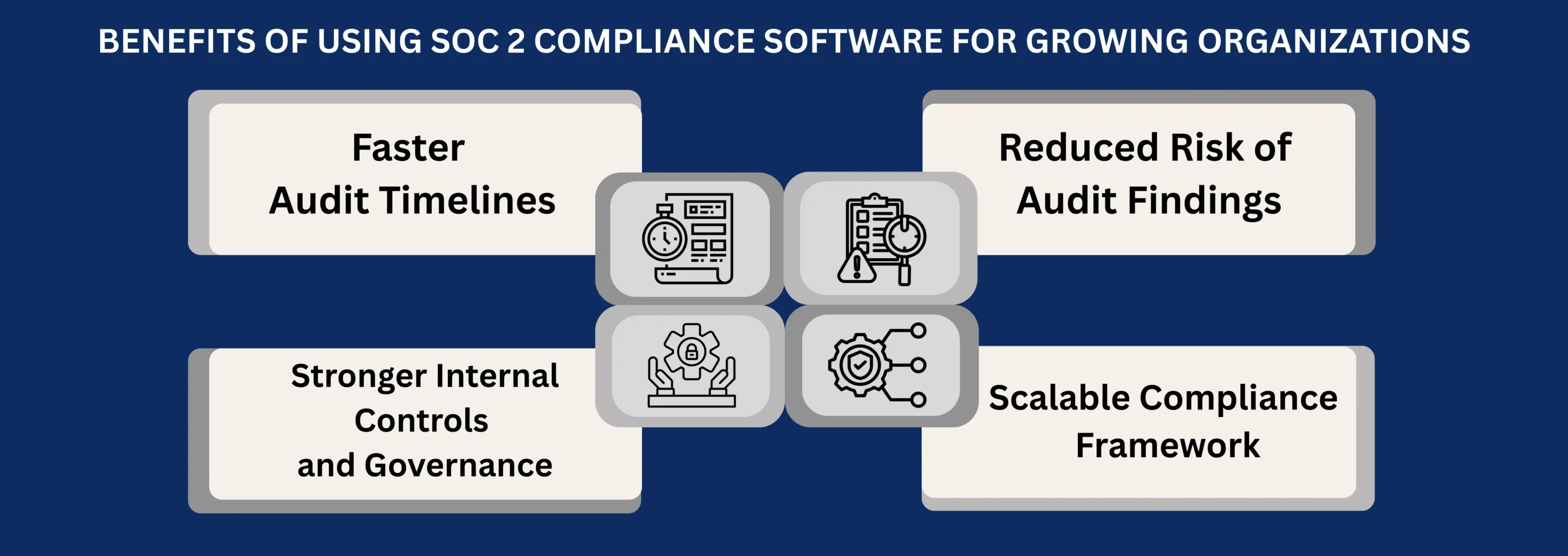
The primary benefit of SOC 2 attestation is independent, third-party verification of an organization’s control environment — verification that carries evidentiary weight precisely because it originates from a Licensed CPA Firm with no advisory or commercial interest in the outcome. Self-assessments, internal audits, and compliance automation platform outputs do not provide the same level of assurance as an independent SOC 2 examination, because they reflect the organization’s own evaluation of its controls rather than an external auditor’s objective assessment. Enterprise customers, institutional investors, and regulatory bodies treat SOC 2 attestation reports as more reliable than self-reported security posture statements because the opinion is formed by an independent professional applying structured examination procedures and professional skepticism.
For Salt Lake City technology organizations pursuing enterprise sales in financial services, healthcare, government contracting, and large-enterprise markets, the SOC 2 attestation report functions as a reusable, standardized verification artifact. Rather than responding to individualized security questionnaires from each prospective customer — a process that is resource-intensive and produces outcomes that vary by customer evaluation standards — the SOC 2 report provides a single authoritative document that enterprise risk management programs recognize and accept. A SOC 2 audit completed through CertPro produces a report valid for the reporting period and shareable with multiple customers, institutional clients, and procurement teams as evidence of ongoing control effectiveness.
SOC 2 Certification in Salt Lake City’s competitive enterprise technology market provides a measurable advantage in sales cycles that include security reviews. Enterprise procurement processes involving vendor risk management evaluations often establish binary qualification criteria — organizations with current SOC 2 Type 2 reports advance in the evaluation, while those without are required to complete lengthy alternative assessment processes or are excluded from consideration. For Salt Lake City SaaS companies targeting financial institution, health system, or large enterprise customers, a current SOC 2 Type 2 report from an independent Licensed CPA Firm directly reduces time to contract by satisfying the security qualification requirement at the outset of the procurement process.
Ongoing surveillance through annual SOC 2 re-examination ensures that the attestation remains current and that enterprise customers receive updated reports reflecting the organization’s control environment over each successive period. Annual re-examination also creates an internal discipline of documented evidence collection, control monitoring, and periodic review — strengthening the organization’s overall security posture as a byproduct of the audit cycle. Salt Lake City organizations that maintain SOC 2 attestation through consistent annual examination cycles demonstrate to institutional clients that security control effectiveness is sustained across time — not simply asserted at a single point during a sales process.
- ✓Independent third-party verification of control design and operating effectiveness
- ✓Recognition in enterprise vendor risk management and procurement qualification processes
- ✓Reduction in security questionnaire burden across multiple enterprise customer relationships
- ✓Demonstrated alignment with AICPA Trust Services Criteria across applicable security domains
- ✓Annual re-examination cycle supporting sustained control performance documentation
- ✓Increased credibility with regulated institutional clients in financial services and healthcare sectors
- ✓Support for international SaaS expansion into markets requiring independent security verification
- ✓Documented evidence base supporting internal governance and board-level reporting on security controls
- ✓Independent Verification of Control Effectiveness
- ✓Enterprise Sales Enablement and Vendor Risk Management Recognition
SOC 2 Certification Requirements and Evaluation Criteria
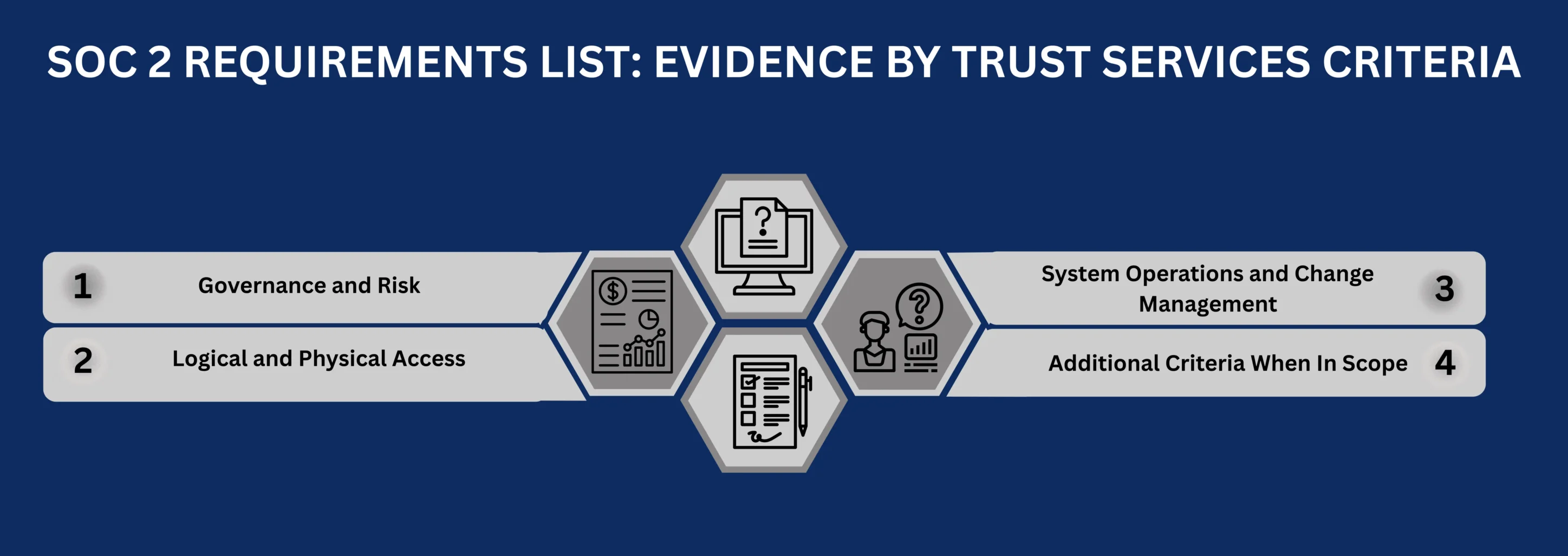
The SOC 2 examination requires that management prepare and present a system description — a formal document describing the services provided, system boundaries, system components (infrastructure, software, people, data, and procedures), and the controls in place to meet the applicable Trust Services Criteria. The system description is a management assertion that the auditor evaluates for fair presentation. Incomplete, inaccurate, or overstated system descriptions result in qualification of the auditor’s opinion on description fairness. For organizations undertaking SOC 2 Certification in Salt Lake City, the system description must accurately reflect the cloud infrastructure, third-party service providers, logical access architecture, and operational controls that constitute the in-scope system.
Evidence collection for the SOC 2 examination must be organized and accessible. Organizations undergoing a SOC 2 audit are expected to produce records demonstrating that controls were executed as described — including access review logs, change management approval records, security awareness training completion data, incident response documentation, vulnerability scan results, and vendor assessment records. Evidence gaps — instances where controls are described in the system description but no records of their execution exist — result in auditor exceptions. Systematic evidence collection throughout the observation period, aligned with the control activities described in the system description, is essential to producing a well-supported SOC 2 attestation report.
The Security criterion — mandatory in every SOC 2 engagement — requires evaluation of controls across logical access management, network security, change management, risk assessment, and incident response. Logical access controls address how user accounts are provisioned, maintained, and deprovisioned, including multi-factor authentication requirements, privileged access management, and periodic access certification. Network security controls address perimeter protection, segmentation, intrusion detection, and encryption of data in transit. Change management controls evaluate how system changes are reviewed, tested, approved, and implemented without introducing unauthorized modifications. Risk assessment controls address whether the organization formally identifies, evaluates, and responds to security risks on a defined periodic basis.
Incident response controls are evaluated for both design and operation under the SOC 2 examination. The auditor assesses whether the organization has a documented incident response procedure, whether responsible personnel are trained and aware of their roles, and — for Type 2 examinations — whether actual security incidents during the observation period were handled in accordance with the documented procedure. Vendor management controls, which address how the organization identifies and oversees third-party service providers affecting the in-scope system, are also evaluated under the Security criterion through Common Criteria related to risk and monitoring activities. For cloud-native organizations in Salt Lake City, vendor management controls typically encompass cloud infrastructure providers, identity management platforms, and third-party security monitoring services.
- ✓Control Documentation and System Description Requirements
- ✓Technical Control Requirements Under the Security Criterion
CertPro as an Independent Licensed CPA Firm for SOC 2 Attestation in Salt Lake City
Independent Certification Body Positioning
CertPro operates exclusively as an independent certification and attestation body — not as a consulting, advisory, or implementation firm. This positioning is fundamental to the integrity of the SOC 2 attestation reports CertPro issues. An auditor that also provides consulting or advisory services to the organizations it audits faces inherent independence impairments that undermine the reliability of the resulting attestation. CertPro’s exclusive focus on audit and attestation activities ensures that every SOC 2 examination it conducts is free from the independence conflicts that arise when a firm simultaneously advises clients on control design and then audits those same controls. For organizations seeking SOC 2 Certification in Salt Lake City that will withstand enterprise vendor risk management scrutiny, the independence of the issuing firm is a material quality consideration.
CertPro’s status as a Licensed CPA Firm is the foundational qualification required to issue SOC 2 attestation reports under AICPA standards. SOC 2 examinations are attest engagements governed by the AICPA’s attestation standards, and only Licensed CPA Firms are authorized to issue attestation reports under these standards. Organizations that engage non-CPA entities or compliance automation platforms for SOC 2 reporting receive outputs that do not constitute attestation reports under AICPA standards — and are not equivalent to a SOC 2 examination conducted by a Licensed CPA Firm. Enterprise customers and procurement teams conducting vendor risk assessments increasingly recognize this distinction and specifically request reports issued by Licensed CPA Firms. CertPro’s engagements produce SOC 2 attestation reports that meet this standard for Salt Lake City organizations across all in-scope industries.
Examination Standards and Professional Methodology
CertPro conducts SOC 2 examinations under AT-C Section 205 (Examination Engagements) of the AICPA’s Statement on Standards for Attestation Engagements (SSAE 18) — the current governing standard for SOC 2 attest engagements. The examination applies professional skepticism, evidence-based testing, and sampling methodologies consistent with AICPA professional standards. The auditor’s opinion in the SOC 2 attestation report reflects a professional judgment formed through documented examination procedures — not a certification based on questionnaire responses or self-reported compliance scores. For every SOC 2 examination CertPro conducts, the examination file documents the evidence collected, procedures performed, and conclusions reached for each in-scope control — providing a complete audit trail supporting the opinion expressed in the attestation report.
The SOC 2 attestation issued by CertPro upon completion of the examination identifies the scope of the system reviewed, the applicable Trust Services Criteria, the observation period (for Type 2 reports), the auditor’s opinion on management’s system description, and the auditor’s opinion on control design and operating effectiveness. The report also includes management’s assertion, a description of the system, and — for Type 2 reports — a description of tests performed and the results of those tests. This structured report format is consistent with AICPA reporting standards for SOC 2 engagements and is the format recognized and expected by enterprise customers, institutional clients, and regulatory bodies evaluating vendor security credentials for Salt Lake City technology and financial services organizations.
FAQ
▶
What is SOC 2 Certification and why does it matter for Salt Lake City organizations?
▶
What are the SOC 2 Trust Services Criteria?
▶
What is the difference between SOC 2 Type 1 and SOC 2 Type 2?
▶
What does the SOC 2 audit process involve?
▶
How long is the SOC 2 observation period for Type 2 audits?
▶
How long is a SOC 2 report valid?
▶
Which Salt Lake City industries and organizations require SOC 2 attestation?
▶
Why is a Licensed CPA Firm required for SOC 2 attestation?
SOC 1 VS SOC 2: WHICH REPORT YOUR CUSTOMERS ACTUALLY ASK FOR
If you sell SaaS or provide outsourced services, you have likely been asked for a SOC report. However, the follow-up question is rarely easy to answer…

AICPA Issues New Guidance for Peer Reviewers Evaluating SOC 2 Engagements
AICPA SOC 2 guidance has been issued to help peer reviewers identify quality risks associated with SOC 2 engagements as the use of compliance automati…
SOC 2 Certified: What Does It Mean for Your Business
For companies that handle sensitive data or run cloud-based services, the question “Can you provide your SOC 2 report?” carries enormous weight. Yet, …
Get In Touch
have a question? let us get back to you.