
ISO 27001 Certification in Arlington
The ISO 27001 certification audit process for Arlington organizations follows a structured, multi-stage methodology conducted by CertPro as an independent Licensed CPA Firm. The process systematically evaluates whether an organization’s ISMS conforms to ISO/IEC 27001:2022 requirements through document review, evidence assessment, and operational testing. Each stage produces documented audit findings that form the basis for the certification committee’s independent decision. The table below summarizes the key stages, activities, and outputs of the ISO 27001 audit process.
OUR CLIENTS









ISO 27001 Certification for Arlington-Based Technology and Government Contractor Organizations
ISO 27001 Certification in Arlington is actively pursued by technology firms, defense contractors, cloud service providers, cybersecurity organizations, and government vendors operating within the Northern Virginia and Washington, D.C. technology corridor. CertPro, a Licensed CPA Firm, conducts independent ISO 27001 certification audits for Arlington-based organizations. These audits evaluate conformity against ISO/IEC 27001:2022 requirements through structured Stage 1 and Stage 2 audit procedures. Certification decisions are issued by an independent certification committee following objective evaluation of Information Security Management System (ISMS) conformity. No consulting, advisory, or implementation services are provided.
Arlington’s Technology and Defense Ecosystem
Arlington sits at the center of the Northern Virginia technology corridor — one of the most concentrated clusters of federal agency contractors, defense technology firms, cybersecurity companies, managed service providers, cloud infrastructure operators, and enterprise SaaS organizations in the United States. The region’s proximity to Washington, D.C. and the Pentagon creates a distinct market dynamic where information security credentials carry direct procurement weight.
Federal agencies, prime contractors, and enterprise buyers in this ecosystem routinely evaluate ISO 27001 compliance as a vendor assurance criterion before authorizing technology vendors, data processors, and service providers. ISO 27001 Certification in Arlington has become a structurally relevant conformity credential for organizations engaged in government technology programs, sensitive data handling, and federal supply chain participation. Organizations across sectors — from SaaS and cloud platforms to professional services and healthcare technology — operate in an environment where independent ISO 27001 certification is evaluated at the procurement and contract review level.
Licensed CPA Firm and Independent Certification Body Positioning
CertPro operates as a Licensed CPA Firm and independent third-party certification body. The firm conducts ISO 27001 certification audits by evaluating an organization’s ISMS against the requirements of ISO/IEC 27001:2022, including Clauses 4 through 10 and applicable Annex A controls identified in the organization’s Statement of Applicability.
The ISO 27001 certification audit process is distinct from any consulting or implementation engagement. CertPro does not establish, design, remediate, or advise on ISMS implementation. The evaluation is conducted on the basis of objective evidence gathered during structured audit procedures. The certification decision is made independently by a certification committee that reviews audit findings, evaluates conformity with the ISO 27001 standard, and issues the certificate when all requirements are demonstrably satisfied. This independence is a foundational characteristic of credible third-party conformity assessment — differentiating a certification audit from an internal audit or readiness review conducted by the organization itself.
Sectors Seeking ISO 27001 Certification in Arlington
ISO 27001 Certification in Arlington is actively pursued across a broad range of sectors reflecting the region’s economic composition. Defense and government technology contractors seek certification to satisfy vendor assurance requirements from federal procurement offices and prime contractor security programs. SaaS providers and cloud service providers pursue ISO 27001 certification to demonstrate information security governance to enterprise customers and regulated industry buyers.
Cybersecurity organizations, financial services firms, fintech companies, healthcare technology providers, telecommunications operators, data centers, professional services firms, construction and engineering organizations with digital infrastructure, and educational and research institutions handling sensitive data all engage the ISO 27001 certification process to obtain independent validation of ISMS conformity. For Arlington-based organizations operating across multiple regulated sectors — particularly those serving federal agencies, state government bodies, or large enterprise clients — ISO 27001 Certification functions as a primary third-party assurance mechanism recognized by procurement teams, legal reviewers, and risk officers conducting vendor due diligence.

What Is ISO 27001 Certification?
ISO 27001 Certification is the formal, third-party verified confirmation that an organization’s Information Security Management System conforms to the requirements of the ISO/IEC 27001:2022 standard, published by the International Organization for Standardization and the International Electrotechnical Commission. The ISO 27001 standard defines the requirements for establishing, implementing, maintaining, and continually improving an ISMS — a structured framework governing how an organization identifies, assesses, treats, and monitors information security risks.
Certification is issued only after an accredited or recognized independent certification body completes a structured audit program and confirms that the organization’s ISMS meets all specified requirements. The current version, ISO/IEC 27001:2022, supersedes the 2013 edition and includes an updated Annex A control set organized into four domains: Organizational Controls, People Controls, Physical Controls, and Technological Controls — covering 93 controls in total, reduced from 114 in the prior version. Organizations transitioning from ISO/IEC 27001:2013 certifications were required to migrate to the 2022 standard by October 31, 2025, as established by the international certification body community.
The Information Security Management System (ISMS)
An Information Security Management System is the documented, operational framework through which an organization manages information security risks across its people, processes, and technology. Under ISO/IEC 27001:2022, the ISMS is defined by the organization’s leadership and scoped to specific information assets, processes, and organizational units.
Core ISMS documentation required by the ISO 27001 standard includes an information security policy, a risk assessment methodology and results, a risk treatment plan, and a Statement of Applicability identifying which Annex A controls are applicable, which are implemented, and the justification for any exclusions. The ISMS must also include internal audit records and management review outputs demonstrating that the system is being actively monitored and improved. During a certification audit, the auditor evaluates whether these documented elements exist, whether they are operationally effective, and whether the organization’s control implementation aligns with its risk treatment decisions. The ISMS scope — not the entire organization by default — defines the boundary of what is covered by the ISO 27001 certificate.
ISO/IEC 27001:2022 Clause Structure and Annex A Control Domains
The ISO 27001 standard is structured across two components: the mandatory management system clauses (Clauses 4 through 10) and the normative Annex A, which provides a reference set of information security controls. Clauses 4 through 10 govern organizational context, leadership commitment, planning, support, operations, performance evaluation, and continual improvement — all evaluated during the ISO 27001 certification audit as mandatory requirements.
Annex A controls are not uniformly mandatory. The organization determines applicable controls through its risk assessment and documents its selections in the Statement of Applicability. The 2022 update reorganized Annex A into four domains: Organizational Controls (37 controls), People Controls (8 controls), Physical Controls (14 controls), and Technological Controls (34 controls). Five new control categories were introduced in the 2022 revision, including threat intelligence, information security for cloud services, ICT readiness for business continuity, physical security monitoring, and data masking. During the ISO 27001 audit, auditors evaluate the completeness and appropriateness of the SoA, the rationale for control exclusions, and the operational effectiveness of implemented controls during Stage 2 fieldwork.
ISO 27001 Certification Audit Process for Organizations in Arlington
The ISO 27001 certification audit process for Arlington organizations follows a structured, multi-stage methodology conducted by CertPro as an independent Licensed CPA Firm. The process systematically evaluates whether an organization’s ISMS conforms to ISO/IEC 27001:2022 requirements through document review, evidence assessment, and operational testing. Each stage produces documented audit findings that form the basis for the certification committee’s independent decision. The table below summarizes the key stages, activities, and outputs of the ISO 27001 audit process.
| Audit Stage | Key Activities | Output |
|---|---|---|
| Application Review | Scope definition, audit program determination, documentation of ISMS boundary | Audit program and engagement scope agreement |
| Stage 1 Audit | Review of ISMS documentation, policy framework, risk assessment, SoA, internal audit records, and management review outputs | Stage 1 audit report identifying readiness for Stage 2 |
| Stage 2 Audit | Fieldwork evaluation of control implementation, objective evidence collection, operational effectiveness testing, interviews with process owners | Stage 2 audit report with conformity findings and any nonconformities |
| Nonconformity Review | Assessment of corrective actions submitted for identified nonconformities; verification of root cause resolution | Closure determination for all open nonconformities |
| Certification Decision | Independent certification committee review of audit findings and conformity evidence | Certificate issuance or deferred decision with conditions |
| Surveillance Audits | Annual surveillance audits evaluating ongoing ISMS conformity and control effectiveness | Surveillance audit report confirming certification maintenance |
| Recertification Audit | Full-scope audit conducted at the end of the three-year certificate cycle | Renewed ISO 27001 certificate or nonconformity findings |
The Stage 1 audit is a structured review of the organization’s ISMS documentation conducted before fieldwork begins. During this stage, the auditor evaluates whether the organization has established the foundational documented elements required by ISO/IEC 27001:2022. This includes the information security policy, the defined ISMS scope, the risk assessment methodology and completed outputs, the risk treatment plan, the Statement of Applicability with justifications for control selection and exclusion, records of internal audits, and outputs from management review.
The Stage 1 audit also evaluates whether the organization is prepared for Stage 2 fieldwork — specifically, whether documented controls are sufficiently implemented to allow evidence-based evaluation. The resulting report identifies any areas requiring attention before Stage 2 proceeds and confirms the audit scope, audit criteria, and planned fieldwork activities. For Arlington-based organizations with complex ISMS scopes spanning multiple operational sites, cloud environments, or government-sensitive processing activities, the Stage 1 documentation review is particularly thorough.
The Stage 2 audit constitutes the primary conformity assessment fieldwork in the ISO 27001 certification audit process. Auditors evaluate the operational effectiveness of the organization’s ISMS controls by examining objective evidence — including configuration records, access control logs, incident reports, training records, vendor contract documentation, business continuity test results, and physical security records — against the requirements of ISO/IEC 27001:2022.
Interviews with process owners, system administrators, information security personnel, and senior leadership are conducted to assess whether controls are consistently applied and understood across the organization. The auditor evaluates the alignment between the risk treatment plan, the Statement of Applicability, and the actual state of control implementation. Nonconformities identified during the Stage 2 ISO 27001 audit are classified and documented in the audit report. The organization must submit corrective actions addressing root causes, which are reviewed before the certification committee proceeds with its decision. The ISO 27001 certification audit at this stage is evidence-driven and objective — the auditor’s role is to assess, not to prescribe.
Following the Stage 2 audit and resolution of identified nonconformities, the certification committee conducts an independent review of all audit evidence and findings. The committee evaluates whether the organization’s ISMS demonstrably conforms to ISO/IEC 27001:2022 and issues the ISO 27001 certificate when conformity is confirmed. The certificate is valid for a three-year period, subject to satisfactory annual surveillance audits.
Surveillance audits are conducted each year during the certification cycle and evaluate continued conformity with the ISO 27001 standard, including any changes to the ISMS scope, control environment, or organizational risk profile. At the end of the three-year cycle, a full recertification audit is required to renew the certificate. Organizations in Arlington undergoing significant changes — such as cloud migration, acquisition activity, expansion of government contract scope, or addition of new information processing systems — may be subject to additional audit activities within the certification cycle. The certification committee’s decision remains independent of the audit team that conducted fieldwork.
- ✓Stage 1 Audit: Documentation and Readiness Review
- ✓Stage 2 Audit: Operational Conformity and Evidence Evaluation
- ✓Certification Decision, Issuance, and Ongoing Surveillance
Why Organizations in Arlington Pursue ISO 27001 Certification
Demand for ISO 27001 compliance in Arlington is driven by a specific combination of procurement requirements, regulatory expectations, client contractual demands, and enterprise risk management practices. These factors reflect Arlington’s unique position in the federal technology and defense contracting ecosystem. Organizations operating in this environment face information security scrutiny from multiple directions simultaneously — federal agency security reviewers, prime contractor risk teams, commercial enterprise buyers, and international procurement offices all reference ISO 27001 certification as a recognized assurance mechanism.
Government Vendor and Defense Contractor Requirements
ISO 27001 certification for Arlington defense contractors and government vendors has become a recognized security assurance credential in federal procurement contexts. While federal contracting frameworks such as CMMC and FedRAMP govern specific regulatory compliance requirements, ISO 27001 certification serves as an independently verified baseline for information security governance that complements these frameworks.
Prime contractors conducting supplier risk assessments frequently require or strongly prefer ISO 27001 certification from technology subcontractors, managed service providers, software vendors, and data processors participating in government programs. Arlington government vendors pursuing ISO 27001 certification in Arlington position their ISMS conformity as a documented, audited credential available for review during vendor qualification processes, security reviews, and contract renewals. The independent nature of the ISO 27001 certification audit — conducted by a Licensed CPA Firm separate from the organization’s internal team — provides procurement offices with an objective basis for evaluating vendor security posture without relying solely on self-attested questionnaire responses.
Technology Company and SaaS Provider Demand Drivers
ISO 27001 certification for Arlington technology companies and SaaS providers is driven primarily by enterprise customer security review requirements and international market access expectations. Enterprise buyers in financial services, healthcare, legal, and regulated industries routinely issue vendor security questionnaires requesting evidence of ISO 27001 certification as a precondition for contract execution or renewal.
SaaS companies offering platforms that process customer data, financial records, or sensitive operational information face increasing pressure from procurement and legal teams to provide third-party audit evidence of information security controls. ISO 27001 Certification in Arlington gives these organizations a structured, internationally recognized credential that can be referenced in customer contracts, due diligence responses, and RFP submissions. Technology companies expanding into international markets — particularly in Europe, the Middle East, and Asia-Pacific — also encounter ISO 27001 certification as a baseline assurance requirement from local enterprise buyers and government procurement bodies, making local ISO 27001 compliance directly relevant to cross-border sales and contracting.
Regulatory Alignment and Third-Party Risk Management
ISO 27001 compliance supports organizations in mapping information security controls to legal and regulatory requirements including GDPR for European data subjects, HIPAA for healthcare information, GLBA for financial data, and applicable state-level privacy laws. While ISO 27001 certification does not constitute regulatory compliance in itself, the structured risk assessment and control framework required by the ISO 27001 standard provides documented evidence that information security risks have been systematically identified, treated, and monitored.
Organizations subject to third-party risk management programs — including those serving as vendors to larger regulated entities such as banks, insurers, or hospital systems — use ISO 27001 certification as the primary evidence mechanism for security questionnaire responses and vendor risk assessments. For Arlington organizations in the financial services and healthcare technology sectors, ISO 27001 certification provides an audited, evidence-based foundation that satisfies the information security documentation requirements of multiple overlapping regulatory and contractual frameworks — without requiring separate, duplicative audit engagements for each customer or regulator.
ISO 27001 Certification Requirements Evaluated During the Audit
The ISO 27001 certification audit evaluates conformity with all mandatory requirements defined in ISO/IEC 27001:2022. These requirements span organizational context, leadership and governance, risk management, operational controls, performance evaluation, and continual improvement. Auditors assess whether the organization has fulfilled each requirement through documented policies, operational evidence, and demonstrated management practices — not through self-declaration alone.
ISO/IEC 27001:2022 specifies mandatory documented information that must be maintained and retained to demonstrate ISMS conformity. Core documentation requirements evaluated during the ISO 27001 audit include the information security policy, the ISMS scope document, the risk assessment process and results, the risk treatment plan, the Statement of Applicability, information security objectives, competence evidence, operational planning and control records, internal audit program and reports, management review records, and records of nonconformities and corrective actions.
The Statement of Applicability is a particularly critical document. It links the organization’s risk treatment decisions to specific Annex A controls, identifies which controls are implemented, documents the rationale for any controls deemed not applicable, and provides the auditor with the primary reference for evaluating control coverage. For Arlington-based organizations with geographically distributed operations, cloud-hosted systems, or government-sensitive processing environments, the SoA must accurately reflect all in-scope information assets and the controls applied across the full ISMS boundary.
The ISO 27001 standard requires organizations to establish and apply a documented information security risk assessment process that identifies risks associated with the loss of confidentiality, integrity, and availability of information within the ISMS scope. The risk assessment must produce a documented set of results identifying information security risks, risk owners, risk levels, and the basis for risk evaluation.
The risk treatment plan must document selected treatment options — acceptance, avoidance, transfer, or mitigation — and map treatment decisions to specific Annex A controls where mitigation is chosen. During the ISO 27001 certification audit, the auditor evaluates whether the risk assessment methodology is consistently applied, whether identified risks are linked to implemented controls, and whether the risk treatment plan is actively maintained and reviewed. Auditors also assess whether changes in the organization’s operating environment — such as adoption of new cloud services, expansion into new markets, or shifts in the regulatory landscape — have triggered appropriate risk reassessment and, where necessary, updates to the treatment plan and Statement of Applicability.
ISO/IEC 27001:2022 Clause 9 requires organizations to conduct internal audits of the ISMS at planned intervals to determine whether the management system conforms to the organization’s own requirements and to the requirements of the ISO 27001 standard, and is effectively implemented and maintained. Internal audit records — including the audit program, audit criteria, scope, methods, results, and corrective actions — are reviewed during the certification audit as evidence that the organization is actively monitoring its own ISMS conformity.
Management review, required under Clause 9.3, must be conducted by senior leadership at planned intervals and must address changes in the internal and external context, information security performance data, risk assessment results, and opportunities for continual improvement. Management review records are examined by the certification auditor to verify that leadership is actively engaged in ISMS governance, that decisions and action items are documented, and that the ISMS is being treated as a living management system rather than a static documentation exercise. For ISO 27001 compliance in Arlington, these internal governance requirements are especially relevant to organizations where ISMS responsibilities are distributed across technical and business leadership teams.
- ✓ISMS Documentation Requirements
- ✓Risk Assessment and Risk Treatment Evaluation
- ✓Internal Audit and Management Review Requirements
Benefits of ISO 27001 Certification for Arlington-Based Organizations
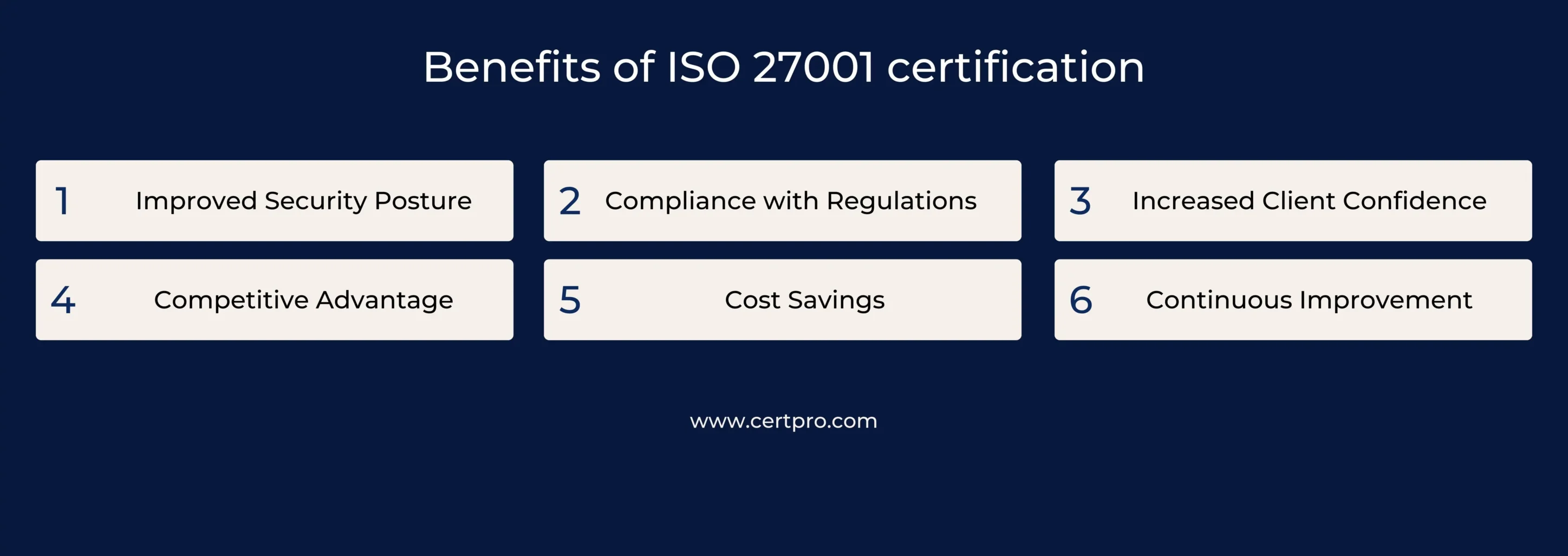
ISO 27001 Certification in Arlington delivers measurable operational and commercial value across the information security, procurement, and risk management dimensions of an organization’s activities. The benefits listed below reflect the independently verifiable outcomes of ISMS conformity assessment — not advisory-stage projections.
- ✓Independent verification of ISMS conformity through structured third-party ISO 27001 audit by a Licensed CPA Firm — providing evidence that information security controls are designed and operating effectively
- ✓Recognition in enterprise and government procurement processes — ISO 27001 certification is referenced as a vendor qualification criterion by federal agency contractors, enterprise technology buyers, and regulated industry procurement teams in the Arlington ecosystem
- ✓Structured alignment of information security controls with identified risks — the risk assessment and risk treatment framework required by the ISO 27001 standard ensures that controls are applied where risk exposure is greatest
- ✓Documented basis for regulatory alignment — ISO 27001 controls map to requirements under GDPR, HIPAA, GLBA, and applicable privacy and cybersecurity frameworks, providing audited evidence for multi-framework compliance reporting
- ✓Ongoing surveillance oversight — annual surveillance audits confirm that ISMS conformity is maintained over the three-year certificate cycle, providing continuous assurance rather than a single point-in-time evaluation
- ✓Improved information security risk awareness — the management review and internal audit requirements embedded in the ISO 27001 standard drive active leadership engagement in information security governance
- ✓Competitive differentiation in vendor selection and RFP responses — organizations holding ISO 27001 certification can provide certified audit evidence rather than self-attested questionnaire responses during vendor due diligence
For Arlington organizations participating in federal procurement, defense supply chains, or commercial enterprise sales cycles, ISO 27001 certification provides a structured, independently audited credential that procurement teams can directly reference during vendor evaluation. A common scenario in Arlington’s technology market involves a SaaS provider bidding on a government technology contract: the procurement office requests evidence of information security controls as part of the vendor qualification assessment.
An organization holding a current ISO 27001 certificate — issued following a completed ISO 27001 certification audit — can provide audited documentation of ISMS conformity covering risk assessment, control implementation, and ongoing surveillance. This is a material distinction in competitive bid environments where procurement officers are evaluating multiple vendors and need objective, third-party-verified evidence to support security evaluation decisions. ISO 27001 certification for Arlington government vendors and technology companies directly addresses this evidence gap in vendor qualification processes.
Organizations that have completed the ISO 27001 certification process have, by definition, established a documented risk assessment methodology, completed a systematic identification of information security risks, implemented a risk treatment plan linked to Annex A controls, and verified through internal audit that the ISMS is functioning as designed. These operational outcomes — driven by the ISO 27001 standard’s requirements — contribute to a measurably improved information security risk posture relative to organizations operating without a structured ISMS framework.
For Arlington-based organizations handling government-sensitive information, healthcare records, financial data, or enterprise customer data, the risk management discipline embedded in ISO 27001 compliance provides a structured basis for managing information security incidents, responding to data breach scenarios, and demonstrating due care to regulators, customers, and legal counsel. The independently audited nature of the certification distinguishes these outcomes from self-assessed risk management programs that lack third-party verification.
- ✓Procurement and Vendor Assurance Value
- ✓Improved Information Security Risk Management Outcomes
ISO 27001 Certification Scope and ISMS Boundary Definition
The scope of an ISO 27001 certification defines the precise boundary of the Information Security Management System that has been evaluated and certified. The scope is determined by the organization in accordance with Clause 4.3 of ISO/IEC 27001:2022 and reflects the organization’s context, interested parties, and the interfaces and dependencies between the ISMS scope and activities or information outside that scope. During the ISO 27001 audit, the auditor evaluates whether the defined scope accurately represents the organization’s information security perimeter and whether the controls implemented cover all information assets, processes, locations, and technology systems included within the stated boundary.
Defining ISMS Scope for Arlington Organizations
For Arlington-based organizations operating in complex technological and regulatory environments, ISMS scope definition requires careful consideration of the information assets, services, and organizational units to be included. A government technology contractor, for example, may define its ISMS scope to cover the specific program office, systems, and personnel handling classified or sensitive unclassified information under a particular federal contract — rather than applying the ISMS scope to the entire enterprise. A cloud service provider may define its scope to cover the specific infrastructure, platform services, and support processes associated with customer data processing, while excluding internal corporate functions unrelated to service delivery.
The ISO 27001 certification audit scope reflects this defined ISMS boundary: the certificate attests to conformity within the declared scope only. Information assets, processes, or organizational units outside the defined ISMS boundary are not covered by the certification. Organizations must ensure that the ISMS scope is not artificially narrow in a way that omits material information security risks, as scope limitations are evaluated by the auditor during Stage 1 review.
Multi-Site and Cloud Environment Scope Considerations
Many Arlington organizations operate across multiple physical locations, remote work environments, and cloud-hosted infrastructure platforms. ISO/IEC 27001:2022 accommodates multi-site ISMS scopes, provided the organization demonstrates consistent application of ISMS policies, controls, and risk management practices across all included sites and environments.
For organizations utilizing cloud service providers as part of their information processing infrastructure, the ISMS scope must address how shared responsibility arrangements with cloud providers are reflected in the organization’s risk assessment and control implementation. The 2022 revision of the ISO 27001 standard specifically introduced control A.5.23 — Information Security for Use of Cloud Services — as a new Annex A control addressing the governance of cloud service relationships. During the ISO 27001 certification audit, auditors evaluate whether cloud service usage is identified in the risk assessment, whether the organization has documented its responsibilities under shared responsibility models, and whether contracts with cloud providers include appropriate information security provisions. For technology-intensive Arlington organizations dependent on cloud infrastructure, this area of the audit typically receives detailed examination.
ISO 27001 Annex A Controls: Evaluation During Certification Audit
The ISO 27001 standard’s Annex A provides a normative reference set of 93 information security controls organized across four domains. During the ISO 27001 certification audit, the auditor evaluates the organization’s Statement of Applicability to determine which controls have been selected as applicable, reviews the implementation status of each applicable control, and assesses operational effectiveness through evidence examination and process owner interviews. Controls identified as not applicable in the SoA must be supported by documented justification.
| Annex A Domain | Number of Controls | Example Controls Evaluated in Audit |
|---|---|---|
| Organizational Controls | 37 | Information security policies, roles and responsibilities, threat intelligence, information security in supplier relationships, incident management, business continuity |
| People Controls | 8 | Screening, terms of employment, information security awareness and training, disciplinary process, responsibilities after termination |
| Physical Controls | 14 | Physical security perimeters, clear desk and screen policies, equipment maintenance, secure disposal, physical security monitoring |
| Technological Controls | 34 | Access control, identity management, authentication, encryption, logging, vulnerability management, data masking, secure development, cloud service security |
Organizational and People Controls
Organizational controls under Annex A address governance, policy, and process-level information security requirements. These include the establishment of information security policies and their communication to relevant personnel, the definition of roles and responsibilities for information security, the management of information security in supplier and third-party relationships, and the processes for managing information security incidents and events.
For Arlington organizations with complex supply chains — including government contractors with multiple technology subcontractors or SaaS companies with third-party data processors — the supplier relationship controls within Organizational Controls receive significant audit attention. Auditors evaluate whether supplier contracts include appropriate information security clauses, whether supplier risk is assessed periodically, and whether the organization monitors supplier compliance with security requirements. People controls address the information security requirements associated with human resource management, including background screening, contractual obligations, security awareness, and the management of access rights upon role change or termination. Evidence of structured security awareness programs and documented screening records is required to satisfy these controls during the ISO 27001 certification audit.
Technological Controls and Evidence Requirements
Technological controls in Annex A cover the technical implementation of information security measures across access management, network security, cryptography, system security, and operational security. These controls are evaluated through examination of technical configuration records, access control matrices, privilege management logs, encryption implementation documentation, vulnerability scan results, patch management records, and system monitoring logs.
For Arlington technology companies and cloud service providers, the technological controls domain is typically the most evidence-intensive portion of the ISO 27001 certification audit. Auditors require demonstration that access to information systems is restricted to authorized users, that privileged access is managed and monitored, that systems are regularly assessed for vulnerabilities, and that logs are collected, protected, and reviewed. The 2022 revision added several new technological controls — including data masking (A.8.11), data leakage prevention (A.8.12), monitoring activities (A.8.16), and web filtering (A.8.23) — reflecting the evolution of the threat landscape and the increased prevalence of cloud-based information processing environments relevant to ISO 27001 compliance for Arlington technology companies.
ISO 27001 Certification vs. Related Frameworks for Arlington Organizations
Arlington organizations operating across government technology, financial services, healthcare, and enterprise software sectors frequently encounter multiple information security frameworks and certification requirements. Understanding how ISO 27001 certification relates to other relevant frameworks allows organizations to make informed decisions about audit scope, documentation reuse, and multi-framework conformity. The following comparison addresses the most common framework relationships relevant to ISO 27001 audit engagements in Arlington.
| Framework | Relationship to ISO 27001 | Relevant Arlington Sectors |
|---|---|---|
| SOC 2 (AICPA) | SOC 2 evaluates security controls against Trust Services Criteria; ISO 27001 evaluates ISMS conformity against the ISO 27001 standard. Both require independent third-party audit. Some control domains overlap, but evaluation criteria and report formats differ. | SaaS providers, cloud service companies, data centers, financial technology |
| CMMC (DoD) | CMMC governs cybersecurity maturity for defense contractors handling Controlled Unclassified Information. ISO 27001 certification complements but does not substitute for CMMC compliance. ISMS documentation may provide supporting evidence for CMMC practices. | Defense contractors, government technology vendors, Arlington government vendors |
| HIPAA Security Rule | HIPAA requires specific administrative, physical, and technical safeguards for electronic Protected Health Information. ISO 27001 Annex A controls map to HIPAA requirements; ISO 27001 certification provides a structured audit framework for healthcare technology organizations. | Healthcare technology, health IT, clinical data analytics, telehealth platforms |
| GDPR | GDPR requires appropriate technical and organizational measures for personal data protection. ISO 27001 certification provides documented evidence of a risk-based information security management approach consistent with GDPR Article 32 requirements. | SaaS companies with EU customers, global technology platforms, professional services firms |
ISO 27001 and SOC 2 for Arlington Technology Companies
Many Arlington technology companies are asked to provide both ISO 27001 certification and SOC 2 reports to different customer segments simultaneously. Enterprise buyers in financial services and healthcare frequently request SOC 2 Type II reports as evidence of control operating effectiveness over a defined period. International enterprise customers and government procurement offices, meanwhile, reference ISO 27001 certification as the primary information security assurance credential.
The two frameworks are complementary rather than duplicative. ISO 27001 focuses on the conformity of the overall ISMS management system and control selection rationale, while SOC 2 evaluates the operating effectiveness of specific controls against the AICPA’s Trust Services Criteria over a defined examination period. For Arlington SaaS providers and cloud infrastructure companies serving both domestic government clients and international enterprise buyers, maintaining both ISO 27001 certification and a current SOC 2 report provides the broadest coverage of customer assurance requirements. Audit evidence collected for ISO 27001 compliance frequently overlaps with evidence relevant to SOC 2 examinations, though each audit is conducted independently against its own criteria.
FAQ
▶
What is ISO 27001 Certification and why is it relevant to Arlington organizations?
▶
Who conducts ISO 27001 certification audits in Arlington?
▶
What is the difference between a Stage 1 and Stage 2 ISO 27001 audit?
▶
How long is an ISO 27001 certificate valid for Arlington organizations?
▶
What is the Statement of Applicability and why is it important in the ISO 27001 audit?
▶
Which Arlington sectors are most commonly seeking ISO 27001 certification?
▶
Does ISO 27001 certification cover all of an organization’s operations?
▶
How does ISO 27001 compliance relate to CMMC for Arlington defense contractors?
Get In Touch
have a question? let us get back to you.