
ISO 27001 Certification in Baltimore
ISO 27001 Certification in Baltimore is pursued by organizations across healthcare and life sciences, biotechnology, cybersecurity, financial services, defense contracting, maritime and logistics, and SaaS sectors. The goal is to obtain independent, third-party verification that their Information Security Management System (ISMS) conforms to the requirements of ISO/IEC 27001:2022. CertPro, a Licensed CPA Firm, operates as an independent certification body conducting conformity assessments against the ISO 27001 standard for organizations across Baltimore and the broader Baltimore-Washington region.
OUR CLIENTS










ISO 27001 Certification for Baltimore-Based Financial, Healthcare, and Technology Organizations
ISO 27001 Certification in Baltimore is pursued by organizations across healthcare and life sciences, biotechnology, cybersecurity, financial services, defense contracting, maritime and logistics, and SaaS sectors. The goal is to obtain independent, third-party verification that their Information Security Management System (ISMS) conforms to the requirements of ISO/IEC 27001:2022. CertPro, a Licensed CPA Firm, operates as an independent certification body conducting conformity assessments against the ISO 27001 standard for organizations across Baltimore and the broader Baltimore-Washington region.
Baltimore occupies a strategically significant position within the Mid-Atlantic technology and regulatory ecosystem. Its proximity to Washington, D.C., and Northern Virginia — home to federal agencies, defense contractors, and an extensive government technology supply chain — creates substantial demand for ISO 27001 compliance among organizations that serve regulated industries or participate in federal procurement. Baltimore’s Inner Harbor business district, the biotech corridor anchored by Johns Hopkins University and the University of Maryland Medical System, and the concentration of cybersecurity firms in surrounding Maryland counties collectively establish a high-information-security-maturity environment. In this environment, independent ISO 27001 Certification in Baltimore carries significant procurement and regulatory weight.
ISO 27001 certification for Baltimore companies involves a structured, evidence-based audit conducted by CertPro as an independent certification body. The ISO 27001 audit evaluates whether the organization has established, implemented, maintained, and continually improved an ISMS in accordance with ISO/IEC 27001:2022 Clauses 4 through 10. These clauses address organizational context, leadership commitment, planning, support, operational controls, performance evaluation, and improvement processes that form the management system framework. The ISO 27001 certification audit does not evaluate the organization’s security posture in isolation; it evaluates documented conformity with the standard’s requirements against objective evidence collected during Stage 1 and Stage 2 audits.
The ISO 27001 standard applies to organizations of all sizes and types. In Baltimore, this includes cloud service providers, digital health technology companies, financial technology firms, professional services organizations handling sensitive client data, research institutions, and manufacturers operating within regulated supply chains. The scope of ISO 27001 certification is defined by the organization and reflects the boundaries of its ISMS — encompassing the information assets, processes, departments, and physical or cloud-based infrastructure covered by the management system. CertPro’s ISO 27001 certification audit scope aligns directly with the ISMS scope declared by the organization.
CertPro’s role is strictly limited to independent evaluation and certification decision-making. The organization seeking ISO 27001 Certification in Baltimore is solely responsible for establishing, operating, and maintaining its ISMS. CertPro evaluates the conformity of that system against the requirements of ISO/IEC 27001:2022 through structured audit activities, evidence review, and an independent certification committee decision. This clear separation between the organization’s ISMS responsibilities and CertPro’s certification responsibilities preserves the integrity and independence of the process, consistent with international accreditation norms and ISO/IEC 17021-1 conformity assessment principles.

What Is ISO 27001 Certification?
ISO 27001 certification is the formal recognition, issued by an independent certification body, that an organization’s Information Security Management System (ISMS) conforms to the requirements of ISO/IEC 27001:2022. The ISO 27001 standard is published jointly by the International Organization for Standardization (ISO) and the International Electrotechnical Commission (IEC). It specifies requirements for establishing, implementing, maintaining, and continually improving an ISMS. It also provides a structured framework for identifying and treating information security risks in a systematic and documented manner.
The ISO/IEC 27001:2022 Standard and Its Structure
The ISO 27001 standard is organized into two primary components. The first is the management system requirements, contained in Clauses 4 through 10, which address organizational context, leadership, planning, support, operations, performance evaluation, and improvement. The second is Annex A, which contains 93 information security controls organized across four domains: Organizational controls, People controls, Physical controls, and Technological controls. The 2022 revision updated the control structure from 114 controls across 14 categories in the 2013 version to 93 controls across these four domains. It also introduced 11 new controls reflecting contemporary information security practices — including threat intelligence, cloud security, data masking, and secure coding. Organizations transitioning from the 2013 version must complete migration to ISO/IEC 27001:2022 by October 31, 2025, as required by accreditation bodies internationally.
The Statement of Applicability (SoA) is a central document within the ISO 27001 standard framework. It records which Annex A controls are applicable to the organization’s ISMS scope, whether each control has been implemented, and the justification for any excluded controls. The SoA links the organization’s risk treatment decisions to its selected controls, giving auditors a traceable record of how identified information security risks have been addressed. During an ISO ISMS Audit, the SoA is reviewed as primary documentation to confirm logical consistency between risk assessment outputs, risk treatment plans, and implemented controls.
ISMS Documentation Requirements Under ISO 27001
ISO 27001 compliance requires organizations to maintain specific documented information as evidence that the ISMS operates in accordance with the standard. Core documentation includes the information security policy, the ISMS scope statement, the risk assessment methodology and results, the risk treatment plan, the Statement of Applicability, internal audit reports, and management review records. These documents are not merely administrative artifacts. They represent the organization’s structured approach to identifying risks, selecting controls, and monitoring ISMS performance over time. During the ISO 27001 certification audit, CertPro evaluates whether this documented information is present, current, approved at the appropriate level of authority, and consistently applied across the ISMS scope.
Beyond core required documents, the ISO 27001 standard requires organizations to retain records demonstrating the effective operation of controls and management system processes. These operational records include evidence of competency and training for personnel with information security responsibilities, access control records, incident response logs, results of monitoring and measurement activities, and records of corrective actions taken in response to nonconformities. The totality of this documented evidence — both required documents and retained records — forms the evidentiary basis against which CertPro conducts its independent ISO 27001 certification audit for Baltimore organizations.
ISO 27001 Certification Audit Process for Organizations in Baltimore
The ISO 27001 certification audit process for Baltimore-based organizations follows a structured, multi-stage methodology conducted by CertPro as an independent certification body. Each stage serves a distinct evaluative purpose, and progression through the process depends on satisfactory completion of prior stages. The process is designed to provide an objective, evidence-based determination of whether the organization’s ISMS conforms to the requirements of ISO/IEC 27001:2022 across its declared scope.
| Audit Stage | Key Activities | Output |
|---|---|---|
| Application Review | Review of ISMS scope, organizational context, and audit program determination | Confirmed audit scope and program |
| Stage 1 Audit | Documentation review, ISMS readiness evaluation, identification of areas requiring clarification | Stage 1 audit report with findings |
| Stage 2 Audit | On-site or remote evidence collection, control testing, personnel interviews, records review | Stage 2 audit report with nonconformities |
| Nonconformity Review | Organization submits corrective actions; CertPro evaluates adequacy of responses | Verified closure of nonconformities |
| Certification Decision | Independent certification committee reviews audit evidence and issues certification decision | ISO 27001 certificate (3-year validity) |
| Surveillance Audits | Annual audits confirming continued conformity within certificate validity period | Surveillance audit reports |
| Recertification Audit | Full reassessment prior to certificate expiry to renew ISO 27001 certification | Renewed ISO 27001 certificate |
The Stage 1 audit constitutes the initial formal evaluation within the ISO 27001 certification audit process. At this stage, CertPro reviews the organization’s ISMS documentation to assess whether the management system has been established in accordance with the requirements of ISO/IEC 27001:2022. The audit team examines the information security policy, ISMS scope statement, risk assessment methodology, risk treatment plan, Statement of Applicability, internal audit results, and management review records. The Stage 1 audit identifies any areas where documentation is incomplete, inconsistent, or insufficient to support a Stage 2 evidence-based assessment. CertPro communicates Stage 1 findings to the organization in a formal audit report before scheduling the Stage 2 audit.
For Baltimore organizations operating complex information environments — such as digital health platforms connecting to hospital systems, SaaS providers serving federal clients, or financial technology firms processing sensitive transactional data — the Stage 1 audit is particularly valuable. It establishes a clear understanding of how the ISMS scope has been defined and whether that scope accurately reflects the information assets and processes subject to the management system. The Stage 1 audit output determines the audit program for Stage 2, including the sampling approach, areas of focus, and the sequencing of audit activities across the organization’s ISMS scope.
The Stage 2 audit is the principal conformity assessment within the ISO 27001 certification audit process for Baltimore organizations. CertPro audit personnel collect objective evidence through document review, personnel interviews, technical observation, and records examination. This evidence is used to evaluate whether the ISMS operates in conformity with ISO/IEC 27001:2022 requirements across all applicable Clauses 4 through 10 and the implemented Annex A controls documented in the Statement of Applicability. Any observed gaps between the standard’s requirements and the organization’s demonstrated practices are recorded as nonconformities or observations in the Stage 2 audit report.
Nonconformities identified during the ISO 27001 audit require documented corrective actions from the organization. CertPro evaluates the adequacy of those corrective actions against the root cause and nature of each nonconformity before the certification committee proceeds with its decision. The certification decision is made by an independent review committee that was not involved in the audit activities, ensuring objectivity. Upon a positive certification decision, the organization receives an ISO 27001 certificate valid for three years, subject to annual surveillance audits that confirm continued conformity with the ISO 27001 standard during the certificate validity period.
- ✓Stage 1 Audit: Documentation Review and Readiness Evaluation
- ✓Stage 2 Audit: Evidence Collection and Control Evaluation
Why Organizations in Baltimore Pursue ISO 27001 Certification
Organizations across Baltimore’s diverse economic sectors pursue ISO 27001 certification to satisfy a range of procurement, regulatory, contractual, and risk management requirements. The motivations vary by sector, but a common thread runs through all of them: the need to demonstrate independently verified conformity with a recognized international information security standard. Customers, partners, regulators, and other stakeholders with a material interest in an organization’s information security posture increasingly require this level of assurance.
Federal Contracting and Defense Supply Chain Requirements
Baltimore’s proximity to federal agencies in Washington, D.C., and the extensive defense contracting ecosystem spanning Maryland, Northern Virginia, and the Beltway corridor creates direct demand for ISO 27001 Certification in Baltimore among technology vendors and service providers. Organizations supplying software, data analytics, artificial intelligence platforms, cybersecurity services, managed IT services, and professional services to federal departments or prime contractors frequently encounter ISO 27001 compliance requirements in contract solicitations and vendor qualification processes. ISO 27001 certification audit outcomes provide contracting officers and prime contractors with independently verified documentation of the vendor’s information security management practices, reducing the need for duplicative customer-conducted security assessments.
Defense contractors in Baltimore that handle Controlled Unclassified Information (CUI) or participate in Department of Defense supply chains face overlapping compliance frameworks. ISO 27001 Certification in Baltimore does not substitute for CMMC (Cybersecurity Maturity Model Certification) or NIST SP 800-171 compliance obligations. However, the ISMS discipline established under the ISO 27001 standard — including systematic risk assessment, documented controls, internal audit, and management review — provides a governance structure that supports alignment with multiple federal information security frameworks simultaneously. Procurement evaluators in the defense and federal sectors recognize ISO 27001 certification as evidence of structured information security governance.
Healthcare, Life Sciences, and Digital Health Technology Sectors
Baltimore’s healthcare and life sciences ecosystem — anchored by Johns Hopkins Medicine, the University of Maryland Medical System, MedStar Health, LifeBridge Health, and a dense concentration of biotechnology and digital health companies — generates significant demand for ISO 27001 compliance among technology vendors serving clinical, research, and administrative functions. Health information technology firms, electronic health record integrators, telehealth platforms, medical device software developers, and health data analytics companies frequently receive ISO 27001 certification requirements from hospital systems, integrated delivery networks, and health plans as a condition of vendor onboarding or contract renewal. ISO 27001 Certification in Baltimore for digital health vendors demonstrates that the vendor’s ISMS addresses information security risks relevant to protected health information, clinical data, and research data.
ISO 27001 compliance in Baltimore healthcare contexts frequently involves HIPAA-regulated data environments. While ISO 27001 certification is not equivalent to HIPAA compliance certification, the ISO 27001 standard’s requirements for risk assessment, access control, encryption, incident management, and business continuity address information security controls that are also relevant to HIPAA Security Rule compliance. Healthcare technology vendors that obtain ISO 27001 Certification in Baltimore can reference their certification as evidence of systematic information security risk management during HIPAA Business Associate Agreement negotiations and healthcare procurement evaluations.
Financial Services, Fintech, and Enterprise Technology Vendors
Baltimore financial services organizations — including regional banks, investment management firms, insurance carriers, and financial technology companies — pursue ISO 27001 certification to satisfy vendor risk management requirements imposed by financial regulators and institutional clients. Maryland’s financial sector includes organizations subject to oversight by the Maryland Office of Financial Regulation, the Federal Reserve, the Office of the Comptroller of the Currency, and the Securities and Exchange Commission. Financial institutions conducting third-party risk assessments of their technology vendors routinely request ISO 27001 certification as evidence of the vendor’s information security controls. SaaS providers and enterprise software companies serving Baltimore’s financial sector find that ISO 27001 certification accelerates vendor qualification and reduces the burden of responding to individual customer security questionnaires.
ISO 27001 Requirements Evaluated During the Certification Audit
The ISO 27001 certification audit evaluates conformity with all mandatory requirements of ISO/IEC 27001:2022, spanning both the management system clauses and the applicable controls documented in the organization’s Statement of Applicability. Understanding the scope of these requirements clarifies what the ISO 27001 audit assesses and how organizations operating in Baltimore’s regulated sectors structure their ISMS to address the full range of mandatory provisions.
ISO/IEC 27001:2022 Clauses 4 through 10 define the mandatory management system requirements that every organization seeking ISO 27001 certification must satisfy. Clause 4 requires the organization to determine external and internal issues relevant to its information security objectives and to identify interested parties and their requirements. Clause 5 establishes leadership and commitment obligations, including the assignment of information security responsibilities and the establishment of a senior-leadership-approved information security policy. Clause 6 addresses planning, requiring organizations to conduct information security risk assessments, define risk acceptance criteria, and select risk treatment options with corresponding controls. Clause 7 covers support requirements, including resource allocation, competency, awareness, communication, and documented information management.
Clause 8 requires organizations to plan, implement, and control ISMS processes, including operational risk assessments and risk treatment implementation. Clause 9 establishes performance evaluation requirements, including monitoring and measurement of ISMS effectiveness, internal audit program maintenance, and management review. Clause 10 addresses improvement, requiring organizations to address nonconformities with corrective actions and to pursue continual improvement of the ISMS. During the ISO 27001 audit, CertPro evaluates objective evidence of conformity with each of these clauses across the declared ISMS scope. For Baltimore organizations with distributed operations, multiple office locations, or cloud-based infrastructure, the audit sampling approach reflects the complexity and geographic distribution of the ISMS.
Annex A of ISO/IEC 27001:2022 contains 93 controls organized across four domains. The Organizational controls domain (37 controls) addresses policies for information security, roles and responsibilities, threat intelligence, information security in project management, asset management, access control, supplier relationships, incident management, business continuity, and compliance. The People controls domain (8 controls) addresses screening, terms and conditions of employment, information security awareness, training and education, disciplinary processes, post-employment responsibilities, and confidentiality agreements. The Physical controls domain (14 controls) covers physical security perimeters, entry controls, securing offices and facilities, physical security monitoring, and equipment protection. The Technological controls domain (34 controls) addresses user endpoint devices, privileged access, information access restriction, authentication, cryptography, secure configuration, information deletion, data masking, data leakage prevention, monitoring, web filtering, and secure development practices.
Not all 93 Annex A controls are mandatory for every organization. The organization selects applicable controls based on its risk assessment results and documents its selections and exclusions in the Statement of Applicability. During the ISO ISMS Audit, CertPro evaluates whether the controls identified as applicable in the SoA have been implemented and whether they operate effectively to address the information security risks for which they were selected. Exclusions must be justified, and that justification must demonstrate that the excluded controls are genuinely not applicable to the organization’s risk environment — not simply unimplemented. This distinction is a focal point of the ISO 27001 certification audit evaluation.
Risk assessment is the analytical foundation of ISO 27001 compliance. The ISO 27001 standard requires organizations to define and apply a repeatable information security risk assessment process that identifies risks, analyzes their likelihood and potential impact, and evaluates them against defined risk acceptance criteria. The risk assessment must be documented, and the results must inform the risk treatment plan. That plan specifies how each identified risk will be addressed — through risk modification (implementing controls), risk avoidance, risk sharing, or risk acceptance. Baltimore organizations operating in sectors with high information sensitivity, such as healthcare data management, financial data processing, or defense-related research, typically identify a broad risk landscape requiring treatment across multiple Annex A control domains.
- ✓Management System Clauses 4 Through 10
- ✓Annex A Controls: Organizational, People, Physical, and Technological Domains
- ✓Information Security Risk Assessment and Treatment
Benefits of ISO 27001 Certification for Baltimore-Based Organizations
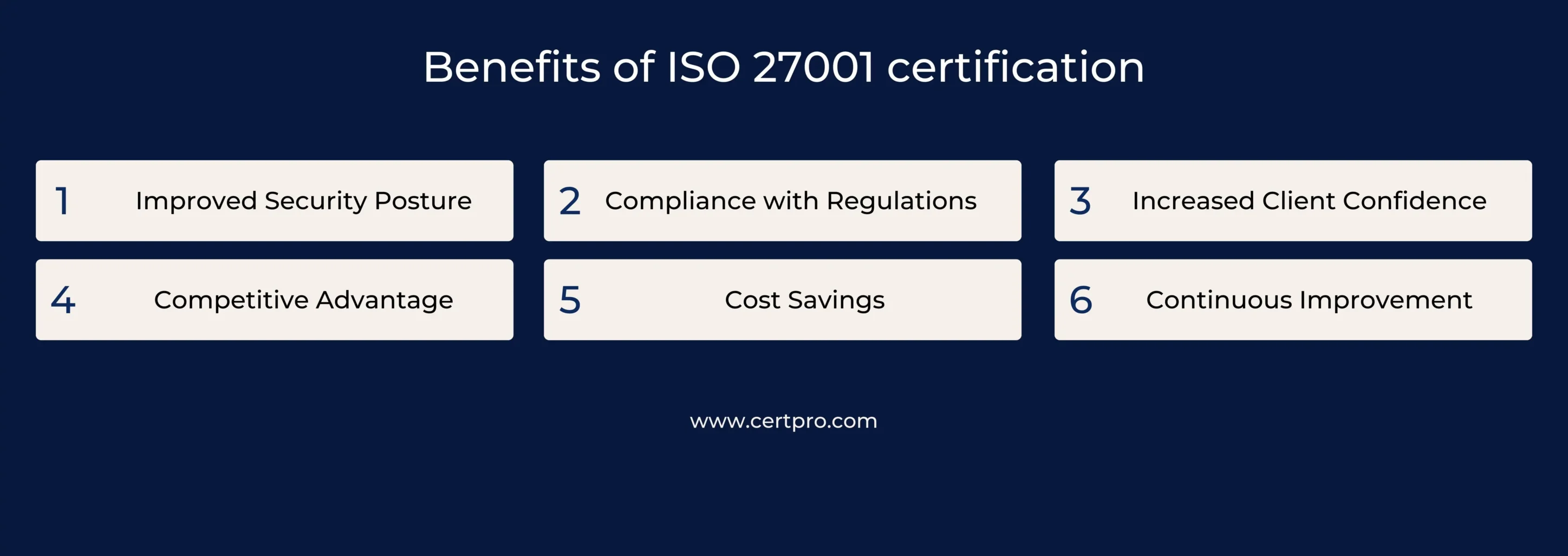
ISO 27001 Certification in Baltimore delivers measurable organizational benefits across procurement, regulatory alignment, operational discipline, and information security risk management. These benefits are realized through the structured discipline required to achieve and maintain conformity with the ISO 27001 standard, independent of the specific sector or size of the organization seeking certification.
- ✓Independent third-party verification of ISMS conformity, providing stakeholders with objective evidence of information security governance
- ✓Accelerated vendor qualification in enterprise procurement processes, particularly in Baltimore’s financial services, healthcare, and federal contracting sectors
- ✓Structured risk assessment discipline that systematically identifies and documents information security risks across the ISMS scope
- ✓Documented control framework aligned to Annex A that addresses access control, cryptography, incident response, supplier security, and business continuity
- ✓Support for regulatory alignment with HIPAA Security Rule, GLBA Safeguards Rule, Maryland Personal Information Protection Act, and federal information security requirements
- ✓Competitive differentiation in Baltimore’s technology and SaaS markets where ISO 27001 compliance is increasingly a baseline procurement expectation
- ✓Reduced customer security questionnaire burden through provision of a recognized ISO 27001 certification credential in lieu of individual security assessments
- ✓Annual surveillance audit cycle that maintains certification currency and provides ongoing independent evaluation of ISMS effectiveness
ISO 27001 certification audit evaluations for Baltimore organizations assess controls that address information security risks across multiple regulatory domains simultaneously. For healthcare technology organizations, the Annex A controls evaluated during the ISO ISMS Audit — particularly those addressing access control, cryptography, physical security, incident management, and business continuity — correspond to safeguard categories addressed under the HIPAA Security Rule. For financial services and fintech organizations, the risk assessment discipline and control documentation requirements of ISO 27001 compliance align with expectations under the Gramm-Leach-Bliley Act Safeguards Rule and the New York Department of Financial Services cybersecurity regulation, which affects some Maryland organizations with New York nexus. Certification does not constitute legal compliance with these regulations, but it provides documented evidence of systematic information security risk management that regulators and institutional clients evaluate favorably.
The Maryland Personal Information Protection Act imposes data breach notification obligations and information security requirements on businesses that own or license personal information of Maryland residents. Baltimore organizations that have implemented an ISMS conforming to ISO 27001 standard requirements — with documented risk assessment, access controls, incident response procedures, and employee awareness programs — are better positioned to demonstrate reasonable information security practices in the event of a regulatory inquiry or litigation following a data security incident. The ISO 27001 certification audit documentation and surveillance audit records provide an auditable history of the organization’s information security management activities.
Enterprise vendor security reviews in Baltimore’s financial services, healthcare, and technology sectors increasingly require technology vendors and SaaS providers to demonstrate ISO 27001 certification as a condition of vendor qualification. A Baltimore-based SaaS company seeking to onboard a regional health system as a client, for example, may encounter an information security questionnaire requiring evidence of third-party ISMS certification. The ISO 27001 certificate issued following a successful ISO 27001 certification audit provides a recognized, independently verified credential that satisfies this requirement — without requiring the health system to conduct its own security assessment of the vendor. This procurement recognition benefit is directly quantifiable in reduced sales cycle duration and lower cost of responding to vendor security reviews.
- ✓Regulatory Alignment and Compliance Support
- ✓Procurement Recognition and Enterprise Vendor Qualification
ISO 27001 Certification Scope and Independent Decision Framework
The scope of ISO 27001 Certification in Baltimore is defined by the organization and reviewed by CertPro during the certification audit process. Scope definition is a foundational element of both the ISMS and the certification, as it establishes the boundaries within which the management system operates and within which the certification credential applies. Stakeholders reviewing an ISO 27001 certificate should evaluate the scope statement carefully to understand which parts of the organization, which information assets, and which processes are covered by the certification.
Defining and Evaluating ISMS Scope
The ISMS scope must clearly define the boundaries and applicability of the management system, considering internal and external issues, interested party requirements, and interfaces between activities performed by the organization and those performed by external parties — such as cloud service providers, managed service providers, and outsourced processing vendors. For Baltimore organizations with multi-cloud architectures, remote workforces, or complex third-party dependencies — characteristics common across the technology, healthcare, and financial services sectors — the scope definition must accurately reflect how information flows across organizational and system boundaries. CertPro reviews the scope statement during Stage 1 of the ISO 27001 certification audit to confirm that it is consistent with the organization’s actual ISMS boundaries and that the audit program covers the full declared scope.
Exclusions from the ISMS scope are permitted under ISO/IEC 27001:2022 only where they do not affect the organization’s ability or responsibility to provide information security and where they do not affect the interests of relevant stakeholders. During the ISO 27001 certification audit process in Baltimore, CertPro evaluates whether any scope exclusions are justified and whether the declared scope accurately represents the information security perimeter the organization has chosen to certify. Scope limitations that appear designed to exclude high-risk or non-conforming areas from evaluation are subject to scrutiny by the audit team and the independent certification committee.
Independent Certification Committee and Certificate Validity
Following completion of Stage 2 audit activities and satisfactory resolution of identified nonconformities, CertPro’s independent certification committee reviews the complete audit record — including Stage 1 findings, Stage 2 evidence, nonconformity documentation, and corrective action verification — to make an independent certification decision. The committee members were not involved in conducting the audit, ensuring that the ISO 27001 certification decision is made by personnel who can evaluate the evidence objectively. A positive certification decision results in the issuance of an ISO 27001 certificate with a three-year validity period commencing from the certification decision date.
ISO 27001 certification validity is contingent on the organization maintaining conformity with the standard throughout the certificate period. CertPro conducts annual surveillance audits within the three-year certificate cycle to verify that the ISMS continues to operate in conformity with ISO/IEC 27001:2022 requirements and that any significant changes to the organization, its scope, or its information environment have been addressed within the management system. Failure to maintain conformity, refusal to undergo surveillance audits, or significant deterioration in ISMS effectiveness can result in suspension or withdrawal of the certificate. Prior to certificate expiry, organizations must complete a full recertification audit to renew their ISO 27001 certification for a subsequent three-year period.
Baltimore Industry Sectors and ISO 27001 Certification Applications
ISO 27001 certification for Baltimore companies spans a wide range of industry sectors, each with distinct information security risk profiles, regulatory environments, and stakeholder expectations. These factors shape the scope and focus of the ISMS and the ISO 27001 certification audit. The following table summarizes the primary industry sectors in Baltimore that seek ISO 27001 certification and the specific drivers relevant to each sector.
| Industry Sector | Key ISO 27001 Demand Drivers | Relevant Regulatory Context |
|---|---|---|
| Healthcare & Life Sciences | Hospital vendor qualification, clinical data protection, EHR integration security | HIPAA Security Rule, Maryland PIPA |
| Financial Services & Fintech | Third-party risk management, institutional client procurement, banking vendor reviews | GLBA Safeguards Rule, OCC guidance |
| Defense & Government Contracting | Federal supply chain security, contract solicitation requirements, prime contractor reviews | NIST SP 800-171, CMMC alignment |
| SaaS & Cloud Technology | Enterprise customer procurement, international market expansion, multi-tenant security | SOC 2 Type II complementary, GDPR |
| Biotechnology & Research | IP protection, clinical trial data security, sponsor and partner requirements | FDA 21 CFR Part 11, HIPAA Research |
Cybersecurity, Maritime, and Logistics Organizations
Baltimore’s cybersecurity sector — comprising managed security service providers, threat intelligence firms, security operations center operators, and cybersecurity software developers — frequently pursues ISO 27001 Certification in Baltimore to demonstrate that the organization’s own information security governance meets the same standards it delivers to clients. The credibility value of ISO 27001 certification is particularly pronounced in enterprise and government sales contexts, where procurement evaluators expect security service providers to hold independently verified ISMS certifications. ISO 27001 compliance in these organizations typically covers the full operational environment, including internal systems, client data environments, and tools used to deliver security services.
The Port of Baltimore and the associated maritime and logistics sector represent an often-overlooked context for ISO 27001 certification. Port terminal operators, freight forwarders, customs brokers, logistics technology platforms, and supply chain software providers handling cargo tracking, customs documentation, and port operations data increasingly face information security certification requirements from shipping lines, cargo owners, and government agencies. ISO 27001 compliance for Baltimore maritime and logistics organizations addresses operational technology security, cargo data confidentiality, and business continuity — control areas directly evaluated during the ISO 27001 certification audit process.
FAQ
▶
What is ISO 27001 certification and what does it certify?
▶
Which Baltimore organizations are required to obtain ISO 27001 certification?
▶
How long does the ISO 27001 certification audit process take in Baltimore?
▶
What is the difference between Stage 1 and Stage 2 of the ISO 27001 audit?
▶
What is an ISO ISMS Audit and how does it differ from an internal audit?
▶
How long is an ISO 27001 certificate valid?
▶
What is the Statement of Applicability and why is it important in the ISO 27001 audit?
▶
Does ISO 27001 certification replace HIPAA compliance for Baltimore healthcare technology vendors?
Get In Touch
have a question? let us get back to you.