
ISO 27001 Certification in Jacksonville
The ISO 27001 certification audit process for Jacksonville organizations follows a structured, multi-stage methodology conducted by CertPro as an independent certification body. Each stage serves a distinct evaluation purpose, and the certification decision is made only upon satisfactory completion of all required audit activities. The process is evidence-based throughout, with findings documented against specific clause and control requirements of ISO/IEC 27001:2022. No certificate is issued prior to completion of the full audit cycle and independent review by CertPro’s certification committee.
OUR CLIENTS









ISO 27001 Certification for Jacksonville-Based Organizations
CertPro is a Licensed CPA Firm providing independent ISO 27001 Certification in Jacksonville to organizations across logistics and transportation, maritime and port operations, healthcare and health technology, financial services, fintech, insurance, software and SaaS, cybersecurity, cloud services, aerospace and defense, manufacturing, and professional services. ISO 27001 Certification in Jacksonville is conducted exclusively as a third-party conformity assessment against the mandatory requirements of ISO/IEC 27001:2022 — distinct from any advisory, implementation, or readiness function. CertPro’s role is limited to independently evaluating whether an organization’s Information Security Management System conforms to the ISO 27001 standard and issuing a certification decision based on objective evidence.
Jacksonville holds a strategically significant position as Northeast Florida’s primary business hub, anchored by the Jacksonville Port Authority (JAXPORT) — one of the busiest container ports on the U.S. East Coast. This port ecosystem connects Jacksonville-based organizations to global supply chains, international trade partners, and multinational procurement frameworks. Each of these relationships carries information security expectations that require independent validation. Organizations operating within JAXPORT’s logistics and maritime corridor increasingly face vendor assurance reviews requiring documented, third-party-verified information security governance. ISO 27001 Certification in Jacksonville provides that independently verified assurance through a structured certification audit evaluated against ISO/IEC 27001:2022.
Jacksonville’s expanding financial services and fintech corridor — encompassing banking institutions, insurance carriers, payment processors, and financial technology firms — operates under sector-specific third-party risk management expectations from federal and state regulators. Healthcare organizations and health-technology companies across the Jacksonville metropolitan area are subject to HIPAA data protection requirements and enterprise vendor security assessments that increasingly reference ISO 27001 compliance as an accepted assurance framework. SaaS companies, cloud service providers, and cybersecurity firms serving regulated industries across Northeast Florida similarly encounter procurement requirements that specify independently issued ISO 27001 certification as a condition of engagement.
The ISO 27001 standard — formally designated ISO/IEC 27001:2022 — is the internationally recognized framework for establishing, implementing, maintaining, and continually improving an Information Security Management System. Certification under this standard is issued only by independent third-party certification bodies following a structured audit process. CertPro evaluates conformity against all mandatory clauses of the standard (Clauses 4 through 10) and assesses whether selected Annex A controls are implemented and operating effectively within the defined scope. Organizations subject to U.S. federal cybersecurity frameworks, international procurement requirements, and enterprise vendor due diligence processes across Jacksonville’s diverse economy rely on independently issued ISO 27001 Certification in Jacksonville, FL to demonstrate verified information security governance to customers, partners, regulators, and counterparties.
CertPro’s ISO 27001 certification audit evaluates the design and operating effectiveness of controls, the completeness of documented information, the rigor of the organization’s risk assessment and risk treatment processes, and the functioning of management system processes — including internal audit and management review. The certification decision is made independently by a certification committee based solely on audit findings and objective evidence. Jacksonville organizations across all sectors benefit from a certification process that is structured, transparent, evidence-based, and wholly separate from any implementation or consulting function. This separation maintains the integrity of the certification outcome and the credibility of the resulting certificate with third parties.

What Is ISO 27001 Certification?
ISO 27001 Certification is the formal, independent verification that an organization’s Information Security Management System conforms to all mandatory requirements of ISO/IEC 27001:2022. The ISO 27001 standard defines the criteria for establishing, implementing, maintaining, and continually improving an ISMS — a systematic framework for managing information security risks through documented policies, assessed controls, structured risk treatment, and ongoing management oversight. Certification is issued only after an independent third-party certification body conducts a structured two-stage audit and determines that the organization’s ISMS satisfies all requirements of the standard.
The ISO/IEC 27001:2022 Standard and Its Structure
ISO/IEC 27001:2022 is structured around ten clauses, of which Clauses 4 through 10 contain mandatory management system requirements. Clause 4 addresses organizational context and interested party requirements. Clause 5 covers leadership, information security policy, and organizational roles. Clause 6 defines planning requirements including risk assessment and risk treatment. Clause 7 covers support requirements including competence, awareness, and documented information. Clause 8 addresses operational controls and risk treatment implementation. Clause 9 covers performance evaluation including internal audit and management review. Clause 10 addresses improvement, including nonconformity management and corrective action. All mandatory clauses are evaluated during the ISO 27001 certification audit.
Annex A of ISO/IEC 27001:2022 contains 93 information security controls organized across four domains: Organizational Controls (37 controls), People Controls (8 controls), Physical Controls (14 controls), and Technological Controls (34 controls). Organizations select applicable controls based on their risk assessment outcomes and document these selections in a Statement of Applicability (SoA), which must justify both inclusions and exclusions. During the ISO 27001 certification audit, the certification body evaluates whether selected controls are appropriately implemented and operating effectively — and whether the SoA accurately reflects the organization’s risk treatment decisions. The 2022 revision introduced 11 new controls addressing threat intelligence, cloud service security, data masking, and ICT readiness for business continuity.
Information Security Management System (ISMS) Requirements
An Information Security Management System is the organizational framework through which information security risks are identified, assessed, treated, and monitored on an ongoing basis. Under ISO/IEC 27001:2022, organizations must establish a defined ISMS scope, conduct a systematic information security risk assessment, develop and implement a risk treatment plan, and maintain a Statement of Applicability documenting selected Annex A controls. Key documented information requirements include the information security policy, risk assessment results, risk treatment plan, SoA, internal audit reports, and management review records. These documented outputs form the primary evidence base that the ISO 27001 certification audit evaluates to determine conformity with the standard’s requirements.
ISO 27001 compliance requires organizations to operate their ISMS on a continual improvement cycle — not merely implement controls as a one-time activity. The ISO 27001 standard requires that internal audits be conducted at planned intervals to assess ISMS conformity and effectiveness, and that top management conduct formal management reviews to evaluate ISMS performance against defined objectives. Nonconformities identified through internal audits, incidents, or external reviews must be subject to documented root cause analysis and corrective action. For Jacksonville organizations operating in regulated sectors — including healthcare, financial services, and defense — these ongoing management system obligations align directly with sector-specific requirements for documented, evidence-based information security governance and continuous control monitoring.
ISO 27001 Certification Audit Process for Organizations in Jacksonville
The ISO 27001 certification audit process for Jacksonville organizations follows a structured, multi-stage methodology conducted by CertPro as an independent certification body. Each stage serves a distinct evaluation purpose, and the certification decision is made only upon satisfactory completion of all required audit activities. The process is evidence-based throughout, with findings documented against specific clause and control requirements of ISO/IEC 27001:2022. No certificate is issued prior to completion of the full audit cycle and independent review by CertPro’s certification committee.
| Audit Stage | Key Activities | Output |
|---|---|---|
| Application Review | Scope confirmation, organizational context review, audit program determination | Audit plan and scope agreement |
| Stage 1 Audit | Documentation review, ISMS readiness assessment, identification of areas requiring attention before Stage 2 | Stage 1 findings report |
| Stage 2 Audit | On-site or remote evidence evaluation, control effectiveness testing, clause conformity assessment against ISO/IEC 27001:2022 | Stage 2 audit report with findings |
| Nonconformity Review | Evaluation of corrective actions submitted in response to identified nonconformities | Nonconformity closure determination |
| Certification Decision | Independent certification committee review of complete audit record including all findings and corrective actions | Certificate issuance or non-issuance decision |
The Stage 1 audit is a structured review of the organization’s documented information against the requirements of ISO/IEC 27001:2022. During this stage, the auditor evaluates the ISMS scope documentation, information security policy, risk assessment methodology and results, risk treatment plan, Statement of Applicability, and evidence of internal audit and management review completion. The Stage 1 audit determines whether the ISMS documentation is sufficiently developed and whether the organization appears prepared for the Stage 2 audit. Significant documentation gaps identified during Stage 1 are communicated to the organization before the Stage 2 audit is scheduled. The Stage 1 audit does not itself result in a certification decision — it is a prerequisite evaluation that informs the scope and focus of the subsequent Stage 2 audit.
The Stage 2 audit constitutes the primary conformity assessment component of the ISO 27001 audit process. Auditors evaluate objective evidence to determine whether the ISMS conforms to all mandatory requirements of ISO/IEC 27001:2022 (Clauses 4–10) and whether selected Annex A controls are implemented and operating effectively within the defined scope. Evidence evaluation methods include document review, records inspection, personnel interviews, observation of operational processes, and technical testing where appropriate. For Jacksonville organizations in sectors such as healthcare IT, financial services technology, logistics platforms, and cloud service delivery, the Stage 2 audit evaluates security controls relevant to the specific systems, data types, and operational processes within the defined ISMS scope.
Nonconformities identified during the Stage 2 audit are classified and documented with reference to specific clauses or Annex A controls. The organization must submit evidence of corrective action addressing identified nonconformities before the certification committee’s final review. The certification committee evaluates the complete audit record — including Stage 1 findings, Stage 2 findings, nonconformity responses, and auditor assessments — and makes an independent determination regarding certification. Where the committee determines that the ISMS conforms to ISO/IEC 27001:2022 requirements, a certificate is issued specifying the organization name, defined scope, and certificate validity period. ISO 27001 Certification in Jacksonville results in a certificate valid for three years, subject to annual surveillance audits.
Following initial certification, ISO 27001 compliance is maintained through annual surveillance audits conducted in Years 1 and 2 of the three-year certification cycle. Surveillance audits evaluate whether the ISMS continues to conform to ISO/IEC 27001:2022 requirements, whether previously identified nonconformities have been effectively resolved, and whether the organization has responded appropriately to changes in its operational environment, threat landscape, or regulatory context. Surveillance audit findings are reviewed by the certification committee, which may suspend or withdraw certification where significant nonconformities remain unresolved. Recertification audits — conducted prior to certificate expiry at the end of the three-year cycle — involve a comprehensive re-evaluation of the ISMS against full standard requirements, functioning similarly in scope to the initial ISO 27001 certification audit.
- ✓Stage 1 Audit: Documentation and Readiness Review
- ✓Stage 2 Audit: Evidence Evaluation and Control Assessment
- ✓Surveillance Audits and Recertification
Why Organizations in Jacksonville Pursue ISO 27001 Certification
ISO 27001 Certification in Jacksonville reflects a convergence of enterprise vendor security demands, sector-specific regulatory expectations, international procurement requirements, and competitive positioning across Northeast Florida’s diverse business ecosystem. Organizations across Jacksonville’s logistics, maritime, healthcare, financial services, fintech, defense, and technology sectors face distinct but overlapping demand drivers. For these organizations, independently issued ISO 27001 Certification in Jacksonville is an operationally significant credential — not a discretionary initiative.
Logistics, Maritime, and Port-Related Organizations
Jacksonville’s position as home to JAXPORT — one of the largest container ports by volume on the U.S. East Coast — generates substantial information security governance demands among logistics operators, freight forwarders, customs brokers, terminal operators, and supply chain technology providers. Organizations connected to the JAXPORT ecosystem process sensitive cargo data, international trade documentation, vessel scheduling information, and customer supply chain data that require systematic protection under the ISO 27001 standard. International trade partners, multinational shipping companies, and global logistics customers increasingly require ISO 27001 Certification in Jacksonville as a condition of vendor approval or preferred supplier status. The port’s connections to markets in Europe, Latin America, and Asia create cross-border procurement expectations that reference ISO/IEC 27001:2022 as an accepted information security assurance framework.
Supply chain technology platforms, warehouse management system providers, transportation management software vendors, and logistics data analytics companies serving port-connected operations across Jacksonville face enterprise vendor security reviews conducted by large shipper and logistics customers. These reviews assess whether technology vendors hold independently verified information security controls — a requirement that ISO 27001 Certification in Jacksonville satisfies through the independently issued certificate and audit report. Defense-related logistics organizations in Jacksonville — including those supporting Naval Station Mayport and related military supply chain operations — additionally encounter federal contractor security expectations that align with ISO 27001 compliance frameworks as an internationally recognized assurance standard.
Financial Services, Fintech, and Insurance Organizations
ISO 27001 Certification in Jacksonville for financial services organizations responds to expectations from bank regulators, financial sector supervisory bodies, institutional clients, and enterprise procurement teams. Jacksonville’s financial corridor includes regional banking institutions, national bank operations centers, payment processors, credit unions, and insurance carriers. ISO 27001 compliance demonstrated through independent certification provides structured assurance that customer financial data, payment processing systems, and transaction infrastructure are governed by a documented and audited information security management framework. Third-party risk management programs at large financial institutions increasingly require ISO/IEC 27001:2022 certification as an accepted control assurance mechanism for technology vendors and cloud service providers within their service delivery chains.
Insurance carriers and specialty insurers headquartered or operating significantly in Jacksonville face information security governance expectations from reinsurers, state insurance regulators, and large corporate policyholders conducting vendor due diligence. For these organizations, ISO 27001 certification audit findings provide independently verified evidence of control design and operating effectiveness across systems handling policyholder data, claims information, actuarial data, and underwriting systems. Jacksonville’s growing concentration of insurtech and financial technology firms operating cloud-native platforms also encounters enterprise customer security requirements that specify independently issued ISO 27001 Certification as a prerequisite for processing financial or personally identifiable information on behalf of regulated entities.
Healthcare, Health Technology, and Life Sciences Organizations
ISO 27001 Certification in Jacksonville for healthcare organizations complements HIPAA compliance by providing independently verified assurance that information security controls governing electronic protected health information are systematically managed and audited. Jacksonville’s substantial healthcare sector — including major health systems, academic medical centers, specialty care providers, and healthcare IT companies — generates significant demand for the ISO 27001 standard as a structured information security governance framework applicable to both covered entities and business associates. Health technology companies, electronic health record vendors, telehealth platforms, medical device software providers, and health data analytics firms serving Jacksonville’s healthcare market encounter hospital procurement security requirements and enterprise vendor assessments that reference ISO 27001 certification as an accepted assurance standard alongside or in addition to HIPAA compliance documentation.
ISO 27001 Certification Requirements and Evaluation Criteria
ISO 27001 certification requires organizations to demonstrate conformity with all mandatory requirements of ISO/IEC 27001:2022 through objective evidence evaluated during the certification audit. The evaluation criteria span the full management system framework (Clauses 4–10) and the Annex A control set selected through the organization’s risk treatment process. Understanding the requirements evaluated during the ISO 27001 certification audit enables organizations to structure their ISMS appropriately — ensuring the certification outcome reflects genuine conformity rather than documentation alone.
ISO/IEC 27001:2022 specifies mandatory documented information that organizations must maintain and retain as evidence of ISMS operation. Required documentation includes the ISMS scope, information security policy, risk assessment methodology and results, risk treatment plan, Statement of Applicability, monitoring and measurement results, internal audit programs and results, and management review records. The ISO 27001 certification audit evaluates whether these documents exist, are appropriately controlled, reflect actual organizational practices, and contain the substantive content required by the standard. Documentation that exists in form but does not reflect operational reality — for example, a risk assessment that does not correspond to the organization’s actual threat environment or asset inventory — will result in nonconformity findings during the audit.
Beyond mandatory documented information, organizations typically maintain additional procedures, work instructions, and records that support ISMS operation and provide evidence of control effectiveness. For Jacksonville organizations operating in sectors with sector-specific documentation obligations — including HIPAA-regulated healthcare entities, SEC-regulated financial firms, and CMMC-aligned defense contractors — the ISMS documentation framework can be structured to address multiple regulatory requirements through a unified evidence base. The ISO 27001 certification audit evaluates documented information against ISO/IEC 27001:2022 requirements exclusively. Alignment with sector-specific frameworks is the organization’s responsibility and may be referenced in scope definitions but does not alter the certification criteria applied during the audit.
The ISO 27001 standard requires organizations to establish and apply a documented information security risk assessment process that identifies information security risks, analyzes their likelihood and potential consequences, and evaluates them against defined risk acceptance criteria. Risk assessment results must be documented and retained as evidence. Based on risk assessment outcomes, organizations must develop a risk treatment plan specifying selected risk treatment options (including selection of Annex A controls), identifying risk owners, and documenting expected residual risk levels. The Statement of Applicability must reference all Annex A controls, justify any exclusions, and indicate the implementation status of selected controls. During the ISO 27001 certification audit, auditors assess whether the risk assessment methodology is systematically applied, whether risk treatment decisions are traceable to risk assessment findings, and whether the SoA accurately reflects the organization’s control selection rationale.
ISO/IEC 27001:2022 requires organizations to conduct internal audits at planned intervals to determine whether the ISMS conforms to the organization’s own requirements and to the standard’s requirements, and whether it is effectively implemented and maintained. Internal audit programs must be planned, executed by competent personnel, and documented with findings and conclusions. Separately, top management must conduct formal management reviews of the ISMS at planned intervals — evaluating performance against defined objectives, the adequacy of resources, and the need for changes in response to internal or external developments. Both internal audit reports and management review records are evaluated during the ISO 27001 certification audit as evidence that the ISMS operates as a functioning management system — not merely a set of documented controls — and that leadership oversight is actively exercised over information security governance.
- ✓Documentation and Recorded Information Requirements
- ✓Risk Assessment and Risk Treatment Requirements
- ✓Internal Audit and Management Review Requirements
ISO 27001 Certification Scope for Jacksonville Organizations
Defining the ISMS scope is one of the most consequential decisions in the ISO 27001 certification process. The scope determines which organizational units, locations, systems, services, and information assets are included within the boundary of the certified ISMS. The ISO 27001 certification audit evaluates conformity only within the defined scope, and the issued certificate specifies that scope explicitly. Scope decisions must be made carefully to ensure the certified boundary is meaningful to the intended audience — customers, partners, and regulators — while remaining operationally manageable for the organization.
Scope Definition Considerations for Jacksonville Sectors
For Jacksonville-based SaaS companies and cloud service providers, scope typically encompasses the cloud infrastructure, application platform, development and operations environments, and associated data processing activities within which customer data is handled. For logistics and supply chain technology firms, scope may include transportation management systems, customer portal platforms, cargo tracking infrastructure, and the organizational functions responsible for their operation and security. For financial services organizations and fintech firms pursuing ISO 27001 compliance, scope frequently covers core banking or payment processing platforms, data centers or cloud environments hosting financial data, and the information security management functions governing those systems. For healthcare IT providers and health data companies, scope includes systems processing electronic protected health information and the organizational controls governing data access, transmission, and storage.
Scope exclusions must be justified in the ISMS scope documentation and must not compromise the organization’s ability to meet requirements or achieve intended outcomes. During the ISO 27001 audit in Jacksonville, auditors evaluate whether the defined scope accurately reflects the organization’s operational reality, whether scope boundaries are clearly documented and communicated, and whether interfaces and dependencies between in-scope and out-of-scope elements are identified and managed. Organizations that define scopes narrowly to exclude significant operational systems or data processing activities without adequate justification may receive nonconformity findings related to scope definition under Clause 4.3 of ISO/IEC 27001:2022. Well-structured, accurately described scope definitions that align with actual operations support a more efficient audit process and produce a certificate that carries credibility with enterprise customers conducting vendor assurance reviews.
Multi-Site and Distributed Organization Scope Considerations
Jacksonville organizations with distributed operations across multiple facilities, data centers, or geographic locations must determine how these sites relate to the defined ISMS scope. Organizations with significant operations outside Jacksonville — including those with national or international footprints — may define a scope encompassing all relevant locations or limit scope to specific sites or service lines. For organizations with operations connected to JAXPORT’s logistics ecosystem spanning multiple Florida locations or extending to partner facilities in other states, the ISMS scope documentation must clearly describe how information security management extends across the defined boundary. The ISO 27001 certification audit evaluates distributed or multi-site scopes by assessing whether ISMS requirements are consistently applied across all included locations and whether location-specific risks and controls are addressed within the overall risk assessment and treatment framework.
Benefits of ISO 27001 Certification for Jacksonville-Based Organizations
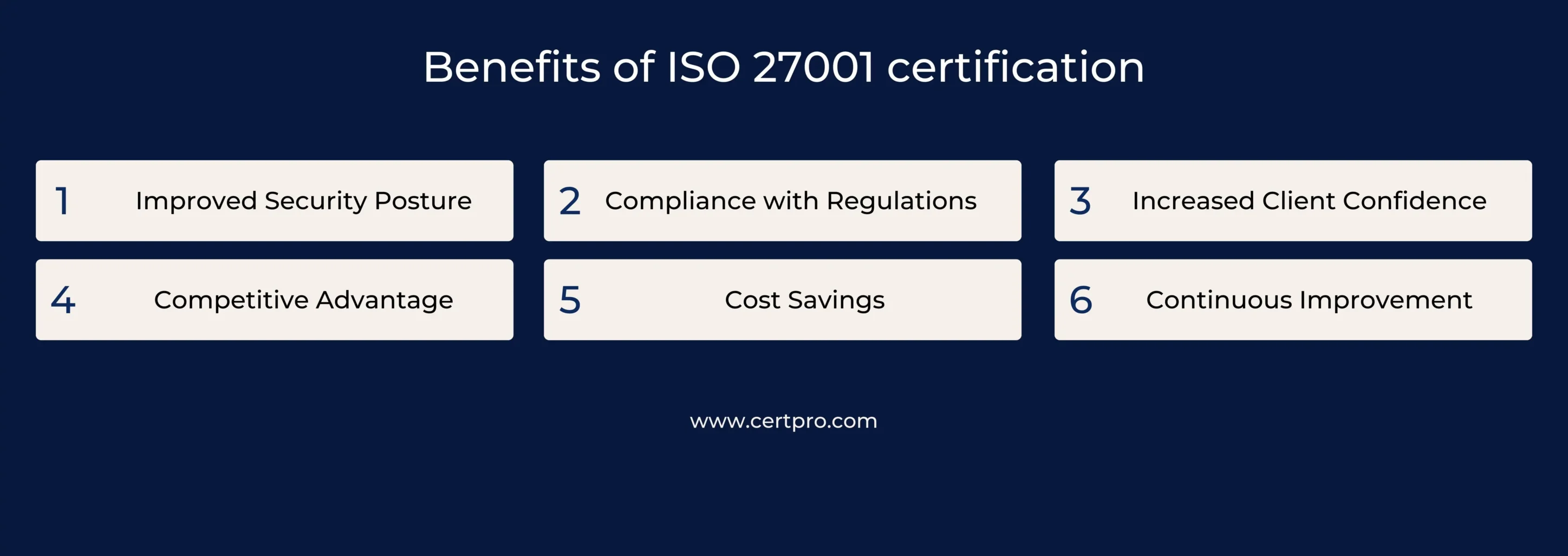
ISO 27001 Certification in Jacksonville delivers independently verified assurance of information security governance that carries objective weight in enterprise vendor reviews, regulatory assessments, and international procurement processes. The benefits of ISO 27001 certification for Jacksonville organizations reflect the practical value of independently issued, evidence-based certification across diverse market contexts — from port-connected supply chain operations to financial technology platforms and healthcare data management environments.
- ✓Independent, third-party verification of ISMS conformity to ISO/IEC 27001:2022 requirements, accepted by enterprise customers, regulators, and international trade partners
- ✓Structured ISO 27001 audit methodology that evaluates both documentation completeness and control operating effectiveness — not merely policy existence
- ✓Recognition in enterprise vendor security reviews across Jacksonville’s logistics, financial services, healthcare, defense, and technology sectors
- ✓Demonstrated ISO 27001 compliance through an audited, evidence-based framework that aligns with HIPAA, financial-sector third-party risk, and federal cybersecurity expectations
- ✓Annual surveillance oversight maintaining ongoing accountability for ISMS performance throughout the three-year certification cycle
- ✓ISO 27001 Certification in Jacksonville for companies pursuing international contracts, cross-border trade relationships, or multinational customer engagements
- ✓Certification committee independence ensuring that the certification decision reflects objective audit findings rather than organizational self-assessment
- ✓Credible assurance artifact — the ISO 27001 certificate and associated audit scope — shareable with customers, partners, and procurement teams as evidence of verified information security governance
Jacksonville organizations that have obtained ISO 27001 Certification in Jacksonville are well-positioned to respond to enterprise vendor security questionnaires, third-party risk assessments, and procurement security requirements. They can provide the certificate and defined scope as primary assurance documentation. Large enterprises, government agencies, financial institutions, and healthcare systems conducting vendor due diligence increasingly accept ISO 27001 certification as evidence of baseline information security governance — reducing the burden of individual customer security assessments. For Jacksonville logistics companies pursuing contracts with multinational shipping operators or global supply chain managers, ISO 27001 Certification in Jacksonville provides recognized assurance accepted in international procurement frameworks that may otherwise require country-specific certification or complex security documentation submissions.
SaaS companies and cloud service providers based in Jacksonville that serve regulated industries — including financial services, healthcare, government, and defense — frequently encounter security questionnaires that ask specifically whether the vendor holds current ISO 27001 certification. An independently issued certificate from a Licensed CPA Firm operating as a certification body carries weight in these assessments because it represents a third-party audit conclusion rather than a self-attestation. The ISO 27001 certification audit report — available to customers and partners within the terms of the certification agreement — provides additional detail on the evaluated scope, audit methodology, and findings that sophisticated procurement teams can use to assess control coverage relevant to their specific vendor risk concerns.
ISO 27001 compliance provides Jacksonville organizations with a structured framework for mapping legal and regulatory information security requirements to documented controls. This addresses HIPAA administrative and technical safeguard requirements, Florida information security statutes, federal contractor cybersecurity expectations, and financial-sector data protection obligations through a unified management system. The risk assessment and risk treatment requirements of ISO/IEC 27001:2022 create a documented, auditable record of how the organization identifies, evaluates, and addresses information security risks — satisfying regulatory expectations for documented risk management programs across multiple regulated sectors. The ISO 27001 standard’s continual improvement requirements ensure that compliance is not a static snapshot but a maintained posture subject to ongoing management review and periodic independent reassessment through surveillance and recertification audits.
- ✓Vendor Assurance and Procurement Positioning
- ✓Regulatory Alignment and Risk Management Outcomes
Industries Served by ISO 27001 Certification in Jacksonville
ISO 27001 Certification in Jacksonville applies across a broad range of industries operating within Northeast Florida’s diverse economy. CertPro conducts ISO 27001 certification audits for organizations in the following sectors, each of which encounters distinct information security governance requirements and assurance demands from customers, regulators, and trade partners.
| Industry Sector | Primary ISO 27001 Demand Driver | Representative Organizations |
|---|---|---|
| Logistics & Transportation | International vendor assurance, JAXPORT supply chain partners, multinational procurement requirements | Freight forwarders, 3PLs, logistics technology providers |
| Financial Services & Fintech | Third-party risk management programs, regulatory expectations, enterprise client security requirements | Banks, payment processors, insurtech firms, credit unions |
| Healthcare & Health Technology | HIPAA alignment, hospital vendor assessments, health data governance requirements | Health IT vendors, EHR platforms, telehealth companies |
| SaaS & Cloud Services | Enterprise customer security requirements, regulated-industry client procurement conditions | SaaS platforms, cloud hosting providers, data analytics companies |
| Aerospace & Defense | Federal contractor cybersecurity frameworks, DoD supply chain security requirements | Defense contractors, aerospace manufacturers, systems integrators |
Technology, SaaS, and Cybersecurity Organizations
Jacksonville’s growing technology sector — encompassing software development companies, SaaS platform providers, managed IT service providers, cybersecurity firms, and data analytics organizations — represents a significant concentration of ISO 27001 certification demand driven by enterprise customer security requirements. SaaS companies handling customer data, personal information, or financial records on behalf of enterprise clients routinely encounter procurement security requirements specifying independently issued ISO 27001 certification as a condition of vendor approval. Cybersecurity firms and managed security service providers in Jacksonville that hold ISO 27001 Certification in Jacksonville demonstrate through independent audit that their own information security governance meets the same standards they apply when assessing customer environments — a credibility marker with significant competitive value.
Artificial intelligence companies, data analytics platforms, and digital services organizations operating in Jacksonville that process large volumes of customer or business data face growing demand for independently verified information security assurance. As AI systems increasingly handle sensitive business data, financial information, and operational records on behalf of enterprise customers, procurement and legal teams require assurance that the vendor’s information security management framework is structured, audited, and certified against a recognized international standard. ISO 27001 Certification in Jacksonville for companies developing or deploying AI-enabled services provides that assurance through an independently issued certificate referencing the specific systems and data processing activities within the certified scope.
ISO 27001 Certification vs. Related Standards and Frameworks
Jacksonville organizations evaluating information security assurance options frequently encounter multiple standards and frameworks — including SOC 2, NIST CSF, CMMC, and the HIPAA Security Rule — alongside the ISO 27001 standard. Understanding how ISO 27001 Certification relates to these frameworks helps organizations identify the appropriate assurance mechanism for their specific customer, regulatory, and market requirements. ISO 27001 differs from self-attestation frameworks and regulatory compliance programs in that certification requires an independent third-party audit and issues a formal certificate valid for a defined period with ongoing surveillance obligations.
ISO 27001 and SOC 2: Distinct Assurance Mechanisms
ISO 27001 Certification and SOC 2 attestation are both independently issued assurance products but serve different purposes and follow different methodologies. ISO 27001 certification is issued against the ISO/IEC 27001:2022 standard and results in a certificate valid for three years with annual surveillance audits. SOC 2 is an attestation engagement conducted under AICPA attestation standards, resulting in a report rather than a certificate and typically covering a 12-month period. ISO 27001 certification is internationally recognized and widely accepted in global procurement frameworks — including those governing the international trade relationships relevant to Jacksonville’s port and logistics sector. SOC 2 is primarily recognized within the U.S. market and is commonly requested by U.S.-based enterprise technology customers. Some Jacksonville organizations pursue both to satisfy distinct customer populations: ISO 27001 for international and enterprise procurement requirements, SOC 2 for U.S.-focused technology customer assurance expectations.
ISO 27001 and NIST, CMMC, and Regulatory Frameworks
The NIST Cybersecurity Framework (CSF) and NIST SP 800-53 are widely referenced by U.S. federal agencies, defense contractors, and critical infrastructure operators but do not themselves produce independently issued certifications in the same manner as ISO 27001. CMMC (Cybersecurity Maturity Model Certification) applies specifically to organizations within the U.S. Department of Defense supply chain and represents a separate certification regime. For Jacksonville aerospace and defense contractors subject to CMMC requirements, ISO 27001 Certification in Jacksonville is a complementary assurance product — addressing international supply chain security expectations while CMMC addresses DoD-specific requirements. The ISO 27001 standard’s risk-based control selection framework and Annex A control domains overlap substantively with NIST SP 800-53 control families. This enables organizations to build a unified control environment addressing multiple frameworks through a shared evidence base, with ISO 27001 certification providing the independently issued assurance artifact for international and enterprise procurement purposes.
FAQ
▶
What is ISO 27001 Certification and why is it relevant for Jacksonville organizations?
▶
What does the ISO 27001 audit process involve for a Jacksonville organization?
▶
Which ISO/IEC 27001:2022 clauses are evaluated during the certification audit?
▶
What is a Statement of Applicability and why is it evaluated during the ISO 27001 audit?
▶
How long is an ISO 27001 certificate valid and what are the ongoing requirements?
▶
Does ISO 27001 certification satisfy HIPAA requirements for Jacksonville healthcare organizations?
▶
What sectors in Jacksonville most commonly seek ISO 27001 certification?
▶
What is the difference between ISO 27001 certification and ISO 27001 compliance?
Get In Touch
have a question? let us get back to you.