
ISO 27001 Certification in Western Australia
ISO 27001 certification for Western Australia organizations is driven by a combination of procurement requirements, regulatory obligations, client security expectations, and enterprise risk governance objectives. The following sections describe the primary demand drivers identified across organizations operating in Western Australia’s resources, technology, services, and government sectors.
OUR CLIENTS










Independent ISO 27001 Certification by a Licensed CPA Firm in Western Australia
CertPro is a Licensed CPA Firm delivering independent third-party ISO 27001 Certification in Western Australia to organizations across mining and resources, oil and gas, energy, engineering, financial services, SaaS, healthcare, and government technology. CertPro evaluates conformity against ISO/IEC 27001:2022 through structured certification audits, issuing certification decisions based exclusively on objective evidence gathered during the audit process.
Organizations seeking ISO 27001 Certification in Western Australia are responsible for establishing, implementing, operating, and maintaining their Information Security Management System (ISMS). CertPro’s role is to independently assess whether that system conforms to the requirements of the ISO 27001 standard — providing clients, regulators, and procurement bodies with credible, third-party assurance.
Western Australia’s Regulatory and Business Environment
Organizations operating in Western Australia are subject to the Privacy Act 1988 (Cth), the Australian Privacy Principles (APPs), the Security of Critical Infrastructure Act 2018, and evolving Australian Government cybersecurity expectations including the Essential Eight Maturity Model. Western Australia’s economy is anchored in resources, energy, engineering services, and a rapidly growing technology sector centered on Perth.
Perth functions as the primary business hub for organizations serving the resources and energy sectors, as well as a growing base for fintech, SaaS, artificial intelligence, and cloud services providers. ISO 27001 compliance across Western Australia has become a recognized benchmark for organizations that handle commercially sensitive, operational, or personal information in these sectors.
The Privacy Act 1988 requires organizations above the applicable annual turnover threshold to protect personal information in accordance with the Australian Privacy Principles. ISO 27001 Certification in Western Australia provides a documented, independently audited framework for satisfying those obligations. Australian Government procurement frameworks and enterprise vendor security requirements increasingly reference ISO 27001 certification as a condition of engagement — making it directly relevant to organizations pursuing government contracts or supplying critical infrastructure operators.
Cross-Border Compliance and Vendor Security Requirements
A Western Australia-headquartered mining technology firm supplying operational data management platforms to international joint-venture partners and Southeast Asian enterprise clients illustrates a common cross-border scenario. Such a firm is typically required to demonstrate ISO 27001 certification as a condition of vendor qualification under its international partners’ information security policies.
Independent ISO 27001 Certification in Western Australia, issued by a Licensed CPA Firm following a structured certification audit, provides an internationally recognized, independently verified attestation of conformity. This satisfies vendor security due diligence requirements across multiple jurisdictions in a single engagement. Similar requirements apply to Western Australia-based engineering services firms contracting with multinational energy companies, SaaS providers supplying regulated financial institutions in Singapore or Japan, and cloud service providers seeking to qualify for enterprise procurement panels across the Asia-Pacific region.
ISO 27001 audit engagements conducted by CertPro in Western Australia follow ISO/IEC 17021-1 and ISO/IEC 27006 accreditation requirements, ensuring the resulting certificate is recognized by enterprise procurement functions internationally.
Sectors Seeking ISO 27001 Certification in Western Australia
ISO 27001 Certification in Western Australia is pursued across a broad range of sectors where protection of operational, commercial, customer, and government information is a material requirement. Key sectors include:
Mining and resources companies handling royalty data, geological survey results, and joint-venture commercial terms; oil and gas operators managing operational technology and SCADA environments; energy and utilities providers subject to critical infrastructure obligations; and engineering and advanced manufacturing firms holding intellectual property and project delivery information.
Additionally, financial services and fintech organizations processing customer payment and identity data; SaaS and cloud service providers hosting regulated client data; healthcare and life sciences organizations managing clinical and patient information; and artificial intelligence and data analytics companies processing large-scale personal or commercially sensitive datasets all pursue ISO 27001 certification to demonstrate independently audited information security controls to clients, regulators, and procurement bodies.
Logistics, maritime, and transport operators managing supply chain and cargo information, along with government technology suppliers subject to whole-of-government procurement security requirements, round out the diverse range of organizations seeking ISO 27001 Certification in Western Australia.

What Is ISO 27001 Certification?
ISO 27001 certification is the formal recognition that an organization’s Information Security Management System (ISMS) conforms to the requirements of ISO/IEC 27001:2022 — the international standard for information security management published by the International Organization for Standardization (ISO) and the International Electrotechnical Commission (IEC).
The ISO 27001 standard specifies requirements for establishing, implementing, maintaining, and continually improving an ISMS within the context of an organization’s risk environment. Certification is issued by an independent third-party certification body following a structured conformity assessment that includes a Stage 1 documentation review and a Stage 2 on-site or remote audit.
ISO 27001 certification differs from self-declaration or internal assessments in one critical way: it requires an accredited, independent auditor to evaluate objective evidence of control implementation and system effectiveness before a certificate is issued. This independent verification is what gives the certification its credibility with clients, regulators, and procurement bodies.
ISO/IEC 27001:2022 and the ISMS Framework
ISO/IEC 27001:2022 is the current version of the ISO 27001 standard, having replaced ISO/IEC 27001:2013 with a global transition deadline of 31 October 2025. The 2022 revision restructured Annex A to contain 93 controls organized across four domains: Organizational controls (37), People controls (8), Physical controls (14), and Technological controls (34).
The management system requirements in Clauses 4 through 10 remain the core of the ISO 27001 standard. These clauses govern how an organization defines its context, establishes leadership commitment, addresses information security risks, operates its ISMS, and conducts internal audit and management review.
Organizations certified to the 2013 version are required to transition to ISO/IEC 27001:2022 before the October 2025 deadline. New certifications issued after October 2023 must be assessed against the 2022 standard. This makes timely transition planning essential for any organization currently holding or pursuing ISO 27001 certification.
Key Documentation Requirements Under the ISO 27001 Standard
The ISO 27001 standard requires organizations to produce and maintain specific documented information as evidence of ISMS conformity. Four foundational documents are evaluated during every ISO 27001 certification audit: the information security policy, the information security risk assessment, the risk treatment plan, and the Statement of Applicability (SoA).
The Statement of Applicability is a critical document. It identifies which of the 93 Annex A controls are applicable to the organization, documents the justification for inclusion or exclusion of each control, and records whether applicable controls have been implemented. During the ISO 27001 certification audit, auditors review the SoA alongside the risk treatment plan to confirm that controls have been selected and implemented in response to identified risks — and that the rationale for any exclusions is sound.
Additional documented information required by the ISO 27001 standard includes security objectives, competence records, internal audit results, management review outputs, and records of nonconformities and corrective actions. Together, these documents form the evidentiary backbone of the certification process.
Annex A Controls and Risk-Based Selection
Annex A of ISO/IEC 27001:2022 provides a reference set of 93 information security controls that organizations use to address identified risks. Control selection is not prescriptive. The ISO 27001 standard requires organizations to conduct a risk assessment, identify information security risks relevant to their context, and then select controls from Annex A — or additional controls from other sources — that are proportionate to the identified risk level.
The four Annex A control domains cover a wide range of measures, including information security policies, asset management, access control, cryptography, physical security, operations security, communications security, supplier relationships, incident management, business continuity, and compliance.
During an ISO 27001 certification audit, auditors assess whether implemented controls align with the risk assessment findings, whether the Statement of Applicability accurately reflects the organization’s control selection decisions, and whether controls are operating effectively. Evidence reviewed includes documented records, system configurations, logs, and structured interviews with personnel responsible for information security controls.
ISO 27001 Certification Audit Process in Western Australia
The ISO 27001 certification audit process for organizations in Western Australia follows a structured, multi-stage methodology conducted by CertPro as an independent third-party certification body. Each stage is governed by ISO/IEC 17021-1 (requirements for bodies providing audit and certification of management systems) and ISO/IEC 27006 (requirements specific to ISMS certification bodies).
The process moves from application and scope determination through Stage 1 and Stage 2 audits, nonconformity resolution, certification committee review, and certificate issuance. This is followed by ongoing surveillance and recertification cycles that maintain the integrity and currency of the ISO 27001 certification throughout its three-year validity period.
| Audit Stage | Key Activities | Output |
|---|---|---|
| Application & Scope Determination | Review of ISMS scope, organizational context, asset boundaries, and applicable exclusions | Confirmed audit scope and audit program |
| Stage 1 Audit | Review of ISMS documentation, information security policy, risk assessment, risk treatment plan, Statement of Applicability, and readiness indicators | Stage 1 audit report; identification of areas requiring clarification before Stage 2 |
| Stage 2 Audit | On-site or remote evaluation of ISMS implementation and operating effectiveness; evidence collection against ISO/IEC 27001:2022 Clauses 4–10 and Annex A controls | Stage 2 audit report; nonconformity findings |
| Nonconformity Review & Corrective Action | Review of corrective action evidence submitted in response to identified nonconformities | Closure of nonconformities or escalation to certification committee |
| Certification Committee Decision | Independent review of audit findings and corrective action evidence by a certification committee separate from the audit team | Certification decision; certificate issuance or rejection |
The Stage 1 audit is a structured review of the organization’s ISMS documentation, conducted by the CertPro audit team prior to the Stage 2 field audit. During Stage 1, auditors evaluate the information security policy, risk assessment methodology and results, risk treatment plan, Statement of Applicability, internal audit records, and management review outputs.
The Stage 1 audit determines whether the organization’s documented ISMS is sufficiently developed and implemented to proceed to Stage 2 evaluation. Auditors identify any areas where documentation is absent, incomplete, or inconsistent with the requirements of ISO/IEC 27001:2022, and communicate these findings through a formal Stage 1 audit report.
The Stage 1 audit also confirms the ISMS scope, verifies that organizational context has been defined in accordance with Clause 4 of the ISO 27001 standard, and identifies the Annex A controls covered by the certification scope. Significant deficiencies in ISMS documentation identified during Stage 1 may result in a recommendation to delay the Stage 2 audit until the issues are resolved — protecting the integrity of the overall ISO 27001 certification audit process.
The Stage 2 audit evaluates the implementation and operating effectiveness of the ISMS against the requirements of ISO/IEC 27001:2022. Auditors collect objective evidence through document review, technical configuration inspection, process observation, and structured interviews with personnel responsible for information security controls.
Evidence is assessed against each applicable clause of the ISO 27001 standard (Clauses 4 through 10) and each Annex A control identified as applicable in the Statement of Applicability. Nonconformities identified during the Stage 2 audit are classified and documented in the audit report. The organization is then required to submit a corrective action plan addressing each nonconformity within a defined timeframe. CertPro reviews the corrective action evidence before audit findings are submitted to the certification committee.
ISO 27001 certification audit engagements in Western Australia conducted by CertPro may be performed on-site at the organization’s premises in Perth or regional Western Australia, or using remote audit techniques where the scope and evidence availability support that approach.
ISO 27001 certification is valid for a three-year certification cycle. During this period, CertPro conducts annual surveillance audits to verify that the certified ISMS continues to conform to the requirements of the ISO 27001 standard and that the organization is maintaining and improving its information security management system.
Surveillance audits focus on selected clauses, controls, and processes from the full certification scope — with particular attention to findings from the initial certification audit, changes to the organization’s information security risk environment, and evidence of continual improvement.
At the end of the three-year cycle, a recertification audit is conducted against the full scope of ISO/IEC 27001:2022, following a process equivalent to the initial Stage 1 and Stage 2 sequence. Recertification confirms continued conformity and renews the certificate for a further three-year cycle. ISO 27001 certification holders in Western Australia that fail to maintain conformity during the surveillance cycle may have their certificate suspended or withdrawn by the certification committee.
- ✓Stage 1 Audit: Documentation and Readiness Review
- ✓Stage 2 Audit: Implementation and Effectiveness Evaluation
- ✓Surveillance Audits and Recertification
ISO 27001 Requirements and Evaluation Criteria
ISO 27001 compliance is evaluated against the requirements set out in ISO/IEC 27001:2022, which is organized into two parts: the management system requirements in Clauses 4 through 10, and the reference control set in Annex A. During an ISO 27001 certification audit, CertPro evaluates objective evidence against each of these requirements to determine whether the organization’s ISMS conforms to the standard.
The table below summarizes the clause-level requirements evaluated during a certification audit, providing a clear reference for organizations preparing for ISO 27001 Certification in Western Australia.
| ISO 27001 Clause | Requirement Area | Key Evaluation Points |
|---|---|---|
| Clause 4 | Context of the Organization | Internal and external issues, interested parties, ISMS scope definition |
| Clause 5 | Leadership | Information security policy, top management commitment, roles and responsibilities |
| Clause 6 | Planning | Information security risk assessment, risk treatment, Statement of Applicability, information security objectives |
| Clause 7 | Support | Resources, competence, awareness, communication, documented information |
| Clause 8 | Operation | Operational planning, risk assessment execution, risk treatment implementation |
| Clause 9 | Performance Evaluation | Monitoring, measurement, internal audit, management review |
| Clause 10 | Improvement | Nonconformity, corrective action, continual improvement |
The ISO 27001 standard requires organizations to establish and apply an information security risk assessment process that identifies risks associated with the loss of confidentiality, integrity, and availability of information within the ISMS scope. Risk assessments must be conducted at planned intervals and whenever significant changes occur that could affect the information security risk environment.
The risk treatment process requires organizations to select appropriate treatment options — including applying Annex A controls — and produce a risk treatment plan documenting selected controls, their implementation status, and the residual risk accepted by management.
During an ISO 27001 certification audit, auditors evaluate whether the risk assessment methodology is defined, consistently applied, and produces comparable and reproducible results. Evidence reviewed includes risk registers, risk assessment records, risk treatment plans, and the Statement of Applicability. Auditors verify that control selection decisions are traceable to risk assessment findings, and that the SoA reflects actual control implementation status rather than an aspirational or theoretical position.
Clause 9 of the ISO 27001 standard requires organizations to conduct internal audits of the ISMS at planned intervals. These audits determine whether the system conforms to the organization’s own requirements and to the requirements of ISO/IEC 27001:2022, and whether it is effectively implemented and maintained. Internal auditors must be selected to ensure objectivity and impartiality.
Internal audit findings must be reported to relevant management, and documented records of the audit program and results must be maintained. Management review is a separate Clause 9.3 requirement: top management must review the ISMS at planned intervals to ensure its continuing suitability, adequacy, and effectiveness. Review inputs include audit results, risk treatment status, security incidents, and information on continual improvement opportunities.
During an ISO 27001 certification audit, CertPro auditors review internal audit records, management review minutes, and follow-up actions to assess whether these processes are functioning as required by the standard. Weak or absent internal audit and management review processes are among the most common causes of nonconformity findings.
The scope of ISO 27001 certification defines the boundaries of the certified ISMS, including the organizational units, locations, assets, processes, and technologies covered by the certificate. Scope definition is evaluated during the Stage 1 audit to confirm consistency with Clause 4.3 of the ISO 27001 standard and to verify that any scope exclusions are justified.
Certificates issued by CertPro state the certified scope on their face, enabling relying parties — including clients, procurement bodies, and regulators — to verify exactly what is covered by the ISO 27001 certification.
ISO 27001 certification may be suspended where surveillance audit findings reveal significant nonconformities that have not been resolved within the specified timeframe, where the organization fails to make the ISMS available for surveillance audit, or where material changes to operations affect conformity. Certification may be withdrawn where suspension is not resolved or where evidence of fundamental ISMS failure is established. The certification committee makes all suspension and withdrawal decisions independently of the audit team, based on documented evidence submitted through the formal audit and nonconformity process.
- ✓Information Security Risk Assessment and Treatment
- ✓Internal Audit and Management Review Requirements
- ✓Certification Scope, Suspension, and Withdrawal
Why Western Australia Organizations Pursue ISO 27001 Certification
ISO 27001 certification for Western Australia organizations is driven by a combination of procurement requirements, regulatory obligations, client security expectations, and enterprise risk governance objectives. The following sections describe the primary demand drivers identified across organizations operating in Western Australia’s resources, technology, services, and government sectors.
Procurement and Vendor Security Requirements
Enterprise procurement processes in the resources, energy, financial services, and government technology sectors in Western Australia increasingly require vendors and service providers to hold current ISO 27001 certification as a condition of qualification. Major mining and resources companies apply vendor information security requirements — including ISO 27001 certification — to technology providers, data management platform vendors, engineering software suppliers, and professional services firms with access to operational or commercial data.
Australian Government procurement frameworks reference ISO 27001 compliance as a recognized information security management standard, and whole-of-government information security policies require agencies and their suppliers to address information security risk systematically.
For Western Australia-based organizations seeking to qualify for government contracts, resources sector panel arrangements, or financial services vendor panels, a current ISO 27001 certification audit status provides an independently verified credential. This credential satisfies procurement evaluation criteria without requiring the organization to respond to individual security questionnaires for each client — significantly reducing the administrative burden of vendor qualification.
Regulatory Alignment and Privacy Obligations
Organizations subject to the Privacy Act 1988 (Cth) are required to take reasonable steps to protect personal information from misuse, interference, loss, unauthorized access, modification, or disclosure under Australian Privacy Principle 11. ISO 27001 compliance provides a structured, documented, and independently audited approach to satisfying APP 11 obligations, with the ISO 27001 certification audit process generating objective evidence that information security controls have been designed and are operating effectively.
The Security of Critical Infrastructure Act 2018 imposes additional obligations on organizations operating critical infrastructure assets in sectors including energy, water, transport, communications, and financial services. ISO 27001 certification supports compliance with the Act’s risk management program obligations by providing a documented ISMS with independently verified controls.
Western Australia-based healthcare organizations subject to the My Health Records Act 2012 and the Notifiable Data Breaches scheme under the Privacy Act also benefit from ISO 27001 certification as evidence of systematic information security governance applicable to health record protection obligations.
International Market Access and Cross-Border Requirements
Western Australia-based organizations exporting technology, data services, engineering expertise, or resources sector solutions to international markets frequently encounter information security requirements from clients and joint-venture partners in the European Union, the United Kingdom, Singapore, Japan, South Korea, and the United States. ISO 27001 certification is recognized internationally as a benchmark for information security management, and a certificate issued by an accredited certification body is accepted across multiple regulatory environments as evidence of systematic information security governance.
For a Western Australia SaaS provider or cloud services company seeking to contract with regulated financial institutions in Singapore or enterprise clients in the European Union, ISO 27001 Certification in Western Australia provides an internationally portable, independently verified credential. This credential reduces the documentation burden of cross-border vendor qualification substantially.
ISO 27001 certification also supports alignment with data protection requirements across multiple jurisdictions — including the EU General Data Protection Regulation (GDPR) and Singapore’s Personal Data Protection Act — by providing a documented control framework that maps to legal information security obligations in those frameworks.
Benefits of ISO 27001 Certification for Western Australia-Based Organizations
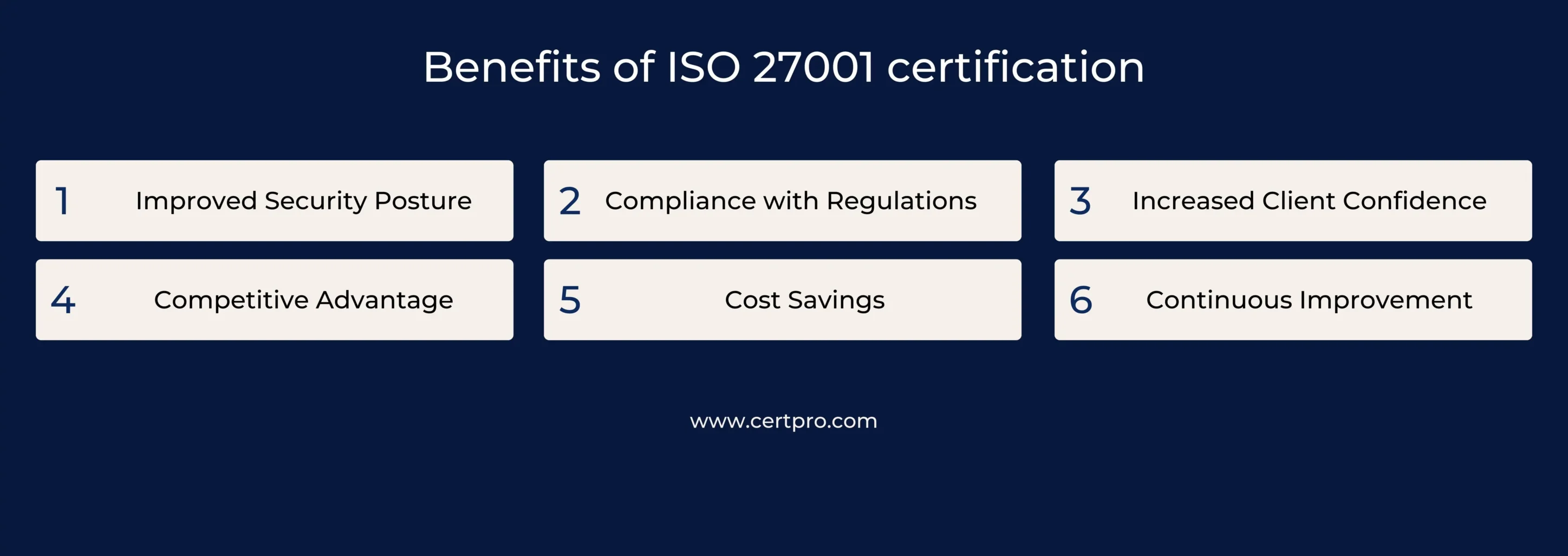
ISO 27001 Certification in Western Australia delivers independently verified, structured, and internationally recognized information security governance outcomes. The benefits listed below are documented outcomes of the certification process, not assurances or guarantees of any specific result.
- ✓Independent third-party verification that the ISMS conforms to ISO/IEC 27001:2022, providing objective assurance to clients, regulators, and procurement bodies
- ✓Structured evidence base demonstrating that information security controls have been designed, implemented, and are operating effectively across the certified scope
- ✓Recognition in enterprise procurement processes and vendor qualification panels in the resources, energy, financial services, and government technology sectors in Western Australia
- ✓Alignment with Privacy Act 1988 obligations and Australian Privacy Principle 11 requirements through a documented, independently audited information security control framework
- ✓Support for Security of Critical Infrastructure Act 2018 risk management program compliance for organizations operating critical infrastructure assets
- ✓International portability of the ISO 27001 certificate, supporting market access in the European Union, Singapore, Japan, and other jurisdictions that recognize ISO 27001 compliance
- ✓Ongoing surveillance audit oversight that provides continuous independent validation of ISMS conformity throughout the three-year certification cycle
- ✓Reduced client-side security assessment burden through a single, independently issued certificate accepted in place of individual security questionnaires across multiple client relationships
The ISO 27001 standard requires organizations to establish a systematic, risk-based approach to information security governance. This includes defined roles and responsibilities, documented policies, a structured risk assessment and treatment process, and ongoing performance monitoring. Organizations that achieve ISO 27001 certification demonstrate that their information security governance framework has been independently evaluated and found to conform to an internationally recognized standard.
This outcome is particularly relevant for Western Australia organizations in the resources sector, where information security governance of remote operations, operational technology environments, joint-venture data sharing arrangements, and contractor access to sensitive operational systems represents a material governance requirement.
For financial services and fintech organizations, ISO 27001 certification provides evidence of systematic information security risk management that aligns with APRA Prudential Standard CPS 234 expectations and AUSTRAC’s anti-money-laundering information security obligations — supporting a comprehensive regulatory compliance posture.
For technology companies, SaaS providers, cloud service providers, and artificial intelligence organizations operating in Western Australia, ISO 27001 certification serves as the primary independently verified information security credential recognized in enterprise and government procurement markets. Holding a current ISO 27001 certification audit status enables technology organizations to respond to enterprise client security questionnaires by referencing their certificate — rather than providing ad hoc documentation for each engagement — significantly reducing the time and resource cost of vendor qualification.
ISO 27001 standard certification also supports alignment with international SaaS and cloud security frameworks, including the Cloud Security Alliance’s Cloud Controls Matrix, and provides a foundation for organizations additionally pursuing SOC 2 Type II attestation for United States market access.
Western Australia-based AI and data analytics companies handling large volumes of personal or commercially sensitive data benefit from ISO 27001 certification as a demonstrated commitment to information security risk management. This commitment supports client confidence and regulatory alignment across multiple data protection frameworks — from Australia’s Privacy Act to the EU GDPR.
- ✓Information Security Governance and Risk Management Outcomes
- ✓Technology Sector and SaaS Provider Outcomes
ISO 27001 Certification for Key Sectors in Western Australia
ISO 27001 certification engagements in Western Australia are conducted across a diverse range of industry sectors, each presenting distinct information security risk profiles, regulatory contexts, and certification objectives. The following sections describe the ISO 27001 certification context for the primary sectors operating in Western Australia.
Mining, Resources, Energy, and Engineering
Western Australia’s mining and resources sector generates, processes, and stores substantial volumes of commercially sensitive information — including geological survey data, resource estimates, royalty and production records, environmental compliance data, and joint-venture commercial terms. Engineering firms providing project delivery, operations, and maintenance services to this sector handle confidential client project data, intellectual property, and operational technology configurations.
Energy and utilities operators subject to the Security of Critical Infrastructure Act 2018 are required to maintain risk management programs that address information security for critical infrastructure assets. ISO 27001 compliance provides a structured framework for meeting these obligations effectively.
ISO 27001 certification engagements in Perth and regional Western Australia covering the resources and energy sectors typically scope ISMS boundaries to include operational technology environments, remote monitoring systems, enterprise resource planning platforms, and contractor access management systems. Independent ISO 27001 certification audit findings in these sectors provide evidence to joint-venture partners, commodity offtake counterparties, and regulatory bodies that information security controls are systematically managed.
Financial Services, Fintech, Healthcare, and Government Technology
Financial services organizations and fintech companies operating in Western Australia — including banks, credit unions, payment processors, wealth management platforms, and insurance technology providers — are subject to APRA Prudential Standard CPS 234 Information Security, the Privacy Act 1988, and AUSTRAC reporting obligations. All of these frameworks require systematic information security risk management. ISO 27001 certification provides an independently audited framework that supports CPS 234 compliance and satisfies information security due diligence requirements from institutional clients and regulators.
Healthcare and life sciences organizations managing patient information, clinical trial data, and medical device software are subject to the Privacy Act 1988, the My Health Records Act 2012, and Notifiable Data Breaches scheme obligations. ISO 27001 certification audit outcomes provide documented evidence of clinical information security governance that can be presented to regulators and clients alike.
Government technology suppliers to Western Australian state agencies and Commonwealth departments require demonstrated information security governance as a condition of procurement qualification. ISO 27001 standard certification is accepted as evidence of conformity with the Australian Government Information Security Manual (ISM) principles in vendor assurance contexts, making it a practical requirement for organizations supplying government digital services.
ISO 27001 Standard: Transition to ISO/IEC 27001:2022
The transition from ISO/IEC 27001:2013 to ISO/IEC 27001:2022 is a mandatory requirement for all certified organizations. The transition deadline of 31 October 2025, set by accreditation bodies internationally, applies to all organizations regardless of their current certification cycle position.
Organizations in Western Australia that hold ISO 27001 certification issued against the 2013 version of the standard must complete a transition audit before this deadline to maintain certified status. After 31 October 2025, certificates issued against ISO/IEC 27001:2013 are no longer valid. Organizations that have not completed transition will lose their certified status until a full recertification audit against the 2022 standard is completed and a new certificate is issued.
Key Changes in ISO/IEC 27001:2022
The ISO/IEC 27001:2022 revision introduced several material changes to the standard that affect how organizations structure their ISMS and how ISO 27001 certification audits are conducted. The most significant structural change is the reorganization of Annex A controls from 114 controls across 14 domains (in the 2013 version) to 93 controls across four thematic domains in the 2022 version.
The 2022 revision also introduced 11 new controls addressing: threat intelligence, information security for cloud services, ICT readiness for business continuity, physical security monitoring, configuration management, information deletion, data masking, web filtering, secure coding, and monitoring activities. Organizations must update their Statement of Applicability to reflect the 2022 Annex A structure, map existing controls to the revised control set, and evaluate whether any of the 11 new controls are applicable to their risk environment.
The management system clauses (4 through 10) were also updated to align with the harmonized structure used across other ISO management system standards. This facilitates integrated management system approaches for organizations holding multiple certifications — for example, combining ISO 27001 with ISO 9001 or ISO 22301.
Transition Audit Process for Western Australia Organizations
The ISO 27001 standard transition audit process conducted by CertPro in Western Australia evaluates the organization’s updated ISMS documentation, revised Statement of Applicability, and implementation of any new or modified controls required by ISO/IEC 27001:2022. Transition audits may be conducted as a standalone engagement or combined with a scheduled surveillance audit, depending on the organization’s certification cycle position and the extent of changes required to address the 2022 standard.
Auditors review evidence that the organization has assessed the applicability of the 11 new Annex A controls, updated its risk treatment plan to reflect the 2022 control structure, revised relevant information security policies and procedures, and trained personnel responsible for information security on any ISMS changes resulting from the transition.
The output of a successful transition audit is an updated certificate referencing ISO/IEC 27001:2022 and reflecting the certified scope as reviewed during the transition engagement. Organizations in Western Australia that do not complete the transition audit before 31 October 2025 will require a full recertification audit against ISO/IEC 27001:2022 to regain certified status.
ISO 27001 Certification Perth and Regional Western Australia
ISO 27001 certification engagements in Perth cover organizations headquartered in Perth’s central business district and surrounding metropolitan areas, including technology precincts, financial services organizations, government agencies, and professional services firms. CertPro conducts ISO 27001 audit engagements across Perth and regional Western Australia — including the Pilbara, Goldfields, Kimberley, South West, Mid West, and Gascoyne regions — where significant resources, energy, agriculture, maritime, and logistics operations are conducted.
Perth Technology and Business Ecosystem
Perth has developed a substantial technology and professional services ecosystem serving both the resources sector and broader enterprise markets. Technology precincts including Hatch Quarter and Spacecubed, along with organizations affiliated with Curtin University, the University of Western Australia, and Murdoch University, contribute to Perth’s growing capacity in SaaS development, cybersecurity, artificial intelligence, data analytics, and resources technology.
Perth-based SaaS companies and cloud service providers supplying enterprise clients in the resources, financial services, and government sectors require ISO 27001 certification in Perth to satisfy client security qualification requirements. Perth’s position as the primary services and logistics hub for Western Australia’s resources regions means that technology companies, engineering services providers, and data management platform vendors operating in Perth regularly supply clients whose own information security requirements mandate vendor ISO 27001 certification.
ISO 27001 compliance across Western Australia is therefore a commercial requirement for a significant proportion of Perth’s technology and professional services community — not solely a regulatory obligation. This commercial reality is driving strong and sustained demand for ISO 27001 Certification in Western Australia across sectors.
Remote Operations and Operational Technology Environments
Western Australia’s geographic scale creates distinct information security challenges for organizations managing remote mining operations, offshore oil and gas platforms, remote energy infrastructure, and agricultural operations. Remote operations environments rely on satellite connectivity, operational technology networks, SCADA systems, industrial control systems, and remote monitoring platforms — each presenting information security risks requiring systematic governance under the ISO 27001 standard.
ISO 27001 certification audit engagements in Western Australia that include operational technology environments require auditors with relevant expertise to evaluate controls governing OT network segmentation, access control for industrial control systems, patch management for operational technology assets, and incident response procedures applicable to remote and critical operational environments.
CertPro’s ISO 27001 certification audit engagements in the resources and energy sectors across Western Australia address these OT-specific control requirements within the scope of the certified ISMS. This approach is consistent with the guidance provided in ISO/IEC 27019 (information security controls for the energy utility industry) and relevant IEC standards for industrial control system security.
FAQ
▶
What is ISO 27001 certification and what does it cover?
▶
Who needs ISO 27001 certification in Western Australia?
▶
What is the difference between the Stage 1 and Stage 2 ISO 27001 audit?
▶
How long is an ISO 27001 certificate valid?
▶
What is the Statement of Applicability in ISO 27001?
▶
Does ISO 27001 certification satisfy Privacy Act 1988 obligations in Western Australia?
▶
Is ISO 27001 certification recognized for Australian Government procurement?
▶
What is the transition deadline for ISO/IEC 27001:2022?
Get In Touch
have a question? let us get back to you.