

Missing Complementary User Entity Controls' (CUECs) SOC report disclosure can affect how report users understand a service organization's control environment. Management must identify the customer-side controls that it assumes user entities will implement and describe them in its SOC 2 report. Understand how auditors evaluate CUECs SOC report disclosures, identify missing customer responsibilities, assess their effect on the system description, and determine whether an omission warrants an unmodified or modified SOC 2 Type 2 opinion.

Concern
Management may describe its controls as operating effectively while omitting customer-side activities that its control design assumes user entities will perform.
Overview
AICPA Description Criterion DC6 addresses complementary user entity controls (CUECs). Missing disclosures can affect the fair presentation of the system description when management omits controls necessary to achieve its service commitments and system requirements.
Solution
The auditor evaluates management's identification and description of CUECs, determines whether an omission affects the system description or other examination conclusions, and assesses whether an opinion modification is necessary.
A service organization's controls may depend on activities performed by its customers.
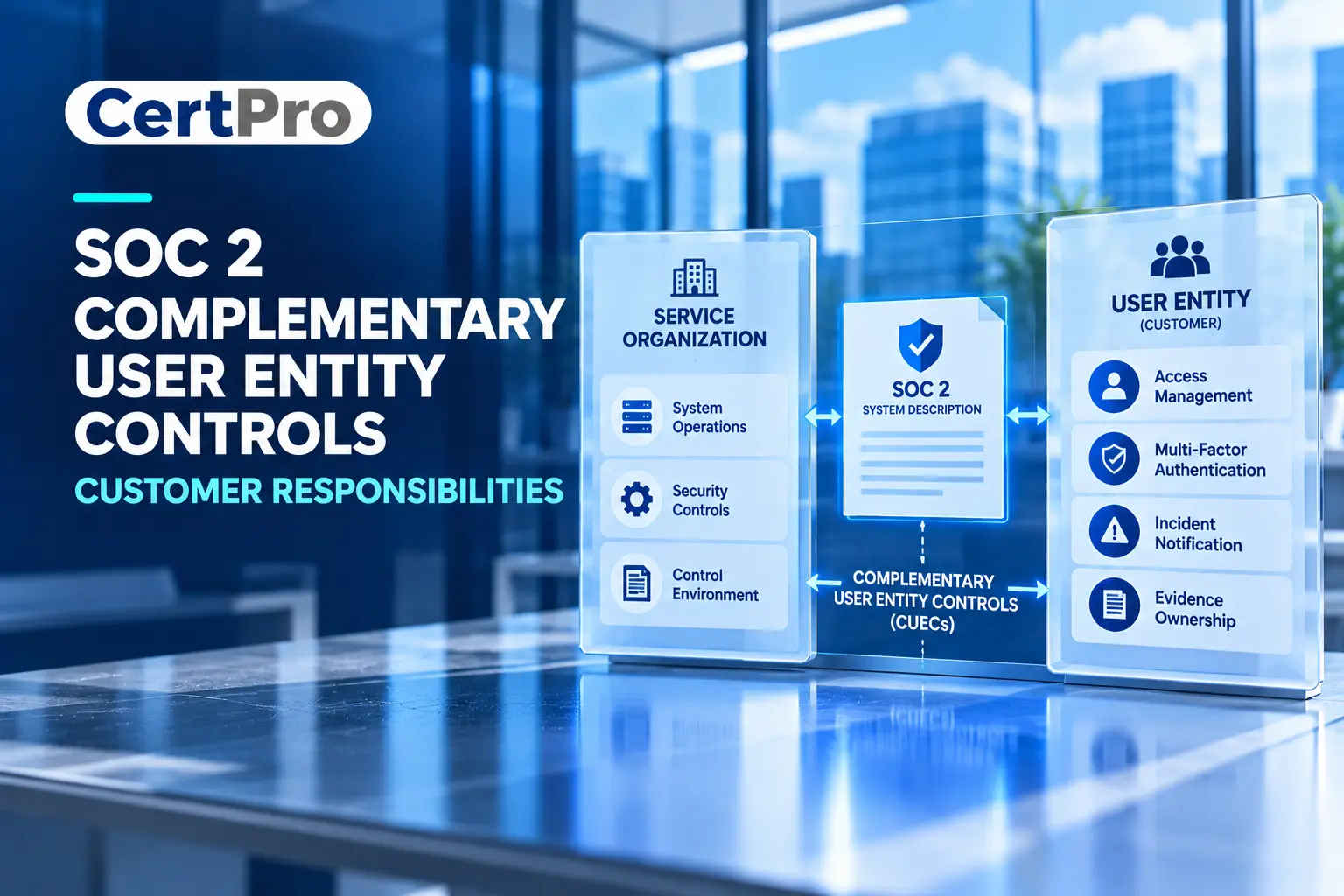
Complementary User Entity Controls or CUECs SOC report are customer-side controls that management assumes user entities will implement in combination with the service organization's controls. Management identifies these controls and discloses them in its SOC 2 report so report users can understand their responsibilities.
A disclosure gap occurs when management omits a customer-side control that forms a necessary part of its control arrangement. This can leave report users with an incomplete understanding of how the service organization achieves its commitments.
CUECs in a SOC 2 Type 2 Examination
What is a SOC 2 Type 2 examination?
A SOC 2 Type 2 examination is an independent CPA examination that evaluates whether a service organization's controls meet the applicable Trust Services Criteria and operate effectively over a specified period.
A cloud provider may rely on customers to maintain authorized administrator lists and review privileged access. These activities qualify as CUECs when the provider's access controls depend on them. The auditor evaluates CUEC disclosures and tests the provider's controls during the SOC 2 Type 2 examination. The disclosure process involves three parties:
-
Step 1: Service organization
Management identifies the customer-side controls it assumes user entities will implement and describes them in the SOC 2 system description.
-
Step 2: SOC 2 report
The service auditor examines management's system description, including its identification and description of CUECs. The report communicates these assumed customer responsibilities to report users.
-
Step 3: User entities
Customers review the CUECs SOC report disclosures to understand which controls they must implement within their own environments.
An important distinction applies here: the service auditor does not test whether individual user entities have implemented the disclosed CUECs. Each user entity remains responsible for implementing the controls applicable to its environment.
A customer may also review the service organization's SOC 2 report as part of its vendor risk assessment. However, the report does not provide assurance that the customer has fulfilled its own control responsibilities.
Management's Responsibility for CUEC Disclosures
What Does AICPA Description Criterion DC6 Require?
AICPA Description Criterion DC6 addresses complementary user entity controls within the system description. It helps report users understand the assumptions behind the service organization's control environment and the customer-side activities required by those assumptions.
CUECs' SOC Report and General User Entity Responsibilities: What Is the Difference?
Not every customer-side security activity qualifies as a CUEC. An activity qualifies when management expects user entities to perform it alongside the service organization's controls to meet relevant commitments and system requirements. For example, customer privileged access reviews become CUECs when the provider relies on customer notifications to identify and revoke inappropriate access.
How Does Management Establish Completeness?
Management must consider the actual control dependencies within its service delivery model.
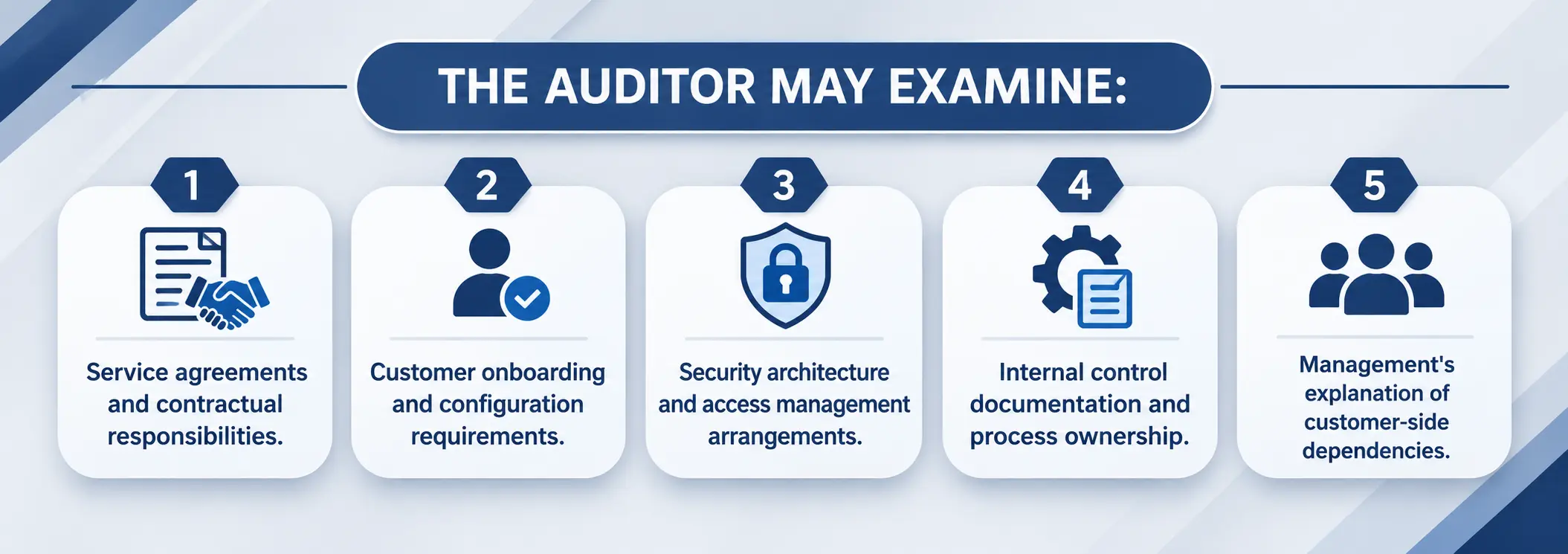
The auditor may examine:
- Service agreements and contractual responsibilities.
- Customer onboarding and configuration requirements.
- Security architecture and access management arrangements.
- Internal control documentation and process ownership.
- Management's explanation of customer-side control dependencies.
These records help the auditor assess whether management's CUECs SOC report disclosures reflect the actual system and its operating arrangements.
How Auditors Identify and Evaluate CUEC Disclosure Gaps
The auditor compares management's system description with the service organization's actual operating arrangements by methods such as inquiry, inspection, and observation.
The auditor also distinguishes necessary CUECs from general customer recommendations.
An important audit distinction: The service auditor examines whether management appropriately identifies and describes the CUECs but does not test whether individual user entities actually implement those controls.
A CUECs SOC report review therefore focuses on the accuracy and completeness of management's assumptions, rather than customer-level control effectiveness.
When Does a CUEC Disclosure Gap Become an Examination Finding?
An omission requires further evaluation, but its existence alone does not establish a control deficiency or material misstatement.
The auditor considers four situations:
1. An Omitted Responsibility Does Not Qualify as a CUEC
A general customer recommendation may have no necessary relationship with the service organization's control design or service commitments. If the provider's controls do not depend on this activity, its omission may not affect the fair presentation of the system description.
2. Management Omits a Necessary CUEC
If the service organization's control design depends on a customer activity, its omission may make the system description incomplete.
For example, management may rely on customers to review privileged accounts and notify the provider when access must be revoked. Omitting this responsibility may prevent report users from understanding an important assumption behind the provider's access management controls. The auditor evaluates the effect of the omission on fair presentation.
3. A Customer Fails to Perform a Disclosed CUEC
A customer's failure to implement a disclosed CUEC does not automatically create an exception in the service organization's SOC 2 examination.
The service auditor does not test individual customers' implementation of CUECs.
However, information about recurring customer failures may cause the auditor to question whether management's assumptions remain reasonable or whether the service organization's own controls operate as described.
4. CUECs SOC Report Reveals a Weakness in the Service Organization's Control Design
A service organization cannot use customer responsibilities to replace controls that it must perform to meet its own commitments.
For example, suppose management relies on customers to review privileged access, while the provider also has responsibility for detecting unauthorized administrative activity.
A customer-side review does not remove the provider's responsibility for its own monitoring controls. The auditor evaluates the provider's control design against its commitments and applicable Trust Services Criteria.
How Do CUEC Disclosure Gaps Affect the SOC 2 Opinion?
A CUECs SOC report disclosure gap affects the opinion when the auditor concludes that the matter creates a material misstatement or prevents the auditor from obtaining sufficient appropriate evidence.
The auditor evaluates its effect on three opinion components:
- Whether the system description fairly presents the system.
- Whether the stated controls are suitably designed.
- Whether the stated controls operated effectively throughout the examination period.
A missing CUEC may primarily affect the fair presentation of the system description. However, the same matter may also reveal a weakness in the service organization's own control design or operating effectiveness.
When Can the Auditor Issue an Unmodified Opinion?
An unmodified opinion may remain appropriate when an omission does not materially affect the system description or other opinion conclusions. For example, management may omit a recommendation unrelated to control dependencies or correct a material CUEC disclosure gap before report issuance, provided the revised description and supporting evidence satisfy the auditor's evaluation.
When Can the Auditor Issue a Qualified or Adverse Opinion?
A qualified opinion may apply when a material misstatement affects a specific part of the system description without pervasive effects. For example, omitting a necessary CUEC may misstate a specific control dependency. An adverse opinion may apply when widespread CUEC omissions materially misrepresent fundamental control dependencies across the service organization's system.
When Can the Auditor Issue a Disclaimer of Opinion?
A disclaimer addresses a different situation. It applies when the auditor cannot obtain sufficient appropriate evidence and the possible effects of that limitation may be both material and pervasive.
For example, management may lack records that establish actual customer responsibilities across significant parts of its service delivery model. If alternative procedures cannot provide sufficient evidence, the auditor evaluates the resulting scope limitation.
How Do Changes in CUECs Affect a Type 2 Examination?
Customer responsibilities may change during what is a SOC 2 Type 2 examination period.
For example, a service organization may assume customer access reviews. The auditor examines the effective date, revised responsibilities, and supporting evidence to evaluate control operation across the period. The system description must reflect these changes and applicable control arrangements.
The Bottom Line
CUECs' SOC report omission does not automatically require a modified SOC 2 opinion. The auditor evaluates whether the missing responsibility qualifies as a CUEC, whether its omission materially affects the system description, and whether it changes the conclusions on control design or operating effectiveness.
As an independent CPA firm, CertPro conducts SOC 2 examinations under AICPA attestation standards. Our examinations evaluate whether management's representations align with the system and whether sufficient appropriate evidence supports the auditor's opinion.