
ISO 27001 Certification in Adelaide
The ISO 27001 audit process conducted by CertPro follows a structured, multi-stage methodology aligned with ISO/IEC 17021-1 requirements for bodies providing audit and certification of management systems. Each stage of the ISO 27001 certification audit produces documented outputs that support an independent certification committee decision. The process evaluates both the design adequacy and the operating effectiveness of the ISMS against the requirements of ISO/IEC 27001:2022, including the controls selected and documented in the organisation’s Statement of Applicability.
OUR CLIENTS










ISO 27001 Certification for Adelaide-Based Financial, Technology, and Defence Organisations
ISO 27001 Certification in Adelaide is conducted by CertPro CPA LLC, a Licensed CPA Firm operating as an independent third-party certification body. CertPro performs conformity assessments to evaluate whether an organisation’s Information Security Management System (ISMS) meets the requirements of ISO/IEC 27001:2022, including Clauses 4 through 10 and the Annex A controls documented in the Statement of Applicability. CertPro does not design, implement, or operate an ISMS on behalf of any organisation. The certification function is strictly limited to independent audit and conformity assessment, preserving the objectivity required of a third-party certification body.
Adelaide’s economy spans defence and aerospace, advanced manufacturing, automotive and mobility, healthcare and life sciences, financial services and fintech, software and SaaS, energy and utilities, mining and resources, cybersecurity, AI, cloud and data services, agriculture and agribusiness, food and beverage, logistics and transport, education and research, professional services, and government technology. Across all of these sectors, independent ISO 27001 Certification is increasingly evaluated in enterprise procurement processes, vendor assurance frameworks, and government contracting requirements. Organisations operating across South Australia seek ISO 27001 Certification in Adelaide to demonstrate that their information security controls have been independently assessed against an internationally recognised standard.
The ISO/IEC 27001:2022 standard, published by the International Organization for Standardization and the International Electrotechnical Commission, defines requirements for establishing, implementing, maintaining, and continually improving an ISMS. The 2022 revision restructured the Annex A controls from 114 controls across 14 domains in the 2013 version to 93 controls across four thematic domains: Organisational, People, Physical, and Technological. Organisations certified under ISO/IEC 27001:2013 were required to transition to the 2022 version by 31 October 2025, as established by accreditation and certification bodies. All ISO 27001 certification audits conducted by CertPro are assessed against ISO/IEC 27001:2022.
ISO 27001 compliance in Adelaide requires organisations to document their ISMS scope, conduct a systematic information security risk assessment, and develop a risk treatment plan. Organisations must also prepare a Statement of Applicability (SoA) identifying which Annex A controls are applicable, along with the justification for inclusion or exclusion, and maintain documented information demonstrating that the ISMS operates effectively. Internal audits and management reviews are mandatory requirements under Clause 9 of the ISO 27001 standard. These activities generate the objective evidence evaluated by CertPro’s auditors during the ISO 27001 certification audit process. The certification outcome reflects an independent evaluation of whether the documented ISMS conforms to the applicable requirements of ISO/IEC 27001:2022 and whether the controls operate as described.
For Adelaide organisations operating in sectors subject to Australian regulatory obligations — including the Privacy Act 1988, the Australian Government Information Security Manual (ISM), APRA Prudential Standard CPS 234, and the Security of Critical Infrastructure Act 2018 — ISO 27001 Certification in Adelaide provides a structured framework through which documented controls are independently verified. The ISO 27001 certification audit evaluates whether the organisation’s ISMS addresses identified risks, applies appropriate controls, and operates within a continual improvement cycle. Certification does not substitute for regulatory compliance obligations, but it provides an internationally recognised basis for demonstrating information security governance to regulators, customers, and procurement authorities across South Australia and beyond.

ISO 27001 Certification Audit Process for Organisations in Adelaide
The ISO 27001 audit process conducted by CertPro follows a structured, multi-stage methodology aligned with ISO/IEC 17021-1 requirements for bodies providing audit and certification of management systems. Each stage of the ISO 27001 certification audit produces documented outputs that support an independent certification committee decision. The process evaluates both the design adequacy and the operating effectiveness of the ISMS against the requirements of ISO/IEC 27001:2022, including the controls selected and documented in the organisation’s Statement of Applicability.
The Stage 1 audit involves a detailed review of the organisation’s ISMS documentation to assess whether the management system has been established in accordance with ISO/IEC 27001:2022 requirements. The auditor reviews the ISMS scope statement, information security policy, risk assessment methodology and outputs, risk treatment plan, Statement of Applicability, internal audit records, and management review outputs. The Stage 1 audit for ISO 27001 Certification in Adelaide identifies areas where documentation is incomplete or where the ISMS scope requires clarification before proceeding to the Stage 2 audit. Findings from Stage 1 are communicated to the organisation in a formal audit report, and any concerns are resolved before Stage 2 is scheduled.
During Stage 1, the auditor also evaluates whether the organisation has conducted an information security risk assessment that identifies risks to the confidentiality, integrity, and availability of information within the defined ISMS scope. The risk assessment methodology must be systematic and repeatable, with documented criteria for risk acceptance. The risk treatment plan must demonstrate that identified risks have been addressed through the selection of Annex A controls or other appropriate controls. Additionally, the Statement of Applicability must reflect which controls are applicable, which are implemented, and the justification for any exclusions. These documents form the primary basis for evaluating ISMS conformity during the ISO 27001 audit.
The Stage 2 audit is the primary conformity assessment activity in the ISO 27001 certification audit process. CertPro auditors conduct on-site or remote evaluation of the ISMS controls identified in the Statement of Applicability, assessing whether those controls are implemented as documented and whether they operate effectively within the organisation’s environment. Evidence collection methods include interviews with personnel responsible for ISMS functions, observation of operational processes, review of system configurations and access control records, and examination of incident records, vulnerability management outputs, and supplier security assessments. For Adelaide organisations in defence, aerospace, and government technology, the Stage 2 audit may involve evaluation of controls addressing classified information handling, personnel security, and physical access controls relevant to those sectors.
Nonconformities identified during the Stage 2 audit are classified and documented in the audit report. The organisation is required to submit a corrective action plan addressing each nonconformity before the certification committee reviews the audit file. The certification decision is made by a CertPro certification committee member who was not involved in the audit, maintaining independence throughout the process. The ISO 27001 certification audit outcome for Adelaide organisations — whether to grant, withhold, or conditionally grant certification — is based solely on the documented evidence and the auditor’s assessment of conformity with ISO/IEC 27001:2022 requirements.
ISO 27001 certification is valid for three years from the date of the certification decision, subject to satisfactory surveillance audits conducted in the intervening years. Surveillance audits are scheduled at least once per calendar year during the certification cycle and evaluate whether the ISMS continues to conform to ISO/IEC 27001:2022 requirements. These audits assess areas including internal audit and management review outputs, progress on corrective actions, changes to the ISMS scope or organisational context, and continued operation of selected Annex A controls. For Adelaide organisations undergoing surveillance, the audit program may be adjusted to reflect changes in the organisation’s risk environment — such as the adoption of new cloud services, changes in third-party supplier relationships, or expansion into new business areas.
| Audit Stage | Key Activities | Output |
|---|---|---|
| Stage 1 Audit | Review of ISMS documentation, scope, risk assessment, Statement of Applicability, and internal audit records | Stage 1 audit report; identification of areas requiring attention before Stage 2 |
| Stage 2 Audit | On-site or remote control effectiveness evaluation, evidence collection, personnel interviews, nonconformity assessment | Stage 2 audit report; nonconformity findings and corrective action requirements |
| Certification Decision | Independent committee review of audit file and corrective action responses | Grant, withhold, or conditional ISO 27001 certification decision |
| Surveillance Audit | Annual review of ISMS operation, internal audits, management review outputs, and control changes | Surveillance audit report; continued certification status confirmation |
| Recertification Audit | Full ISMS reassessment against ISO/IEC 27001:2022 requirements at the end of the three-year cycle | Renewed ISO 27001 certificate valid for a further three-year period |
- ✓Stage 1 Audit: Documentation and Readiness Review
- ✓Stage 2 Audit: Control Effectiveness and Evidence Evaluation
- ✓Surveillance Audits and Recertification
ISO 27001 Standard Requirements Evaluated During Certification
The ISO 27001 standard defines requirements across Clauses 4 through 10 of the management system framework and 93 controls across four Annex A domains. An ISO 27001 certification audit evaluates whether the organisation has addressed each applicable clause and whether the controls documented in the Statement of Applicability have been implemented and are operating effectively. The following sections describe the primary areas assessed during ISO 27001 compliance audits conducted for Adelaide-based organisations.
ISO/IEC 27001:2022 specifies mandatory documented information requirements that must be present and available during the ISO 27001 certification audit. Core documentation includes the ISMS scope statement (Clause 4.3), the information security policy (Clause 5.2), the risk assessment process and outputs (Clause 6.1.2), the risk treatment plan (Clause 6.1.3), the Statement of Applicability (Clause 6.1.3(d)), information security objectives and plans for achieving them (Clause 6.2), competence evidence (Clause 7.2), operational planning and control records (Clause 8.1), internal audit programme and results (Clause 9.2), management review outputs (Clause 9.3), and records of nonconformities and corrective actions (Clause 10.1). CertPro auditors request access to these documents during Stage 1 and verify their operational application during Stage 2 of the ISO 27001 audit.
For organisations in Adelaide’s defence and aerospace sector, documented information requirements extend to supplier security agreements, security clearance records, and access control documentation for restricted facilities. Healthcare and life sciences organisations must demonstrate that their ISMS documentation addresses the classification and handling of patient data, medical device security, and clinical information system access controls. Financial services organisations are assessed for documented controls addressing payment system security, customer data protection, and business continuity for critical financial processes. The specific documented information reviewed during each ISO 27001 certification audit in Adelaide reflects the organisation’s defined ISMS scope and the sectors in which it operates.
ISO/IEC 27001:2022 Annex A organises the 93 reference controls into four domains. The Organisational domain (37 controls) addresses policies, roles and responsibilities, threat intelligence, information security in project management, supplier relationships, and incident management. The People domain (8 controls) covers personnel security screening, terms of employment, training and awareness, and disciplinary processes. The Physical domain (14 controls) addresses physical security perimeters, equipment security, clear desk and screen policies, and secure disposal of media. The Technological domain (34 controls) covers access control, authentication, cryptography, network security, vulnerability management, logging and monitoring, data masking, and secure development. The organisation’s Statement of Applicability documents which of these controls are applicable and implemented, and the ISO 27001 certification audit evaluates the evidence supporting each selected control’s effectiveness.
New controls introduced in ISO/IEC 27001:2022 that are frequently relevant to Adelaide-based technology and cloud organisations include Control 5.7 (Threat intelligence), Control 5.23 (Information security for use of cloud services), Control 5.30 (ICT readiness for business continuity), Control 8.9 (Configuration management), Control 8.10 (Information deletion), Control 8.11 (Data masking), Control 8.12 (Data leakage prevention), Control 8.16 (Monitoring activities), Control 8.23 (Web filtering), and Control 8.28 (Secure coding). During the ISO 27001 audit, CertPro evaluates whether these controls — where included in the SoA — are implemented with sufficient rigour relative to the risks identified in the organisation’s risk assessment.
ISO/IEC 27001:2022 requires organisations to define and apply an information security risk assessment process that produces consistent and reproducible results. The risk assessment must identify risks associated with the loss of confidentiality, integrity, and availability of information within the ISMS scope, assign risk owners, and evaluate risks against defined acceptance criteria. The risk treatment process requires each identified risk to be addressed through one or more treatment options — modifying, retaining, avoiding, or sharing the risk — with the selection of Annex A controls documented in the risk treatment plan and reflected in the Statement of Applicability. During the ISO 27001 certification audit, CertPro auditors evaluate the completeness of the risk assessment, the appropriateness of risk treatment decisions, and whether the implemented controls address the identified risks as documented.
- ✓ISMS Documentation Requirements
- ✓Annex A Control Domains
- ✓Risk Assessment and Treatment Requirements
Why Adelaide Organisations Pursue ISO 27001 Certification
ISO 27001 Certification in Adelaide is pursued by organisations across multiple sectors in response to procurement requirements, regulatory expectations, customer due diligence processes, and international market access requirements. The following sections describe the primary demand drivers for ISO 27001 certification for Adelaide businesses across the city’s key industry sectors.
Defence, Aerospace, and Government Technology
Adelaide is home to a significant concentration of defence and aerospace organisations, including prime contractors and supply chain participants operating under the AUKUS partnership, the Future Submarine Program, and various Department of Defence procurement frameworks. The Defence Industry Security Program (DISP) and the Cyber Security Requirements for Defence Industry establish information security obligations for organisations handling controlled unclassified information and classified defence data. ISO 27001 Certification in Adelaide is increasingly referenced in defence procurement documentation as a baseline against which vendor information security maturity is assessed. Government technology providers supplying services to South Australian government agencies are also evaluated against information security requirements that align with the Australian Government ISM, for which ISO 27001 certification provides a documented control baseline.
For defence supply chain organisations in Adelaide, the ISO 27001 certification audit evaluates whether ISMS controls address the specific risks associated with handling sensitive technical information, managing third-party access to controlled facilities, and maintaining secure communications with prime contractors and government clients. The certification audit scope for a defence-sector organisation typically encompasses information systems used in design, manufacturing, and programme management functions, as well as the people and physical security controls applicable to those environments. ISO 27001 compliance provides a documented and independently verified basis for demonstrating information security governance to defence procurement authorities across South Australia and nationally.
Financial Services, Fintech, and Healthcare
Adelaide’s financial services sector includes banks, credit unions, insurance providers, wealth management firms, and a growing fintech ecosystem centred around emerging payment technologies and digital banking services. APRA-regulated entities are subject to CPS 234, which establishes mandatory information security requirements including defined information asset identification, control implementation, and 72-hour incident reporting obligations. ISO 27001 Certification does not substitute for CPS 234 compliance, but organisations that have undergone an ISO 27001 audit can map their documented controls directly to CPS 234 requirements, reducing duplication across compliance activities. Fintech organisations in Adelaide seeking to partner with major financial institutions are frequently evaluated against ISO 27001 Certification in Adelaide as a condition of vendor onboarding due diligence.
Healthcare and life sciences organisations in Adelaide — including hospitals, pathology laboratories, medical device manufacturers, and health IT providers — handle sensitive patient information subject to the Privacy Act 1988 and the Australian Privacy Principles. ISO 27001 compliance provides a structured basis for implementing and independently verifying the information security controls required to protect electronic health records, medical device data, and clinical trial information. Pharmaceutical and biotechnology organisations undertaking research in Adelaide’s health and medical research precinct also seek ISO 27001 Certification to satisfy information security requirements imposed by international research partners, regulatory submissions, and clinical trial sponsors.
Software, SaaS, Cloud, and Technology Organisations
Adelaide’s software and SaaS ecosystem includes organisations developing enterprise applications, cloud-native platforms, data analytics services, and AI-driven solutions for domestic and international markets. ISO 27001 certified companies in Adelaide operating in the SaaS and cloud sectors use certification to satisfy customer security questionnaires, pass enterprise procurement security reviews, and meet contractual information security requirements imposed by large enterprise clients in Australia and internationally. For SaaS providers serving regulated industries — including financial services, healthcare, and government — ISO 27001 Certification in Adelaide provides an independently verified basis for demonstrating that the information security controls protecting customer data have been assessed by a qualified third-party auditor.
Cloud service providers and data hosting organisations operating from Adelaide’s data centre facilities seek ISO 27001 Certification to demonstrate physical and logical security controls to enterprise customers conducting vendor risk assessments. The ISO 27001 certification audit for cloud organisations typically evaluates controls across all four Annex A domains, with particular focus on access control, cryptography, network security, vulnerability management, logging and monitoring, and the management of customer data across multi-tenant environments. ISO 27001 certification audit engagements for cloud providers in Adelaide may also assess the organisation’s supplier security management controls, evaluating how upstream cloud infrastructure providers’ security postures are incorporated into the ISMS risk treatment framework.
Benefits of ISO 27001 Certification for Adelaide-Based Organisations
ISO 27001 Certification in Adelaide provides independently verified evidence that an organisation’s ISMS conforms to an internationally recognised information security standard. The following benefits reflect outcomes associated with a completed ISO 27001 certification audit and the ongoing maintenance of certification status through annual surveillance audits.
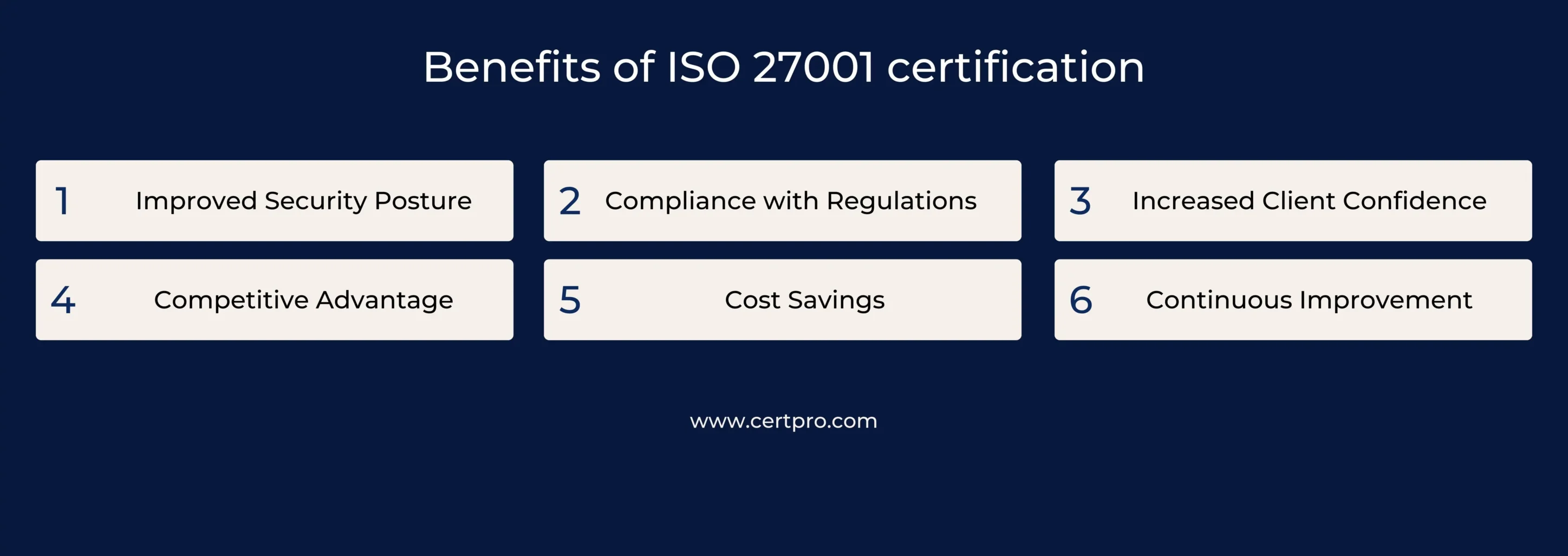
The primary outcome of ISO 27001 Certification is independent, third-party verification that an organisation’s information security controls have been assessed against the requirements of ISO/IEC 27001:2022. This verification is conducted by a Licensed CPA Firm operating as an independent certification body, providing an objective basis for reliance by customers, enterprise procurement teams, government contracting authorities, and other stakeholders. ISO 27001 certified companies in Adelaide can present the certification outcome in vendor security questionnaires, due diligence processes, and contract negotiations as documented evidence of information security governance. The certification is internationally recognised, enabling Adelaide-based organisations to satisfy information security requirements imposed by customers and partners in North America, Europe, the Middle East, and the Asia-Pacific region.
Enterprise procurement processes in South Australia’s defence, financial services, and government sectors increasingly require suppliers to demonstrate ISO 27001 compliance as a condition of vendor qualification. ISO 27001 certification for Adelaide businesses that have successfully completed the certification audit provides a documented, externally verified answer to procurement security requirements, reducing the volume of bespoke security questionnaires and audit requests that uncertified organisations must respond to individually. For organisations tendering for South Australian government contracts or participating in Commonwealth procurement processes, ISO 27001 Certification in Adelaide provides a recognised basis for demonstrating information security maturity to evaluation panels.
The ISO 27001 standard requires organisations to establish and maintain a systematic information security risk management process as a core element of the ISMS. The risk assessment and risk treatment requirements of ISO/IEC 27001:2022 provide a structured methodology for identifying information security risks, evaluating their likelihood and impact, and implementing controls proportionate to the identified risk level. Organisations that complete the ISO 27001 certification audit process establish a documented risk register and risk treatment plan, giving management a structured view of information security risks and the controls in place to address them. Surveillance audits conducted annually during the certification cycle verify that the risk management process continues to operate effectively and that changes in the organisation’s risk environment are reflected in updated risk assessments and treatment decisions.
- ✓Independent third-party verification of ISMS conformity against ISO/IEC 27001:2022 by a Licensed CPA Firm
- ✓Recognition in enterprise and government procurement processes as a qualified vendor with assessed information security controls
- ✓Documented risk assessment and risk treatment framework evaluated through the ISO 27001 certification audit
- ✓Annual surveillance audit oversight maintaining ongoing conformity with the ISO 27001 standard
- ✓Internationally recognised ISO 27001 Certification supporting market access in regulated sectors across Australia and globally
- ✓Structured documentation of Annex A control implementation providing an audit-ready evidence base
- ✓Alignment of information security governance with Australian regulatory requirements including CPS 234 and the Privacy Act 1988
- ✓Independent Verification and Procurement Recognition
- ✓Structured Risk Management and Continual Improvement
ISO 27001 Certification Scope for Adelaide Organisations
The ISMS scope defines the boundaries and applicability of ISO 27001 compliance for an organisation. Scope definition is documented under Clause 4.3 of ISO/IEC 27001:2022 and must consider the organisation’s context, interested parties, and the information assets, processes, and locations included within the certification boundary. The ISO 27001 certification audit evaluates whether the defined scope is appropriate and whether the ISMS controls adequately address the risks within the declared scope. Organisations in Adelaide may define their ISMS scope to encompass the entire organisation or a specific division, product line, data centre, or service offering.
Defining and Documenting the ISMS Scope
The ISMS scope statement must identify the external and internal issues relevant to the organisation’s purpose (Clause 4.1), the requirements of interested parties (Clause 4.2), and the interfaces and dependencies between activities performed within the scope and those outside it. For Adelaide-based manufacturing organisations with both information technology and operational technology environments, the scope statement must clearly indicate whether industrial control systems, SCADA systems, and connected manufacturing equipment are within the ISMS boundary. For SaaS and cloud providers, the scope typically encompasses the infrastructure, development, operations, and support functions that handle customer data, along with the physical facilities and supplier relationships relevant to those functions.
The ISO 27001 certification audit evaluates whether the organisation’s documented scope accurately represents the operational environment subject to the ISMS. Auditors assess whether information assets, processes, and locations identified in the risk assessment align with the declared scope, and whether controls applied at scope boundaries are sufficient to protect information passing between in-scope and out-of-scope environments. Organisations that define an overly narrow scope — excluding significant information processing activities — may receive nonconformity findings during the ISO 27001 audit if the auditor determines that the exclusion cannot be justified under the requirements of ISO/IEC 27001:2022. The scope is documented on the issued certificate and reflects the boundaries within which the ISO 27001 Certification in Adelaide is valid.
Certification Decision and Certificate Issuance
Following the completion of the Stage 2 audit and the satisfactory resolution of nonconformities, the audit file is reviewed by a CertPro certification committee member independent of the audit team. The certification committee evaluates whether the audit has been conducted in accordance with the applicable audit program, whether the evidence supports a conformity finding, and whether any remaining open items have been adequately addressed. The ISO 27001 certification audit decision — to grant, withhold, or suspend certification — is documented and communicated to the organisation. Where certification is granted, CertPro issues an ISO 27001 certificate specifying the organisation’s name, the defined ISMS scope, the applicable standard (ISO/IEC 27001:2022), and the certification validity dates covering the three-year certification cycle.
ISO 27001 Standard: Key Clauses Assessed During Audit
The ISO 27001 standard structures management system requirements across seven clauses (4 through 10). During the ISO 27001 certification audit, CertPro auditors evaluate conformity with each applicable clause through document review, interviews, and evidence examination. The following table summarises the primary requirements evaluated under each clause of the ISO 27001 standard for Adelaide organisations.
| ISO 27001 Clause | Requirement Area | Primary Audit Focus |
|---|---|---|
| Clause 4 | Context of the Organisation | Scope definition, interested party requirements, identification of internal and external issues |
| Clause 5 | Leadership | Information security policy, management commitment, roles and responsibilities documentation |
| Clause 6 | Planning | Risk assessment process, risk treatment plan, Statement of Applicability, information security objectives |
| Clause 7 | Support | Resources, competence records, awareness programmes, communication, and documented information control |
| Clause 8 | Operation | Risk assessment outputs, risk treatment implementation, operational controls, and supplier management |
| Clause 9 | Performance Evaluation | Internal audit programme and results, management review records, monitoring and measurement activities |
| Clause 10 | Improvement | Nonconformity records, corrective action documentation, and continual improvement evidence |
Internal Audit and Management Review Requirements
Clause 9.2 of ISO/IEC 27001:2022 requires organisations to conduct internal audits of the ISMS at planned intervals. The internal audit programme must cover all clauses of the standard and the controls included in the ISMS, with audit criteria, scope, and methods defined in advance. Internal audit results are reported to relevant management, and the organisation must retain records of the internal audit programme and audit results as mandatory documented information. During the ISO 27001 certification audit, CertPro auditors review the internal audit programme to assess whether it provides adequate coverage of the ISMS and whether internal audit findings have been addressed through documented corrective actions. Organisations that have not conducted internal audits prior to the certification audit will receive a nonconformity finding under Clause 9.2.
Clause 9.3 requires top management to conduct a management review of the ISMS at planned intervals. The management review must consider internal and external issues relevant to the ISMS, the results of information security risk assessments, performance against security objectives, internal audit results, nonconformities and corrective actions, and opportunities for improvement. Management review outputs must include decisions relating to continual improvement opportunities, changes to ISMS requirements, and resource needs. The ISO 27001 audit evaluates management review records to assess whether top management is actively engaged in ISMS oversight and whether review outputs reflect genuine consideration of the ISMS’s performance and effectiveness. Nominal or formulaic management review records that do not reflect substantive consideration of ISMS performance may attract nonconformity findings during the ISO 27001 certification audit.
ISO 27001 Certification in Adelaide: Sector-Specific Considerations
The ISO 27001 certification audit process is consistent across all organisations, but the specific controls evaluated, the evidence reviewed, and the risk context considered vary significantly depending on the sector and the organisation’s ISMS scope. The following sections describe sector-specific considerations relevant to ISO 27001 certification for Adelaide businesses across key industry areas.
Energy, Utilities, Mining, and Advanced Manufacturing
Adelaide’s energy and utilities sector includes electricity generation and distribution networks, gas infrastructure operators, and renewable energy organisations. Organisations classified as critical infrastructure under the Security of Critical Infrastructure Act 2018 have mandatory information security obligations, and ISO 27001 Certification in Adelaide provides a structured basis for demonstrating compliance with some of those obligations through independently verified controls. The ISO 27001 certification audit for energy and utilities organisations evaluates controls addressing operational technology security, network segmentation between IT and OT environments, physical access to critical facilities, incident response procedures, and business continuity for essential services. Mining and resources organisations operating in South Australia — and using Adelaide as a corporate and technology hub — similarly seek ISO 27001 certification to address the information security risks associated with remote operations, satellite communications, and industrial control system connectivity.
Advanced manufacturing organisations in Adelaide — including those involved in defence systems, automotive components, and high-value industrial equipment — handle proprietary design data, customer technical specifications, and supply chain information requiring structured information security controls. ISO 27001 compliance for these organisations typically encompasses controls addressing intellectual property protection, secure file sharing with international customers and partners, access controls for computer-aided design and manufacturing systems, and the management of third-party contractors who access production facilities and information systems. The ISO 27001 audit evaluates whether these controls are documented, implemented, and operating effectively within the defined ISMS scope.
Agriculture, Logistics, Education, and Research
South Australia’s agriculture and agribusiness sector — including food processing, wine production, and export-oriented food and beverage organisations — increasingly relies on digital supply chain management systems, IoT-enabled precision agriculture platforms, and cloud-based export documentation systems that require documented information security governance. ISO 27001 Certification provides a structured framework through which agricultural and food industry organisations can demonstrate to international trading partners and export market regulators that their information systems and data handling practices have been independently assessed. Logistics and transport organisations operating through Adelaide’s port and freight infrastructure similarly seek ISO 27001 compliance to satisfy the information security requirements of international shipping partners, customs authorities, and government freight management systems.
Adelaide’s education and research sector — including the University of Adelaide, the University of South Australia, Flinders University, and associated research institutes — handles sensitive research data, clinical trial information, intellectual property, and personal data relating to students and research participants. ISO 27001 certification for research organisations in Adelaide is relevant where research funding agreements, international research partnerships, or data custodianship obligations impose information security requirements. The ISO 27001 audit for education and research organisations evaluates controls addressing research data governance, access management for shared research infrastructure, cloud data storage and transfer controls, and the management of visiting researchers and external collaborators with access to sensitive systems.
FAQ
▶
What is ISO 27001 certification?
▶
Who needs ISO 27001 certification?
▶
How long does ISO 27001 certification take?
▶
What are the benefits of ISO 27001 certification?
▶
What is the cost of ISO 27001 certification?
▶
How do I prepare for ISO 27001 certification?
▶
What happens after ISO 27001 certification?
▶
How long does the ISO 27001 certification process take?
Get In Touch
have a question? let us get back to you.