
ISO 27001 Certification in Austria
CertPro is a Licensed CPA Firm conducting ISO 27001 certification audits for organizations operating in Austria. Audit engagements evaluate information security management systems against ISO/IEC 27001:2022 requirements, including Annex A controls, risk treatment frameworks, and documented compliance obligations under GDPR and the Austrian Data Protection Act (DSG).
OUR CLIENTS








Introduction to ISO 27001 Certification in Austria
ISO 27001 certification in Austria is recognized as the authoritative international standard for establishing, operating, maintaining, and continually improving an Information Security Management System (ISMS). The standard is formally designated as ISO/IEC 27001:2022 and belongs to the ISO/IEC 27000 family of standards. Organizations operating in Austria across sectors including financial services, manufacturing, SaaS, healthcare, and public administration pursue ISO 27001 certification to demonstrate measurable compliance with structured information security requirements. The certification process involves an independent, third-party audit conducted by a qualified certification body, evaluating the organization’s ISMS against all mandatory clauses and applicable Annex A controls.
Austria’s position as a central European hub for multinational corporations, financial institutions, and technology companies has increased demand for ISO 27001 certification in recent years. Organizations headquartered in Vienna, Graz, Linz, Salzburg, and Innsbruck increasingly require certification to satisfy contractual obligations with public sector clients, EU regulatory frameworks, and international business partners. The Austrian Data Protection Act (Datenschutzgesetz, DSG) imposes specific obligations on organizations processing personal data, and ISO 27001 certification provides a structured mechanism for demonstrating alignment with these legal requirements alongside GDPR Article 32 obligations related to technical and organizational security measures.
What Is ISO 27001?
ISO 27001 is a globally recognized information security standard published jointly by the International Organization for Standardization (ISO) and the International Electrotechnical Commission (IEC). The standard specifies requirements for establishing, implementing, maintaining, and continually improving an Information Security Management System within the context of the organization. ISO 27001 requires organizations to assess information security risks systematically, implement controls to address identified risks, and maintain documented evidence of control effectiveness. The 2022 revision reduced the number of Annex A controls from 114 to 93, organized across four domains: Organizational Controls, People Controls, Physical Controls, and Technological Controls.
ISO 27001 certification is achieved when an accredited certification body independently verifies that an organization’s ISMS conforms to all mandatory clauses (Clauses 4 through 10) and that the Statement of Applicability (SoA) accurately reflects the selected and justified Annex A controls. The standard operates on the Plan-Do-Check-Act (PDCA) cycle, requiring organizations to continuously monitor, measure, analyze, and improve their information security performance. ISO 27001 differs from other security frameworks such as SOC 2 or NIST CSF in that it results in a formal certification issued by an accredited body, making it directly comparable across international jurisdictions and recognized by regulatory authorities in Austria and across the European Union.
ISO 27001:2022 and the Transition Deadline
The ISO/IEC 27001:2022 standard supersedes the 2013 version and introduces updated control categories, new controls addressing cloud security, threat intelligence, data masking, and secure coding, and a restructured Annex A aligned with ISO/IEC 27002:2022. Organizations certified against the 2013 standard are required to transition to the 2022 version by October 31, 2025, as established by the International Accreditation Forum (IAF). Austrian organizations that have not yet initiated the transition process face the risk of certification lapse after this deadline, which may disrupt contractual obligations and regulatory standing. Transition audits evaluate the additional controls introduced in the 2022 revision and verify that the organization’s risk treatment plan and SoA have been updated accordingly.
The 2022 revision introduced 11 new controls, including controls for threat intelligence (5.7), information security for use of cloud services (5.23), ICT readiness for business continuity (5.30), physical security monitoring (7.4), configuration management (8.9), and web filtering (8.23). Austrian organizations in the financial services and technology sectors are particularly affected by these additions, given the prevalence of cloud-based infrastructure and third-party ICT dependencies. Each new control must be assessed for applicability in the Statement of Applicability, with documented justifications for inclusion or exclusion based on the organization’s risk assessment outcomes.
ISO 27001 and the Austrian Legal Framework
Austrian organizations subject to the General Data Protection Regulation (GDPR) and the Datenschutzgesetz (DSG) must implement appropriate technical and organizational measures to protect personal data under Article 32 of the GDPR. ISO 27001 certification provides documented evidence of such measures, directly supporting an organization’s ability to demonstrate compliance to the Austrian Data Protection Authority (Datenschutzbehörde, DSB). The Austrian DSB has the authority to conduct investigations, impose corrective measures, and levy administrative fines for data protection violations. ISO 27001 certification, as an independently verified attestation of ISMS conformance, constitutes tangible evidence of due diligence in information security governance.
Beyond GDPR, Austrian organizations in critical infrastructure sectors—including energy, transport, banking, and health—are subject to the NIS2 Directive (Network and Information Security Directive 2), which was transposed into Austrian law through the Netz- und Informationssystemsicherheitsgesetz (NISG 2024). ISO 27001 controls and risk management processes directly map to NIS2 obligations related to risk assessment, incident handling, business continuity, supply chain security, and network security. Organizations that hold ISO 27001 certification demonstrate substantial alignment with NIS2 requirements, reducing duplicative compliance effort and providing auditable documentation for regulatory review by Austrian competent authorities.

Benefits of ISO 27001 Certification for Austrian Organizations
ISO 27001 certification delivers measurable organizational benefits that extend beyond regulatory compliance. For Austrian businesses competing in domestic and European markets, certification signals a verifiable commitment to information security governance backed by independent third-party audit evidence. The certification is increasingly required as a procurement condition by Austrian public sector entities, EU institutions, and multinational corporations operating under Group-level information security policies. The following sections detail the principal benefit categories relevant to Austrian organizations across key industry verticals.
ISO 27001 certification requires organizations to implement a systematic, risk-based approach to information security that addresses the confidentiality, integrity, and availability of information assets. The standard mandates a formal risk assessment process that identifies and evaluates threats and vulnerabilities specific to the organization’s information assets, operational context, and technology environment. For Austrian manufacturing firms managing industrial control systems and proprietary design data, ISO 27001 controls address both IT and OT security requirements. For SaaS providers and fintech companies operating in Vienna’s growing technology sector, the standard’s controls for access management, cryptography, secure development, and cloud security provide a structured framework for protecting customer data and proprietary systems.
The risk treatment process under ISO 27001 requires organizations to select controls from Annex A or from other sources, document their selection in the Statement of Applicability, and implement risk treatment plans with defined owners, timelines, and measurable outcomes. Internal audit programs required by Clause 9.2 ensure that control effectiveness is periodically evaluated and that nonconformities are addressed through documented corrective actions. This continuous improvement cycle strengthens the organization’s security posture over time, reducing the likelihood and impact of security incidents. Austrian organizations that have implemented ISO 27001 report improved incident detection capabilities, faster response times, and reduced frequency of security breaches compared to pre-certification baselines.
ISO 27001 certification directly supports compliance with multiple regulatory obligations applicable to Austrian organizations. The standard’s control framework maps to GDPR requirements, particularly Article 32 (security of processing), Article 25 (data protection by design and by default), and Article 33 (notification of personal data breaches). Annex A controls for incident management (5.24–5.28), access control (5.15–5.18), and cryptography (8.24) provide the technical and organizational measures that GDPR mandates. Austrian organizations subject to DSG obligations benefit from the documented evidence generated through ISO 27001 certification, which can be presented to the Datenschutzbehörde during regulatory investigations or in response to data subject complaints.
For Austrian financial institutions regulated by the Financial Market Authority (FMA) and subject to European Banking Authority (EBA) guidelines on ICT risk management, ISO 27001 provides a recognized framework for demonstrating ICT security governance. The EBA Guidelines on ICT and Security Risk Management explicitly reference international standards including ISO/IEC 27001 as acceptable frameworks for compliance. Similarly, Austrian insurance companies subject to Solvency II and the EIOPA guidelines on cybersecurity can use ISO 27001 certification as evidence of their information security management capabilities in regulatory submissions and supervisory reviews.
ISO 27001 certification is increasingly specified as a mandatory requirement in public procurement tenders issued by Austrian federal ministries, state governments (Länder), and public agencies. Organizations seeking contracts with the Austrian federal government, Vienna City Council, or EU institutions must demonstrate ISO 27001 certification or equivalent security controls. For technology companies and managed service providers operating in Austria, certification enables participation in procurement processes that would otherwise be inaccessible. The certification also satisfies security prequalification requirements from multinational clients who mandate ISO 27001 across their supplier base as part of supply chain risk management programs.
In Austria’s competitive SaaS and financial technology market, ISO 27001 certification serves as a differentiator in enterprise sales cycles. Procurement teams at Austrian banks, insurance companies, and large enterprises routinely include ISO 27001 certification in vendor due diligence questionnaires and security assessment processes. Certified organizations can provide their ISO 27001 certificate and surveillance audit reports as evidence of ongoing security governance, reducing the burden of customer-initiated security assessments and accelerating the sales cycle. For Austrian companies expanding into German-speaking markets (Germany, Switzerland) or seeking EU institutional contracts, ISO 27001 certification is recognized as the baseline security credential across all these jurisdictions.
- ✓Demonstrates conformance with ISO/IEC 27001:2022 through independent third-party audit
- ✓Supports GDPR Article 32 compliance and Austrian DSG obligations
- ✓Enables participation in public sector procurement requiring ISO 27001 certification
- ✓Reduces duplicative security assessments from enterprise clients and business partners
- ✓Provides documented alignment with NIS2 Directive requirements under Austrian NISG 2024
- ✓Strengthens organizational resilience through structured risk treatment and control implementation
- ✓Builds verifiable trust with customers, regulators, and investors in Austrian and EU markets
- ✓Supports alignment with FMA and EBA guidelines for Austrian financial institutions
- ✓Reduces cyber insurance premiums through demonstrated security controls documentation
- ✓Provides a continuous improvement framework for information security governance
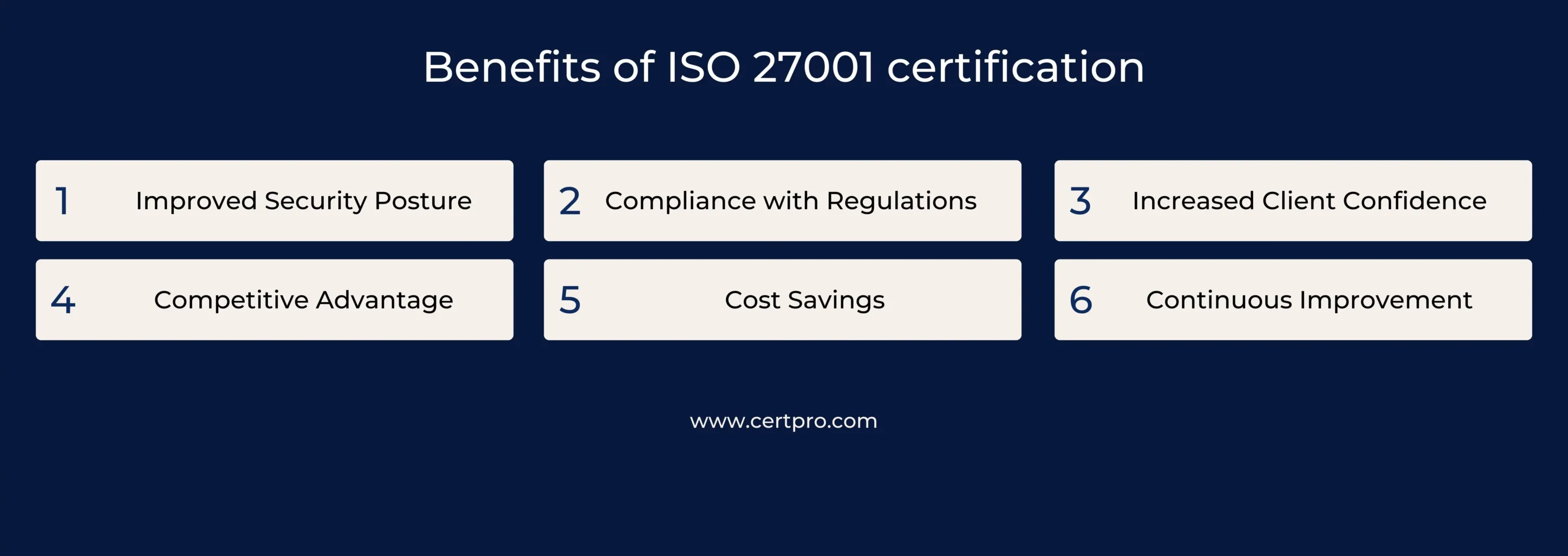
- ✓Enhanced Information Security Posture
- ✓Regulatory Compliance and Legal Risk Reduction
- ✓Market Access and Competitive Differentiation
ISO 27001 Certification Cost in Austria
The cost of ISO 27001 certification in Austria varies based on multiple organizational and audit-specific factors. Certification costs are determined primarily by the size of the organization (number of employees and sites), the complexity of the ISMS scope, the number of information assets and processes within scope, the maturity of existing security controls and documentation, and the certification body’s fee structure. Austrian organizations should evaluate total certification costs across three primary categories: internal resource investment, certification body audit fees, and ongoing maintenance costs over the three-year certification cycle.
Certification Body Audit Fees
Certification body fees for ISO 27001 audits in Austria are calculated based on audit person-days, which are determined by organization size and scope complexity. For small organizations (under 50 employees) with a narrowly defined ISMS scope, the initial certification audit (Stage 1 and Stage 2 combined) typically requires 3 to 5 audit person-days. For medium-sized organizations (50 to 500 employees), the certification audit may require 5 to 10 audit person-days. For large Austrian enterprises with multiple sites and complex ISMS scopes, audit person-days can exceed 15 for the initial certification cycle. Certification body daily rates for ISO 27001 audits in Austria range from approximately EUR 1,200 to EUR 2,000 per audit day, resulting in total certification body fees of EUR 5,000 to EUR 30,000 for initial certification depending on organizational scale.
Annual surveillance audit fees represent a recurring cost over the three-year certification cycle. Surveillance audits are shorter in scope than the initial certification audit and typically require 1 to 3 audit person-days, resulting in fees of EUR 1,500 to EUR 6,000 per surveillance audit. Recertification audits, conducted at the end of the three-year cycle, are comparable in scope to the initial certification audit and carry similar fee structures. Organizations should budget for the full three-year certification lifecycle when evaluating the total cost of ISO 27001 certification, as the aggregate cost of annual surveillance audits and recertification can equal or exceed the initial certification cost over the full cycle.
Internal Resource and Maintenance Costs
Internal resource costs for ISO 27001 certification in Austria include the staff time required to develop and maintain ISMS documentation, conduct risk assessments, operate internal audit programs, manage corrective actions, and prepare for external audits. For organizations with limited internal information security expertise, the cost of recruiting or developing qualified internal audit and ISMS management capability represents a significant investment. The internal resource cost varies widely based on the organization’s existing security maturity—organizations with established security programs and documentation can achieve certification with substantially lower internal effort than organizations building ISMS processes from a low baseline.
Technology investments supporting ISO 27001 implementation—such as security information and event management (SIEM) systems, vulnerability management tools, data loss prevention solutions, and identity and access management platforms—represent additional costs that should be considered as part of the overall certification investment. However, many of these technology investments generate independent operational value beyond certification compliance. Austrian organizations in the financial services sector may already have these technologies in place due to FMA regulatory requirements, reducing incremental technology costs associated with ISO 27001 certification. The certification body audit fees represent only a fraction of the total investment in achieving and maintaining ISO 27001 certification; the majority of the investment is internal and technology-related.
| Organization Size | Initial Audit Days | Estimated Certification Fee (EUR) | Annual Surveillance Fee (EUR) |
|---|---|---|---|
| Small (under 50 employees) | 3–5 days | 5,000–10,000 | 2,000–4,000 |
| Medium (50–500 employees) | 5–10 days | 10,000–20,000 | 3,000–6,000 |
| Large (500+ employees, multi-site) | 10–20+ days | 20,000–40,000+ | 5,000–12,000+ |
Steps for Obtaining ISO 27001 Certification
Obtaining ISO 27001 certification in Austria requires a structured, sequential approach. Each step generates documented evidence that is evaluated during the certification audit. The following steps represent the standard pathway to ISO 27001 certification for Austrian organizations, regardless of size or sector. Organizations should note that the timeline for completing these steps varies significantly based on organizational complexity and the current state of information security governance.
- Define the ISMS scope: Document the boundaries of the ISMS including organizational units, physical locations, information assets, and processes. Specify interfaces with external parties and justify any exclusions.
- Conduct the information security risk assessment: Identify information assets, threats, and vulnerabilities within the defined scope. Analyze and evaluate risks using documented methodology and criteria. Produce a risk register with risk ratings for all identified risks.
- Develop the risk treatment plan: Select risk treatment options for each identified risk. Identify applicable Annex A controls. Assign risk owners and implementation timelines. Obtain risk owner sign-off on the risk treatment plan.
- Complete the Statement of Applicability (SoA): List all 93 Annex A controls from ISO/IEC 27001:2022. Document applicability decisions with justifications. Record current implementation status for each applicable control.
- Implement ISMS policies, procedures, and controls: Develop and approve information security policies aligned with Clause 5.2. Implement operational procedures for all applicable controls. Establish monitoring and measurement processes for control effectiveness.
- Establish the internal audit program: Define the internal audit schedule and methodology. Conduct internal audits covering all ISMS requirements and applicable controls. Document findings and initiate corrective actions for identified nonconformities.
- Conduct management review: Present ISMS performance data, audit results, risk treatment status, and improvement opportunities to top management. Document review outcomes and decisions. Assign action items with owners and deadlines.
- Select an accredited certification body: Identify a certification body accredited under ISO/IEC 17021-1 by an IAF member accreditation body. Submit the ISMS scope and documentation for Stage 1 audit scheduling.
- Complete Stage 1 and Stage 2 certification audits: Address documentation gaps identified in Stage 1. Demonstrate ISMS implementation and control effectiveness during Stage 2. Resolve any nonconformities within the timeframe specified by the certification body.
- Receive ISO 27001 certificate and maintain surveillance program: Obtain ISO 27001 certificate upon positive certification decision. Schedule annual surveillance audits. Maintain ISMS documentation and continue internal audit program throughout the certification cycle.

ISO 27001 Annex A Controls and Domains
ISO/IEC 27001:2022 Annex A provides a reference set of 93 information security controls organized across four domains. These controls are normatively referenced by the main body of the standard through Clause 6.1.3, which requires organizations to determine which controls are necessary to treat identified risks and to compare their selected controls against the Annex A list to verify that no necessary controls have been omitted. The controls in Annex A are not all mandatory—each organization must determine applicability based on its risk assessment outcomes and document justifications in the Statement of Applicability.
Organizational Controls (Domain 5)
The Organizational Controls domain contains 37 controls addressing the governance, policy, and process aspects of information security management. Key controls include information security policies (5.1), information security roles and responsibilities (5.2), segregation of duties (5.3), management responsibilities (5.4), contact with authorities (5.5), contact with special interest groups (5.6), and threat intelligence (5.7—a new control in 2022). The supplier relationship controls (5.19–5.22) are particularly relevant for Austrian organizations with complex supply chains, requiring documented information security requirements in supplier contracts, monitoring of supplier service delivery, and management of changes in supplier services.
Information security incident management controls (5.24–5.28) require organizations to plan and prepare for information security incident management, assess and make decisions about information security events, respond to information security incidents, learn from incidents, and collect evidence for post-incident analysis. Austrian organizations subject to GDPR Article 33 (72-hour breach notification obligation to the Datenschutzbehörde) and NIS2 Article 23 (24-hour early warning and 72-hour incident notification to competent authorities) must ensure their incident management procedures address these specific regulatory notification timelines. The incident management controls in Annex A provide the operational framework for meeting these obligations.
Technological Controls (Domain 8)
The Technological Controls domain contains 34 controls covering the technical security measures that organizations must implement to protect information assets. This domain includes several new controls introduced in ISO/IEC 27001:2022 that are particularly relevant for Austrian technology companies and financial services firms. Data masking (8.11) requires organizations to mask personal data to minimize exposure during processing, testing, and development activities—directly relevant to GDPR data minimization obligations. Data leakage prevention (8.12) requires technical controls to prevent unauthorized disclosure or extraction of sensitive information. Monitoring activities (8.16) requires systems to monitor networks, systems, and applications for anomalous behavior, supporting both security operations and regulatory compliance reporting.
The secure development controls (8.25–8.32) address security requirements throughout the software development lifecycle, including secure development principles, secure coding, security testing, and protection of test data. For Austrian SaaS providers and software development companies, these controls align with the requirements of standards such as OWASP and with customer security requirements in enterprise contracts. The web filtering control (8.23) and secure configuration control (8.9) are new in the 2022 revision and address prevalent attack vectors including malicious web content and configuration vulnerabilities in cloud and on-premises systems. Auditors evaluate these controls by reviewing policies, configuration management records, code review evidence, and security testing results.
ISO 27001 Certification for Key Austrian Industry Sectors
ISO 27001 certification requirements and implementation priorities vary across Austrian industry sectors based on the specific information assets at risk, applicable regulatory obligations, and contractual requirements from clients and business partners. The following sections address the particular considerations for ISO 27001 certification across the major Austrian sectors where certification demand is highest.
Financial Services and Fintech
Austrian financial institutions—including banks, insurance companies, investment firms, and fintech companies operating under FMA supervision—face comprehensive information security regulatory requirements from multiple overlapping frameworks. ISO 27001 certification provides a structured mechanism for demonstrating compliance with FMA Minimum Standards for IT Security, EBA Guidelines on ICT and Security Risk Management, and the European Central Bank’s TIBER-EU framework for threat intelligence-based ethical red teaming. For Vienna-based fintech companies—of which Austria has a growing ecosystem—ISO 27001 certification is frequently required by banking partners, payment network operators, and enterprise clients as a condition of commercial arrangements.
The Digital Operational Resilience Act (DORA), which became applicable in January 2025, imposes specific ICT risk management requirements on Austrian financial entities including banks, insurance companies, investment firms, and crypto-asset service providers. ISO 27001 controls directly address many DORA requirements related to ICT risk management frameworks, ICT-related incident classification and reporting, digital operational resilience testing, and ICT third-party risk management. Austrian financial institutions that hold ISO 27001 certification are better positioned to demonstrate DORA compliance, as their existing ISMS documentation and control evidence provides a foundation for the DORA-specific governance artifacts required by the FMA and European supervisory authorities.
Manufacturing and Industrial Organizations
Austria’s manufacturing sector—including automotive suppliers, machinery manufacturers, and pharmaceutical companies—increasingly requires ISO 27001 certification to satisfy customer security requirements from large OEMs and multinational clients. German automotive manufacturers and their Austrian Tier 1 and Tier 2 suppliers operate under industry-specific security frameworks such as TISAX (Trusted Information Security Assessment Exchange), which is based on ISO 27001 and aligned with VDA ISA (German Association of the Automotive Industry Information Security Assessment). Austrian automotive suppliers that achieve ISO 27001 certification are positioned to streamline TISAX assessments, as the control frameworks are closely aligned and audit evidence from ISO 27001 surveillance can be leveraged in TISAX label assessments.
Austrian manufacturing companies with industrial control systems (ICS) and operational technology (OT) environments face additional challenges in defining the ISO 27001 ISMS scope. The standard can be applied to OT environments, though implementation of Annex A controls may require adaptation to account for operational constraints such as availability requirements, patch management limitations on legacy systems, and physical security considerations in production environments. Organizations in sectors classified as critical infrastructure under the Austrian NISG 2024 must address security requirements for both IT and OT systems, and ISO 27001 certification covering both environments provides comprehensive documentation of security governance for regulatory review.
Public Sector and Government Organizations
Austrian federal ministries, state government agencies, and public administrative bodies increasingly adopt ISO 27001 certification to demonstrate structured information security governance to citizens, oversight bodies, and the European Commission. The Austrian Federal Chancellery’s IT security guidelines and the Bundeskanzleramt’s cybersecurity strategy reference international standards including ISO 27001 as the baseline for public sector information security management. Public sector entities processing personal data of Austrian citizens are subject to GDPR and DSG obligations, and ISO 27001 certification provides documented evidence of compliance with Article 32 technical and organizational security measures.
Austrian public sector organizations subject to the NIS2 Directive—including providers of essential services in energy, transport, water, health, and digital infrastructure—must implement security measures under the Austrian NISG 2024. ISO 27001 certification covering the systems and processes within the NIS2 scope provides a recognized framework for demonstrating compliance with the NISG 2024 security requirements to the Austrian competent authorities (Bundeskanzleramt for digital infrastructure, sector-specific regulators for other sectors). The overlap between ISO 27001 control requirements and NISG 2024 security obligations reduces the burden of parallel compliance programs and provides a single audit framework for demonstrating both international and domestic security governance standards.
Austrian organizations pursuing ISO 27001 certification should approach the certification process with a clear understanding of the standard’s requirements, the audit process structure, and the organizational commitment required to achieve and maintain certification. The following guidance addresses the most critical considerations for Austrian organizations at various stages of the ISO 27001 certification journey, from initial scoping decisions through ongoing certification maintenance.
ISMS Scope Definition Best Practices
ISMS scope definition is among the most consequential decisions in the ISO 27001 certification process. Scope too narrowly defined may exclude critical information assets and processes, creating certification that does not reflect the organization’s actual security posture and failing to satisfy contractual or regulatory requirements. Scope too broadly defined increases the complexity and cost of certification without proportionate benefit. Austrian organizations should define their ISMS scope based on the information assets that are material to their business operations, the assets that are most critical to their clients and stakeholders, and the processes and systems that are subject to regulatory oversight. For Austrian fintech companies, the ISMS scope typically covers customer data processing systems, payment infrastructure, APIs, and cloud environments. For manufacturing firms, the scope typically covers design data repositories, ERP systems, and engineering networks.
The ISMS scope statement must identify the internal and external issues relevant to the organization’s information security (Clause 4.1), the requirements of interested parties (Clause 4.2), and the interfaces with activities outside the ISMS boundary (Clause 4.3). Interested parties for Austrian organizations typically include the Datenschutzbehörde, the FMA, sector-specific regulators, major clients with contractual security requirements, cloud service providers operating under data processing agreements, and shareholders or investors with governance expectations. The scope statement must be sufficiently specific that auditors can determine what is included and excluded from the ISMS, and that clients and regulators can understand what systems and processes are covered by the certification.
Common Nonconformities in Austrian ISO 27001 Audits
Based on ISO 27001 certification audit patterns across Austrian organizations, certain nonconformity categories appear with high frequency. Incomplete or inconsistent Statements of Applicability represent a common finding, particularly where control exclusions lack documented risk-based justification or where the SoA does not reflect the 2022 control set. Risk assessment methodologies that lack clearly defined risk acceptance criteria or that produce results that cannot be objectively replicated are frequently cited as nonconformities under Clause 6.1.2. Absence of documented management review outcomes and action items is a recurring finding under Clause 9.3, as many organizations conduct management reviews informally without generating the records required by the standard.
Internal audit program deficiencies are commonly identified in smaller Austrian organizations where internal audit resources are limited. The standard requires that internal audits cover the full scope of the ISMS across a planned audit cycle, that auditors are objective and impartial, and that findings are documented and followed up through corrective action processes. Organizations that conduct perfunctory internal audits without adequate scope, evidence collection, or finding documentation frequently receive nonconformities under Clause 9.2. Similarly, corrective action processes under Clause 10.1 that lack root cause analysis, defined timelines, and verification of effectiveness generate recurring findings in organizations where corrective action management is not systematically tracked.
ISMS Maintenance and Continual Improvement
Maintaining ISO 27001 certification in Austria requires ongoing operational commitment to ISMS processes between external audit cycles. The standard’s continual improvement requirement (Clause 10.2) mandates that organizations actively seek and implement improvements to the suitability, adequacy, and effectiveness of the ISMS—not merely maintain the status quo. Effective ISMS maintenance programs include regular risk assessment reviews triggered by significant changes to the organization’s information assets, technology environment, threat landscape, or regulatory requirements. Austrian organizations should conduct risk assessment updates at least annually and whenever significant changes occur, such as the adoption of new cloud services, major software deployments, corporate restructuring, or regulatory changes affecting information security obligations.
The transition to ISO/IEC 27001:2022 from the 2013 version requires existing certified Austrian organizations to update their ISMS documentation, conduct a gap assessment against the new Annex A controls, update their Statement of Applicability to reflect the 2022 control structure, and demonstrate implementation of newly applicable controls before their transition audit. Organizations that delay initiating the transition process risk being unable to complete all required steps before the October 31, 2025 deadline, potentially resulting in certification lapse. Austrian organizations should schedule their transition audit with sufficient lead time to allow for identification and remediation of gaps against the 2022 requirements before the external audit takes place.
FAQ
▶
What is ISO 27001 certification and why is it relevant to Austrian organizations?
▶
How long does the ISO 27001 certification process take in Austria?
▶
What is the difference between ISO 27001 Stage 1 and Stage 2 audits?
▶
How does ISO 27001 certification support GDPR compliance in Austria?
▶
What is the Statement of Applicability (SoA) in ISO 27001?
▶
What is the ISO 27001:2022 transition deadline and what does it mean for Austrian organizations?
▶
How much does ISO 27001 certification cost in Austria?
▶
Does ISO 27001 certification cover cloud environments and third-party services?
HOW COMPLIANCE AUDIT SOFTWARE IMPROVES AUDIT READINESS
Today, most companies deal with a growing number of compliance regulations. From data privacy standards to security frameworks like SOC 2 and ISO 2700…

THE ROLE OF GRC IN ISO 27001, SOC 2, AND OTHER FRAMEWORKS
The term GRC stands for Governance Risk and Compliance. It’s a system of integrated and centralized approaches used by organizations. This system comb…
HOW TO PREPARE FOR A MULTI-STANDARD AUDIT (SOC 2, ISO 27001, HIPAA) WITHOUT OVERLAPPING EFFORTS
The current regulatory landscape is no less than a proving ground for global businesses. Organizations are struggling to comply with the complex regul…
Get In Touch
have a question? let us get back to you.