
SOC 2 Certification in Austria
Executive Summary: SOC 2 Certification in Austria is issued exclusively by Licensed CPA Firms under AICPA governance, evaluating organizational controls against Trust Services Criteria. CertPro, a Licensed CPA Firm, conducts SOC 2 audits for Austria-based organizations across financial services, SaaS, healthcare IT, and logistics — delivering formal SOC 2 attestation reports that demonstrate verifiable data security and operational compliance.
OUR CLIENTS










What Is SOC 2 Certification?
SOC 2 Certification is a formal attestation standard developed and governed by the American Institute of Certified Public Accountants (AICPA). It confirms that an organization’s information systems and controls have been independently examined and found to meet defined criteria for security, availability, processing integrity, confidentiality, and privacy. SOC 2 Certification in Austria functions as an authoritative third-party confirmation that an organization’s data handling practices satisfy these rigorous standards — not a self-declaration or internal compliance checklist.
SOC 2 attestation is distinct from other compliance frameworks in one critical respect: it can only be issued by a Licensed CPA Firm. No technology vendor, internal audit team, or compliance advisory firm has the authority to issue a SOC 2 report. This requirement ensures the independence and professional accountability that SOC 2 reports demand. When an Austrian organization achieves SOC 2 attestation, it means a qualified, independent auditor has evaluated its controls against the AICPA’s Trust Services Criteria and issued a formal opinion.
SOC 2 compliance differs fundamentally from mere implementation of security controls. An organization may deploy firewalls, encryption protocols, and access management systems without ever achieving formal SOC 2 compliance. True SOC 2 compliance requires those controls to be tested, documented, and evaluated by an independent CPA auditor over a defined period. The resulting SOC 2 report reflects an auditor’s examined conclusion — not organizational self-assessment. This distinction matters greatly for Austrian businesses presenting SOC 2 credentials to enterprise clients, procurement teams, and regulatory stakeholders.
The AICPA Framework and Trust Services Criteria
The AICPA’s Trust Services Criteria (TSC) form the evaluative backbone of every SOC 2 audit. These criteria define the specific control objectives and testing procedures that auditors apply when assessing an organization’s systems. The Security criterion — also known as the Common Criteria — is mandatory in every SOC 2 engagement. The remaining four criteria (Availability, Processing Integrity, Confidentiality, and Privacy) are selected based on the organization’s service commitments and the nature of the data it handles. For Austrian technology companies and financial services organizations, selecting the right TSC categories is a foundational decision in scoping any SOC 2 audit.
The Security criterion addresses logical and physical access controls, system monitoring, change management, risk assessment, and incident response. Availability addresses system uptime commitments and supporting controls. Processing Integrity evaluates whether system processes are complete, accurate, and authorized. Confidentiality examines controls protecting information designated as confidential. Privacy — increasingly relevant for Austrian organizations operating under GDPR — addresses the collection, use, retention, disclosure, and disposal of personal information in alignment with privacy commitments. Each criterion carries its own set of points of focus that auditors test methodically during a SOC 2 audit.
SOC 2 Versus Other Attestation Standards
SOC 2 attestation occupies a distinct position among information security standards. Unlike ISO 27001 — a certifiable management system standard issued by accredited certification bodies under ISO/IEC governance — SOC 2 is an attestation engagement conducted under AICPA standards (specifically AT-C Section 205). SOC 2 reports are not certificates. They are formal examination or review reports issued by CPA firms, containing an auditor’s opinion on whether controls meet specified criteria. This makes SOC 2 particularly valuable in US-facing markets and for organizations serving American enterprise clients, where SOC 2 reports are a standard procurement requirement.
For Austrian businesses operating in both European and North American markets, SOC 2 Certification in Austria serves a dual function. It satisfies US client requirements while complementing existing European compliance frameworks such as GDPR, the Austrian Data Protection Act (DSG), and the NIS2 Directive. Organizations that have already implemented ISO 27001 controls often find significant overlap between their existing documentation and what SOC 2 auditors require — though the evaluation approach, report format, and issuing authority differ substantially. SOC 2 and ISO 27001 are complementary rather than interchangeable, and many Austrian multinationals pursue both.

SOC 2 Type 1 vs. SOC 2 Type 2: Key Differences for Austrian Organizations
SOC 2 audits are conducted in two distinct formats — Type 1 and Type 2 — each serving a different evaluative purpose and carrying different weight with stakeholders. Understanding this distinction is essential for Austrian organizations planning their SOC 2 engagement. The choice between a SOC 2 Type 1 audit in Austria and a Type 2 assessment depends on organizational maturity, timeline requirements, and the expectations of customers and partners.
SOC 2 Type 1: Point-in-Time Design Assessment
A SOC 2 Type 1 audit in Austria evaluates the design and implementation of an organization’s controls as of a specific point in time. The auditor examines whether the described controls are suitably designed to meet the applicable Trust Services Criteria on the report date. A Type 1 report does not assess whether controls have operated effectively over any period — it confirms their existence and suitability of design at a single moment. This makes Type 1 the appropriate starting point for organizations that have recently implemented a control framework and seek formal validation before committing to a longer observation period.
For Austrian SaaS companies entering enterprise sales cycles, a SOC 2 Type 1 report provides immediate credibility. It demonstrates that controls are formally documented and designed in accordance with AICPA standards. Many Austrian technology organizations obtain a Type 1 report as a stepping stone, using the defined attestation period to establish baseline security commitment before engaging in the more rigorous Type 2 process. The Type 1 audit typically takes between four and eight weeks to complete from scoping through report issuance.
SOC 2 Type 2: Operational Effectiveness Over Time
SOC 2 Type 2 certification in Austria represents the full attestation standard that most enterprise clients and regulated industries require. A Type 2 report evaluates not only the design of controls but their operational effectiveness over a defined observation period — typically six to twelve months. During this period, the auditor collects and tests evidence demonstrating that controls operated consistently and effectively throughout the review window. This includes sampling transactions, reviewing logs, testing system configurations, and interviewing personnel responsible for control execution.
SOC 2 Type 2 certification in Austria is the standard required by most Fortune 500 procurement teams, US federal contractors, and regulated financial services organizations. For Austrian fintech companies, healthcare IT providers, and logistics technology firms with US client bases, achieving SOC 2 Type 2 certification is frequently a contractual prerequisite. The observation period for a Type 2 engagement commonly spans a minimum of six months, with twelve-month periods providing the broadest and most credible coverage. Organizations must maintain annual audit cycles to preserve current certified status.
| Attribute | SOC 2 Type 1 | SOC 2 Type 2 |
|---|---|---|
| Evaluation Scope | Design of controls at a point in time | Design and operating effectiveness over an observation period |
| Observation Period | None — single date assessment | Minimum 6 months, typically 12 months |
| Audit Duration | 4–8 weeks | 6–14 months (including observation period) |
| Stakeholder Acceptance | Accepted as initial validation | Required by most enterprise and regulated clients |
| Use Case (Austria) | New programs, rapid market entry | Enterprise sales, regulated sectors, US market access |
Choosing the Right Report Type for Your Austrian Business
The selection between Type 1 and Type 2 engagements should be driven by customer requirements and target market. Austrian organizations whose primary clients are in the United States, the UK, or regulated European financial sectors should pursue SOC 2 Type 2 certification in Austria as the standard deliverable. Organizations preparing for enterprise procurement evaluations should pursue whichever report type is explicitly requested in vendor questionnaires or contractual requirements. CertPro, as a Licensed CPA Firm, conducts scoping consultations to determine the appropriate report type based on documented business requirements before any SOC 2 audit engagement commences.
SOC 2 Trust Services Criteria: Detailed Overview
The five Trust Services Criteria categories define the domains evaluated in every SOC 2 audit. Each category contains specific criteria — points of focus — that auditors test against an organization’s actual controls, policies, and operational evidence. Austrian organizations must understand each TSC category to accurately scope their SOC 2 engagement and ensure the resulting report addresses the concerns of their specific stakeholders.
The Security criterion is the only mandatory component in every SOC 2 audit. It evaluates whether the entity uses controls to protect information and systems from unauthorized access, unauthorized disclosure, and damage that could compromise the availability, integrity, confidentiality, and privacy of information. Specific areas tested under the Security criterion include logical access controls (user authentication, privileged access management), physical access controls, system monitoring and logging, change management processes, risk assessment procedures, and incident response capabilities.
For Austrian technology companies, the Security criterion frequently requires auditors to examine multi-factor authentication enforcement, encryption standards for data in transit and at rest, vulnerability management programs, and security awareness training records. Evidence collected during this phase includes system configuration screenshots, access provisioning and de-provisioning logs, penetration testing reports, and change management tickets. The depth and volume of evidence required under the Security criterion is substantial — organizations should expect auditors to request evidence spanning multiple systems and personnel roles throughout the observation period.
The Availability criterion evaluates whether the system is available for operation and use as committed or agreed. For Austrian SaaS and cloud service providers, this typically encompasses uptime monitoring, redundancy architecture, backup and recovery procedures, and incident response protocols that directly affect service delivery. Evidence includes system uptime reports, backup test records, and disaster recovery test documentation. Availability is frequently selected by Austrian organizations offering managed services or infrastructure products where uptime guarantees are contractually defined.
Processing Integrity addresses whether system processing is complete, valid, accurate, timely, and authorized. This criterion is particularly relevant for Austrian financial services technology firms and payment processing organizations where transaction accuracy is a core service commitment. Confidentiality evaluates controls protecting information designated as confidential — including encryption, access restrictions, and data retention policies. The Privacy criterion is increasingly selected by Austrian organizations processing personal data, as it aligns closely with GDPR obligations and addresses collection, use, retention, disclosure, and disposal of personal information in accordance with privacy commitments and applicable law.

- ✓Security (Common Criteria) — Mandatory for All Engagements
- ✓Availability, Processing Integrity, Confidentiality, and Privacy Criteria
SOC 2 Audit Process: Step-by-Step for Austrian Organizations
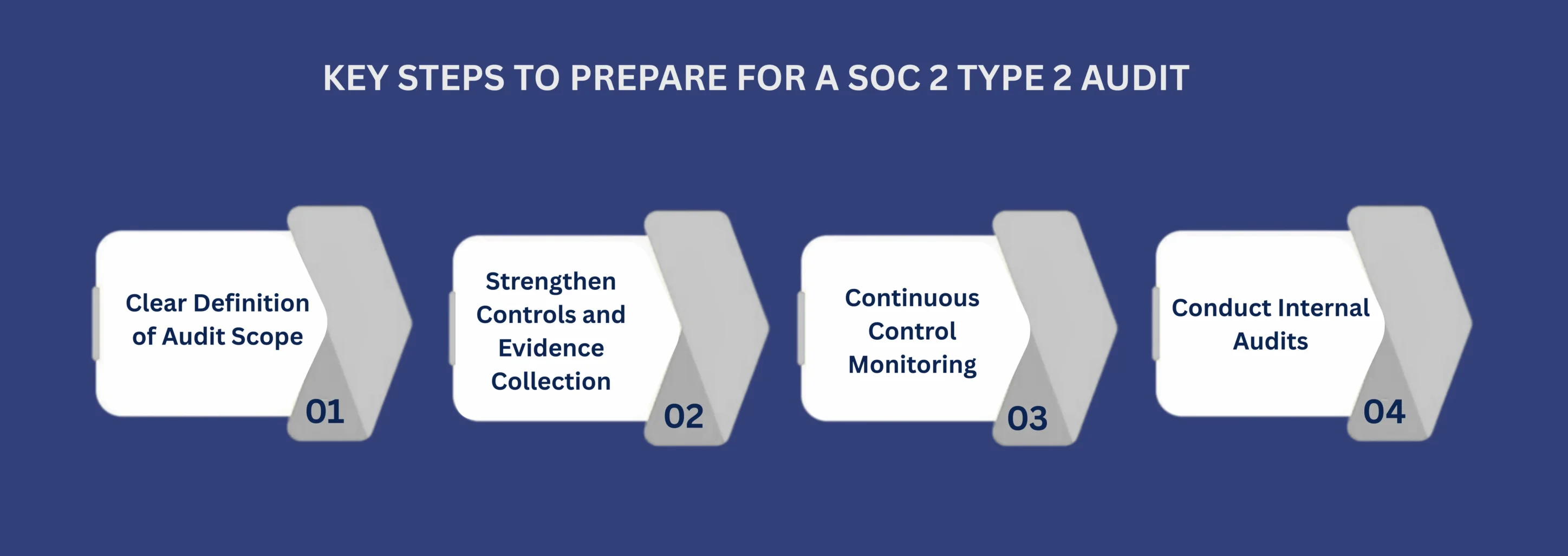
The SOC 2 audit process follows a structured sequence of formally defined stages. Each stage is conducted by CertPro’s licensed audit team and results in documented outputs that form the basis of the final attestation report. Austrian organizations engaging CertPro for SOC 2 audit services in Austria should expect the following sequential process, which applies to both Type 1 and Type 2 engagements — with differences in duration and evidence requirements.
- Scope Definition: The audit team defines system boundaries, applicable Trust Services Criteria, and the services and infrastructure included in the engagement. Scope documentation is formalized before fieldwork begins.
- Audit Program Determination: CertPro determines the specific control objectives, testing procedures, and evidence requirements applicable to the defined scope and selected TSC categories.
- Stage 1 Audit: The auditor reviews system descriptions, control documentation, policies, and organizational structures to confirm that the described controls are suitably designed. This stage applies to both Type 1 and Type 2 engagements.
- Type I Assessment (if applicable): For Type 1 engagements, the auditor issues an opinion on the design and implementation of controls as of the specified report date. The report is finalized at this stage.
- Observation Period (Type 2 only): For Type 2 engagements, the defined observation period commences. Controls must operate consistently throughout this period, which spans a minimum of six months.
- Control Testing and Evidence Collection: The auditor systematically tests controls against Trust Services Criteria, collecting documentary evidence including logs, configurations, screenshots, and personnel records throughout the observation period.
- Nonconformity Review: Any control failures, exceptions, or gaps identified during testing are formally documented. The organization is notified of identified nonconformities, and relevant findings are incorporated into the report.
- Certification Decision: Based on accumulated evidence and test results, the Licensed CPA auditor forms an opinion on whether controls meet the applicable Trust Services Criteria. The opinion may be unqualified, qualified, or adverse.
- Issuance of SOC 2 Attestation Report: The formal SOC 2 attestation report is issued, containing the auditor’s opinion, system description, control testing results, and any identified exceptions. This report constitutes the SOC 2 certification deliverable.
- Surveillance and Recertification: SOC 2 compliance requires annual audit cycles to maintain current certification status. Organizations must repeat the Type 2 process annually to provide clients with current-period reports.
Effective evidence collection is foundational to a successful SOC 2 audit outcome. SOC 2 auditors do not merely verify that controls exist on paper — they examine whether controls operated consistently throughout the observation period. Evidence must be contemporaneous, meaning it must have been generated during the observation period rather than retrospectively assembled. For Austrian organizations undergoing their first SOC 2 audit, this requires establishing systematic evidence collection procedures from the start of the observation period, not at its conclusion.
Typical evidence categories required in a SOC 2 audit in Austria include access provisioning and deprovisioning records, system configuration exports, security monitoring logs, change management tickets, vendor management documentation, business continuity test records, training completion records, and incident response documentation. Auditors apply sampling methodologies to select specific evidence items from the population of control activities performed during the observation period. Organizations that maintain clean, timestamped, and consistently formatted evidence are significantly better positioned for efficient audit completion.
SOC 2 Type 1 audit engagements in Austria typically complete within four to eight weeks from scope finalization through report issuance, assuming documentation is organized and controls are implemented. The majority of this time is spent in Stage 1 fieldwork, evidence review, and report drafting. SOC 2 Type 2 certification timelines in Austria are substantially longer due to the mandatory observation period. Organizations should plan for a minimum of eight to fourteen months from engagement commencement through final report issuance when pursuing a twelve-month Type 2 observation period. Six-month observation periods reduce this total to approximately six to nine months.
- ✓Evidence Collection and Documentation Requirements
- ✓Timeline Expectations for Austrian Organizations
Requirements for SOC 2 Certification in Austria
SOC 2 Certification in Austria requires organizations to satisfy a defined set of documentation, technical, operational, and organizational requirements before and during the audit engagement. These requirements reflect the specific control objectives and points of focus contained within the AICPA’s Trust Services Criteria. Austrian organizations across all sectors must demonstrate readiness across each of these requirement categories for the SOC 2 audit to proceed effectively.
Documentation requirements for SOC 2 compliance in Austria include a formally authored system description that accurately describes the services, infrastructure, software, people, data, and procedures included in the audit scope. The system description must be prepared by management and must be sufficiently detailed that an informed reader can understand the nature of the services provided and the controls in place. Policies and procedures covering information security, access management, incident response, change management, risk assessment, and vendor management must be documented, approved, and maintained in current versions.
Additional documentation requirements include organizational charts demonstrating reporting lines and accountability for security functions, formal risk assessment records including risk identification and treatment decisions, and documented service commitments defining what the organization has committed to deliver to customers. For Austrian organizations processing personal data, privacy notices, data processing agreements, and records of processing activities (required under GDPR Article 30) also serve as relevant supporting documentation during the SOC 2 audit process.
Technical requirements for SOC 2 certification in Austria — particularly for financial services and technology organizations — include implemented and demonstrably operating security controls covering logical access management, network security architecture, encryption, system monitoring, and vulnerability management. Multi-factor authentication must be enforced for access to all in-scope systems. Audit logging must be enabled across relevant systems, and logs must be retained for periods sufficient to support audit testing. Encryption must be applied to sensitive data both in transit and at rest using current industry-standard protocols.
Vulnerability management programs must produce documented evidence of regular scanning, identified vulnerabilities, and remediation activities. Patch management processes must demonstrate that critical security patches are applied within defined timeframes. Backup and recovery procedures must be documented and tested, with results recorded. For Austrian organizations operating in cloud environments — including those hosted in Austrian or EU-based data centers — infrastructure configuration documentation and cloud security controls must be available for auditor review and testing.
Operational requirements for SOC 2 compliance include a security awareness training program with documented completion records for all personnel with access to in-scope systems. Background screening procedures for employees in security-sensitive roles must be in place and documented. Vendor and third-party risk management processes must include documented assessments of service providers whose services affect the in-scope system. Incident response procedures must be tested, with tabletop exercise or simulation records available as evidence.
- ✓Formally documented system description covering all in-scope infrastructure, services, and personnel
- ✓Approved and current information security policy and supporting procedures
- ✓Documented risk assessment and risk treatment records
- ✓Implemented multi-factor authentication across all in-scope system access points
- ✓Security monitoring and SIEM logging covering in-scope infrastructure
- ✓Documented and tested incident response plan with exercise records
- ✓Vendor risk management program with third-party assessments
- ✓Security awareness training program with completion tracking
- ✓Business continuity and disaster recovery plan with documented test results
- ✓Change management process with ticketing and approval records
- ✓Documentation Requirements
- ✓Technical Requirements
- ✓Organizational and Operational Requirements
Benefits of SOC 2 Certification for Austria-Based Organizations
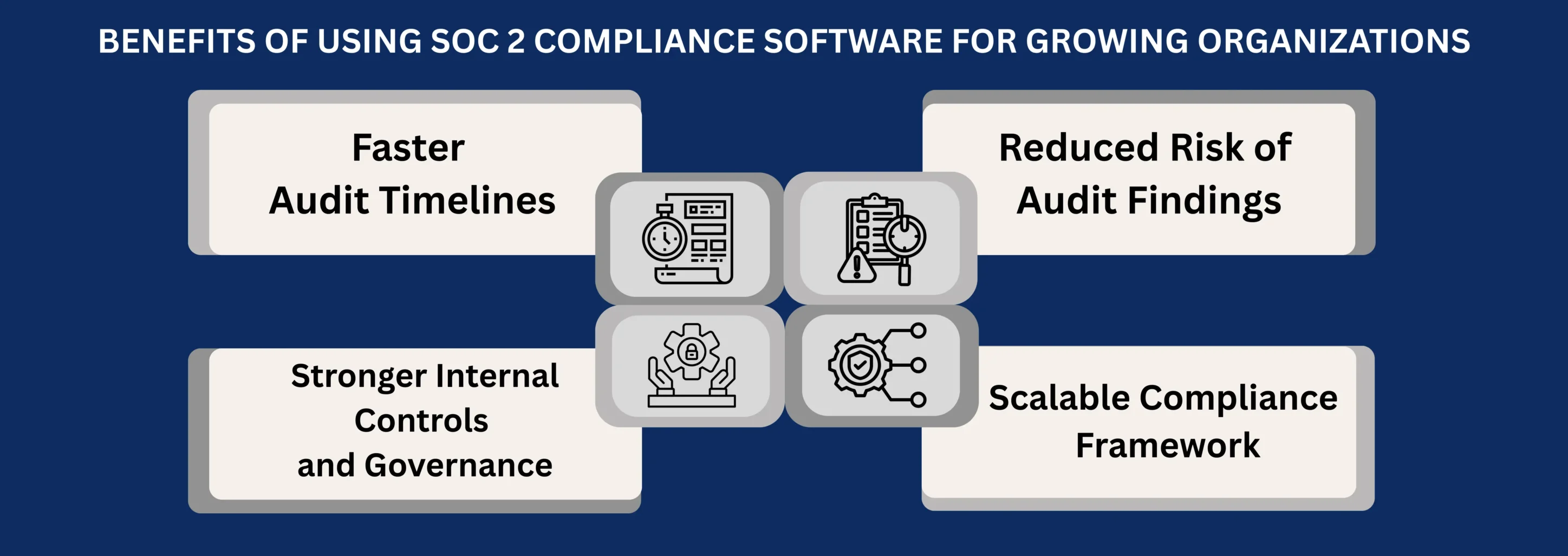
SOC 2 Certification in Austria delivers measurable business advantages that extend well beyond basic security validation. For Austrian organizations competing in international markets, holding a current SOC 2 attestation report is an increasingly decisive differentiator in enterprise sales cycles, procurement evaluations, and regulatory due diligence processes. The benefits of SOC 2 certification in Vienna and nationwide apply equally to organizations of all sizes operating in Austria’s technology, financial services, and healthcare IT sectors.
SOC 2 certification for Austria-based companies directly enables access to enterprise client segments that require formal security attestation as a procurement condition. US-headquartered corporations, multinational financial institutions, and regulated healthcare organizations routinely include SOC 2 report requirements in vendor qualification processes. Austrian SaaS companies, cloud service providers, and managed service organizations that hold SOC 2 Type 2 certification in Austria can respond to vendor security questionnaires with their audit report rather than answering hundreds of individual control questions — dramatically reducing sales cycle duration and procurement friction.
In Vienna’s fintech ecosystem — which has grown substantially as a European business gateway and EU financial services hub — SOC 2 certification serves as a market access credential for Austrian fintech companies targeting institutional clients. Austrian payment technology firms, regtech providers, and banking infrastructure vendors serving US or UK financial institutions are routinely required to produce SOC 2 Type 2 reports as part of third-party risk management programs. The SOC 2 compliance that Austrian fintech organizations achieve through this process is recognized as a substantive security commitment — not merely a checkbox exercise.
The process of achieving and maintaining SOC 2 certification produces measurable improvements in organizational security posture. The discipline of maintaining audit-ready controls — with consistent documentation, regular testing, and systematic evidence collection — strengthens internal security operations. Organizations that undergo annual SOC 2 audit cycles develop institutional habits around access management, monitoring, incident response, and vendor oversight that directly reduce operational security risk. Austrian organizations that have pursued SOC 2 Certification in Austria report that the annual audit process reinforces accountability and consistency across security functions.
SOC 2 certification pursued by Austrian financial services and technology companies also provides meaningful alignment with regulatory obligations under GDPR, the Austrian Data Protection Act (DSG), and the NIS2 Directive. While SOC 2 is not a legal compliance requirement in Austria, the control framework it imposes overlaps substantially with the technical and organizational measures required under these regulatory regimes. Demonstrating SOC 2 attestation during regulatory inspections or incident investigations provides objective evidence of systematic security investment — a relevant factor in regulatory penalty determinations under GDPR.
- ✓Formal third-party validation of security controls, replacing self-attestation in procurement processes
- ✓Accelerated enterprise sales cycles through standardized security report provision
- ✓Access to US market segments requiring AICPA SOC 2 attestation as a vendor qualification criterion
- ✓Strengthened customer trust through independently examined security practices
- ✓Annual audit discipline that reinforces consistent control operation across the organization
- ✓Regulatory alignment with GDPR Article 32 technical and organizational measures
- ✓Reduced vendor questionnaire burden through shareable SOC 2 report distribution
- ✓Competitive differentiation in Austria’s financial services, SaaS, and healthcare IT sectors
- ✓Documented security posture for insurance underwriting and cyber risk assessments
- ✓Board-level reporting mechanism for information security governance
- ✓Market Access and Enterprise Sales Enablement
- ✓Operational Security Improvements
- ✓Regulatory Alignment and Risk Reduction
SOC 2 and Austrian Regulatory Compliance: GDPR, DSG, and NIS2
Austria operates within one of Europe’s most rigorous data protection regulatory environments. Austrian organizations are subject to the EU General Data Protection Regulation (GDPR), the Austrian Data Protection Act (Datenschutzgesetz — DSG), and — for organizations qualifying as essential or important entities — the NIS2 Directive as transposed into Austrian law. The SOC 2 compliance that Austrian organizations achieve through the audit process creates substantial alignment with each of these regulatory frameworks, though SOC 2 does not substitute for legal compliance with any of them.
GDPR and SOC 2: Explicit Alignment
GDPR Article 32 requires organizations to implement appropriate technical and organizational measures to ensure a level of security appropriate to the risk of processing personal data. SOC 2 audit procedures — particularly those covering the Security and Privacy Trust Services Criteria — directly test the controls that constitute Article 32 compliance. Access management controls, encryption, monitoring, incident response, and vendor management procedures evaluated in a SOC 2 audit are the same categories addressed by GDPR’s technical and organizational measures requirements. An organization holding a SOC 2 Type 2 attestation report in Austria can present it as substantive evidence of implemented Article 32 measures.
Austria’s national supervisory authority, the Datenschutzbehörde (DSB), enforces GDPR and the DSG within Austria. The DSB has issued enforcement decisions resulting in fines and corrective measures for organizations that failed to demonstrate adequate technical and organizational measures. Austrian organizations that have undergone SOC 2 audit procedures are demonstrably better positioned to respond to DSB inquiries and enforcement investigations, as they possess independently examined evidence of their security control framework. SOC 2 attestation records for Austria-based organizations provide concrete documentation that the DSB can evaluate in data protection compliance assessments.
NIS2 Directive and SOC 2 Control Alignment
The NIS2 Directive, which Austria transposed into national law through the NISG 2024, imposes cybersecurity risk management obligations on essential and important entities across multiple sectors. These obligations include risk analysis and information system security policies, incident handling, business continuity measures, supply chain security, network security, and cybersecurity training. The overlap between NIS2 risk management requirements and SOC 2 Trust Services Criteria is direct and substantial. Austrian organizations subject to NIS2 — including those in energy, transport, financial market infrastructure, healthcare, digital infrastructure, and managed service provision — find that SOC 2 audit procedures address many of the same control domains.
SOC 2 certification does not constitute NIS2 compliance, as NIS2 is a legal directive with specific reporting and governance requirements that go beyond what SOC 2 addresses. However, the security control framework documented and tested in a SOC 2 audit provides a structured foundation for NIS2 compliance programs. Austrian organizations pursuing SOC 2 Certification in Austria while also managing NIS2 obligations benefit from this overlap by avoiding duplication of control documentation and testing activities across the two frameworks.
| Regulatory Framework | Relevant SOC 2 TSC | Key Control Overlap Areas |
|---|---|---|
| GDPR Article 32 | Security, Privacy | Access control, encryption, incident response, vendor management |
| Austrian DSG | Security, Privacy, Confidentiality | Data subject rights processes, personal data protection measures |
| NIS2 Directive (NISG 2024) | Security, Availability | Risk management, incident handling, business continuity, supply chain security |
| Austrian Financial Market Authority (FMA) | Security, Availability, Processing Integrity | System resilience, transaction accuracy, operational risk controls |
SOC 2 Certification Cost in Austria
The cost of SOC 2 certification in Austria is determined by several objective factors: the scope of the audit (number and type of Trust Services Criteria selected), the complexity of the in-scope technology environment, the number of systems and personnel involved, and whether the engagement is a Type 1 or Type 2 assessment. CertPro operates on a fixed pricing model for SOC 2 audit services in Austria — providing transparent cost certainty that enables accurate organizational budgeting without variable billing surprises.
Type 1 and Type 2 Cost Structures
SOC 2 Type 1 audit engagements in Austria are priced lower than Type 2 assessments due to the shorter duration, reduced evidence collection requirements, and the absence of an extended observation period. Organizations pursuing Type 1 as an initial step before committing to the full Type 2 process benefit from this cost structure. Type 2 engagements carry higher costs reflecting the extended observation period, greater volume of evidence to be collected and tested, and the more comprehensive auditor work program required. CertPro’s fixed pricing model means that the agreed scope and price are locked at engagement commencement — with no additional billing items for evidence follow-up, report revisions within scope, or standard communication activities.
For Austrian organizations comparing SOC 2 audit service providers, the total cost of certification should incorporate both the direct audit fee and the internal resource investment required to support the audit process. Organizations with well-documented controls and organized evidence collections complete audits more efficiently — reducing both internal cost and the potential for scope expansion due to evidence gaps. CertPro’s structured audit program and defined evidence request lists enable Austrian organizations to plan internal resource allocation systematically before the SOC 2 audit commences.
Cost Factors Specific to Austrian Organizations
Several factors specific to the Austrian business environment influence SOC 2 certification costs. Organizations operating multi-site infrastructure across Vienna, Graz, Linz, or other Austrian locations may require broader physical security scope evaluation. Austrian companies using a combination of EU-based cloud providers (such as those operating in Austrian or German data centers) and US-based cloud services may require auditor evaluation of cross-border data transfer controls, adding scope complexity. Organizations in Austria’s financial services sector subject to FMA oversight may require expanded Processing Integrity and Availability criteria coverage, reflecting the heightened operational resilience requirements applicable to financial market participants.
Industries Requiring SOC 2 Certification in Austria
SOC 2 certification in Austria is sought by financial services, technology, and healthcare organizations driven by both market requirements and regulatory context. Austria’s economic structure — anchored in financial services, technology, manufacturing, logistics, and an expanding SaaS sector — creates distinct demand for SOC 2 attestation across multiple industry verticals. Understanding which industries in Austria most frequently require SOC 2 helps organizations assess their specific need and competitive positioning.
Financial Services and Fintech
Austria’s financial services sector — encompassing banking, insurance, asset management, payment technology, and regulatory technology — is one of the primary drivers of SOC 2 audit demand in the country. Vienna functions as a significant European financial center, hosting regional headquarters of major international banking groups, insurance corporations, and financial market infrastructure providers. Financial institutions operating in Austria as technology vendors or service providers to regulated entities are routinely required to produce SOC 2 Type 2 reports as part of third-party risk management due diligence. The SOC 2 compliance that Austrian fintech organizations achieve through the attestation process is treated as foundational security credentialing in institutional financial services procurement.
SaaS, Technology, and Cloud Services
Austria’s growing SaaS and technology sector — concentrated in Vienna but with significant operations in Graz, Linz, and Salzburg — increasingly participates in international enterprise markets where SOC 2 certification is a standard vendor requirement. Austrian SaaS companies targeting US enterprise clients, European financial institutions, or multinational healthcare organizations encounter SOC 2 report requests as standard features of vendor onboarding processes. Cloud infrastructure providers, managed service organizations, and data center operators based in Austria face similar requirements from enterprise tenants and regulatory stakeholders evaluating operational security maturity.
Healthcare IT and Logistics Technology
Austria’s healthcare IT sector includes electronic health record providers, telemedicine platforms, health data analytics companies, and medical device software developers — all of which handle sensitive personal health information subject to both GDPR and sector-specific regulations. SOC 2 certification provides healthcare IT organizations with a recognized security attestation framework that supports compliance documentation and client confidence. Austria’s logistics technology sector — including supply chain management platforms, warehouse management systems, and transportation technology providers — increasingly encounters SOC 2 requirements from multinational clients evaluating third-party data security practices.
CertPro’s SOC 2 Audit Services in Austria
CertPro is a Licensed CPA Firm that conducts SOC 2 audit services that Austria-based organizations rely on for formal attestation under AICPA standards. CertPro’s audit engagements are conducted exclusively by qualified CPA professionals with SOC 2 examination experience across Austria’s primary industry sectors. The firm’s engagement model is structured around defined scope, fixed pricing, and documented deliverables — providing Austrian organizations with certainty about audit timeline, cost, and outputs before fieldwork commences.
Audit Scope and Deliverables
CertPro’s SOC 2 audit services in Austria cover the full audit lifecycle from initial scope definition through final report issuance. Each engagement produces a formal SOC 2 attestation report containing a management description of the in-scope system, the auditor’s opinion on whether controls meet the applicable Trust Services Criteria, detailed results of control testing, and documentation of any exceptions or nonconformities identified. For Type 2 engagements, the report covers the full observation period and includes evidence-based conclusions on control operating effectiveness throughout that period.
Deliverables from a CertPro SOC 2 audit engagement in Austria include the formal Type 1 or Type 2 attestation report suitable for distribution to customers, partners, and regulators; a findings summary documenting identified control gaps and exceptions; and a management response framework allowing the organization to formally address any findings included in the report. CertPro conducts all audit activities in accordance with AICPA AT-C Section 205 standards and issues reports under the professional standards governing CPA attestation engagements.
Fixed Pricing and Engagement Model
CertPro’s fixed pricing model for SOC 2 audit services in Austria provides organizations with complete cost transparency from the outset of the engagement. The fixed fee covers all audit activities within the defined scope — including scope definition, evidence collection support, control testing, nonconformity review, and report drafting. CertPro’s pricing structure is based on engagement complexity factors determined at scoping: the number of Trust Services Criteria selected, the size and complexity of the in-scope infrastructure, and the duration of the observation period for Type 2 engagements. Organizations receive a fixed engagement fee before signing — enabling accurate budget allocation without variable billing risk.
Sector Experience Across Austrian Industries
CertPro’s audit team brings documented experience across Austria’s primary SOC 2 demand sectors, including fintech, SaaS, cloud infrastructure, healthcare IT, and logistics technology. This sector-specific experience enables auditors to apply industry-appropriate judgment in scoping decisions, evidence evaluation, and control testing — reducing the risk of scope misalignment or disproportionate evidence requests. Austrian organizations engaging CertPro for SOC 2 Certification in Austria benefit from auditors who understand the specific technology architectures, regulatory contexts, and operational patterns common in Austrian industry — rather than applying a generic global template to an Austria-specific engagement.
SOC 2 Certification in Austria: Key Takeaways
SOC 2 Certification in Austria represents the recognized standard for independent security attestation for organizations that handle sensitive data, deliver cloud-based services, or participate in enterprise supply chains with international reach. The certification process — conducted exclusively by Licensed CPA Firms under AICPA governance — produces a formal SOC 2 attestation report that carries weight with enterprise clients, regulated financial institutions, healthcare organizations, and procurement teams globally. For Austrian organizations operating in Vienna’s fintech ecosystem, the broader Austrian technology sector, or internationally regulated industries, SOC 2 Certification in Austria is a foundational business credential.
The SOC 2 compliance that Austrian organizations achieve through the annual audit cycle aligns with GDPR Article 32 technical and organizational measures, NIS2 Directive cybersecurity risk management requirements, and the Datenschutzbehörde’s enforcement expectations for data protection. While SOC 2 does not substitute for legal compliance with these frameworks, the controls it evaluates directly address the security obligations they impose. Austrian organizations that integrate SOC 2 audit cycles into their ongoing compliance programs derive the dual benefit of satisfying client-facing attestation requirements while simultaneously strengthening their documented compliance posture with national and EU regulators.
CertPro, as a Licensed CPA Firm with sector-specific experience across Austria’s financial services, SaaS, healthcare IT, and logistics technology industries, conducts SOC 2 audit services that Austrian organizations require under AICPA standards. CertPro’s fixed pricing model, structured audit program, and formal deliverable framework provide Austrian organizations with the certainty and institutional rigor that SOC 2 attestation demands. Organizations seeking SOC 2 Certification in Austria — whether pursuing an initial Type 1 report or maintaining an ongoing Type 2 certification cycle — engage with CertPro through a formally defined audit engagement process that produces examination-grade attestation reports recognized by enterprise clients worldwide.
FAQ
▶
What is SOC 2 Certification and who can issue it in Austria?
▶
How long does a SOC 2 audit take in Austria?
▶
Is SOC 2 certification legally required for Austrian companies?
▶
What is the difference between SOC 2 certified and SOC 2 compliant?
▶
Does SOC 2 certification satisfy GDPR requirements in Austria?
▶
Should Austrian organizations pursue SOC 2 or ISO 27001 first?
▶
What Trust Services Criteria should Austrian companies include in their SOC 2 audit?
▶
How often must SOC 2 audits be renewed in Austria?
SOC 1 VS SOC 2: WHICH REPORT YOUR CUSTOMERS ACTUALLY ASK FOR
If you sell SaaS or provide outsourced services, you have likely been asked for a SOC report. However, the follow-up question is rarely easy to answer…

Secure Email Platform Exclaimer Renews ISO, SOC 2
Excerpt from The Manila Times Article, Published on February 26, 2026 Secure email solutions provider Exclaimer has renewed its ISO and SOC 2 certific…
SOC 2 FRAMEWORK REQUIREMENTS IN 2026. WHAT HAS CHANGED?
Security reviews used to happen at the tail end of a deal. Today, they happen in the first conversation. Enterprise buyers come prepared. They ask abo…
Get In Touch
have a question? let us get back to you.